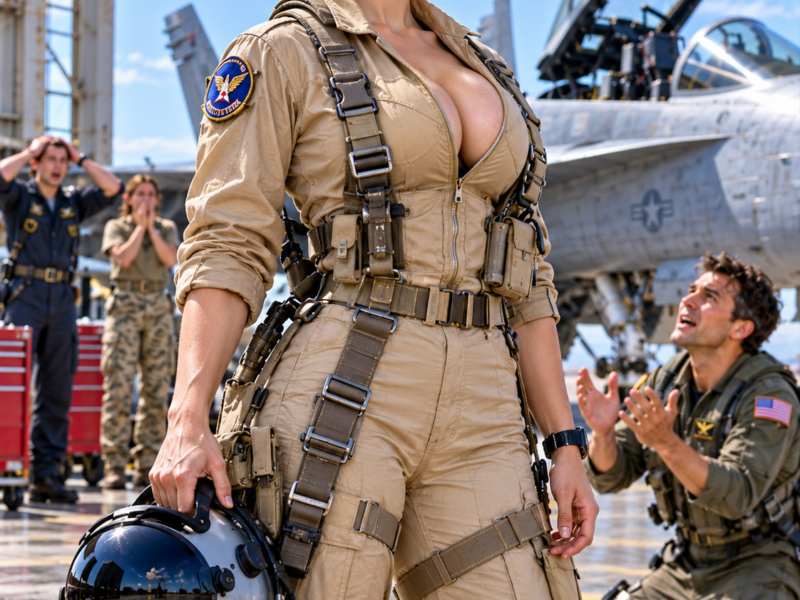
“I watched an F-18 pilot slam his flight helmet onto the maintenance table and call me useless in front of twenty-three sailors at Naval Air Station Oceana
I kept my eyes on the telemetry screen.
“Commander Turner, I need you to maintain your current heading and avoid unnecessary control inputs.”
His breathing was uneven over the radio.
“Hayes, I’m losing pressure. I need an answer.”
“I know. I’m working on it.”
The warning alarm continued to sound in the maintenance office.
Chief Brooks was on the emergency line, coordinating with the tower and the aircraft recovery team.
I pulled up the original inspection report and enlarged the handwritten notes.
The technician had written something beneath the pressure-control valve inspection.
If primary pressure drops, do not isolate the secondary return line. Both systems share a compromised control manifold.
I read it again.
Then I understood.
The problem wasn’t simply a faulty valve.
The aircraft had a compromised hydraulic control manifold, and the replacement valve entered into the maintenance system had never been installed.
Worse, someone had apparently altered the emergency procedure notes to make the aircraft appear safe for flight.
“Chief Brooks,” I said, “find Lucas Bennett. I need the technician who wrote this report.”
Brooks covered the telephone.
“He’s in administrative duty, Admiral.”
I looked at him.
“Bring him here. Now.”
He nodded and made another call.
I returned to the radio.
“Commander Turner, I need you to listen carefully. Your aircraft may have a problem affecting both hydraulic circuits.”
His response came immediately.
“Both?”
“That’s what the maintenance data suggests.”
“Then why did nobody tell me?”
I glanced at the altered records.
“Because someone made sure the warning never reached you.”
There was a pause.
“Are you telling me someone knowingly sent me up in this aircraft?”
I didn’t answer immediately.
I wasn’t going to speculate while he was fighting to bring a damaged aircraft home.
“Right now, I need you focused on flying. The investigation can wait until you’re safely on the ground.”
He exhaled.
“Copy.”
The tower came through.
“Aircraft 219, you are cleared to return for emergency recovery. Runway two-nine is available. Emergency crews are standing by.”
Turner answered.
“Understood.”
I watched the telemetry.
The aircraft was still transmitting.
The primary hydraulic pressure continued to fall.
Then a second warning appeared.
I leaned toward the screen.
“That’s not good.”
Brooks looked at me.
“What?”
“The secondary system is showing an unstable return-pressure reading.”
I picked up the headset again.
“Commander, confirm your control response.”
“Still responsive. A little heavier than normal.”
“Don’t make any sudden movements.”
“Hayes, I’m approaching the recovery area.”
“Understood.”
I studied the flight data.
The pressure readings were fluctuating in a pattern I had seen once before during a simulator exercise.
The aircraft’s backup system was trying to compensate for a restriction in the return circuit.
If the pilot followed the printed emergency checklist without considering that restriction, he could make the problem worse.
I turned to Brooks.
“Where is Bennett?”
“On his way.”
“Tell him to bring the original valve inspection notes.”
Brooks relayed the message.
A moment later, the office door opened.
A young petty officer entered, still wearing his work gloves.
Lucas Bennett.
He looked from me to the telemetry screen.
“Ma’am?”
I pointed at the pressure graph.
“Did you inspect aircraft 219?”
His eyes widened.
“Yes, ma’am.”
“Did you write this warning?”
I showed him the report.
He nodded.
“I did.”
“Explain what you found.”
He stepped closer.
“The pressure-control valve wasn’t the only problem. There was debris in the return manifold. I couldn’t determine how far it had traveled through the system, so I recommended grounding the aircraft until the manifold was inspected.”
“Did you ever sign off on the repair?”
“No, ma’am.”
“Who entered the replacement valve?”
“I don’t know. But that serial number is wrong.”
He pointed at the screen.
“That’s the valve we removed from aircraft 207. I remember because the housing was cracked.”
My stomach tightened.
“You’re certain?”
“Yes, ma’am. I photographed it before disposal.”
“Do you still have the photograph?”
He pulled out his phone.
“Yes. I sent it to my personal email after the maintenance record disappeared.”
He opened the image.
There it was.
The same serial number listed as the replacement component on aircraft 219.
A cracked valve housing.
I looked at Brooks.
“Preserve that image. Get the original email metadata. Don’t alter anything.”
Then I turned back to Bennett.
“Tell me about the emergency procedure.”
He studied the telemetry.
“If the return manifold is blocked, isolating the wrong line could cause pressure to build in the secondary circuit. The checklist assumes the return path is clear.”
“Was the checklist revised?”
He shook his head.
“Not by maintenance.”
“Who could have changed it?”
“Someone with access to the aircraft’s technical documentation system.”
I looked at Brooks.
“Get the current and previous versions of that checklist.”
He nodded.
I returned to the radio.
“Commander Turner, I have a technician here who inspected your aircraft. He’s confirmed a possible restriction in the hydraulic return manifold.”
Turner was quiet.
Then he said, “What does that mean for landing?”
Bennett leaned toward my headset.
“Ma’am, can I speak to him?”
I nodded.
Bennett took the microphone.
“Commander, this is Petty Officer Bennett. I inspected that aircraft eleven days ago.”
“You’re the one who grounded it?”
“Yes, sir.”
“Why didn’t anyone tell me?”
Bennett looked down.
“I thought they had.”
There was a long pause.
Then Turner said something I hadn’t expected.
“I remember your report.”
Bennett looked up.
“What?”
“Your name was on the discrepancy sheet. I saw it before my flight.”
My hands tightened.
“Commander, what exactly did you see?”
“The maintenance system showed the issue as resolved. I assumed someone had replaced the valve.”
Bennett shook his head.
“I never approved that.”
Turner exhaled.
“I understand that now.”
The tower interrupted.
“Aircraft 219, confirm landing configuration.”
Turner answered.
“Preparing for recovery.”
I watched the telemetry.
The aircraft was approaching the runway.
Its pressure readings continued to fluctuate.
I turned to Bennett.
“Is there anything else I need to know?”
He stared at the screen.
Then he pointed to the lower section.
“That reading.”
“What about it?”
“The secondary return pressure is climbing. If it reaches the limit, the system may become even less predictable.”
I picked up the radio.
“Commander Turner, we need to keep this recovery as controlled as possible. Follow the tower’s instructions and do not make any unnecessary configuration changes.”
“Understood.”
The tower called again.
“Aircraft 219, wind is within limits. Emergency response vehicles are positioned.”
Turner answered.
“Roger.”
Then his voice changed.
“Hayes?”
“Go ahead.”
“I owe you an apology.”
I looked at the telemetry.
“Let’s talk about that when you’re safely down.”
“No. I want to say it now.”
His breathing was audible.
“I called you useless this morning.”
I swallowed.
“I remember.”
“I shouldn’t have.”
“No, you shouldn’t have.”
He gave a brief, strained laugh.
“Fair enough.”
Then the aircraft crossed the threshold.
I watched the screen.
The telemetry signal flickered.
For a second, the pressure readings disappeared.
“Maintenance control, do you still have data?” Brooks asked.
I stared at the monitor.
“Negative.”
The tower’s voice came through.
“Aircraft 219, confirm status.”
No answer.
Then we heard Turner’s voice.
“Hydraulic caution. Control response is degraded.”
Bennett leaned forward.
“Ma’am, he’s losing pressure faster than expected.”
I pressed the radio button.
“Commander, acknowledge.”
A burst of static.
Then:
“Rebecca, I need your help.”
It was the first time he had used my first name.
I kept my voice level.
“I’m here, Blake. Stay with us.”
The telemetry returned.
The aircraft was descending.
Its pressure readings were dangerously unstable.
I looked at Bennett.
He was following the graph with his finger.
“There’s another problem,” he said.
“What?”
“The replacement record isn’t just false. The original valve was removed from a different aircraft with a different manifold configuration.”
I stared at him.
“Explain.”
“The valve they claimed to install wouldn’t have been compatible with this aircraft’s configuration. Even if someone had installed it, it wouldn’t have corrected the original problem.”
I looked at the maintenance record again.
The falsification wasn’t designed to repair the aircraft.
It was designed to make the paperwork look complete.
I turned toward Brooks.
“Who approved the aircraft release?”
He checked the system.
“Commander Turner.”
I looked at the screen.
Then at the aircraft’s telemetry.
The pilot had trusted the official maintenance record because it carried the proper authorization.
He hadn’t known that the authorization itself was fraudulent.
“Commander Turner,” I said into the radio, “I need you to focus on the recovery. We have evidence that your maintenance documentation was falsified.”
His voice came back, strained.
“I figured that out.”
“Stay with the tower.”
The next few seconds felt longer than they should have.
Then the telemetry showed the aircraft touching down.
The pressure readings fluctuated violently.
The aircraft veered slightly before correcting.
The tower called out.
“Aircraft 219, continue straight. Emergency crews are approaching.”
Turner answered.
“Copy.”
The aircraft slowed.
Then stopped.
For a moment, nobody in the maintenance office moved.
Brooks lowered his headset.
Bennett closed his eyes.
I let out a breath I hadn’t realized I was holding.
“Get the emergency crew to the aircraft,” I said. “No one approaches the hydraulic equipment until the safety team has secured the scene.”
The tower confirmed.
A minute later, Turner came over the radio.
“Maintenance control, aircraft 219 is stopped.”
I pressed the transmit button.
“Copy, Commander. Are you injured?”
“Negative.”
“Remain in the aircraft until the response team gives you clearance.”
He paused.
Then he said quietly, “Thank you, Rebecca.”
I removed my headset.
My hands were shaking.
Not because I was afraid of what Turner had said that morning.
Because I knew how close we had come to losing someone over a falsified maintenance entry.
The investigation began before sunset.
The aircraft was secured, the maintenance records preserved, and the relevant personnel separated for interviews.
I expected Turner to be angry when he returned to the hangar.
Instead, he walked straight toward the maintenance office.
His flight suit was damp with sweat.
His helmet was tucked under one arm.
He stopped in front of me.
For a moment, neither of us spoke.
Then he removed his helmet.
“Hayes.”
“Commander.”
He looked at Bennett.
“Petty Officer.”
Bennett stood.
Turner looked back at me.
“I owe you more than an apology.”
I folded my arms.
“What do you owe me?”
He glanced at the floor.
“An explanation. I saw the maintenance discrepancy before I flew. I didn’t read it carefully because the system showed it as resolved.”
“Why didn’t you ask?”
He didn’t answer immediately.
“Because I trusted the authorization.”
“That’s understandable. But you also dismissed the person telling you the aircraft wasn’t safe.”
His face tightened.
“I know.”
I waited.
He finally said, “I thought you were delaying my flight because you wanted to prove something.”
I looked at him.
“And now?”
“Now I know you were trying to keep me alive.”
The words hung between us.
Bennett looked away.
Turner turned toward him.
“I should have listened to you, too.”
Bennett nodded.
“Yes, sir.”
Turner swallowed.
“I don’t expect either of you to forgive me today.”
I appreciated that he didn’t ask.
“Then don’t ask for it,” I said. “Show us you’ve learned something.”
He nodded.
“Understood.”
Before he left, he looked at the maintenance report on my desk.
“Who changed those records?”
“That’s what we’re finding out.”
By the next morning, the scope of the problem was much larger than we had anticipated.
The investigation revealed that maintenance entries had been altered across several aircraft over a period of months.
The false replacement records had been used to maintain the squadron’s readiness numbers ahead of an important deployment evaluation.
A civilian maintenance contractor had been reporting replacement components that were never delivered.
The contractor received payment for work that had not been completed.
Several personnel had raised concerns.
Their reports had been marked resolved without proper inspections.
The investigation also uncovered a disturbing pattern.
Whenever someone challenged the paperwork, that person was transferred away from the flight line.
Lucas Bennett wasn’t the first.
He was simply the last person willing to keep a copy of the evidence.
The commanding officer, Captain Lawson, initially denied knowing about the altered records.
But the electronic approval history showed that his credentials had been used to authorize several of the releases.
Further investigation revealed that he had received repeated warnings from maintenance personnel.
Instead of addressing them, he had pressured supervisors to keep aircraft available.
The contractor’s regional manager had also been communicating directly with Turner.
Those messages became important evidence.
One read:
We need 219 cleared before Friday. The replacement entry is already in the system. Don’t create another delay.
Another said:
The commander understands the readiness requirement. Please keep this within the maintenance chain.
Turner was asked to provide a sworn statement.
He admitted that he had approved a maintenance release without verifying the original inspection.
He also admitted that he had ignored Bennett’s warning because he believed the aircraft had already been repaired.
His statement did not make him innocent.
But it helped investigators understand how the deception had worked.
The contractor’s false billing records were referred for federal investigation.
Captain Lawson was relieved of his command pending proceedings.
Several personnel received disciplinary action.
And the aircraft that had been listed as operational were grounded until independent inspections were completed.
For the first time in months, the squadron’s readiness report reflected reality.
It was not an impressive number.
But every aircraft listed as ready was actually ready.
That mattered more to me than any evaluation score.
Three weeks later, Turner came to my office.
He wasn’t wearing his flight gear.
He carried a paper folder and looked unusually uncomfortable.
“Do you have a minute?”
I pointed to the chair.
“Sit.”
He placed the folder on my desk.
“I’ve been reviewing the safety reports from the last six months.”
“Why?”
“Because I realized I knew almost nothing about the people signing them.”
I opened the folder.
Inside were copies of maintenance discrepancies, inspection notes, and recommendations from junior technicians.
Some had been submitted months earlier.
Others had never received a response.
Turner sat quietly while I read.
“I’ve spent most of my career thinking that if an aircraft gets off the ground, the people responsible for preparing it must have done their jobs,” he said.
I closed the folder.
“That’s a dangerous assumption.”
“I know.”
He looked at his hands.
“When I called you useless, I wasn’t really talking about your work.”
I raised an eyebrow.
“What were you talking about?”
He hesitated.
“I was frustrated that someone had the authority to stop me. I didn’t like being told no.”
I nodded slowly.
“That’s a problem many people have, Commander. Especially when they’re used to being the one everyone listens to.”
He gave a small, embarrassed smile.
“That’s probably true.”
He stood.
“I’ve requested that the squadron begin monthly safety meetings where maintenance personnel can raise concerns directly with flight leadership. No retaliation. No shortcuts.”
“Good.”
“I’d like you to attend the first one.”
“I’ll consider it.”
He paused at the door.
“Rebecca?”
“Yes?”
“I used to think the most important person in an aircraft was the pilot.”
“And now?”
He looked toward the hangar.
“Now I think the most important person might be the one who knows when the aircraft shouldn’t fly.”
I didn’t smile.
Not yet.
“Remember that the next time someone tells you no.”
He nodded and left.
Six months later, the squadron held a small ceremony to recognize the maintenance team.
There were no television cameras.
No speeches about heroic leadership.
Just sailors standing together in the hangar, wearing their dress uniforms and trying not to look uncomfortable while someone read their names.
Lucas Bennett received a Navy and Marine Corps Achievement Medal for his role in documenting the maintenance discrepancies and preserving the original evidence.
When his name was called, he looked genuinely surprised.
Afterward, he approached me.
“Ma’am, I almost threw away those photographs.”
“Why didn’t you?”
He shrugged.
“I figured someone might need them.”
I smiled.
“Someone did.”
Chief Brooks stood beside us, holding a paper cup of coffee.
“Rebecca, there’s someone who wants to speak with you.”
I turned.
Blake Turner was standing near aircraft 219.
The jet had undergone extensive inspection and repair.
Its maintenance records were now complete, and every replacement component had been independently verified.
Turner approached.
“Hayes.”
“Commander.”
He held out a small envelope.
I opened it.
Inside was a handwritten note.
You were right to ground the aircraft. I was wrong to call you useless. I hope I never forget that the person who tells me what I don’t want to hear may be the person keeping me alive.
I read it once.
Then I folded it and placed it back inside.
“Thank you.”
He nodded.
“I know an apology doesn’t erase what happened.”
“No, it doesn’t.”
He looked toward Bennett and the maintenance team.
“But I think I finally understand something.”
“What?”
He watched a young technician inspect the landing gear.
“Those people don’t work for the pilots. The pilots don’t work for them. We’re all responsible for the same aircraft and the same lives.”
I looked at him.
“That’s a better way to think about it.”
He smiled faintly.
Then he walked toward the aircraft.
I stayed behind for a moment.
A few months earlier, he had slammed his helmet onto a table and told me I was useless because I refused to approve an unsafe aircraft.
Later, he had called my name over the radio because he needed the very knowledge he had dismissed.
I hadn’t needed him to admire me.
I hadn’t needed an apology in front of the entire squadron.
What mattered was that the next time a young technician noticed something unusual, that person would have a better chance of being heard.
As I walked toward the hangar doors, I passed a new maintenance board mounted beside the entrance.
Across the top, someone had printed a sentence in large black letters:
NO RANK, TITLE, OR FLIGHT HOURS OUTRANK SAFETY.
I stopped and read it.
Then I noticed a small handwritten addition beneath it.
And no one should have to prove their worth before their warning is taken seriously.
I recognized the handwriting.
Lucas Bennett’s.
I stood there for another moment, listening to the familiar sounds of the hangar.
For years, I’d believed my job was to keep aircraft flying.
That day, I was reminded that sometimes the most important thing I could do was keep one on the ground.
THe end.









