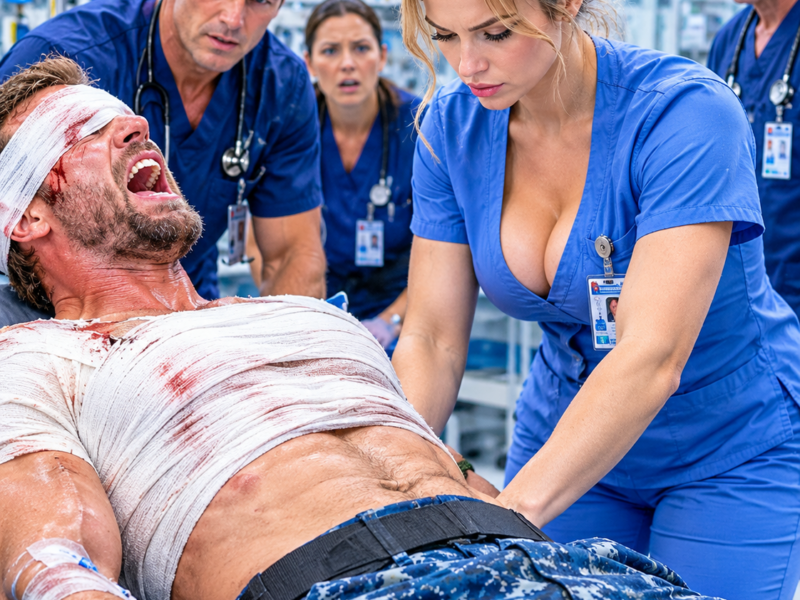
“I watched a wounded Navy SEAL shove three experienced nurses away from his hospital bed, blood soaking through his bandages
The man in the dark suit didn’t rush toward us.
He simply stood behind the glass doors, one hand resting on the handle, watching as the surgical team prepared to move Ethan down the corridor.
He looked to be in his early fifties, with neatly combed silver hair and the kind of expensive watch that seemed out of place in a hospital emergency department.
His expression was almost friendly.
Almost.
“That’s enough,” he said, stepping inside. “I’ll take it from here.”
Dr. Harris turned toward him.
“Excuse me? This patient needs emergency surgery.”
The man reached into his jacket and produced a small leather identification wallet.
“Special military liaison. This patient is under federal jurisdiction.”
Dr. Harris didn’t even look at it.
“He’s under my medical care. If you have paperwork, you can discuss it with hospital administration.”
The man’s smile disappeared.
“Doctor, I strongly suggest you reconsider.”
I was still standing beside Ethan’s bed, holding the edge of his hospital gown.
Ethan’s fingers found mine again.
“Don’t let him take me,” he whispered.
I looked down at him.
“Nobody is taking you anywhere until the surgeon says you’re stable.”
The man in the suit heard me.
His eyes moved to my badge.
“Natalie Brooks.”
He pronounced my full name carefully.
It wasn’t a question.
“Yes?”
He looked at me for a moment longer than necessary.
“You’re making a mistake involving yourself in something you don’t understand.”
I felt the old photograph in my memory like a weight against my chest.
“Then perhaps you should explain it.”
His expression hardened.
“Step away from the patient.”
Dr. Harris moved between us.
“Security!”
Two officers appeared at the entrance.
The stranger raised both hands, as if he were the reasonable person in the room.
“I’m not here to cause trouble. I’m here to protect a classified operation.”
Ethan let out a dry, painful laugh.
“That’s what you called it last time.”
The man’s eyes flickered.
Only for a second.
But I saw it.
He knew Ethan.
And Ethan knew him.
The surgical team finally wheeled the bed toward the operating rooms.
As they passed the stranger, Ethan turned his head.
“Tell Marcus I remember the river.”
The man stopped smiling.
For the first time, he looked genuinely afraid.
Then the operating room doors closed.
I stood in the corridor, my hands still trembling.
Dr. Harris approached me.
“Nat, I need you to tell me what you know.”
I glanced toward the closed doors.
“Not here.”
He studied my face.
Then he nodded.
“Go wash your hands. You look like you’ve seen a ghost.”
I almost told him that I had.
Instead, I walked to the staff restroom and locked myself inside.
For several minutes, I stared at my reflection.
I was thirty years old.
I had dark circles beneath my eyes, a small scar on my chin, and a faded blue bracelet around my wrist that I hadn’t taken off in four years.
The bracelet had been a gift from Ethan.
He’d bought it at a gas station after I told him I couldn’t afford to replace the one I’d lost.
It was cheap, made of woven blue cord.
He had tied it around my wrist and said, “Now you have something to remember me by.”
I’d laughed.
“You’re not that memorable.”
He’d looked at me seriously.
“You’d be surprised.”
I pulled out my phone and searched through the old photographs I’d kept in a hidden folder.
There it was.
The picture from the diner.
Four men outside a military transport aircraft.
Ethan stood on the right.
The three other faces had been crossed out.
But beneath the photograph, in Ethan’s handwriting, were five words.
IF THEY SAY I’M DEAD, WAIT.
I had never understood that sentence.
Now I wondered whether the man in the dark suit had been watching me all along.
My phone vibrated.
An unknown number.
One message.
STOP ASKING ABOUT THE PHOTOGRAPH.
I stared at the screen.
A second message appeared.
YOU HAVE NO IDEA WHAT HE BROUGHT BACK.
I didn’t reply.
I took a screenshot, sent it to my personal email, and returned to the nurses’ station.
The surgery lasted nearly three hours.
During that time, the man in the suit remained in the hospital.
He spoke quietly with someone on his phone, walked the corridors, and occasionally looked toward the operating room.
He never gave his name.
When I asked the charge nurse whether security had verified his credentials, she said the hospital administrator was handling it.
That answer didn’t comfort me.
At 2:17 a.m., Dr. Harris finally came out.
His surgical cap was damp with sweat.
“He’s alive,” he said.
I let out a breath I hadn’t realized I’d been holding.
“We repaired the damage to his shoulder and controlled the internal bleeding. His leg will need another procedure, but he’s stable.”
“Can I see him?”
“In a little while. He’s going to intensive care.”
He paused.
“Nat, there’s something else.”
I waited.
“We found a small metal capsule beneath the skin near his old surgical scar. It wasn’t part of his previous operation.”
My mouth went dry.
“What’s inside?”
“We haven’t opened it. The military liaison is insisting it be handed over to him.”
“Did you?”
Dr. Harris looked at me.
“Of course not. It’s part of the patient’s property, and the hospital has a responsibility to document anything removed during treatment.”
He lowered his voice.
“Someone tried to enter the operating room while we were closing.”
I stared at him.
“Who?”
“That man in the suit.”
My fingers curled around the counter.
“What happened?”
“I asked security to remove him. He claimed there was a national security concern.”
Dr. Harris shook his head.
“I’ve been a surgeon for twenty-two years. I’ve never seen anyone so determined to get his hands on a piece of metal.”
I thought about the numbers beneath Ethan’s scar.
The date he was supposedly dead.
The symbol that looked like a crooked M.
And the stranger’s reaction when Ethan mentioned a river.
“Where is the capsule now?”
“In a locked evidence bag in the hospital safe. Administration has been notified.”
I nodded.
Then I went to see Ethan.
He was in intensive care, surrounded by monitors and quiet machines.
His face looked thinner without the anger that had kept him upright in the emergency department.
I pulled a chair beside his bed.
For a while, I said nothing.
Then his eyes opened.
“You’re still here.”
“Unfortunately, you’re still a difficult patient.”
The corner of his mouth moved.
It was the first almost-smile I’d seen from him.
“Still making jokes.”
“Someone has to.”
He looked toward the door.
“Did he leave?”
“No.”
Ethan closed his eyes.
“Then we’re running out of time.”
I leaned forward.
“Who is he?”
“Richard Voss.”
The name meant nothing to me.
“He’s a civilian contractor,” Ethan continued. “He worked with our unit overseas. He wasn’t supposed to be anywhere near us.”
“What happened?”
Ethan stared at the ceiling.
“Three years ago, my team was sent to recover a missing intelligence officer near the Syrian border. The mission was supposed to be routine. We were told the officer had information that could prevent an attack on American personnel.”
He paused to catch his breath.
“There were four of us. Me, Marcus Reed, Daniel Price, and Lucas Bennett.”
I remembered the photograph.
“Those are the men in the picture?”
He nodded.
“What happened to them?”
“Marcus disappeared. Daniel and Lucas were reported killed. I was told I was the only one who made it out.”
“By whom?”
“Voss.”
His voice was barely audible.
“He said our position had been compromised. He told me the extraction team was coming, but when they arrived, they weren’t there to rescue us.”
I felt cold.
“Who were they there for?”
“Me.”
Ethan turned his head toward me.
“Voss needed something I had seen.”
“What?”
“The intelligence officer.”
I waited.
“He wasn’t an officer at all. He was an American civilian analyst who had discovered that mission reports were being altered. Names were being removed. People were being listed as dead when they weren’t.”
My stomach tightened.
“Why?”
“Because someone was selling operational information. Every time a mission went wrong, the reports blamed dead men who couldn’t defend themselves.”
Ethan swallowed.
“The analyst had proof. He was going to testify. But Voss intercepted him before we could get him out.”
I thought about the three crossed-out faces.
“Did you find him?”
Ethan looked away.
“Yes.”
The silence that followed seemed to fill the room.
“Was he alive?”
“He was when we found him.”
Ethan’s voice broke.
“He died before we could get him to safety.”
I looked down at my hands.
“And the others?”
“Marcus was captured. Daniel and Lucas were killed during the extraction. I was shot and taken to a temporary holding site.”
He stopped.
I waited for him to continue.
“When I woke up, Voss was standing beside my bed. He told me my team was dead, that I had been officially declared killed in action, and that I should cooperate if I wanted to stay alive.”
“How did you escape?”
“I didn’t.”
He looked directly at me.
“Someone helped me.”
“Who?”
“Marcus.”
My breath caught.
“The man you told Voss to contact?”
Ethan nodded.
“He got me out six months later. But by then, my identity had been buried. My mother had received a death notification. My records were sealed. Anyone looking for Ethan Cole would find a dead man.”
“Why didn’t you come to me?”
His eyes dropped to my bracelet.
“Because I thought you’d be safer believing I was dead.”
I felt something tighten in my throat.
“Four years, Ethan.”
“I know.”
“No. You don’t.”
My voice shook despite my effort to keep it steady.
“You left that diner, and I never heard from you again. I spent months checking my phone every time it rang. I thought something had happened to you. Then I convinced myself you simply hadn’t cared enough to say goodbye.”
He looked at me with an expression I couldn’t read.
“I cared.”
“That wasn’t enough.”
“I know.”
He didn’t defend himself.
That made it harder.
I leaned back in the chair.
“Why did you ask for me?”
“Because I recognized your voice.”
I looked at him.
“At the emergency department?”
“When you said my name.”
He took a careful breath.
“Back in the holding site, there were nights when I couldn’t sleep. I’d remember that diner. You telling me that I didn’t have to pretend to be fearless all the time.”
I hadn’t remembered saying that.
He had been trying to make me laugh that night, but every time the conversation drifted toward his family, his smile disappeared.
I had finally told him that he could stop acting like nothing frightened him.
He’d looked at me for a long time.
Then he’d said, “You make it easier to be a person instead of a uniform.”
I had forgotten the exact words.
He hadn’t.
“Nat, there’s something else.”
He turned his head toward the locked door.
“The capsule.”
I stood.
“What about it?”
“There’s a key inside.”
“A key?”
“Not a physical key. A decryption key. The information it unlocks is stored somewhere else.”
“Where?”
“With Marcus.”
Before I could ask another question, a nurse entered to check his monitors.
I stepped away from the bed.
When she left, Ethan’s eyes were closed again.
I decided to let him rest.
But I didn’t go far.
At 6:40 a.m., the hospital administrator called me into her office.
Dr. Harris was already there.
So was Richard Voss.
He stood beside the window, holding a paper coffee cup.
“Ms. Brooks,” the administrator began, “we’ve received a formal request for the immediate transfer of Commander Cole and all materials recovered during his surgery.”
“He’s not medically cleared for transport,” I said.
Voss turned.
“That is not your decision.”
“It is not yours either.”
The administrator looked uncomfortable.
“Let’s all remain professional.”
Voss placed a folder on the desk.
“Commander Cole is involved in a classified investigation. His presence here creates a security risk.”
I opened the folder.
There were copies of documents, a photograph of Ethan, and an official-looking military report.
One page caught my attention.
It was a death notification.
Ethan Cole.
Date of death: October 14, three years earlier.
The next page was a transfer authorization.
Signed by someone named Richard Voss.
I looked up.
“You signed his transfer into custody?”
Voss closed the folder.
“I signed many documents during that operation.”
“Then why does the date of his death come before the date of his transfer?”
For the first time, his expression shifted.
“Administrative irregularities happen.”
“Not usually three years apart.”
Dr. Harris looked at the papers.
“That is enough. The patient remains under hospital care.”
Voss leaned toward me.
“You’ve already made one mistake by getting involved. Don’t make another.”
I held his gaze.
“Is that supposed to frighten me?”
“No,” he said quietly. “It’s supposed to save you.”
Then he walked out.
The administrator waited until the door closed.
“Nat, I need you to understand that the hospital cannot become part of a federal dispute.”
“Then don’t let a stranger remove a patient who isn’t medically cleared.”
She rubbed her forehead.
“I’ll have legal counsel review the documents.”
It wasn’t enough.
But it was something.
I returned to the nurses’ station.
There was a voicemail from an unknown number.
A man’s voice.
“Ms. Brooks, my name is Marcus Reed. If you’re hearing this, Ethan made it out.”
I sat down.
“I know what Voss told you. Don’t trust the paperwork. Don’t trust the man who brought the paperwork.”
There was a pause.
“There’s a storage unit in Chula Vista. Unit 214. The access code is 1014. Ethan knows what to do with what’s inside.”
The message ended.
I listened to it again.
October 14.
The date Ethan had supposedly died.
The access code.
I called the number back.
It had been disconnected.
I didn’t tell the administrator.
I didn’t tell Voss.
And I didn’t tell Dr. Harris.
Instead, I waited until my shift ended and drove to Chula Vista.
The storage facility was quiet, with rows of identical metal doors and a small office near the entrance.
I entered the code at unit 214.
The lock clicked.
Inside was a narrow space containing a folding table, several cardboard boxes, and a dusty black duffel bag.
I turned on my phone flashlight.
The first box contained old photographs.
The second held copies of military reports.
The third contained a small laptop and a stack of envelopes.
On top of the envelopes was my name.
NATALIE BROOKS.
I stood perfectly still.
Someone had written the date on the first envelope.
Four years earlier.
The same week Ethan had disappeared from my life.
I opened it.
Inside was a photograph of me standing outside the Tucson diner, holding two paper coffee cups.
I remembered that morning.
I’d been laughing because Ethan had spilled half his coffee on his uniform.
On the back, he’d written:
SHE KNOWS NOTHING. KEEP IT THAT WAY.
I read it twice.
Then I noticed another photograph beneath it.
This one showed me leaving the diner alone, several minutes after Ethan had gone.
A man stood across the street, watching me.
It was Richard Voss.
My hands went cold.
I opened the next envelope.
Inside was a handwritten letter.
Nat,
If you’re reading this, I couldn’t keep the promise I made to you.
You deserve to know why I disappeared.
The first time I met you, I wasn’t looking for a friend. I was looking for a place to make a phone call without being followed.
I had been ordered to meet someone at the diner, and I thought I could trust him.
Then you sat down because every other table was occupied.
You talked to me like I was a regular person.
I didn’t expect to remember you.
But I did.
The letter continued.
I found out later that Voss had been watching the diner. He knew I had spoken to you. He asked questions about your family, your work, and where you lived.
I was afraid he’d use you to get to me.
So I disappeared.
I told myself it was the only way to protect you.
I know you may hate me for that.
I wouldn’t blame you.
I stopped reading.
For four years, I had believed Ethan simply hadn’t cared enough to return.
Now I was discovering that someone had known my name before I ever understood the danger I was in.
I sat on the edge of the folding table.
Then I noticed something tucked into the back of the envelope.
A small photograph.
A young man standing beside Ethan.
The name written underneath was Marcus Reed.
I recognized him.
Not from the military photograph.
From the hospital.
He had been the man in the dark suit’s reflection in the glass doors.
But that wasn’t possible.
I turned the photograph over.
On the back was a phone number and a handwritten sentence.
IF VOSS IS STILL FREE, HE HAS ALREADY FOUND YOU.
My phone rang.
Unknown number.
I answered.
“Hello?”
A familiar voice spoke.
“Nat, leave the unit.”
It was Ethan.
I gripped the phone.
“How are you calling me? You’re in intensive care.”
“I borrowed a phone.”
“You need to be resting.”
“Listen to me. Voss knows about the storage unit.”
I looked toward the entrance.
A black SUV had just turned into the facility.
Its headlights swept across the row of doors.
“How does he know?”
“Because he knew Marcus had a backup.”
The vehicle stopped.
Two men got out.
One was Richard Voss.
The other was someone I recognized from the old photograph.
Marcus Reed.
I stared at him.
He looked directly at me.
Then he raised one hand.
Not in greeting.
In warning.
“Nat,” Ethan said urgently through the phone, “don’t let Marcus take the capsule.”
I looked at the photograph in my hand.
Then at Marcus.
“Which Marcus?”
There was silence.
Ethan’s voice returned, strained and low.
“The one who called you.”
I stepped backward.
Marcus opened the door of the storage unit.
He didn’t seem surprised to find me there.
“You’re Natalie,” he said.
“Who are you?”
“Marcus Reed.”
I held up the photograph.
“Then why are there two of you?”
His expression changed.
For a moment, he said nothing.
Then he glanced toward Voss.
“Because the man you’ve been talking to is using my name.”
The world seemed to narrow around me.
Voss stepped closer.
“Ms. Brooks, give me the photograph.”
I tightened my grip.
“Not until you explain.”
He sighed.
“You’re making this much more complicated than it needs to be.”
Marcus moved between us.
“Don’t listen to him.”
Voss’s face hardened.
“Move.”
“No.”
The two men stared at each other.
I finally understood why Ethan had been so frightened when Voss entered the hospital.
This wasn’t a simple dispute over classified information.
These men had been hunting each other for years.
And I was standing in the middle of it.
Marcus reached into his jacket.
I stepped back.
“Don’t.”
He pulled out a small identification card and held it toward me.
“My name is Marcus Reed. I served with Ethan. I was captured during the extraction, but I escaped with help from a local contact. I’ve been trying to get evidence out ever since.”
“Then who is he?”
I pointed toward Voss.
Marcus looked at the man in the suit.
“Richard Voss was the civilian security coordinator assigned to our operation. He was responsible for protecting the intelligence officer.”
Voss laughed softly.
“That’s a very convenient story.”
Marcus ignored him.
“Voss wasn’t protecting the officer. He was trying to recover the records the officer had stolen.”
“What records?”
“The mission logs. Payment records. Communications. Evidence that people inside the operation were selling information about our locations.”
He looked at me.
“Your friend Ethan copied part of the evidence before he was captured. The capsule in his back contains the decryption key.”
I thought of the metal object removed during surgery.
“Where is the rest?”
Marcus pointed toward the laptop.
“On that drive.”
Voss took one step forward.
“Enough.”
Marcus pulled a small device from his pocket.
“Do you remember October 14?”
Voss didn’t answer.
“That’s the date they reported Ethan dead. It’s also the date the transfer records were altered. The date they moved the analyst’s files out of military custody.”
I looked at the letter in my hand.
Then at the photograph.
“Why did Ethan give me the picture?”
Marcus’s expression softened.
“Because he knew you would keep it.”
I didn’t understand.
“He needed someone outside the operation who wouldn’t be tempted to sell the information. Someone who wasn’t part of the chain of command.”
“That’s why he involved me?”
“No,” Marcus said quietly. “He didn’t intend to involve you. He left the photograph because he thought he might never make it home.”
Voss suddenly lunged toward the folding table.
Marcus blocked him.
The laptop fell to the floor.
A cardboard box overturned.
Papers scattered across the concrete.
I reached for the laptop.
Voss turned toward me.
“Put that down.”
I didn’t.
He grabbed my arm.
I pulled away, knocking a stack of folders to the ground.
A security alarm began sounding outside.
The facility manager had noticed the vehicles blocking the entrance.
Voss looked toward the door.
Marcus used the distraction to push him back.
“Go!” he shouted.
I grabbed the laptop and ran.
I didn’t get far.
A man appeared at the end of the corridor.
Then another.
I stopped.
For one horrible second, I thought I had run straight into another trap.
But the first man held up a badge.
“Federal agents. Step away from the laptop.”
I looked over my shoulder.
Voss had stopped fighting.
His face had gone pale.
Marcus stood with his hands raised.
One of the agents approached me.
“Ms. Brooks?”
I nodded.
“You’re safe. We need to secure that device.”
I didn’t hand it over immediately.
“Who sent you?”
The agent glanced at his partner.
“Commander Cole contacted an independent military investigative office before his hospitalization. We’ve been trying to locate the backup evidence.”
I swallowed.
“Can I see the authorization?”
He showed me his credentials.
This time, I read every word.
I checked the photograph.
I called the number printed on the card.
And only after the person on the other end confirmed the operation did I surrender the laptop.
The agents arrested Voss that night.
Marcus was taken separately for questioning.
Before he left, he turned toward me.
“Tell Ethan I’m sorry.”
I stared at him.
“For what?”
“For not getting him home sooner.”
I didn’t know what to say.
I drove straight back to St. Mary’s.
When I entered intensive care, Ethan was awake.
He looked at my face and immediately understood.
“You found it.”
I nodded.
“Voss is in custody.”
His eyes closed.
For a moment, neither of us spoke.
Then I pulled the chair closer.
“You owe me a lot of explanations.”
“I know.”
“And I am not going to pretend four years didn’t happen just because you were protecting me.”
“I wouldn’t ask you to.”
I looked at him.
“Did you really think disappearing without a word was the only way?”
He stared at his hands.
“At the time, yes.”
“Did you ever consider that I might have wanted the truth, even if it was frightening?”
His voice became quiet.
“Every day.”
I waited.
He looked at me.
“I wanted to come back. I wrote letters. I never sent them.”
“Why?”
“Because I couldn’t promise I would be alive the next morning.”
I felt tears gathering in my eyes.
“That should have been my choice too.”
He nodded.
“You’re right.”
There was no grand declaration.
No attempt to make the past disappear.
Just a wounded man admitting that he had made a decision for both of us and called it protection.
I reached for his hand.
Not because everything was forgiven.
Because I was finally ready to hear the rest.
The investigation lasted several months.
The evidence recovered from the storage unit connected Voss to falsified mission reports, illegal payments, and the disappearance of the intelligence analyst.
More importantly, it helped investigators identify the people who had altered Ethan’s records and concealed his survival.
The official report about his death was corrected.
Daniel Price and Lucas Bennett were finally recognized for what had happened to them.
Their families received the truth they had been denied.
Marcus gave testimony.
He had been living under a false identity for years, moving between temporary jobs and borrowed apartments, afraid that anyone connected to the old operation could be found.
He wasn’t innocent of every decision he’d made, but he had risked his life to preserve the evidence.
Ethan’s mother came to San Diego two weeks after his second surgery.
I was at the nurses’ station when I heard a woman crying in the hallway.
Then I saw Ethan’s mother standing outside his room, holding a photograph against her chest.
She had silver hair and tired eyes.
Ethan saw her and began to cry.
“Mom.”
She crossed the room in three steps and took his face between her hands.
“They told me you were gone.”
“I know.”
“I buried an empty coffin.”
He couldn’t answer.
She pressed her forehead against his.
“I called your phone every birthday.”
Ethan closed his eyes.
“I’m sorry.”
She held him for a long time.
I stepped quietly into the hallway.
Some things didn’t need an audience.
When I returned later, she was sitting beside his bed, holding his hand.
She looked up at me.
“You’re Natalie?”
I nodded.
“Ethan told me about you.”
I wasn’t sure what to say.
She smiled through her tears.
“He said you were the first person who made him feel safe enough to be afraid.”
I looked at Ethan.
He turned his face toward the window.
For the first time, I saw him blush.
His mother laughed softly.
“He talked about that diner more than anything else.”
I smiled.
“His coffee was terrible.”
“Still is,” she said.
Ethan shook his head.
“Both of you are enjoying this too much.”
For the first time in a long while, the room sounded like a family again.
His recovery was slow.
He needed another procedure on his leg and months of physical therapy.
Some mornings, the pain made him irritable.
Other nights, he woke from dreams he couldn’t explain.
I didn’t try to fix every silence.
Sometimes I sat beside him and read.
Sometimes I brought coffee.
Sometimes I simply reminded him that he was in California, not overseas, and that nobody was coming through the door without permission.
He eventually learned to sleep through the night.
I eventually learned not to mistake every unanswered question for another disappearance.
We didn’t return to what we had been.
Neither of us was the same person who had sat in that Tucson diner.
But we began again, slowly.
One afternoon, almost five months after his arrival at St. Mary’s, I found him outside the rehabilitation gym.
He was leaning on a cane, trying to walk without putting too much weight on his injured leg.
“You know,” I said, “most patients wait until they’re discharged before trying to escape.”
He glanced at me.
“I’m not escaping.”
“Then why are you walking toward the parking garage?”
He smiled.
“I wanted to ask you something.”
I folded my arms.
“This sounds suspicious.”
He reached into his jacket and pulled out a small envelope.
My name was written across the front.
I recognized his handwriting.
Inside was a letter.
It was dated the night he had disappeared from the diner.
I opened it carefully.
Nat,
I don’t know if I’ll ever get the chance to explain this properly.
You made me laugh tonight, and I needed that more than you know.
I have spent most of my adult life learning how to survive things I never wanted to experience.
But sitting across from you reminded me that surviving isn’t the same as living.
If I come back, I hope you’ll let me buy you a better cup of coffee.
If I don’t, please don’t spend your life waiting for me.
You deserve a life that isn’t built around someone else’s fear.
I lowered the letter.
“Why didn’t you send this?”
Ethan looked down at his cane.
“Because I was afraid you’d wait.”
I studied his face.
“I did wait.”
His eyes lifted.
“I know.”
“And it hurt.”
“I know that too.”
I folded the letter and placed it back inside the envelope.
“Next time, let me decide whether something is worth waiting for.”
He nodded.
“Next time, I will.”
We stood there for a moment.
Then he reached into his other pocket.
It was a small blue cord bracelet.
The same kind he’d given me at the gas station four years earlier.
“I thought you might need a replacement.”
I looked at the faded bracelet on my wrist.
“This one’s still holding up.”
“I know.”
“Then why another?”
He took a breath.
“Because I don’t want you wearing something that reminds you of the night I left. I’d rather give you something that reminds you of the day I came back.”
I couldn’t stop the tears that time.
He didn’t rush to wipe them away.
He simply waited.
I took the bracelet from his hand.
“Coffee first,” I said.
His smile returned.
“Coffee first.”
We went to a little café near the hospital.
He walked slowly, and I matched his pace.
We ordered two coffees.
His was terrible.
Mine was worse.
We laughed anyway.
A few months later, Ethan moved into a small apartment near the coast while continuing his rehabilitation.
He wasn’t cleared to return to active duty, and he eventually decided not to go back.
He began working with a veterans’ support organization, helping injured service members navigate medical care and the difficult transition home.
I stayed at St. Mary’s.
Sometimes, when I walked past the emergency department, I remembered the night he had refused to let anyone touch him.
I remembered the panic in his eyes.
I remembered the way he had searched the room for someone he thought might never come.
One evening, after a particularly long shift, I found him waiting outside the hospital.
He held two coffees.
“These are from somewhere better,” he said.
I took one.
“That’s a dangerous promise.”
He laughed.
Then he looked at me with the same seriousness I’d seen in the diner years earlier.
“Nat, I don’t want you to feel responsible for keeping me alive.”
I frowned.
“What?”
“You came forward that night because you were a nurse. Because you cared. But I don’t want our future to depend on you rescuing me.”
I watched him for a moment.
“Good. Because I’m not going to spend the rest of my life being someone’s emergency contact.”
He smiled.
“Fair enough.”
“I want ordinary things, Ethan. Dinner. Bad movies. Arguments about the thermostat. Someone who tells me when he’s scared instead of disappearing.”
He nodded slowly.
“I can try to give you that.”
“Trying is a start.”
He held out his hand.
I took it.
We didn’t promise forever that evening.
We didn’t need to.
The next morning, I found a text from him waiting on my phone.
A photograph of two coffees on a kitchen counter.
Underneath it were six words.
I’M HOME. THE COFFEE IS TERRIBLE.
I laughed so hard that one of my coworkers asked what had happened.
I showed her the picture.
She smiled.
“Someone special?”
I looked at the faded blue bracelet on my wrist, then at the new one beside it.
“Someone who finally came back.”
And for the first time, I understood that the most important part of Ethan’s return wasn’t that he had survived the people who wanted him gone.
It was that he had finally learned he didn’t have to disappear to protect the people he loved.
The end.









