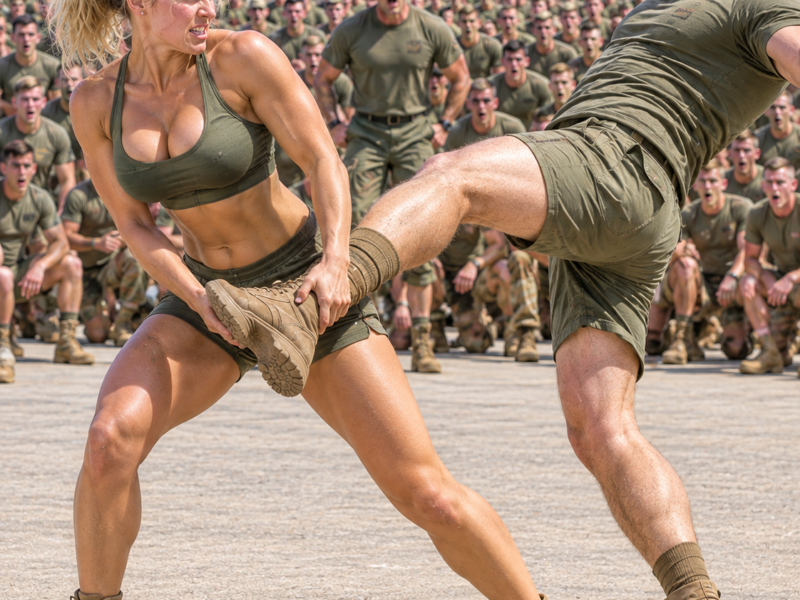
“I watched a six-foot-two Army instructor charge at a woman half his size in front of 500 soldiers, his boot already swinging toward her ribs
The first thing Major Reynolds did was order the military police to move everyone away from the training mat.
The second thing he did was tell them not to touch the black folder.
That was when I realized this wasn’t an ordinary training accident.
I stood in formation, watching two medics secure Staff Sergeant Derek Mitchell onto a stretcher. His face was twisted with pain, and sweat ran down his temples.
“Get her away from me!” he shouted as they lifted him.
Emily Carter didn’t move.
She stood beside the equipment table, her eyes fixed on the folder.
“Sergeant Carter,” Major Reynolds said, lowering his voice. “I need you to come with me.”
“Not until that folder is secured under the proper procedure.”
The major’s expression hardened.
“I gave an order.”
“And I am asking you not to destroy evidence, sir.”
A murmur traveled through the soldiers.
I glanced at the other instructors. None of them seemed willing to speak.
Mitchell turned his head toward her.
“What evidence? You attacked me in front of everyone!”
Emily finally looked at him.
“Then you shouldn’t have a problem with the cameras recording what happened.”
One of the medics told Mitchell to remain still.
He ignored her.
“She’s lying! She knew exactly what she was doing!”
Major Reynolds motioned toward the military police.
“Take Sergeant Carter to the administrative building. We’ll sort this out there.”
Emily slowly removed the small identification card clipped to her uniform and placed it on the table beside the gloves.
“I’ll come voluntarily,” she said. “But I want the recording preserved before anyone reviews or edits it.”
The major didn’t answer.
As she walked past our formation, I noticed something that bothered me.
She wasn’t looking at the soldiers who had just watched her defend herself.
She was looking at the photographer.
“Did you get the whole thing?” she asked him.
He nodded.
“I was recording from the beginning.”
“Keep the original file. Don’t send it to anyone yet.”
The photographer glanced at Major Reynolds.
For a moment, nobody seemed to know whose instructions he was supposed to follow.
Then Emily walked out of the training area.
And the black folder remained on the table.
I later learned that the incident had started nearly three weeks before that demonstration.
At the time, I was a corporal assigned to the same training battalion. I wasn’t close to Mitchell, but I’d attended enough of his classes to recognize his habits.
He liked control.
He liked being the strongest person in the room.
And he especially disliked being questioned by someone he considered beneath him.
Emily had arrived at Fort Bragg quietly.
She had transferred from another installation with an assignment that most of us didn’t understand. Her official role was to evaluate defensive training procedures and review several complaints involving excessive force during instructor-led exercises.
Nobody told us much about her background.
She didn’t talk about previous assignments, awards, or deployments.
When soldiers asked where she’d trained, she’d simply say, “In enough places to know that technique matters more than size.”
Mitchell hated that answer.
I remembered one afternoon when a young private named Tyler Brooks had struggled during a defensive exercise.
Mitchell had ordered him to repeat the drill after the rest of the class had been dismissed.
Tyler was exhausted, and his right shoulder was already bothering him.
“Again,” Mitchell commanded.
“Staff Sergeant, my shoulder—”
“Are you injured or are you making excuses?”
Tyler swallowed.
“Just a little sore, sir.”
“Then you’ll be fine.”
Emily had been observing from the edge of the training area.
“That’s enough, Staff Sergeant.”
Mitchell turned.
“Nobody asked for your opinion.”
“His shoulder needs to be evaluated.”
“He’s a soldier. Soldiers get sore.”
Emily stepped toward Tyler.
“Go to medical. I’ll document the exercise.”
Mitchell laughed.
“You planning to write me up?”
“I’m planning to write down what happened.”
He stared at her for several seconds before dismissing the private.
Tyler left without saying another word.
That evening, I saw Emily speaking with him outside the medical building.
She handed him a small notebook.
“Write down the date, the time, and exactly what you remember. Don’t exaggerate anything.”
Tyler looked nervous.
“What if he finds out?”
“Then we’ll deal with that through the proper channels.”
I didn’t think much of it at the time.
But now, after watching Mitchell fall on the mat, I began remembering all the little incidents we’d dismissed as normal military pressure.
The folder suddenly seemed much more important.
About an hour after the demonstration, I was called into the administrative building.
Major Reynolds sat behind his desk.
Emily was seated across from him, her hands folded neatly in front of her.
Two military police officers stood near the door.
The black folder was on the desk.
“Corporal,” Reynolds said, “you witnessed the demonstration?”
“Yes, sir.”
“Describe what happened.”
I explained how Mitchell had challenged Emily, how the demonstration had become increasingly aggressive, and how he had attempted to kick her.
Reynolds listened without interrupting.
When I finished, he leaned back.
“Did you see Sergeant Carter deliberately injure Staff Sergeant Mitchell?”
I hesitated.
“No, sir. I saw her respond to his attack.”
Emily said nothing.
Reynolds tapped his pen against the desk.
“That’s not quite what I asked.”
“Sir, I don’t know what she intended. I know what I saw.”
For the first time, Emily looked at me.
It wasn’t gratitude exactly.
It was something closer to relief.
Reynolds opened the folder.
Inside were printed emails, incident reports, photographs, and several pages of handwritten statements.
I recognized Tyler Brooks’s name on the first document.
Then I saw the names of four other soldiers.
“These are complaints against Staff Sergeant Mitchell,” Reynolds said.
Emily nodded.
“Five formal complaints and two requests for confidential interviews. All submitted over the past six months.”
“Some of these were already reviewed.”
“Some were closed without the witnesses being interviewed.”
Reynolds looked uncomfortable.
“Those decisions were made through the appropriate channels.”
“Then the records should support them.”
He turned another page.
I caught a glimpse of a photograph showing a bruised shoulder and a handwritten date.
Mitchell had apparently been accused of using excessive force during training exercises, then pressuring soldiers not to report injuries.
One statement described how he had threatened to recommend poor evaluations for anyone who challenged his methods.
Another described a private being ordered to repeat a dangerous drill despite repeatedly reporting pain.
The final document was different.
It was a printed email with a date from two weeks earlier.
The subject line read: REQUEST FOR REMOVAL OF EVALUATION AUTHORITY.
The sender was Staff Sergeant Derek Mitchell.
The recipient was Major Reynolds.
I couldn’t read the entire message, but one sentence caught my attention.
“Her presence is creating unnecessary problems within the training unit.”
Emily watched me reading.
“That email was sent after I requested the original injury reports.”
Major Reynolds closed the folder.
“Corporal, you can return to your unit.”
I stood.
Before I reached the door, Emily spoke.
“Corporal, one more thing.”
I turned.
“Did you notice anything unusual about the photographer’s position?”
I thought about it.
“He was standing near the equipment table.”
“Was he recording before the exercise began?”
“Yes, ma’am. I saw him filming the entire demonstration.”
She nodded.
“Thank you.”
I left the room with more questions than answers.
By late afternoon, word had spread across the installation.
Some soldiers said Emily had broken Mitchell’s leg deliberately.
Others said he’d attacked her because he couldn’t stand being challenged.
A few insisted the entire demonstration had been staged.
The truth was buried beneath rumors.
Then, just before evening formation, I received a message from Tyler Brooks.
“Corporal, do you know what’s happening with Sergeant Carter?”
I called him.
“They’re reviewing the incident.”
There was a pause.
“Did they find the folder?”
“Yes.”
Tyler exhaled.
“Then it’s finally happening.”
“What do you mean?”
He hesitated.
“She told us not to say anything until she had enough evidence. But Mitchell wasn’t just trying to get her removed.”
I sat down on the edge of my bunk.
“What else?”
Tyler lowered his voice.
“He wanted the complaints to disappear before the inspection team arrived.”
“Which inspection team?”
“The one coming next week. The team that’s supposed to review our training program.”
I looked toward the window.
That explained why Mitchell had been so desperate to discredit Emily.
But it didn’t explain why Major Reynolds had looked frightened when he saw the folder.
“Tyler, do you know anything else?”
He was quiet for a long time.
Then he said, “You need to ask who signed the reports.”
The call ended.
I stared at my phone.
The next morning, I found out why.
At 0700, an official notice was distributed to the battalion.
Staff Sergeant Mitchell had been transported to the hospital for treatment of a serious lower-leg injury. He was placed on medical leave pending further evaluation.
Sergeant First Class Emily Carter had been temporarily relieved from her instructional duties while the incident was reviewed.
But there was another announcement.
An external investigative team had arrived at the installation.
And Major Reynolds had been instructed to provide all records relating to the complaints against Mitchell.
By noon, investigators were interviewing soldiers individually.
I was among the first.
The lead investigator was a woman named Captain Laura Bennett.
She placed a recorder on the table and introduced herself.
“Corporal, I understand you witnessed the demonstration yesterday.”
“Yes, ma’am.”
“Did you see Staff Sergeant Mitchell initiate physical contact?”
“Yes.”
“Did you see Sergeant Carter use force?”
“Yes.”
“Did you see her continue after he was no longer a threat?”
I thought carefully.
“No, ma’am. She stepped away immediately.”
Captain Bennett nodded and wrote something down.
“Did you hear any instructions from Major Reynolds before the incident?”
I remembered the major’s order.
“Controlled exercise. No unnecessary contact.”
“And did Staff Sergeant Mitchell follow that instruction?”
“No, ma’am.”
She closed her notebook.
“Thank you. That’s all for now.”
I stood, but she stopped me.
“Corporal, have you ever witnessed Staff Sergeant Mitchell pressure someone not to report an injury?”
I thought of Tyler.
Then I remembered another soldier whose wrist had been wrapped for days after one of Mitchell’s training sessions.
“Yes, ma’am.”
“Are you willing to provide a separate statement?”
I nodded.
“Yes.”
That afternoon, the photographer’s original recording was secured.
The investigators watched it in a closed room.
I wasn’t invited, but I heard later that the footage was clearer than anyone expected.
It showed Mitchell making several aggressive movements after being told to keep the exercise controlled.
It also showed him lifting his leg and driving forward.
Emily’s response happened so quickly that even the investigators watched the footage more than once.
But there was something else on the recording.
Just before Mitchell attacked, he glanced toward the reviewing platform.
He looked directly at Major Reynolds.
And Reynolds gave him a small nod.
That detail changed everything.
The major was questioned again.
This time, he was not allowed to leave after the first interview.
Two days later, Emily requested permission to speak with the investigative team.
She arrived in her dress uniform, her hair tied back, and no expression of victory on her face.
I happened to be in the hallway when she came out.
“Sergeant Carter,” I said.
She stopped.
“Corporal.”
“Are you going to be all right?”
She looked at the closed conference-room door.
“I don’t know yet.”
“Everyone is talking about what happened.”
“I know.”
“Some people think you should be punished.”
She considered that.
“People are allowed to have opinions. Investigators need evidence.”
I hesitated.
“Why didn’t you tell us who you were when you arrived?”
For the first time, she smiled faintly.
“Because I wasn’t there to impress anyone.”
Then she walked away.
That evening, the investigators released a preliminary statement to the command staff.
The physical confrontation was being reviewed separately from the allegations involving the training program.
No conclusions had been reached.
But the folder had opened a much larger investigation.
The following morning, I learned that Mitchell had requested to speak with Emily.
He was still in the hospital.
His lower leg had been surgically stabilized, and doctors expected a lengthy recovery.
Emily initially declined.
Then she changed her mind.
I wasn’t present for their meeting, but I later learned what happened from Emily herself.
Mitchell was sitting beside the hospital window when she entered.
His leg was elevated, and a walking aid rested against the wall.
He looked older than he had on the training ground.
For a few moments, neither spoke.
Then he broke the silence.
“You happy now?”
Emily pulled a chair closer.
“No.”
“You’ve ruined my career.”
“I didn’t write the complaints.”
“You could have handled this differently.”
She looked at him.
“I tried.”
He turned toward the window.
“You don’t know what it’s like trying to keep a unit disciplined.”
“I know what it’s like to be responsible for soldiers.”
“Some of them need pressure.”
“Pressure isn’t the same as intimidation.”
He laughed bitterly.
“You think you’re better than me?”
“No.”
“Then why are you doing this?”
Emily rested her hands on her knees.
“Because Tyler Brooks asked for help, and nobody listened.”
Mitchell’s expression changed.
“That kid?”
“He wasn’t the only one.”
“He was weak.”
Emily didn’t raise her voice.
“He was injured.”
For several seconds, Mitchell said nothing.
Then he asked a question that would eventually become central to the investigation.
“Did you find the original reports?”
Emily looked at him carefully.
“Which reports?”
He seemed to realize he’d said too much.
“Forget it.”
She stood.
“Staff Sergeant, if you know something about missing records, tell the investigators.”
He stared at her.
Then he said quietly, “You don’t understand how things work here.”
Emily paused at the door.
“Maybe that’s why things need to change.”
She left without waiting for an answer.
Three days later, the investigation uncovered the missing piece.
Several injury reports had been marked as reviewed, even though the soldiers who submitted them had never been interviewed.
The approval signatures belonged to different officers, but the electronic audit trail showed that many of the reports had been accessed through the same administrative account.
That account was assigned to Major Reynolds.
Investigators also found emails between Reynolds and Mitchell discussing the upcoming inspection.
One message included a sentence that would later be read aloud during a formal hearing:
“We cannot afford another incident before the evaluation team arrives.”
Reynolds claimed he had been trying to protect the unit from unnecessary scrutiny.
Mitchell claimed he had simply followed instructions.
Neither explanation erased the records.
The investigation continued for several weeks.
During that time, Emily remained assigned to administrative duties.
She wasn’t celebrated.
She wasn’t treated like a hero.
Some soldiers avoided her because they didn’t want to become involved.
Others quietly thanked her when they passed in the hallway.
Tyler Brooks eventually returned to regular training after medical clearance.
His shoulder had improved, but he was still hesitant around instructors.
One afternoon, I found him sitting alone outside the gym.
“How are you doing?” I asked.
He shrugged.
“Better.”
“Good.”
He looked toward the training field.
“Do you think Mitchell will come back?”
“I don’t know.”
Tyler rubbed his shoulder.
“I used to think being a good soldier meant never saying anything when something hurt.”
I sat beside him.
“It doesn’t.”
He looked at me.
“Then why did it take so long for someone to listen?”
I didn’t have a good answer.
A week later, the preliminary findings were released to the command.
Mitchell was formally removed from his instructional position pending the outcome of disciplinary proceedings. The review also identified serious failures in how injury complaints had been handled.
Major Reynolds was suspended from his command responsibilities while investigators examined his role.
But Emily’s own case was not finished.
The Army still had to determine whether her use of force during the demonstration complied with the applicable rules.
That hearing took place in a conference room on a rainy Thursday morning.
I attended because I had been listed as a witness.
Emily sat at one end of the table.
Mitchell joined by video from the hospital.
Major Reynolds was represented separately.
The investigator played the recording.
We watched Mitchell challenge Emily.
We watched her evade his first movements.
We watched the major order controlled contact.
Then we watched Mitchell ignore the instruction and launch his kick.
The video stopped immediately after Emily’s defensive movement.
Captain Bennett looked around the room.
“Does anyone dispute that Staff Sergeant Mitchell initiated the final physical attack?”
No one spoke.
She continued.
“Does anyone have evidence that Sergeant Carter continued using force after the threat ended?”
Again, silence.
Then Mitchell’s voice came through the screen.
“She knew exactly how to hurt me.”
Emily turned toward the monitor.
“I knew how to stop you.”
“That’s convenient.”
“No. What’s convenient is pretending you were following instructions when the recording shows otherwise.”
Mitchell looked away.
The hearing continued for another hour.
When it ended, I walked into the hallway with Emily.
“Do you think they’ll clear you?” I asked.
She adjusted the sleeve of her uniform.
“I hope they’ll look at the evidence.”
“You don’t seem worried.”
She stopped near a window.
“I am worried.”
I hadn’t expected that answer.
“About what?”
She watched rain slide down the glass.
“About what happens after this. People focus on the person who gets hurt in front of five hundred witnesses. They don’t always remember the people who were hurt quietly for months.”
I thought about Tyler.
Then the other soldiers whose names had appeared in the folder.
“What happens to them now?”
“They get a chance to tell the truth without being told they’re the problem.”
Several days later, the formal findings were announced.
Emily was cleared of wrongdoing in the demonstration. Investigators determined that her response had been a defensive action during an uncontrolled physical attack and that she had disengaged immediately afterward.
Mitchell faced formal disciplinary action related to his conduct as an instructor and the allegations of intimidation and improper handling of injury reports.
Major Reynolds was relieved of his command position while the administrative investigation continued.
The Army did not announce every detail publicly, and not every allegation resulted in a finding.
But the records were no longer being quietly closed.
When Emily returned to the training grounds, nobody organized a celebration.
There were no speeches.
No applause.
She simply walked onto the mat where the incident had happened and placed a new set of training gloves on the equipment table.
Tyler Brooks was there.
So were several of the soldiers who had attended the original demonstration.
Emily looked at the group.
“Today, we’re going to work on defensive movement.”
She paused.
“Not because the strongest person always wins, but because every soldier deserves to know how to protect themselves without losing control.”
Then she looked toward Tyler.
“Would you like to demonstrate the first movement?”
He seemed surprised.
“Me?”
“Only if you’re comfortable.”
He glanced at his shoulder, then nodded.
“Yes, Sergeant.”
As they began, I watched the soldiers around me.
Nobody laughed.
Nobody questioned why he had been chosen.
They paid attention.
I still remember the sound of Mitchell hitting the mat that morning. I remember the silence afterward, the medics rushing forward, and the anger in his voice as he blamed the woman who had stopped him.
But the moment I remember most clearly happened weeks later.
It was when Tyler finished the exercise, stepped away from the mat, and smiled because he’d completed it without pain.
Emily gave him a small nod.
“Good work.”
It wasn’t dramatic.
It wasn’t something anyone would have written a headline about.
But for the first time in months, that training ground felt like a place where soldiers could admit they were human without being ashamed of it.
And I finally understood something I’d missed during the demonstration.
The most important thing Emily Carter had done that day wasn’t breaking a man’s attack.
It was making sure the people who had been too afraid to speak finally had someone willing to listen.
The end.









