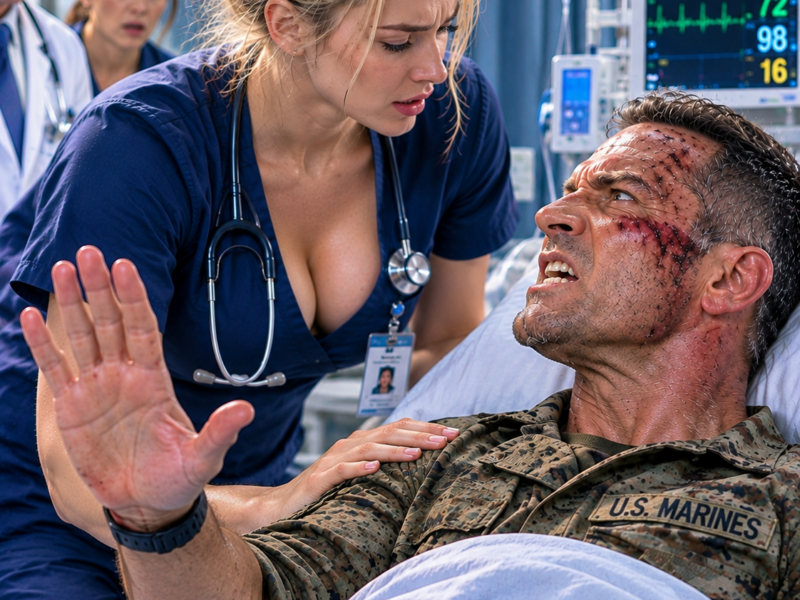
“I watched a dying Marine Corps commander shove twenty doctors away from his hospital bed, rip out his IV, and threaten to have the entire medical team removed
I stared at the photograph of my mother until the screen dimmed.
It had been taken outside our house.
The blue porch light was on, the curtains were drawn, and my mother was standing beside the mailbox in her gray cardigan.
She was looking directly at the camera.
Whoever had taken the picture hadn’t been hiding.
They wanted me to know they could reach her.
I immediately called her.
She answered on the fourth ring.
“Claire?”
Her voice sounded sleepy.
“Mom, are you home?”
“Of course. What’s wrong?”
“Are you alone?”
There was a pause.
“Why are you asking me that?”
I stepped away from the nurses’ station.
“Someone just sent me a photograph of you standing outside the house.”
The silence that followed was unlike anything I’d heard from her before.
Then she whispered, “What did you find?”
My stomach tightened.
“Ghost Six.”
I heard a faint sound on the other end.
It might have been a chair moving.
Or my mother sitting down.
“Claire, listen to me carefully. Don’t speak to anyone about that name.”
“Mom, Dad’s in that photograph.”
“I know.”
“General Whitaker said he saved his life.”
“I know.”
“Why didn’t you tell me?”
Her breathing became uneven.
“Because I promised your father.”
I closed my eyes.
“Promised him what?”
“That I would let you have a normal life.”
I looked through the glass toward the intensive care unit.
“Mom, somebody is watching you.”
“I know.”
The words were so quiet I almost missed them.
“What?”
“There’s a car across the street. It’s been there for twenty minutes.”
I moved toward the emergency exit.
“Call the police.”
“No.”
“Mom!”
“If you call the police, they’ll know we’re frightened.”
I stopped walking.
“Who are they?”
She didn’t answer.
Instead, she asked something that made my hands go cold.
“Did the general tell you to find the sixth man?”
“Yes.”
“Then your father was right.”
“Right about what?”
“That one day, someone would come looking for the people who survived Ghost Six.”
The call ended.
I immediately called her back.
This time, she didn’t answer.
I stood in the hallway, listening to the hospital’s ventilation system hum above me.
Then a security officer approached.
“Ms. Bennett?”
I turned.
He was a middle-aged man wearing the hospital’s standard security uniform.
“Yes?”
“Your mother is here.”
I blinked.
“She’s what?”
He pointed toward the elevator.
“She asked for you.”
I hurried down the corridor.
The elevator doors opened.
My mother stepped out.
She was still wearing the gray cardigan from the photograph.
Her hair was pulled into a loose bun, and she carried the small wooden box I remembered from childhood.
The same box that had contained my father’s medals and notebook.
She looked at me.
For several seconds, neither of us spoke.
Then she said, “We need to leave this hospital.”
I glanced toward the intensive care unit.
“I can’t leave General Whitaker.”
“Claire, you don’t understand.”
“Then explain it.”
She looked toward the security officer.
“Not here.”
I took her into an empty family consultation room.
Once the door closed, I turned toward her.
“Start talking.”
She placed the wooden box on the table.
Her hands were trembling.
“Your father wasn’t killed in an accident.”
I had already read the message.
Still, hearing her say it made the words feel different.
“How did he die?”
She looked at the box.
“Your father was part of a Marine reconnaissance team assigned to a mission in Afghanistan twenty-three years ago. Their task was supposed to be simple. They were ordered to locate a missing intelligence officer and recover information from an abandoned weapons facility.”
“Ghost Six?”
She nodded.
“Your father was the team’s communications specialist. General Whitaker was the commanding officer.”
“Why was it called Ghost Six?”
“Because there were six members of the unit. Five were listed as having returned from the operation.”
I frowned.
“But the general said my father saved his life.”
“He did.”
“Then why did he tell me to find the sixth man?”
My mother slowly opened the wooden box.
Inside was a military notebook, several photographs, and a small silver dog tag.
She picked up the dog tag.
“Because your father wasn’t the only one who disappeared that night.”
She turned it over.
A name was engraved on the back.
SERGEANT MICHAEL D. CROSS.
I had never heard that name.
“Who was he?”
“The sixth Marine.”
I stared at the tag.
“Why was he removed from the photograph?”
“Because he was the only person who knew what happened inside the weapons facility.”
My mother sat down.
“Your father and the others discovered that the facility wasn’t abandoned. It was being used to store weapons that had been officially reported as destroyed. Some of those weapons were being transferred to private contractors without authorization.”
“Who was responsible?”
“People with enough influence to make reports disappear.”
I felt sick.
“And the general knew?”
“He knew something was wrong. But he didn’t know how far it went.”
“Then what happened?”
My mother opened the notebook.
A page near the back had been folded several times.
My father’s handwriting was unmistakable.
At the top were six names.
Daniel Bennett.
Thomas Whitaker.
Michael Cross.
And three others.
Beneath the names was a sentence.
“If anything happens, the recording must reach someone outside the command structure.”
I looked up.
“Recording?”
My mother nodded.
“Your father made a recording during the operation.”
“Where is it?”
She closed the notebook.
“That is what Michael Cross spent the last twenty-three years trying to protect.”
Before I could ask another question, someone knocked on the consultation room door.
Three firm knocks.
My mother immediately stood.
“Don’t open it.”
I looked through the small window.
A man in a dark suit stood outside.
He was holding a visitor badge.
“Hospital security,” he said.
I recognized him.
He had been standing near the elevator earlier.
Except his badge had been facing backward.
And his shoes were muddy.
The man knocked again.
“Ms. Bennett, we need to speak with you.”
My mother grabbed my arm.
“Claire, listen to me. If that man asks about the box, tell him you don’t have it.”
The door handle moved.
Then someone tried a key.
I stepped backward.
My mother pulled a small envelope from the wooden box and slipped it into my hand.
“Your father left this for you.”
“What is it?”
“His last letter.”
The lock clicked.
The door began opening.
My mother pushed me toward the second exit.
“Go.”
“What about you?”
“I’ll handle this.”
I refused to move.
She looked directly into my eyes.
For the first time since my father’s funeral, she looked like the woman who had once carried me through thunderstorms and promised nothing bad would ever happen.
Only now, she wasn’t making that promise.
She was asking me to survive.
“Claire, please.”
The door opened.
A man stepped inside.
My mother turned toward him.
“You’re late,” she said.
He looked at her.
“Where is the notebook?”
My mother smiled sadly.
“Somewhere you should have looked twenty-three years ago.”
Then the hospital alarm sounded.
A code blue announcement echoed through the corridor.
The man turned instinctively.
I used that moment to slip through the second door.
I ran toward the stairwell.
Behind me, I heard my mother shout my name.
Then the door slammed.
I reached the third floor before I stopped.
My legs were shaking.
I pulled the envelope from my pocket.
My name was written on the front.
Not Claire.
My full name.
Claire Elizabeth Bennett.
My father’s handwriting.
I opened it carefully.
Inside was a letter dated three days before his death.
“My little girl,
If you’re reading this, then I wasn’t able to come home and explain something I should have told you a long time ago.
I need you to understand that the men I serve with are not all what they appear to be.
Some of them are good men who have made terrible mistakes.
Some have made terrible choices and convinced themselves they were necessary.
And one man is trying to make sure the truth never comes out.
His name is not the name you will find in any official record.
Trust Thomas Whitaker only if he tells you what happened at the eastern ridge.
Find Michael Cross.
He has the original recording.
Tell him the phrase:
The lantern never went out.
And Claire, whatever happens, remember that your father loved you more than any mission.”
I read the letter twice.
The eastern ridge.
Michael Cross.
The lantern never went out.
I folded the letter and placed it inside my uniform pocket.
Then I called the hospital’s security desk.
A dispatcher answered.
“This is security.”
“This is Claire Bennett in the north stairwell. I need police assistance immediately. There is an unauthorized person in the family consultation area.”
“Are you in immediate danger?”
“Yes.”
“Stay where you are.”
I hung up.
Then I called my mother.
No answer.
I called again.
Still nothing.
I was about to dial 911 when a voice came from behind me.
“Claire.”
I turned.
A man stood on the landing.
He was in his late fifties, with silver hair and a dark green jacket.
His face was familiar.
I had seen it in the photograph beside General Whitaker’s bed.
The sixth man.
Michael Cross.
He looked at the letter in my hand.
Then he said something that made me forget to breathe.
“Your father told me you’d come looking eventually.”
I didn’t move closer.
“Who are you?”
He gave a small, tired smile.
“You already know my name.”
“How did you get into the hospital?”
“Through the front entrance.”
“Why should I trust you?”
“You shouldn’t.”
His answer surprised me.
He leaned against the railing.
“Not until you know what happened.”
I tightened my grip on the letter.
“Did you kill my father?”
His expression changed.
“No.”
“Did you leave him?”
“No.”
“Then tell me what happened.”
Cross looked toward the stairwell door.
“We don’t have much time.”
“Why?”
“Because the people who sent that man into the consultation room are already searching this building.”
I thought about my mother.
“Where is she?”
“Safe, if she followed the instructions I gave her.”
“You knew she was coming?”
“She called me when she saw the photograph.”
I stared at him.
“You’ve been talking to my mother?”
“For years.”
The words hurt more than I expected.
“She knew where you were?”
“Yes.”
“And she never told me?”
“She was trying to protect you.”
I shook my head.
“Everyone keeps saying that. Nobody seems to understand what it feels like to be the last person who knows nothing.”
Cross lowered his eyes.
“You’re right.”
He reached into his jacket.
I immediately stepped backward.
He stopped.
Then he slowly removed a small photograph.
It showed the same six Marines.
But this time, all six were visible.
My father stood beside Whitaker.
Cross was at the far end.
And behind them stood another man.
A civilian.
His face had been scratched out.
“Who is that?” I asked.
Cross looked at the photograph.
“That’s the man who ordered the operation.”
“What’s his name?”
“Senator Richard Halstead.”
I recognized the name.
He had served on the Senate Armed Services Committee for years and was frequently interviewed on television about national security.
He was now one of the most powerful people in Washington.
“You’re telling me a United States senator was involved in an illegal weapons operation?”
“I’m telling you he was there.”
Cross folded the photograph.
“And your father recorded him.”
I felt the floor shift beneath my feet.
“Why didn’t you take the recording to the authorities?”
“I tried.”
“What happened?”
“The first agent I contacted was dead two days later. The second disappeared. The third told me he would help, then handed my location to Halstead’s people.”
“Why not go to the press?”
“Because the recording alone wouldn’t have been enough. Halstead had spent years building a network of people who could discredit anyone who challenged him.”
He looked at me.
“Your father understood that. That’s why he made a second copy.”
“Where?”
Cross tapped the photograph.
“At the eastern ridge.”
I remembered the letter.
“What’s at the eastern ridge?”
“The place where your father died.”
I swallowed.
“Then why does the general need me?”
Cross’s expression became serious.
“Because Whitaker was the only other man who knew where the second copy was hidden.”
“And why did he reject twenty doctors?”
“Because one of the doctors treating him was connected to Halstead.”
I stared at him.
“Dr. Reeves?”
Cross nodded.
“Reeves has been providing medical information to Halstead’s people. They knew Whitaker was dying. They wanted him dead before he could tell anyone what happened.”
My mind raced through the last few hours.
The crossed-out name.
The general’s refusal.
The fear in his eyes.
It all made sense.
But one question remained.
“Why did the general recognize my father’s call sign?”
Cross looked at me.
“Because he was the one who gave it to him.”
I shook my head.
“No. The general said Ghost Six wasn’t our call sign. It was the operation.”
Cross nodded.
“That was true. But your father had another call sign.”
He leaned closer.
“Lantern.”
The phrase in the letter.
The lantern never went out.
I felt tears gathering in my eyes.
For twenty-three years, I had believed my father died in a routine military accident.
Now I was learning that he had been part of something much larger.
And that his final act had been to leave a trail of evidence for a daughter who hadn’t even reached adulthood yet.
Cross looked at me.
“There’s something else you need to know.”
I waited.
“Your father didn’t die at the eastern ridge.”
I stared at him.
“What?”
“He was taken alive.”
The words barely registered.
“You’re lying.”
“I wish I were.”
“His body was identified.”
“That wasn’t your father.”
My knees weakened.
I grabbed the railing.
“Then where is he?”
Cross looked down.
“That’s the question I’ve spent twenty-three years trying to answer.”
Before I could respond, the stairwell door opened.
A nurse rushed inside.
“Claire! They’re looking for you.”
I recognized her.
Angela Morris.
She worked the night shift in intensive care.
“What’s happening?”
She looked at Cross.
“Who is that?”
“An old friend.”
Angela shook her head.
“Your patient is awake.”
I turned.
“General Whitaker?”
She nodded.
“He’s asking for you.”
I followed Angela back to intensive care.
Cross stayed behind.
Before I left, he gave me the photograph.
“Don’t let anyone take this,” he said.
“Why?”
“Because it proves the sixth man existed.”
When I entered Whitaker’s room, the general was sitting upright.
His face was pale.
An oxygen mask covered his mouth.
The attending physician stood beside him.
Dr. Reeves was nowhere to be seen.
Whitaker reached for me.
“Claire.”
“I’m here.”
He glanced toward the door.
“Are you alone?”
“No.”
“Good.”
He removed the oxygen mask.
“Did you find him?”
“Michael Cross?”
His eyes widened.
“He’s alive?”
“Yes.”
For a moment, the general looked as though a weight had been lifted from his chest.
Then he closed his eyes.
“Thank God.”
I pulled a chair beside the bed.
“General, I need you to tell me what happened to my father.”
He looked at the photograph in my hand.
Then he nodded.
“Twenty-three years ago, your father discovered that the weapons facility was being used to move restricted equipment to private contractors.”
“Senator Halstead?”
“Yes.”
“Why did you let it happen?”
Whitaker looked away.
“I didn’t know the full truth until we reached the facility.”
“But you knew something was wrong.”
“Yes.”
He swallowed.
“I received an intelligence warning the night before the operation. It said the eastern route had been compromised.”
I remembered Cross saying the same thing.
“Why did you ignore it?”
“Because Halstead had convinced my superiors that the information was unreliable.”
“And you believed them?”
“I wanted to believe them.”
His voice cracked.
“Your father didn’t.”
He looked toward the ceiling.
“Daniel Bennett was the best communications specialist I ever served with. He found the recording device in the facility and realized our radio traffic was being monitored.”
“What happened next?”
“We tried to withdraw.”
Whitaker paused.
“But the extraction team never came.”
I looked at him.
“Why?”
“Because Mason had given our coordinates to Halstead’s people.”
The name meant nothing to me.
“Who was Mason?”
“An officer assigned to our unit. He had been working with the contractors.”
I thought of the five men in the photograph.
“Did he kill my father?”
Whitaker shook his head.
“No. He took him.”
I held the chair tightly.
“Why?”
“Because your father had memorized the access codes to the weapons facility. He was the only one who could unlock the original records.”
“Where did they take him?”
Whitaker’s breathing became strained.
“I don’t know.”
“Then why did my father disappear?”
“Because someone made a deal.”
“What deal?”
The general looked directly at me.
“Your father would be kept alive as long as the evidence remained hidden.”
I couldn’t speak.
For twenty-three years, my mother had mourned a husband who might still have been alive.
I had grown up believing my father died in a helicopter accident.
And the people responsible had allowed us to grieve while keeping him somewhere we couldn’t reach.
Whitaker reached for my hand.
“Claire, there’s something I need to tell you about your father’s final message.”
I leaned closer.
“He didn’t send it to your mother.”
I frowned.
“What?”
“He sent it to me.”
“Why?”
“Because he knew I had failed him.”
Whitaker’s eyes filled.
“He asked me to protect you. He said if he ever got out, he would come home.”
I looked down.
“Did you try to find him?”
“Every year.”
“Then why did you wait twenty-three years to tell me?”
He turned his face away.
“Because every time I got close, someone threatened your family.”
I wanted to hate him.
Part of me did.
But I could see how much the truth had cost him.
And I could see that he had carried his own guilt for a very long time.
“Where is the second recording?” I asked.
He closed his eyes.
“At the eastern ridge. Beneath the old communications tower.”
“How do I find it?”
He reached toward the bedside table.
A small envelope lay beside the water glass.
He pushed it toward me.
Inside was a set of coordinates.
And a handwritten note.
“Lantern knows the way.”
I looked at him.
“What does that mean?”
Whitaker’s voice dropped to a whisper.
“Your father left a trail. Only someone who knew his call sign would understand it.”
Then the monitor began beeping rapidly.
The attending physician rushed toward the bed.
“General, put the mask back on.”
Whitaker grabbed my wrist one last time.
“Claire, don’t go alone.”
His eyes moved toward the door.
“Halstead knows you’re here.”
Then he lost consciousness.
By sunrise, the hospital was surrounded by federal agents.
The man who had entered the consultation room had been arrested.
His real name was Peter Lawson.
He had worked for a private security company contracted by a defense supplier connected to Halstead.
My mother was found safe at a nearby hotel.
She had managed to escape the hospital through a service entrance after Cross contacted her.
When I finally saw her, I didn’t hug her immediately.
I stood in front of her with the wooden box between us.
“How long have you known?”
She looked exhausted.
“About your father?”
“About everything.”
She sat down.
“Not everything. But enough.”
“Did you know he might still be alive?”
Her eyes filled.
“Michael told me he had reason to believe that.”
“How long?”
“Sixteen years.”
I stepped away.
“Sixteen years?”
She covered her mouth.
“I was afraid.”
“You let me believe he was dead.”
“I wanted you to grow up without looking over your shoulder every time a car passed.”
I stared at her.
“Do you understand what that did to me?”
She began crying.
“I know.”
“No, you don’t. I spent years wondering whether I had forgotten his voice. I kept his birthday on my calendar. I visited his grave every year.”
My mother reached for me.
I moved away.
“That grave didn’t even belong to him.”
She lowered her head.
“No.”
I sat opposite her.
“Why didn’t you tell me?”
“Because the people involved were powerful. Michael had already lost friends trying to expose them. Your father had asked me to keep you safe.”
I looked at the wooden box.
“Did Dad ask you to keep me ignorant?”
She shook her head.
“No. He asked me to keep you alive.”
The distinction hurt.
But it mattered.
I took her hand.
“Next time, don’t protect me by taking away my right to know.”
She nodded.
“I won’t.”
For a while, we sat quietly.
Then she opened the notebook and showed me something I hadn’t noticed before.
A series of small drawings in the margins.
A lantern.
A mountain.
A radio tower.
A compass.
My father had drawn them beside certain paragraphs.
I remembered him teaching me how to use a compass when I was nine.
He had hidden little clues in the notebook.
Not random doodles.
A map.
I looked at Cross’s photograph.
Then at the coordinates Whitaker had given me.
“He’s telling us where to go.”
My mother stared at the pages.
“Claire, no.”
“We have to find him.”
“We don’t know what we’re walking into.”
“Then we’ll take people who do.”
I called Cross.
He answered immediately.
“I was wondering when you’d call.”
“I found the map.”
There was a long pause.
“Then we need to move quickly.”
“Why?”
“Because Halstead’s people know about the coordinates.”
Two days later, a federal investigative team arranged a secure trip to Afghanistan.
I was not supposed to be part of it.
The agents wanted me to stay home.
They had no reason to bring a civilian nurse into a dangerous recovery operation.
But I had something they didn’t.
My father’s notebook.
His call sign.
And the ability to recognize the small symbols he had used to mark the trail.
Cross was allowed to accompany the team as a witness.
General Whitaker was too ill to travel, but he provided a recorded statement.
Before we left, he asked to speak with me.
I stood beside his bed.
“Claire.”
“Yes, General?”
He looked older than he had two days earlier.
“Your father was the bravest man I ever knew.”
I said nothing.
“I don’t expect you to forgive me.”
“I haven’t decided.”
He nodded.
“That’s fair.”
Then he handed me a small military pin.
It was an old communications insignia.
“Your father carried this.”
I took it carefully.
“Why are you giving it to me?”
“Because I should have given it to you twenty-three years ago.”
I placed it in my pocket.
Then I left.
The journey took nearly two days.
When we reached the region identified in the notebook, the mountains looked exactly like the photographs.
Brown ridges.
Narrow valleys.
Wind cutting through the rocks.
The communications tower stood on a slope overlooking an abandoned military facility.
Its metal frame was rusted.
One side had collapsed.
Cross walked beside me.
“Your father used this tower to transmit a signal after the extraction failed.”
“Did anyone receive it?”
“I did.”
I looked at him.
“What did it say?”
He stopped.
“Three words.”
I waited.
“Lantern is still burning.”
I looked toward the tower.
“That was his message?”
Cross nodded.
“He was telling me he was alive.”
My throat tightened.
The federal team searched the surrounding area.
One agent discovered a metal panel beneath the tower.
The panel had been secured with old bolts.
Inside was a small waterproof container.
My father’s initials were engraved on the lid.
I knelt.
My hands were shaking too much to open it.
Cross crouched beside me.
“Take your time.”
I turned the lid.
Inside was a memory card, a folded photograph, and a small strip of paper.
The photograph showed my father standing beside a young girl.
I recognized myself.
I was about seven years old.
He had taken the picture before his last deployment.
On the back, he had written:
“Always find your way home.”
I pressed the photograph against my chest.
Then I opened the paper.
It contained one sentence.
“Ask the man who never left.”
I looked at Cross.
“What does that mean?”
He didn’t answer immediately.
His face had gone pale.
Then he whispered, “It means your father may not have been taken as far as we thought.”
An agent approached.
“Sir, we’ve got something.”
He pointed toward a small structure built into the hillside.
A metal door was visible beneath a layer of dust.
There were fresh marks around the lock.
Someone had opened it recently.
Cross moved toward the door.
I followed.
Inside was a narrow underground room.
A table.
Two chairs.
An old radio.
And a wall covered with photographs.
One showed my father in uniform.
Another showed General Whitaker.
A third showed a man I had never seen before.
He was older, with a long gray beard and a scar across his chin.
But the most recent photograph was the one that made my knees weaken.
It showed a man standing outside a small building.
His hair was almost completely white.
His shoulders were thinner.
But his face was unmistakable.
My father.
Alive.
The photograph had been taken only six months earlier.
I reached toward it.
My fingers touched the paper.
“Where is he?”
Cross looked at the date.
Then at the back of the photograph.
A location had been written there.
A village several miles north.
An agent spoke through his radio.
“Movement detected near the northern road.”
Cross grabbed my arm.
“Claire, stay behind us.”
I nodded.
We moved toward the exit.
Then a voice came from the old radio.
Static.
A brief burst of interference.
And a man’s voice.
“Lantern, if you’re listening, don’t come alone.”
I looked at Cross.
He had gone completely still.
The voice continued.
“Tell Claire I’m sorry I missed her birthday.”
I began crying before I could stop myself.
It was my father’s voice.
Older.
Rougher.
But unmistakably his.
For twenty-three years, I had imagined hearing it again.
I had imagined him saying my name.
I had never imagined he would remember my birthday.
The radio crackled once more.
Then he spoke the words I had waited half my life to hear.
“Little Claire, Daddy’s coming home.”
The federal team located the village before sunset.
My father was staying in a small house near the edge of the settlement.
He had been living under a false identity.
The people who had held him had eventually lost control of the operation, but he had been moved repeatedly to prevent him from exposing the weapons network.
The final years had been different.
He had been allowed to work as a mechanic.
He had made friends.
He had even helped a local family raise two children.
But he had never stopped trying to get home.
When the team approached the house, I was asked to remain behind the vehicles.
I refused.
Cross stood beside me.
“Claire, you need to understand something.”
“What?”
“Your father may not be the man you remember.”
I looked at him.
“Neither am I.”
He nodded.
We walked toward the house.
The door opened.
An older man stepped outside.
He leaned heavily on a wooden cane.
His beard was white.
His face was lined.
But his eyes were the same.
The same eyes that had looked at me across the kitchen table when I was a little girl.
For a moment, he simply stared.
Then he whispered, “Claire?”
I couldn’t speak.
He took one careful step forward.
“I thought I’d never see you again.”
I ran to him.
His cane fell to the ground.
His arms wrapped around me.
He was thinner than I remembered.
His uniform was gone.
His hair was white.
But he smelled faintly of soap and tobacco, just as he had when I was a child.
I held him so tightly that he winced.
“Sorry,” I whispered.
He laughed through his tears.
“Don’t ever apologize for hugging your father.”
I buried my face against his shoulder.
For several minutes, neither of us spoke.
Then he pulled back and touched my cheek.
“You look like your mother.”
I laughed and cried at the same time.
“She looks terrible right now.”
He smiled.
“Then I suppose I have a lot of catching up to do.”
Cross stood several feet away.
My father looked at him.
“Michael.”
Cross nodded.
“Daniel.”
They embraced.
Two men who had spent twenty-three years carrying the same secret finally stood together again.
But there was still something left to resolve.
My father looked at the federal agents.
“Did you recover the recording?”
I nodded.
“We found it.”
“All of it?”
“Yes.”
He closed his eyes.
“Then it’s finally over.”
I took his hand.
“Not yet.”
He looked at me.
“Senator Halstead is still alive. The people who took you haven’t all been identified.”
My father nodded slowly.
“Then we finish it properly.”
The evidence recovered from the communications tower changed everything.
The original recording contained the voices of the men who had authorized the weapons transfers.
It also included Mason’s instructions to the extraction team and the orders that had led to my father’s capture.
The memory card held copies of shipment records, payment details, and names that had been missing from the official investigation for more than two decades.
Senator Richard Halstead was arrested six weeks later.
Several former military officials and private contractors were also charged.
Some pleaded guilty.
Others fought the accusations.
The investigation exposed a network that had survived multiple administrations by changing names, companies, and political connections.
General Whitaker testified from his hospital bed.
His health improved after doctors finally treated the infection without Reeves’s involvement.
He underwent the procedure he had rejected twenty doctors to avoid.
The hospital later confirmed that Reeves had accessed his confidential medical information without authorization.
He was arrested for conspiracy and obstruction.
When Whitaker heard the news, he simply closed his eyes.
“I should have listened to the first doctor,” he said.
I smiled faintly.
“You should have listened to the first nurse.”
He laughed.
It was the first time I had heard him laugh without pain.
My father returned to the United States four months after we found him.
The first time he walked into our old house, he stopped in the hallway.
My mother was standing beside the kitchen table.
Neither of them moved.
Then she crossed the room.
She touched his face as if she needed to make sure he was real.
He held her hands.
“I’m sorry,” he whispered.
She shook her head.
“Don’t.”
“I should have found a way home.”
“You were alive. That’s what matters.”
They embraced.
I stood in the doorway and watched the two people who had raised me find each other again.
There were difficult days afterward.
My father had trouble sleeping.
He disliked crowded rooms.
Sometimes a helicopter passing overhead made him leave whatever he was doing and stand silently in the yard.
He had missed twenty-three years of birthdays, holidays, arguments, and ordinary mornings.
I couldn’t give those years back.
Neither could he.
But we started again.
Slowly.
He learned how to use a smartphone.
I taught him how to order groceries online.
He complained about the price of coffee and insisted that the old truck in the driveway still had another hundred thousand miles left in it.
My mother started leaving two cups on the kitchen counter every morning.
And sometimes, when I came home after a long hospital shift, I found my father sitting at the table reading his old notebook.
He never tried to pretend the years hadn’t happened.
Neither did I.
One evening, several months after his return, I found him in the garage holding the photograph of Ghost Six.
He was staring at the six Marines.
“Do you miss them?” I asked.
He nodded.
“Every day.”
“Do you think they would be proud of you?”
He looked at me.
“I don’t know.”
I sat beside him.
“General Whitaker told me you saved his life.”
My father looked down at the photograph.
“He was a good man who made a terrible decision.”
“Can you forgive him?”
He considered the question.
“Forgiveness isn’t the same as pretending it didn’t happen.”
I nodded.
He placed the photograph on the workbench.
“Those men deserved better.”
I looked at the six faces.
For the first time, I understood why my father had kept their photograph all those years.
He hadn’t been trying to remember a mission.
He had been trying to remember the people who never got to come home.
A year later, Walter Reed held a small ceremony honoring the members of the Ghost Six operation.
My father attended in a dark suit.
General Whitaker came in a wheelchair.
Michael Cross stood beside him.
Families of the fallen Marines filled the first three rows.
There were no television cameras.
No speeches about politics.
No attempts to make the story sound cleaner than it was.
Just names.
Six names.
Each one read aloud.
When they reached my father’s name, I looked at him.
He was standing with his hands folded in front of him.
His eyes were wet.
After the ceremony, Whitaker approached.
He stopped in front of my father.
“Daniel.”
My father looked at him.
“Thomas.”
Whitaker extended his hand.
“I don’t know if I deserve this.”
My father looked at his hand for a moment.
Then he took it.
“You don’t get to decide what you deserve. You just have to decide what you do with the time you have left.”
Whitaker nodded.
Neither man said anything else.
Later, when the room had emptied, I walked with my father toward the parking lot.
He was carrying the wooden box that had once sat in my mother’s closet.
Inside were his medals, the old notebook, and the photograph of Ghost Six.
I asked him why he had kept the call sign Lantern.
He smiled.
“Because a lantern doesn’t have to be powerful. It just has to stay lit long enough for someone to find their way.”
I thought about the hospital room.
The twenty doctors.
The general who refused treatment.
The old photograph.
The message from an unknown number.
And the quiet nurse who had whispered a forgotten call sign without knowing she was opening the door to her own family’s past.
I had entered that hospital believing my job was to help a dying man survive the night.
I had no idea that he would lead me back to a father I had mourned for twenty-three years.
Before we reached the car, my father stopped and looked at me.
“Claire?”
“Yes?”
“Thank you for finding me.”
I took his hand.
“I didn’t find you alone.”
He looked toward the building where Michael Cross and General Whitaker were still talking.
Then he looked back at me.
“No,” he said softly. “But you were the one who knew which voice to listen for.”
We walked toward the car together.
For twenty-three years, I had believed my father’s story ended in the mountains of Afghanistan.
It hadn’t.
And when he reached over and squeezed my hand, I finally understood that sometimes the people we lose aren’t gone because they stopped loving us.
Sometimes, they are simply still trying to find their way home.
THE END.









