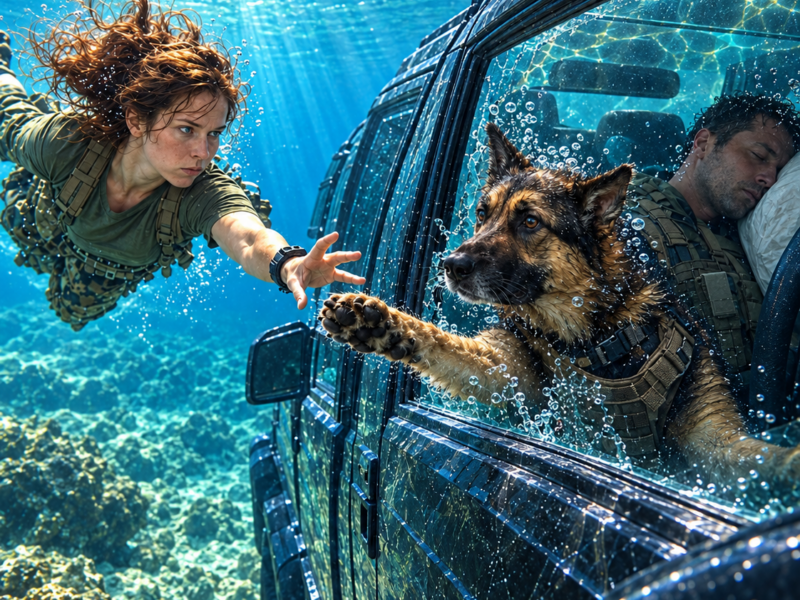
“I was still kneeling in the mud beside a wounded Navy SEAL and his bleeding German Shepherd when his commanding officer grabbed my collar
I stared at the date on the back of the photograph until the numbers blurred.
October 14, 2003.
My father had supposedly died on June 8, 2000.
I knew the official date without having to think about it. It was printed on his death certificate, repeated in the military notification my mother kept in a cedar chest, and engraved on the small brass plaque she placed beside his folded flag every Memorial Day.
Three years and four months separated those dates.
My father had been dead for three years when someone photographed him standing beside me.
I looked at Michael Cole.
“Tell me what this means.”
He glanced toward the door again.
“Lock it.”
I turned the lock, then returned to his bedside.
“Start talking.”
Michael shifted against his pillows and winced. The movement pulled at the bandages beneath his hospital gown.
“Your father was Sergeant Daniel Hayes. He was a Marine intelligence specialist attached to a joint task force in Afghanistan. His official assignment was communications security, but he was also investigating missing equipment and falsified supply records.”
I shook my head.
“My father worked in logistics.”
“That’s what you were told.”
“He called us every Sunday. He sent postcards from bases I’ve never heard of. My mother received his personal effects.”
“Some of them.”
The room seemed to shrink around me.
“What does that mean?”
Michael drew a slow breath.
“When I met your father in 1999, he was already suspicious that someone was moving military equipment off the books. Radios, encrypted storage devices, weapons components. Small shipments at first. The records showed they were being delivered to authorized units, but those units never received them.”
“Who was doing it?”
“He didn’t know at first. He spent months collecting evidence.”
Michael stopped, his eyes fixed on the photograph in my hands.
“Then he found the connection.”
“To Commander Brooks?”
His silence answered before he did.
“Brooks was a lieutenant commander back then. He supervised part of the joint operation. Your father found evidence that he was approving shipments to a logistics contractor that didn’t exist on paper.”
I sat down in the chair beside the bed.
Commander Daniel Brooks had been in the military long enough to have gray at his temples. He spoke about discipline as if it were a sacred obligation, and his record was spotless.
He’d looked me in the eye that morning and told me to stay away from Michael.
“Why wasn’t Brooks investigated?”
“Because your father disappeared before he could submit everything.”
“Disappeared?”
“The convoy he was traveling with was attacked. The official report said he died in the explosion. They recovered enough personal effects to support the identification, but they never recovered his body.”
I remembered my mother at the kitchen table, holding a telephone receiver against her ear while her other hand covered her mouth.
I remembered the way she stopped sleeping in their bedroom.
I remembered asking whether Dad had been hurt before he died.
She’d held me so tightly I couldn’t breathe and said, “He didn’t suffer, sweetheart.”
For twenty-three years, I’d thought she was trying to comfort me.
Now I wondered what she’d actually known.
“How do you know he survived?” I asked.
Michael’s expression tightened.
“Because I helped him escape.”
The words hung between us.
Outside, a cart rattled down the hallway.
Michael waited until the sound faded.
“The explosion destroyed the convoy, but your father had left the vehicle before it happened. He was supposed to meet me at a secondary location. When he didn’t arrive, I went looking for him.”
“And you found him?”
“Three days later. Injured, dehydrated, and carrying a small storage device containing copies of the records he’d collected.”
“Why didn’t he come home?”
“Because the people responsible knew his family existed.”
My fingers tightened around the photograph.
“You’re saying they threatened us?”
“I’m saying your father’s name had already appeared in a file containing your mother’s address, your school, and the places you went after school. He believed someone was watching you.”
I felt suddenly cold despite the warmth of the hospital room.
My father had taught me to ride a bicycle in the driveway. He’d checked under my bed for monsters and left handwritten notes in my lunchbox.
He was the man who sang off-key while washing dishes.
The idea that he’d been afraid to come home because of me made something inside my chest ache.
“Why didn’t he tell us he was alive?”
“He tried.”
Michael’s answer came so quickly that I looked up.
“What?”
“He sent letters through a private intermediary. Your mother received at least one.”
I stood.
“You’re lying.”
“I wish I were.”
“My mother never told me that.”
“She may have been trying to protect you.”
“From what? Knowing my father was alive?”
Michael looked down at his hands.
“From becoming the reason he couldn’t stay alive.”
I wanted to leave the room. I wanted to call my mother and demand every answer she’d kept from me.
Instead, I sat down again because my knees had begun to shake.
“Where is he now?”
Michael didn’t answer.
I waited.
He turned his head toward the window, where the afternoon light had faded into a dull gray.
“I don’t know.”
“You’re telling me you helped him disappear, and you don’t know where he is?”
“The last time I saw him was in 2003. He’d arranged to transfer the evidence to someone outside the operation. We planned to meet at a safe location afterward. He never arrived.”
“And you just gave up?”
His jaw tightened.
“No.”
For the first time, anger broke through his exhaustion.
“I spent years trying to find him. I checked hospitals, military detention records, overseas casualty lists. I contacted people who wouldn’t return my calls and went places I was told to avoid. Eventually, I was warned that if I kept searching, I’d endanger the people I cared about.”
He looked at me.
“Then I found out you had joined the Marines.”
I frowned.
“How?”
“I recognized your name in a personnel report. I knew your father had a daughter named Rebecca, and I knew the scar beneath your ear.”
My hand moved instinctively to the scar.
“When I saw you on that ridge, I thought I was hallucinating.”
“You said I wasn’t supposed to be alive.”
“I meant the photograph. The little girl in it was listed as a casualty in the same operation that supposedly killed your father.”
I couldn’t speak.
Michael reached for the glass of water on his bedside table, but his fingers trembled too badly to lift it. I handed it to him.
He took a sip.
“Someone had altered the records. I don’t know who reported you dead or why, but your name disappeared from the files connected to your father. When I saw you alive, wearing a Marine uniform, I realized someone had gone to extraordinary lengths to bury your family’s history.”
I stared at the photograph.
The little girl wore my yellow raincoat. I remembered the coat because my mother had sewn a red patch over a tear in its pocket.
I could even remember the cold October wind that day.
But the photograph was impossible.
“I was six years old in 2003,” I said.
“Yes.”
“I don’t remember taking this picture.”
“That doesn’t mean you didn’t.”
I looked at him sharply.
“Are you suggesting I forgot my own father?”
“No. I’m suggesting there may be more to that day than you remember.”
Before I could answer, the door handle moved.
Michael went rigid.
I slipped the photograph inside my uniform pocket.
The door opened, and Commander Brooks entered without knocking.
His eyes went first to Michael, then to me, and finally to the locked door.
“Sergeant Hayes. Outside.”
“I’m in the middle of a medical conversation.”
“That wasn’t a request.”
Michael shifted forward.
“She stays.”
Brooks turned toward him.
“You’re in no condition to dictate anything.”
“Neither were you in 2000, but that didn’t stop you from signing the report.”
The commander’s face changed.
It was only a fraction of a second, but I saw it: the sudden stillness, the tiny tightening around his mouth.
Then he smiled without warmth.
“Your injuries are affecting your judgment, Petty Officer.”
Michael gave a tired, humorless laugh.
“Funny. You always did say that when somebody found something you didn’t want them to see.”
I watched Brooks carefully.
He didn’t ask what report Michael meant.
He didn’t ask why Michael was accusing him.
He simply looked at me.
“Sergeant, I want your weapon and identification turned over to your commanding officer. You’re suspended from this operation pending an inquiry.”
“On what grounds?”
“Failure to follow orders, unauthorized contact with a protected witness, and interference with an ongoing investigation.”
“An investigation into what?”
Brooks stepped closer.
“That’s above your clearance.”
Michael’s hand closed around the blanket.
“She’s earned the truth.”
Brooks rounded on him.
“You have no idea what you’ve put in motion.”
For one brief moment, the room was silent.
Then the commander looked at the photograph-shaped outline in my pocket.
I saw his eyes settle there.
His voice dropped.
“Whatever he has shown you, Sergeant, you need to understand that not every secret is worth dragging into the light.”
I thought of my mother sitting alone at our kitchen table, carefully folding the flag that had been presented to her as my father’s remains.
I thought of every birthday she’d spent telling me how proud he would have been.
And I thought of the three years between the date of his death and the date on that photograph.
“I’ll decide what the truth is worth,” I said.
Brooks stared at me as though I’d just committed a far greater offense than disobeying an order.
Then he walked out.
I waited until his footsteps disappeared before turning to Michael.
“How much time do we have?”
He looked at the door.
“Less than you think.”
That night, I drove to my mother’s house.
I hadn’t called ahead. I couldn’t trust myself to speak to her over the phone without shouting, and I needed to see her face when I asked the questions that had haunted me since the hospital.
The house stood at the end of a quiet cul-de-sac in a suburb outside Richmond, Virginia. The porch light was on, and the wind carried the smell of wet leaves across the driveway.
My mother opened the door wearing her old blue cardigan.
She looked at my uniform, then at my face.
“Rebecca? Honey, what happened?”
I stepped inside.
“Did Dad send you a letter after they told us he died?”
Her hand froze on the doorknob.
It was a small movement, but I saw it.
The color drained from her cheeks.
“Where did you hear that?”
I pulled the photograph from my pocket and held it out.
She stared at it for a long time.
Then she reached for the back of a chair as if the floor had tilted beneath her.
“Come sit down,” she whispered.
“Please don’t tell me you need to sit down before you can lie to me.”
Her eyes filled.
“I have never lied about loving your father.”
“That’s not what I asked.”
She lowered herself onto the couch.
I remained standing.
“Did you receive a letter?”
She nodded.
“One.”
“When?”
“About a month after the military notified us.”
I felt the room tilt.
“What did it say?”
My mother pressed her palms together, rubbing her thumbs over the same patch of skin.
“It said your father was alive. It said he couldn’t come home yet, but he was trying to find a way back to us.”
I stared at her.
“You let me believe he was dead.”
“I was told the letter might be a trick.”
“By whom?”
She closed her eyes.
“A man from the military came to the house. He said people were exploiting families of fallen service members. He said the letter was probably a cruel attempt to get money or information.”
“Did he show you identification?”
“Yes.”
“Do you remember his name?”
She shook her head.
“It was so long ago.”
“Mom.”
“I remember his face.”
She stood abruptly and walked toward the kitchen.
For a moment, I thought she was trying to escape the conversation.
Instead, she returned carrying a small wooden box.
I’d seen it before, always tucked behind winter scarves in her bedroom closet. She set it on the coffee table and opened the lid.
Inside lay my father’s wedding ring, a faded picture of our family, and a stack of envelopes tied with a narrow piece of ribbon.
I stared at them.
“How many?”
“Five.”
My mouth went dry.
“You said you received one.”
“I did. The others came later.”
“Then why did you keep them?”
She looked at me with an expression so exhausted it seemed older than she was.
“Because every time I tried to throw them away, I thought about the possibility that one day you’d ask me what I’d done with them.”
I sat beside her.
She untied the ribbon and placed the first envelope in my hands.
The handwriting was unmistakable.
My father’s.
The first letter was dated December 2000.
He wrote that he was safe, that he missed us, and that he was trying to prove what had happened during the convoy attack. He asked my mother not to contact anyone who claimed to know where he was.
The second letter arrived six months later.
The third was shorter, its sentences uneven, as if he’d written it in a hurry.
By the fourth, he had stopped mentioning a return date.
The final envelope contained only three lines.
I have reason to believe they know about Rebecca’s school.
Do not answer any messages claiming to come from me unless they contain the words we used in the garden.
I am sorry I cannot be the father you deserve right now.
I read the lines again.
“What words?”
My mother shook her head.
“I never received anything after that.”
I looked up.
“You just said there were five letters.”
“There were. But I never opened the last one.”
She reached into the box and removed a sealed envelope.
The paper was yellowed, and my father’s handwriting covered the front.
For Rebecca, when she is old enough to understand.
I turned it over.
The seal was intact.
“Why didn’t you give this to me?”
“Because I was afraid.”
“Of him?”
“Of what might happen if he was telling the truth.”
Her voice cracked.
“I was twenty-nine, Rebecca. I had a little girl who cried herself to sleep every night. I was told your father was dead, then told he might be alive, then warned that anyone searching for him could put our family in danger. I didn’t know who to trust.”
She looked at me.
“I thought if I kept you away from the story, I could keep you safe.”
I wanted to hate her.
It would have been easier than trying to understand how fear could turn a mother into the keeper of a secret that had hurt her child for decades.
But I couldn’t forgive her simply because she had been frightened.
Not yet.
I took the envelope.
“Did you ever tell anyone about these letters?”
“No.”
“Did you give copies to the military?”
“No.”
“Did the man who visited you ever come back?”
She hesitated.
“Once. In 2003.”
My eyes lifted.
“What did he want?”
“He asked whether your father had contacted me. I said no.”
“Why?”
“Because I’d received a letter two days earlier. Your father had written that if anyone came asking questions, I should tell them nothing.”
I looked down at the photograph in my hand.
October 14, 2003.
The date on the photograph.
“Mom, was Dad here that day?”
She covered her mouth.
Then she nodded.
I sat motionless as the memory came back in pieces.
The yellow raincoat.
The smell of damp soil.
A man crouching in the garden, holding a small wooden bird he’d carved for me.
My mother calling me inside before I could ask him why he was crying.
I’d been six. I’d thought the man was a family friend.
I’d forgotten his face.
Or someone had helped me forget it.
My father had come home.
He’d stood in our garden while I played a few feet away, and then he’d left again.
“Why didn’t you tell me?”
My mother began to cry.
“Because he asked me not to.”
I looked at the photograph again.
“Where is the garden bird?”
She pointed toward the wooden box.
Beneath the envelopes lay a small carved sparrow, its wings worn smooth by years of handling.
I picked it up.
Something rattled inside.
My mother stared at it.
“Your father made that the day he visited. He said it was a gift for you.”
I turned the bird over and examined its base.
A thin seam ran around the underside.
I pressed gently, and a tiny wooden panel sprang loose.
Inside was a narrow strip of paper wrapped around a miniature metal key.
My mother whispered my father’s name.
I unrolled the paper.
There was one sentence, written in his hand.
Rebecca, if you are reading this, Michael Cole has finally found you. Go to the place where we planted the maple tree.
I read it twice.
Then I looked at my mother.
“Where’s the tree?”
She wiped her cheeks.
“Behind the old house. The one your father grew up in.”
I knew the place. It was a small property in rural Virginia, sold years ago after my grandmother died.
“Who owns it now?”
“I don’t know.”
I took a picture of the note and sent it to Michael.
His reply arrived less than a minute later.
Don’t go alone.
Then another message appeared.
Brooks knows about the tree.
I stared at the screen.
Before I could respond, a third message came through.
He just left the hospital. He took Ranger with him.
I called Michael immediately.
He answered on the second ring.
“Where are you?”
“Still at the hospital. They moved me to a secure room after Brooks left. Ranger was supposed to remain with the veterinary staff, but somebody signed him out using emergency transfer orders.”
“Can you walk?”
“Not well.”
“Then stay there.”
“Rebecca, listen to me. The key may open a storage compartment, but your father wouldn’t have left the evidence somewhere obvious. He knew Brooks would look for it.”
“Then why tell me to go to the tree?”
“Because he trusted you.”
I looked at the little metal key.
“Maybe he trusted the wrong people.”
Michael was quiet for a moment.
“That’s what he was afraid of.”
The next morning, I drove to my father’s childhood property.
I didn’t go alone.
Michael arrived in a rented sedan, pale and moving carefully with a cane. He’d discharged himself against medical advice, but he’d also contacted a former teammate who was willing to meet us nearby and keep watch.
The property sat beyond a narrow country road lined with bare oaks. The house was gone, replaced by a newer building, but the old maple remained at the far edge of the yard.
Its trunk was broad and deeply furrowed.
I remembered my father telling me that he’d planted it with his own father when he was a boy.
Michael stood beside me.
“If your father left anything here, he probably chose a place that wouldn’t draw attention.”
I circled the tree.
Near the roots, I noticed a flat stone that didn’t match the others.
I knelt and moved it aside.
Beneath it was a small metal box sealed inside a weatherproof pouch.
My hands shook as I opened the pouch.
The key fit the lock.
Inside lay a compact digital storage device, several folded documents, and a letter addressed to me.
Michael exhaled.
“He kept it.”
I opened the letter first.
Rebecca,
If this reaches you, then the people who told you I was dead have failed to keep the truth buried.
I need you to understand something before you read the records. I did not leave because I stopped loving you. I left because I believed I could destroy the network that threatened our family, and I thought staying away was the only way to protect you.
I was wrong about many things. I may have been wrong about that, too.
I have spent years trying to prove who arranged the convoy attack and who altered the records afterward. I trusted people I should have questioned, and I let fear make decisions that belonged to all of us.
If I am still alive when you find this, I may not be able to explain everything myself. Trust evidence, not rank. Trust actions, not promises. And if Michael Cole is beside you, listen to him. He paid for my mistakes with years of his own life.
I lowered the letter.
Michael was staring at the storage device.
“What’s on it?”
“I don’t know.”
He shook his head.
“Your father said it contained copies of the original shipment logs, the contractor records, and a set of communications that could identify the people involved.”
I looked at the documents.
One bore the seal of a military investigation that had supposedly been closed in 2001.
Another listed a series of equipment shipments authorized by officers whose names had been redacted from the public record.
At the bottom of the page was a signature.
Daniel Brooks.
But the documents weren’t enough by themselves. We needed someone who could authenticate them and prove that they hadn’t been altered.
Michael knew a retired investigator who had worked on the original case. He’d been trying to contact her for years.
We called her from the car.
Her name was Colonel Patricia Warren, and she agreed to meet us at a federal building in Washington, D.C.
Before we left Virginia, I called my commanding officer and reported the discovery.
I told him I had evidence potentially connected to a long-closed investigation and that I was preserving it for authorized review.
He ordered me not to distribute the files or attempt to confront anyone involved.
For once, I followed the order.
We arrived in Washington shortly after noon.
Colonel Warren met us in a conference room with no windows. She was in her late sixties, with silver hair cut neatly at her jaw and the steady gaze of someone who had spent a career separating facts from excuses.
She listened without interrupting as Michael described the convoy attack, the missing evidence, and the years of warnings that had kept him silent.
When he finished, she placed the storage device inside a sealed evidence bag.
“I remember this case,” she said. “The original inquiry was closed after the command reported that all relevant personnel had been accounted for.”
“That wasn’t true,” Michael replied.
“No,” Warren said. “Apparently not.”
She examined the documents, comparing their markings with records she had brought from the archive.
Then she turned to me.
“Your father submitted a preliminary complaint three weeks before the attack. It disappeared from the official case file.”
“Who received it?”
Warren looked down at the page.
“Commander Brooks.”
I felt the same cold pressure I’d felt in the hospital when Brooks ordered me away from Michael.
Warren continued.
“The records show that several shipments were diverted through a private contractor. The contractor was connected to a network that resold military equipment through intermediaries. Some of the money was used to pay people who had access to restricted intelligence.”
“Was Brooks running it?” I asked.
“We don’t know yet. His signature proves he authorized certain transactions, but it doesn’t prove he understood every part of the scheme.”
Michael leaned forward.
“He knew enough to threaten Daniel.”
Warren met his eyes.
“Then we need evidence of that, too.”
She arranged for the storage device to be examined by forensic specialists. She also contacted investigators with the authority to reopen the case.
For the first time since the ridge, I felt that the truth might have somewhere to go besides another locked drawer.
Then Warren played the first recovered audio file.
The recording was distorted, filled with static, but a man’s voice came through clearly enough to understand.
“Hayes has the copies. If he gets them out, we’re finished.”
A second voice answered.
“What about the family?”
There was a pause.
“Keep them away from him. Whatever it takes.”
The file ended.
No one spoke.
Warren replayed it.
The first voice could not be identified immediately, but the second sounded familiar to Michael.
He rubbed his forehead.
“I’ve heard that voice before.”
“Whose?” I asked.
He didn’t answer right away.
Then he looked at me.
“Brooks.”
The recording wasn’t enough to prove who had said what, but it gave the investigators a lead.
Over the next two days, the forensic team recovered additional files, including emails and shipment authorizations that connected the contractor to several senior officers.
They also found a scanned copy of the original report describing my father’s death.
One page had been replaced.
The replacement bore a signature authorizing the identification of my father’s remains despite the absence of a body.
The signature belonged to Daniel Brooks.
I sat in Warren’s office staring at the document.
“Why would he sign a death report for someone he knew was alive?”
“That’s what we intend to find out,” she said.
“Could he have been protecting Dad?”
Warren studied me.
“It’s possible he helped your father disappear initially. It’s also possible he later tried to erase the evidence that could expose him. We won’t know until we establish the sequence of events.”
Michael leaned on his cane.
“Brooks warned me to stop looking. He didn’t want the records found.”
“That suggests he feared what they contained,” Warren replied. “It doesn’t tell us whether he was protecting himself, someone else, or both.”
I hated the uncertainty.
I wanted a single villain, a clear answer, a moment when all the years of confusion could finally arrange themselves into something I understood.
Instead, the evidence kept pointing toward a truth that was harder to accept.
My father had trusted people who failed him.
My mother had been frightened into silence.
Michael had spent years carrying a secret he couldn’t prove.
And Commander Brooks might have been involved in a conspiracy that began long before any of us understood its reach.
On the third day, the investigators requested an interview with Brooks.
He arrived in a dark suit, carrying a folder and wearing the same controlled expression he’d shown me at the hospital.
When he saw me seated beside Warren, his eyes narrowed.
“Sergeant Hayes. You seem determined to turn a medical rescue into a personal crusade.”
“I rescued two injured people, sir.”
“And then you removed classified materials from a military installation.”
“I recovered a sealed container on private property and immediately reported it to my commanding officer.”
Brooks turned to Warren.
“Those documents are not authenticated. The audio is incomplete. You’re building a case around the claims of a man who has spent years pursuing an obsession.”
Michael sat very still.
Warren slid a document across the table.
“Do you recognize your signature?”
Brooks glanced at it.
“Yes.”
“Did you authorize the shipment transfers listed here?”
“I signed hundreds of logistics documents during that period.”
“Did you approve the contractor identified in these records?”
“I’d need to examine the full file.”
Warren placed the original report beside it.
“Did you sign the casualty identification for Daniel Hayes?”
Brooks didn’t answer.
Warren waited.
Finally, he said, “I signed the report based on information provided to me.”
“From whom?”
“I don’t recall.”
“Did you know Sergeant Hayes’s father was alive after the convoy attack?”
Brooks looked at me.
“I was informed that he might have survived.”
“Did you investigate?”
“Yes.”
“Did you inform his family?”
“No.”
“Why not?”
His eyes hardened.
“Because the situation was classified, and I believed that disclosure could put them in danger.”
It was the first explanation I’d heard that sounded remotely possible.
I leaned forward.
“Then why did you tell me to stay away from Michael?”
Brooks looked at me for a long moment.
“Because Michael has spent years chasing a theory that has cost him his career, his health, and nearly his life. I believed he was using you to reach your father.”
Michael’s voice was quiet.
“I never asked her to help me find Daniel.”
“No,” Brooks said. “You simply told her everything you’d spent twenty-three years hiding.”
Warren raised a hand.
“Commander, did you threaten Michael Cole?”
“No.”
“Did you order anyone to remove his dog from veterinary care?”
“No. I signed an emergency transfer because I believed the animal’s continued presence at the installation created a security concern.”
I felt my stomach tighten.
“Where is Ranger?”
Brooks looked at me.
“He’s safe.”
“Where?”
“I don’t know the current location.”
Warren made a note.
“That answer will be verified.”
The interview continued for another hour. Brooks denied involvement in the contractor scheme, claimed the missing records had been lost during a routine systems migration, and insisted that his actions had been intended to protect national security.
He did not confess.
He did not apologize.
But when Warren asked whether he knew where Daniel Hayes was now, he hesitated.
Only briefly.
“I haven’t seen him since 2003,” he said.
Michael’s fingers curled around the armrest.
Warren noticed.
“So you admit you saw him alive in 2003?”
Brooks’s face went still.
“I said I haven’t seen him since then.”
“That wasn’t my question.”
His lawyer intervened, and the interview ended.
Brooks left the room without looking at me.
That evening, Warren called with an update.
The investigators had located Ranger at a private training facility in Maryland. He had been transferred there under orders that did not appear to have been properly authorized.
A veterinarian confirmed that his wound was healing.
Michael insisted on going to see him.
We drove together the following morning.
When the kennel attendant opened the gate, Ranger came forward slowly, favoring his injured shoulder.
For a moment, he seemed confused by the sight of Michael standing with a cane.
Then he recognized him.
His ears lifted, his tail began to move, and he pushed his broad head against Michael’s chest.
Michael dropped to one knee with a quiet groan and wrapped both arms around the dog.
“I’m here, buddy,” he whispered. “I’m sorry I left you.”
Ranger licked his face.
I stood a few feet away, watching a man who had spent years trying to look unbreakable finally allow himself to fall apart.
Michael had lost so much time to the search for my father that he’d forgotten how to speak about his own pain.
I understood that better than I’d wanted to.
When he finally stood, he wiped his eyes with the back of his hand.
“Your father used to say a working dog never forgets the person who comes back for him.”
I smiled faintly.
“Sounds like Dad.”
Michael looked at Ranger.
“Yeah. It does.”
The investigation continued for months.
Forensic analysts authenticated the records, traced the contractor’s payments, and identified several people who had helped conceal the diverted shipments.
Two officers agreed to cooperate in exchange for consideration in their own cases. Their testimony established that Brooks had known about the false contractor and had signed documents designed to conceal its activities.
The evidence also showed that Brooks had initially helped Daniel escape after the convoy attack.
He’d done it because he feared the conspiracy would be exposed and because he believed Daniel’s death would be inevitable if he remained in military custody.
But when Daniel refused to surrender the evidence, Brooks changed sides.
He didn’t order the original attack. He hadn’t arranged my father’s disappearance from the family records.
What he did was help conceal the truth afterward.
He signed the false casualty report, withheld information from investigators, and pressured Michael to abandon his search.
He’d convinced himself that burying the case would prevent a larger scandal.
Instead, it had allowed the people responsible to keep operating.
Brooks was relieved of command and later charged with obstruction, falsifying official records, and related offenses. Other officials faced separate proceedings.
The investigation did not recover every dollar or identify every person who had benefited from the scheme, but it established what had happened to my father and why his name had been erased.
It also answered the question that had haunted me since the hospital.
Daniel Hayes had survived the convoy attack.
He had lived under an assumed identity for years, moving between temporary jobs and safe locations while trying to find a way to expose the network without endangering his family.
In late 2003, he had returned to Virginia long enough to see me.
He had stood in our garden, given me the carved sparrow, and left before anyone could follow him home.
After that, he disappeared again.
No confirmed sighting followed.
The investigators eventually concluded that he had likely died sometime after 2004, though they could not establish when or where.
There would be no dramatic reunion.
No knock on the door one winter evening.
No chance to ask him why he hadn’t come back when the danger eased, or why he had allowed his little girl to grow up believing he was gone.
I had to learn to live with the fact that the truth could restore a person’s history without restoring the person himself.
My mother and I spent a long time learning how to speak honestly to each other again.
At first, our conversations were awkward. She would start to explain something, stop, and ask whether I wanted to hear it.
Sometimes I did.
Sometimes I told her I needed a little more time.
She never asked me to forgive her.
One Sunday, I found her sitting at the kitchen table with the cedar chest open beside her.
She was sorting through my father’s old letters, placing them into clear protective sleeves.
“I should have given these to you years ago,” she said.
I pulled out the chair across from her.
“Yes, you should have.”
She nodded, accepting the answer without defending herself.
“I thought I was protecting you.”
“I know.”
She looked up, surprised by my gentleness.
“But protecting me isn’t the same as letting me decide what I can bear.”
Her eyes filled, and she reached across the table.
I let her take my hand.
It wasn’t forgiveness all at once. It was the beginning of something more honest than the silence we’d lived with before.
A year after I found the photograph, Michael and I returned to the ridge where we’d first met.
The rain had stopped by the time we reached the trail. New leaves covered the slope, and the creek below ran clear over the stones.
Ranger walked beside Michael, his injured shoulder fully healed. He paused at the place where he’d once lain beside his handler, sniffed the ground, then continued down the path.
Michael watched him with a small smile.
“He still checks that spot every time we come here.”
“Maybe he’s making sure nobody else needs help.”
“Maybe.”
We stood quietly for a while.
Then Michael handed me a small envelope.
Inside was a photograph of my father standing beside the maple tree, older than I remembered him, with one hand resting against the trunk.
On the back, he had written a date and a few words.
I hope she grows up knowing she was loved.
I pressed the photograph against my chest.
For years, I’d thought my father’s absence meant I’d been left behind.
Now I understood that love and absence could exist in the same life, and that understanding one did not excuse the other.
I could love my father and still grieve the years he’d missed.
I could understand my mother’s fear without pretending it hadn’t hurt me.
I could be grateful to Michael for finding me without asking him to carry the burden of my family’s past forever.
The military eventually cleared me of the accusations related to the rescue and commended my actions in saving Michael and Ranger.
I kept the commendation in a drawer rather than hanging it on the wall.
The photograph went on my mantel beside the old picture of my father and me in the yellow raincoat.
For the first time, I could look at both images without wondering which one had been a lie.
Before we left the ridge that afternoon, I crouched beside Ranger and rubbed the fur behind his ears.
He leaned into my hand, then turned toward Michael when his handler called.
I watched them walk ahead of me along the trail.
The man I’d found bleeding in the mud had helped return my father’s name to me, but he hadn’t given me back the childhood I’d lost.
No investigation could do that.
What it gave me instead was the chance to stop living inside a story written by frightened people and powerful men.
I tucked the photograph into my jacket and followed Michael toward the road.
For twenty-three years, I’d carried a folded flag as proof that my father was gone.
Now I carried his picture as proof that, even when the truth arrived too late to bring someone home, it could still show me where to begin.
THe end.









