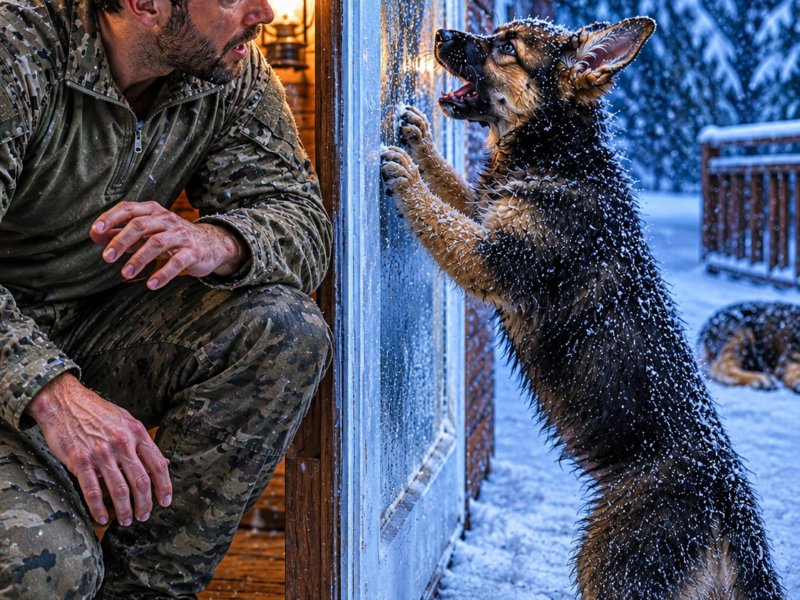
“I was halfway through locking my front door on a freezing December night when I heard a puppy crying beneath my porch
The first thing I did was look through the clinic window at the dark pickup.
The second was put myself between that truck and the puppy.
Dr. Emily Brooks stood beside the examination table, one hand resting protectively near the little German Shepherd.
“Daniel,” she whispered, “you need to tell me what’s happening.”
I wanted to.
But the truth was that I had spent six years believing I knew exactly what had happened to Ryan Mitchell.
And now a man I had buried was calling my phone.
“I need you to lock the back door,” I said. “And keep the puppy away from the windows.”
Emily glanced at the screen of her phone.
“Should I call the police?”
“Not yet.”
That answer sounded reckless, even to me.
But the photograph on the stranger’s phone had shown something I couldn’t explain.
It was taken six years earlier, outside a training facility in Virginia.
Ryan stood on my left.
Mason, his Belgian Malinois, sat proudly between us.
I remembered that afternoon because Ryan had given me a challenge coin and told me he was finally going to tell me something important.
He never got the chance.
Three days later, I received the news that he had died in a vehicle accident.
Now someone had that photograph.
And someone knew where I lived.
My phone vibrated again.
UNKNOWN NUMBER: You have no idea what Ryan did.
I typed back.
DANIEL: Then tell me.
The reply came almost immediately.
UNKNOWN NUMBER: Ask him why he left you at the warehouse.
My stomach tightened.
The warehouse.
There it was.
The place I had tried not to think about for six years.
I looked at Emily.
“Have you ever heard of a man named Ryan Mitchell?”
She shook her head.
“Not personally.”
“He was a handler. One of the best I ever worked with.”
“And the puppy?”
I glanced down.
The little dog was curled beneath a blanket, his injured paw wrapped carefully.
“He isn’t Mason,” I said. “Not the Mason I knew.”
Emily frowned.
“Then why does his collar say Mason?”
“I don’t know yet.”
I bent down and examined the old collar again.
The metal plate had been scratched and worn, but the name remained clear.
UNIT 47.
MASON.
On the reverse, the date and those five words:
HE DIDN’T BETRAY YOU.
I had spent six years carrying the belief that Ryan had betrayed his team.
That belief had nearly destroyed me.
And someone had just put a puppy in my yard to make sure I remembered it.
A soft sound came from the examination table.
The puppy lifted his head.
His eyes found mine.
I reached out, and he pressed his nose against my fingers.
“Easy, buddy,” I whispered.
Then my phone rang.
The number from the waterproof note.
I answered.
“Daniel?”
Ryan’s voice was quieter this time.
Older.
Tired.
But unmistakably his.
“Where are you?” I demanded.
“Somewhere I can talk without being followed.”
“You have thirty seconds to explain why I buried you.”
A pause.
Then he said, “I didn’t die.”
“I figured that out.”
“I couldn’t come back.”
“You could have called.”
“I did.”
I went still.
“What?”
“Three times. The first was two days after the warehouse. The second was a month later. The third was the night they told you I was dead.”
My grip tightened around the phone.
“Who is they?”
“People who had access to the investigation. People who knew what happened inside that warehouse.”
I looked at the clinic door.
The pickup was still outside.
“Ryan, I need a name.”
“Captain Voss.”
The name landed like a blow.
Captain Voss had supervised the operation six years earlier.
He had been the man who stood beside me after the accident report arrived.
He had told me Ryan’s death was confirmed.
He had looked me in the eyes and said there was nothing more to investigate.
“That doesn’t make sense,” I said.
“Voss wasn’t working alone.”
“Then who?”
“Before I tell you, I need to know whether you still have the original mission report.”
I stared at the floor.
I did.
It was in a locked cabinet in my garage, along with Ryan’s old photograph and the folded American flag from the memorial service.
“I have it.”
“Don’t open it.”
“Why?”
“Because the copy you were given was altered.”
I felt cold all over.
“Ryan, what happened at that warehouse?”
His breathing changed.
For a moment, I heard only static.
Then he spoke.
“We were sent to recover a missing military working dog and secure a shipment of stolen equipment. The briefing said the warehouse was empty except for two suspects.”
“I remember.”
“It wasn’t empty.”
I closed my eyes.
The operation had gone wrong before we even reached the building.
A security alarm triggered.
Someone fired from an upper window.
Our communications failed.
And then I heard Ryan’s voice over the radio.
“Daniel, get Mason out. Now.”
I had thought Ryan was ordering me to retreat.
Instead, I had run toward the east entrance.
I remembered the smoke.
The shouting.
The sound of something heavy crashing to the floor.
I remembered seeing Ryan’s dog, Mason, limping near a loading bay.
I remembered Ryan pushing a metal door open and yelling for me to get out.
And I remembered the final radio transmission.
“Tell Daniel I didn’t betray him.”
At the time, I thought the transmission had been a desperate message from a dying man.
Now Ryan was telling me it had meant something else.
“You were supposed to meet me at the east entrance,” I said.
“I know.”
“You never showed.”
“I was taken.”
The room seemed to tilt.
“Taken by whom?”
“By the men who were supposed to be guarding the equipment.”
I pressed my free hand against the counter.
“Why didn’t they kill you?”
“Because I had seen the shipment manifest. I knew the dogs were being sold through a private contractor. I knew where the money was going.”
“And Voss?”
“He was protecting the operation.”
I looked at Emily.
She had stopped pretending not to listen.
“Why did they tell me you were dead?”
“Because I was easier to control if everyone believed I was gone.”
“That’s not an answer.”
“They needed you to stop looking.”
I thought about the weeks after Ryan disappeared.
The calls I made.
The questions I asked.
The report I requested.
Every door had closed.
Every person had told me the same thing.
Ryan was dead.
The case was closed.
Move on.
And I had.
Not because I wanted to.
Because I had been shown a photograph of a wrecked vehicle and a death certificate with his name on it.
“Where have you been?” I asked.
“Moving. Hiding. Trying to find proof.”
“Six years?”
“I had to stay alive first.”
I wanted to scream at him.
I wanted to tell him what those six years had cost me.
Instead, I asked the question that had been eating at me since I found the puppy.
“Why send a dog to my porch?”
“Because I couldn’t reach you directly.”
“Why this puppy?”
“Because he’s carrying the evidence.”
I looked down at the small German Shepherd.
His ears twitched at the sound of Ryan’s voice.
“What’s his real name?”
“Scout.”
“Then why does his collar say Mason?”
Ryan exhaled.
“Because Mason saved him.”
I waited.
“After I escaped, I found Mason alive. He had been taken to a private training compound and used to move animals through their system. He was injured, but he recognized me.”
My eyes stung.
“Mason was alive?”
“For a while.”
The words came slowly.
“He died last winter. His body finally gave out. But before he did, he helped me find the last piece of evidence.”
I looked at the collar again.
“Scout was named after him?”
“No. The plate belonged to Mason. I put it on Scout because I wanted the people following us to think Mason’s old file had resurfaced.”
“Why?”
“Because they know what Mason did. They know what he saw.”
I remembered that dog.
Mason had never been just a working animal.
He was stubborn, clever, and loyal in a way that made every person around him want to be better.
He had once dragged Ryan out of a burning training shed.
He had also found a hidden door in a building that three human teams had searched.
If Mason had discovered something at that compound, it would not surprise me.
“What is Scout carrying?”
“An encrypted storage card. It’s hidden inside the collar plate.”
I stared at the metal tag.
The plate looked too small to hold anything.
“Emily,” I said, “do you have a small tool kit?”
She nodded slowly.
“Daniel, I think we should wait for the police.”
“Not until I know who I can trust.”
Ryan’s voice sharpened.
“Don’t open it there.”
“Why?”
“Because the pickup isn’t there to scare you.”
I looked through the window.
The driver’s door opened.
A man stepped out.
He wore a dark coat and held a phone to his ear.
Then he looked directly at me.
Ryan continued.
“They’re there to take Scout.”
The clinic lights flickered.
Emily moved toward the back hallway.
I picked up the puppy and carried him into the examination room.
“Ryan, tell me where you are.”
“I’m close.”
“That’s not good enough.”
“I’ll be at the old training field in twenty minutes.”
“You expect me to walk into a trap?”
“No. I expect you to bring Scout.”
The man outside began walking toward the clinic entrance.
I ended the call.
Emily locked the examination room door.
“Daniel, I am calling the police.”
“Call the state investigators. Not the local department.”
She looked at me.
“Why?”
“Because I don’t know how deep this goes.”
I gave her the name of an investigator I had worked with years earlier.
Her fingers trembled as she dialed.
Then I heard the front door open.
A man’s voice carried through the waiting room.
“I’m looking for a dog that was brought in tonight.”
Emily’s voice answered.
“We’re closed.”
“I know the dog is here.”
I held Scout close.
The puppy began to shake.
I put one hand beneath his chin.
“Listen to me,” I whispered. “Nobody is taking you.”
The man tried the examination room handle.
Once.
Twice.
Then he stopped.
A phone vibrated outside the door.
Mine.
UNKNOWN NUMBER: Last chance, Daniel. Walk away.
I looked at the puppy.
Then at the collar.
I had spent six years believing Ryan had abandoned us.
Now I understood that someone had been working very hard to make sure I never learned the truth.
I was done helping them.
I slid the collar plate into my pocket and waited.
A moment later, the clinic’s back door slammed.
Emily looked toward the hallway.
“They’re leaving.”
I didn’t believe it.
Neither did she.
We waited until the investigator answered her call.
Then we left through the rear entrance, with Scout wrapped inside my coat.
The old training field was twenty minutes away.
It had been abandoned for years, but I knew every gate and every access road.
I parked behind the equipment shed.
The place smelled of wet grass and rust.
A single light burned near the far fence.
And beneath it stood a man.
He was thinner than I remembered.
His hair had turned gray at the temples.
He leaned heavily on a walking stick.
But when he lifted his face, I saw the same eyes.
“Ryan.”
He took one step toward me.
“Daniel.”
For several seconds, neither of us moved.
Then I crossed the distance between us and grabbed his coat.
I wanted to hit him.
I wanted to hug him.
I wanted to demand six years back.
Instead, I held on.
“You let me bury you,” I said.
His eyes filled.
“I know.”
“You let me stand at your memorial.”
“I know.”
“You let me believe you were dead.”
“I had no choice.”
I stepped back.
“Don’t say that unless you can prove it.”
Ryan nodded.
“That’s why I brought you here.”
He looked at Scout.
The puppy had lifted his head from my coat.
Ryan’s expression broke.
“Hey, little man.”
Scout sniffed the air.
Then he began to wag his tail.
Ryan crouched slowly and offered his hand.
The puppy crawled toward him.
Ryan pressed his forehead against the dog’s.
“Mason would have liked you,” he whispered.
I looked away.
For the first time that night, I understood why Ryan had put Mason’s old collar on the puppy.
It wasn’t only a disguise.
It was a promise.
A promise that the dog who had saved them would not be forgotten.
Ryan stood and pointed toward the equipment shed.
“There’s something you need to see.”
Inside, a small metal box sat beneath a workbench.
Ryan opened it with a key.
There were photographs, handwritten notes, and a folded document.
He placed the document in my hands.
It was the original mission report.
Not the copy I had received.
The pages were marked with corrections.
Names had been removed.
A route had been changed.
And one signature appeared at the bottom of the authorization page.
Captain Voss.
“Look at the time stamp,” Ryan said.
I did.
The report had been altered three hours after the operation.
It showed that Ryan had abandoned his post and stolen classified material.
The accusation had been used to justify his disappearance.
But there was another signature.
Mine.
I stared at it.
“What is this?”
Ryan didn’t answer immediately.
“You signed the equipment transfer form.”
“I signed dozens of forms that week.”
“This one authorized the movement of the dogs.”
My mouth went dry.
“I never authorized that.”
“I know.”
The signature looked like mine.
The handwriting was close.
But the date was wrong.
Someone had copied my signature from another document.
“They made it look like you helped them,” Ryan said.
“Why?”
“Because if anyone investigated the shipment, they needed someone else to blame.”
I felt sick.
“And you knew?”
“I found the document after the warehouse. I knew they were setting you up.”
“Then why didn’t you tell me?”
“Because the people who took me had a recording.”
He reached into his coat and pulled out a small digital recorder.
“They told me they would release it if I contacted you.”
“What recording?”
“The one from the warehouse.”
He pressed play.
Static filled the shed.
Then my own voice came through.
“Ryan, get Mason out. I’ll cover the east entrance.”
A second voice followed.
Ryan’s.
“Daniel, listen to me. The shipment is compromised. Don’t let them move the dogs.”
Then another voice.
Captain Voss.
“Mitchell, stand down. That’s an order.”
Ryan answered.
“Not until those animals are safe.”
A loud crash.
Gunfire.
Then my voice again.
“Ryan! Where are you?”
The recording ended.
I stared at the device.
The official report had claimed Ryan ordered the evacuation and abandoned the animals.
The recording proved the opposite.
He had tried to stop the shipment.
And I had been the one sent away.
I looked at him.
“You were trying to protect me.”
“I was trying to protect everyone.”
“Why did the message say I was the reason you disappeared?”
“Because they knew you’d blame yourself.”
He lowered his eyes.
“I heard you asking where I was. I heard you calling for me. I knew you would come looking.”
I swallowed hard.
“And you thought staying away would keep me safe.”
“Yes.”
I wanted to be angry.
Part of me was.
But the anger had nowhere to go now.
It had been built on a lie.
“What happened to the dogs?”
Ryan opened the metal box again.
He showed me photographs of several working dogs.
Some were military-trained.
Others were young animals being prepared for private buyers.
The shipment had been routed through a contractor that claimed to provide security training.
Instead, it had been selling animals to buyers who wanted trained attack dogs without any oversight.
Mason had been one of the dogs recovered from that system.
Scout was the last surviving puppy from a litter born at the compound.
Ryan had found him after Mason led him to a hidden room.
The puppy had been too young to survive without help.
Ryan had taken him.
And someone had followed.
“Why bring him to my house?” I asked.
“Because Mason trusted you.”
Ryan’s voice cracked.
“He used to recognize your truck before you reached the driveway. He would pull me toward your porch every Sunday.”
I remembered those visits.
Mason would sit beside me while Ryan drank coffee.
Sometimes Ryan would stay for hours.
Sometimes he would ask me about retirement.
Once, he had told me he hoped to have a family someday.
I had told him he already had one.
I hadn’t realized how much he needed to hear it.
“I found the note on the collar,” I said.
Ryan nodded.
“I wrote it.”
“Why?”
“Because I knew you would see the name Mason and remember the warehouse. I needed you to know I hadn’t betrayed you.”
I looked down at the tag.
“Who left Scout under my porch?”
“I did.”
I stared at him.
“You chained a puppy beneath my porch?”
“Only long enough to keep him from running into the road. I had to leave before the pickup found me.”
“You could have knocked.”
“I couldn’t risk leading them to your front door.”
“You already did.”
“I know.”
For the first time, Ryan looked ashamed.
“I thought they would follow the old collar, not you.”
I shook my head.
“You’ve got a lot to answer for.”
“I know.”
Before I could say anything else, headlights appeared beyond the fence.
Ryan stiffened.
“They found us.”
I moved toward the shed door.
A vehicle stopped outside.
Two men stepped out.
One was the man from the clinic.
The other was older, broad-shouldered, and familiar.
Captain Voss.
Even after six years, I recognized the way he carried himself.
He looked at me and smiled.
“Daniel. I was hoping you would stay retired.”
I stepped in front of Ryan.
“You told me he was dead.”
Voss shrugged.
“It was the cleanest way to close the matter.”
“You falsified the report.”
“I protected an operation.”
“You sold working dogs.”
His smile disappeared.
“Watch your words.”
I held up the recorder.
“I heard the original transmission.”
Voss looked at it.
Then he looked at Scout.
“Give me the dog.”
“No.”
“You don’t understand what you’re holding.”
“I understand enough.”
Voss took a step closer.
“You signed the transfer form.”
“It wasn’t my signature.”
“Try proving that.”
Behind him, the second man shifted his weight.
I felt Scout trembling against my leg.
Ryan moved beside me.
“It’s over, Voss.”
Voss laughed.
“You’ve been hiding in holes for six years. You think anyone is going to believe you?”
Ryan raised his hand.
He was holding a small camera.
“Everything you’ve said tonight has been recorded.”
Voss’s face changed.
Then sirens sounded in the distance.
Emily’s call had reached the investigator.
The investigator had contacted a federal task force that had been investigating the contractor for months.
Voss looked toward the road.
He knew.
The two men behind him began to separate.
One ran toward the fence.
The other dropped his hands and stepped away.
Voss remained still.
For a moment, he looked directly at me.
“You have no idea what you’ve done.”
I thought about the six years I had spent mourning Ryan.
The empty Sundays.
The memorial service.
The years I had spent questioning every decision I made that night.
Then I looked at Scout.
“I know exactly what I’ve done.”
I had finally stopped believing a lie.
The officers arrived within minutes.
They secured the scene and took the recorder, the documents, and the collar plate.
Ryan gave his statement.
I gave mine.
And for the first time in six years, someone listened without telling me the case was closed.
The investigation took months.
The original mission records were examined.
The recordings were authenticated.
The contractor’s financial records were traced.
Several people were arrested.
Captain Voss was charged with evidence tampering, conspiracy, and crimes connected to the illegal sale of working dogs.
The case against Ryan was formally dismissed.
My name was cleared.
The forged signature was traced to a document Voss had accessed during the operation.
But the most important discovery came from the storage card hidden inside Mason’s collar plate.
It contained a list of every dog moved through the contractor’s network.
There were dates.
Locations.
Payments.
And names.
Some dogs had been recovered.
Others had been transferred to private owners.
A few had never been found.
The evidence gave investigators the chance to locate several animals that had disappeared years earlier.
Scout’s litter was listed at the bottom.
Beside his name was a note:
SURVIVOR — DO NOT RELEASE.
I couldn’t stop thinking about that line.
Someone had decided a little puppy was worth more as evidence than as a living creature.
They had treated him like a piece of property.
But Scout wasn’t property.
He was a dog.
A frightened, stubborn, beautiful little dog who had survived more than he ever should have.
Ryan spent several weeks in the hospital after the investigation began.
His injuries were worse than he had admitted.
The years of hiding had taken their toll.
I visited him every afternoon.
At first, our conversations were awkward.
There were too many things to say.
Too many apologies.
Too many questions.
One day, I finally asked him the question I had been avoiding.
“Did you ever think about coming home?”
Ryan looked out the hospital window.
“Every day.”
“Then why didn’t you?”
“Because I thought you would hate me.”
I stared at him.
“After everything?”
“I knew what they had told you. I knew they had made it look like I betrayed the team.”
“You should have trusted me.”
“I should have.”
He turned toward me.
“I was afraid.”
It was the first honest answer he had given me.
Not a mission explanation.
Not an excuse.
Just the truth.
I nodded slowly.
“So was I.”
We sat quietly.
Then he said, “I’m sorry, Daniel.”
I looked at the man I had once considered family.
“I know.”
It wasn’t forgiveness all at once.
It was the beginning of it.
When Ryan was discharged, he came home with me.
He had nowhere else to go.
I told him the spare room was his until he figured things out.
He tried to argue.
I told him he could argue after he learned how to make decent coffee.
For the first time in six years, he laughed.
Scout was waiting at the door.
His injured paw had healed, though he still limped slightly when he got tired.
He recognized Ryan immediately.
The puppy ran toward him, slipped on the hardwood floor, and bumped into his legs.
Ryan dropped to his knees.
“Hey, Scout.”
The little dog climbed into his lap.
I watched them for a long moment.
Then I noticed something.
Scout had begun carrying Mason’s old collar around the house.
He dragged it from room to room, sometimes dropping it beside Ryan’s chair.
It was almost as if he understood it belonged to someone important.
We kept the collar.
Not because it was evidence anymore.
Because it was a reminder.
A reminder of the dog who had helped Ryan survive.
A reminder of the truth that had been buried.
And a reminder that loyalty sometimes lasts longer than the people who try to destroy it.
A few months later, Ryan and I returned to the old training field.
The grass had grown tall.
The equipment shed had been cleared.
The gates were repaired.
We brought Scout with us.
He was no longer the tiny, trembling puppy I had found beneath my porch.
He was stronger now.
His ears stood upright.
His eyes were bright.
He ran ahead, then turned back to make sure we were following.
Ryan watched him.
“Mason used to do that.”
“I remember.”
“He always checked on everybody.”
I smiled.
“He was better at his job than most people I knew.”
Ryan laughed softly.
We stood near the fence where Mason had once waited during training.
Then Ryan took something from his pocket.
A small metal tag.
It had been made from the same type of steel as Mason’s old identification plate.
UNIT 47.
MASON.
Underneath were three words:
NEVER FORGOTTEN.
Ryan handed it to me.
“I thought you should have this.”
I closed my fingers around it.
“Thank you.”
We buried it beneath the old oak tree at the edge of the field.
Not as a grave.
As a marker.
For a dog who had done more than anyone could have asked of him.
Scout sat beside us while we finished.
Then he placed one muddy paw on the fresh earth.
Ryan looked at me.
“Think Mason would approve?”
I looked at the puppy.
Then at the man who had finally come home.
“I think he’d be proud.”
We stayed until the sun began to set.
On the drive back, Ryan asked if I still planned to live alone.
I glanced at him.
“Are you asking to move in permanently?”
He shrugged.
“I was thinking Scout might need a yard.”
I laughed.
“Scout has a yard.”
“And a porch?”
“He has a porch.”
“And someone who knows how to train him?”
I looked at the puppy sleeping in the back seat.
Then I looked at Ryan.
“You’re not getting out of yard work just because you used to be a good handler.”
Ryan smiled.
“I wouldn’t dream of it.”
That winter, the porch became Scout’s favorite place.
He liked lying beneath the same wooden railing where I had first heard him cry.
Sometimes he watched the road.
Sometimes he slept in the afternoon sun.
And sometimes, when a car turned into the driveway, he would lift his head and wait.
Ryan said it was the way Mason used to wait for him.
I said it was probably because Scout had learned that people came home.
One Sunday morning, I found Ryan sitting on the porch with two cups of coffee.
Scout was asleep beside his boots.
I sat down.
For a while, neither of us spoke.
Then Ryan said, “Do you ever think about what would have happened if you hadn’t heard him?”
I looked at the puppy.
I thought about the chain.
The cold.
The little identification tag.
The note hidden beneath it.
And the six years that had nearly convinced me the best man I knew had betrayed me.
“I think someone wanted me to find him,” I said.
Ryan nodded.
“I think Mason did.”
I smiled.
“Maybe.”
Scout stirred and placed his head on my foot.
I reached down and scratched behind his ears.
For years, I had believed retirement meant leaving the work behind.
The missions.
The dogs.
The people I had lost.
But that night beneath my porch had taught me something different.
Sometimes the work finds you.
Sometimes it arrives in the shape of a frightened puppy.
Sometimes it carries a name you thought you would never hear again.
And sometimes, when you finally stop running from the past, you discover that the thing you thought was lost was waiting for you to come home.
I had spent six years mourning Ryan.
He had spent six years trying to survive.
Mason had spent his final days helping him protect one more life.
And Scout, the little dog who had cried beneath my porch, had brought us all back together.
I still keep the old collar in a wooden box beside my front door.
Not hidden away.
Not locked in a cabinet.
Where I can see it every morning.
The words on the back are still there.
HE DIDN’T BETRAY YOU.
I used to think those words were meant to clear Ryan’s name.
Now I know they were meant to remind me of something bigger.
Loyalty isn’t always loud.
Sometimes it waits in the cold.
Sometimes it survives behind a locked door.
And sometimes it comes home on four little paws, asking only for someone to open the door.
THE end.









