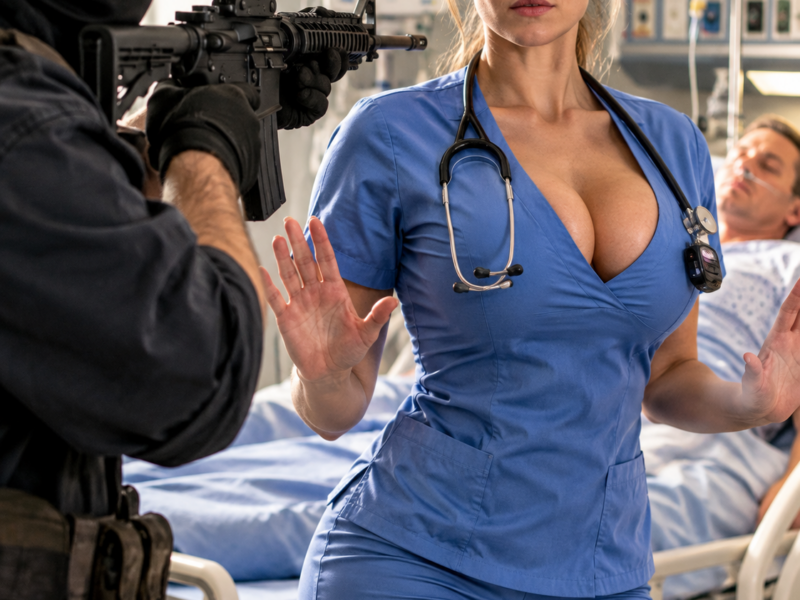
“I was checking a patient’s IV in a quiet hospital hallway when three armed men stormed through the emergency department
The man with the gun took another step toward me.
“Move away from the desk,” he ordered.
I kept my hands visible.
“You’re frightening the patients. Whatever you’re looking for, we can talk about it.”
He gave a short, humorless laugh.
“You’re a nurse. You don’t get to negotiate.”
Behind him, the second man was checking the doors to the treatment rooms. The third had moved toward the elevators.
They weren’t acting like ordinary criminals.
They knew where they were going, what they wanted, and how quickly they needed to find it.
That bothered me more than the weapons.
I had seen men like this before.
I had also learned that the most dangerous person in a room wasn’t always the one holding a gun.
“Where’s Mercer?” the first man demanded.
I glanced toward the corridor.
“Being treated.”
“Which room?”
“He’s a trauma patient. You need to speak to the attending physician.”
The man leaned closer.
“Do I look like I came here to speak to a physician?”
I heard Melissa moving behind me.
“Claire,” she whispered.
I didn’t turn.
“Take Mrs. Patterson and the other patients into the staff break room. Lock the door.”
“There’s a little boy in the waiting room.”
“Take him with you.”
The gunman followed my eyes.
“Nobody goes anywhere.”
He raised his weapon toward Melissa.
That was when the last of my hesitation disappeared.
I moved.
I won’t describe the mechanics of what happened next. It was fast, loud, and frighteningly brief.
The weapon struck the floor, skidding beneath the reception counter. The man hit the ground hard enough to knock the air from his lungs.
For a moment, nobody spoke.
Then the second man turned toward me.
His expression changed when he saw the first man on the floor.
“Who the hell are you?”
I didn’t answer.
He reached inside his jacket.
Before he could do anything, a crash sounded from the corridor behind us.
The third man had reached room seven.
“Mercer!” he shouted.
Melissa screamed.
I looked toward the hallway, and the man in front of me used that moment to run.
He disappeared through the emergency exit.
I didn’t chase him.
There were patients on the floor, a frightened child crying near the vending machines, and a colleague whose hands were shaking so badly she couldn’t hold her phone.
My priorities hadn’t changed.
“Call 911,” I told Melissa. “Tell them we have armed intruders and multiple people injured.”
She stared at me.
“Claire, what just happened?”
“Later.”
I ran toward room seven.
The door was open.
Daniel was sitting halfway upright, his injured shoulder bleeding through the fresh dressing. A man in dark clothing stood beside his bed, holding a small black object.
The missing piece of fabric.
“Put it down,” I said.
He turned.
For a second, his eyes moved over my face as though he were searching through an old memory.
Then he smiled.
“Well, I’ll be damned.”
I didn’t move.
He tilted his head.
“Claire Bennett. I heard you were dead.”
My mouth went dry.
I knew him.
Not from Nashville.
Not from the hospital.
From a deployment overseas, years earlier.
His name was Evan Rourke.
And the last time I’d seen him, he had been wearing the uniform of an American military contractor.
He had also been standing beside a man who never made it home.
“Rourke,” I said quietly.
His smile disappeared.
“Still using that name?”
I glanced at Daniel.
“Step away from the patient.”
Rourke looked at the black fabric in his hand.
“You’re not in uniform anymore, Claire. You should remember that.”
“I remember plenty.”
He laughed under his breath.
“Then you remember what happened outside Kandahar.”
The words struck harder than I expected.
For three years, I had tried not to think about that operation.
For three years, I had convinced myself that leaving the military meant leaving its ghosts behind.
But Rourke was standing in front of me.
And he knew exactly which ghost to summon.
“Don’t listen to him,” Daniel whispered.
Rourke turned toward the bed.
“Shut up.”
Daniel looked at me.
“She doesn’t know, does she?”
Rourke’s jaw tightened.
I noticed it.
A tiny movement, but enough.
“What doesn’t she know?” I asked.
Rourke folded the black fabric into his pocket.
“You’re wasting time.”
He stepped toward the door.
I moved to keep myself between him and Daniel.
“You’re not leaving with anything from this room.”
He studied me for a moment.
Then he said something that made my hands go cold.
“Ask your old commander why the extraction coordinates changed that night.”
Before I could respond, the hallway filled with the sound of approaching sirens.
Rourke looked toward the window, then back at me.
“This isn’t over.”
He slipped through the doorway just as two hospital security officers appeared at the far end of the corridor.
One of them shouted for him to stop.
Rourke kept walking.
The next few minutes were chaos.
Police officers entered the emergency department. Paramedics treated the injured security guard. Hospital staff moved patients away from the affected area.
The first gunman was taken into custody.
The second had escaped.
Rourke was nowhere to be found.
And Daniel Mercer was asking for me.
I returned to his bedside after the police finished taking my initial statement.
He looked exhausted.
“Can we talk?” he asked.
“Not until the doctor clears you.”
“Claire, please.”
I pulled a chair closer.
“Who are you?”
He swallowed.
“My name is Daniel Mercer. I used to work for a private intelligence contractor.”
“Which one?”
He hesitated.
“Northstar Strategic.”
I recognized the name.
Northstar had provided logistical support during several overseas operations. They weren’t soldiers, but their people had access to military facilities, transport schedules, and sensitive information.
“How do you know Rourke?”
“He recruited me.”
“Why did he send armed men after you?”
Daniel looked down at his bandaged shoulder.
“Because I took something.”
“The black fabric?”
He nodded.
“It isn’t fabric. It’s a protective sleeve for a data storage device. The actual device is hidden somewhere else.”
I leaned back.
“What does it contain?”
“Records from a classified operation. Payment logs, communications, and the original mission orders.”
My stomach tightened.
“Which operation?”
He looked directly at me.
“Kandahar. October 2019.”
For several seconds, the room seemed to lose its sound.
I remembered the dust.
The radio chatter.
The sudden change in our extraction route.
And Sergeant Michael Hayes.
Michael had been twenty-nine years old. He had a wife named Rachel and a little girl who had just learned to walk.
He was the man who had died during that operation.
The official report said our team had received incorrect intelligence and entered an area that had become compromised.
It said the enemy had been waiting.
It said the extraction delay was unavoidable.
But Rourke had just asked me to question the coordinates.
“Why do you have those records?” I asked.
Daniel rubbed his forehead.
“Because I was assigned to review Northstar’s archived communications. I found a discrepancy between the mission orders and the final report.”
“What kind of discrepancy?”
“The original extraction coordinates were changed eleven minutes before your team entered the area.”
I stared at him.
“Who authorized the change?”
Daniel didn’t answer immediately.
Then he said, “The authorization came from a military account.”
I stood.
“Whose account?”
He looked toward the closed door.
“I can’t tell you without showing you the original file.”
“Then show me.”
“I can’t. The device is missing.”
“Where?”
He hesitated.
“Room fourteen.”
I remembered his warning.
The woman they were supposed to leave alone.
“Who is in room fourteen?”
Daniel’s expression softened.
“My sister.”
I stared at him.
“Your sister is a patient here?”
“Her name is Emily Mercer. She was admitted yesterday under a different surname.”
“Why?”
“Because she was helping me investigate Northstar. They found out.”
He lowered his voice.
“She has the original drive. The black sleeve I had was only a decoy.”
Before I could ask another question, someone knocked.
Dr. Harris entered with a police officer.
“Claire, I need you to come with us.”
I looked at Daniel.
“What’s happened?”
The officer glanced at the chart.
“We need to discuss your involvement in tonight’s incident.”
“I’ve already given a statement.”
“This is about something else.”
He held up a small evidence bag.
Inside was a folded photograph.
My breath caught.
It showed me standing outside a military building in Virginia, years earlier.
Beside me was my former commanding officer, Colonel James Whitaker.
On the back, someone had written a single sentence.
Ask Whitaker why he signed the order.
I looked at the officer.
“Where did you get this?”
“It was left at the security desk.”
“By whom?”
“We’re trying to establish that.”
Dr. Harris watched me carefully.
“Claire, are you going to tell me what’s happening?”
I wanted to.
But I didn’t know where to begin.
And for the first time since leaving the military, I realized that my past wasn’t simply catching up with me.
Someone had been keeping track of me all along.
The police interviewed me for another hour.
They asked about Rourke, Daniel, and my military service.
I answered what I could without discussing classified information.
When they finally let me return to the nurses’ station, Melissa was waiting with two coffees.
She handed me one.
“You’re going to tell me everything now.”
I looked at her.
“I can’t tell you everything.”
“Then tell me what you can.”
We sat in the small staff lounge.
The coffee had gone lukewarm before I spoke.
“I served in the Army.”
“I know that.”
“I was part of a special operations unit.”
She nodded slowly.
“Okay.”
“I wasn’t a regular nurse before I came here.”
Melissa looked at me for a long moment.
“Is that why you never talk about your past?”
“Partly.”
She wrapped both hands around her cup.
“Claire, I don’t care what you did before you came here. I care that you almost got shot tonight.”
I looked down.
“I know.”
“And I care that you keep acting like you have to handle everything alone.”
That was harder to answer.
For years, I had treated silence as a form of protection.
I hadn’t considered that it could also become a wall.
Melissa reached across the table and touched my hand.
“Whatever this is, you don’t have to pretend you’re fine.”
I nodded.
But my mind was already back in room fourteen.
Emily Mercer.
The original drive.
The changed coordinates.
And Colonel Whitaker.
I hadn’t spoken to him since my discharge.
He had written a letter of recommendation for my nursing program and told me I deserved a quieter life.
I had believed him.
Now I wasn’t sure whether that kindness had been genuine or simply convenient.
At 2:40 a.m., I called the number I still had saved under his name.
He answered on the fourth ring.
“Claire?”
His voice sounded older.
“Colonel.”
A pause.
“Is everything all right?”
“No.”
I told him about Rourke.
I told him about Daniel.
I didn’t mention the photograph until the end.
When I described the writing on the back, he went silent.
“Where did you get that?” he asked.
“Someone left it at the hospital.”
“Listen to me carefully. Do not speak to anyone else about this.”
“Why?”
“Because you don’t know what you’re dealing with.”
“I know exactly what I’m dealing with. I was there.”
He exhaled.
“Claire, that operation was investigated.”
“Then why did Rourke tell me the coordinates were changed eleven minutes before insertion?”
Silence.
Then he said, “You need to come see me.”
“Why?”
“Because there are things you were never told.”
I gripped the phone.
“Did you authorize the change?”
He didn’t answer.
Instead, he said, “I can explain. But not over the phone.”
“Colonel, did you sign the order?”
His voice dropped.
“Come alone, Claire.”
The call ended.
I stared at the screen.
Melissa stood in the doorway.
“That didn’t sound good.”
“No.”
“Are you going?”
I thought about Daniel’s sister.
About Michael Hayes.
About the little girl who had lost her father.
“Yes.”
“Then you’re not going alone.”
I almost argued.
But Melissa had already picked up her coat.
At 7:30 that morning, the police confirmed that Emily Mercer was still in the hospital.
She had been admitted under the name Emily Carter after a minor car accident two days earlier.
Her room was on the fourth floor.
I went there with a hospital administrator and a uniformed officer.
Emily was in her early thirties, with dark hair tied loosely behind her head.
She looked tired but alert.
When I introduced myself, she immediately asked, “Is Daniel alive?”
“He’s stable.”
She closed her eyes.
“Thank God.”
I sat beside her.
“Daniel told me you have something he needs.”
Her expression changed.
“Did he tell you about the drive?”
“Yes.”
Emily looked toward the officer.
“Can we speak privately?”
The officer shook his head.
“Not until we’ve established what the device contains.”
Emily frowned.
“Then establish it. But don’t let anyone from Northstar near it.”
She reached beneath her blanket and pulled out a small hospital property envelope.
Inside was a silver storage drive.
“I hid it in the lining of my bag,” she said. “When I realized someone had searched my apartment, I checked into the hospital under another name.”
“Why didn’t you go to the police?”
“I tried.”
She looked down at her hands.
“The first officer I spoke to knew details I hadn’t given him. He told me to stop making trouble.”
The uniformed officer beside us stiffened.
“Do you remember his name?”
Emily shook her head.
“No. But he knew where I lived.”
I looked at the silver drive.
“What’s on it?”
“Enough to show that Michael Hayes didn’t die because your team made a mistake.”
My throat tightened.
“What are you saying?”
Emily took a shaky breath.
“The original mission order was deliberately altered. The route your team was given wasn’t the approved route.”
The officer asked for the device.
Emily held it tighter.
“Not until you guarantee it goes to an independent federal investigator.”
He nodded.
“I can request that.”
She looked at me.
“There’s something else.”
“What?”
“Your name is in the files.”
I stared at her.
“Why?”
“Because someone submitted a report claiming your team had received the corrected coordinates before the operation.”
I felt the blood drain from my face.
“That’s impossible.”
“I know.”
Emily’s voice softened.
“Your radio acknowledgment is listed as proof.”
I remembered that night.
A transmission had come through shortly before we moved.
The signal had been distorted.
I had asked for confirmation.
Someone had responded that the order was verified.
But I had never received the full coordinates.
I had assumed the confirmation came from our operations center.
“What does the recording say?” I asked.
Emily looked at the officer.
He placed the drive inside an evidence pouch.
“We’ll arrange a forensic examination.”
I nodded.
Then I looked back at Emily.
“Did you find out who sent the transmission?”
She hesitated.
“Yes.”
I waited.
“It was routed through Colonel Whitaker’s command terminal.”
I didn’t go straight to see Whitaker.
I called the federal investigator whose contact information the police provided.
By noon, a special agent named Laura Chen had arrived at the hospital.
She was calm, direct, and clearly unimpressed by dramatic explanations.
She listened while I described the operation.
Then she examined the photograph and asked to see the evidence log.
“Colonel Whitaker has already been contacted,” she said.
“Did he agree to speak?”
“He’s agreed to meet us.”
“Where?”
“His home.”
I looked at her.
“That’s not a secure location.”
She gave a small nod.
“Which is why we’re not going alone.”
For the first time that day, I felt the pressure in my chest ease slightly.
I wasn’t the only person carrying the weight anymore.
Before we left, Agent Chen asked one more question.
“Claire, is there anything about that night you haven’t told us?”
I thought about the radio transmission.
About the distorted voice.
About the eleven minutes.
“There was a second voice on the channel,” I said.
Chen looked up.
“What did it say?”
“I couldn’t make it out. I thought it was interference.”
“Do you remember anything?”
I closed my eyes.
A burst of static.
A command.
Then three words.
“Abort the extraction.”
I opened my eyes.
“That message came after the coordinates changed.”
Chen wrote something down.
“Why didn’t you include it in your original statement?”
“Because I thought it was an error in the transmission.”
She closed her notebook.
“That may be important.”
Whitaker lived in a quiet neighborhood outside Nashville.
His house was modest, with a small porch and a flag hanging beside the front door.
When he opened it, he looked smaller than I remembered.
His hair had turned almost completely gray.
“Claire.”
“Colonel.”
His eyes moved to Agent Chen.
“I see you brought company.”
“We have questions,” she said.
He stepped aside.
“Come in.”
We sat in the living room.
A framed photograph of his former unit stood on the mantel.
Michael Hayes was in the front row, smiling with one arm around another soldier.
I looked away.
Whitaker followed my gaze.
“I think about him every day.”
“Then tell us why you signed the order.”
He lowered himself into a chair.
For a long time, he said nothing.
Finally, he reached for a folder on the side table.
“I didn’t create the altered coordinates.”
He placed a document in front of us.
“But I approved the transmission that went out.”
Agent Chen opened the folder.
“Why?”
Whitaker rubbed his forehead.
“I received an urgent instruction from a senior command office. I was told the original route had been compromised.”
“Who gave you that instruction?” Chen asked.
He hesitated.
“Rourke.”
I stared at him.
“Rourke was a contractor.”
“At the time, he was acting as a liaison. He claimed he had intelligence that the approved extraction point had been discovered.”
“And you believed him?”
“I had limited information and less than fifteen minutes to make a decision.”
“Did you verify it?”
Whitaker looked down.
“No.”
The answer sat between us.
“Why didn’t you tell the investigation?” I asked.
He swallowed.
“Because afterward, I was told the information had come from a protected intelligence source. I was ordered not to disclose the communications.”
“Who ordered you?”
“I was told the matter was handled at a higher level.”
Agent Chen leaned forward.
“By whom?”
Whitaker opened his mouth.
Then the front doorbell rang.
He frowned.
“I wasn’t expecting anyone.”
Agent Chen stood.
“Stay here.”
She moved toward the hallway with the other agent.
I remained beside Whitaker.
He looked at me with exhausted eyes.
“Claire, there’s something you need to understand.”
“What?”
“Rourke didn’t change the coordinates because he wanted your team dead.”
I stared at him.
“Then why?”
Whitaker’s hands trembled.
“He wanted someone else to reach the extraction point first.”
“Who?”
He looked toward the hallway.
Then, in a voice barely above a whisper, he said, “The person who was supposed to meet you there.”
A crash came from the front of the house.
Agent Chen shouted.
Whitaker grabbed my wrist.
“Don’t let them take the folder.”
I turned.
A man in a dark jacket stood in the doorway.
He wasn’t Rourke.
But I recognized his face from the photograph.
He was the man whose identity had been scratched out beside Daniel.
And he was looking directly at me.
“Claire Bennett,” he said calmly. “You’ve been asking questions that should have stayed buried.”
Agent Chen stepped into view, weapon drawn.
“Federal agent. Don’t move.”
The man raised both hands.
But his eyes never left mine.
Then he smiled.
“Ask Colonel Whitaker who was waiting at the extraction point that night.”
Whitaker made a small, broken sound behind me.
And suddenly I understood that the story I had been told about Michael Hayes’s death was only the beginning.
The man was taken into custody before he could leave the house.
He identified himself as Victor Shaw, a former intelligence analyst who had worked with Northstar.
He refused to answer most questions.
But when Agent Chen showed him the photograph, his expression changed.
“You people have no idea what you’re holding,” he said.
Chen placed the evidence bag on the table.
“We have a storage device, altered mission records, and testimony from two people who were involved in the operation.”
Shaw looked at me.
“You have testimony from people who want to survive.”
I stepped forward.
“And what do you have?”
He smiled faintly.
“The truth.”
Whitaker stood slowly.
“Victor, enough.”
Shaw turned toward him.
“You don’t get to say that now, James.”
The use of his first name seemed to cut deeper than any accusation.
Chen ordered Shaw to remain silent.
Then she turned to Whitaker.
“Who was waiting at the extraction point?”
Whitaker sat down.
His shoulders seemed to collapse.
“An informant.”
“Name?”
“Samuel Price.”
I had never heard that name.
Whitaker continued.
“Price had been providing intelligence to our unit for months. He was supposed to meet us at the original extraction location with information about a planned attack.”
“And the coordinates were changed so the team wouldn’t reach him?” Chen asked.
Whitaker nodded.
“Rourke told me Price had been compromised. He said the new route would keep the team alive.”
“Was that true?”
Whitaker looked at the floor.
“I don’t know.”
Shaw laughed.
“Of course you don’t.”
I turned toward him.
“Then tell us.”
He looked at me for a long moment.
“Price had discovered that Northstar was selling operational information to multiple buyers. He had records. Names, payments, communications. He wanted to hand everything over.”
My hands tightened.
“And Michael?”
“Michael had been the first person to believe him.”
The room went quiet.
Shaw continued.
“Your team wasn’t supposed to be killed. It was supposed to be delayed. Long enough for Price to disappear and the records to be recovered.”
“Then why did Michael die?”
Shaw looked away.
“Because the men waiting at the alternate route weren’t supposed to open fire.”
I stared at him.
“Who were they?”
“Contractors working for Northstar.”
Whitaker closed his eyes.
The pieces began falling into place.
The altered coordinates.
The missing informant.
The false report claiming we had received the corrected route.
The effort to silence Daniel and Emily.
And Michael, who had died because people who were supposed to support us had decided their business mattered more than his life.
I felt sick.
Agent Chen asked Shaw for names.
He refused.
But the silver drive would do what he wouldn’t.
The forensic examination took several days.
During that time, Daniel underwent surgery and began recovering.
Emily was moved to a protected location.
Melissa visited me after every shift, sometimes bringing coffee, sometimes bringing food, and sometimes simply sitting beside me without speaking.
I was grateful for all of it.
I hadn’t realized how much I needed someone to stay.
On the fifth day, Agent Chen called.
“We found the original transmission.”
I sat down in the hospital break room.
“What does it say?”
“Your team received an altered route authorization. The message was sent through Whitaker’s terminal, but the voice recording originated from a Northstar communications relay.”
“Can you prove who was speaking?”
“Not conclusively yet.”
She paused.
“But we found something else.”
“What?”
“Michael Hayes filed a written complaint two days before the operation. He reported that someone had been accessing mission data without authorization.”
I closed my eyes.
“Did he name anyone?”
“Yes.”
She read the name.
Victor Shaw.
I remembered the photograph.
The scratched-out face.
The man at Whitaker’s house.
“Why was his identity removed?”
“Someone altered the original image before it was given to the hospital.”
I looked down at my hands.
“Was Shaw the one who changed the coordinates?”
“He’s one of the people involved. We’re still establishing the full chain of authorization.”
I swallowed.
“Did Whitaker know?”
“His actions were negligent, and he concealed information afterward. But the evidence does not currently show that he intended to put your team in danger.”
That distinction mattered.
It didn’t erase what he had done.
But it mattered.
“What’s next?” I asked.
“We’re building the case. There will be hearings, interviews, and probably a long investigation.”
I thanked her and ended the call.
For the first time in years, I allowed myself to cry.
Not because I had finally discovered who was responsible.
But because Michael’s name was no longer buried beneath a report that blamed the people who had trusted one another.
Three weeks later, I visited Rachel Hayes.
She lived in a small house outside Fort Campbell with her daughter, Lily.
I had rehearsed what I would say during the drive.
None of it survived the moment she opened the door.
She looked at me for a long time.
“Claire?”
I nodded.
“Hi, Rachel.”
She stepped aside.
“Come in.”
Lily was seven now.
She was sitting at the kitchen table, drawing a picture of a house with a bright yellow sun.
When she saw me, she smiled politely.
“Are you one of Daddy’s friends?”
I felt something tighten in my throat.
“Yes, sweetheart.”
Rachel brought us coffee.
We sat at the table while Lily continued drawing.
I told Rachel what the investigation had uncovered.
I didn’t make excuses for Whitaker.
I didn’t soften the facts.
I told her that Michael had noticed something was wrong before the mission. I told her he had tried to report it.
And I told her that the official story had left out important truths.
Rachel listened without interrupting.
When I finished, she stared at her coffee.
“Did he know?”
“Know what?”
“That something was going to happen.”
I shook my head.
“I don’t know. But he was trying to protect the team.”
Her eyes filled.
“That sounds like him.”
She wiped her cheek.
“For years, I wondered if he had made a mistake. If he’d ignored something. If he’d been careless.”
“He wasn’t careless.”
I reached into my bag and took out a copy of the photograph.
Michael was smiling in the front row.
Rachel touched the edge of the paper.
“He hated pictures.”
A small laugh escaped her.
“He always said his hair looked ridiculous.”
I smiled, though my eyes were wet.
For a while, we talked about ordinary things.
Lily showed me her drawing.
She had added a small figure beside the house.
“That’s Daddy,” she explained.
Rachel put an arm around her.
“That’s a beautiful picture.”
Before I left, Rachel walked me to the door.
“Thank you for coming.”
“I should have come sooner.”
She shook her head.
“You came when you were ready.”
I looked at her.
“I wish I could have brought him home.”
Rachel held my hand.
“So do I.”
There was no forgiveness speech.
No perfect moment that made the years disappear.
There was only a woman who had lost her husband and a woman who had survived the same night.
And for the first time, I felt that telling the truth was something I could do for Michael, even if it couldn’t bring him back.
The investigation continued for months.
Northstar’s contracts were suspended while federal authorities examined its records.
Victor Shaw and several associates faced charges connected to the theft and distribution of classified information, obstruction, and the cover-up surrounding the operation.
Rourke was eventually located outside the country and taken into custody after investigators connected him to the hospital attack and the earlier communications network.
Colonel Whitaker cooperated with the investigation.
He admitted that he had approved the altered transmission without proper verification and had later withheld information that could have changed the findings.
His military career ended.
I never learned whether he would have made the same decision if he could go back.
I only knew that Michael had paid for it.
Daniel recovered enough to leave the hospital.
Before he went, he came to see me.
His shoulder was still healing, and he moved carefully.
“I owe you,” he said.
“You don’t owe me anything.”
“That’s not how I see it.”
He handed me a small envelope.
Inside was a photograph of Emily and him standing outside a diner, both laughing.
“She wanted you to have this.”
I smiled.
“Tell her I’m glad she’s safe.”
Daniel hesitated.
“There’s something else. I keep thinking about what happened in the emergency department.”
I raised an eyebrow.
“What about it?”
“You could have left.”
I looked at him.
“I had patients.”
“You could have protected yourself.”
I placed the photograph on the counter.
“I was a nurse. That was my job.”
He nodded slowly.
“I guess that’s why you left the other life.”
I didn’t answer.
Because I wasn’t sure I had left it as completely as I once believed.
Six months after the attack, I returned to the emergency department for my first night shift after a short leave.
The same vending machines stood against the wall.
The same fluorescent lights hummed overhead.
A new security guard sat near the entrance.
Melissa was at the nurses’ station, sorting patient charts.
She looked up when I walked in.
“Well, look who finally decided to come back.”
I smiled.
“Someone has to make sure you take your breaks.”
She laughed.
“Don’t start.”
For a moment, the hospital felt ordinary again.
Then an ambulance radio crackled outside.
The doors opened.
A young soldier was wheeled in, his face pale, his uniform stained with blood.
His mother followed behind him, crying and asking whether he was going to be all right.
I pulled on a fresh pair of gloves.
“Let’s get him into trauma two.”
Melissa moved beside me.
I checked his airway, listened to his breathing, and asked the paramedics for their report.
The young man opened his eyes.
“Am I going to be okay?”
I looked at him.
“You’re in the right place.”
His fingers tightened around mine.
I stayed until his breathing steadied and the physician took over.
Later, when the department finally quieted, I stepped outside for a breath of cool night air.
I thought about Michael.
About Rachel and Lily.
About the people who had tried to bury the truth.
And about the woman I had been before I learned that surviving something didn’t mean I had to spend the rest of my life hiding from it.
My phone buzzed.
A message from Rachel.
It was a photograph of Lily holding a new drawing.
This time, she had drawn three people standing beneath a bright blue sky.
Her mother.
Her father.
And me.
Rachel had written beneath it:
“She says Daddy wanted you to know we’re doing okay.”
I read the message twice.
Then I slipped the phone into my pocket and looked back through the hospital doors.
I had once believed that leaving the battlefield meant finding a place where nobody needed me to be brave.
But that night, standing beneath the hospital’s quiet lights, I finally understood something.
I hadn’t stopped being the woman who protected people.
I’d simply found a different place to do it.
The end.









