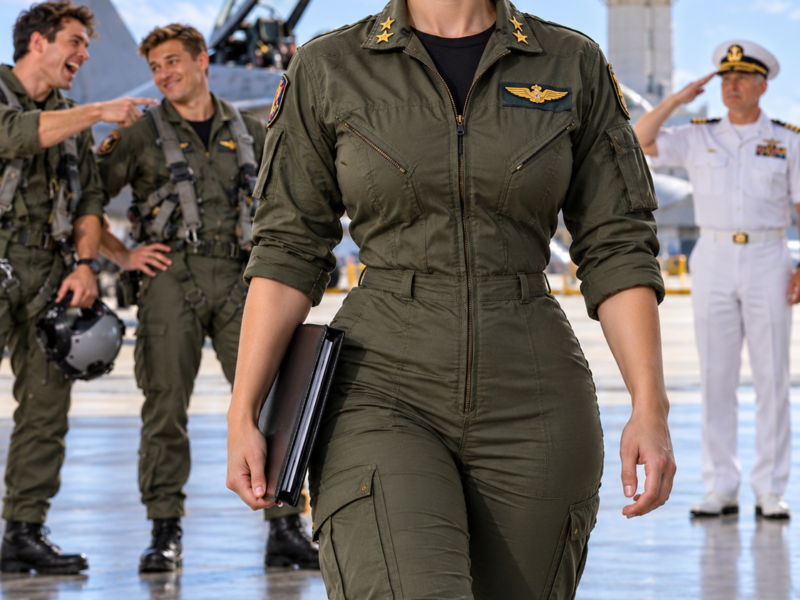
“I heard one of the F-18 pilots laugh and ask, ‘Who’s the new girl?’ as I walked across the hangar at Naval Air Station Oceana, carrying nothing but a black folder and a cup of coffee
I looked at Emily.
“Did you tell anyone Chief Reyes was coming here?”
She shook her head.
“No, Admiral. I haven’t spoken to him since yesterday.”
The knock came again.
Three deliberate taps.
I moved toward the door, but Emily caught my arm.
“Please be careful. Captain Lawson has people watching the administrative building.”
I studied her face.
“How long have you known?”
“About the maintenance records? Two weeks. About Lieutenant Cole?” She swallowed. “Since yesterday.”
I opened the door.
A broad-shouldered man in a faded Navy work uniform stood in the hallway.
His hair was almost entirely gray, and a small scar ran along his jaw.
He looked tired in the way people look when they have spent too many nights trying to convince themselves they did the right thing.
“Chief Michael Reyes?”
“Yes, ma’am.”
He glanced past me.
“Are we alone?”
“For now.”
He stepped inside and closed the door.
Then he looked at the photograph on Emily’s tablet.
“Where did you get that?”
“An anonymous message.”
His jaw tightened.
“Then they know you’re here.”
“Who?”
He pulled a folded piece of paper from his pocket and placed it on the table.
“Captain Lawson. And possibly someone above him.”
I unfolded it.
It was a maintenance discrepancy report.
The aircraft number matched the Super Hornet in the hangar.
Several entries had been crossed out and replaced with new ones.
At the bottom was a signature.
Commander Daniel Carter.
The same pilot who had laughed at me that morning.
“Why is Carter signing maintenance paperwork?” I asked.
“He shouldn’t be,” Reyes replied. “He’s a pilot, not an aircraft maintenance officer.”
“Then why did he?”
“Because Captain Lawson told him to.”
Reyes sat down slowly.
“Six weeks ago, Lieutenant Cole was scheduled for a routine training flight. Before launch, one of our technicians noticed an intermittent hydraulic pressure warning. It wasn’t a minor issue. We had already documented it twice.”
“Was the aircraft grounded?”
“Yes. I signed the grounding order myself.”
He paused.
“Three hours later, I found out the aircraft had been cleared.”
“By whom?”
“Captain Lawson.”
“Did you challenge the decision?”
“I did. I told him I wouldn’t release that aircraft.”
“What happened?”
Reyes looked down at his hands.
“He told me to stay in my lane.”
The room went quiet.
“Then Cole took off,” I said.
“Yes.”
“What happened in the air?”
Reyes shook his head.
“That’s the part nobody will explain.”
He leaned forward.
“About twenty minutes into the flight, Cole reported a hydraulic warning. Then he reported that his control response was inconsistent. The tower instructed him to return to base.”
“Did he make it?”
“He landed.”
I stared at him.
“Then why was he declared dead?”
“Because someone wanted the investigation to end before anyone could ask why an aircraft with an active grounding order had been allowed to fly.”
Emily moved closer to the table.
“But the accident report says he crashed offshore.”
“That’s what they filed,” Reyes said. “There was a second aircraft involved in the exercise. A communications failure was reported, and the official story became that Cole had gone down during a recovery maneuver.”
“You’re saying the crash never happened?”
“I’m saying I saw him leave the aircraft after landing.”
I watched his face.
He wasn’t speaking like a man trying to impress an admiral.
He was speaking like someone who had repeated the same memory to himself so many times that he could no longer bear keeping it inside.
“Where did he go?”
“Medical.”
“Was he injured?”
“His shoulder was dislocated. He had a cut above his eye. Nothing that should have killed him.”
“Then what happened?”
Reyes took a breath.
“An ambulance arrived. Two men in plain clothes escorted him away. I was told he was being transferred for a classified medical evaluation.”
“Who told you?”
“Captain Lawson.”
“Did you ever see Cole again?”
“No.”
I looked at Emily.
“Find the transfer authorization.”
She started typing.
Reyes continued.
“I tried to report everything through the proper channels. The next morning, I was removed from flight-line duties. My security access was restricted, and my complaint was closed before I received a response.”
“Why didn’t you contact another command?”
“I did.”
He reached into his pocket again.
This time, he produced a small flash drive.
“I sent a copy of the original logs to the Inspector General’s office. Three days later, someone accessed my personal email account. They deleted the message and sent me a photograph of my granddaughter leaving school.”
Emily covered her mouth.
I didn’t move.
“Did you report that threat?”
“To whom? The same people who closed my complaint?”
He looked at me.
“I have served this country for twenty-two years, Admiral. I know how the system is supposed to work. But when the people responsible for protecting it are the ones bending it, you start wondering whether speaking up will do anything except put your family in danger.”
I picked up the flash drive.
“Chief, you did the right thing.”
He gave a tired laugh.
“That hasn’t been very comforting lately.”
“It won’t fix everything today,” I said. “But it gives us somewhere to start.”
I turned to Emily.
“Make two copies of that drive. One stays with you. One goes to a secure location outside this command. Don’t connect either copy to the squadron network.”
“Yes, ma’am.”
“And contact the regional legal office. I want an independent investigation initiated.”
Before she could answer, my phone rang.
The caller ID showed an unfamiliar number.
I answered.
“Admiral Morgan.”
A man’s voice came through.
“Good morning, Admiral. This is Captain Lawson.”
I looked at the conference room door.
“Good morning, Captain.”
“I understand Chief Reyes is with you.”
I glanced at Reyes.
He had gone pale.
“How did you hear that?”
A brief pause.
“People talk. I would appreciate it if you returned him to his assigned duties. He is currently under investigation for misconduct.”
“An investigation that was closed yesterday?”
“Correct.”
“Then why are you concerned about him speaking to me?”
Lawson exhaled.
“Because he’s been spreading accusations that could damage this squadron.”
“Captain, accusations are best answered with evidence.”
“We have evidence, Admiral.”
“Then I’m sure you’ll be happy to provide it.”
His voice became colder.
“With respect, ma’am, you don’t understand the operational pressures we face here.”
“I understand them very well.”
“Then you should understand that sometimes commanders have to make difficult decisions.”
I looked at the photograph of Nathan Cole.
“Did one of those decisions involve declaring a living pilot dead?”
The line went silent.
For several seconds, I heard nothing but faint background noise.
Then Lawson said, “I think you should come to my office.”
“Why?”
“Because this conversation should not be happening in front of junior personnel.”
I almost smiled.
“Captain, the junior personnel appear to be the only people willing to tell me the truth.”
I ended the call.
Emily stared at me.
“He’s going to know we’re investigating.”
“He already knows.”
I turned to Reyes.
“Can you identify the two men who took Cole?”
He nodded.
“One was a civilian contractor. The other was Commander Carter.”
The name landed heavily.
“Carter?”
“Yes, ma’am.”
“The pilot who was in the hangar this morning?”
“That’s him.”
I thought about his easy smile, his casual disrespect, and the way the maintenance technician had avoided looking at him.
Suddenly, the laughter in the hangar seemed much less important.
“Chief, I need you to tell me something. Did Carter know Cole personally?”
Reyes hesitated.
“They were close. Flew together for almost two years.”
“Then why would he help hide Cole’s disappearance?”
“That’s what I never understood.”
He looked toward the window.
“Until yesterday.”
“What happened yesterday?”
Reyes reached for the flash drive again.
“I found something in the original flight recorder data.”
He connected his laptop to the tablet Emily had brought.
A series of technical entries appeared.
I didn’t understand every detail, but I understood the timestamp.
The recorded aircraft data showed that Cole had successfully landed.
The official report listed his aircraft as destroyed before that time.
“Someone changed the timeline,” I said.
“Yes.”
Reyes pointed to another entry.
“And look at this.”
A maintenance authorization had been entered seventeen minutes after Cole’s aircraft had returned to the runway.
The authorization bore Lawson’s digital credentials.
But the actual signature belonged to someone else.
Commander Daniel Carter.
Emily leaned closer.
“Why would Carter authorize maintenance on an aircraft after the accident supposedly happened?”
“Because the accident report was written afterward,” Reyes replied. “They needed a reason to explain why the aircraft had been moved.”
I studied the record.
“Moved where?”
Reyes opened another file.
A shipping manifest appeared.
The aircraft had been transferred to a contractor’s storage facility outside Virginia Beach.
It was listed as damaged beyond economical repair.
“Was it actually destroyed?”
“No,” Reyes said. “I checked the serial number last night. The aircraft is still in storage.”
I looked at Emily.
“Find the contractor’s name.”
She began typing.
But before she could finish, someone knocked on the conference room door.
This time, it wasn’t three quiet taps.
It was a firm, impatient pounding.
“Admiral Morgan!”
Captain Lawson’s voice.
“Open this door.”
Emily looked at me.
I nodded.
She opened it.
Lawson stood in the hallway with Commander Carter beside him.
Two security personnel were behind them.
Carter no longer looked amused.
Lawson entered without waiting for an invitation.
“Admiral, this has gone far enough.”
“Has it?”
“You have an unauthorized person in a restricted area, classified records on an unsecured device, and a former maintenance chief who has already been disciplined for misconduct.”
Reyes stood.
“Captain, you know that’s not true.”
“Sit down, Chief.”
“No.”
Lawson’s eyes hardened.
“That was an order.”
I stepped between them.
“Captain, Chief Reyes is speaking to me under my authority. Nobody is removing him from this room.”
Lawson looked at me.
“With respect, Admiral, you’re allowing a disgruntled sailor to manipulate you.”
“Then you shouldn’t have any trouble answering a few questions.”
I placed the shipping manifest on the table.
“Why was Lieutenant Cole’s aircraft transferred to a civilian storage facility?”
Lawson glanced at it.
His face barely changed.
“That aircraft was determined to be unsafe.”
“Then why does the official accident report say it was destroyed?”
“Administrative error.”
“An administrative error that also declared the pilot dead?”
Carter shifted his weight.
Lawson didn’t answer.
I turned toward him.
“Commander Carter, did you personally sign the maintenance authorization for that aircraft?”
Carter looked at Lawson before answering.
“Yes, ma’am.”
“Why?”
“Captain Lawson instructed me to.”
“Did you know the aircraft had been grounded before Lieutenant Cole’s flight?”
He hesitated.
“Yes.”
“Did you know Cole had landed safely?”
Carter’s jaw tightened.
“Yes, ma’am.”
“Then why did you sign a report stating he had been lost in an accident?”
Lawson interrupted.
“Admiral, this is an internal command matter.”
I didn’t look at him.
“I’m asking the commander.”
Carter stared at the floor.
“I was told it was necessary.”
“Necessary for what?”
His lips parted, but no answer came.
Then Reyes spoke.
“Tell her what you told me that night.”
Carter’s head snapped up.
“Don’t.”
Reyes took a step forward.
“You said Nathan was alive. You said he was being kept somewhere until everyone stopped asking questions.”
Lawson moved toward the door.
“Security, escort Chief Reyes out.”
The two security personnel looked at me.
I shook my head.
“Nobody moves.”
Lawson’s face flushed.
“You are making a serious mistake.”
“Perhaps. But I prefer to make them after reviewing the evidence.”
I reached into my jacket and removed my identification.
I placed it on the table.
The gold stars on my uniform were no longer the only indication of my authority.
My identification read:
REAR ADMIRAL ELIZABETH MORGAN.
COMMANDER, NAVAL AIR FORCES ATLANTIC.
Carter stared at it.
For the first time that morning, he had nothing to say.
Lawson’s expression changed.
He had known I was coming.
He simply hadn’t expected me to arrive without the usual entourage or the obvious signs of rank.
“Admiral,” he said carefully.
“Now that we’ve established who is asking the questions, let’s continue.”
He straightened his uniform.
“Of course.”
But his eyes had moved to the flash drive.
And I knew he was calculating something.
I picked up the phone on the table.
“Security, seal this building’s access logs and preserve all electronic records from the past sixty days. No deletions, no transfers, no exceptions.”
“Yes, Admiral.”
I called the regional legal office next.
Then I contacted the Inspector General’s duty officer.
By the time I finished, Lawson’s confidence had begun to disappear.
But there was still one thing I didn’t understand.
If Lieutenant Cole was alive, where was he?
I turned to Carter.
“You’re going to tell me where he is.”
He looked at Lawson.
“Commander,” I said, “this is your opportunity to tell the truth before someone else has to explain your part in this.”
Carter’s shoulders dropped.
“He’s at a medical rehabilitation facility.”
“Which one?”
“I don’t know the name.”
“Don’t insult my intelligence.”
He closed his eyes.
“Harbor Ridge.”
Emily immediately searched the name.
A private rehabilitation center outside Norfolk appeared on her screen.
It specialized in treating military personnel with complex injuries.
“Why wasn’t this facility listed in the transfer documents?” I asked.
Carter rubbed his forehead.
“Because the transfer wasn’t supposed to be public.”
“Why?”
He looked at Reyes.
“Because Nathan asked us to keep him hidden.”
That stopped me.
“Explain.”
Carter took a shaky breath.
“After the flight, Cole discovered that the aircraft’s maintenance history had been altered before he ever climbed into the cockpit. He told Lawson he intended to report it. Lawson said he needed time to resolve the issue quietly.”
“And Cole agreed?”
“At first. He thought it would protect the squadron.”
Carter’s voice became quieter.
“But then someone told him that if he filed a formal complaint, the investigation would expose the people who had signed the earlier inspections. Some of those people were senior officers. Others were civilian contractors.”
“Was he threatened?”
Carter nodded.
“He was told his career would be over. Then his family started receiving calls.”
I looked at Lawson.
“Did you threaten his family?”
“Absolutely not.”
Carter looked at him.
“Sir…”
Lawson turned sharply.
“Watch what you say.”
Carter flinched.
That reaction told me more than his words.
“Commander,” I said, “continue.”
He swallowed.
“Cole was injured during the emergency landing. He was afraid someone would come after him before he could recover. He asked me to help arrange a temporary transfer to Harbor Ridge.”
“Then why declare him dead?”
Carter looked down.
“Lawson said the squadron needed time. He said the false report would prevent anyone from searching for Cole while the investigation was contained.”
I stared at him.
“You believed that?”
“I wanted to believe it.”
“That doesn’t make it acceptable.”
“I know.”
His eyes were wet now.
“I thought I was protecting my friend.”
Reyes shook his head.
“You let them erase him.”
Carter didn’t argue.
Lawson finally spoke.
“This is absurd. Commander Carter acted on my instructions during an emergency situation. We were trying to protect a service member.”
“Then why did you falsify the maintenance reports?”
He said nothing.
“Why did you close Chief Reyes’s complaint without interviewing him?”
Still nothing.
“Why did you submit an accident report that you knew was false?”
Lawson’s composure cracked.
“You don’t understand what would have happened if the original records had come out.”
“Then explain it.”
He looked at Carter, then at Reyes.
Finally, he sat down.
“The contractor had been pressuring the squadron to maintain a particular readiness rating. We had a deployment deadline, and the fleet was already short of available aircraft.”
“That doesn’t explain falsifying records.”
“The contractor had promised replacement components. They were delayed. If we grounded too many aircraft, we would miss our readiness target.”
“So you kept aircraft on the books as operational when they weren’t.”
“We were trying to keep the squadron functioning.”
“By putting pilots in danger?”
He lowered his voice.
“I never intended anyone to get hurt.”
I looked at the maintenance report.
“Intent doesn’t repair a failed hydraulic system.”
For a moment, nobody spoke.
Then Lawson said something I hadn’t expected.
“Cole wasn’t supposed to fly that morning.”
I looked up.
“What?”
“He had been removed from the schedule. Carter was supposed to take the aircraft.”
Carter’s face went white.
“Sir, that’s not—”
“Enough.”
I turned toward Carter.
“Why did Cole fly instead?”
Carter swallowed.
“Because I switched with him.”
“Why?”
He stared at his hands.
“I had a family emergency. My daughter had been taken to the hospital the night before. I called Nathan and asked him to cover the training flight.”
The room became painfully quiet.
“Did you know the aircraft was grounded?”
“Yes.”
“Did you tell him?”
“No.”
His voice broke.
“I thought the issue had been fixed. Lawson told me the maintenance team had cleared it.”
Reyes looked at him with something close to disbelief.
“You knew I hadn’t signed the release.”
Carter nodded.
“I know.”
“You knew I had told them not to fly it.”
“I know.”
“And you sent your friend up anyway?”
Carter covered his face.
“I didn’t know what else to do.”
I let the silence remain.
This was no longer simply a story about a dishonest commanding officer and an innocent maintenance chief.
It was about people making choices under pressure, then trying to bury the consequences.
Some had done it to protect careers.
Some had done it to protect families.
And one pilot had been left carrying the cost.
“Where is Lieutenant Cole now?” I asked.
Carter looked at Emily.
“Harbor Ridge. Room 214.”
I stood.
“Then we’re going there.”
Lawson rose immediately.
“You cannot conduct an investigation at a private medical facility without coordinating with the proper authorities.”
“I’ll coordinate on the way.”
He moved toward the door.
I stopped him.
“Captain Lawson, you are relieved of command pending investigation. You will surrender your command credentials and remain available to the investigative team.”
His face tightened.
“You’re making a mistake.”
“That’s possible. But the records will decide whether it was yours or mine.”
I turned to the security personnel.
“Please escort the captain to the command office and ensure all relevant records are preserved.”
Then I looked at Carter.
“You’ll remain here for questioning.”
He nodded.
For the first time, he didn’t try to defend himself.
Before leaving, I turned to Reyes.
“Chief, you’re coming with us.”
He looked surprised.
“Admiral?”
“Lieutenant Cole deserves to see someone who believed him.”
Harbor Ridge was a quiet building surrounded by pine trees and a narrow walking path.
It looked nothing like the military facilities I was used to.
There were no flags outside, no ceremonial signs, and no armed guards at the entrance.
A receptionist checked our identification and called upstairs.
A few minutes later, a nurse approached.
“Lieutenant Cole is resting. He has had a difficult morning.”
“Has someone contacted him about this visit?”
She nodded.
“He asked to see Chief Reyes.”
I glanced at Reyes.
His eyes had become glassy.
We took the elevator to the second floor.
Room 214 was at the end of a quiet hallway.
The door was open.
A young man sat beside the window in a wheelchair.
His left arm rested in a sling.
A thin scar ran from his temple toward his eyebrow.
He was thinner than the photograph I had seen, but his face was unmistakable.
Nathan Cole.
He looked up when we entered.
For several seconds, he stared at Reyes.
Then he said, “You came.”
Reyes stepped forward.
“I told you I would.”
Nathan looked at me.
“Who are you?”
“Rear Admiral Elizabeth Morgan.”
He looked at my uniform, then at my face.
“Did they finally send someone?”
“Yes.”
He gave a tired smile.
“You’re about six weeks late.”
“I know.”
I pulled a chair beside his bed.
“I’m sorry.”
He looked toward the window.
“People kept telling me it was temporary. A few days, maybe a week. Then they said the investigation was too complicated.”
He rubbed the edge of his blanket.
“After a while, I stopped asking when I could go home.”
“Why didn’t you contact another command?”
“I tried. My phone was taken during the transfer. They told me it was part of the medical process.”
He looked at Reyes.
“Did they tell you I was dead?”
Reyes nodded.
Nathan closed his eyes.
“I saw the report.”
I waited.
“They brought me a copy of my own death certificate.”
The words were quiet.
Almost matter-of-fact.
But Reyes turned away and pressed his fingers against his mouth.
“Who brought it?” I asked.
Nathan hesitated.
“Captain Lawson.”
“Did he explain why?”
“He said it was the only way to keep the situation from becoming public until the investigation was finished.”
“Did you agree to it?”
Nathan looked at me.
“I agreed to keep quiet while I recovered. I never agreed to become a dead man.”
He reached toward the bedside table and picked up a small photograph.
It showed a woman holding a little girl.
“My wife, Sarah. My daughter, Lily.”
He ran his thumb along the edge.
“Sarah was told I died in a training accident. She received a phone call from someone she had never met. They told her there had been an incident and that the Navy would contact her with more information.”
I felt my hands tighten.
“Did she believe them?”
“At first.”
He looked down.
“Then she called the base. Nobody would answer her questions. She started calling hospitals. She contacted the Red Cross. She even called the local police.”
He paused.
“Eventually, she stopped sleeping.”
“Does she know you’re alive?”
Nathan nodded.
“She found out three days ago.”
“How?”
“An anonymous envelope arrived at our house. Inside was a photograph of me at Harbor Ridge.”
He handed me his phone.
The last message from Sarah read:
I’m coming tomorrow. Please don’t let them move you again.
I read it twice.
“Tomorrow?”
He nodded.
“She doesn’t know you’re here today?”
“No.”
I looked at Reyes.
“We need to make sure nobody interferes with that visit.”
The nurse stepped into the doorway.
“Admiral, there’s something you should know.”
I turned.
She held a small envelope.
“This was delivered for Lieutenant Cole about an hour ago. The sender asked that he open it privately.”
Nathan stared at it.
“Who brought it?”
“A man who identified himself as a representative of the contractor.”
I took the envelope.
It was unmarked except for Nathan’s name.
Inside was a single sheet of paper.
The message was typed.
You have been given a chance to recover quietly. Don’t mistake today’s attention for protection. Your family is not part of this investigation, and we would prefer to keep it that way.
There was no signature.
No direct threat.
Just enough to make its meaning clear.
I handed it to the nurse.
“Please preserve this envelope and the delivery information. Don’t discard anything.”
Then I looked at Nathan.
“You’re not going to be moved without your consent and proper medical coordination. Your family will have a safe way to contact you.”
He studied my face.
“Can you promise that?”
I considered the question.
I had spent enough years in the Navy to know that promises were easy to make and difficult to keep.
“I can promise that every attempt to intimidate you will be documented, investigated, and taken seriously.”
He nodded slowly.
It wasn’t the reassurance he wanted.
But it was the truth.
Sarah arrived just after four that afternoon.
I was still in the hallway with Reyes when the elevator doors opened.
A woman in a gray sweater stepped out, holding a little girl’s hand.
She looked around until she saw the room number.
Then she stopped.
Nathan was standing near the doorway, supported by a physical therapist.
For a second, Sarah didn’t move.
The little girl looked up at her.
“Mom?”
Sarah released her hand and crossed the hallway.
Nathan took one step forward.
She touched his face with both hands, as if she needed to make sure he was real.
Then she began to cry.
“You were dead,” she whispered.
Nathan lowered his head.
“I know.”
“They told me you were dead.”
“I know, Sarah.”
She struck his chest once with the flat of her hand.
Not hard.
Not to hurt him.
Then she pulled him into her arms and held on.
Their daughter stood a few feet away, watching.
Nathan reached one hand toward her.
“Lily.”
The little girl approached cautiously.
“Are you really Daddy?”
He nodded.
She looked at the sling on his arm.
“Did you get hurt?”
“A little.”
She wrapped both arms around his waist.
And Nathan began to cry.
I turned away.
Reyes stood beside me, his eyes fixed on the floor.
After a moment, he whispered, “That’s what all those reports almost cost.”
I nodded.
For the first time that day, the consequences of a falsified document were no longer numbers on a screen.
They had a face.
A family.
A child who had been told her father was never coming home.
The investigation lasted four months.
It was not as simple as removing Captain Lawson and declaring the problem solved.
Independent investigators reviewed maintenance records, flight data, contractor communications, and the medical transfer documents.
They discovered that the contractor had been pressuring squadron leadership to maintain readiness numbers despite shortages of replacement components.
Several inspection records had been altered.
Two additional aircraft had been improperly listed as mission-ready.
The false accident report had been submitted after Nathan’s emergency landing, using information that had been deliberately changed.
Captain Lawson was relieved of command and later faced formal proceedings for falsifying records, obstructing an investigation, and failing to report safety concerns.
Commander Carter received disciplinary action for his role in the false reporting and unauthorized transfer arrangements.
He also cooperated with investigators and provided evidence against Lawson and the contractor.
He was removed from operational flying duties.
His career in naval aviation was effectively over.
But the most difficult conversation came when Carter asked to see Nathan.
Nathan agreed to meet him once.
I wasn’t present for the entire conversation, but Reyes told me what happened afterward.
Carter sat across from Nathan in a small rehabilitation room.
He apologized for switching flights and for remaining silent after the landing.
He told Nathan about his daughter’s hospital stay and admitted that fear had made him selfish.
Nathan listened without interrupting.
When Carter finished, Nathan said, “I understand why you switched with me. I understand why you were scared. But you let me believe I was alone while you helped everyone else pretend I was dead.”
Carter began to cry.
Nathan didn’t comfort him.
He simply said, “I hope your daughter never has to wonder whether her father is alive.”
Then he asked him to leave.
It was not forgiveness.
But it was the first honest conversation they had shared in six weeks.
Chief Reyes was fully reinstated after the investigation cleared him of misconduct.
His safety complaint was reopened, and his original maintenance logs became central evidence in the case.
When I offered him a leadership position in a new aviation safety review team, he initially refused.
“I’ve spent twenty-two years fixing aircraft,” he told me. “I’m not sure I’m qualified to sit behind a desk.”
I smiled.
“Chief, you were the only person in that squadron willing to stand between a dangerous aircraft and a pilot. I think you understand safety better than most people who write reports about it.”
He accepted three days later.
As for Nathan, his recovery took longer.
His shoulder healed, but the emotional damage did not disappear when the medical restrictions were lifted.
He had to rebuild his relationship with Sarah.
His daughter sometimes woke up at night and asked whether he was still home.
For months, he slept with the bedroom door open because Lily needed to see him when she woke.
He eventually chose not to return to operational flying.
Instead, he requested a position in aviation safety training.
He wanted younger pilots to understand that a green light on a screen was not worth more than the person sitting in the cockpit.
I approved the transfer.
Six months after my first visit to Oceana, I returned to the hangar.
The same concrete floor.
The same smell of jet fuel.
The same rows of aircraft.
But the atmosphere had changed.
Maintenance records were now independently reviewed, safety complaints went directly to an external reporting channel, and no single commander could quietly close an investigation involving his own decisions.
I walked past the spot where Carter had laughed at me.
A young pilot was standing beside a maintenance technician, studying a discrepancy report.
He looked frustrated.
“Sir, the aircraft is scheduled for tomorrow. Can’t we just sign off and fix it later?”
The technician shook his head.
“Not until it’s safe.”
The pilot looked at the paperwork again.
Then he nodded.
“All right. Ground it.”
I kept walking.
Near the administrative offices, Chief Reyes was waiting for me.
He wore his old maintenance uniform, but his expression seemed lighter.
“Good to have you back, Admiral.”
“Good to be back, Chief.”
He handed me a photograph.
It showed Nathan, Sarah, and Lily standing outside their home.
Nathan had one arm around his wife, while Lily held a small birthday cake.
On the back, Nathan had written:
Thank you for remembering that a pilot is a person before he is a number.
I read the sentence twice.
Then I looked up.
“How is he?”
“Doing better. He’s still learning how to let people help him.”
I smiled.
“That can be harder than flying.”
Reyes laughed.
We stood there for a moment, watching a crew prepare an aircraft for inspection.
Then he asked, “Do you remember what those pilots called you the first morning?”
I nodded.
“The new girl.”
He shook his head.
“Commander Carter still talks about that day.”
“What does he say?”
Reyes looked toward the hangar.
“He says he wishes he’d asked your name before deciding what you were capable of.”
I slipped Nathan’s photograph into my folder.
“I hope he remembers something else, too.”
“What’s that, Admiral?”
“Rank tells people where you sit in the room. It doesn’t tell them whether you have the courage to speak when something is wrong.”
Outside, a Super Hornet rolled slowly toward the runway.
Its engines remained quiet until the ground crew completed the final checks.
I watched the technician give the pilot a clear signal.
Only then did the aircraft move forward.
That morning, nobody laughed.
And somewhere beyond the hangar, a little girl who had once been told her father was gone was learning that when the people who are supposed to tell the truth fail you, sometimes one person refusing to stay silent can bring someone home.
The end.









