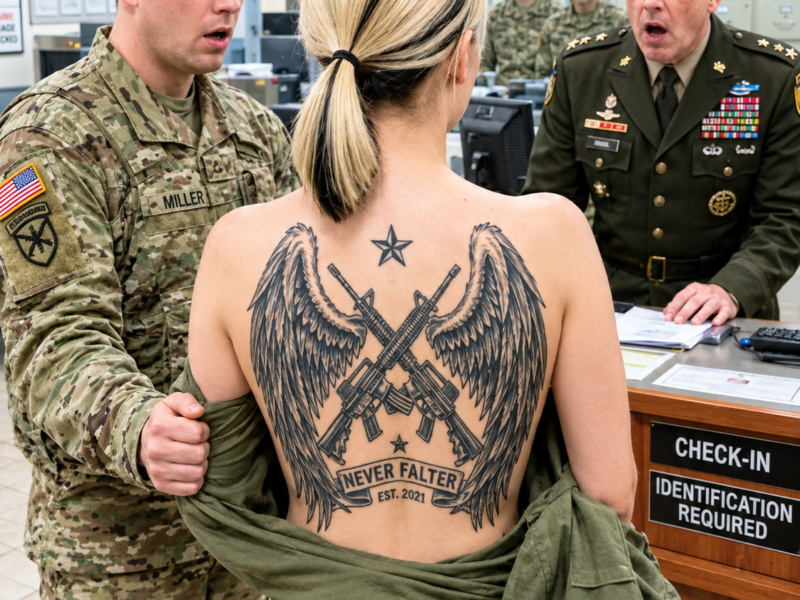
““Got the balls to strip a Navy SEAL?” the chief petty officer sneered as two armed guards ordered me to remove my uniform in front of a crowded naval security office
I couldn’t stop looking at the words beneath the photograph.
CASE REOPENED.
The commander stood across the steel table, waiting for me to speak, while the fluorescent lights hummed overhead.
“What’s your name, Commander?” I asked.
“Commander James Reeves.”
“Did you know Daniel Cross?”
His expression tightened at the sound of the name.
“Yes.”
“Then you know why I’m here.”
“I know why your access request was submitted. I don’t know why you’re wearing that mark.”
I pulled my shirt against my chest.
“Because Daniel gave it to me.”
Reeves slowly lowered himself into the chair.
“Daniel Cross has been dead for six years.”
“That’s what your records say.”
“His remains were identified, his family was notified, and a memorial service was held at Coronado.”
“None of that answers my question.”
“No,” he admitted. “It doesn’t.”
He turned the photograph toward me.
Daniel stood in front of a gray concrete wall, his expression serious, his hair cropped short. He wore civilian clothes, but I recognized the small scar above his right eyebrow and the crooked smile he always tried to hide when someone took his picture.
I’d seen that face in my dreams so often that sometimes I woke up reaching for a phone that no longer had his number.
The photograph had been taken before his final deployment.
Before the operation that supposedly killed him.
Before I had learned how many people could look me in the eye and call a lie the truth.
“Where did you get this?” I asked.
“From a file transferred to my office this morning.”
“Who reopened the case?”
“I did.”
I looked at him sharply.
“Why?”
“Because someone submitted new evidence three weeks ago. Evidence that suggests the original investigation was incomplete.”
My hands went cold.
“What evidence?”
He glanced at the door.
“I can tell you that the case is under review. I can’t tell you the contents of a restricted file without confirming your identity and authorization.”
I almost laughed.
An hour earlier, I’d been treated like an impostor because a computer couldn’t verify my credentials.
Now the commander standing before me was telling me that the truth about a man I loved was locked behind the same system.
“Then verify me.”
“I intend to.”
He picked up the telephone and called the duty officer.
While he waited, I studied the photograph.
Daniel had been twenty-nine when he disappeared. He was the kind of man who remembered the names of the janitors in every building he worked in and could tell when someone was pretending to be fine.
He had never liked being called a hero.
“Heroes are what people call you when they don’t have to explain what happened,” he’d once told me.
At the time, I’d thought he was being cynical.
Now I wondered how much he had already known.
Reeves hung up.
“Your credentials are being verified through the appropriate command.”
“How long?”
“Not long.”
I looked toward the door.
“Chief Lawson ordered me to remove my clothes in front of two guards because he thought I was lying about my identity.”
“I will address his conduct.”
“That’s not why I’m here.”
“I understand.”
“Do you?”
My voice came out sharper than I’d intended.
“I’ve spent six years being told that Daniel died in an operation that nobody can explain to me. I’ve watched his mother grow old waiting for answers. I’ve had people suggest that I should accept the official account and move on.”
I placed my shirt on the table.
“And now someone has reopened the case, my credentials are suddenly a problem, and your chief thinks a tattoo is grounds for humiliating me in a locked room.”
Reeves didn’t interrupt.
“If you know something,” I continued, “tell me. If you don’t, stop looking at me like I’m the answer to a question you haven’t asked.”
For several seconds, he studied me.
Then he nodded.
“That’s fair.”
He turned the photograph facedown.
“Daniel Cross was part of a special operations support team assigned to a classified maritime recovery mission six years ago. The mission took place off the coast of the Philippines. The team was supposed to recover a piece of equipment from a vessel that had been abandoned after an intelligence operation.”
“That isn’t what Daniel told me.”
“What did he tell you?”
“That he was going on a short assignment. He said he’d be back before my birthday.”
Reeves looked down at the table.
“The operation went wrong. Communications were lost, and the team was extracted under emergency conditions. Daniel was reported missing after the recovery.”
“Reported missing?”
“His status was changed to presumed dead several months later.”
I stared at him.
“Then why did you say his remains were identified?”
Reeves went very still.
I realized what he’d done.
He’d repeated the official account before checking whether it was true.
“Commander, you told me his remains were identified.”
“That’s what the original file states.”
“Have you seen the identification records?”
He didn’t answer immediately.
“No,” he said at last. “I haven’t.”
The room felt colder.
“Then you don’t know that Daniel is dead.”
“I know what the record says.”
“That isn’t the same thing.”
He nodded once.
“No. It isn’t.”
A knock came at the door.
A young lieutenant entered carrying a thin folder.
“Sir, the verification just came through.”
Reeves took the folder.
He read the first page, then the second.
His eyes moved back to the first.
“Are you certain?”
“Yes, sir. The issuing authority confirmed it.”
He dismissed the lieutenant and closed the door.
Then he looked at me.
“Your identity is verified, Lieutenant Mitchell.”
I let out a breath.
“Thank you.”
“Your access request is also legitimate.”
“I could have told you that.”
“I know.”
He looked as though he wanted to say more, but something in the folder stopped him.
“There’s another issue,” he said.
“Of course there is.”
“The name Daniel Cross doesn’t appear anywhere in your current access request.”
“Because I’m not here under his name.”
“Your request references a former operational designation.”
I waited.
He slid the folder across the table.
At the top of the page was a designation I’d last seen on a document six years earlier.
NIGHTJAR.
My mouth went dry.
I had not heard that word spoken aloud since the night Daniel disappeared.
“Who submitted this?” I whispered.
“The request came through Captain Sarah Bennett’s office.”
My mother’s name.
For the first time that morning, I forgot about Lawson, the guards, and the humiliating search.
“My mother is dead.”
Reeves’s expression changed.
“I know.”
“Then how did her office submit anything?”
“I don’t have that answer yet.”
I pushed the folder away.
“My mother was a Navy nurse. She never had access to special operations files.”
“According to her personnel record, she didn’t.”
“Then why is her name on this?”
Reeves looked toward the windowless wall.
“Because someone used her credentials to authorize your visit.”
I gripped the edge of the table.
My mother had died from cancer seven years earlier, a year before Daniel vanished.
She had spent the last months of her life in a small house outside Virginia Beach, where she kept a garden she could no longer tend and a stack of letters she’d never mailed.
She had been the only person who knew Daniel and I were more than friends.
She had also been the person who told me to stop waiting for him.
“Did you ever meet my mother?” I asked.
“No.”
“Did Daniel?”
“According to his personnel file, they never had contact.”
I looked at him.
“Then his personnel file is wrong.”
Reeves didn’t argue.
He reached for the phone again.
This time, he asked for Captain Mercer at the special investigations office.
When the call connected, he gave his name, his location, and the designation on the folder.
Then he said, “Yes, sir. She’s here.”
He listened for several seconds.
His expression hardened.
“Understood.”
He hung up.
“Captain Mercer is coming here.”
“How long?”
“Twenty minutes.”
I picked up my shirt.
“Then I’m getting dressed.”
Reeves turned away to give me privacy.
I pulled the shirt over my head and straightened the collar.
When I looked in the mirror above the steel sink, I barely recognized the woman staring back.
My face was pale, my eyes tired, and the tattoo beneath my shoulder had begun to itch.
I touched the small trident through the fabric.
Six years earlier, Daniel had pressed the stencil into my hand and told me not to get the tattoo until I understood what it meant.
I’d laughed at him.
“I know what a trident means.”
“Not this one.”
He’d taken my hand and traced the three lines beneath it.
“Three people. One promise. If one of us goes missing, the other two don’t stop looking.”
I had thought he was being sentimental.
Now I wondered whether he had been trying to warn me.
Captain Mercer arrived twenty-three minutes later.
He was in his late forties, broad-shouldered, with close-cropped hair and a face that looked as if it had forgotten how to relax.
He entered the room carrying a black folder.
His eyes went directly to my shoulder.
For a moment, he said nothing.
Then he closed the door behind him.
“Lieutenant Mitchell.”
“Captain.”
He placed the folder on the table.
“I apologize for what happened during your screening.”
“Did you know Chief Lawson was going to order a strip search?”
“No.”
“Would it have happened if I’d been a man wearing the same credentials?”
Mercer hesitated.
“I can’t answer that.”
“Then don’t apologize as if you can.”
Reeves looked at me, but Mercer simply nodded.
“Fair enough.”
He opened the folder and removed a photograph.
It showed three people standing beside a military helicopter.
Daniel was on the left.
A woman with short blond hair stood in the middle.
And on the right was a younger version of my mother.
I reached for the photograph, but Mercer held it back.
“Before I give you this, I need to ask whether you understand what your presence here may mean.”
“I’ve been trying to understand that for six years.”
“This isn’t just about Daniel Cross.”
“Then who else is involved?”
Mercer placed the photograph on the table.
“The woman in the middle is Commander Elise Ward. She led the recovery team. She’s been missing for six years.”
I stared at the picture.
“Why was my mother with them?”
“That is one of the questions we’re trying to answer.”
“My mother was a nurse.”
“She was a nurse by training. Her final assignment involved casualty evacuation and medical support for a specialized maritime unit.”
“She never told me.”
“She may not have been permitted to.”
I studied the photograph.
My mother looked younger than I remembered her, her hair tied back, her expression focused.
She stood close enough to Daniel that their shoulders almost touched.
He wasn’t smiling.
He was looking directly at the camera, one hand resting on the strap of a bag.
“Where was this taken?”
“At a staging facility in California, two days before the mission.”
I turned the photograph over.
There was a handwritten date and a string of coordinates.
Beneath them, in my mother’s unmistakable handwriting, were four words.
If anything happens, Hannah knows.
I sat down.
“No,” I whispered.
Mercer watched me carefully.
“Did your mother ever tell you about Nightjar?”
“No.”
“Did Daniel?”
“Not directly.”
“What did he tell you?”
I traced the handwriting with my fingertip.
“He told me that some promises were too important to write down.”
Mercer exchanged a glance with Reeves.
“What?” I demanded.
“The original investigation concluded that Commander Ward had died during the operation,” Mercer said. “But the new evidence suggests that she may have survived the initial extraction.”
“And Daniel?”
“His status was changed to presumed dead. No remains were conclusively identified in the final report.”
I closed my eyes.
For six years, I had carried a folded copy of Daniel’s death notification in the back of my desk drawer.
It had been signed by an officer who never met me, using words that said a lot without actually telling me anything.
Missing during a classified operation.
Presumed dead.
No further details available.
I had learned to live around those words.
Now I understood that even the one fact I had believed was certain might never have been established.
“Why reopen the case now?” I asked.
Mercer slid another document across the table.
“Three weeks ago, an encrypted message was received through a channel that had been inactive since the operation.”
“What did it say?”
He turned the page.
The message contained a single line.
NIGHTJAR IS ALIVE. THE THIRD PROMISE MUST BE KEPT.
I read it once.
Then again.
“What does the third promise mean?”
Mercer folded his hands.
“We don’t know.”
I looked at my tattoo.
Three people. One promise.
Daniel had told me those words six years ago.
My mother had written that I knew what would happen if anything went wrong.
And someone had just used the same language to reopen a case the Navy had spent years treating as closed.
“Who sent the message?”
“The source hasn’t been identified.”
“Where did it originate?”
“An old communications relay near the coast of Virginia.”
“That’s not an answer.”
“It’s the only one I can give you right now.”
I pushed the document toward him.
“Then I want to see the original file.”
Mercer shook his head.
“Not until we establish your role.”
“My role?”
“The message was addressed to Nightjar. Your access request uses the same designation, and your mother’s credentials were used to submit it.”
I looked at Reeves.
He seemed as unsettled as I felt.
Mercer continued.
“We need to know what your mother told you, what Daniel may have shared with you, and why someone believes you can help us locate Commander Ward.”
I laughed once, without humor.
“I don’t know where Commander Ward is. I don’t even know why my mother was in that photograph.”
“Then we’ll start there.”
He opened his folder and took out a sealed envelope.
The handwriting on the front was my mother’s.
My name was written beneath it.
Hannah.
I reached for the envelope.
Mercer put his hand over it.
“Where did you get this?”
“It was recovered from a storage locker registered under your mother’s name. The locker was accessed two weeks ago, using a key that wasn’t in the original inventory.”
“Who accessed it?”
“We’re still investigating.”
“Then why are you holding my mother’s letter?”
“Because it was found alongside a document bearing the Nightjar designation, and the contents may be relevant to a restricted operation.”
I stared at his hand.
“That’s my mother’s handwriting.”
“I understand.”
“No, Captain. You don’t.”
I drew a breath.
“You don’t get to keep using my mother as a reason to deny me the truth about her.”
Mercer withdrew his hand.
I picked up the envelope.
It was thin and yellowed at the edges, with a faint crease running across the flap.
My mother had written the date six years earlier.
Three days before Daniel disappeared.
I opened it carefully.
Inside was a single sheet of paper.
Hannah,
If you’re reading this, it means Daniel couldn’t return to explain what happened. I need you to remember something I told you when you were little: a promise isn’t a chain. It’s a choice you make again when the truth becomes difficult.
I hope you never have to understand why I wrote this.
If you do, look beneath the blue tile in the garden.
Trust the person who asks what you remember, not the person who tells you what to believe.
I love you more than I ever knew how to say.
Mom.
I read the letter twice.
Then I folded it along its original crease.
My mother had been dead for seven years.
She couldn’t have known with certainty that Daniel would disappear.
She couldn’t have predicted the exact circumstances.
But she had left me instructions that pointed toward something she believed I might one day need.
“The garden,” I said.
Mercer looked up.
“What garden?”
“My mother’s house.”
“Does it still exist?”
“I own it.”
Reeves stood.
“We should have someone accompany you.”
“No.”
“Hannah—”
I turned toward Mercer.
“If my mother left something there, I want to find it myself.”
“That could compromise evidence.”
“Then send an investigator to document the discovery. But I’m not handing you another piece of my family before I know what it is.”
Mercer considered that.
Finally, he nodded.
“An investigator will meet you at the property. You won’t open anything that appears sealed or secured until they arrive.”
“Agreed.”
He slid a card across the table.
“Call me when you find the tile.”
I took the card and put it in my pocket.
Then I walked out of the room.
As I passed the security desk, Chief Lawson stood beside the printer.
He opened his mouth as if he wanted to say something.
I kept walking.
For once, I didn’t need to make him understand who I was.
I needed to find out who my mother had been.
The house stood on a quiet street in Virginia Beach, tucked between two newer homes with bright windows and carefully trimmed lawns.
My mother had bought it when I was twelve.
After she died, I’d kept the house because selling it felt too much like agreeing that she was gone.
I’d rented it for a while, then left it empty when the maintenance became more trouble than I could manage.
The garden had grown wild.
Rose bushes leaned over the brick path, and weeds filled the spaces between the stepping-stones.
At the far end, beneath a maple tree, sat the old blue-tiled fountain my mother had built the summer after my father left.
I knelt beside it.
The blue tile was easy to find once I knew where to look. It sat near the base, half hidden behind a cluster of dead leaves.
I pressed my fingers against the edges.
The tile shifted.
Beneath it was a small metal ring.
I pulled gently.
A narrow compartment opened in the concrete base, revealing a waterproof pouch wrapped in faded cloth.
Inside was a brass key, a folded map, and a photograph.
The photograph showed my mother, Daniel, and Commander Ward standing beside a small fishing boat.
On the back, someone had written a location and a time.
Old Point Harbor. Friday. 0430.
Below it was a second sentence.
Bring the third.
I stared at the words until the paper trembled in my hand.
A car door slammed behind me.
I turned.
A woman stood at the garden gate, wearing jeans, a gray jacket, and a baseball cap pulled low over her forehead.
She looked to be in her early forties.
Her face was unfamiliar, but the way she stood made me think of someone who had spent years learning to keep her weight balanced and her exits in sight.
“Lieutenant Mitchell?” she asked.
“Who’s asking?”
She raised both hands slightly.
“My name is Nora Ellis. Captain Mercer sent me.”
I studied her.
“Where’s your identification?”
She produced a badge and held it where I could read it.
Naval Criminal Investigative Service.
I checked the photograph, then looked at her face.
“You’re early.”
“Traffic was light.”
She glanced at the open compartment.
“Did you find something?”
I held up the pouch.
“Yes.”
“Don’t touch anything else.”
“I haven’t.”
She put on gloves and photographed the compartment before examining the contents.
When she reached the photograph, her expression changed.
“You recognize them?” I asked.
“I recognize Commander Ward.”
“Did you know her?”
“Not personally.”
She looked at the back of the photograph.
Then she studied the map.
“This location is still active?”
“I don’t know. The note says Friday at four-thirty in the morning.”
“Which Friday?”
I checked the date written beside the coordinates.
My stomach tightened.
“This Friday.”
Nora looked at her watch.
It was Thursday afternoon.
“That’s less than twelve hours from now.”
I stared at her.
“Then we should call Mercer.”
“We will.”
She put the map in an evidence sleeve.
But before she could close the pouch, I noticed a small folded slip tucked into the lining.
“Wait.”
I pointed.
Nora removed it carefully.
The slip contained a sequence of numbers and a short phrase.
If the third comes alone, the first will answer.
Nora read it twice.
“Do you know what this means?”
I shook my head.
“No.”
But even as I said it, I remembered Daniel standing in my mother’s kitchen six years earlier, holding three mismatched coffee mugs.
He had placed them in a row on the counter.
“First, second, third,” he’d said.
My mother had rolled her eyes.
“You’re making this sound like a children’s game.”
“Sometimes a children’s game is the only safe way to remember something important.”
I’d laughed and asked what the game was.
Daniel had looked at me for a long moment.
Then he’d said, “When someone asks you to choose between loyalty and the truth, remember that the truth is the only thing that can protect the people you love.”
At the time, I’d thought he was talking about my father’s departure.
Now I wondered whether he’d been talking about something much larger.
Nora’s phone rang.
She answered, listened, then looked at me.
“Captain Mercer wants us at the command office immediately.”
“What happened?”
She lowered the phone.
“The encrypted channel just sent another message.”
“What does it say?”
Nora hesitated.
Then she turned the screen toward me.
THE THIRD HAS ARRIVED. DO NOT BRING MERCER.
I looked from the message to the photograph in the evidence sleeve.
Someone knew I had found the compartment.
Someone knew I was the third.
And someone was telling me not to trust the captain who had sent an investigator to protect the evidence.
I had no idea who was watching us.
But for the first time since Daniel disappeared, I felt certain of one thing.
The next choice I made would decide whether I finally learned what happened to him—or helped someone bury the truth all over again.
We drove to the command office in silence.
Nora kept the evidence pouch locked in a case on the passenger-side floor, and I watched the streets pass through the window.
Every familiar landmark seemed suddenly connected to a memory I hadn’t understood.
The coffee shop where Daniel had once waited two hours for me because my car broke down.
The gas station where my mother had insisted we stop for snacks on the way to a hospital appointment.
The intersection where Daniel had kissed me for the first time and then apologized because he thought he’d ruined our friendship.
I had loved him long before I knew he was involved in anything classified.
We had never made grand promises about the future.
We talked about small things instead: where we’d live, what kind of dog we’d get, whether we could ever learn to cook something other than pasta.
When he left for his final assignment, he’d stood on my porch with a duffel bag over one shoulder.
“I’ll call when I can,” he’d said.
“You always say that.”
“I know.”
“Daniel, I’m serious.”
“So am I.”
He’d taken my hand.
“If I can’t call, it doesn’t mean I’ve forgotten you.”
I’d wanted to believe him.
Now, six years later, I was beginning to understand how little I had known about the life he was asking me to trust.
At the command office, Mercer was waiting in a conference room.
He stood when I entered.
“Where’s the evidence?”
Nora placed the sealed case on the table.
“Documented and secured.”
Mercer looked relieved.
Then he noticed the message on my phone.
“Who sent this?”
“We don’t know,” Nora replied.
“Was it received through the same channel?”
“Yes.”
Mercer read the message.
His expression hardened.
“Someone is trying to interfere with the investigation.”
“Or warn us,” I said.
He looked at me.
“Those aren’t mutually exclusive.”
“Neither is the possibility that you aren’t the person I should trust.”
The room went silent.
Mercer slowly closed the folder in front of him.
“Tell me why you think that.”
“Because someone knows I found the garden compartment. They knew I was the third before I understood what that meant. And they specifically told me not to bring you.”
“That doesn’t establish that I’m involved.”
“No. But it means someone believes you are.”
Mercer considered this.
Then he turned toward Nora.
“Can you trace the message?”
“Not without accessing the original relay.”
“Do it.”
Nora left the room.
Mercer gestured for me to sit.
I remained standing.
“Before we proceed, I want to know why my mother was involved in Nightjar.”
He rubbed his forehead.
“Your mother wasn’t a covert operator. She was assigned to a medical support unit attached to the mission. She had expertise in emergency evacuation, trauma care, and survival medicine.”
“Then why did she leave a message telling me to look beneath a garden tile?”
“I don’t know.”
“Why was she photographed with Daniel and Commander Ward?”
“I don’t know.”
“Why did she use her credentials to authorize my visit?”
“I don’t know that she did. Someone may have used them.”
I watched him carefully.
He wasn’t avoiding the questions.
He genuinely seemed to lack the answers.
That didn’t make him trustworthy.
It made him another person standing inside a story that had been written before he arrived.
“What was Nightjar?” I asked.
Mercer looked at the door before answering.
“Nightjar was the designation for a small recovery protocol developed for situations in which a team became separated from its primary command structure.”
“Separated how?”
“Loss of communications. Compromised extraction. Inability to verify whether a recovery team had been captured or killed.”
“And the three promises?”
His eyes moved to my shoulder.
“The designation was never supposed to become public.”
“That’s not what I asked.”
He took a slow breath.
“The first promise was to preserve the truth of what happened. The second was to protect the identities of anyone who survived. The third was to keep looking until every missing person was accounted for.”
I sat down.
The words seemed to settle into the room like dust.
“Who were the three?”
Mercer didn’t answer.
“Daniel, my mother, and Commander Ward?”
“I believe they were involved in the protocol, yes.”
“Then why was I called the third?”
“I don’t know.”
A soft chime came from the conference room computer.
Nora returned carrying a tablet.
“We have a location.”
She placed it on the table.
The message had been routed through a decommissioned relay near Old Point Harbor.
The signal was weak, but it had originated from a device that was still transmitting.
Mercer looked at the map.
“That’s a restricted maritime area.”
“There’s an old storage facility nearby,” Nora said. “It was used by the recovery unit before the operation.”
I leaned forward.
“Then that’s where we go.”
Mercer shook his head.
“Not without authorization.”
“By the time we get it, the person sending those messages could be gone.”
“We don’t know who we’re dealing with.”
“We don’t know anything because every time we get close to an answer, someone tells us to wait.”
Mercer held my gaze.
“I understand your frustration.”
“No, Captain. You understand the investigation. I understand what it feels like to spend six years mourning someone who might have been alive.”
His expression softened, but he didn’t look away.
“I won’t send you into an unsecured location.”
“Then don’t send me. I’m going because I have a reason to believe someone there knows what happened to Daniel.”
Nora folded her arms.
“If you go alone, you’ll compromise the evidence and put yourself at risk.”
“Then come with me.”
Mercer looked at her.
She met his gaze without blinking.
“She’s right about one thing, sir. The message was addressed to her. If someone is expecting the third, an official team could make them disappear before we get answers.”
He looked at me for a long moment.
Finally, he nodded.
“We’ll conduct a controlled approach. No one enters the facility until we’ve assessed the site.”
I agreed.
But as we prepared to leave, a new message appeared on the tablet.
0430. COME ALONE.
Below it was a second line.
ASK WHAT HAPPENED TO THE SECOND.
I read the words again.
The first promise was to preserve the truth.
The second was to protect survivors.
The third was to keep looking.
If the message was telling me to ask what happened to the second, then someone believed the three promises had been broken.
And someone wanted me to know where the break had begun.
We reached Old Point Harbor shortly before four in the morning.
Mist hung above the water, blurring the dock lights into pale yellow circles.
The storage facility stood beyond a chain-link fence, a low concrete building with boarded windows and a rusted metal door.
Nora stayed near the vehicle while two investigators moved toward the perimeter.
Mercer had arranged for a small team to cover the access road, but no one would enter the building unless we found evidence of an immediate threat.
I understood the logic.
I also understood that whoever had sent the messages might not wait for us to finish our procedures.
At 4:27, my phone vibrated.
THIRD PROMISE.
I looked toward the building.
A light appeared behind one of the boarded windows.
Then the door opened.
A man stepped outside.
He was thinner than I remembered, his hair longer, his beard threaded with gray.
He stood with one hand braced against the doorframe, as if he wasn’t entirely certain his legs would hold him.
But I knew the shape of his shoulders.
I knew the way he tilted his head when he was trying to recognize something in the dark.
I knew him.
“Daniel,” I whispered.
He didn’t move.
For several seconds, we simply stared at each other across the wet pavement.
Then he took one step forward.
“Hannah.”
My knees nearly gave way.
I had imagined this moment so many times that I had stopped trusting my own imagination.
In some versions, I slapped him.
In others, I ran into his arms and cried until I couldn’t breathe.
Sometimes I stood perfectly still while he explained everything, and every terrible thing that had happened during the previous six years turned out to have a reason I could understand.
But when he finally stood in front of me, all I could say was, “You’re alive.”
He nodded.
“I’m alive.”
I struck his chest with both hands.
Not hard enough to hurt him, but hard enough to make him step backward.
“You let me bury you.”
His face crumpled.
“I know.”
“You let your mother—”
He closed his eyes.
“My mother died before the mission.”
“I know. You let me think you were dead.”
“I didn’t know how to reach you.”
“You didn’t know how?”
My voice broke.
“Daniel, I spent six years believing you were gone. I sat with your mother at the memorial. I helped her choose the photograph they put beside your name. I watched her look at every man who came through the door, hoping one of them would have an answer.”
He swallowed.
“I know.”
“No, you don’t. You don’t get to say that as if it makes us even.”
He looked down.
For the first time, I noticed the thin white scar running along his neck and disappearing beneath his collar.
“What happened to you?”
He looked toward the building.
“Not here.”
I caught his arm.
“You’re not going anywhere until you tell me why.”
He didn’t pull away.
“Because I was afraid that if I contacted you, they’d use you to find me.”
“Who?”
“People who believed the mission had failed because someone had betrayed us.”
“Did someone?”
He looked at me.
“Yes.”
I felt the old familiar coldness settle beneath my ribs.
“Who?”
Daniel glanced toward the road.
“Captain Mercer wasn’t the one who gave the order to proceed. But he signed the report that made it look as if everyone had followed procedure.”
“Then why is he helping us?”
“Because he finally found the original transmission.”
“What transmission?”
Daniel reached into his jacket and pulled out a small, weathered memory card.
“This contains the original communications log from the operation. The radio failure wasn’t an accident. Someone deliberately disabled the backup system before we deployed.”
I stared at the card.
“Who?”
“Commander Ward discovered it. She tried to report it, but the message never reached the people who could stop the mission.”
“And my mother?”
“She was the only person who knew where Ward was supposed to be taken after the extraction failed.”
I looked at the building.
“Is she here?”
Daniel shook his head.
“She’s gone.”
The words fell heavily between us.
“Dead?”
“I don’t know.”
I closed my eyes.
“Daniel, I can’t do this again. I can’t spend another six years chasing someone who may or may not be alive.”
“I wouldn’t ask you to.”
“Then tell me what happened.”
He took a breath.
“After the communications system failed, our team was separated. Ward was injured, and the extraction vehicle never arrived. We found a secondary route to the coast, but the people who were supposed to meet us had already left.”
“Why?”
“We believe someone leaked the location.”
“Who?”
“We don’t know for certain.”
“Then why hide?”
“Because I found evidence that the original report was being altered before the inquiry even began. Someone had access to the investigation and was removing the records that could prove the backup radio had been disabled.”
He looked at the memory card.
“I took the original communications log and went underground. I thought I could get it to someone outside the chain of command.”
“And you never thought to tell me?”
“I thought about you every day.”
“That’s not an answer.”
“No,” he said quietly. “It isn’t.”
He looked at me with the same expression he used to wear when he’d made a mistake and knew there was no clever way to explain it.
“I was trying to protect you, Hannah. But I also didn’t want to face what my disappearance would do to you. I told myself staying away was the only safe choice, and then every month I waited made it harder to come back.”
I wanted to forgive him for saying it.
I wanted to punish him for believing it.
Instead, I stepped away.
“You should have trusted me enough to let me make my own decisions.”
He nodded.
“You’re right.”
A sharp sound came from inside the storage facility.
Daniel turned immediately.
“Get down.”
He pulled me behind a concrete barrier as a figure moved through the doorway.
Nora shouted from the access road.
“Federal agents! Keep your hands visible!”
The figure raised both hands.
It was a woman in a dark coat.
She stepped into the light.
I recognized her from the photograph.
Commander Elise Ward.
She was older, her blond hair now streaked with gray, and she leaned heavily on a metal cane.
But she was alive.
She looked at Daniel, then at me.
“You brought the third,” she said.
Daniel nodded.
Ward’s eyes settled on the tattoo beneath my collar.
“Then it’s time you knew what your mother really did.”
We moved into the storage facility under the supervision of the investigators.
Inside, a folding table stood beneath a single hanging light. The walls were lined with old filing cabinets, and a portable radio sat beside a stack of sealed plastic containers.
Ward lowered herself into a chair.
Daniel remained standing near the door.
I took the seat opposite her.
“Start at the beginning,” I said.
Ward looked at Daniel.
He gave a small nod.
“Six years ago, we were assigned to recover a data module from a vessel that had been abandoned after an intelligence operation. The module contained records of a network of unauthorized transfers involving military equipment and operational information.”
“Who was involved?”
“People in several positions. Some were military. Some were contractors. We didn’t know the full extent of it at the time.”
“And the mission?”
“It was supposed to be a controlled recovery. But the backup communications system was disabled before deployment. When the primary radio failed, we couldn’t call for extraction.”
Ward paused.
“Two members of the team were injured. One died before we reached the shoreline. Daniel and I were separated from the others during the evacuation.”
“Why were you reported dead?”
“Because the official team that arrived later was told there were no survivors. By the time Daniel and I realized the report had been falsified, the people responsible had already begun closing the investigation.”
I looked at Daniel.
“You said the second radio was deliberately disabled.”
He handed Ward the memory card.
“This is the original log.”
Ward examined it.
“The time stamps are intact.”
“Can you prove who altered the system?”
“Not by itself. But it can establish when the failure was recorded and who had access to the equipment.”
She placed the card on the table.
“The person who disabled the backup system had access to the maintenance records. Someone signed off on a test that never happened.”
I thought of the message on the back of the photograph.
The second radio was never tested.
“Who signed it?”
Ward looked at me.
“Commander Alan Voss.”
I had heard the name.
Voss had retired from active duty several years earlier and now served as a senior consultant for a defense contractor.
His face had appeared in newspapers and official photographs. He was often described as a respected leader who had modernized the Navy’s maritime recovery program.
“He was in charge of the equipment review,” Ward continued. “He also had the authority to delay the mission. If he had reported the failure, we wouldn’t have deployed.”
“Why would he risk killing his own team?”
“We believe the recovery operation threatened to expose the unauthorized transfers.”
Daniel leaned against the wall.
“Someone needed the data module destroyed. If the mission failed, the loss could be blamed on equipment and weather.”
“And you survived,” I said.
“Yes.”
“So they buried you.”
“They tried.”
Ward looked down at her hands.
“I was injured during the escape. Daniel got me to a safe location, but we couldn’t contact anyone without risking discovery. We spent months moving between safe houses while trying to get the evidence out.”
“Why didn’t you go to the authorities?”
“We tried. One contact was arrested. Another disappeared. We couldn’t tell who was compromised.”
“And my mother?”
Ward’s expression softened.
“Your mother was the person who helped us understand how the original evidence had been altered. She wasn’t part of the operation itself, but she had been assigned to review medical evacuation records after the mission.”
I remembered the photograph.
My mother standing beside Daniel and Ward.
Her face serious.
Her handwriting on the back.
If anything happens, Hannah knows.
“What did she know?”
Ward looked at Daniel.
He hesitated before answering.
“Your mother had discovered a discrepancy in the casualty records. The official report listed one of our team members as having died before extraction, but the medical log showed that he had been alive when the evacuation team reached him.”
I gripped the edge of the table.
“Who was he?”
“Petty Officer Michael Hayes.”
“What happened to him?”
“We don’t know.”
Ward’s voice was quiet.
“We never found a verified record of his arrival at the medical facility. His name disappeared from the transfer list. His family was told he’d died during the operation, but the body identified under his name was never conclusively linked to him.”
I looked from Ward to Daniel.
“How many people were reported dead without proof?”
“Three,” Ward said. “Including Daniel.”
The room seemed to tilt.
My mother hadn’t been trying to protect a secret for the sake of secrecy.
She’d been trying to keep a record of people whose identities had been erased.
“And the tattoo?” I asked.
Ward looked at the trident.
“It was a private mark used by the original recovery group. Three lines represented the three people responsible for keeping the evidence intact if the team was separated.”
“Daniel, you, and my mother?”
“Yes.”
“Then why did Daniel give it to me?”
Ward studied him.
Daniel lowered his eyes.
“Because your mother asked me to.”
I turned toward him.
“Why?”
“She knew that if the operation went wrong, the people who survived might not be able to contact one another. She didn’t want the evidence to depend on a single person.”
He took a breath.
“She asked me to give you the mark because you were the one person she trusted to keep asking questions even when people told you to stop.”
I looked at the tattoo.
I had thought it was a symbol of loyalty.
Now I understood that it was a warning about what loyalty could cost.
Ward opened one of the plastic containers and removed a small notebook.
“Your mother left the final part of the record with me. It contains the names of the people who handled the original evidence, the dates of the altered reports, and the location of the missing transfer logs.”
She placed it on the table.
“With Daniel’s communications record and the original maintenance data, we can establish that the investigation was compromised.”
I looked at the notebook.
“Then why wait six years?”
“Because the people responsible were still in positions where they could influence the review. We needed evidence that couldn’t be dismissed as the memory of two people who had supposedly died.”
Daniel looked at me.
“And we needed someone outside the original chain of command.”
“Me.”
“Yes.”
I leaned back.
For six years, I had believed that Daniel’s disappearance was a tragedy I could do nothing about.
Now I understood that my mother’s death, Daniel’s disappearance, Ward’s survival, and the altered reports were connected by a series of decisions made by people who believed they could control what the rest of us knew.
But one question remained.
“Who sent the messages?”
Ward glanced toward the radio.
“I did.”
I stared at her.
“You were watching the house?”
“Not personally. I had someone monitoring the old relay. When your access request appeared, I knew the third had finally been called.”
“Why didn’t you contact me directly?”
“Because I needed to know whether the request had been submitted through a legitimate channel or whether someone was using your identity to draw us out.”
I thought of the warning telling me not to bring Mercer.
“Why did you tell me not to bring him?”
“Because Mercer signed the original report.”
Daniel stepped forward.
“But he didn’t know the full story. He was a junior officer at the time. He was told the evidence had been verified, and he accepted the report without seeing the underlying records.”
“How do you know?”
“Because I confronted him six years ago, before I disappeared. He admitted he had signed the report, but he didn’t know the casualty records had been altered.”
Ward closed the notebook.
“He has spent years trying to understand what happened. When the new evidence surfaced, he reopened the case. He doesn’t know who can be trusted either.”
I sat in silence.
It was a terrible thing to realize that the truth hadn’t been hidden by one brilliant criminal who had planned every detail.
It had been buried by a succession of ordinary decisions.
A test marked complete when it wasn’t.
A report signed without being checked.
A warning dismissed because the schedule mattered more.
A young officer who trusted his superiors.
A woman who kept asking questions until she became inconvenient.
And a man who disappeared because he thought being absent was the same as keeping someone safe.
I looked at Daniel.
“Why didn’t you come back when you could?”
He held my gaze.
“Because I thought you would be safer without me.”
“That was your decision to make?”
“No.”
His voice broke.
“No, it wasn’t.”
For the first time since I’d seen him outside the building, I believed he understood the difference between loving someone and deciding what they were allowed to know.
I wasn’t ready to forgive him.
But I could finally see the man beneath the silence.
And I could see how much his fear had cost both of us.
The evidence was secured before sunrise.
The communications log, maintenance records, casualty discrepancies, and Ward’s notebook were transferred to an independent investigative team.
Mercer voluntarily surrendered the original report he had signed six years earlier and gave a formal statement explaining what he knew and what he had failed to verify.
The new investigation did not rely on Daniel’s account alone.
Technicians authenticated the memory card. Investigators recovered archived maintenance data from a separate system. Financial records established that Commander Voss had received undisclosed payments through a contractor connected to the equipment program.
The records did not prove that Voss had personally ordered every action that led to the failed mission.
They did establish that he had concealed the backup radio failure, falsified the inspection record, and interfered with the handling of the casualty documentation.
When confronted with the evidence, Voss denied knowing that anyone had survived.
But the investigators found a message he had sent the morning after the operation.
Confirm that all remaining witnesses have been accounted for.
He claimed he had been referring to routine personnel checks.
The investigators found that explanation inconsistent with other messages and the altered records.
He was charged through the appropriate legal process, and the case proceeded without the shortcuts that had ruined the first inquiry.
The review also established that Michael Hayes had survived the initial extraction and been transferred under an incorrect identity during an emergency evacuation. He had later died from his injuries at a civilian medical facility.
His family had spent six years believing his death had been immediate and unavoidable.
They were finally given an accurate account of what happened.
Commander Ward’s status was corrected.
Daniel’s presumed-dead designation was removed after his identity and survival were formally verified.
The Navy issued a revised account of the operation, acknowledging the known equipment failure and the deficiencies in the original investigation.
It was not a perfect resolution.
Some questions remained unanswered. Some records had been destroyed before investigators could recover them. And no legal finding could return the years that Daniel and I had lost.
But the people who had been erased from the story were finally being named.
That mattered.
Three months later, I visited Daniel at a small house near the Chesapeake Bay.
He had been placed on administrative status while his identity and testimony were processed, and he was still adjusting to the strange experience of being alive in a world that had spent years mourning him.
He opened the door wearing a faded T-shirt and carrying two cups of coffee.
“I wasn’t sure you’d come.”
“Neither was I.”
I accepted the cup.
We sat on the porch and watched the tide move slowly through the marsh.
For a while, neither of us spoke.
Then he said, “I don’t expect you to forgive me.”
“Good.”
He smiled faintly.
“I deserved that.”
“You did.”
He stared at the water.
“I keep thinking about what I should have done differently.”
“Have you come up with anything?”
“About a hundred things.”
I took a sip of coffee.
“Start with one.”
He turned toward me.
“I should have trusted you enough to tell you the truth. Even if it meant putting you at risk, I should have let you understand the choice you were being asked to make.”
I looked at him.
“Yes.”
“I can’t undo that.”
“No.”
He swallowed.
“But I can stop pretending I know what’s best for you.”
I set my cup on the porch railing.
“That’s a start.”
We sat together until the sun dropped behind the trees.
I didn’t promise that we would return to the relationship we’d had before he disappeared.
I wasn’t sure that relationship still existed.
We were older now, shaped by six years of grief, fear, and choices neither of us could erase.
But when I stood to leave, Daniel didn’t ask me to stay.
He didn’t ask me to forgive him.
He simply said, “Thank you for coming.”
I looked at the man I’d loved, the man I’d mourned, and the man I was still learning to know.
“Don’t make me regret it.”
“I won’t.”
I believed that he wanted to keep the promise.
Whether he could keep it was something time would have to show me.
A year after the case reopened, I returned to Norfolk for a formal ceremony honoring the service members whose records had been corrected.
Michael Hayes’s parents attended.
So did Daniel’s mother, who had been alive when he disappeared but had died before his status could be changed.
His sister held a photograph of him as a teenager, smiling with a missing front tooth.
When she saw Daniel walk into the room, she pressed both hands over her mouth.
He stopped a few feet away.
For a moment, neither of them moved.
Then she crossed the space between them and wrapped her arms around him.
I turned away to give them privacy.
Across the room, Commander Reeves approached me.
“Lieutenant Mitchell.”
“Commander.”
He glanced at my shoulder.
“I owe you an apology for what happened during your screening.”
“You weren’t the one who ordered it.”
“No, but I was responsible for the office.”
He paused.
“Chief Lawson has been removed from screening duties pending the review of his conduct. The investigation found that he failed to follow the required procedures.”
I nodded.
“Good.”
“I hope you understand that the decision had nothing to do with your tattoo.”
I looked at him.
“It had everything to do with the tattoo. Not because of what it meant, but because he saw something he didn’t understand and decided humiliation was an acceptable way to demand an explanation.”
Reeves lowered his eyes.
“You’re right.”
I hadn’t expected him to admit it.
That made the apology feel more honest.
Before he left, he handed me a small envelope.
Inside was a copy of the revised incident record, along with a letter confirming that my role in the inquiry had been formally documented.
At the bottom, someone had added a handwritten note.
The record is not the truth itself. It is the responsibility to keep looking for it.
I recognized Daniel’s handwriting.
I looked across the room.
He was standing beside his sister, listening as she told him about the years he had missed.
He glanced toward me and gave a small, uncertain smile.
I returned it.
Not because everything was forgiven.
Because for the first time, we were standing in a room where nobody had to pretend he was dead.
Later that afternoon, I walked alone to the waterfront.
The wind carried the smell of salt and fuel across the harbor, and the water moved beneath the pier in long, quiet folds.
I touched the trident tattoo beneath my shoulder.
For years, I had thought the mark meant I had to keep searching until I could bring Daniel home.
Now I understood that it had never been a promise to wait forever.
It was a promise to refuse the easy lie when the truth was difficult, to keep asking questions when silence was more comfortable, and to let the people I loved make their own choices—even when I was afraid of what those choices might cost.
Daniel had come home.
The record had been corrected.
The people responsible had been forced to answer for what they had done.
And I was finally free to decide what came next without allowing six years of grief to make the decision for me.
I turned away from the water and walked toward the parking lot.
The tattoo remained on my shoulder, its three lines dark against my skin.
I no longer wore it as a reminder of the people I had lost.
I wore it as a reminder that the truth could survive even when the people who carried it could not.
And that a promise, no matter how sacred, was never meant to become a prison.
The end.









