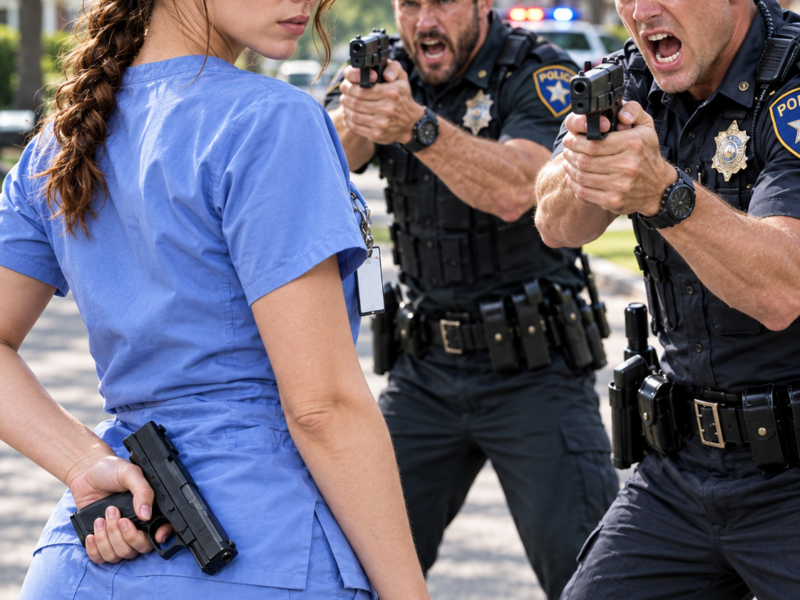
“‘Get on the ground!’ the police officer shouted before firing at me at a crowded bus stop
The handwriting was mine.
I stared at the document until the letters blurred together. Every curve, every sharp stroke, even the way the capital letters leaned slightly to the right—it all looked exactly like my handwriting.
But I had never written those words.
ACTIVE. INSIDE THE FBI.
Beneath the note was the name of someone I had watched disappear seven years earlier in a burning building overseas.
Sergeant Nathan Cole.
My former combat medic partner. My closest friend in the Army. The man whose body had never been recovered after an explosion destroyed our field operations center.
For seven years, I had carried the guilt of leaving him behind.
Now someone was telling me he was alive.
And someone had used my handwriting to make sure I would believe it.
“Where did you get this?” I asked Special Agent Thomas Reed.
“An anonymous source delivered it to our field office this morning.”
“Who handled it?”
“Two agents. Both have been interviewed.”
“Did either recognize the handwriting?”
“No.”
“Then why bring it to me?”
Reed leaned closer.
“Because the note was attached to a photograph of you entering the bus station yesterday. Someone knew you would be there before we finalized the meeting arrangements.”
I tried to sit up, but the pain in my side forced me back against the pillow.
“Then someone is watching your team.”
“Yes.”
“And you still came here alone?”
His expression tightened.
“I came through a secure entrance, and nobody outside a restricted circle knew I was visiting you.”
“Except whoever knew about the bus stop.”
He didn’t answer.
That silence frightened me more than the gunshots had.
I had spent four months helping the FBI investigate a network of corrupt police officers, contractors, and criminals who used legitimate operations to hide illegal shipments. We had suspected that information was leaking from inside the police department.
Now the evidence suggested the leak might be coming from the agency investigating it.
I looked at Nathan’s name again.
“Agent Reed, I need you to tell me something. Is there any evidence Nathan Cole survived the explosion?”
He hesitated.
“Seven years ago, the official report listed him as missing and presumed dead. There was no recovered body, no verified identification, and no independent confirmation of his death.”
“That isn’t an answer.”
“No,” he admitted. “It isn’t.”
I closed my eyes.
Nathan had been more than my partner. He had been the person who knew when I was pretending to be fine, the person who could make me laugh after a night when we had lost patients we couldn’t save.
During our final operation together, he had dragged me behind a concrete barrier after a mortar struck the medical station. I remembered smoke filling the corridor, the alarms, and the pressure of his hand against my shoulder.
“Get the patients out, Emily,” he had shouted.
“What about you?”
“I’ll be right behind you.”
He hadn’t been.
The building collapsed less than three minutes later.
For years, I had told myself that there had been no way to go back. The fire had been too intense, the structure too unstable, and the extraction team had ordered us to withdraw.
I had followed the order.
I had survived.
Nathan had vanished.
And now his name was connected to a criminal network that had nearly killed me.
“Could he have been recruited by someone inside the government?” I asked.
“Possibly. But I won’t speculate about a man whose status hasn’t been established.”
I opened my eyes.
“Then establish it.”
Reed placed the document in a clear evidence sleeve.
“We’re going to find out who created this note, who delivered it, and why they wanted you to see it.”
“No,” I said. “We’re going to find out why someone is willing to kill people to keep this network hidden.”
He studied me for a moment.
Then he nodded.
“Fair enough.”
Before he could say anything else, a nurse entered to check my blood pressure. Reed stepped aside while she examined the monitor and asked me to rate my pain.
When she finished, Reed returned to the bedside.
“One more thing, Captain. Mercer has requested legal counsel. He has refused to answer questions about the shooting.”
“Of course he has.”
“But he did say something to the officers who arrested him.”
“What?”
Reed lowered his voice.
“He said the shooting wasn’t supposed to happen in public.”
My skin went cold.
“What does that mean?”
“We don’t know yet. He claims he was instructed to retrieve the drive and detain you. He says the decision to fire was his own.”
“And you believe him?”
“No.”
For the first time since entering my room, Reed sounded completely certain.
“Neither do I,” I whispered.
Because Officer Daniel Mercer had looked at me with recognition before he drew his weapon.
He hadn’t seemed surprised to find me at the bus stop.
He had seemed angry that I was still carrying something he wanted.
And when he fired, he had whispered that I should have stayed out of their business.
He had not said my business.
He had said our business.
Someone had given him that word.
Someone had made him believe I was a threat to something he was protecting.
And now that someone knew I was alive.
The following afternoon, I was transferred to a secure medical facility under a different name.
The FBI arranged the move after investigators discovered that someone had requested access to my hospital records using credentials that belonged to a law enforcement liaison.
The request had been denied by the hospital’s security office, but the attempt itself was enough to make the investigators nervous.
I was still recovering from surgery. Walking more than a few steps left me exhausted, and coughing sent pain through my ribs. The doctors told me I would need several weeks before returning to normal activity.
I hated hearing that.
I had spent years being the person who moved toward the emergency while others moved away from it. Being confined to a bed felt like surrender.
But there was nothing heroic about reopening a wound because I was impatient.
So I followed the medical instructions, took the medication, and concentrated on getting strong enough to think clearly.
Agent Reed visited that evening with Special Agent Laura Bennett.
Laura looked furious.
Not at me.
At herself.
“I should have changed the meeting location,” she said as soon as she entered.
“You didn’t know Mercer had the information.”
“I knew we had a leak. I should have assumed every location was compromised.”
“You can’t protect everyone by assuming everyone is a traitor.”
“No,” she said. “But I can protect an investigation by refusing to trust a single person with the entire plan.”
She sat beside my bed.
“I’m sorry, Emily.”
I studied her face.
Laura had been my point of contact from the beginning. She was meticulous, blunt, and almost annoyingly careful. She had insisted on written procedures, separate communication channels, and independent verification of every important claim.
If she was compromised, then I had no idea who I could trust.
But I also knew guilt when I saw it.
“You didn’t pull the trigger,” I said.
“I helped create the conditions that put you in front of it.”
“That was Mercer’s decision.”
“And someone else’s decision to send him there.”
I let the silence settle.
Then I asked the question that had been tormenting me since Reed showed me the note.
“Did you know Nathan Cole?”
Laura exchanged a glance with Reed.
It was brief.
It was enough.
“You did,” I said.
Laura folded her hands.
“I reviewed his file during a separate investigation several years ago. It was classified under a restricted personnel-access designation.”
“Was he alive?”
“I never saw proof that he was.”
“Did you see his name?”
“Yes.”
“Where?”
“In a communications log associated with a private security contractor. The entry was brief, and the identity was never verified. I reported it through the appropriate channel.”
“Which channel?”
Laura hesitated.
“An internal review office.”
“Who had access?”
“Several senior officials.”
I felt my pulse quicken.
“Was Deputy Chief Robert Vance one of them?”
“We don’t know.”
“But he could have been.”
“Yes.”
I looked away.
Vance’s photograph was still burned into my memory. He had stood beside federal officials at press conferences, promising that misconduct would not be tolerated. He had helped create the task force that gave the FBI access to local police records.
He had also been the person named in the message sent to Mercer shortly before the shooting.
If Nathan was alive, Vance might know why.
“Tell me everything you can about that communications log,” I said.
Laura shook her head.
“I can’t discuss the details of a separate classified investigation until we establish whether it’s connected to this one.”
“Laura, someone shot me because I was carrying evidence. Someone sent me a forged note in my own handwriting. And now you’re telling me Nathan’s name appeared in another investigation.”
“I understand how it looks.”
“Do you?”
My voice rose, and the pain in my side immediately reminded me that anger was not going to make me stronger.
I lowered my voice.
“I spent seven years believing Nathan died because I couldn’t get back to him. If he’s alive, I need to know. If someone has been using his identity to manipulate this investigation, I need to know that too.”
Laura stared at me for a long moment.
Then she opened her briefcase and removed a single sheet of paper.
“This is not the complete file,” she said. “It’s a record of the entry I reviewed. I’m showing it to you because I believe the connection is real, and because I don’t want you chasing rumors.”
The entry contained a date, a location code, and a short description of a person identified as N. Cole.
The date was three years after the explosion.
Three years after I had attended a memorial service without a body to bury.
Three years after I had finally stopped expecting Nathan to walk through a door.
The location code referred to a private medical facility in Virginia.
My throat tightened.
“Who was he treating?”
“We don’t know.”
“What was the contractor?”
“Meridian Strategic Solutions.”
I recognized the name from the financial records in our investigation.
Meridian had received payments from companies linked to the suspicious shipments. It had also provided security personnel for several facilities where evidence had disappeared.
I stared at Laura.
“This isn’t a coincidence.”
“No,” she said quietly. “I don’t think it is.”
“Then we need the full file.”
“We do. But the request has to go through a clean channel.”
“Who decides which channel is clean?”
Neither agent answered.
That was when I understood the real danger.
The network had not survived by keeping every participant secret. It had survived by making honest people uncertain about whom they could trust.
A corrupt officer could hide behind a badge.
A contractor could hide behind a legitimate invoice.
An official could hide behind a classification.
And a dead man could hide behind a name that no one was permitted to investigate.
I looked at Nathan’s entry again.
“Find the facility,” I said.
Laura carefully returned the paper to her briefcase.
“We will.”
“No,” I replied. “Find the people who worked there. Find the records. Find the patients. I want to know whether Nathan Cole was alive three years after the explosion.”
Laura nodded.
“I’ll start with the records.”
“And Laura?”
She paused at the door.
“If anyone tells you to stop looking, document it.”
A small, grim smile crossed her face.
“That’s exactly what I would expect you to say.”
Three days later, I was well enough to sit at a desk in the secure facility’s small conference room.
I wasn’t permitted to conduct field operations, and no one was pretending otherwise. My job was to review medical evidence, compare injury patterns with incident reports, and help the investigators identify discrepancies that might otherwise be dismissed as routine errors.
It was familiar work.
The difference was that this time, I knew what could happen when someone tried to erase those discrepancies.
The first breakthrough came from a medical supply invoice.
Meridian Strategic Solutions had paid for emergency trauma equipment at the Virginia facility, including supplies intended for treating gunshot wounds, restraints, and injuries consistent with prolonged confinement.
The purchases themselves were not illegal.
The problem was the timing.
Several invoices coincided with the dates of suspicious arrests and undocumented transfers. A contractor could legitimately provide medical equipment to a secure facility, but the records showed that some supplies had been delivered to locations that officially had no medical unit.
One of those locations appeared in the file connected to Nathan.
A former clinic manager agreed to speak with us after learning that the inquiry had been authorized by an independent federal prosecutor. She had left the facility two years earlier and was now working at a nursing home in Maryland.
We met her in a secure interview room.
Her name was Patricia Sloan. She was in her late fifties, with tired eyes and the guarded posture of someone who had spent years deciding which truths were safe to say aloud.
“I wasn’t part of whatever they were doing,” she began. “I handled supplies and staffing. That’s all.”
“We’re not asking you to speculate,” Agent Bennett said. “We want to understand the records.”
Patricia nodded.
She described a facility that operated under several different administrative names. Some patients arrived with complete documentation. Others came with only a code and a set of instructions.
“Were any of them military personnel?” I asked.
“Some appeared to be. I couldn’t verify their identities.”
“Did you ever treat a man named Nathan Cole?”
Her fingers tightened around her cup.
I noticed it immediately.
“Why are you asking about him?”
“Because his name appears in a communications record associated with the facility.”
She stared at me.
“Was he a medic?” she asked.
My heart began to pound.
“Yes.”
Patricia lowered her eyes.
“I remember a man who worked in the treatment unit. He wasn’t listed as a nurse or physician. He was called a medical coordinator.”
“Can you describe him?”
“Tall. Dark hair. A scar near his right temple. He rarely spoke unless someone asked him a direct question.”
Nathan had a scar near his right temple.
He had received it when a metal fragment struck him during a training accident years before the explosion.
“What was his name?”
“I don’t know what name he used with patients. Some of the staff called him Cole.”
I gripped the edge of the table.
“Was he alive when you worked there?”
Patricia looked at me with something like pity.
“Yes.”
For a moment, every sound in the room seemed to disappear.
Laura leaned forward.
“When was this?”
“Three years ago. I worked there for almost eight months. The man was already there when I arrived, and he was gone before I left.”
“Did he appear to be a prisoner?”
Patricia considered the question.
“Not in the way people imagine. He had a room, clothing, and access to the treatment area. But he couldn’t leave the facility without an escort. His phone was taken away, and every time he asked to contact someone outside, the request was denied.”
“Did he ever say why he was there?”
“He told me he had been injured overseas and was recovering.”
“Did you see his medical records?”
“Only enough to order supplies. The identifying information was restricted.”
“Who supervised him?”
“A man named Victor Shaw.”
Laura and Reed exchanged a glance.
I knew that name, too.
Victor Shaw was a senior operations manager at Meridian Strategic Solutions. He had signed several invoices connected to the suspicious shipments.
“Did Shaw ever mention the FBI?” Laura asked.
Patricia shook her head.
“No. But he often said that the people in the building were there because they had information that could damage national security.”
I felt a chill move through me.
“Did Nathan know he was being held?”
Patricia looked at me carefully.
“He knew he wasn’t free to leave.”
“Did he ever talk about someone named Emily Carter?”
Her expression changed.
She took a long breath.
“Yes.”
My hands went cold.
“What did he say?”
Patricia looked toward the investigators.
“He asked me once whether the facility kept records of visitors. I told him it did. He asked whether anyone could find out if a person had been looking for him.”
“And what did you say?”
“I told him that I didn’t know.”
She paused.
“Then he said, ‘If Emily ever comes looking, tell her I didn’t leave because I wanted to.’”
I closed my eyes.
For seven years, I had imagined Nathan’s last moments over and over. I had wondered whether he had been afraid, whether he had tried to reach me, whether he had blamed me for leaving.
Now I knew that at least once, years after the explosion, he had spoken my name.
He had been alive.
He had remembered me.
And he had wanted me to know that his disappearance had not been a choice.
I pressed my fingers against my mouth until I could breathe normally again.
Laura gave me a moment before asking the next question.
“Did you keep any records from the facility?”
Patricia nodded slowly.
“I kept a personal copy of the staffing roster. I wasn’t supposed to, but there were discrepancies in the payroll, and I wanted proof that I had reported them.”
“Do you still have it?”
“Yes.”
“Does it include the medical coordinator?”
“I think so.”
Laura leaned back.
“We’ll arrange a secure transfer. We won’t ask you to do anything that puts you at risk.”
Patricia looked at me.
“Is he still alive?”
I wanted to say yes.
I wanted to promise that we would find him and bring him home.
But I had learned that false hope could be as cruel as a lie.
“We don’t know yet,” I said. “But we know he was alive when you saw him, and we won’t ignore that.”
Patricia nodded, tears gathering in her eyes.
“That man helped me once,” she whispered. “One of the patients was bleeding, and the doctor was gone. He took over, stopped the bleeding, and stayed beside the patient until help arrived. He didn’t act like a prisoner or a criminal. He acted like a medic.”
I thought of Nathan in the ruined compound, shouting for me to get the patients out.
That sounded like him.
It sounded exactly like him.
The staffing roster arrived the following morning.
Nathan’s name wasn’t on it.
Instead, one entry listed a medical coordinator under the identification number MS-417. The start date matched the period Patricia had described, and the personnel photograph was too blurred to establish identity.
But the roster contained another useful detail: the coordinator’s supervisor had been Victor Shaw, and the facility’s administrative records had been routed through a subsidiary of Meridian that was also connected to the police network.
The same network that had led us to Officer Mercer.
The same network that had tried to erase my medical report.
The same network that appeared to have known about the FBI meeting before it happened.
At last, the pieces were beginning to fit.
Meridian had not merely been supplying security services. It had been moving people and information between facilities, using legitimate contracts to obscure who was being held, treated, or transferred.
Some of those people might have been witnesses.
Others might have been individuals who possessed evidence the network wanted to control.
Daniel Mercer—Officer Mercer, as I had to keep reminding myself—might have been part of the operation that protected those transfers.
And Deputy Chief Vance might have been ensuring that local police reports never drew attention to them.
But there was still a crucial gap.
We did not know whether Nathan was currently alive, where he was, or whether he was still being held.
Then the FBI’s technical team recovered a deleted file from a device seized during the investigation.
The file contained a short video recorded inside a concrete room.
The image was grainy, and the date stamp had been altered. A man sat at a table with his hands folded in front of him. He was thinner than I remembered, his hair longer, and his face marked by a bruise.
But the scar near his right temple was visible.
I knew him before he looked up.
Nathan.
He appeared to be listening to someone outside the camera’s view.
Then a man’s voice said, “You can make this easier. All you need to do is sign the statement.”
Nathan shook his head.
“The statement is false.”
“You were declared dead. Nobody is asking you to change that.”
“Then why do you need my signature?”
“Because the records don’t match.”
“That’s because you changed them.”
The unseen man stepped closer to the camera.
“You have no idea how many people this can hurt.”
Nathan looked directly at him.
“I know exactly how many people your lies have already hurt.”
The video ended.
I sat motionless as the screen went black.
No one in the room spoke.
Finally, Reed said, “The file was recovered from a device associated with Meridian’s regional office. We haven’t established when the video was recorded or who was behind the camera.”
“Can you identify the voice?”
“Not yet.”
“Can you trace the file?”
“Our technical team is working on it.”
I looked at the frozen image of Nathan.
He had survived the explosion. He had been held somewhere under a false identity. And someone had tried to make him sign a statement that would validate the official version of Black Harbor.
“Why did they need his signature?” I asked.
Laura answered.
“Because a dead man cannot contradict the record. A living man can. If they could force him to endorse the false version, they could use his signature to discredit every witness who challenged it.”
“Or they could make him disappear again.”
No one contradicted me.
I stared at the screen.
The man in the video looked exhausted, but he was still fighting.
That was the Nathan I remembered.
The man who could be injured, frightened, and outnumbered without surrendering the one thing he believed mattered.
The truth.
“We need to find him,” I said.
Reed nodded.
“We’re preparing a coordinated operation to secure the remaining Meridian facilities.”
“Don’t send a large team to every location at once. If someone is monitoring your movements, they’ll know you’re coming.”
“We have a tactical team developing the plan.”
“Then make sure the people executing it know that there may be patients inside. People who have been injured, restrained, or denied treatment. They may be frightened and confused. Don’t treat everyone in those buildings as a suspect.”
Reed studied me.
“You’re thinking like a medic.”
“I am a medic.”
He nodded.
“Understood.”
The break in the case came from a source none of us expected.
Two weeks after the video was recovered, Officer Mercer requested a formal interview under an agreement negotiated through his attorney.
He had been suspended, his weapon had been secured, and the investigation into the shooting had uncovered inconsistencies in his first statement. The surviving camera footage showed that I had raised my hands before he fired. Witnesses confirmed that I had not reached for a weapon.
Mercer could no longer maintain that the shooting had been a justified response to an immediate threat.
But he still had something to offer.
He wanted protection.
The interview took place in a secure federal building. I was present because the investigators wanted me to hear his account of the shooting and identify any details that contradicted the evidence.
Mercer entered wearing a plain shirt and dark trousers. Without his uniform, he looked less imposing, but the hard expression on his face remained.
He sat across from Reed and the prosecutor.
“I want to make one thing clear,” he began. “I didn’t want to shoot her.”
I stared at him.
“You pulled the trigger.”
“I know.”
“You watched me raise my hands.”
His jaw tightened.
“I know what the footage shows.”
“Then don’t tell me you didn’t want to shoot me as though that changes anything.”
The prosecutor raised a hand.
“Officer Mercer, you’ll have an opportunity to explain your actions. Start with who instructed you to approach Captain Carter.”
Mercer looked down at the table.
“Deputy Chief Vance.”
The room became very still.
“Did he order you to shoot her?” Reed asked.
“No. Not in those words.”
“What did he tell you?”
“He said she was carrying stolen classified material and that she might be armed. He said I needed to recover the material before she reached the FBI meeting.”
“Did he provide evidence that the material was stolen?”
“No.”
“Did you ask for it?”
Mercer hesitated.
“No.”
“Why not?”
“Because Vance said the matter was already approved at a higher level.”
The prosecutor leaned forward.
“You’re a police officer. You understand that a supervisor’s instruction does not authorize you to use unlawful force.”
“Yes.”
“Why did you fire?”
Mercer rubbed his face.
“She reached toward her coat.”
“I was lowering myself to the ground,” I said.
He looked at me.
“I know that now.”
“You knew it then.”
He didn’t answer.
Reed placed a printed message on the table.
“Who sent you this?”
Mercer looked at it and swallowed.
The message had been recovered from his phone: The nurse has the file. If she reaches the meeting, we’re finished.
“Vance,” he said.
“Did he tell you what was in the file?”
“No. He said it contained information that could expose a sensitive operation.”
“Did he mention Meridian Strategic Solutions?”
Mercer’s expression changed.
“Yes.”
“How?”
“He told me that Meridian was supporting a protected investigation and that anyone interfering with its work could compromise national security.”
“Was that true?”
“I don’t know.”
“Did you know that people connected to Meridian were being held against their will?”
Mercer stared at the table.
“I knew about transfers.”
“What kind of transfers?”
“People moved between facilities without normal arrest records. Some were described as witnesses. Some were described as security risks.”
“Were they prisoners?”
“I didn’t ask.”
I felt anger rising so sharply that I had to grip my hands beneath the table.
“You didn’t ask,” I repeated. “You were helping move people without proper records, and you didn’t ask why?”
Mercer looked at me.
“I was told the transfers were authorized.”
“And when you were told to stop me, you didn’t ask why.”
“No.”
“And when you decided to shoot an unarmed nurse in front of a crowd, you didn’t ask why.”
He flinched.
“No.”
For the first time, he looked less like a man who believed himself untouchable and more like someone who had finally realized that the excuses he had relied on were not going to protect him.
“Who else was involved?” Reed asked.
Mercer gave them three names.
One was a police lieutenant who had approved unusual vehicle movements. Another was a Meridian security supervisor. The third was a federal liaison who had provided Vance with information about the FBI investigation.
That last name sent a ripple through the room.
It belonged to Deputy Director Alan Price, a senior official who had been assigned to coordinate interagency cooperation.
The handwritten note with my name on it had not been a random attempt to frighten me.
Someone with access to restricted information had deliberately placed it in front of me, hoping I would follow the trail to Nathan and make a mistake.
But Mercer had one more piece of information.
“Vance told me the nurse was connected to the old operation,” he said. “He said if she remembered the name Cole, she would become a problem.”
I felt the blood drain from my face.
“Why did he say that?”
Mercer shook his head.
“He didn’t explain. But after the shooting, I heard him on the phone. He said the old medic was still alive and that they needed to move him before the FBI found the facility.”
I leaned forward.
“When?”
“The same morning you were shot.”
“Where was Nathan?”
Mercer looked at Reed.
“I can give you the location.”
The address led to a private medical center in an industrial district outside Baltimore.
It was not the same facility Patricia had described. According to the records, it had opened less than a year earlier and provided rehabilitation services to corporate clients.
But its ownership traced back to a Meridian subsidiary.
A federal judge approved a warrant based on the evidence gathered from the video, the staffing roster, Mercer’s statement, and the financial records. The operation was planned with care. Medical personnel accompanied the tactical team, and investigators prepared to secure patient records before anyone could remove or destroy them.
I was not permitted to go with them.
For once, I didn’t argue.
I was still recovering, and I knew that my presence would not improve the team’s ability to secure a building. My job was to remain available to identify medical information and help the investigators understand what they found.
At 6:18 a.m., Laura called.
“We’re inside.”
I stood beside the desk, one hand pressed against my side.
“Any patients?”
“Seven. All alive. Several have injuries that need immediate evaluation. The medical team is treating them now.”
“Do you have Nathan?”
A pause.
“Not yet.”
I closed my eyes.
“Keep looking.”
“We are.”
Ten minutes passed.
Then twenty.
I walked the length of the room until the pain forced me to sit. I checked the clock, put down my phone, and picked it up again.
At 6:52, Laura called once more.
Her voice sounded different.
“Emily, we’ve found a restricted room behind the treatment area.”
I couldn’t speak.
“There is a man inside. He matches Nathan’s description. He’s conscious, but severely dehydrated and underweight. The medical team is with him.”
I gripped the desk.
“Is it him?”
“We’re verifying his identity.”
“Laura.”
She took a breath.
“Yes. It’s Nathan.”
I covered my mouth.
For seven years, I had imagined what it would feel like to hear those words. I had thought I would scream, or cry, or demand to speak to him immediately.
Instead, I sat in silence, unable to make my lungs work properly.
“Can I talk to him?”
“He’s receiving treatment. Give us a little time.”
“Please tell him I’m here.”
“I will.”
The call ended.
I sat down and cried.
Not the quiet tears I had shed at the memorial service, when I had been afraid to let anyone see how deeply the loss had affected me.
These were different.
They carried seven years of grief, anger, guilt, and hope that I had trained myself not to feel.
Nathan was alive.
He had been alive all those years.
And now, finally, someone had opened the door.
When I arrived at the medical facility the following afternoon, Nathan was in a secure hospital room under federal protection.
He had been examined, treated for dehydration and malnutrition, and stabilized. The doctors had found evidence of old injuries, including a poorly healed fracture and several scars consistent with past trauma.
He was thinner than the man I remembered. His hair had gone gray at the temples, and the scar near his right eye seemed more prominent against his pale skin.
But when I stepped into the room, he looked up.
For a moment, neither of us moved.
Then he whispered, “Emily?”
I crossed the room as quickly as my healing injuries allowed.
“Nathan.”
I stopped beside his bed, afraid that touching him would make the moment disappear.
He lifted one hand.
I took it.
His fingers were cold.
“You’re real,” he said.
I laughed through my tears.
“So are you.”
He looked at me for a long time.
“I thought they might tell you I was dead forever.”
“They did.”
His face crumpled.
“I’m sorry.”
I sat beside him.
“You don’t have to explain everything right now.”
“I do.”
“No, you don’t. You need to recover.”
He shook his head weakly.
“I need you to know I tried to get home.”
The words broke something inside me.
I bowed my head over our joined hands.
“I spent years thinking I had left you behind.”
“You didn’t leave me. You followed the extraction order.”
“I should have gone back.”
“You would have died too.”
“Maybe.”
“Emily.” His voice was firmer now. “Look at me.”
I lifted my head.
“You got the patients out. You kept people alive. You did what you were trained to do. Don’t let them turn that into a failure just because they lied about what happened afterward.”
I wiped my face.
“Why didn’t you contact me?”
His eyes filled with tears.
“At first, I couldn’t. I was unconscious for days. When I woke up, they told me the operation had been compromised and that my identity had to remain restricted while they investigated.”
“Who told you?”
“Victor Shaw. Then other people came. Some were contractors. Some wore government identification. They said my testimony could expose classified information and endanger people who had nothing to do with the operation.”
“Did you believe them?”
“At first. I was injured, confused, and on medication. I thought the military would sort it out.”
He looked away.
“Then I realized they weren’t investigating anything. They wanted me to sign a statement saying I had ignored a direct order and that the team had been delayed because of my mistake.”
“And you refused.”
“Every time.”
I remembered the video.
“You told them the records had been changed.”
“Yes. They hated that.”
“Did they hurt you?”
Nathan looked at the blanket.
“Sometimes. Mostly they kept me isolated. They moved me when I asked too many questions. They told me you had left the service and wanted nothing to do with the operation.”
My chest tightened.
“They told you that?”
“They said you had signed a statement blaming me.”
I stared at him.
“I never did.”
“I know that now.”
“Who told you?”
“Patricia. Before she left the first facility, she managed to tell me that she had heard your name mentioned in a review request. She said the person asking questions was trying to find out whether I was alive.”
“Laura Bennett?”
“I didn’t know her name then.”
I let out a shaky breath.
“Someone was looking for you.”
“I know. But by the time I understood that the records were being used to keep me hidden, I was afraid they would move me somewhere no one could find me.”
“So you waited.”
“I waited until I had evidence.”
He turned his head toward me.
“The video, the records, the communications logs—I was trying to preserve enough proof that they couldn’t simply deny I existed. When Voss contacted me, I thought we finally had a chance. Then he was killed, and I knew they were closing in.”
“You should have gone to the authorities.”
“I know.”
“Even if you were afraid.”
“I know, Emily.”
He did not defend himself.
That mattered.
I sat quietly, letting the anger and relief coexist without forcing one to erase the other.
“I can’t give you back those seven years,” he said.
“No.”
“And I can’t ask you to forgive me for every decision I made.”
“No.”
He nodded.
“But I can tell you the truth now.”
I squeezed his hand.
“Then start there.”
The investigation did not end with Nathan’s rescue.
In some ways, that was when the hardest work began.
The evidence recovered from the Baltimore facility included medical records, internal transfer logs, and communications linking Meridian’s operations managers to the police officers who had helped move people without proper documentation.
The files also contained a more complete copy of the Black Harbor communications archive.
Forensic experts authenticated the records against surviving military logs and confirmed that the official mission timeline had been altered. The archive showed that Daniel Hayes had requested a route change and immediate evacuation before the team came under sustained fire.
Command had denied the request.
The subsequent report had blamed Hayes for the compromised route.
Nathan’s testimony, my original medical notes, and the communications archive established that the official account was false.
Investigators also recovered evidence that Harlan had authorized the transfer of Nathan into restricted custody after the operation. The stated reason was to protect classified information while an inquiry was conducted. But the records showed that the restrictions continued long after any legitimate review should have ended.
Several people had known Nathan was alive.
Some had helped conceal him.
Others had maintained the false story because they feared the consequences of exposing it.
The FBI investigation into the current network uncovered a related pattern. Meridian had used its legitimate security contracts to move witnesses and individuals who possessed sensitive information. Corrupt officers provided access to police systems, while intermediaries manipulated incident reports and transfer records.
Deputy Chief Robert Vance had used his position to warn members of the network when investigators approached. Officer Mercer had been tasked with intercepting me because the encrypted drive contained evidence connecting the current investigation to the old operation.
The drive itself proved critical.
It contained payment records, messages, and references to the restricted medical facilities. It did not prove every crime by itself, but it corroborated the evidence recovered from Meridian and helped establish the connections between the people involved.
The handwritten note remained a mystery for several weeks.
Then forensic examination revealed that it had been created using a digital image of my handwriting taken from an old military medical statement. Someone had copied my signature and writing samples from the restricted Black Harbor archive, then reproduced the note to make it appear that I had written it.
The purpose was not simply to frighten me.
It was to make me question whether I could trust my own memory and whether Nathan’s name had been deliberately placed in front of me as bait.
The deception had almost worked.
But the recovered archive contained the original medical statement, complete with my actual signature and the date I had submitted it. The document proved that I had refused to endorse the altered account of Black Harbor.
The same evidence that had been used to frame me now helped establish that I had told the truth.
Vance was arrested after investigators obtained evidence of obstruction, conspiracy, and unlawful interference with the investigation. Mercer was charged in connection with the shooting and related conduct. Other officers and contractor employees faced separate proceedings as investigators continued tracing the financial transactions and unauthorized transfers.
No one was allowed to escape scrutiny simply because they had cooperated late.
Mercer’s statement helped investigators find Nathan, but it did not erase the fact that he had shot an unarmed woman who had raised her hands.
At his hearing, he admitted that he had acted on Vance’s instructions without verifying the allegations against me. He acknowledged that he had seen my hands raised and had fired anyway.
He also admitted that he had accepted the explanation that the transfer operations were authorized because asking questions would have threatened his standing within the department.
I listened to his testimony without feeling triumph.
There was no satisfaction in knowing that a man had finally admitted what I already knew.
The important thing was that the record now reflected what happened.
I had not reached for a weapon.
I had not threatened him.
I had been shot while trying to comply.
The camera footage, witness statements, and medical evidence supported my account.
The official investigation rejected the claim that the shooting was justified, and Mercer’s actions became the subject of criminal proceedings and departmental discipline.
For the first time, the truth did not depend on whether a powerful person found it convenient.
My recovery took longer than I wanted.
The wound to my arm healed first, but the injury near my ribs made every deep breath painful for weeks. I had to rebuild my stamina gradually, following the same advice I had given countless patients who were frustrated by the pace of their own healing.
I learned to accept help.
I learned to rest without treating it as failure.
And I learned that surviving something did not mean I had to pretend it hadn’t affected me.
Nathan’s recovery was slower.
His body had endured years of inadequate care, isolation, and repeated transfers. His physical injuries required treatment, and he began working with a counselor who specialized in prolonged captivity and trauma.
Some days he spoke openly about what had happened.
Other days he withdrew into silence.
I stopped trying to force progress.
Instead, I visited when he wanted company, brought him coffee when the doctors allowed it, and sat beside him when conversation felt impossible.
One afternoon, he asked me to bring the old photograph from our final deployment.
It showed us standing outside a field medical station, both exhausted, with dust covering our uniforms. Nathan had an arm around my shoulders, and I was holding a clipboard as though someone might ask me to complete a chart at any moment.
He studied the photograph for a long time.
“We thought we had everything figured out,” he said.
“We were young.”
“We were good at our jobs.”
“We were.”
He traced the edge of the photograph with one finger.
“I remember telling you that if anything happened to me, you should keep doing the work.”
“You also told me you’d be right behind me.”
He closed his eyes.
“I know.”
I regretted the sharpness in my voice, but he shook his head.
“It’s okay. I need to hear what it cost you. I don’t want to hide behind what happened to me.”
I sat beside him.
“Sometimes I was angry with you. Sometimes I was angry with myself. And sometimes I was angry at everyone who told me to move on when I didn’t even know what I was moving on from.”
He nodded.
“I wish I could change that.”
“So do I.”
We sat quietly.
Then he said, “Do you think we can ever go back to the way things were?”
I looked at the photograph.
“No.”
He swallowed.
“But maybe we don’t have to.”
He turned toward me.
“We can build something different,” I continued. “We can tell the truth about what happened. We can stop pretending the years didn’t exist. We can learn how to be people who survived it instead of people who are still waiting for it to end.”
Nathan’s eyes filled with tears.
“I’d like that.”
It was not a dramatic reconciliation.
There was no sudden forgiveness that erased seven years of grief.
There was simply a decision to begin again, one honest conversation at a time.
For us, that was enough.
Nearly a year after the shooting, I returned to work at a military medical center.
I did not return to undercover work. The FBI offered to keep me available as a medical consultant, but I made it clear that I wanted my primary responsibility to remain patient care.
I had spent too much of my life believing that I could only make a difference when the stakes were extraordinary.
I was beginning to understand that the ordinary moments mattered too.
A nurse who notices an inconsistency.
A physician who refuses to alter a chart without a clear reason.
A witness who tells investigators what they saw, even when it would be easier to stay quiet.
A supervisor who chooses to ask a difficult question instead of protecting a comfortable lie.
None of those actions guarantees justice.
But each one can make it harder for someone to bury the truth.
On my first week back, I was reviewing a patient’s file when a young corpsman approached my desk.
“Captain Carter?”
“Yes?”
“I’m assigned to the trauma unit. They told me you might be willing to speak with me.”
“About what?”
He looked embarrassed.
“I heard about what happened. About the shooting and the investigation.”
I waited.
He took a breath.
“I wanted to ask how you knew to keep documenting everything when people were telling you to stop.”
I thought about the question.
“I didn’t always know what to do,” I said. “I was scared, and I made mistakes. But I knew that if I changed the record to match what someone wanted instead of what I observed, the patient might be the one who paid for it.”
He nodded slowly.
“What if the person telling you to change it outranks you?”
“Then you document the instruction, ask for clarification, and use the appropriate reporting channels. You don’t have to accuse someone of a crime to insist that the record be accurate.”
“And if they threaten your career?”
I thought of the hospital that had tried to fire me, the officer who had shot me, and the years Nathan had lost because powerful people had decided that their version of events mattered more than his life.
“Then you remember that your career is important,” I said. “Your safety is important. You should seek support and protect yourself. But you also remember that the truth doesn’t become less important just because telling it is expensive.”
The corpsman nodded.
“Thank you, ma’am.”
After he left, I returned to the chart.
For the first time in a long while, I felt at peace with the work in front of me.
Not because the world had become safer.
Not because every corrupt person had been caught.
And not because I had stopped carrying the memories of Black Harbor.
I felt at peace because I no longer believed that silence was the only way to survive them.
The final report on the Black Harbor investigation was released to the appropriate oversight authorities after months of review.
It corrected the record concerning Daniel Hayes’s evacuation requests and identified serious failures in the handling of his disappearance. The report documented how the original timeline had been altered, how his medical status had been misrepresented, and how his restricted custody had continued without a legitimate basis.
The investigation into Meridian’s network resulted in additional charges and disciplinary actions. Several officials lost their positions. Others faced criminal proceedings. The full consequences took time, and some parts of the inquiry remained restricted because they involved sensitive operations.
But the essential facts were no longer buried.
Daniel was alive.
His request for evacuation had been real.
The delays had happened.
The report had been altered.
And I had refused to sign it.
When the final corrected record arrived, I read it alone in my apartment.
The document was not dramatic. It contained dates, findings, references, and formal language. It did not describe the sound of the explosion or the way the smoke had burned my lungs. It did not capture the years Nathan had spent wondering whether anyone remembered him.
It could not give us those years back.
But it acknowledged what had happened.
I placed the corrected record in a folder beside my military medal.
For years, I had kept that medal hidden because I associated it with an operation whose official story had made me feel ashamed.
Now I understood that the medal itself had never been the problem.
It represented the lives we had saved that day. It represented the work I had done under fire. It represented the part of me that had continued treating the wounded even when the people giving the orders had failed us.
The lie had been built around that service.
It did not define it.
I put the medal in a small frame on my shelf, beside the photograph of Nathan and me outside the field medical station.
Then I turned off the light.
For the first time in seven years, I could look at that photograph without wondering whether my friend had died believing I had abandoned him.
I knew he had survived.
I knew why he had disappeared.
And I knew that when someone tried to erase the truth again, I had not allowed them to do it.
I had been a soldier, a combat medic, a nurse, a witness, and a target.
But none of those roles was the most important thing about me.
I was a person who had seen someone in danger and refused to look away.
That was why I had treated Daniel Mercer’s patient records so carefully. That was why I had refused to change the report at Westbridge. That was why I had carried the evidence to the FBI even when the risks became personal.
And that was why, when a police officer pointed a gun at me and ordered me to the ground, I had still believed that the truth mattered.
They had tried to make me afraid enough to stop asking questions.
Instead, the shooting exposed the network they had spent years protecting.
They had tried to turn Nathan Cole into a dead man.
Instead, he came home.
And they had tried to make my own handwriting into evidence against me.
Instead, it helped lead investigators back to the truth.
I could not undo what happened at the bus stop.
I could not recover the years Nathan had lost.
But I could live the rest of my life without carrying the burden of their lie.
And for the first time since Black Harbor, that felt like freedom.
The end.









