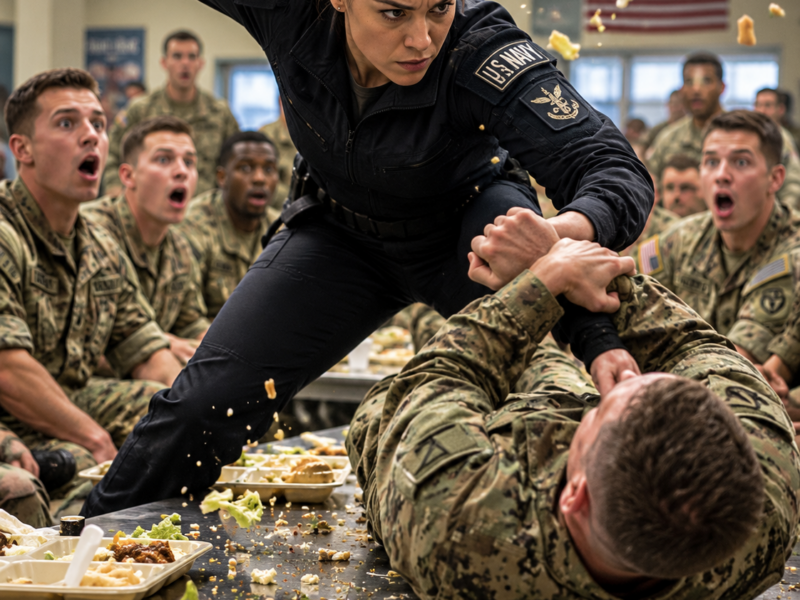
“Four recruits boxed me in beside the stainless-steel serving counter at the Navy training mess hall, laughing as one of them demanded I apologize for embarrassing him
I read the message again, then looked through the glass at Mason.
He was no longer watching the chief.
He was staring directly at me.
“Chief,” I said, keeping my voice low, “I need the names of everyone who had access to this report before it was withdrawn.”
Senior Chief Daniel Reeves took the paper from my hand and folded it once.
“Commander, I can get those names. But before I do, I need you to tell me whether we’re dealing with a training issue or something else.”
“I don’t know yet.”
That was the truth, and I hated how little of it I had.
My phone remained in my hand. The message had come from an unfamiliar number, with no name attached and no explanation of how the sender knew where I was.
Don’t trust the report. One of those four recruits was sent to find you.
I had spent enough years in the Navy to know that a warning without a name could be more dangerous than no warning at all.
“Can you trace the number?” I asked.
Reeves shook his head. “Not from here. We can preserve the message and refer it to the appropriate people.”
“Do that. And don’t mention it to the recruits.”
He studied my face. “You think one of them is involved?”
“I think somebody wants me to think one of them is involved.”
Before he could answer, the administration building’s side door opened.
A broad-shouldered officer in his late forties stepped outside, adjusting the cuff of his uniform as he walked toward us. Captain Robert Harlan had commanded the training group for nearly two years, and his name appeared on the top page of the evaluation packet I had received that morning.
He was also the officer whose signature had withdrawn Mason Cole’s disciplinary recommendation.
“Commander Bennett,” Harlan said, offering his hand. “I heard about the incident in the mess hall. I’m sorry your first day has started this way.”
I shook his hand.
His grip was firm, his expression sympathetic, and his eyes moved briefly to the paper in Reeves’s hand.
“An unfortunate misunderstanding,” he continued. “Young men sometimes let their pride get ahead of their judgment.”
“Four of them?”
His smile thinned.
“That’s why we have instructors.”
“Apparently, the instructors filed a report.”
Harlan glanced at Reeves.
The senior chief did not move.
“I assume you’ve seen the paperwork,” Harlan said.
“I have.”
“Then you’ll understand that the matter was reviewed.”
“By whom?”
“By me.”
He said it without hesitation.
I watched him carefully.
“And why was the recommendation withdrawn?”
“Insufficient evidence to support formal disciplinary action.”
“Was the original instructor interviewed?”
“Of course.”
“Was the report amended?”
Harlan paused.
“I’m not sure what you’re getting at, Commander.”
“I’m asking whether the report changed after the instructor submitted it.”
For the first time, his expression lost its practiced warmth.
“I’m happy to arrange a formal briefing. This isn’t the place for it.”
“That sounds reasonable.”
He seemed relieved.
Then I added, “I’ll need the original report, the amended version, the access log, and the names of everyone involved in the review.”
His relief vanished.
“That’s a fairly extensive request.”
“It’s an evaluation assignment.”
“I understand your assignment.”
“Then you understand why I need the records.”
For a moment, none of us spoke.
Finally, Harlan nodded.
“I’ll have my staff prepare the documents.”
“Please preserve the originals as they are. No further revisions.”
He gave me a short, stiff nod before returning inside.
Reeves waited until the door closed.
“You’ve worked with him before?”
“No.”
“Then what makes you suspicious?”
I looked at the folded report.
“Because I asked why a recommendation was withdrawn, and he answered a different question.”
Reeves considered that.
“That’s not proof of anything.”
“No,” I said. “It isn’t.”
I had learned the hard way that suspicion could ruin an innocent person’s career just as easily as it could expose a guilty one.
Mason Cole might have been a bully with an inflated sense of importance. He might have been a frightened young man trying to impress his friends. He might even have been the target of someone else’s manipulation.
I wasn’t going to decide which based on one message and a signature.
“Let’s speak to the four recruits separately,” I said. “No group interviews. No promises, no threats, and no suggestion that we’ve already decided what happened.”
Reeves nodded.
“And Commander?”
“Yes?”
“If that message is real, somebody knows you’re here.”
I slipped my phone into my pocket.
“Then let’s find out who.”
The first interview took place in a small conference room adjoining the training offices.
The walls were bare except for a clock and a framed photograph of a destroyer underway in rough seas. A young instructor named Lieutenant Aaron Price sat opposite me, his hands clasped on the table.
He had submitted the original report on Mason’s behavior.
“Tell me what happened two weeks ago,” I said.
Price described an exercise in which Mason had repeatedly ignored a partner’s instructions, escalated a controlled drill, and continued after the instructor ordered him to stop.
“Did anyone get hurt?”
“Minor bruising. Nothing that required medical treatment.”
“Then why did you recommend formal discipline?”
“Because it wasn’t an isolated incident. He’d been warned twice before.”
“What happened to your recommendation?”
“Captain Harlan said he’d review it.”
“Did he speak to you?”
“Yes.”
“What did he say?”
Price looked toward the closed door.
“He asked whether I might have misinterpreted Mason’s conduct. He said the recruit had been under unusual stress and that we should consider whether additional counseling would be more appropriate.”
“Was that a reasonable possibility?”
Price didn’t answer immediately.
“I thought so at first. Mason’s performance was excellent in some areas, and his temper seemed to get worse when he felt challenged. I was willing to consider that he needed help rather than punishment.”
“That sounds fair.”
“But then I saw the final report.”
“What was different?”
Price leaned forward.
“My original recommendation said Mason had deliberately continued the exercise after receiving a clear stop command. The final version said he had displayed poor judgment during an ambiguous training situation.”
“Who changed the wording?”
“I don’t know. My name was still on the document, but those weren’t my words.”
“Did you approve the change?”
“No.”
The answer came quickly enough that I believed he meant it.
“Did you confront Captain Harlan?”
“I asked him why the language had changed. He told me the command staff had reviewed it and that I should focus on training.”
“Did he threaten you?”
“No. He didn’t have to.” Price looked down at his hands. “My evaluation is due next month. I’m trying to earn a competitive assignment. I knew that arguing could make me look difficult.”
I let the silence settle between us.
“Lieutenant, did anyone tell you Mason was being evaluated for a special program?”
His head lifted.
“Not officially.”
“What does that mean?”
“A few weeks ago, an officer from outside the training group asked me about Mason’s performance. He wanted to know whether Mason followed instructions under pressure.”
“Do you remember his name?”
“Commander Ellis. I think he was attached to an operational training unit.”
“Did he tell you why he was asking?”
“No. He said it was routine.”
I wrote the name down.
“Did he ask about any other recruits?”
Price hesitated.
“He mentioned three others. I assumed he was comparing candidates.”
“Which three?”
“Mason Cole, Tyler Brooks, Evan Shaw, and Daniel Price.”
I looked up. “Daniel Price?”
“My brother. Different last name in the system because of a family adoption years ago. We aren’t in the same chain of command, and I disclosed the relationship when I took the instructor position.”
That was the first detail that didn’t fit neatly into the story.
“Is your brother one of the four recruits from the mess hall?”
“Yes.”
“Did you tell him about the disciplinary report?”
“No. I didn’t think it was appropriate.”
“Has he behaved aggressively during training?”
“Daniel? No. He’s quiet. Sometimes too quiet.”
“Why was he standing with Mason?”
Price rubbed his thumb along the edge of his watch.
“That’s what I’ve been trying to understand.”
When I left the room, I had more questions than answers.
Someone had taken an ordinary disciplinary report and altered its meaning. Someone had shown an unusual interest in four recruits. And one of the men involved had a family connection to the instructor whose report had been changed.
Those facts could be connected.
They could also be separate problems that happened to intersect.
I needed evidence.
The second recruit, Tyler Brooks, arrived wearing the expression of someone who had rehearsed an explanation in his head and was still unsure whether it would work.
He admitted that Mason had started the confrontation in the mess hall.
“He’s been on edge lately,” Tyler said. “He keeps asking whether any officers have been watching him.”
“Why would he ask that?”
“I don’t know.”
“Did he know I was coming to the facility?”
Tyler’s eyes flicked toward the door.
“I heard he thought someone from an operational unit might be here.”
“Who told him?”
“I can’t remember.”
“Try.”
He swallowed.
“Commander Ellis. He spoke to Mason after a training session last week.”
“What did he say?”
“I wasn’t close enough to hear all of it. But Mason came back and said he was getting his chance.”
“His chance to do what?”
Tyler shook his head.
“He didn’t say.”
I slid a blank sheet of paper across the table.
“Start with what you know. Leave out what you suspect.”
Tyler stared at the paper.
“Commander Ellis told Mason there might be an evaluation. He said the people conducting it would pay attention to how candidates handled pressure.”
“Did he tell Mason to approach me?”
“No.”
“Did he tell any of you to provoke an officer?”
“No, ma’am.”
“Then why did four of you surround me?”
Tyler’s face reddened.
“Mason thought you were making him look weak. We followed him because he’s the loudest guy in our group, and none of us wanted to be the one who walked away.”
“That’s an honest answer.”
“It doesn’t make it better.”
“No,” I said. “It doesn’t.”
For the first time, he looked directly at me.
“Are we all going to be kicked out?”
“I haven’t made any decisions. Neither should you.”
He nodded, but his shoulders remained tight.
Before he left, I asked one final question.
“Did anyone give Mason information about me?”
Tyler shook his head.
“Not that I know of. But when he saw you in the mess hall, he said something strange.”
“What?”
“He said, ‘That’s her.’”
My pen stopped.
“Her?”
“Yeah. I asked what he meant. He told me to mind my business.”
“Did he seem surprised to see me?”
Tyler thought for a moment.
“No. That’s what bothered me. He looked like he’d been waiting for somebody.”
By the time Mason entered the conference room, the afternoon light had shifted across the windows.
He sat down without being asked, his chin raised, but the confidence he’d displayed in the mess hall had become brittle.
I placed a printed copy of the incident report on the table.
“Tell me what happened.”
“You already know what happened.”
“I know what I saw. I’m asking for your account.”
He described my refusal to move, my comments about his behavior, and the physical exchange that followed. In his version, he had been trying to maintain order when I attacked him without warning.
I let him finish.
“Did you know who I was before you approached me?”
“No.”
“Then why did you say, ‘That’s her,’ when you saw me?”
His face changed.
For several seconds, he said nothing.
“Who told you that someone from an operational unit might visit the facility?” I asked.
He leaned back.
“I don’t know what you’re talking about.”
“Commander Ellis?”
His gaze dropped to the paper.
“I met him once.”
“When?”
“Last week.”
“What did he tell you?”
“That I might be considered for an advanced training opportunity.”
“Did he tell you to test me?”
“No.”
“Did he tell you to watch for a woman in Navy working clothes?”
Mason’s jaw tightened.
“He said there might be an evaluator who wouldn’t identify herself.”
“And what were you supposed to do if you encountered that evaluator?”
“Nothing.”
“Did you believe that?”
He looked at me, then away.
“He said the evaluation might not be announced.”
“That’s not an answer.”
Mason dragged a hand over his face.
“He told me that people sometimes reveal their real abilities when they think no one’s watching. He said I shouldn’t try to impress anyone, because the evaluators were looking for discipline.”
“And you thought surrounding me and demanding an apology would demonstrate discipline?”
“I didn’t know you were the evaluator.”
“But you thought you were being tested.”
He stared at the table.
“I thought I was being watched.”
The distinction mattered to him, though he couldn’t explain why.
“Did Commander Ellis tell you that you had to make me react?”
“No.”
“Did anyone else?”
Mason’s eyes lifted.
“No.”
He sounded angry now, but the anger had lost its direction.
“Commander, I know how it looks. I acted like an idiot. But I wasn’t trying to hurt you.”
“You grabbed at me.”
“I was trying to make you stand up.”
“Why?”
“Because you embarrassed me.”
There it was: the simplest explanation, and the one he’d been avoiding since the mess hall.
He had wanted control of a room, and when he couldn’t get it through respect, he’d tried to get it through intimidation.
“Did you know your disciplinary report had been withdrawn?” I asked.
He shook his head.
“No. I thought the matter was closed.”
“Who told you that?”
“Captain Harlan.”
“Did he tell you not to discuss the original incident?”
Mason hesitated.
“He said there was no point reopening it.”
“Did he mention your selection for the advanced opportunity?”
“Yes.”
“What did he say?”
“That I needed to show maturity if I wanted to be considered.”
Mason’s hands tightened together.
“I thought today might be my chance to prove I could handle myself.”
I looked at him for a long moment.
“You had a chance to handle yourself. You chose to surround someone and demand an apology.”
His eyes shone with humiliation, but he didn’t look away.
“I know.”
It was the first thing he’d said that sounded like genuine understanding.
I ended the interview without promising him anything.
The fourth recruit, Evan Shaw, was the one who unsettled me most.
He answered every question carefully, never volunteering more than I asked, and never seeming surprised by any of the subjects I raised.
When I asked whether Commander Ellis had spoken to him, he said yes.
When I asked whether Ellis had mentioned me, he said no.
When I asked why he’d followed Mason into the confrontation, he said he hadn’t wanted to leave his friends unsupported.
His answers were reasonable.
They were also incomplete.
“Evan, do you believe Mason was acting on someone’s instructions in the mess hall?”
“I believe Mason made his own decision.”
“That’s not what I asked.”
He folded his hands.
“I don’t have evidence that anyone instructed him to approach you.”
“Do you have evidence that someone did?”
His eyes met mine.
“No, ma’am.”
I waited.
Finally, he asked, “If someone did tell him to approach you, would that change how you view the incident?”
“It would change how I investigate it. It wouldn’t erase his choices.”
He seemed to consider that carefully.
“Then I think you should look at the training schedule for last Thursday.”
“Why?”
“Because the schedule doesn’t match what actually happened.”
“What happened last Thursday?”
He glanced at the door.
“I can’t explain it without the original records.”
I leaned forward.
“Then help me get them.”
He shook his head.
“I don’t have them. But Lieutenant Price does.”
“Your instructor?”
“Yes.”
“Why would he have records of an event that wasn’t on the schedule?”
Evan’s mouth tightened.
“Because he was there.”
Before I could ask another question, a knock sounded at the door.
Reeves entered carrying a folder and a sealed envelope.
“Commander, the records have arrived.”
He set the folder on the table.
“Captain Harlan’s office sent these over. The original report, the revised report, and the access log.”
I thanked him and opened the folder.
The first two documents confirmed what Lieutenant Price had said. The original report described a deliberate failure to follow a stop command. The revised version softened the language and reframed the incident as a misunderstanding.
The signature on the revision belonged to Harlan.
The access log showed that Commander Ellis had opened the report two days before Harlan withdrew the recommendation.
That alone wasn’t proof of misconduct. Ellis might have had a legitimate reason to review a candidate’s record.
But the final entry was dated the night before my arrival.
At 9:42 p.m., someone had accessed the file using Harlan’s credentials.
At 9:46 p.m., the document had been exported.
At 9:51 p.m., the revised report had been uploaded.
I looked at Reeves.
“Who was physically in Harlan’s office last night?”
“I don’t know yet.”
“Find out. Preserve the building access records, the system audit logs, and the original files.”
He nodded and left.
I opened the sealed envelope.
Inside was a printed training schedule for the previous Thursday.
One event had been crossed out in black ink: a closed evaluation involving the four recruits and an unidentified observer.
Beneath it, in handwriting I recognized from the revised report, were five words.
Observe Bennett. Do not engage.
For several seconds, I could hear only the hum of the ventilation system.
Someone had known I was coming.
Someone had used my name.
And someone had apparently told four young recruits to observe me, while making sure at least one of them believed he was being evaluated.
I turned the paper over.
There was a handwritten time and a room number.
The room was an equipment storage area in a building scheduled for maintenance that evening.
“Chief,” I said when Reeves returned, “I need you to find out who wrote this.”
He studied the handwriting.
“Looks like Harlan’s.”
“Maybe. But I want it verified.”
Reeves nodded toward Evan, who was still seated at the other end of the table.
“Should I send the recruit back to his unit?”
“Not yet.”
Evan watched me with an expression that was almost apologetic.
“I told you to check the schedule,” he said.
“You did.”
“I didn’t tell you everything.”
“No,” I replied. “You didn’t.”
He looked at the envelope.
“There’s a reason.”
“Then tell me.”
Evan’s fingers moved against the edge of the table.
“My brother was in that evaluation.”
I glanced at his personnel record.
“You have a brother in the Navy?”
“Not here. He’s a civilian contractor. He worked on a training system that was being tested at this facility.”
“What system?”
“I don’t know all the technical details. He told me it was designed to record how people respond under pressure, including what they say and do when they think they’re being watched.”
“Was it used on recruits?”
“He said it wasn’t supposed to be.”
The room seemed smaller.
“Did he tell you who authorized the evaluation?”
Evan shook his head.
“He said the project was suspended after somebody complained that the results were being used to make personnel decisions without proper oversight.”
“Who complained?”
“I don’t know. My brother stopped talking about it after that.”
“What’s his name?”
“Luke Shaw.”
I wrote it down.
“Can you contact him?”
“He won’t answer my calls.”
“Why not?”
Evan looked at the floor.
“Because he thinks I’m the reason he lost his contract.”
That was the first time his composure broke.
He explained that he had once mentioned the project to another recruit, assuming it was harmless. Within days, his brother had been questioned about an apparent disclosure of confidential information. Luke denied giving him anything sensitive, but his contract was not renewed.
Evan had spent months believing he had damaged his brother’s career by talking too freely.
Now he suspected that somebody had deliberately used their relationship to keep him quiet.
“I didn’t surround you because I wanted to hurt you,” he said. “I followed Mason because I thought if I stayed close, I might learn whether he knew anything about the project.”
“You could have walked away and reported your concerns.”
“I know.”
“Why didn’t you?”
He swallowed.
“Because I was afraid they’d do to me what they did to Luke.”
I let that sit between us.
Fear could explain a decision. It could not make the consequences disappear.
“You’ll need to put what you know into a formal statement,” I told him. “And you’ll need to understand that the statement may have consequences for you and your brother.”
He nodded.
“I understand.”
When he left, I remained in the conference room with the papers spread before me.
The pieces were beginning to form a pattern, but the center was still missing.
A suspended training project.
An altered disciplinary report.
Four recruits told to expect an unidentified evaluator.
My arrival, known in advance by someone who apparently had no reason to know the details of my assignment.
And a message warning me not to trust the report.
At 6:15 p.m., Reeves returned with the building access records.
“Captain Harlan was in his office last night,” he said. “So was Commander Ellis. They arrived separately and left within minutes of each other.”
“Anyone else?”
“One person entered the building using a temporary maintenance badge. The badge was issued under a contractor’s name, but the photograph doesn’t match the identification on file.”
“Can we identify the person?”
“Not yet. The camera covering the side entrance was offline for maintenance.”
“Convenient.”
“Possibly. The maintenance request was submitted three days ago.”
I looked at the schedule again.
The storage room number matched the room listed beneath the crossed-out evaluation.
“Can you get us access to that room?”
Reeves hesitated.
“It’s currently restricted. Captain Harlan’s office has the authorization.”
“Then request it through the proper channel.”
“And if he refuses?”
“Record the refusal.”
Reeves gave me a brief nod and stepped into the hall to make the call.
Ten minutes later, he returned.
“Harlan says the room contains routine equipment and that there’s no reason for you to inspect it.”
“Did he give a reason for the restriction?”
“He said the area is part of a separate project.”
“Which project?”
“He wouldn’t specify.”
I looked at the clock.
The message on my phone remained unanswered. Whoever had sent it had not contacted me again.
I considered waiting until morning, when the relevant authorities could coordinate a formal inspection.
That would be the cleanest choice.
It would also give whoever had arranged the evaluation another night to move whatever they wanted moved.
I picked up the folder.
“I’m not going to enter a restricted area without authorization,” I said. “But I’m going to request an immediate preservation order for anything connected to that project.”
Reeves nodded.
“I’ll make the calls.”
I spent the next hour documenting what we had found and forwarding the evidence through the appropriate command channels. I did not accuse Harlan of a crime. I did not label Ellis a conspirator. I described the discrepancies, the access records, the recruits’ statements, and the anonymous warning.
By the time the preservation order was acknowledged, the building had grown quiet.
At 8:03 p.m., my phone vibrated again.
This time, the message included a photograph.
It showed a narrow room with metal shelves, stacked equipment cases, and a table covered in electronic components.
At the far end stood a man in civilian clothes, his face turned away from the camera.
The caption read:
They know you found the room. Get there before they erase the original recording.
I stared at the photograph.
Then I noticed the reflection in the glass cabinet beside the man.
A second figure stood behind the camera.
The reflection was blurry, but the posture was unmistakable.
Captain Harlan.
I called Reeves.
“Don’t go anywhere alone,” I told him. “We have a new piece of evidence.”
Within minutes, the preservation team confirmed that the storage room was included in the order. We were authorized to secure the area and document its contents, with the appropriate personnel notified.
Reeves and I went together.
The corridor outside the room smelled of floor polish and old dust. A maintenance cart stood against the wall, its wheels still damp from cleaning.
The door was locked.
Reeves used the authorized access procedure while I checked the surrounding hallway for anyone who might be waiting.
When the door opened, the first thing I noticed was the silence.
The room was too quiet for one filled with electronics.
Rows of metal shelves held cases labeled with inventory numbers. A monitor sat on a folding table beside a rack of recording equipment. Several cables had been disconnected and laid neatly on the floor.
Someone had tried to make the room look unused.
They had done it in a hurry.
Reeves stayed near the entrance while I moved toward the table.
A small red light blinked on the monitor.
The screen displayed a file directory, most of the entries marked as deleted.
One file remained.
Its name was a date, followed by four initials.
MC. TB. ES. DP.
Mason Cole. Tyler Brooks. Evan Shaw. Daniel Price.
I didn’t touch the equipment.
“Photograph everything,” I said. “Get the technical team here before anyone attempts recovery.”
Reeves radioed the request.
As we waited, I examined the labels on the cases. One bore the name of the suspended training project Evan had described. Another had a handwritten note taped to its lid.
Observer response data — restricted.
I stepped back.
The room wasn’t merely storing training equipment.
It had been used to collect information about people, and somebody had gone to considerable trouble to conceal the fact that the project continued after it was supposedly suspended.
The technical team arrived and began documenting the system.
They recovered a fragment of a recording from the remaining file, but the audio was corrupted. The video showed the four recruits seated around a table while an unseen voice asked them questions about authority, obedience, and their reactions to being evaluated.
Mason looked uncomfortable.
Tyler kept glancing at the door.
Evan sat with his hands folded.
Daniel Price barely moved at all.
Then the camera angle changed.
A woman entered the room.
She was wearing ordinary Navy working clothes, her hair secured in a tight bun.
My clothes.
My posture.
My face, turned slightly away from the camera.
The footage had been recorded before I arrived at Great Lakes.
For several seconds, I couldn’t make sense of what I was seeing.
Then I recognized the source.
It was a recording from a previous training exercise I had participated in months earlier at another facility. The footage had been captured for a separate professional review, under controlled conditions, and was not supposed to have been copied into this system.
Someone had taken my image from an authorized recording and inserted it into a new evaluation.
The recruits hadn’t been told to find a random evaluator.
They had been shown me.
The video ended before the audio could be recovered.
I stood very still while the technical team continued working.
Reeves approached quietly.
“Commander, does this mean they knew who you were?”
“They knew what I looked like.”
“Is that different?”
“It might be.”
I looked at the screen again.
The woman in the footage was me, but the recording said nothing about why my image had been used or what the recruits had been told.
It didn’t prove Mason had been instructed to provoke me.
It didn’t prove Harlan had ordered the project to continue.
It did prove that somebody had used material from an unrelated evaluation to create a connection between my arrival and a group of recruits.
And that meant my assignment had been compromised before it began.
The next morning, the investigation expanded.
The original recording was preserved, the system was secured, and the access records were sent for independent review. Captain Harlan and Commander Ellis were directed to provide formal statements.
Neither was permitted to oversee the review of the project.
Mason, Tyler, Evan, and Daniel were removed from the evaluation process pending further inquiry.
I met with them separately once more.
Mason was the last to arrive.
He stood in the doorway, his face pale from a night without much sleep.
“Commander, can I ask you something?”
“Yes.”
“Were you actually testing us?”
“No.”
He looked down.
“Then why did they show us your picture?”
“That’s what we’re trying to find out.”
He took a breath.
“I thought if I could prove I wasn’t afraid of you, I’d finally get picked for something that mattered.”
“Who told you that?”
“No one said it exactly like that. I put it together myself.”
He looked embarrassed, but he didn’t hide behind anger this time.
“I wanted to be the guy who could handle anything. I thought if I looked weak, I’d never get a chance.”
“You weren’t asked to prove you could intimidate someone,” I said. “You were responsible for deciding what kind of person you wanted to be when you felt challenged.”
His eyes dropped to the floor.
“I know.”
“Do you?”
He was silent for a long moment.
“I think I’m starting to.”
I didn’t forgive him on behalf of the woman he’d cornered in the mess hall, or pretend that a single conversation had changed his character. He still had to face the consequences of his conduct.
But I believed he was finally looking at the incident honestly.
Tyler submitted a complete statement, acknowledging that he had followed Mason out of fear of losing his place in the group.
Daniel Price admitted he had suspected the evaluation was improper but had remained silent because he didn’t want to jeopardize his future.
Evan provided the information he had about the suspended project and agreed to contact his brother through the investigators.
Lieutenant Price’s original report was restored to the personnel record, with a notation explaining that its wording had been altered without his approval.
The inquiry found that the training project had continued beyond its authorized scope. Personnel had used recordings from unrelated exercises, accessed restricted files, and collected behavioral data without the required oversight.
The evidence did not establish that every person involved had understood the full extent of the misconduct.
It did establish that the evaluation process could no longer be trusted.
Captain Harlan was removed from his oversight role while the investigation proceeded. Commander Ellis was reassigned pending a separate review of his involvement. The person who had sent the anonymous messages was eventually identified as a civilian technician who had worked on the project and feared the records would be destroyed.
His warning had been incomplete, but it had been genuine.
He had not known whether Mason had been ordered to confront me. He had known that someone was using my image to influence the recruits, and he had seen the original recording scheduled for deletion.
That was why he had contacted me.
Months later, after the investigation had concluded, I returned to Great Lakes for a meeting with the training staff.
The mess hall looked exactly as it had on my first day: bright lights, metal trays, crowded tables, and the smell of coffee that had been sitting too long.
I stood near the serving counter for a moment, remembering the fallen tray and Mason’s face as the room went silent.
Then I noticed him at a table near the windows.
He was eating alone.
When he saw me, he stood immediately.
“Commander Bennett.”
“Recruit Cole.”
He glanced at the empty chair across from him.
“Would you like to sit?”
I considered the invitation, then set my tray down.
For a while, we ate without talking.
Finally, he said, “I received my disciplinary decision last week.”
I waited.
“I’m staying in training, but I’m on probation. I have to complete additional leadership work and repeat the conduct evaluation.”
“How do you feel about that?”
He turned his fork between his fingers.
“Part of me thinks it’s unfair because the evaluation was manipulated.”
“And the other part?”
“The other part knows nobody forced me to surround you.”
I nodded.
“That distinction matters.”
“I used to think leadership meant never backing down,” he said. “Now I think maybe it means knowing when you’re wrong before somebody else has to make you see it.”
He gave a small, uncomfortable laugh.
“I wish I’d figured that out before the tray hit the floor.”
“So do I.”
Across the room, Tyler was helping a new recruit find a seat. Daniel was speaking with an instructor near the exit. Evan had transferred to a different training group while the remaining questions about his brother’s contract were reviewed.
None of them had become a different person overnight.
They were simply facing the consequences of what they had done, and learning that a uniform could not make a bad decision disappear.
Mason looked at me again.
“Can I ask you one more thing?”
“Go ahead.”
“When you stood up that day, I thought you were just another officer who was going to tell me to behave.”
“What changed your mind?”
He thought about it.
“You didn’t try to humiliate me after you could have. You just stopped me.”
I folded my napkin beside my tray.
“Stopping someone and humiliating them aren’t the same thing.”
“I know that now.”
I believed he understood the words.
Whether he would live by them was something time would have to answer.
When I left the mess hall, the afternoon sun was shining across the windows, and the lake beyond the base looked calm beneath a pale sky.
I had arrived at Great Lakes expecting to evaluate a training program.
Instead, I had found a system in which people had mistaken surveillance for leadership, silence for loyalty, and intimidation for strength.
The investigation would produce reports, disciplinary decisions, and new procedures. Those things mattered. They were necessary.
But the moment I remembered most clearly wasn’t the recovered recording or the signature on the altered report.
It was the instant Mason looked around the mess hall and realized his friends were no longer laughing.
For forty-five seconds, he had believed that power meant making another person back down.
It took much longer for him to understand that the harder test had begun when nobody was forcing him to do anything at all.
THE end.









