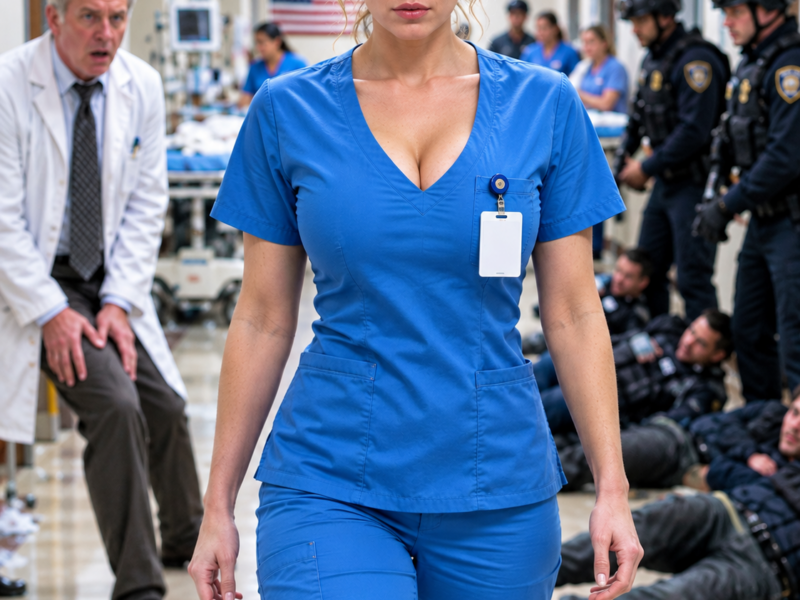
“Dr. Mitchell screamed at me in front of a packed emergency room, telling me I was just a nurse and had no right to question him
The man holding my sister’s military ID tag stood in the middle of the emergency room, his weapon pointed toward the floor.
“Rebecca Hayes,” he said. “You need to come with us.”
I looked at the tag swinging between his fingers. Sarah’s name was still engraved on it. The same tag Major Ellison had once placed in my hands after telling me my sister had died in a military transport accident eight years earlier.
“You’re making a mistake,” I said.
The man shook his head. “No. The mistake was letting you believe she was dead.”
Behind him, the other armed men spread through the emergency department. Patients were crying. A child clung to his mother. Dr. Mitchell stood frozen beside the nurses’ station, his face pale.
Thomas Miller, the wounded man on the gurney, struggled to lift his head.
“Don’t listen to him,” he rasped. “He doesn’t work for Sarah.”
The armed man turned toward him.
And in that instant, I understood something that made my blood run cold.
These men hadn’t come to the hospital because of Thomas.
They had come because of me.
I had spent eight years learning how to keep my hands steady when someone was bleeding. I had learned to control my breathing, make decisions under pressure, and keep fear from interfering with the work that needed to be done.
But nothing in my training had prepared me for seeing my sister’s name on the ID tag of a man pointing a gun at my patients.
“Everybody down!” I shouted.
The emergency room erupted into motion.
I grabbed the nearest rolling medical cart and shoved it hard into the man’s knees. His weapon clattered across the floor. Before he could recover, I drove my shoulder into his chest and sent him crashing against the wall.
A second man lunged toward me.
I ducked beneath his arm, caught his wrist, and twisted until he lost his grip on his weapon. The gun skidded beneath a row of chairs.
I wasn’t thinking about fighting.
I was thinking about keeping those weapons away from the people lying helpless in hospital beds.
Someone screamed. Glass shattered. A security guard shouted from the entrance.
Then the emergency lights flashed red.
“Rebecca!” Thomas yelled.
I turned.
A third man had reached his gurney. He was reaching beneath the blanket, searching for something.
Thomas caught his wrist.
“Not here,” Thomas growled. “You don’t get it here.”
The man struck him across the face.
I grabbed a metal instrument tray and slammed it against the man’s forearm. He stumbled backward, and two hospital security officers rushed in from the corridor.
Within seconds, the man was on the floor.
The others had scattered.
One ran toward the ambulance entrance. Another disappeared through the corridor leading to radiology. The remaining men were intercepted by security and two officers who had arrived after the first emergency call.
The man with Sarah’s tag was still on the floor, breathing hard.
I knelt beside him and picked up the tag.
“Where did you get this?”
He stared at me.
“You should ask Major Ellison.”
My stomach tightened.
“Where is my sister?”
He gave a thin, humorless smile.
“Room 214.”
Then he closed his eyes and refused to say another word.
For several seconds, I could hear nothing except the monitor beside Thomas’s bed.
Room 214.
The words seemed to echo through my head.
Eight years earlier, Major Robert Ellison had sat across from me in a small government office and explained that Sarah’s transport had crashed during a classified operation. He told me there had been no survivors. He said the remains were too badly damaged for a proper identification, but that her personal effects had been recovered.
He had given me Sarah’s necklace.
He had looked me in the eyes and told me to go home.
I had believed him.
Now a stranger carrying my sister’s military tag was telling me she might still be alive.
“Rebecca.”
Dr. Mitchell’s voice pulled me back.
He stood beside me, one hand pressed against a cut on his forehead.
“Are you hurt?”
I shook my head.
“Check the patients,” I said. “Make sure nobody was hit.”
“I’ve already called for additional staff.”
“Then check Thomas.”
Thomas was conscious, but barely. Blood ran from a cut above his eyebrow.
I moved to his bedside.
“Who are you?” I asked.
He swallowed.
“My name is Thomas Miller. I worked with your sister.”
“Worked with her where?”
“Afghanistan. Later, on a classified communications operation.”
“What does Room 214 mean?”
His eyes moved toward the armed man on the floor.
“Not here.”
“You brought this into my hospital. You don’t get to tell me not to ask questions.”
He looked at me for a long moment.
“Your sister sent me to find you. She said you were the only person she could trust outside the operation.”
“Why me?”
“Because you’re her family. Because you never stopped asking questions. And because she knew they would never suspect you.”
I felt my throat tighten.
“Is she alive?”
Thomas closed his eyes.
“I believe she is.”
That was not the answer I wanted.
It was the first honest answer anyone had given me in eight years.
Before I could ask anything else, two federal agents entered the room. One was a tall woman with dark hair pulled into a tight bun. The other was a broad-shouldered man carrying a tablet.
The woman showed her badge.
“Agent Lena Foster, FBI. Who is Rebecca Hayes?”
“I am.”
“We need to speak with you.”
“I need to speak with him first.”
She glanced at Thomas.
“Mr. Miller is being transferred to a secure medical facility. We have reason to believe this incident is connected to a federal investigation.”
“Then you can explain why men with guns came into my emergency room carrying my dead sister’s identification.”
Agent Foster’s expression changed.
She looked at the tag in my hand.
“Where did you get that?”
“From the man who said my sister was alive.”
The agent exchanged a glance with her partner.
“Rebecca, we need you to come with us.”
“No.”
“Your safety is at risk.”
“My safety became your concern about ten minutes ago. My sister has been missing for eight years. I’m not leaving until someone tells me what is happening.”
Agent Foster lowered her voice.
“Your sister was never officially confirmed dead.”
The room seemed to tilt.
“What?”
“The transport crash was reported as a total loss. But the identification process was incomplete. The operation was classified, and several records were sealed.”
“Major Ellison told me she was dead.”
“Major Ellison may have been working with incomplete information.”
“Or he lied.”
Agent Foster didn’t answer.
That silence told me more than her words.
I looked back at Thomas.
“Room 214,” I said. “Where is it?”
He shifted painfully.
“Fort McPherson. The old communications facility.”
Agent Foster immediately stiffened.
“That’s not possible.”
“Why?”
“Because that building has been closed for years.”
Thomas gave a weak laugh.
“Officially.”
He reached beneath the blanket and pulled out a small metal key attached to a plastic tag.
The number 214 was written across it in faded black ink.
He pressed it into my palm.
“Your sister wanted you to have this.”
I stared at the key.
“What does it open?”
“Something she hid before they took her.”
“Who took her?”
Thomas glanced toward Agent Foster.
“Ask Richard Cross.”
The name meant nothing to me.
But it meant something to the agent.
Her jaw tightened.
“Mr. Miller, you need to stop talking.”
“Why?” he whispered. “Because his name is still protected?”
Agent Foster turned toward her partner.
“Get him out of here. Now.”
Two medical personnel arrived with a secure transport team. Thomas was moved carefully onto another stretcher.
Before they wheeled him away, he caught my hand.
“Rebecca, listen. If you find Sarah, don’t trust anyone who tells you the operation was a mistake.”
“Was it?”
His eyes filled with exhaustion.
“No. It was a warning. Someone discovered what they were doing, and your sister tried to stop it.”
Then he was gone.
Agent Foster escorted me into a private consultation room.
The door closed.
For the first time since the attack, the noise of the emergency department faded.
She placed a tablet on the table.
“I’m going to show you something. I need you to understand that once you see it, your life will not go back to the way it was.”
“I think we’re already past that point.”
She tapped the screen.
A photograph appeared.
A woman stood in front of a concrete building, her dark hair shorter than I remembered, her face thinner, and a pale scar running from her left temple toward her cheek.
But I knew those eyes.
I knew the way she tilted her head when someone was taking a photograph.
I knew the tiny crooked smile she had never quite managed to hide.
“Sarah,” I whispered.
The picture was dated six days earlier.
I reached for the tablet, but Agent Foster held it still.
“Where did you get this?”
“It was recovered from an encrypted message sent to Thomas.”
“Where is she?”
“We don’t know.”
I stared at the date again.
Six days.
My sister had been alive six days ago.
Eight years of grief suddenly became something else. Anger. Hope. Terror. A thousand questions with no place to go.
“Why didn’t you tell me?”
“Because the people involved have been monitoring your sister’s family for years. We couldn’t risk exposing her location.”
“You let me bury her.”
Agent Foster looked down.
“I know.”
“No, you don’t.”
I stood so quickly the chair scraped against the floor.
“You don’t know what it was like to receive a box of personal belongings and be told there would be no funeral. You don’t know what it’s like to keep a bedroom untouched because you can’t accept that someone is gone. You don’t know what it’s like to call a number that no longer exists just to hear the voicemail greeting.”
My voice broke.
“You knew there was a chance she was alive.”
Agent Foster didn’t defend herself.
Instead, she turned the tablet around.
There was a second image.
A close-up of a handwritten note.
The writing was unmistakable.
Becca. If you’re seeing this, I need you to finish what I couldn’t. Room 214. Bring the key. Trust no one who says the truth is classified.
I covered my mouth.
Sarah had called me Becca since we were children.
No one else did.
“Why would she send this to me?”
“Because she believes the key opens a storage compartment containing evidence that could expose the people responsible for the operation.”
“Richard Cross?”
Agent Foster nodded.
“Richard Cross was a defense contractor. His company maintained communications equipment for several overseas operations. Eight years ago, we discovered that information from a classified mission had been diverted to unauthorized buyers.”
“And my sister discovered it?”
“She discovered something more serious. The operation was being used to move people and intelligence assets without proper authorization. When she tried to report it, the records disappeared.”
“Who was responsible?”
“We believe Richard Cross coordinated the operation. His brother Daniel handled security and recovery.”
I thought of the man in the emergency room.
The one holding Sarah’s tag.
“Daniel was one of the men who came for Thomas.”
“Yes.”
“Why did he have her identification?”
“We don’t know whether it was taken from her or given to him.”
I looked down at the key in my palm.
“And Major Ellison?”
Agent Foster took a breath.
“Ellison was the officer who signed the original mission report. He has been cooperating with our investigation, but we haven’t established how much he knew.”
“He told me Sarah was dead.”
“I know.”
“Then I want to hear it from him.”
Agent Foster hesitated.
“He’s on his way.”
Twenty minutes later, Major Robert Ellison entered the consultation room.
He looked older than I remembered. His hair had turned almost completely gray, and his shoulders seemed to carry more weight than his uniform did.
For eight years, I had remembered him as the man who delivered the worst news of my life.
Now I saw him as a man who might have helped make it happen.
“Rebecca,” he said quietly.
“Don’t.”
He stopped.
I placed Sarah’s tag on the table.
“Tell me why you gave me her necklace.”
His eyes dropped to it.
“Because it was recovered from the crash site.”
“You told me there were no survivors.”
“At the time, that’s what the report said.”
“Was the report false?”
He didn’t answer immediately.
That was enough.
“You knew,” I whispered.
“I knew there were inconsistencies.”
“You knew she might be alive.”
“I suspected.”
I felt something inside me harden.
“Eight years.”
“I was ordered not to discuss the operation.”
“You were ordered to let me believe my sister was dead?”
He looked away.
“I thought keeping you out of it would keep you safe.”
“Did it?”
His face tightened.
“No.”
I leaned toward him.
“Where is she?”
“I don’t know.”
“Then why are you here?”
“Because I can take you to Fort McPherson.”
Agent Foster stepped between us.
“Major, you’re not authorized to take her anywhere.”
“I know the facility better than anyone in this room.”
“You’re also a potential witness.”
“Then let me be one.”
I studied his face.
There was fear in his expression, but something else too.
Guilt.
“Why did you wait eight years?” I asked.
“Because I believed the people responsible were untouchable. And because I was afraid that if I spoke, they would come after you.”
“They came after me anyway.”
He nodded.
“I know.”
Agent Foster turned to me.
“We’re not going to Fort McPherson without a full team.”
“Fine,” I said. “But I’m going.”
“Rebecca—”
“My sister sent me that message. She sent Thomas to find me. She left that key for me. If there’s even a chance she’s alive, I’m not staying behind while everyone else decides what I can handle.”
Agent Foster watched me for a long moment.
Then she nodded.
“You’ll be under our protection. You follow every instruction. If I tell you to stop, you stop.”
I closed my fingers around the key.
“Agreed.”
We left the hospital just after midnight.
The city was quiet, but I couldn’t stop seeing the photograph of Sarah. Every red light felt like a delay. Every passing car made me wonder whether someone was following us.
Agent Foster drove. Her partner, Agent Cole, sat beside her. Major Ellison rode in the back with me.
No one spoke for the first fifteen minutes.
Then Ellison finally broke the silence.
“Your sister was one of the best people I ever served with.”
I kept my eyes on the window.
“Then you should have protected her.”
“I tried.”
“Not hard enough.”
He accepted that without argument.
After a moment, he said, “The night of the crash, Sarah discovered that mission records had been altered. She found proof that equipment assigned to our unit had been used to intercept communications from another operation.”
“Why would anyone do that?”
“To identify informants. To expose safe locations. To sell information to people who would pay for it.”
“Who?”
“Richard Cross had access to the systems. Daniel managed the teams that recovered equipment and personnel.”
“And Sarah?”
“She copied the records. Before she could deliver them, her transport was attacked.”
I turned toward him.
“Was it an accident?”
“No.”
The word landed between us like a stone.
“Who attacked it?”
“We believe Daniel Cross arranged it. The aircraft went down, but Sarah survived. A recovery team found her before our people could reach the site.”
“And they took her?”
“Yes.”
“Why didn’t you tell anyone?”
“I reported the discrepancy. The report disappeared. I was warned that the operation had been compromised at a level I couldn’t challenge.”
“So you did nothing.”
“I kept looking.”
“For eight years?”
“I used every contact I had. I followed rumors, false names, and dead ends. Three years ago, I found a reference to a woman held under an unidentified personnel record. It was the first time I believed Sarah might still be alive.”
I stared at him.
“And you still didn’t tell me.”
“I had no proof. And the people who held her were watching you.”
I looked away.
I wanted to hate him. Part of me did.
But I also knew that hatred would not bring Sarah home.
The vehicle turned through an old industrial district. Beyond a chain-link fence, the abandoned buildings of Fort McPherson rose against the night sky.
The communications facility was a long concrete structure with boarded windows and a rusted metal entrance.
Agent Foster parked behind a row of overgrown trees.
“From here, we move together,” she said.
She handed me a small earpiece.
I put it in.
“Stay behind us. Do not touch anything unless I tell you.”
I nodded.
Ellison approached the entrance and used a keycard. The lock flashed red.
He tried again.
Nothing.
“Someone changed the access system,” he muttered.
Agent Cole examined the panel.
“Power’s still active.”
He connected a small device.
A moment later, the lock clicked.
The door opened with a low groan.
Inside, the air smelled of dust, damp concrete, and old electrical equipment.
Our flashlights moved across rows of cabinets and abandoned desks.
“Room 214 is on the second floor,” Ellison said.
We climbed a narrow staircase.
At the end of the corridor was a metal door with a faded number.
214.
I stopped.
For eight years, I had imagined Sarah’s last moments in a hundred different ways. I had imagined a crash, a fire, a lonely burial in a place I would never see.
Now I was standing outside a room that might contain the reason she had disappeared.
Agent Foster raised one hand.
“Wait.”
She examined the door and the floor around it.
A thin wire ran from the doorframe to a small device mounted near the wall.
“Don’t move.”
She signaled Agent Cole.
He crouched and studied the mechanism.
“Not an explosive,” he whispered. “Alarm trigger.”
He disconnected the wire.
Agent Foster nodded to Ellison.
“Open it.”
Ellison pushed the door.
It swung inward.
The room was almost empty.
A metal desk stood against one wall. A chair lay on its side. Shelves held dusty binders and several plastic storage boxes.
On the desk sat a small black recorder.
I moved toward it.
Agent Foster stopped me.
“Let me check it.”
She examined the recorder, then nodded.
“It’s safe.”
I picked it up.
A strip of tape had been placed across the front.
In Sarah’s handwriting were two words.
For Becca.
My knees almost gave way.
I pressed the play button.
At first there was static.
Then a familiar voice filled the room.
“Becca, if you’re hearing this, it means Thomas found you. I hope he made it. I hope you didn’t come alone, even though I know you probably wanted to.”
I pressed my hand against my mouth.
Sarah continued.
“I don’t know how much time I have. I don’t know who will find this recording. But I need you to understand something. I didn’t die in that crash.”
A shaky breath.
“I survived. I was taken by men working for Richard Cross. They wanted the files I copied. They wanted the names of everyone who had helped me.”
Her voice became quieter.
“I refused to give them the names. I thought if I stayed silent, I could keep the others safe. I thought someone would come for me.”
There was a pause.
“Ellison tried. I know that now. But he couldn’t get close enough.”
I glanced at the major.
He looked down.
Sarah continued.
“Richard Cross used the communications network to sell information. He knew which units were moving, which routes were safe, and which people were helping us. The crash was arranged to erase the evidence and make sure I couldn’t testify.”
The recording crackled.
“Daniel is more dangerous than Richard. Richard wants money. Daniel wants control. He has been moving people and records for years.”
I looked at Agent Foster.
She was listening without moving.
Sarah’s voice softened.
“Becca, I know you spent years believing I was gone. I’m sorry. I am so sorry. I wanted to contact you, but every attempt put you in danger. They knew your name. They knew where you worked. They knew what time you left the hospital.”
My stomach turned.
“They used you as leverage. They told me if I ever contacted you, they would hurt you.”
A faint sound came through the recording, like a door closing.
“I found a way to hide the original files. The key Thomas gave you opens the storage compartment beneath the desk. The files are there. They include the names, the payments, and the orders that prove what happened.”
I looked down at the desk.
There was a small metal lock beneath it.
I inserted the key.
It turned.
A narrow compartment slid open.
Inside was a sealed waterproof case.
Agent Foster opened it carefully.
There were several memory cards, a stack of printed documents, and a small envelope.
The envelope had my name written on it.
I opened it with trembling fingers.
Inside was a photograph of Sarah and me as children, standing in front of our old house. I was eight, and Sarah had one arm around my shoulders.
On the back, she had written:
You were always braver than you knew.
I pressed the photograph against my chest.
Then the recording continued.
“If you found the files, don’t hand them to anyone who isn’t part of an independent investigation. I don’t know who can be trusted anymore. I don’t know how far Richard’s people have reached.”
A pause.
“I’m being held at a place called the North Annex. It’s outside the city. I don’t know the exact address, but I heard them mention a water tower and an old rail line. If I get out, I’ll try to reach you.”
The recording ended with a soft click.
For a moment, nobody moved.
Then Agent Foster took the case.
“North Annex,” she said. “We need to identify that location.”
Ellison was staring at the photograph.
“She was alive when she made this.”
“When?” I asked.
He checked the recorder.
“The recording file has a date. Three weeks ago.”
My heart hammered.
“Then she could still be there.”
Agent Foster nodded.
“We’ll find it.”
A sudden noise echoed from the corridor.
Footsteps.
Agent Cole raised his weapon.
“Someone’s coming.”
Agent Foster pulled me behind the desk.
Ellison moved toward the door.
“Major, don’t,” she whispered.
The footsteps stopped outside.
Then a voice spoke.
“Robert. I know you’re in there.”
Ellison went pale.
Agent Foster mouthed a name.
“Cross.”
The door opened.
Daniel Cross stepped into the room.
He wore a dark coat and held a pistol low against his thigh. Two men stood behind him.
He looked at the open storage compartment.
Then at the recorder.
Finally, his eyes settled on me.
“Rebecca Hayes,” he said. “You really should have stayed at the hospital.”
Agent Foster stepped out from behind the desk.
“FBI. Put your weapon down.”
Daniel smiled.
“Lena. Still cleaning up other people’s messes?”
“Drop it.”
He glanced at Ellison.
“You brought her here?”
Ellison stood rigid.
“I brought the evidence out of hiding.”
“You should have left it there.”
Daniel looked at me again.
“Your sister has caused a lot of trouble.”
“Where is she?”
His smile disappeared.
“You don’t understand what you’re asking.”
“I understand that she’s alive.”
For the first time, his expression shifted.
Just slightly.
“You’ve heard the recording.”
“Where is the North Annex?”
Daniel said nothing.
Agent Cole moved a fraction to his left.
One of Daniel’s men noticed and raised his weapon.
“Don’t,” Agent Foster warned.
The next few seconds happened too quickly.
Daniel lunged toward the desk. Agent Foster moved to intercept him. A gunshot cracked through the room, striking the wall above us.
I dropped to the floor.
Agent Cole tackled one of the men. Ellison grabbed the other by the arm and drove him against the doorframe.
Daniel reached for the waterproof case.
I kicked it beneath the desk.
He turned toward me.
“You have no idea what you’ve just done.”
I stared at him.
“I know exactly what I’ve done.”
He raised his pistol.
Before he could fire, Agent Foster struck his arm. The weapon hit the floor, and Agent Cole forced Daniel face-down against the concrete.
The room fell silent except for our breathing.
Agent Foster handcuffed him.
“Daniel Cross, you’re under arrest.”
He laughed against the floor.
“You think this ends with me?”
“No,” she said. “I think it starts with you.”
The two men with him were secured. Agent Cole checked the corridor and called for backup.
I picked up the waterproof case.
“Can the files tell us where Sarah is?”
Agent Foster nodded.
“If they’re complete.”
“Then let’s find out.”
We spent the next hour reviewing the documents in a secure vehicle outside the facility.
The files included payment records, mission schedules, altered personnel reports, and encrypted communications between Richard Cross and several officials.
There were also references to a property listed as North Annex.
The address was buried beneath a series of shell companies, but Agent Foster’s team found a match.
An old private rehabilitation center outside the city, near a disused railway line and a water tower.
The facility had been closed to the public for years.
But the electricity records showed activity.
A lot of it.
Agent Foster looked at the map.
“This could be the place.”
“Then we go now,” I said.
“We need a tactical team.”
“How long?”
“Twenty minutes.”
I looked at the photograph of Sarah.
Twenty minutes felt like an eternity.
Ellison sat across from me, his hands folded.
“I should have told you sooner,” he said.
“Yes.”
“I was wrong.”
“Yes.”
He looked at me.
“I don’t expect you to forgive me.”
“Good.”
He nodded.
“But I need you to know that I never stopped trying to find her.”
I looked down at the photograph.
“Then help us bring her home.”
He straightened.
“I will.”
The tactical team arrived shortly afterward.
Agent Foster briefed them, and we drove toward the North Annex in a convoy of unmarked vehicles.
The road grew narrower as we left the city. Bare trees lined the fields. In the distance, I could see the outline of an old water tower.
My hands were shaking.
I folded them together in my lap.
I had treated people with gunshot wounds, delivered difficult diagnoses, and stood beside families as they said goodbye.
I knew how fragile life could be.
But I had never been this afraid of what I might find.
The convoy stopped several hundred feet from the facility.
Agents moved into position.
Agent Foster turned to me.
“You stay in the vehicle.”
“I understand.”
“I mean it, Rebecca. You don’t leave this vehicle.”
I nodded.
She got out and joined the team.
Through the windshield, I watched the agents approach the building.
A loudspeaker crackled.
“Federal agents! Come out with your hands visible!”
Nothing happened.
Then a side door opened.
A man stumbled out with his hands raised.
Another followed.
Then a third.
The agents moved forward.
A few minutes later, Agent Foster returned to the vehicle.
“We found several people inside,” she said. “Some are staff. Some are security. We’re clearing the building.”
“Did you find her?”
“Not yet.”
I swallowed.
“Please.”
She placed a hand on my shoulder.
“We’re still searching.”
The next ten minutes were the longest of my life.
Then Agent Cole appeared at the entrance.
He raised one hand and signaled.
Agent Foster looked at me.
“We found someone.”
I opened the door before she could stop me.
“Rebecca!”
She caught my arm.
“Stay behind me.”
We walked toward the building.
Inside, the hallway smelled of disinfectant and damp plaster. Several rooms had been converted into sleeping quarters. There were medical supplies on a cart and a desk covered in paperwork.
At the end of the corridor stood a locked door.
A female agent was working on it.
When the lock finally opened, the door swung inward.
A woman sat on the edge of a narrow bed.
Her hair was shorter than I remembered. Her face was thinner. There were faint bruises along her wrist and a scar near her temple.
But when she looked up, I knew.
“Sarah?”
She stood slowly.
For a moment, neither of us moved.
Then her lips parted.
“Becca?”
I ran.
I crossed the room and threw my arms around her.
She held me so tightly I could barely breathe.
I buried my face against her shoulder.
She smelled different. Not like the shampoo she used to steal from my bathroom, not like the perfume she wore before deployments.
She smelled like antiseptic, dust, and a life I knew nothing about.
But she was warm.
She was breathing.
She was real.
“I thought you were dead,” I sobbed.
“I know.”
“I waited for you.”
“I know, sweetheart.”
“You didn’t come home.”
Sarah closed her eyes.
“I tried.”
I pulled back and looked at her face.
“Why didn’t you call me?”
“Because they threatened you.”
“Sarah—”
“I know. I know what it sounds like. I wanted to call every day. I wrote letters I never sent. I memorized your hospital’s address. I kept thinking that if I could just get one message to you, everything would change.”
Her voice broke.
“But every time I tried, someone reminded me they knew where you lived.”
I held her face in my hands.
“You don’t have to protect me from the truth anymore.”
She nodded.
Then she looked past me toward the hallway.
“Thomas?”
“He’s alive,” I said. “He’s being treated.”
Sarah let out a shaky breath.
“Thank God.”
“Are you hurt?”
“Nothing that won’t heal.”
I looked at the bruises on her wrists.
She saw my expression.
“I’m okay.”
“You don’t have to say that.”
For the first time, her face crumpled.
“No,” she whispered. “I don’t.”
I held her again.
Outside the room, agents continued searching the facility. They found additional records, communications equipment, and evidence that several people had been moved through the building under false identities.
Richard Cross was arrested two days later at a private airport while attempting to leave the country.
The evidence recovered from Room 214 connected him to the operation, the attack on Sarah’s transport, and the illegal detention of multiple intelligence personnel.
Daniel Cross was charged with coordinating the armed attack at the hospital, among other crimes.
The investigation expanded quickly.
Names appeared in the files that no one expected to see. Several officials resigned. Others were arrested. The original crash report was formally reopened, and the government issued a public correction acknowledging that Sarah had survived the incident and had been unlawfully detained.
Major Ellison testified before investigators.
He admitted that he had concealed information and accepted responsibility for the years of silence. His cooperation helped expose the people who had protected Cross, but it did not erase what he had done.
I didn’t speak to him again for several months.
Some things couldn’t be repaired simply because someone finally told the truth.
Sarah was taken to a secure medical facility for treatment.
The first few days were difficult.
She woke from nightmares. Sometimes she forgot where she was. Sometimes a slammed door made her freeze. She hated being asked questions about the years she had lost, and she hated even more when people called her brave.
“I wasn’t brave,” she told me one night. “I was just trying to survive.”
I sat beside her bed and took her hand.
“That’s enough.”
She looked at me.
“Are you angry with me?”
I thought about the question.
There were so many things I wanted to say. I wanted to tell her that I had spent years angry at the world, angry at the military, angry at the strangers who sent condolences, and sometimes angry at her for not finding a way home.
But looking at her, I understood that she had been fighting a battle I couldn’t see.
“Yes,” I said honestly. “Sometimes I was.”
She nodded.
“I understand.”
“But I’m not angry that you’re alive.”
Her eyes filled.
“Neither am I.”
We began again in small ways.
I brought her coffee from the hospital café, even though she complained that it tasted like burnt cardboard. I told her stories about our old neighbors. She asked about the dog we had growing up, and I reminded her that he had once eaten an entire birthday cake.
She laughed so hard she had to hold her ribs.
It was the first time I had heard that laugh in eight years.
Thomas recovered from his injuries and was transferred to a rehabilitation program. When he finally visited Sarah, he stood in the doorway for a long time before saying anything.
She smiled at him.
“You look terrible.”
He laughed.
“You should see the other guy.”
They embraced carefully.
Later, he told me that Sarah had made him promise to find me if she couldn’t escape.
“She said you were stubborn,” he told me.
“She was right.”
“She said you would refuse to give up.”
I looked through the window at Sarah, who was arguing with a nurse about being allowed to walk without assistance.
“She was right about that too.”
Three months later, Sarah came home with me.
Not to the old house. That had been sold years earlier. Instead, she moved into the spare bedroom of my apartment.
The first night, I left the hallway light on.
She didn’t ask why.
Neither of us was ready for darkness.
I returned to work gradually. My colleagues welcomed me back, though Dr. Mitchell seemed especially relieved to see me.
One afternoon, he approached me at the nurses’ station.
“I owe you an apology,” he said.
I looked up from the chart in my hands.
“For what?”
“For the way I treated you. I told you that you weren’t there to think. I was wrong.”
I remembered the day he had snapped at me in front of the staff.
It felt like something that had happened to another person.
“You were under pressure,” I said.
“So were you.”
He paused.
“You saved people that day.”
“We all did.”
He nodded.
“Still. I should have listened to you.”
I accepted his apology.
Then I returned to my patients.
Life did not become perfect after Sarah came home.
She had appointments, interviews, and difficult nights. The investigation continued. The legal process moved slowly, and the truth emerged in pieces.
Some days she wanted to talk.
Other days she wanted to sit on the balcony and watch the traffic without saying a word.
I learned not to fill every silence.
She learned that she didn’t have to explain every fear.
And slowly, we began to recognize each other again.
One evening, nearly six months after the night at the hospital, I found her standing in the kitchen with the old photograph from Room 214.
She was looking at the picture of us as children.
“Do you remember this day?” she asked.
“Of course.”
“You were mad because Mom wouldn’t let you climb the fence.”
“I was six.”
“You were convinced you could do it.”
“I could have.”
Sarah smiled.
“You fell off the bottom rail.”
I laughed.
She turned the photograph over and read her own handwriting.
“You were always braver than you knew.”
“I don’t know if I believe that.”
She set the photograph on the counter.
“You came looking for me.”
“I had help.”
“You could have stayed away.”
I looked at her.
“You’re my sister.”
Her eyes filled, but this time she smiled through it.
“I missed you, Becca.”
I reached across the counter and took her hand.
“I missed you too.”
Outside, the city carried on as if nothing extraordinary had happened. Cars moved through the intersection. Someone laughed on the sidewalk. A siren sounded in the distance.
For years, I had thought the worst thing that could happen to a person was losing someone they loved without ever getting to say goodbye.
I was wrong.
Sometimes the worst thing is being told that the person is gone when they are still somewhere in the world, waiting for someone to find them.
And sometimes, after years of silence, the truth finally finds its way home.
Sarah picked up the photograph again.
“Do you think we’ll ever be the same?” she asked.
I considered it.
“No.”
She looked at me.
“We can’t get those eight years back,” I said. “We can’t pretend they didn’t happen.”
Her fingers tightened around mine.
“But we can have tomorrow.”
She leaned her head against my shoulder.
For the first time in eight years, I didn’t have to imagine what it would feel like to have my sister beside me.
She was there.
And this time, when I turned off the kitchen light and walked down the hallway, I knew she would still be there in the morning.
THE END.









