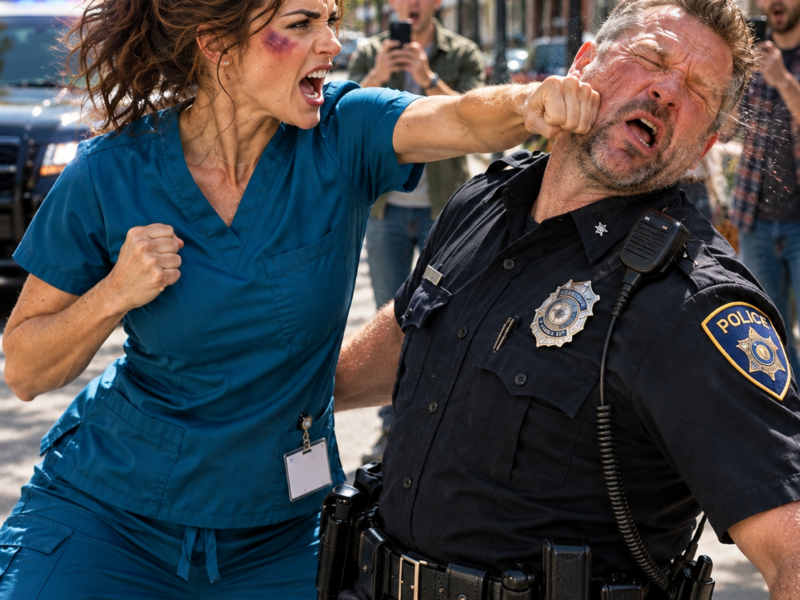
“Don’t touch me!” I screamed as the officer twisted my arm behind my back, ignoring the fact that I was wearing hospital scrubs and had just spent fourteen hours saving lives
The first thing I saw on the tablet was the man’s hand.
It was wrapped around the young woman’s wrist.
The second thing I saw was him shoving me backward into the supply cart.
And the third was the moment Officer Harris stepped between us, looked directly at the man, and then turned away while the young woman stumbled toward the emergency entrance.
The footage showed everything.
There was no ambiguity. No missing angle. No convenient gap in the recording that could explain away what had happened.
The man had attacked her.
I had intervened.
He had shoved me.
And the officers had handcuffed me while he stood nearby, smiling.
The emergency department had gone so quiet that I could hear the faint buzz of the tablet’s speakers.
Deputy Inspector Rachel Morgan watched the recording without moving. When it ended, she tapped the screen and asked the security director to replay the final thirty seconds.
Officer Harris shifted his weight.
Officer Cole stared at the floor.
The man in the expensive jacket, who had introduced himself earlier as Andrew Whitmore, took a step toward the exit.
“Hold on,” Morgan said.
He stopped.
“Where do you think you’re going?”
“I have nothing to do with this,” Whitmore replied. “This nurse attacked me. These officers are handling the situation.”
Morgan turned the tablet toward him.
“Would you like to explain why the video shows you grabbing the patient, shoving the nurse, and then telling the officers that the nurse attacked you?”
Whitmore’s face tightened.
“That video doesn’t show the whole story.”
“Then I suggest you explain the part it does show.”
He glanced at Harris.
It was a small movement, barely noticeable, but Morgan saw it.
So did I.
“Officer Harris,” she said, “did you review this footage before placing the nurse in handcuffs?”
“No, ma’am. We were responding to conflicting accounts.”
“Did you interview the independent witnesses?”
“We were attempting to establish what happened.”
“Did you ask hospital security to preserve the recording?”
“No, ma’am.”
“Did you ask the nurse whether she needed medical attention after she told you that her shoulder hurt?”
Harris hesitated.
“No.”
Morgan’s expression grew colder.
“Then explain to me why you decided to arrest her before establishing the basic facts.”
Harris straightened.
“The suspect was alleging an assault. The nurse admitted physical contact.”
“I pushed his arm away after he shoved me,” I said. “I told them that from the beginning.”
Morgan raised a hand, not to silence me but to acknowledge that she had heard.
“I know. The footage confirms your account.”
Those words nearly broke me.
I had spent what felt like an eternity trying to make two people listen to a sentence that should have been simple.
Now someone had finally watched the evidence.
And she believed what it showed.
“Please remove the handcuffs,” Morgan told the officers.
Cole looked at Harris.
Harris did not move.
“I said remove them.”
The younger officer reached for the keys. His hands shook as he unlocked the cuffs.
When the metal fell away from my wrists, I tried to rotate my arms, but pain shot through my shoulder. I winced and pulled them close to my chest.
Morgan noticed.
“Get her evaluated immediately,” she told the hospital administrator. “And make sure the medical documentation includes the injuries she reported while in custody.”
“I can take care of that,” Daniel said, stepping beside me.
I looked at him, grateful that at least one familiar face was no longer afraid to stand close.
But the confrontation wasn’t over.
Morgan turned back to Harris and Cole.
“Neither of you will leave until your actions have been documented. I am notifying your supervisor and requesting a formal review of this encounter.”
Harris’s face reddened.
“With respect, Inspector, we made a judgment call under pressure.”
“Judgment calls are not substitutes for evidence. You had a visibly injured woman, a nurse reporting an assault, multiple witnesses, and a hospital security system. You chose not to investigate those facts before taking action.”
“He was making an allegation,” Harris insisted.
“And so was she.”
For the first time, Harris had no immediate answer.
Whitmore suddenly laughed.
It was a sharp, unpleasant sound.
“This is ridiculous. I know people in this city. You have no idea how much trouble you’re creating.”
Morgan turned toward him.
“Are you threatening me?”
“I’m telling you that you should be careful.”
“Then let me be equally clear. Your connections will not change what the recording shows.”
He looked at me with an expression that made my stomach tighten.
“You have no idea what you’ve started, Nurse.”
I was exhausted, frightened, and still shaking from the pain in my shoulder.
But I looked directly at him.
“No,” I said. “You started this when you decided another person’s safety didn’t matter.”
For once, he had nothing to say.
Morgan instructed hospital security to preserve the footage and asked the administrator to identify every witness who had been present. The officers were separated while the incident was reviewed, and Whitmore was detained for further questioning about the assault on the patient.
As Daniel guided me toward an examination room, I glanced back.
Whitmore was no longer smiling.
That was the first moment I realized how much he had depended on everyone being too intimidated to challenge him.
And it was the first moment I understood that he might have something much bigger to hide.
The doctor who examined me found bruising around my wrists and tenderness in my shoulder. Fortunately, there was no fracture, but I was instructed to rest the joint and return if the pain worsened.
I sat on the examination bed while Daniel completed the incident paperwork.
My phone vibrated repeatedly in my pocket. Colleagues had sent messages asking whether I was all right. Someone had already posted a short clip of the confrontation online, and the hospital’s administration was receiving calls from people who had heard conflicting versions of what happened.
I couldn’t bring myself to look at any of it.
All I could think about was the young woman.
“Where is she?” I asked.
Daniel looked up.
“Room four. The attending physician is treating her.”
“Can I see her?”
“You should probably rest first.”
“Daniel, please.”
He studied my face, then nodded.
“I’ll walk with you.”
When we entered room four, the young woman was sitting upright in bed with a blanket around her shoulders. A nurse was checking her vital signs.
Her name, I learned, was Olivia Bennett. She was twenty-eight, worked as a graphic designer, and had come to the hospital after her boyfriend, Andrew Whitmore, assaulted her during an argument in a parking garage.
She had initially tried to leave before calling for help because she was afraid of what he might do if she reported him.
When she finally reached the hospital, he followed her inside.
And even there, surrounded by medical staff and security cameras, he had tried to control her.
When Olivia saw me, tears filled her eyes.
“I’m so sorry,” she whispered.
I pulled a chair beside her bed.
“Why are you apologizing?”
“Because he hurt you. Because you got arrested trying to help me.”
“You didn’t do that. He did.”
She shook her head.
“I should have told them everything immediately.”
“You did tell them. You were standing right there.”
“But I froze when the officers came. Andrew always says people won’t believe me. He says he knows how to make things look like my fault.”
I felt a chill run through me.
“Has he done this before?”
Olivia stared at the blanket.
“Yes.”
She explained that the relationship had become increasingly controlling over the previous year. Whitmore monitored her messages, criticized her friends, and threatened to ruin her career whenever she talked about leaving. The physical violence had started months earlier, but she had never reported it.
She was afraid he would retaliate.
She was also afraid that no one would believe her if he accused her first.
“He told me he knew the police,” she said. “He said if I ever tried to leave, he’d make sure I was the one who got arrested.”
I thought about the way Whitmore had watched me in handcuffs.
He had looked almost pleased.
This was not simply a man who had lost control in an argument.
He had expected everyone else to help him regain it.
“Olivia,” I said carefully, “you don’t have to decide everything tonight. But you deserve to be safe, and you deserve to tell your story without someone threatening you.”
She looked at me.
“Do you really think they’ll believe me?”
“I think the footage is a start. And I think you should have the chance to speak with someone who can explain your options and help you make a safety plan.”
The attending physician arranged for the hospital’s domestic violence advocate to meet with her. The advocate explained the available support services, discussed safe ways to contact trusted people, and helped Olivia consider what she wanted to do next.
I stayed until Olivia agreed that she was comfortable with the advocate and the nurse assigned to her care.
Before I left, she caught my hand.
“Why did you help me?”
The question surprised me.
“Because you needed help.”
“Even when he was threatening you?”
I thought about the moment I had stepped between them, before I knew how far Whitmore would go.
“Especially then.”
She began crying again, but this time she did not look away in shame.
I squeezed her hand gently and left the room.
By the following morning, the footage had become central to the investigation.
Hospital security had preserved the original files, including recordings from the entrance, the treatment corridor, and the nurses’ station. Several staff members provided statements, and the security guard confirmed that Whitmore had been physically aggressive before the police arrived.
The video also showed that I had repeatedly asked the officers to review the cameras before they restrained me.
Their failure to do so became part of the professional standards inquiry.
I was placed on paid administrative leave for several days while the hospital completed its own review. The leave was intended to give me time to recover, but at first, it felt like another punishment.
I hated being at home while my colleagues worked.
I hated the uncertainty.
And I hated that a man who had attacked someone could still make me question every decision I had made.
On the third day, Inspector Morgan called me.
“Natalie, I wanted to update you on the case.”
I sat down at my kitchen table.
“Is Olivia all right?”
“She has been connected with an advocate and is staying somewhere safe. I can’t discuss every detail of her case, but she’s cooperating with investigators.”
I closed my eyes in relief.
“And the officers?”
“Their conduct is under formal review. We are examining their decisions, their statements, and whether they complied with department policy. I won’t prejudge the outcome.”
It was the kind of careful answer I respected.
“And Whitmore?”
“He has been charged in connection with the assault, and investigators are examining additional evidence. Any further charges will depend on what the evidence supports.”
I gripped the phone.
“Is there something else?”
“Yes. The review has uncovered information suggesting Whitmore may have used claims of personal connections to intimidate people before. We are checking those claims rather than accepting them at face value.”
“So he might not have the influence he claimed?”
“That’s possible. But whether he knows someone or not is less important than whether he committed the acts we’re investigating.”
I understood what she meant.
A person’s influence should never determine whether evidence matters.
Before we ended the call, Morgan asked me to send her any messages or communications I had received that appeared connected to the incident. I agreed.
Afterward, I sat in silence for a long time.
The case was moving forward, but I knew there was a difference between the first signs of accountability and a final resolution.
I had seen too many people mistake a promising beginning for a guaranteed ending.
Two days later, Daniel sent me a message.
*You need to see this. The hospital has released a statement.*
I opened the link.
The statement confirmed that the hospital had preserved the security footage, cooperated with investigators, and initiated an internal review of the incident. It also reaffirmed that staff should be able to intervene in emergencies without fear of retaliation for following hospital safety procedures.
The statement did not name me.
It did not describe me as a hero.
It did not need to.
For the first time since the incident, I felt that the institution where I worked was willing to acknowledge what had happened instead of treating it as an embarrassment to be hidden.
Then I saw the headline attached to a local news report.
**NURSE HANDCUFFED AFTER PROTECTING WOMAN IN HOSPITAL; VIDEO RAISES QUESTIONS ABOUT POLICE RESPONSE.**
My stomach twisted.
The footage had been released through the proper investigative process, and the report included comments from witnesses who had agreed to speak publicly. It showed the confrontation without sensationalizing the injuries or identifying Olivia’s private medical details.
The response was immediate.
Some people expressed outrage. Others called for patience until the investigations were complete. Many nurses and emergency workers shared stories of being pressured to remain silent when a patient or staff member was threatened.
I read a few comments, then closed the page.
I didn’t want to become a symbol.
I wanted to return to work.
I wanted Olivia to be safe.
And I wanted the people responsible to be judged on evidence, not on how loudly they could defend themselves.
A week after the incident, Morgan asked whether I would be willing to provide a more detailed formal statement.
I agreed.
During the interview, she asked about every stage of the encounter: what I had seen, what I had heard, when I had touched Whitmore, how the officers had restrained me, and what I had said before the handcuffs were applied.
She did not interrupt me or try to force my account into a particular shape.
When I finished, she asked one final question.
“Do you believe you could have handled anything differently?”
I considered it carefully.
“I could have called for security sooner. I could have made sure another staff member stayed with Olivia while I addressed Whitmore. There are always things I can learn from an emergency.”
“And do you believe that justified the officers’ actions?”
“No.”
“Why not?”
“Because my decisions can be reviewed without pretending his actions didn’t happen. I was trying to protect a patient. If I made a mistake, examine it. But don’t ignore the assault, disregard the witnesses, and assume the person with the loudest voice must be telling the truth.”
Morgan nodded and recorded my answer.
“That distinction matters.”
When the interview ended, she walked me to the door.
“I can’t promise you that every outcome will be exactly what you want,” she said. “But I can promise that your statement will be evaluated alongside the footage and the other evidence.”
It was not a grand declaration.
It was something better.
A clear description of the process and its limits.
Over the following weeks, the investigations continued. The hospital reviewed its emergency response procedures and arranged additional training on handling violent visitors, protecting vulnerable patients, and preserving evidence after an incident.
Staff were reminded that medical professionals should not be expected to manage dangerous confrontations alone. Security personnel received updated guidance on when to request police assistance and how to document incidents accurately.
The department’s professional standards investigators also reviewed Harris and Cole’s conduct, including their failure to examine available evidence before restraining me.
The findings were not based on a viral headline or public anger. They were based on the footage, witness accounts, the officers’ own explanations, and the policies that governed their actions.
Both officers were found to have violated department procedures during the encounter. Their disciplinary outcomes were handled through the department’s formal process, and additional training and supervisory review were required. The findings also led to changes in how similar incidents would be documented and escalated.
I did not feel triumphant when I learned that.
I felt relieved.
Accountability was not revenge. It was a recognition that authority came with obligations, and that those obligations did not disappear when a situation became uncomfortable.
Whitmore’s case took longer.
Investigators examined statements from Olivia, the hospital witnesses, and other evidence gathered through the proper legal process. They also reviewed earlier reports that might be relevant to the allegations against him.
I did not receive every detail, nor did I need to.
Olivia was entitled to privacy, and her recovery was not a public performance for people who wanted a dramatic ending.
What I did learn was that she continued cooperating with investigators and had support as she navigated the process. She also began rebuilding parts of her life that Whitmore had tried to control.
One afternoon, I received a message from an unfamiliar number.
It was Olivia.
*I wanted to tell you that I moved into a place of my own. I still have difficult days, but I don’t feel like I’m waiting for him to decide what happens next anymore. Thank you for believing me when I couldn’t believe myself.*
I read the message twice.
Then I replied.
*You did the hardest part by choosing your safety. I’m glad you’re getting a chance to start again.*
I put my phone down and cried.
Not because everything had been fixed.
Not because fear disappeared overnight.
But because a woman who had walked into our emergency department believing she had nowhere to turn was beginning to see a future beyond the man who had threatened her.
That was the part I would remember.
Not the cameras.
Not the headlines.
Not even the handcuffs.
Her future.
When I returned to work, Daniel was waiting for me near the nurses’ station with a paper cup of coffee.
“Welcome back,” he said.
“Thanks.”
He looked at my shoulder.
“Still hurting?”
“Only when I forget I’m supposed to take it easy.”
“Then don’t forget.”
I laughed, and the sound surprised me.
For days, I had been afraid that the first time I stepped back into the emergency department, I would relive every second of the incident. I expected the sight of the supply cart or the entrance doors to make my chest tighten.
Instead, I felt nervous, then steady.
The department was still loud. The waiting room was still crowded. Patients still needed help, and the monitors still beeped in the background.
Life had not paused for my fear.
Neither had my purpose.
Before my shift began, the hospital’s nursing director asked whether I would speak briefly at a staff meeting about the incident and the changes that had followed.
I hesitated.
“I don’t want to turn this into a story about me.”
“It doesn’t have to be,” she said. “We want staff to understand the procedures and know what support is available when a situation becomes unsafe.”
That I could do.
At the meeting, I stood in front of a small group of nurses, physicians, technicians, and security staff. My hands trembled slightly, but I kept them resting on the table.
“I want to be clear about something,” I began. “I didn’t intervene because I thought I was invincible. I intervened because a patient was being hurt, and I believed I could help long enough to get her to safety.”
I looked around the room.
“I also made mistakes. I should have called for additional support earlier. I should have made sure we had enough staff between the patient and the aggressor. I will learn from that.”
I paused.
“But what happened afterward was not acceptable simply because the situation was stressful. Evidence should be reviewed. Witnesses should be heard. People in custody should be treated safely, and staff should not be threatened for reporting what they saw.”
Nobody interrupted.
“We cannot control every person who walks through those doors. We cannot guarantee that every decision will be perfect. But we can build procedures that make it harder for fear, status, or intimidation to replace facts.”
When I finished, the room remained quiet for a moment.
Then one of the younger nurses raised her hand.
“What if you’re the only person willing to speak up?”
I thought about Olivia standing in the corridor, injured and frightened, calling out that the officers had arrested the wrong person.
I thought about Daniel refusing to stay silent even after Harris threatened him.
And I thought about the moment Morgan watched the recording and asked the officers to explain themselves.
“You may feel alone at first,” I said. “But start by documenting what you know. Call for support. Identify witnesses. Follow the proper reporting process. You don’t have to win an argument with someone who refuses to listen. You need to make sure the facts are preserved so they can be examined.”
The nurse nodded.
“And if you’re afraid?”
I didn’t pretend to have an easy answer.
“Then say you’re afraid. Ask someone to stand with you. Courage doesn’t mean you should have to face danger alone.”
After the meeting, several people approached me privately. Some wanted to discuss safety procedures. Others shared experiences they had never formally reported because they assumed nothing would change.
I listened.
I did not promise that every case would end fairly or that speaking up would always be easy.
I told them what I had learned: silence could protect the person causing harm, but careful documentation and support could give the truth a better chance of surviving.
Months passed.
My shoulder healed. The bruises disappeared. The case moved through the legal system, and the department completed its review of the officers’ actions.
Whitmore was ultimately convicted of assault-related offenses arising from the incident with Olivia, based on the evidence presented in court. The judge imposed a sentence and protective conditions under the law. Olivia’s testimony was considered alongside the recording and the other evidence, not treated as the only thing standing between truth and denial.
The outcome did not erase what had happened to her.
It did not erase the moment I had been handcuffed.
But it established that the conduct we had reported carried consequences.
Harris and Cole also faced the formal disciplinary outcomes arising from the department’s findings. They were required to complete additional training, and their handling of the encounter remained part of their professional records.
I never received a personal apology from either officer.
For a while, I thought I needed one.
I imagined Harris standing in front of me, admitting that he had decided too quickly. I imagined Cole acknowledging that he had hurt me after I asked him not to grab me.
I wanted them to understand what it felt like to be ignored while asking for help.
Eventually, I realized that an apology was not something I could force from them.
I could only decide what I would do with what had happened.
I would remember it.
I would learn from it.
And I would not let it convince me that helping someone was foolish.
One quiet evening, I found Olivia sitting in the hospital café.
She had come in for a follow-up appointment and was waiting for her ride. Her hair was pulled back, and she wore a simple gray sweater. She looked more relaxed than she had on the night we met, though I could still see a trace of caution in the way she watched the entrance.
When she saw me, she smiled.
“Natalie.”
I walked over.
“It’s good to see you.”
“You too.”
We talked about ordinary things at first. Her new apartment. A design project she had recently accepted. The small routines she was rebuilding now that she could make decisions without worrying about how Whitmore would react.
Then she grew quiet.
“I used to think that the worst thing he could do was hurt me,” she said. “But I think the worst part was how he made me believe no one would help.”
I sat across from her.
“That’s what control does. It tries to make you feel like you have no choices.”
“He almost convinced me.”
“But he didn’t.”
She looked down at her hands.
“I was scared when I came into the hospital. I was scared when the police arrived. And when they put you in handcuffs, I thought it was happening all over again. I thought he was right.”
I remembered her voice in the corridor.
“He’s lying! You’re arresting the wrong person!”
“You still spoke up,” I said.
“Because you did first.”
For a moment, neither of us said anything.
Then Olivia reached across the table and touched my hand.
“I don’t know if I could have done it without you.”
I squeezed her fingers gently.
“You did it yourself, Olivia. I stood beside you, but you were the one who told the truth when you were frightened.”
She smiled through tears.
“Maybe that’s what helping someone really means. You remind them they still have a voice.”
I carried those words with me long after she left.
The next year, St. Catherine’s held a staff recognition ceremony for employees who had demonstrated exceptional commitment to patient safety. The nursing director asked me to attend, and I agreed only after she promised there would be no long speech about me.
I was not comfortable being singled out.
I had not saved Olivia alone. Daniel had witnessed the assault and spoken up. The security team had preserved the footage. The physicians and advocates had cared for her. Inspector Morgan had insisted on examining the evidence.
The truth had survived because multiple people had eventually refused to let it disappear.
When my name was called, I walked to the front of the room and accepted a simple certificate recognizing my actions during the incident.
I thanked the staff, then returned to my seat.
Later, the hospital administrator approached me.
“You know,” she said, “this wasn’t only about one nurse being treated unfairly. It forced us to examine how we respond when someone who needs help becomes the target of intimidation.”
“I hope we keep examining it,” I replied.
“So do I.”
That evening, after my shift, I walked through the emergency department one last time before heading home.
The supply cart had been replaced. The wall beside the nurses’ station had been repainted. New instructions were posted near the security desk, explaining how to preserve recordings and report concerns after a violent incident.
Most people passing through the department would never know why those changes had been made.
They would simply see a hospital doing its job.
That was enough.
I stopped outside room four, now occupied by a patient I had never met. A nurse stood beside the bed, listening patiently as the woman explained why she was afraid to go home.
The nurse did not rush her.
She did not question why the woman had waited so long to ask for help.
She pulled a chair closer and said, “You can tell me what happened. We’ll figure out the next step together.”
I stood in the corridor for another moment, listening.
Then I turned toward the nurses’ station.
For a long time, I had replayed the night Whitmore attacked Olivia and the officers ignored my pleas. I had remembered the handcuffs, the pain in my shoulder, and the fear of losing control over a situation I had tried to make safer.
But that was no longer the ending I carried with me.
The ending was Olivia moving into a home where she could breathe without fear.
It was a hospital that had changed its procedures because a failure had been exposed.
It was an investigation that examined evidence rather than simply accepting the most confident voice in the room.
And it was the knowledge that even when people in authority make the wrong decision, the truth can still survive if enough people are willing to preserve it.
I never forgot the words I had shouted that night.
“Don’t touch me!”
At first, they had been a plea from someone frightened and in pain.
Later, they became a reminder that dignity does not disappear when a person is placed in handcuffs, questioned, or ignored.
No uniform grants someone permission to hurt another person without accountability. No title makes a lie more credible than a recording. And no one should have to prove they deserve protection before anyone bothers to listen.
I had entered that night believing that doing the right thing would automatically lead to the right outcome.
I left it knowing something more difficult, but more valuable.
Doing the right thing does not guarantee that others will respond correctly.
It does not guarantee that the powerful will admit their mistakes or that justice will arrive quickly.
But it gives the truth somewhere to begin.
And sometimes, when a frightened patient is waiting for someone to believe her, that beginning is everything.
I straightened my uniform, checked the next patient’s chart, and stepped back into the work I had chosen.
The emergency department was loud again.
Someone needed pain medication. A child was crying. A physician was calling for assistance from the next room.
Life continued, as it always did.
I took a breath and walked toward the next patient.
I could not promise that I would never be frightened again.
I could not promise that every person in authority would listen the first time.
But I could promise myself one thing.
When someone stood in front of me, terrified and asking for help, I would not look away simply because telling the truth made the room uncomfortable.
I would listen.
I would document what I saw.
And if the moment came when someone tried to silence the person who needed help most, I would remember Olivia standing in that corridor, finding her voice even when the world seemed determined to ignore it.
Then I would stand beside her.
Because that was how everything had changed—not because one person was powerful enough to force the truth into the open, but because, in the end, enough people refused to let a lie have the final word.
ThE ENd.









