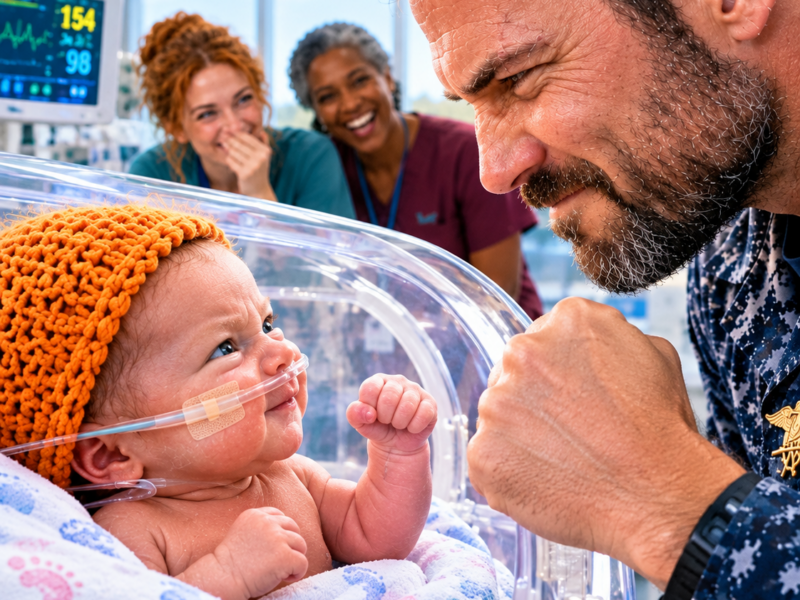
“At the NICU in a Virginia hospital, a battle-hardened Navy SEAL refused to hold a three-pound premature baby
The first thing I did after reading Emily’s letter for the sixth time was call the hospital and ask whether I could stay beside my daughter overnight.
Margaret answered the phone.
“Jackson, you know you can visit her whenever the unit allows, but Lily is doing well enough that you need to get some sleep yourself.”
“I’m not tired.”
“You’ve been sitting in that chair for fourteen hours.”
“I’m fine.”
There was a pause, and I could almost hear her folding her arms on the other end.
“Those two words are going to cause you trouble, young man.”
I almost smiled, but the expression disappeared before it reached my face.
“I just don’t want her to wake up and find nobody there.”
“She has nurses watching her around the clock.”
“That’s not what I meant.”
Margaret softened her voice.
“I know.”
I hung up without promising I would go home, then returned to Lily’s bedside and watched her tiny chest rise beneath the pink blanket.
The monitor beside her incubator gave a steady, reassuring rhythm, but every unexpected beep still sent my muscles tightening.
I had spent twelve years learning to recognize danger before it reached me.
Now, in a quiet hospital room filled with warm light and the smell of disinfectant, I was discovering that fear could be just as relentless when there was nothing I could fight.
Emily had been right about one thing.
I knew how to survive terrible things, but I had never learned what to do afterward.
I tucked her letter into the inside pocket of my jacket and rested my hand against the incubator.
“I’m here, Lily,” I whispered. “Daddy’s right here.”
Her fingers moved beneath the blanket.
I stayed until the nurse reminded me that the unit was changing shifts, then drove home through the dark streets of Virginia Beach with Emily’s words repeating in my head.
You don’t have to be perfect. You just have to keep showing up.
I wished she had told me that while she was still alive.
I wished I had known how much she was carrying when she smiled at me through our video calls.
Most of all, I wished I could go back to the delivery room and hold her hand one more time without believing that I could protect her from everything.
But wishes did not change medical records, and they did not bring the dead home.
When I entered our house, the silence met me at the door.
Emily’s shoes were still beside the stairs.
Her favorite mug sat upside down on the drying rack, and a folded baby blanket lay across the arm of the couch where she had left it the night before we went to the hospital.
I stood in the entryway, unable to move.
For weeks before Lily’s birth, Emily had been filling the house with little preparations.
A bottle brush beside the sink.
A stack of tiny onesies in the dresser.
A list of pediatricians on the refrigerator, each one marked with a small star beside the name she liked best.
I had laughed at her lists, telling her our daughter would be lucky if we remembered where we put the diapers.
She had smiled and said, “That’s why I’m making lists for both of you.”
Now I wanted every list she had ever written.
I walked into the nursery and switched on the lamp.
The pale yellow walls glowed softly, and the rocking chair stood beside the crib with a folded blanket resting on its seat.
Emily had chosen the color because she said white made the room feel like a hospital.
I sat in the chair and pressed my palms against my eyes.
I could still picture her sitting there, one hand on her belly, talking to Lily as if the baby could understand every word.
Sometimes I had joined her, placing my ear against her stomach and asking our daughter whether she planned to let us sleep.
Emily would laugh and tell me that I had better learn to function without sleep before the baby arrived.
I had thought we had months to learn.
I never imagined that I would be coming home alone.
That night, I did not sleep.
Every time I closed my eyes, I saw the delivery room, the rushing doctors, and the nurse who had asked me to step aside.
I heard the flatness in the doctor’s voice when he told me they were still trying.
I remembered the way Emily’s hand had felt in mine, warm and familiar, before the room became a blur of people moving too quickly.
At dawn, I took a shower, put on clean clothes, and drove back to the hospital.
Lily was awake when I arrived.
Her eyes were still too new to focus on me, but she turned her head slightly when I spoke.
“Morning, sweetheart.”
Margaret was standing near the counter, reviewing Lily’s chart.
“She had a good night,” she said. “Her breathing is stable, and she tolerated her feeding.”
I nodded as if I understood every detail, though I was still learning what each number on the monitor meant.
Margaret studied me.
“Did you go home?”
“Yes.”
“Did you sleep?”
I looked at Lily.
“Not much.”
She sighed, but there was no judgment in it.
“Jackson, you can love this child with everything you have and still need rest. Those things aren’t opposites.”
I had heard versions of that advice before, usually from Emily.
I had never listened closely enough to understand it.
Margaret pulled a chair beside the incubator and showed me how to place my hand near Lily without disturbing her.
“She knows your voice,” she said. “Talk to her.”
I looked down at my daughter.
I had spent years giving clear instructions under pressure, but now I couldn’t think of a single thing worth saying.
So I told her about the drive to the hospital, about the terrible coffee in the lobby, and about the time her mother had tried to teach me how to bake a cake.
Emily had insisted I follow the recipe exactly.
I had ignored her, added extra flour because the batter looked too thin, and produced something resembling a brick.
She had laughed until tears ran down her face.
I told Lily about that, and for the first time since Emily died, I laughed too.
The sound surprised me.
I immediately felt guilty, as if laughter were a betrayal of the woman I had lost.
Margaret noticed the change in my face.
“Your wife would want you to remember the funny things, too.”
I looked away.
“You didn’t know her.”
“No,” she said. “But I know grief. And I know that remembering someone doesn’t mean you have to suffer every time you say their name.”
I wanted to argue, but there was nothing I could say that would make her wrong.
Over the next week, Lily grew stronger.
Her doctors adjusted her feeding schedule, monitored her weight, and watched her closely for signs that she could maintain her temperature outside the incubator.
Every small improvement felt enormous.
Every setback felt personal.
When she lost a little weight one morning, I spent an hour asking questions until the pediatrician explained that fluctuations could happen and that they were watching her carefully.
I wrote every answer in a notebook.
When the doctor noticed, he smiled.
“You don’t have to memorize everything today, Chief.”
“I’d rather be prepared.”
“Prepared is good. Panicked is exhausting.”
I closed the notebook.
“I’m not panicked.”
He gave me a look that reminded me uncomfortably of Emily.
“Of course not.”
The first time the nurses offered me a chance to hold Lily against my chest for skin-to-skin care, I almost refused again.
My hands began to sweat as Margaret explained where to place my arms and how to support Lily’s head.
I watched every movement she made, memorizing the sequence like a training exercise.
“Ready?” she asked.
“No.”
She waited.
I looked at Lily’s tiny face.
“Do it anyway.”
Margaret carefully settled her against me.
Lily was warm beneath the blanket, her cheek resting just below my collarbone.
I barely breathed.
“Relax your shoulders,” Margaret said.
“I am relaxed.”
“Jackson, your shoulders are halfway to your ears.”
I let out a breath I hadn’t realized I was holding.
Lily shifted, then settled against me.
Her heartbeat was small and fast beneath my palm.
I stared at the top of her head, and suddenly I wasn’t in the hospital anymore.
I was back in Afghanistan, kneeling beside a teammate who had been wounded during an operation.
I remembered pressing my hands against his injury, trying to keep him alive while waiting for the evacuation team.
I remembered his fingers gripping my sleeve.
I remembered promising him he would see his wife again.
He hadn’t.
The memory came so sharply that my arms tightened around Lily.
Margaret noticed immediately.
“Jackson, look at me.”
I couldn’t.
“Jackson.”
Her voice was calm but firm.
“She’s safe. You’re here, and she’s safe.”
I forced myself to look at Lily.
Her tiny mouth moved against my shirt, and she made a soft sound that barely qualified as a cry.
I loosened my arms.
“I’m sorry,” I whispered.
Margaret adjusted the blanket.
“You don’t need to apologize for being frightened. You just need to keep learning what she needs.”
I stayed with Lily until the session ended.
That afternoon, I called Dr. Helen Brooks.
I almost hung up twice before she answered.
When I finally explained that Emily had left her name in a letter, Dr. Brooks asked whether I wanted to schedule an appointment.
I told her I didn’t know.
“That’s okay,” she said. “You don’t need to decide what therapy means to you before we meet.”
“I’m not interested in talking about my feelings for an hour.”
“Then we won’t start by talking about your feelings for an hour.”
I frowned.
“What would we talk about?”
“What happens when you try to sleep. What you notice in your body when something reminds you of your deployment. What you want to be different in your life.”
I looked toward Lily’s incubator.
“I want to stop being afraid of holding my own daughter.”
There was a pause.
“Then we can start there.”
I scheduled an appointment for the following week.
It felt like a small decision, almost insignificant compared with the things I had faced in uniform.
But after I hung up, I realized my hands had stopped shaking.
The days continued, and I began to find a rhythm.
I visited Lily every morning, learned her care routine, and stayed as long as the nurses allowed.
I went home when I needed to shower or sleep, even when leaving her felt like walking away from a responsibility I could not trust anyone else to carry.
I started eating meals instead of surviving on coffee.
I answered messages from my teammates.
I even called my older sister, Sarah, who lived two hours away and had been leaving voicemails since Emily died.
When she answered, I struggled to speak.
“Jackson?”
“Hey.”
“Oh, thank God. I’ve been worried sick.”
“I know.”
“Why haven’t you called me?”
I stared at the kitchen table.
“I didn’t know what to say.”
“You could have said you were hurting.”
I closed my eyes.
“I didn’t want to make it real.”
Her voice softened.
“Oh, Jack.”
Nobody had called me that since I was a boy.
For a moment, I couldn’t hold myself together.
Sarah stayed on the phone while I cried, and she didn’t try to make me stop.
When I finally spoke again, I told her about Lily, about the hospital, and about Emily’s letter.
“I want to come,” she said immediately.
“You don’t have to.”
“I know. I’m coming because I want to.”
She arrived the following Saturday with groceries, clean laundry, and a bag of baby clothes she had bought on the way.
She hugged me at the door and held on longer than I expected.
“You look terrible,” she said.
“Nice to see you, too.”
She laughed softly, then wiped her eyes.
“Emily would be furious if she saw how little you’ve been eating.”
“She’d probably make me a list.”
“She’d make you three lists.”
For the first time, the memory didn’t feel like a knife.
It felt like Emily was still part of our lives, even if she wasn’t standing in the kitchen.
Sarah visited Lily that afternoon and cried when she saw how small her niece was.
“She looks like Emily,” she whispered.
I watched Lily’s fingers curl around Sarah’s thumb.
“Yeah,” I said. “She does.”
Sarah looked at me.
“And she has your stubborn chin.”
I shook my head.
“She doesn’t even have a chin yet.”
“She will. Just wait.”
For a while, we stood beside the incubator without speaking.
Then Sarah asked whether I had read all of Emily’s letter.
I told her I had.
“Did she say anything about her condition before you deployed?”
“No.”
Sarah looked down.
“She told me she was scared.”
I turned toward her.
“When?”
“A few weeks before you came home.”
The room seemed to grow quieter.
“What did she say?”
Sarah took a slow breath.
“She said she didn’t know how to tell you she was afraid without making you feel like you had to fix it.”
I looked at Lily.
“Why didn’t you tell me?”
“Because she asked me not to. She wanted to tell you herself.”
Anger rose in me, sharp and immediate.
“Everyone knew except me.”
“Not everyone, Jack.”
“You knew she was scared. You knew something was wrong, and I was out there believing everything was fine.”
Sarah’s eyes filled.
“She loved you. She was trying to protect the part of your life that she thought you needed to keep.”
I wanted to argue that she had taken my choice away.
I wanted to tell Sarah that protecting me had not saved Emily.
But when I looked at her, I saw the same grief that had settled into my own face.
She had lost someone, too.
I lowered my voice.
“I wish she’d trusted me enough to tell me.”
Sarah reached for my hand.
“I think she trusted you so much that she was afraid of what you’d sacrifice.”
I didn’t have an answer.
That evening, after Sarah left for the hotel, I returned to Lily’s bedside and sat with Emily’s letter in my lap.
For the first time, I considered that my wife might have been wrong about me.
Perhaps I would have tried to come home if I’d known.
Perhaps I would have insisted on being beside her.
Perhaps I would have done everything in my power to change the outcome.
But I could not know whether any of that would have saved her.
And I could not let the unanswered questions become the only way I remembered her.
At my first appointment with Dr. Brooks, I sat in the chair nearest the door.
She noticed but didn’t comment.
Instead, she asked me what I remembered most clearly about the day Emily died.
I told her about the lights in the delivery room, the sound of the monitors, and the way the doctors moved when things began to go wrong.
I told her how helpless I had felt standing beside the bed.
Then I described the moment when a nurse asked me to step back.
“I’d never felt so useless,” I said. “I couldn’t do anything.”
Dr. Brooks folded her hands.
“What did you believe that meant about you?”
“That I had failed her.”
“Did Emily ever tell you that you failed her?”
“No.”
“Did any doctor tell you that you caused what happened?”
“No.”
“Then where did that belief come from?”
I stared at the carpet.
“I was supposed to protect her.”
Dr. Brooks let the silence remain between us.
After a while, she said, “You can love someone deeply and still be unable to control what happens to them.”
I hated the sentence.
It sounded too simple for the life I was trying to understand.
But I carried it with me when I left.
At the next appointment, we talked about my deployment.
At the one after that, we talked about the men I had lost and the promises I had made to their families.
I told her about the teammate whose hand I had held in Afghanistan.
I had never told Emily the details because I didn’t want her to imagine me lying in the same kind of dust.
Dr. Brooks asked whether I had ever forgiven myself for being unable to save him.
I said I had.
Then I realized I had been lying.
I began to understand why Emily had asked me to get help.
She had seen the way I treated every loss like a personal failure.
She had seen how I tried to turn grief into discipline, fear into anger, and helplessness into work.
I had thought I was keeping my pain from her.
In reality, I had been bringing it home every night and asking her to live beside it without knowing its name.
The realization hurt more than I expected.
It also made me want to change.
When Lily reached the weight her doctors had been hoping for, the team began preparing us for discharge.
They showed me how to install her car seat, how to prepare her feeds, and which warning signs required immediate medical attention.
I wrote everything down.
The nurse teaching me the feeding routine finally put her hand over my notebook.
“Jackson, you are allowed to make mistakes while learning.”
“I’d rather not.”
“Neither would any parent. But your daughter doesn’t need a perfect father. She needs one who pays attention and asks for help when something worries him.”
I glanced at Margaret.
She raised an eyebrow.
“Sounds familiar, doesn’t it?”
I couldn’t help smiling.
The night before Lily came home, I sat beside her incubator and read Emily’s letter one final time.
I had memorized most of it, but I wanted to hear her voice in my head.
I read the words about Lily being wanted.
I read the lines about not making our daughter responsible for giving her mother’s death meaning.
Then I reached the sentence about being gentle with myself.
I had spent years believing gentleness was something I offered other people.
I had never considered that I might need it, too.
I folded the letter carefully and placed it in my pocket.
“Tomorrow, sweetheart,” I whispered to Lily. “We get to go home.”
She stretched one arm beneath her blanket.
I placed my finger in her hand, and she held on.
For once, I didn’t think about all the things that could go wrong.
I thought about the little girl who would soon sleep in the yellow nursery her mother had prepared.
I thought about the mornings we would spend learning each other.
I thought about the future I had nearly been too frightened to imagine.
The following morning, Margaret helped me secure Lily in her car seat while the discharge nurse checked the straps.
“Not too tight,” she reminded me. “You want her secure, not uncomfortable.”
I adjusted the harness and looked at Lily’s tiny face.
“Better?”
Margaret nodded.
“You’re getting the hang of this.”
When I carried Lily through the hospital doors, I stopped just outside and took a breath.
The air smelled like wet pavement and early autumn.
Cars moved through the parking lot, people hurried toward appointments, and somewhere nearby a child was laughing.
The world had continued while I was learning how to live inside my grief.
I held Lily closer, careful to support her head.
“I wish your mom could see this,” I whispered.
Then I remembered Emily’s letter.
She had not asked me to spend my life wishing for the moments she would miss.
She had asked me to be present for the ones Lily and I still had.
So I carried my daughter to the car.
At home, I placed her in the crib and stood beside it until my legs began to ache.
The nursery looked exactly as Emily had planned it.
The yellow walls, the rocking chair, the soft blanket, and the little shelf above the dresser were all waiting for a family that would never be the one we had imagined.
I sat down and watched Lily sleep.
For the first few nights, I barely rested.
I checked her breathing constantly, sometimes standing beside the crib for so long that my back stiffened.
Every small sound brought me to my feet.
When she cried, I picked her up too quickly.
When she slept, I worried that she was too quiet.
I called the pediatrician more than once with questions that sounded foolish even as I asked them.
Each time, I was told what to watch for and reminded that I could call again if I remained concerned.
I started keeping a notebook of Lily’s feedings, naps, and appointments.
But this time, I also wrote down the moments when I became frightened.
I noticed that I was most anxious when the house was quiet.
I noticed that I could relax more easily when Sarah visited or when I spoke to someone who knew what I had been through.
I noticed that I often imagined the worst outcome before anything had happened.
At my next appointment, Dr. Brooks helped me recognize the pattern.
“Your mind learned to prepare for danger because danger was part of your work,” she explained. “That response may have helped you survive overseas. But it doesn’t mean every uncertainty at home is a threat.”
I leaned back in the chair.
“So what am I supposed to do? Pretend nothing bad can happen?”
“No. You learn to distinguish between a real problem that needs action and a frightening possibility that needs patience.”
I looked down at my hands.
“I don’t know how to do that.”
“That’s why we’re practicing.”
It wasn’t a dramatic breakthrough.
I didn’t leave her office feeling transformed.
But the next time Lily made a strange sound in her sleep, I stopped myself from immediately reaching into the crib.
I watched her for a moment.
She shifted, sighed, and settled again.
I stood there, breathing slowly, until the fear passed.
Then I went back to bed.
It was the first full night of sleep I’d had since Emily died.
A few weeks later, I found a small envelope tucked inside the pocket of Emily’s favorite cardigan.
I had been sorting her clothes because I wanted to make space in the closet, but I had to stop several times when the familiar scent of her perfume brought back memories I wasn’t ready for.
The envelope had my name written on it.
I sat on the edge of the bed before opening it.
Inside was a photograph of Emily sitting in the nursery, one hand resting on her pregnant belly.
She was smiling at something outside the frame.
On the back, she had written, For the day you bring our girl home.
Beneath the photograph was a final note.
Jackson, if you’re reading this, you’re probably checking Lily’s breathing for the hundredth time and wondering if you’re doing enough. You are. You don’t have to be perfect. You just have to keep showing up.
I pressed the photograph against my chest.
Then I noticed a second line written beneath the first.
And if you ever feel like you can’t do it alone, call Sarah. She loves you, even when you’re too stubborn to admit you need her.
I laughed through my tears.
Emily had known exactly how I would behave.
She had known I would try to carry the whole world by myself.
She had also known I might need someone to remind me that I was still allowed to be a person.
I placed the photograph on the shelf beside Lily’s crib.
That evening, I called Sarah and asked whether she would come over for dinner the following weekend.
She sounded surprised.
“Are you sure?”
“I’m sure.”
“Do you need me to bring anything?”
“Just yourself.”
There was a long pause.
“Emily would have liked hearing you say that.”
I looked toward the nursery.
“I think she would have.”
As the months passed, Lily grew stronger.
Her cheeks filled out, her cries grew louder, and her tiny hands became surprisingly determined whenever she wanted to hold something.
The first time she smiled at me, I was singing badly while changing her clothes.
I stopped in the middle of the song and stared at her.
She smiled again.
I laughed so hard I had to sit down.
For a moment, I could almost hear Emily laughing with me.
The sound of that memory no longer felt like something I had to earn by suffering.
It was simply part of the life we had shared.
I began taking Lily on short walks when the weather allowed.
I pushed her stroller along the quiet streets near our home, stopping to point out trees, dogs, and the occasional squirrel that seemed determined to outrun us.
I talked to her even when she couldn’t understand me.
I told her about her mother, about the way Emily danced while cooking and how she always stole the warmest blanket on the couch.
I told her about the terrible cake I had once baked and how her mother had insisted it was edible while secretly throwing half of it away.
As Lily grew older, I planned to tell her more.
I would tell her that her mother had been brave without pretending she had never been afraid.
I would tell her that Emily had made her own decisions, loved her deeply, and wanted her to have a life free from guilt.
I would tell her that being strong did not mean never needing anyone.
Most importantly, I would tell her that she had been wanted from the very beginning.
On Lily’s first birthday, I invited Sarah, Margaret, and several of the nurses who had cared for her in the NICU.
Margaret arrived with a tiny pink sweater, while one of the nurses brought a cake decorated with little stars.
Sarah helped me arrange the food, then stopped in the doorway of the nursery.
Emily’s photograph rested on the shelf above the crib.
Sarah looked at it for a long time.
“You’ve made a good home for her,” she said.
I swallowed.
“I wish Emily could see it.”
Sarah stepped beside me.
“I know.”
I looked at the photograph.
“But I don’t want Lily to grow up thinking her whole life is about what we lost.”
Sarah nodded slowly.
“Then tell her about what you had, too.”
That afternoon, we took photographs in the living room.
Lily sat on my lap, wearing the pink sweater Margaret had brought, and grabbed at the paper decorations while everyone laughed.
For the first time in a year, our home was full of voices.
After the guests left, I rocked Lily to sleep.
She rested her head against my chest, warm and heavy compared with the fragile baby I’d first held in the NICU.
I looked at Emily’s photograph and remembered the fear that had kept me from touching our daughter.
I had been terrified that loving Lily would give the world another way to hurt me.
I had been afraid that if I held her too closely, I would lose her, too.
But love had never been a guarantee that nothing bad would happen.
It had been the reason to show up anyway.
I kissed Lily’s forehead.
“Your mom loved you before she ever got to hold you,” I whispered.
Lily stirred, then settled against me.
I continued rocking her until her breathing grew slow and even.
I couldn’t change what had happened in the delivery room.
I couldn’t give Emily the years we’d planned or let her see the daughter she’d fought so hard to bring into the world.
But I could be here for the life that remained.
And when Lily opened her eyes and reached for my finger, I held it gently, no longer afraid that love would break something simply because it was small.
The end.









