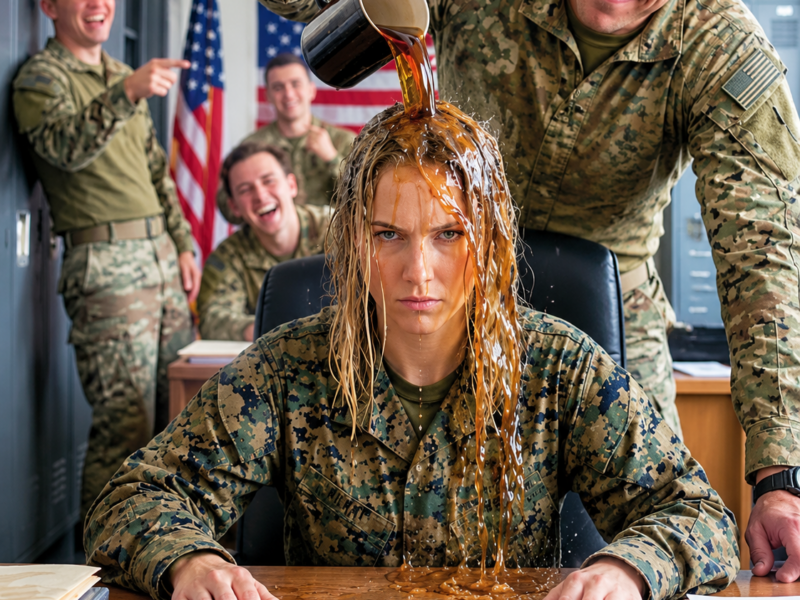
“At the Navy recruiting office in Norfolk, Virginia, my brother laughed when I stepped forward and said I was there to apply for SEAL training
I stared at my name beneath Ryan’s signature, trying to make the letters rearrange themselves into something that made sense.
Claire Elizabeth Bennett.
The handwriting wasn’t mine.
I’d never seen the document before, never signed anything connected to a Navy operation, and certainly never authorized my name to appear beneath my brother’s.
“Sir, what is this?”
Commander Whitaker closed the office door, checked the handle, and returned to his chair.
“It’s a statement attached to the original incident report from Coronado, dated four years ago.”
“An incident report about what?”
He looked at me for a long moment.
“An operation that ended with one sailor dead, another missing, and a chain of command that never gave the families the full story.”
My throat tightened.
“Who died?”
“Petty Officer First Class Ethan Cole.”
The name struck me harder than I expected.
Ethan had been my closest friend for nearly three years. He was the person who taught me to swim in rough water without fighting every wave. He was the one who called me after my father died, even though he barely knew what to say.
He’d been the first person to tell me that being quiet didn’t mean being weak.
Four years earlier, I’d received a phone call informing me that Ethan had died during a classified training operation.
The Navy told his parents there had been an equipment failure.
Ryan told me Ethan had made a mistake.
I had believed them both because I couldn’t imagine that the people I’d trusted could lie about something so terrible.
“Why is my name on this?” I asked.
Whitaker removed his glasses and rubbed the bridge of his nose.
“Because someone wanted the record to show that you had been informed of a safety concern before the operation began.”
“I wasn’t even in the Navy.”
“Exactly.”
He turned the paper toward me.
The statement claimed that I’d contacted Ryan two days before the operation and warned him about a malfunctioning piece of communications equipment. According to the document, Ryan had passed my warning to his commanding officer, and the officer had ordered the team to proceed anyway.
The final paragraph stated that I had later withdrawn my concern.
My eyes moved over the words again.
“I never made this call.”
“I believe you.”
The certainty in his voice made me look up.
“Then why hasn’t anyone corrected it?”
“Because the original inquiry concluded that the equipment failure was unforeseeable, the commanding officer had acted within his authority, and the team had accepted the risks associated with the exercise.”
“And my statement?”
“It was treated as supporting evidence that the concern had been resolved before deployment.”
I pushed the document away.
“So my name helped them close the investigation.”
Whitaker didn’t deny it.
I thought about Ethan’s mother, Margaret Cole, standing in her kitchen six months after his funeral, asking me whether her son had been afraid.
I’d told her he wasn’t.
I hadn’t known whether that was true. I had only known that she needed something to hold on to.
Now I wondered how many other things I’d said to comfort her had been built on information someone had carefully arranged for me to believe.
“Who submitted this statement?”
Whitaker tapped Ryan’s signature.
“Your brother.”
I looked at the date again.
“And he was supposedly discharged two days before the photograph was taken.”
“That’s what the official record says.”
“Was he?”
Whitaker leaned back.
“His separation paperwork was initiated before the operation. It was never finalized until later.”
“So he was still serving.”
“Yes.”
“Then why tell everyone he’d already gone home?”
“That question is one of the reasons Captain Mercer asked me to review your application personally.”
I felt suddenly exhausted.
For four years, I’d been trying to understand why Ethan had died, and every answer I’d been given had led me back to the same wall.
Now the wall had a door.
And my brother was standing on the other side of it.
“Can I see the complete file?”
“Not yet.”
“Why not?”
“Because the photograph and statement are part of a restricted review. Your application gives me a legitimate reason to bring the discrepancies to the attention of the appropriate authorities, but it doesn’t give me permission to hand you classified material.”
I hated that answer because it was reasonable.
“Then what can you tell me?”
He paused.
“The exercise involved a simulated extraction along a section of coastline. The team encountered conditions outside the planned parameters. A communications failure delayed the response. Ethan was killed during the recovery effort.”
“Was the failure reported before they went in?”
Whitaker looked at the statement again.
“That’s what we need to establish.”
“And Ryan knows.”
“I suspect he knows more than he has disclosed.”
I stood so quickly that my chair scraped the floor.
“Then bring him in.”
“Claire.”
“He signed my name to a lie that made a dead man’s death look unavoidable. He’s outside laughing about me wanting to become a SEAL, and you’re telling me he may have helped cover up what happened to Ethan.”
“I am telling you we have evidence of an unexplained document and a discrepancy in the timeline. We do not yet have proof of the motive behind either.”
I hated him a little for being careful with his words.
But I knew he was right.
If I wanted the truth, I couldn’t afford to turn suspicion into certainty just because anger made certainty easier to live with.
I sat down again.
“Then let’s establish it.”
Whitaker studied me before nodding.
“That’s the first sensible thing you’ve said since you walked in.”
He picked up the phone and asked Daniels to bring Ryan back.
While we waited, I turned the photograph over.
On the back, beneath the date, someone had written a short sentence in blue ink.
The second radio was never tested.
I read it twice.
“Sir, who wrote this?”
Whitaker leaned forward.
The moment he saw the words, the color drained from his face.
“Where did you find that?”
“On the back of the photograph.”
He took it from me with unusual care, examining the handwriting.
“Captain Mercer didn’t mention this.”
“Do you recognize it?”
“I recognize the handwriting.”
He looked toward the door.
Before he could say another word, Ryan walked in.
His smile disappeared when he saw the photograph in Whitaker’s hand.
“What is this about?”
Whitaker placed the picture on the desk.
“Do you recognize it?”
Ryan glanced down.
For a fraction of a second, his face changed.
Then he shrugged.
“Looks like an old training photo.”
“Coronado. Four years ago.”
“I was in Coronado a lot.”
“You were officially listed as discharged two days before this was taken.”
Ryan looked at me.
“Why are you here, Claire?”
It was such a small question, delivered so casually, that I almost laughed.
He wasn’t asking why I’d come to the recruiting office.
He was asking why I’d finally reached the part of his life he had spent years keeping away from me.
I pointed to the document.
“Why did you sign my name?”
His gaze dropped to the paper.
Then he looked at Commander Whitaker.
“Where did you get that?”
“Answer the question.”
Ryan pulled out a chair but didn’t sit.
“I don’t know what you think you’re looking at.”
“My name is on a statement I never made.”
“I didn’t write your name.”
“You signed the document.”
“I signed a report that was presented to me.”
“And you knew the statement was false?”
His jaw flexed.
“You have no idea what happened out there.”
“Then tell me.”
He looked at me, and for the first time since we’d entered the building, I saw something other than contempt in his expression.
Fear.
Not the fear of getting caught doing something embarrassing. It was the fear of a man who had spent years building a story and had just discovered that someone else possessed a piece he couldn’t explain away.
“Not here,” he said.
Whitaker stood.
“If you have relevant information about a Navy incident, you can provide it here, or you can provide it through the formal review process. But you will not remove that document, and you will not contact anyone involved in the review to influence their statements.”
Ryan gave him a hard look.
“With respect, sir, you don’t know what you’re stepping into.”
“Then help me understand.”
Ryan said nothing.
I rose from my chair.
“Did Ethan know the second radio wasn’t tested?”
His eyes snapped to mine.
The silence that followed was so complete that I could hear the ventilation fan humming above the door.
“Where did you hear that?” he whispered.
I didn’t answer.
He looked at the photograph again, then lowered himself into the chair as if his legs had suddenly weakened.
For several seconds, he rubbed his palms against his trousers.
Then he said, “Ethan wasn’t supposed to be on that team.”
My mouth went dry.
“What?”
“He was a last-minute replacement. One of the other guys was injured during prep, and Ethan was moved into his position.”
“Why?”
“Because he was qualified.”
“That isn’t what I asked.”
Ryan’s eyes hardened.
“Because the team needed someone who could handle the communications setup, and Ethan was the best person available.”
I remembered Ethan sitting on our mother’s back porch the summer before he died, carefully taking apart a portable radio and explaining how even a tiny fault could become dangerous when people trusted equipment without checking it.
He had always been meticulous.
If a radio had failed, he would have noticed something before anyone else.
“Did he report a problem?”
Ryan looked toward Whitaker.
“Sir, I’d like to speak privately with my sister.”
“No.”
“He’s dead, for God’s sake.”
“And that is why we’re here.”
Ryan’s shoulders sagged.
For a moment, he looked older than his thirty-four years.
“Yes,” he said. “Ethan reported a problem.”
I gripped the back of my chair.
“What kind of problem?”
“The secondary radio wouldn’t hold a connection. It worked during the first check, then failed during the second. Ethan asked for another unit.”
“And?”
“He was told the primary radio was sufficient.”
“Who told him?”
Ryan rubbed his face.
“The officer in charge.”
“Name.”
He stared at the floor.
“Commander Whitaker wasn’t in charge of that operation,” he said. “Captain Mercer was.”
Whitaker remained still.
“Continue.”
Ryan swallowed.
“Mercer was under pressure to finish the exercise before a scheduled inspection. The training area was booked, the support crew was already there, and the team had been waiting for weeks. He said they could proceed with one reliable radio.”
“Was it reliable?” I asked.
“At the time, we thought it was.”
“You thought?”
“The primary radio had passed its checks.”
“But Ethan reported a problem with the second.”
“Yes.”
“And the report says I warned you, then withdrew my concern.”
Ryan shut his eyes.
“I was told to document that the issue had been resolved.”
“By whom?”
“Mercer.”
I took a step toward him.
“So you invented a phone call from your sister to make it look as if the problem had been addressed?”
“I didn’t invent it.”
“Then what did you do?”
He looked at me.
“I signed a statement that someone else prepared.”
“And you knew it was false.”
He didn’t answer.
I had expected anger to feel hot, to surge through me and make me say things I couldn’t take back.
Instead, I felt cold.
I remembered Ryan teaching me to ride a bike when I was seven. I remembered him sitting outside my hospital room when I had my appendix removed. I remembered him telling me that nobody in our family would ever be allowed to make me feel small.
Now I was looking at the same man, and I couldn’t tell whether those memories belonged to the brother I’d loved or to the person he had been pretending to be.
“Why didn’t you tell the truth after Ethan died?”
Ryan’s eyes filled, though no tears fell.
“Because by then, the investigation had started. Mercer told us the equipment failure was an unforeseeable accident. He said the statement was just part of the documentation showing that the team had followed procedure.”
“But it wasn’t.”
“No.”
“And when the official report came out?”
Ryan looked away.
“I told myself there was nothing I could change.”
“You could have told Ethan’s mother.”
“I know.”
“You could have told me.”
“I know.”
“Then why didn’t you?”
His voice cracked.
“Because I was afraid.”
The answer was so ordinary that it hurt more than any excuse could have.
He hadn’t been fearless or cruel in some grand, calculated way.
He’d been a man who made one bad decision, then another, until the truth became something he could no longer face without losing the life he’d built around the lie.
Whitaker returned to his chair.
“Your statement will need to be recorded formally, and the original report will be reviewed. Until then, I expect you to preserve every message, email, and document related to the incident.”
Ryan nodded without looking up.
Then he turned to me.
“Claire, please. I need to explain something.”
I folded my arms.
“Go ahead.”
“That photograph wasn’t supposed to exist.”
Whitaker’s attention sharpened.
“Explain.”
Ryan took a breath.
“After the exercise, someone on the support crew took photographs of the team. They were meant for internal documentation. Most were never circulated.”
“Who wrote the note on the back?” I asked.
“I don’t know.”
“Then why say the photograph wasn’t supposed to exist?”
“Because Mercer ordered the team photos collected after the incident. He said they were being retained as part of the review.”
“And this one?”
“I thought it had been destroyed.”
I looked at the handwriting again.
The second radio was never tested.
The words weren’t an accusation against Ethan.
They were an accusation against everyone who had allowed the exercise to proceed.
“Who gave the photograph to Captain Mercer?”
Ryan shook his head.
“I don’t know.”
“Who gave it to me?”
“I don’t know, Claire.”
For once, I believed he didn’t.
Commander Whitaker placed the photograph inside a clear evidence sleeve.
“We’ll determine where it came from.”
Ryan stood.
“Can I leave?”
“Not until you’ve provided your contact information and agreed to cooperate with the review.”
Ryan nodded.
At the door, he stopped and looked back at me.
“I know you hate me.”
I wanted to tell him that I did.
It would have been easier than admitting I didn’t know what I felt.
“I don’t know you well enough to hate you right now,” I said.
His face crumpled slightly.
Then he walked out.
I sat there for a long time after the door closed.
Whitaker didn’t try to comfort me.
I was grateful for that.
Finally, I asked the question that had brought me to Norfolk in the first place.
“Can I still apply?”
He studied me.
“Yes. Your application will be evaluated on its own merits. This review won’t give you special treatment, and it won’t protect you from scrutiny.”
“I wouldn’t want it to.”
“Good. Because the training won’t care about your brother, your history, or what you think you need to prove.”
“I know.”
He glanced at the photograph in its sleeve.
“Do you?”
I looked at my scarred palm.
Four years earlier, I’d believed that finding the truth would somehow restore the person I had been before Ethan died.
I was beginning to understand that the truth might not restore anything.
It might simply show me what I had to stop carrying.
“I guess I’ll find out,” I said.
Whitaker gave a short nod.
“Then let’s get your application started.”
The review took eleven weeks.
Eleven weeks of interviews, document requests, phone calls, and long stretches when I heard nothing at all.
I returned to my apartment in Virginia Beach and went back to work at the physical therapy clinic where I’d been employed for three years.
Every morning, I woke before dawn and ran along the waterfront.
Every evening, I swam until my shoulders ached.
I didn’t train because I believed becoming a SEAL would solve what had happened to Ethan.
I trained because I wanted to know what I was capable of when nobody was watching, nobody was cheering, and quitting would be the easiest thing in the world.
The first week, I called Ethan’s mother.
I hadn’t spoken to her in months.
She answered on the fourth ring.
“Claire? Is everything okay?”
I sat on the edge of my bed.
“I need to tell you something about Ethan’s death.”
The silence on the other end lasted long enough that I checked to see whether the call had disconnected.
Then she said, “I’ve been waiting four years for someone to tell me something real.”
I closed my eyes.
I told her about the photograph, the report, and Ryan’s admission that Ethan had raised concerns about the radio.
I didn’t speculate about what I couldn’t prove.
I didn’t soften what I knew.
When I finished, Margaret was crying quietly.
“Did he know?” she asked.
“I don’t know what Ethan knew about the risks that night. I only know he reported a problem before the team went out.”
“My son checked everything twice.”
“I know.”
“He once drove forty minutes back to the house because he thought he’d left the garage door open.”
Despite everything, I smiled through my tears.
“That sounds like him.”
She breathed shakily.
“Why didn’t you tell me sooner?”
“Because I didn’t know.”
It was the hardest truth I’d spoken all day.
Margaret didn’t forgive anyone on that call. She didn’t tell me it would be all right.
She simply asked me to send her the information I had, and I promised I would.
Before we hung up, she said, “Please don’t let them turn him into a mistake.”
“I won’t.”
I wasn’t sure how I could keep that promise.
But for the first time in four years, I knew what it meant.
The investigation uncovered more than anyone in the recruiting office had expected.
The secondary radio had failed an intermittent connection test the afternoon before the exercise. The maintenance log showed that the issue had been recorded, but the entry had been marked resolved without a replacement unit being issued.
A technician who had since left the Navy remembered being told that the radio would be checked after the exercise.
The original equipment log had disappeared from the operational packet.
A duplicate, however, remained in an archived maintenance system.
The timestamp proved the fault had been documented before the team deployed.
That evidence didn’t establish that the radio failure alone had caused Ethan’s death. It did establish that the risk had been known, and that the report used to close the investigation had omitted a material fact.
Then investigators found an email from Captain Mercer to Ryan, sent the evening before the exercise.
It contained only three sentences.
Please confirm the communications issue has been addressed. We cannot delay the exercise again.
Ryan had replied, Understood, sir.
There was no mention of my name.
No record of the phone call supposedly made by me.
No indication that I had ever been involved.
The statement bearing my name had been created after the incident.
Ryan eventually admitted that he had signed it without verifying its contents, knowing that it falsely represented the concern as resolved. He claimed Mercer had presented it as routine paperwork, but the review found that Ryan had enough information to recognize that the document was misleading.
Mercer denied instructing anyone to falsify a statement.
His defense was that the communications issue had been assessed, that the primary radio had passed inspection, and that no one could have predicted the precise sequence of events that followed.
The investigation didn’t accept his explanation.
He was removed from his command duties while the case proceeded through the appropriate military channels.
Ryan was also disciplined for his part in the false statement and for failing to disclose what he knew during the original inquiry.
The final findings were careful about what they could prove.
They did not claim that a single person had deliberately caused Ethan’s death.
They did not pretend the equipment failure explained every decision made that night.
But they established that a known communications concern had not been properly resolved, that the original inquiry had relied on misleading documentation, and that the truth had been obscured when the team and their families deserved honesty.
When I read the findings, I sat at my kitchen table until the light outside turned gray.
There was no dramatic confession that made everything right.
No sentence on those pages could give Ethan back to his mother.
No disciplinary action could restore the four years we’d spent believing an incomplete story.
Still, the report mattered.
For the first time, the official record no longer treated Ethan’s death as the inevitable result of an unforeseeable equipment failure.
It acknowledged the decisions that had increased the risk.
And it acknowledged that Ethan had raised a concern before the operation began.
I printed that page and mailed it to Margaret.
She called me two days later.
“I read it three times,” she said.
“Me too.”
“I thought I would feel better.”
I looked out my apartment window at a man walking his dog beneath the streetlight.
“Do you?”
“No.” She paused. “But I don’t feel crazy anymore for thinking there was something missing.”
I swallowed.
“You were right to keep asking.”
“So were you.”
We didn’t talk about forgiveness.
Neither of us was ready to make that word carry more than it could.
But before she hung up, Margaret asked if I’d come to visit.
I told her I would.
Ryan contacted me six weeks after the findings were released.
His first message was short.
Can we talk? Just once, without the investigation hanging over us?
I left it unanswered for two days.
Then I agreed to meet him at a small diner near the beach, a place we’d gone with our parents when we were teenagers.
He was already seated when I arrived.
He’d lost weight. His old Navy hoodie was folded beside him, and for once he wasn’t wearing anything that announced who he’d been.
He stood when he saw me.
“Thanks for coming.”
I sat across from him.
“You said you wanted to talk.”
He nodded.
A waitress brought coffee. Ryan thanked her, then stared at his cup until she walked away.
“I keep thinking about that day at the recruiting office,” he said.
“So do I.”
“You looked at me like you didn’t recognize me.”
“I didn’t.”
He flinched, but he didn’t argue.
“I’ve been trying to figure out how to explain what I did.”
“Do you have an explanation, or are you hoping I’ll find one for you?”
He looked down.
“That’s fair.”
For a while, the only sound between us was the clatter of dishes from the kitchen.
Then he said, “I was afraid of losing everything I’d worked for. I thought if I admitted the statement was false, my career would be over. I told myself I was protecting the team, that the exercise had been dangerous but nobody had intended for Ethan to die.”
“Did you ever think about what you were asking me to carry?”
He looked up.
“No.”
The answer came without defense.
“I didn’t think about you at all,” he said. “Not when I signed it. Not when I repeated the story afterward. I was so busy protecting myself that I made you part of a lie you didn’t even know existed.”
I watched him turn his cup between his hands.
“You let me comfort Ethan’s mother with a story that wasn’t true.”
“I know.”
“You let me believe he had made a mistake.”
“I know.”
“You laughed when I walked into that recruiting office because you thought I was ridiculous.”
He pressed his lips together.
“That was easier than looking at you and remembering what I’d done.”
I hadn’t expected that answer.
It didn’t excuse him.
If anything, it made the years of casual cruelty more painful. He had turned my ambitions into a joke because he couldn’t bear the possibility that I might become someone who asked questions he couldn’t answer.
“Do you want me to forgive you?” I asked.
He shook his head.
“I want to stop asking you to make me feel better about it.”
I looked at him for a long time.
That was the first thing he’d said that sounded like the beginning of accountability rather than an attempt to escape it.
“I’m not ready to forgive you,” I said.
He nodded.
“I understand.”
“And I don’t know when I will be.”
“I understand that, too.”
I reached for my coffee.
“But if you want to do something useful, stop trying to tell me how hard this has been for you. Tell the truth when someone asks. Every time. Even when it costs you something.”
His eyes glistened.
“I will.”
I believed he meant it in that moment.
Whether he would keep that promise was something he would have to prove without my supervision.
When I stood to leave, he didn’t ask for a hug.
He didn’t ask when we’d meet again.
He simply said, “I’m sorry, Claire.”
I paused beside the table.
“I know.”
Then I walked out into the cold afternoon air.
I didn’t feel healed.
I felt lighter by a fraction, as if I’d finally set down a bag I’d been carrying for someone who had never bothered to ask whether it was too heavy.
My application continued through the ordinary process.
There were physical assessments, medical evaluations, interviews, and conversations with people who wanted to know why I was pursuing such a demanding path.
Some asked about my motivation.
Others asked whether the investigation involving my brother had influenced my decision.
I answered honestly.
“I won’t pretend it has nothing to do with my life,” I told one evaluator. “But I’m not applying to settle a score. I want to be judged on what I can do, not on what happened to my family.”
The process was neither easy nor cinematic.
I struggled with certain events. I had to correct my technique, improve my endurance, and accept feedback without treating every criticism as a judgment on my worth.
One instructor told me I was so determined to prove I could endure discomfort that I sometimes ignored useful information from the people around me.
It stung because it was true.
I had spent years believing that strength meant refusing to bend.
Ethan had taught me otherwise, though I’d forgotten the lesson.
During one of our last conversations, he’d told me that a good operator didn’t win by pretending nothing could hurt him.
A good operator noticed what was happening, trusted the team, and spoke up before a manageable problem became a disaster.
I began to understand that my reason for pursuing this path could not be the need to make the past come out differently.
I couldn’t go back and become the person who saved Ethan.
I could only decide what kind of person I wanted to be now.
When my application reached its final review, Commander Whitaker asked me to meet him again.
His office looked exactly as it had the first time I’d entered, down to the same stack of folders beside the telephone.
He placed my paperwork on the desk.
“Your application has been reviewed,” he said.
I waited.
“You’ve demonstrated the required qualifications to move forward to the next stage of selection.”
I let out a breath I hadn’t realized I’d been holding.
“Thank you, sir.”
“Don’t thank me. You earned the opportunity. What happens after this depends on your performance.”
“Understood.”
He watched me for a moment.
“Do you still believe you need to understand why Ethan died before you can move on?”
I considered the question.
“I needed to know the truth. I thought knowing it would make everything feel finished.”
“And now?”
“Now I think the truth is something I have to live with, not something that can give me my old life back.”
Whitaker nodded slowly.
“That’s a better answer.”
He handed me a copy of the letter confirming my next steps.
I took it carefully.
As I stood, he added, “For what it’s worth, your brother came forward with additional information after your meeting. It helped investigators establish the timeline.”
I looked at him.
“Does that change anything?”
“It changes the record. It doesn’t erase what he did.”
I folded the letter and placed it in my bag.
“That seems fair.”
Outside, the sky over Norfolk was bright and cloudless.
I sat in my car for several minutes with the letter in my lap.
Then I called Margaret.
When she answered, I told her I had been accepted to move forward in the selection process.
She laughed softly, the first genuine laugh I’d heard from her in months.
“Ethan would have been proud of you.”
I looked at my reflection in the windshield.
“Maybe,” I said. “But I’m trying to do this for the person I am, too.”
“Good,” she replied. “Don’t let grief make every decision for you.”
I wrote that sentence in my notebook when I got home.
Not because it sounded wise.
Because I needed to remember it.
The morning I left for the next stage of training, Ryan waited outside my apartment building.
He stood beside his truck with his hands in his pockets, looking uncomfortable in the pale dawn.
I stopped a few feet away.
“What are you doing here?”
“I wanted to see you off.”
I glanced at the truck, then back at him.
“You could have called.”
“I know.”
He didn’t offer an excuse.
He looked at the duffel bag over my shoulder.
“I heard you made it through the review.”
“I did.”
“I’m proud of you.”
The words would once have meant everything to me.
Now I let them sit between us without rushing to make them into something bigger.
“Thank you.”
He swallowed.
“I won’t ask you to forgive me while you’re gone.”
“Good.”
“I’ve started seeing someone. A counselor through the veterans’ program.”
I hadn’t expected him to tell me that.
“How’s that going?”
“Harder than I thought.”
For the first time, I saw him smile without trying to win anyone over.
“Apparently, admitting you did something wrong is only the first part.”
“It usually is.”
He nodded.
“I also sent Margaret a letter. I didn’t ask her to forgive me. I told her what I knew and what I’d done.”
I studied his face.
“That’s something.”
“I don’t expect her to answer.”
“She may not.”
“I know.”
The morning wind stirred the trees along the sidewalk.
Ryan glanced at the road, then back at me.
“I keep thinking I should tell you that I was trying to protect you.”
“Don’t.”
He closed his mouth.
“That would be another lie,” I said. “You were protecting yourself. You can admit that and still work toward becoming someone better.”
He nodded slowly.
“You’re right.”
I adjusted the strap of my bag.
“I need to go.”
“I know.”
He stepped back to give me room.
For a second, I remembered him at twelve years old, holding the back of my bicycle while I pedaled down our street.
He’d let go without telling me, and when I turned around, terrified, he was already twenty feet behind me.
“You’re doing it!” he’d shouted.
I had been furious with him for letting go.
Later, I had understood that he couldn’t keep holding the bike forever.
That memory belonged to a different time, before I knew how much a person could love you and still hurt you, how badly fear could twist that love, and how little an apology could repair on its own.
I didn’t hug him.
Not that morning.
But I didn’t walk away hating him, either.
“Take care of yourself, Ryan.”
His eyes reddened.
“You, too, Claire.”
I got into my car and drove toward the highway.
The sun rose over the water as I headed out of Norfolk, turning the surface of the bay into a sheet of silver.
For years, I had imagined that the truth would arrive like a door swinging open, revealing a clear path forward.
Instead, it had come in pieces: a photograph, a false signature, a forgotten maintenance log, a brother who finally admitted what he had done.
None of those things brought Ethan back.
None of them made my family whole again.
But they gave his mother the truth she had been denied, and they gave me the chance to stop mistaking silence for loyalty.
I still carried the scar across my palm.
I still thought about Ethan when I heard a radio crackle to life.
And I still had a long, difficult road ahead of me, one that would judge me by my preparation, my discipline, and the way I responded when things went wrong.
For the first time, that was enough.
I didn’t need to become a SEAL to prove that my brother had been wrong about me.
I didn’t need to punish him to prove that what he had done mattered.
I only needed to walk into the next challenge with my eyes open, speak when something wasn’t right, and refuse to sign my name to a story I knew was false.
As the highway stretched ahead of me, I thought of Ethan’s last lesson, one I’d finally learned to understand.
Courage wasn’t the absence of fear.
It was refusing to let fear make your decisions for you.
THE End.









