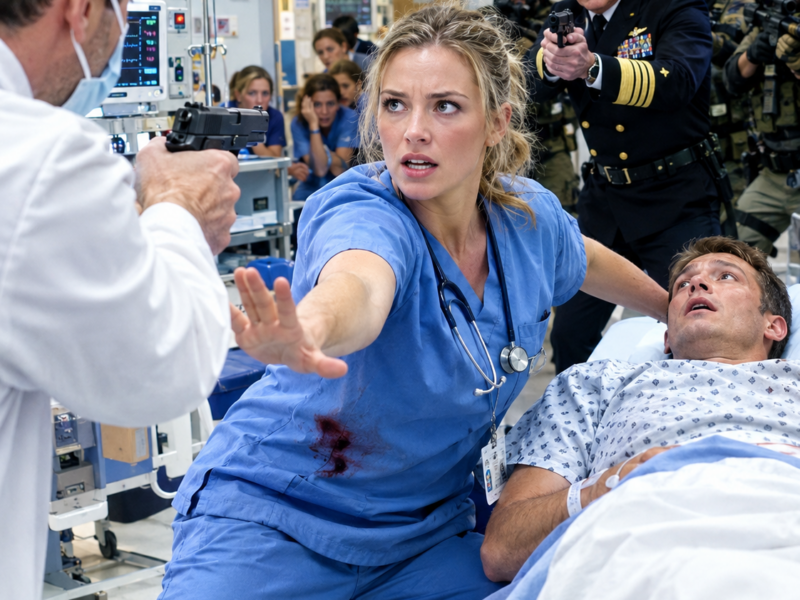
“At the Navy hospital’s annual awards ceremony in Annapolis, I heard the quiet nurse whisper, ‘Don’t be afraid…I’m here,’
“Because Laura Bennett was the last person who saw my wife alive.”
The admiral’s words followed me into the ambulance, repeating beneath the shrill monitor alarms and the paramedic’s clipped instructions.
I tried to sit up, but a sharp pain tore through my side.
“Don’t move, Emily,” the paramedic said. “You’ve lost a significant amount of blood.”
I grabbed his sleeve.
“Who is Laura Bennett?”
He looked at the admiral, who had climbed into the ambulance behind us.
“That’s what I’m trying to find out,” Carter answered.
He sat opposite me, his white uniform stained with my blood. For a man accustomed to giving orders that moved ships and changed lives, he looked remarkably helpless.
“Your wife,” I whispered. “What happened to her?”
His jaw tightened.
“Her name was Rebecca. She disappeared seventeen years ago.”
“Disappeared?”
“She was declared dead after a search that lasted six months. No body was recovered. No credible witnesses came forward. The Navy eventually closed the investigation.”
“And my mother knew something about it?”
He looked down at his hands.
“Your mother was a Navy nurse assigned to the medical team that treated Rebecca after a classified operation overseas. Three days before my wife disappeared, Laura called me and said she had discovered something she couldn’t explain.”
“What?”
“I never found out. She died in a car accident before we could meet.”
The ambulance hit a bump, and I clenched my teeth against the pain.
“My mother died in Pennsylvania,” I said. “A truck crossed the center line. That’s what the police report said.”
Carter nodded slowly.
“That was the official account.”
I stared at him.
“You knew about my mother’s death?”
“I knew her name. I knew she had worked with my wife. I didn’t know she had a daughter.”
The monitor beside me continued its steady beeping, indifferent to the fact that everything I had believed about my childhood was beginning to collapse.
My mother had never spoken about a Vice Admiral Carter.
She had never mentioned a woman named Rebecca.
And she had never told me why, in the months before her death, she started checking the locks on our apartment door twice every night.
I had been twelve years old when she died.
I remembered the rain on the kitchen window. The smell of burnt toast. The way she’d knelt in front of me that morning and tucked a strand of hair behind my ear.
“Whatever happens, sweetheart, never believe that silence means someone has forgotten you.”
At the time, I thought she was talking about my father, a man who had left before I was old enough to remember his face.
Now I wondered whether she had been trying to warn me about something else.
The ambulance doors opened at the hospital.
Medical staff rushed toward us, and the admiral stepped aside while they wheeled me into the trauma bay.
Just before the doors closed, he caught my hand.
“Emily, I need you to promise me something.”
I could barely focus on him.
“What?”
“If anyone asks you about your mother, don’t tell them anything until I’ve spoken to you.”
I pulled my hand away.
“You don’t get to save my life and then tell me what I can know about my own mother.”
For the first time, he seemed to understand that I wasn’t one of his sailors.
He was about to answer when the trauma team pushed him out of the room.
The doors shut between us.
And I was left with a bullet wound, a dead mother, and a question that had apparently frightened a Navy admiral for seventeen years.
By dawn, the bullet had been removed.
It had passed through the soft tissue along my left side, missing my major organs by a narrow margin. The surgeon told me I’d been lucky, though he didn’t seem particularly comfortable using that word.
I spent the next several hours drifting between sleep and pain.
When I finally woke properly, a nurse was checking my IV.
“Your friend has been waiting outside for almost an hour,” she said.
“I don’t have any friends here.”
She gave me a sympathetic smile.
“Then I suppose he’s a very persistent stranger.”
Vice Admiral Carter entered a moment later, carrying two cups of coffee and a manila envelope.
He looked as though he hadn’t slept.
“Your daughter?” I asked.
“Sophie is safe. She’s with my sister.”
“Does she know what happened?”
“She knows you saved her.”
He set one cup on the bedside table.
“She also wants to visit you, but I told her she could come later.”
I swallowed.
“Is she okay?”
Carter’s expression softened.
“She keeps asking whether the nurse with the brown eyes is going to be all right.”
I looked toward the window.
For some reason, that nearly made me cry.
“I’m glad she’s safe.”
He pulled a chair beside my bed but didn’t sit until I nodded.
“There’s something you need to see.”
He opened the envelope and slid a photograph across the blanket.
The picture showed a younger Daniel Carter standing beside a woman with dark hair and a bright, open smile. She wore a simple white blouse and had one hand resting on his shoulder.
I recognized her immediately.
Not from the admiral’s description.
From the photograph tucked inside my mother’s old jewelry box.
“Rebecca,” I whispered.
Carter leaned forward.
“You’ve seen her before?”
I nodded, my fingers trembling as I touched the edge of the picture.
“My mother kept a photograph of her. I thought she was one of her friends from work.”
“Do you still have it?”
“It’s in a box at my apartment.”
“What else is in the box?”
“I don’t know. Photographs. Her nursing certificate. Some letters.”
He studied me carefully.
“Did she ever receive unusual phone calls? Did anyone visit your home?”
I closed my eyes.
The memories came back in fragments.
A black sedan parked across the street.
My mother standing in the hallway after midnight, speaking so softly I couldn’t hear the person on the other end.
A man who came to our apartment one winter afternoon, asked whether Laura was home, then left without saying his name.
I had forgotten all of it.
Or perhaps I had learned not to ask.
“There was a man,” I said. “I was about ten. He came to the door and asked for her. When she saw him, she told me to go to my room.”
“What did he look like?”
“Tall. Gray hair. A scar near his mouth, I think.”
Carter’s face changed.
“What?”
“Do you recognize him?”
He didn’t answer immediately.
Then he took a second photograph from the envelope.
It showed three military officers standing outside a building, their faces turned toward the camera.
The man on the right had a narrow scar running from the corner of his mouth toward his jaw.
I stared at him.
“That’s him.”
Carter placed the photograph back on the bed.
“Admiral Richard Voss.”
The name meant nothing to me.
But it meant something to Carter.
I saw it in the way his shoulders stiffened and his fingers curled around the edge of the chair.
“Who is he?”
“He was my commanding officer when Rebecca disappeared. He retired three years ago.”
“Why would a retired admiral visit my mother?”
“Because he was the last person authorized to review the operation that brought Rebecca home.”
The room suddenly felt colder.
“Was he involved in her disappearance?”
“I don’t know.”
“You’re the Vice Admiral. Surely you can find out.”
“I’ve spent seventeen years trying.”
He opened the envelope again and removed a document with several lines blacked out.
“Rebecca was part of a medical evacuation following a covert mission in Eastern Europe. The mission was classified, but the official report said she suffered a breakdown and requested to leave military service.”
“My mother would never have hidden something like that from me.”
“Perhaps she thought she was protecting you.”
I looked at him sharply.
“That’s what everyone says when they don’t want to tell you the truth.”
He accepted the accusation without defending himself.
“You’re right.”
The admission unsettled me more than an argument would have.
He folded his hands.
“Rebecca had been working with a team that discovered evidence of illegal transfers of military equipment. The equipment was being diverted through contractors who had access to classified supply routes.”
“Was Voss involved?”
“He supervised the logistics division.”
“And your wife found out?”
“We believe she did.”
“Believe?”
Carter stared at the floor.
“The investigation was compromised. Witness statements disappeared. Financial records were altered. By the time I realized something was wrong, Rebecca was gone.”
I thought of my mother sitting at our kitchen table, rubbing her thumb over the rim of a coffee mug while the phone rang unanswered.
“What happened to her?”
“I don’t know.”
“Then why did you tell me she was the last person who saw your wife alive?”
“Because Rebecca called her the night she disappeared. We recovered a fragment of that call from a damaged recording system years later.”
He reached into the envelope and took out a sheet of paper.
The transcript contained only a few lines.
The first was Rebecca’s name.
The second was a time stamp.
The third sentence had been underlined.
**If anything happens to me, Laura knows where the original is.**
I read it twice.
“Where the original is,” I repeated. “The original what?”
“That’s the question I’ve never been able to answer.”
I looked at the photograph again.
“My mother died before you found this?”
“Yes.”
“Then why didn’t anyone search her belongings?”
“We did.”
I lifted my eyes.
“You searched my mother’s apartment?”
“Military investigators visited the property after her death. They reported finding nothing relevant.”
A laugh escaped me, brittle and painful.
“My mother’s jewelry box is still in my apartment. Nobody took it.”
Carter went still.
“Are you certain?”
“I’ve had it since I was twelve.”
He stood.
“We need to retrieve it.”
“No.”
The word came out more sharply than I’d intended.
He stopped.
“You can send someone with me,” I said. “But I’m not handing over the last things my mother owned to a man who admits he doesn’t know who he can trust.”
He studied me for a long moment.
Then he nodded.
“Fair enough.”
That was when his phone rang.
He checked the number and answered.
“Carter.”
A pause.
His expression hardened.
“When?”
Another pause.
“Do not approach him. Keep eyes on the building and wait for my authorization.”
He ended the call.
“What happened?” I asked.
“Admiral Voss has been found dead.”
I felt the room tilt.
“How?”
“An apparent heart attack. He was discovered in his home less than an hour ago.”
“That’s convenient.”
Carter looked at me.
“Yes,” he said quietly. “It is.”
I was discharged two days later, with instructions to rest, avoid strenuous activity, and return if the pain worsened.
Carter arranged a security escort, though I insisted on paying for my own taxi to the apartment.
I wanted one thing in my life that wasn’t controlled by a military officer.
The neighborhood looked exactly as I remembered it. The laundromat on the corner still had a flickering sign, and the woman in the downstairs apartment still kept a row of plants on her windowsill.
Nothing about the street suggested that my mother’s death might have been more complicated than a tragic accident.
My apartment was quiet when I unlocked the door.
The jewelry box sat on the top shelf of my bedroom closet, where I’d left it after moving in seven years earlier.
I lowered it carefully onto the bed.
It was an old wooden box with a brass latch and a faded blue lining. My mother had bought it at a flea market, telling me that beautiful things didn’t have to be expensive to matter.
I opened the lid.
Inside were two rings, a silver pendant, her nursing certificate, and several photographs.
I removed each item, placing it on the bedspread.
At the bottom lay a bundle of letters tied with a narrow ribbon.
I’d read them years ago, when grief made me desperate to find some explanation for why my mother had died.
Most were ordinary: notes from coworkers, holiday cards, a letter from a cousin in Ohio.
One envelope had no return address.
My name was written across the front in my mother’s handwriting.
Emily.
I had never seen it before.
My hands began to shake.
The envelope was sealed, the paper yellowed at the edges. I slid a finger beneath the flap and carefully opened it.
Inside was a single page.
*My darling girl,*
*If you’re reading this, then someone has finally started asking questions about Rebecca. I prayed that day would never come, because it means I failed to keep you away from the danger that followed her.*
I stopped reading.
My eyes blurred, and I had to put the letter down.
For seventeen years, I had imagined that my mother had left me nothing but memories.
She had left me an explanation.
Or the beginning of one.
I continued.
*Rebecca was not the woman the reports described. She was brave, stubborn, and sometimes so frightened that she couldn’t finish a sentence. She came to me after the operation because she had found evidence that people inside our own command structure were selling information that put American service members at risk.*
*She believed she could trust Daniel Carter. I believed it too.*
*But the night she disappeared, I learned that trust was not enough.*
I turned the page over.
There was nothing on the back.
The letter ended there.
I searched the box again, shaking out the lining, checking beneath the velvet tray. There was no second page.
A soft knock came from the front door.
I froze.
“Emily?” a man’s voice called. “It’s Commander Hayes. I’m here with the admiral’s security detail.”
I opened the door only far enough to see the uniform.
The man was in his forties, with close-cropped hair and a calm expression.
“Admiral Carter asked me to accompany you,” he said. “He thought you might find something important.”
I hesitated, then let him in.
His gaze moved to the open jewelry box.
“Did you find it?”
The question was too immediate.
I looked at him.
“Find what?”
He smiled faintly.
“The evidence your mother left behind.”
I hadn’t told anyone about the letter.
Not the admiral.
Not the security team.
Not even the doctor who had treated me.
Commander Hayes noticed my silence.
Then his hand moved toward the inside of his jacket.
I stepped back.
“Don’t.”
He stopped.
For a moment, we stared at each other.
Then he slowly withdrew his hand, holding up a phone rather than a weapon.
“I’m sorry,” he said. “I wasn’t reaching for a gun.”
“What were you reaching for?”
“To show you something.”
He unlocked the phone and turned the screen toward me.
It displayed a photograph of a document with my mother’s signature at the bottom.
The heading read: **WITNESS PROTECTION REQUEST — LAURA BENNETT.**
Below it was a date.
Three days before the accident that killed her.
I gripped the doorframe.
“What is this?”
“Your mother requested protection after Admiral Voss threatened her.”
“Why didn’t the Navy protect her?”
“Someone canceled the request.”
“Who?”
Hayes glanced toward the hallway.
“That’s why I came.”
He lowered his voice.
“Admiral Carter doesn’t know I have this. And if he discovers I’ve shown it to you, I may not have much time left.”
I should have sent him away.
Instead, I asked the question that had been burning inside me since the hospital.
“Did my mother die in an accident?”
Hayes looked at me for several seconds.
“I don’t believe she did.”
The apartment seemed to shrink around us.
He placed a small memory card on the table beside the jewelry box.
“Your mother gave this to someone she trusted shortly before she died. It was recovered from a sealed evidence locker last month.”
“What’s on it?”
“An audio recording. But I haven’t been able to access the full file.”
“Why bring it to me?”
“Because there’s a phrase in the recording that might be a password.”
He showed me a line transcribed from the damaged audio.
*The little girl deserves to know who her father is.*
I stared at the words.
“My father?”
Hayes nodded.
“Your mother never listed his name on your birth certificate. The original records were sealed.”
“My father left before I was born.”
“That’s what your adoption and family records indicate.”
“I was never adopted.”
“Then someone altered the records.”
I stepped away from the table.
The room swayed, and pain flared beneath my bandage.
I pressed a hand to my side and breathed through it.
“Who is my father?”
Hayes looked at the memory card.
“I think your mother was trying to tell you.”
Before I could ask another question, his phone buzzed.
He read the message, and the color drained from his face.
“What is it?”
He turned the screen toward me.
A photograph showed my apartment building from across the street.
Beneath it was a single sentence.
**She has the letter. Get the card before Carter arrives.**
I looked at Hayes.
“Who sent that?”
“I don’t know.”
He moved toward the window and pulled the curtain aside by an inch.
A black sedan was parked across the street.
My mouth went dry.
It was the same model I remembered from my childhood.
The driver’s window lowered.
A man inside raised a phone and took a picture of our apartment.
Then the sedan pulled away.
Hayes turned back to me.
“We need to leave. Now.”
I clutched the memory card.
“No. I’m tired of running from people who won’t tell me why.”
“Emily, please. You were shot two nights ago. Whoever sent that message knows where you live.”
“Then we’ll call the admiral.”
Hayes hesitated.
That hesitation told me more than his words had.
“You don’t trust him either,” I said.
“I trust him to protect his daughter. I trust him to serve his country. But I don’t know what he might do if he learns the truth about you.”
Before I could press him, someone knocked on the door.
Three firm knocks.
Hayes drew his weapon.
I backed toward the bedroom.
“Who’s there?” he called.
A familiar voice answered from the hallway.
“Daniel Carter. Open the door.”
Hayes lowered his weapon but didn’t put it away.
I opened the door.
The admiral stood alone, his expression grim.
His gaze fell on the letter, the memory card, and the document on my table.
Then he looked at Commander Hayes.
“Step outside.”
Hayes didn’t move.
“Sir, with respect—”
“That’s an order.”
I moved between them.
“No. Nobody is leaving until I get some answers.”
Carter’s eyes returned to mine.
For a long moment, he looked like the man kneeling beside me in the ballroom, trying to keep me alive.
Then he noticed the words on the letter.
*I believed it too.*
His face went pale.
“Emily,” he said softly, “where did you find that?”
“In my mother’s jewelry box.”
He reached for the letter, then stopped when I pulled it away.
“You told me your investigators searched her apartment.”
“They did.”
“Then how did they miss it?”
His eyes moved to the memory card.
“Where did you get that?”
“Commander Hayes brought it.”
Carter turned toward him.
“Explain.”
Hayes held his ground.
“Your security office has been compromised, sir.”
The admiral’s expression hardened.
“On what evidence?”
“The witness protection request. It was canceled three days before Laura Bennett died. The authorization bears your command identification.”
Silence filled the room.
I looked at Carter.
“Did you cancel my mother’s protection?”
“No.”
“Then someone used your authority.”
He stared at the document.
For the first time, I saw genuine uncertainty in his face.
“That’s possible.”
“Possible?” My voice cracked. “My mother is dead. Someone tried to kill me. Your daughter was nearly shot, and now you want me to believe all of this is a series of coincidences?”
He flinched.
“No,” he said. “I want you to believe that I’m going to find the person responsible.”
“Why should I?”
He had no answer.
Then Sophie stepped out from the hallway behind him.
She was holding her stuffed rabbit, her blue eyes fixed on the bloodstained bandage visible beneath my blouse.
“Daddy said I could see you,” she whispered.
Carter turned sharply.
“Sophie, you were supposed to stay with Aunt Margaret.”
“I didn’t want to wait in the car.”
She walked toward me, then stopped just short of touching my injured side.
“Does it still hurt?”
“A little.”
She looked down at her rabbit.
“I brought you something.”
From the rabbit’s small fabric pocket, she pulled a folded piece of paper.
“Someone gave this to me at the hospital. They said it was from the nurse who helped me.”
Carter knelt beside her.
“Who gave it to you, sweetheart?”
“I don’t know. A man in a blue shirt.”
My fingers tightened around the memory card.
I unfolded the paper.
It contained six words, written in block capitals.
**ASK DANIEL WHO SIGNED THE EVACUATION ORDER.**
The admiral read it over my shoulder.
For several seconds, he didn’t speak.
Then he reached into his jacket and removed a worn photograph.
It showed him standing beside Rebecca and Admiral Voss outside a military transport plane.
On the back was a handwritten date.
The same date my mother had mentioned in her letter.
“That’s the night Rebecca disappeared,” I said.
Carter nodded.
“I signed the evacuation order.”
The room went quiet.
“Why didn’t you tell me?”
“Because I was ordered to keep the operation classified.”
“By Voss?”
He looked at me.
“No. By someone above him.”
“Who?”
He turned the photograph over again, studying the handwriting.
“Someone whose name was removed from every surviving copy of the report.”
I held up the memory card.
“Then maybe this will tell us.”
Hayes moved to the table and opened his laptop.
“There’s a recovery program that may be able to restore the damaged recording. If the password is connected to the audio, we might have a chance.”
Carter looked at the note Sophie had brought.
“Whoever left this wants us to find the evacuation order.”
“Or wants us to believe you’re guilty,” I said.
He nodded.
“That’s also possible.”
I watched him for a long moment.
“I’m going to help find the truth. But I won’t let you make decisions for me.”
“I understand.”
“And if I discover that you knew more than you’ve told me, I’m going to walk away.”
His eyes flickered toward Sophie.
“I wouldn’t ask you to do otherwise.”
Hayes inserted the memory card into his laptop.
A progress bar appeared on the screen.
The damaged audio began to reconstruct itself, one fragment at a time.
At first, there was only static.
Then a woman’s voice emerged.
My mother’s voice.
I pressed both hands against the edge of the table.
“Emily,” she said through the speakers, sounding younger than I remembered, “if this recording has reached you, then I couldn’t keep my promise.”
A faint rustling followed.
Then Rebecca’s voice.
“Laura, you have to tell him. He has a right to know.”
My mother answered immediately.
“Not until I know who I can trust.”
The audio crackled.
A third voice interrupted them.
A man’s voice, calm and unmistakably familiar to Carter.
Admiral Voss.
“You have until midnight to surrender the original records. After that, neither of you will be protected.”
The recording skipped.
My mother’s breathing became audible.
Then she spoke again.
“If anything happens to Rebecca, the evidence must go to Daniel. He’s the only person who can stop them.”
A pause.
Rebecca whispered, “And Emily?”
My mother’s voice broke.
“She’s the reason I can’t take the risk.”
The recording ended.
Nobody spoke.
I stared at the screen, trying to understand what I’d just heard.
Rebecca had known about me.
She’d been worried about me.
And my mother had believed that the admiral was the only person who could help.
But the recording had left one question unanswered.
Who was the man above Voss?
Hayes leaned closer to the laptop.
“There’s another file.”
He clicked on it.
A scanned document appeared.
The title read: **EVACUATION ORDER — REBECCA CARTER.**
Beneath it were several signatures.
One belonged to Admiral Voss.
Another belonged to Daniel Carter.
The third was blacked out.
But the electronic authorization number was visible.
Carter took one step toward the screen.
“That’s impossible.”
“What?” I asked.
“That authorization number belongs to the office of the Secretary of Defense.”
Hayes looked at him.
“Then whoever signed it had authority above both of you.”
Carter slowly shook his head.
“The Secretary at the time was cleared years ago. He died in retirement.”
“Was he the one who ordered Rebecca evacuated?”
“No,” Carter said. “He was the one who ordered the operation.”
He leaned toward the screen, reading the remaining lines.
Then his face changed.
“There’s a second destination.”
Hayes enlarged the document.
The evacuation order listed two locations: the military hospital where Rebecca had supposedly been treated, and a small airfield in rural Maryland.
I recognized the name of the county.
It was less than an hour from where my mother had died.
The date was the same.
I looked at Carter.
“Why would my mother be there?”
He didn’t answer.
Instead, he opened his phone and called a number from memory.
“This is Vice Admiral Carter. I need the archived flight manifests for the evacuation operation seventeen years ago. No, not the official copy. The original.”
He listened.
“Then find it.”
He ended the call and turned to me.
“Emily, I need to tell you something before we go any further.”
I waited.
“After Rebecca disappeared, I received an anonymous message claiming she had survived. It said she was living under another identity and that if I tried to find her, Sophie would be in danger.”
My chest tightened.
“That’s why you’ve been protecting your daughter so closely.”
“Yes.”
“Did you believe the message?”
“I didn’t know what to believe. I was a commander with a wife who had vanished and a newborn daughter whose life depended on keeping her safe. I made a choice.”
“You stopped searching.”
His eyes dropped.
“I continued quietly, but I never pursued the leads that might have exposed Sophie to danger. I told myself I was protecting my family.”
“And all those years, someone else was deciding what you were allowed to know.”
He nodded.
“I’ve spent seventeen years wondering whether my wife was dead or alive. Now I know someone wanted me to stop asking.”
Sophie tugged gently at my sleeve.
“Is Mommy coming home?”
Carter closed his eyes.
I knelt carefully beside her, wincing as my injured side pulled.
“I don’t know, sweetheart.”
She looked at the photograph on the table.
“That’s my mommy?”
“Yes.”
“Daddy says she loved music. He says she used to sing when she cooked.”
Carter crouched beside us.
“She did.”
“Will you find her?”
He looked at his daughter, and the answer seemed to cost him more than any order he’d ever given.
“I promise I’ll find out what happened to her.”
Sophie nodded solemnly.
Then she hugged her rabbit and went to sit beside Hayes, who had begun checking the recovered files.
I turned back to the admiral.
“You said my mother was the last person who saw Rebecca alive.”
“That was what the records said.”
“But the recording suggests Rebecca was still alive when my mother was preparing to disappear.”
Carter nodded.
“And the evacuation order suggests they were taken to the same location.”
“Then that’s where we start.”
He studied me.
“You should be resting.”
“I’ve spent seventeen years believing my mother died because a truck crossed a wet road. I can rest when I know whether that was true.”
For the first time, the admiral didn’t try to stop me.
He simply nodded.
“Then we’ll go together.”
Hayes looked up from the laptop.
“Sir, there’s one more thing.”
He rotated the screen toward us.
The recovered file contained a photograph taken at the rural airfield on the night of the evacuation.
Three people stood beside a transport plane.
Admiral Voss was one.
My mother was another.
The third person stood with his back to the camera, holding a small child wrapped in a blanket.
I moved closer to the screen.
The child couldn’t have been more than a few months old.
A white hospital bracelet circled one tiny wrist.
Beneath the photograph was a handwritten note.
**Passenger four: female infant. Identity withheld by order of command.**
I stared at the image.
My birthday was recorded in the hospital records as March 14.
The date on the photograph was March 16.
Two days after I was born.
I felt the room slipping away from me again.
“That’s me,” I whispered.
Carter looked from the photograph to my face.
“Emily…”
I shook my head.
“No. Don’t tell me what you think it means. Find out what it means.”
He nodded slowly.
Hayes began copying the files.
Then the laptop chimed.
A new message had arrived from an unknown sender.
It contained no text, only an attachment.
Hayes opened it.
A scanned document filled the screen.
At the top were the words **PATERNITY TEST — CONFIDENTIAL.**
Below them was my mother’s signature.
Beside it was a name.
**Daniel Carter.**
For several seconds, the only sound in the room was the faint hum of the laptop.
Carter stared at the document as though it had become a weapon pointed directly at his heart.
I looked at him, then at Sophie, who was quietly stroking the rabbit’s worn ears.
“No,” I whispered.
The admiral’s face had gone pale.
“I didn’t know,” he said.
I wanted to believe him.
But the document bore my mother’s signature, the same signature I’d seen on birthday cards, school permission slips, and the letter that had just shattered my understanding of her life.
“Then someone used your DNA,” I said.
“Or the document is false.”
“Or you knew and let me believe my father abandoned me.”
He didn’t argue.
He didn’t defend himself.
He simply stood there, looking at the photograph of the infant at the airfield, while the weight of seventeen years settled between us.
Then Sophie’s small voice broke the silence.
“Daddy?”
He turned toward her.
“Why does the paper say Emily is my sister?”
No one answered immediately.
I looked at the child I’d saved from a bullet, the admiral who had spent seventeen years searching for his missing wife, and the evidence my mother had hidden until after her death.
I had gone to the ceremony believing I was an ordinary nurse who had been in the wrong place at the wrong time.
Now I knew someone had been watching me since before I could remember.
And somewhere in the records of a mission the Navy had tried to erase was the truth about my mother, Rebecca Carter, and the man whose name appeared on my birth test.
I reached for the photograph one more time.
On the back, beneath the date, a final line had been written in my mother’s handwriting.
**If Emily ever learns who her father is, make sure she hears the truth from him before the people who took Rebecca reach her first.**
I looked up at Daniel Carter.
“Then we have a lot to talk about.”
He nodded, his eyes wet.
“Yes,” he said. “And this time, Emily, I won’t hide anything.”
The end.









