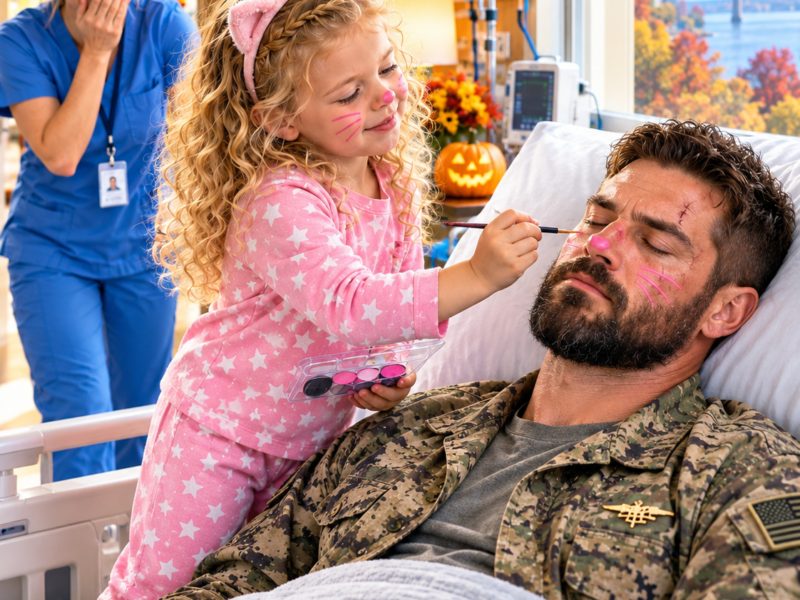
“At the military hospital in Virginia, I walked into the recovery room and found my three-year-old daughter drawing black whiskers across the face of a sleeping Navy SEAL
Mason looked down at the photograph again, running his thumb over the faded blue ink on the back.
For several seconds, neither of us spoke.
My daughter leaned against my leg, clutching the hem of my scrubs, while I tried to understand why a Navy SEAL I’d met less than five minutes ago was holding a picture that looked like it belonged in my family’s private photo albums.
“Your mother’s name is Margaret Carter, isn’t it?” Mason asked.
I took a step back.
“How do you know my mother’s name?”
He closed his eyes briefly, as if the answer hurt more than his surgical incision.
“Because she was the last person who ever let me see my daughter.”
The room seemed to tilt.
I tightened my grip on Lily’s hand.
“My mother has never told me about you.”
“I know.”
“She never mentioned a daughter named Lily, either.”
Mason’s gaze moved to the little girl beside me.
“She wouldn’t have.”
I wanted to demand an explanation, but the words crowded together in my throat.
Before I could speak, Patricia appeared in the doorway.
She took in the marker-streaked face of the patient, my frightened expression, and Lily’s small hand wrapped around mine.
“Emily, what happened?”
“I can explain.”
Mason carefully placed the photograph back on the bedside table.
“She’s not the one who needs to explain herself,” he said quietly. “I asked her a question she had every right not to answer.”
Patricia looked from him to me.
“Take Lily to the staff room. We’ll discuss this later.”
I nodded, grateful for the escape, but Mason’s next words stopped me.
“Emily, please. Just give me five minutes.”
There was no anger in his voice. No demand.
Only a tiredness so deep that it made him seem older than the years I guessed he had lived.
I looked at Lily.
She was studying Mason’s face with the serious concentration she usually reserved for injured birds and broken toys.
“Mommy,” she whispered, “he doesn’t want to be a kitty anymore.”
Despite everything, a small, disbelieving laugh escaped me.
Mason’s mouth twitched at one corner.
“No, sweetheart,” he said. “I think I can manage being a kitty for a little longer.”
For the first time since entering the room, Lily smiled.
That smile made my decision for me.
I asked Patricia to stay with Lily in the family room while I spoke with Mason. Patricia looked as though she had a dozen questions, but she agreed.
When the door closed behind them, I turned back to the man in the bed.
“Five minutes,” I said. “And if you tell me anything that sounds like a threat to my daughter, this conversation ends.”
“Fair enough.”
I pulled the visitor’s chair closer but didn’t sit.
Mason studied the photograph for another moment.
“Twenty-nine years ago, I met your mother when I was stationed near Norfolk. She worked at a diner off the highway. I was young, stupid, and convinced I had enough time to do everything I wanted before settling down.”
He paused.
“Margaret was kind to me when I was having a rough time. We became friends. Eventually, she introduced me to her daughter, Sarah.”
I frowned.
“My mother has no daughter named Sarah.”
“She did once.”
The words landed softly, which somehow made them worse.
“Sarah was your older sister,” Mason continued. “She was six years older than you. She died when you were very young.”
I stared at him.
My mother had always said she had lost a baby before I was born. She’d never given me a name, never shown me a photograph, never spoken about it beyond a few brief, uncomfortable sentences.
“You’re telling me I had a sister?”
“Yes.”
“And what does that have to do with you?”
Mason looked toward the window.
“Sarah was the woman I loved.”
I lowered myself into the chair.
He explained that they had met when he was twenty-two and Sarah was twenty-four. She had been studying to become a teacher and working evenings to help her mother pay the bills.
He described her as stubborn, funny, and incapable of leaving a stray animal alone.
“She once brought a three-legged dog into my apartment because she said it looked like it needed a place to sleep,” he recalled. “I told her I wasn’t keeping it. Six months later, that dog had a bed in my living room and a sweater for Christmas.”
A faint smile crossed his face.
“Sarah never believed people should be abandoned just because they were difficult to love.”
I thought of Lily drawing whiskers on a sleeping stranger because she thought he looked lonely.
“What happened to her?” I asked.
Mason’s smile disappeared.
“She was killed in a car accident when she was pregnant.”
My hand went to my mouth.
“Pregnant?”
He nodded.
“She hadn’t told many people. She was planning to surprise me after I returned from deployment.”
He swallowed hard.
“I was overseas when the accident happened. By the time I got home, Sarah was gone, and Margaret told me the baby hadn’t survived.”
For a moment, I couldn’t hear anything but the steady hum of the hospital ventilation.
“What baby?”
Mason looked straight at me.
“Lily.”
I shook my head.
“No. My daughter is three years old. Sarah died long before I was born.”
“I know.”
“Then how could she be your daughter?”
He hesitated.
“Because I’m talking about two different Lilys.”
The photograph on the table suddenly seemed to weigh a hundred pounds.
Mason picked it up and held it out to me.
“This is my daughter, Lily Reed. She was born two months after Sarah died. Margaret told me the baby had complications and passed away shortly after birth. I never saw her.”
I looked at the little girl in the yellow raincoat.
The photograph was old, but the resemblance to my daughter was undeniable. The dimple. The shape of the eyes. Even the stubborn little tilt of her chin.
“How old is she in this picture?”
“About three.”
“Then she can’t be my Lily.”
“No,” he said. “She can’t.”
He looked relieved that I’d said it, as though he’d been afraid I might try to force the impossible into something that made sense.
“But the resemblance is what brought me back to that photograph,” he continued. “Your daughter has Sarah’s face.”
I sat very still.
Mason rubbed a hand over his jaw.
“When I saw her standing beside my bed, I thought I was seeing a ghost. Then she told me your name, and I saw your badge.”
“Why didn’t you tell me all this immediately?”
“Because I don’t know what happened to my daughter. I don’t know why your mother gave me this picture. And I don’t want to accuse anyone of something I can’t prove.”
I studied him.
His voice was steady, but his fingers had tightened around the blanket.
“Why do you have a photograph of a little girl named Lily Reed if you were told she died?”
“Margaret mailed it to me three years after Sarah’s funeral. No letter. No explanation. Just the picture and a note that said, ‘She has your eyes.'”
He turned the photograph over again.
“I wrote to her. Called her. Went to the address I had. She wouldn’t see me. Eventually, I convinced myself it was a cruel joke, or that she’d changed her mind about what she’d told me.”
He gave a short, humorless laugh.
“Then the military moved me around, I went back to deployments, and life became one long list of things I promised myself I’d deal with later.”
“What happened to the girl in the picture?”
“I don’t know.”
“Did you ever try to find her?”
“Every way I knew how.”
He looked at me.
“By the time I had enough information to start asking better questions, the trail had gone cold. Margaret had moved. The old addresses led nowhere. I hired someone to search, but there wasn’t enough to work with.”
He lowered his eyes.
“I told myself that if she was alive and safe, I shouldn’t disrupt her life just because I wanted to be part of it.”
“And you just stopped?”
“No.” His answer came immediately. “I stopped making noise about it. That’s not the same thing.”
Something in the way he said it made me believe him, even though I had no reason to.
I glanced at the clock.
Our five minutes had become nearly twenty.
“I need to call my mother,” I said.
Mason nodded.
“I think you should.”
I stepped into the corridor and dialed Margaret Carter.
She answered on the fourth ring.
“Emily, sweetheart. Is everything all right?”
“Mom, I need you to tell me the truth about Sarah.”
Silence.
Not the confused silence of someone searching her memory. It was the silence of someone who had been waiting for a question for a very long time.
“Where did you hear that name?” she asked.
I closed my eyes.
“Who was Sarah?”
My mother exhaled shakily.
“Emily, please don’t do this over the phone.”
“Then tell me where to meet you.”
“I can’t.”
“Why not?”
“Because there are things you don’t understand.”
I looked through the open doorway at Mason, who was staring at the ceiling as if he were afraid to move.
“Then explain them to me.”
My mother’s voice broke.
“Is he there?”
I didn’t answer.
“Emily, is Mason Reed there with you?”
The fact that she knew his full name sent a chill through me.
“Yes.”
“Oh, God.”
“Mom, what did you do?”
“I was trying to protect you.”
“From what?”
She started crying.
I had heard my mother cry twice in my life: once at my father’s funeral and once when she thought I’d fallen asleep after a particularly difficult childhood illness.
This was different.
“I can’t tell you everything on the phone,” she whispered. “Come home. Please. Bring Lily if you can.”
“Why?”
“Because you deserve to know who you are.”
The call ended before I could ask another question.
I stood in the corridor holding my phone, feeling as if the floor beneath me had shifted several inches.
When I returned to Mason’s room, he was trying to sit up.
“Don’t do that,” I said automatically. “You’ve had surgery.”
“I need to get dressed.”
“You need to stay in bed.”
“My daughter might be alive.”
“You don’t know that.”
He looked at me with an expression I recognized from the faces of patients who had just received difficult news.
“No,” he said. “I don’t.”
That quiet answer was more convincing than any desperate promise could have been.
I called Patricia and explained that I needed to leave as soon as my shift could be covered. I expected anger.
Instead, she studied my face for a long moment and said, “Go. I’ll handle the paperwork.”
“I may have to explain this to the hospital.”
“You will,” she replied. “But not before you make sure your child is safe.”
When I collected Lily, she ran into my arms with her coloring book pressed against her chest.
“Mommy, I made another picture.”
She showed me a drawing of a tall man, a little girl, and a woman holding hands. All three had black whiskers.
At the bottom, in uneven purple letters, she’d written CAT FAMILY.
I pressed the paper to my chest before folding it carefully into my bag.
Mason was discharged two days later, though his physician warned him against traveling until his follow-up appointment. He insisted on arranging a ride home rather than asking me to take him.
Before he left, he approached me in the hospital lobby.
“I won’t come to your house,” he said. “I won’t contact your mother without your permission. I won’t ask you to believe anything just because I say it.”
He handed me a business card.
“This is my number. If you find something that makes sense of any of this, call me.”
I accepted it.
He looked down at Lily, who was busy trying to persuade a vending machine to give her two bags of crackers for the price of one.
“She’s got Sarah’s determination,” he said.
I almost asked him how he could possibly know.
Instead, I watched him walk away with his shoulders slightly hunched, one arm held close to his body.
For the first time, I wondered whether a man could spend years preparing himself for grief and still be completely unprepared for hope.
That evening, I drove to my mother’s house.
Lily fell asleep in the back seat before we reached the neighborhood where I had grown up. The streetlights passed across her face in pale bands, and I kept glancing at her in the rearview mirror.
My mother was waiting on the porch.
She looked smaller than I remembered, her gray hair pulled into a loose bun, both hands wrapped around a mug she wasn’t drinking from.
When I carried Lily inside, she touched my daughter’s cheek and began to cry again.
“She’s so beautiful,” she whispered.
“Mom, stop.”
She withdrew her hand.
I laid Lily on the couch with a blanket, then faced my mother across the coffee table.
“Start with Sarah.”
My mother sat down slowly.
“Sarah was your sister,” she said. “She was twenty-four when she died. You were four months old.”
I had to grip the back of a chair.
“Why did you tell me she was a baby?”
“Because I couldn’t bear to talk about her. Every time I looked at you, I saw what I’d lost.”
“That’s not an answer.”
“No.” She wiped her cheeks. “It isn’t.”
For the first time, she seemed willing to let the silence remain between us.
Then she told me about the accident.
Sarah had been driving home from a late shift when a truck crossed the center line. She died at the scene. The baby survived the initial impact, but Sarah’s injuries were catastrophic.
“The doctors said the baby had a chance,” my mother whispered. “They transferred her to another hospital.”
I stared at her.
“You told Mason the baby died.”
“Yes.”
“Why?”
My mother pressed both hands against her mouth.
“Because I was terrified.”
She explained that Sarah had been unmarried when she became pregnant. Mason had been deployed, and their relationship had been complicated by long separations and arguments about his career.
My mother had never trusted the military life. She feared Sarah would raise a child alone, waiting for a man who might never come home.
When Sarah died, those fears hardened into something uglier.
“Mason came back and wanted the baby,” she said. “He wanted to take her to live with his family. I thought he would raise her around deployments, strangers, and danger.”
“So you lied to him.”
“I convinced myself I was saving her.”
“From her father?”
My mother began to sob.
“From a life I couldn’t control.”
I looked toward the couch, where Lily slept with one hand tucked beneath her cheek.
“And the photograph?”
My mother reached for a small wooden box on the shelf.
Inside were several letters, an old hospital bracelet, and a photograph of Sarah holding a newborn wrapped in a white blanket.
On the back of the photograph, someone had written a date and the words, “Lily Reed, born at 2:14 a.m.”
My hands trembled.
“Where did you get this?”
“The hospital sent me copies. I was listed as the emergency contact.”
She pulled out a letter in a faded envelope.
“I sent Mason the picture when Lily was three. I wanted him to know she’d survived, but I couldn’t bring myself to tell him where she was.”
“Why send it at all?”
“Because I thought if he knew she was alive, he’d keep looking. And if he kept looking, he might find her.”
She looked up at me.
“I wanted him to know he hadn’t lost everything.”
I felt anger rise so sharply that I had to step away from the table.
“You let him believe his daughter was dead. Then you gave him a picture with no way to find her.”
“I know.”
“No, Mom. I don’t think you do.”
She didn’t defend herself.
That frightened me more than another excuse would have.
“Where is she?” I asked. “The baby. The girl in the photograph. Where did she go?”
My mother stared at the hospital bracelet.
“She was placed with a foster family after she left the hospital. I was told she needed specialized care. I was grieving, Emily. I wasn’t thinking clearly.”
“What family?”
“I don’t remember their name.”
“You don’t remember?”
“It was handled through an agency. I signed papers. They said it would be temporary.”
My mouth went dry.
“Temporary?”
She nodded miserably.
“I thought I would bring her home once I was stronger. But the months passed. I couldn’t face the paperwork, and I couldn’t bear to tell Mason what I’d done.”
“And then?”
“Then I was told she had been adopted.”
The room became unbearably quiet.
I stared at the letters scattered across the table, trying to understand how a baby could disappear into a new family while two people who loved her were left to mourn a child who was still alive.
“Did you ever try to find her?”
My mother nodded.
“I contacted the agency years later. They said the records were sealed. I was told there was nothing I could do.”
She reached for my hand.
“I thought I was protecting everyone. Instead, I hurt all of you.”
I pulled my hand away.
“Did you know Mason was still searching?”
“Not until the photograph.”
“Then why didn’t you tell him?”
She looked toward the sleeping child on the couch.
“Because by then, I was afraid he’d find her and take her away from the only family she’d ever known.”
I wanted to hate her.
Part of me did.
But as I looked at the woman who had raised me, I saw more than a villain in an old family secret. I saw someone who had made a terrible decision in grief, then spent years making smaller decisions to protect the first one.
Understanding that didn’t make what she’d done forgivable.
It only made it harder to know what to do next.
I took the hospital bracelet and photographed every document in the box.
Then I called Mason.
He answered on the second ring.
“Emily?”
“My mother told me what happened.”
He didn’t speak for several seconds.
“Is she alive?” he finally asked. “Do you think Lily is alive?”
“I think the baby survived. I don’t know where she is now.”
I heard him exhale, a sound that was almost a sob.
“My God.”
“I’m sorry.”
“Don’t apologize for what someone else did.”
His voice was unsteady, but he continued.
“There’s something I should tell you. Before I was discharged, I called a lawyer who works with military families. He said that if the adoption records are sealed, we may need a court order to access them.”
“Can we get one?”
“Maybe. We need the agency records, the hospital records, and proof that the child was mine.”
I looked at the photograph of Sarah holding the newborn.
“I have proof.”
“Then we start there.”
The next three weeks were a blur of phone calls, forms, and appointments.
Mason’s attorney helped us locate the hospital where Sarah had been treated. The medical records confirmed that the baby had survived the accident and had been transferred to neonatal care.
They also revealed something my mother had never mentioned.
The baby had suffered a serious respiratory complication and remained hospitalized for several weeks. She had recovered, but the records showed that she had required additional monitoring during her first year.
Mason read the report in silence.
When he finally looked up, his eyes were wet.
“I missed all of it,” he said. “Her first breath. Her first birthday. Everything.”
I had no comforting words.
I had spent years resenting my own daughter’s father for leaving us. Mason had been denied the chance even to try.
We learned that the adoption had been finalized through a private agency that had since merged with another organization. The original files were archived, and the court required a formal petition before they could be released.
Mason filed it.
I submitted an affidavit describing my mother’s account and provided copies of the documents she’d kept.
The process was slow, frustrating, and painfully impersonal.
Every time we called, someone explained that the records were being reviewed. Every time a letter arrived, I opened it with shaking fingers.
Lily, meanwhile, continued to ask about the man with the whiskers.
“Is he still a kitty?” she asked one morning over cereal.
“Sometimes,” I said.
“Can I see him again?”
I hesitated.
“Maybe, sweetheart. We need to find out some things first.”
She considered that, then nodded.
“Tell him I have more markers.”
I smiled, but after she left for preschool, I sat at the kitchen table and cried.
I wasn’t crying for Mason, or even for the child he might have lost.
I was crying because a little girl had been turned into a secret before she was old enough to speak, and every adult who loved her had been forced to live with a different version of the truth.
Two months after we filed the petition, Mason called me late on a Thursday afternoon.
“The court approved access to the archived records,” he said.
I gripped the edge of my desk.
“Did they find her?”
“They found the placement file.”
His voice sounded strangely distant.
“The agency is contacting the adoptive parents. They need to verify the records and make sure the family understands what we’re asking.”
“What exactly are we asking?”
“Not to take anyone’s daughter away,” he said quickly. “I need them to know that. I just want to find out whether she’s alive and whether she’d ever want to know who I am.”
I closed my eyes.
“That’s all I want, too.”
A week later, the attorney called us into his office.
He had a folder on the desk and a careful expression on his face.
“The adoption is valid and final,” he explained. “The family has been located. They’ve agreed to receive a letter from Mr. Reed, but they are not consenting to an immediate meeting.”
Mason nodded slowly.
“I understand.”
The attorney slid a sheet of paper toward him.
“The records list the child’s adoptive name as Hannah Brooks. She’s twenty-nine years old and lives in North Carolina.”
Mason stared at the page.
Twenty-nine.
The same age Sarah would have been if she were alive.
“Does she know?” he asked.
“Her parents say they’ve told her she was adopted, but they have not shared the details of her birth circumstances. They want to speak with her before deciding what information to release.”
Mason sat back.
For years, he’d imagined finding his daughter and holding her close. Now that she was a real person with a name, a home, and a life of her own, he seemed afraid to take another breath.
“What if she doesn’t want to meet me?” he asked after the attorney left the room.
“Then you respect that,” I said.
He nodded.
“What if she thinks I abandoned her?”
I remembered the way my own daughter’s father had left us without looking back.
“You tell her the truth,” I said. “Then you let her decide what it means.”
Mason looked down at his hands.
“I don’t know how to be her father after all this time.”
“Neither of us gets to decide what she needs,” I replied. “We can only give her the choice.”
He looked at me for a long moment.
“You’re a better person than I am.”
“No,” I said. “I’m just as scared as you are.”
We wrote the letter together.
Mason told Hannah about Sarah, about the photograph, and about the years he had spent believing his daughter was dead. He didn’t ask her to forgive him. He didn’t ask her to call him Dad.
He wrote that he would answer any questions she had, and that if she never wanted to meet him, he would still be grateful to know she was alive.
At the end, he added one sentence in his own handwriting.
“I have a picture of you in a yellow raincoat, and I have kept it safe for twenty-six years.”
The letter was sent through the attorney.
Then we waited.
Three weeks passed.
Mason returned to his duties as his doctors allowed, though he was restricted from strenuous activity. He called occasionally to ask how Lily was doing, always making sure not to intrude.
He sent her a coloring book once, with a note that read, “For the artist who improved my appearance.”
Lily insisted on drawing whiskers on the front cover.
I sent him a photograph of her masterpiece.
He replied with a single sentence: “I’ve never owned anything better.”
Then, one rainy Tuesday evening, my phone rang.
It was the attorney.
“Hannah has read the letter,” he said. “She’d like to speak with Mr. Reed.”
I called Mason immediately.
He didn’t answer.
I tried again.
When he finally picked up, I could hear traffic in the background.
“Emily?”
“She wants to talk to you.”
Silence.
Then, very softly, he asked, “What do I say?”
“The truth.”
“What if I say the wrong thing?”
“Then you listen.”
He let out a shaky breath.
“Will you stay on the phone with me while I call her?”
I looked at Lily, who was sitting on the floor arranging her crayons by color.
“Of course.”
Mason called Hannah that evening.
I stayed on the line, muted, while he spoke to his daughter for the first time.
At first, there were only awkward introductions and long pauses.
Then Hannah asked about Sarah.
Mason told her about the three-legged dog, the Christmas sweater, and the way Sarah used to sing off-key while washing dishes.
Hannah laughed once, then cried.
She asked why he hadn’t come looking for her sooner.
Mason didn’t make excuses.
“I was told you were dead,” he said. “When I learned you might be alive, I searched. I didn’t find you. I wish I’d done more.”
“What would you have done if you’d found me?”
“I would have asked whether you wanted to know me.”
“And if I said no?”
“I would have respected that.”
There was another long silence.
Finally, Hannah asked, “Do you still have the photograph?”
Mason’s voice broke.
“Yes.”
“Could you send me a copy?”
“Of course.”
“Thank you.”
It wasn’t a reunion.
It wasn’t forgiveness.
But it was a door opening.
Over the next several months, Hannah and Mason exchanged letters, then emails, then occasional phone calls. She learned about Sarah from the man who had loved her mother, and Mason learned about the childhood he had missed from the woman his daughter had become.
They moved slowly.
There were painful questions, and some days Hannah didn’t respond at all. Mason learned not to fill the silence with apologies she hadn’t asked for.
Eventually, she agreed to meet him.
They chose a small café halfway between their homes. Mason arrived an hour early and sat with the photograph on the table in front of him.
I wasn’t there when Hannah walked in.
Mason later told me that she paused at the door, looked at him, and almost turned around.
Then she noticed the photograph.
She sat down.
Neither of them knew what to say.
So Mason pushed the picture across the table.
Hannah studied the little girl in the yellow raincoat.
“I don’t remember this,” she said.
“You were three.”
She smiled faintly.
“That explains it.”
He laughed, and then they both cried.
They didn’t embrace until Hannah reached across the table and took his hand.
It wasn’t the reunion Mason had imagined for twenty-six years.
It was something quieter, more fragile, and perhaps more honest.
They had coffee. They talked about Sarah. Hannah asked about his work, his injuries, and the years he’d spent searching.
When they parted, she didn’t call him Dad.
She called him Mason.
He told me later that hearing his name in her voice was enough.
As for my mother, our relationship changed in ways I couldn’t repair overnight.
I still loved her. I still called her on Sundays. But I stopped pretending that love erased the consequences of what she’d done.
She wrote Hannah a letter of apology through the attorney. Hannah accepted it but didn’t agree to meet her.
My mother cried when she told me.
“I thought she might want to know me.”
“Maybe one day she will,” I said. “But she gets to decide.”
For once, my mother didn’t argue.
A year after the day Lily painted whiskers on Mason’s face, he came to visit us on a Saturday afternoon.
He arrived carrying a small paper bag and a new pack of washable markers.
Lily opened the door before I could reach it.
“You’re the kitty man!”
Mason laughed.
“That’s me.”
She took his hand and pulled him toward the kitchen, where she’d already laid out paper, crayons, and a plate of cookies.
I watched them from the doorway as Lily explained the rules of her latest drawing game. Mason listened with the solemn attention of a man receiving a mission briefing.
He was no longer just a wounded stranger in a hospital bed.
He was someone who had learned that being present mattered more than having the perfect words.
Before he left, he handed Lily a small frame.
Inside was a copy of the photograph of Hannah in her yellow raincoat.
“I thought you might like to meet my daughter,” he told her.
Lily studied the picture.
“She looks like me.”
“She does,” Mason said.
“Is she sad?”
He considered the question.
“Sometimes. But she’s learning that she doesn’t have to be sad alone.”
Lily nodded, satisfied with that answer.
Then she picked up a black marker and held it out to him.
“Do you want more whiskers?”
Mason looked at me, pretending to consider the offer.
“Only if you promise not to tell my commanding officer.”
Lily giggled and began drawing.
I stood there watching them, thinking about how a child had walked into a hospital room with nothing but a marker and a simple belief that lonely people deserved kindness.
She hadn’t known Mason’s history. She hadn’t understood the years of grief or the choices that had separated him from his daughter.
She had only seen a man who looked sad.
And for one small moment, she had made him smile.
That smile hadn’t solved everything. It hadn’t erased the years he’d lost or forced forgiveness from anyone who wasn’t ready to give it.
But it had opened a door.
Sometimes, I still think about the photograph on Mason’s bedside table, the one that carried a truth my family had buried for decades.
I think about the people who believed silence was protection, and the people who mistook distance for peace.
Most of all, I think about Hannah, sitting across from her father in a quiet café, deciding for herself what their future might become.
When Mason left that afternoon, Lily ran to the window and waved until his car disappeared around the corner.
Then she turned to me, her cheeks smudged with black marker.
“Mommy?”
“Yes, sweetheart?”
“Can sad people become happy again?”
I knelt beside her and brushed a strand of hair from her face.
“I think they can,” I said. “But sometimes they need someone to sit with them while they figure out how.”
She considered that, then held up her drawing.
It showed a man, a woman, and two little girls beneath a bright yellow sun.
All four had whiskers.
And for the first time in a long time, when I looked at my family, I understood that the truth could hurt people, change everything, and still be the beginning of something good.
The end.









