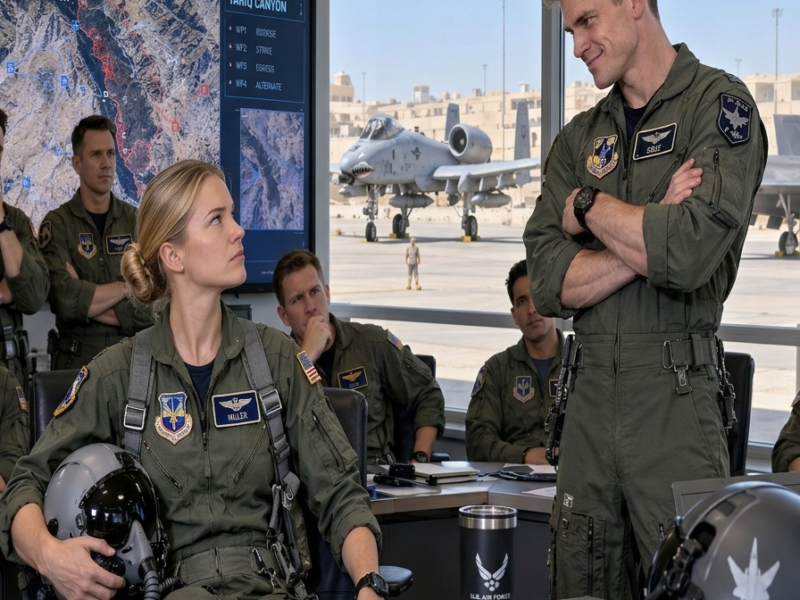
At the crowded briefing room at Edwards Air Force Base, an F-35 pilot laughed in my face and called me useless in front of his entire squadron
The ambient roar of Pratt & Whitney F135 engines vibrated through the reinforced steel floorboards of Hangar 4 at Edwards Air Force Base, a constant, low-frequency tremor that settled deep in the marrow of my bones. Outside, the high desert sun baked the tarmac of the Mojave to a blinding, shimmered white, but inside the air-conditioned confines of the briefing room, the air was sharp with the smell of stale coffee, ozone, and unearned confidence.
I stood by the edge of the central maintenance console, my thumb resting on the cracked bezel of an encrypted Panasonic Toughbook tablet. I wore my usual uniform: a faded charcoal flight jacket with the patches meticulously unstitched, steel-toed tactical boots, and dark hair pulled tightly into a no-nonsense knot at the base of my neck. To the men in flight suits who crossed this room every morning, I was barely part of the furniture. I was Maya Vance: a quiet civilian contractor, a former mid-level avionics technician who spent her days running routine diagnostic sweeps and updating software patches for the 412th Test Wing.
They didn’t know about the classified archives tucked away in a SCIF at Wright-Patterson. They didn’t know about the test-pilot wings I had surrendered five years ago, or the ghost of an experimental stealth prototype that had disintegrated over the Utah Salt Flats, taking my wingman and my military career with it.
“You’re standing in the light, Vance.”
The voice was loud, resonant, and dripping with smooth, effortless authority. Captain Ryan Mitchell dropped his helmet onto the mahogany briefing table with a heavy, metallic clatter. He was thirty-two, possessed the symmetrical jawline of a recruiting poster, and carried himself with the supreme, unshakeable arrogance that only three thousand hours in single-seat fighter jets can bestow. Behind him, two junior pilots—Lieutenants Miller and Hayes—chortled in rehearsed synchronicity.
“Sorry, Captain,” I said, my voice intentionally flat, devoid of cadence or confrontation. I didn’t move an inch, keeping my gaze anchored to the cascade of green telemetry data scrolling across my tablet.
Ryan unzipped his flight suit to the chest, revealing a damp green undershirt. He unstrapped his heavy leather flight gloves and carelessly tossed them onto the maintenance counter, right over the hard-copy circuit schematics I had laid out moments prior.
“You’ve been staring at that screen for twenty minutes,” Ryan said, leaning his broad frame against the counter, crowding my physical space. “Did you find a dust mote in the sensor array, or are you just trying to look busy so Logistics doesn’t cut your contract?”
Miller snickered. “Maybe she’s trying to figure out which button makes the coffee machine work, Mitchell.”
“Careful, Miller,” Ryan replied, tossing a smirk over his shoulder. “She might file a safety hazard report on you. Maybe you should stick to paperwork, Vance. Leave the flying—and the machine logic—to the guys who actually sit on top of the engine.”
A chorus of light laughter rippled through the pilots gathered near the whiteboard.
I swallowed the bitter taste of copper in my mouth, feeling the old, familiar heat rise up the back of my neck. Five years ago, I would have had him against the lockers before his flight gloves hit the floor. Five years ago, I was Lead Test Pilot Captain Maya ‘Valkyrie’ Vance, the youngest female evaluation officer in the history of the Air Force Material Command. But today, I was just a contractor who carried a clipboard. I forced my breathing to remain slow, rhythmic, and invisible.
“Paperwork keeps you from painting yourself across the desert, Captain,” I muttered quietly, turning my eyes back to the diagnostic feeds.
“What was that?” Ryan’s eyes narrowed slightly, his condescending grin slipping just a fraction.
“Nothing, sir.”
I swiped across the tablet interface, isolating the triple-redundant flight-control bus on Aircraft AF-104—Ryan’s assigned F-35A Lightning II for the morning’s multi-axis intercept exercise. The software was supposed to be pristine, a Block 3F baseline patch installed just forty-eight hours ago. But as I cycled through the primary flight control computer (PFCC) telemetry logs, a micro-variance caught my eye.
It wasn’t a hard fault. If it had been a hard fault, the aircraft’s self-diagnostics would have thrown a Master Caution tone immediately. It was a phantom. A three-millisecond delay in the feedback loop between the nose-gear air data probes and the leading-edge flap actuators. It appeared for a single clock cycle, vanished, and then caused a micro-voltage fluctuation in the secondary digital flight control channel.
My pulse spiked. The baseline logic looked clean, but the temporal sequencing was wrong. It was a whispering error—a anomaly so minute that standard military-spec diagnostic suites swept right past it, treating it as background thermal noise.
I walked briskly toward the glass-walled office at the rear of the hangar where Chief Master Sergeant Marcus Reed sat squinting at a logistics manifest. I didn’t knock; I pushed the door open.
“Chief,” I said, setting the tablet on his desk. “Aircraft 104 has an anomaly in the primary flight control architecture. Channel Bravo is dropping clock cycles during actuator handoffs.”
Chief Reed looked up, his weathered, leathery face creased with decades of desert dust and jet fuel exposure. He peered over his reading glasses at the screen, then at me. “Maya, 104 just passed her pre-flight bit test twenty minutes ago. Zero write-ups. Ground crew cleared her for the 0900 launch.”
“The automated BIT test doesn’t stress-cycle the bus logic at cold-start handoffs,” I insisted, my voice tight. “Look at the timing loop here. The actuator isn’t receiving the null-command confirmation before the secondary channel polls the bus. Ground the aircraft until we understand this.”
Before Reed could reply, the door swung wider. Ryan Mitchell stood in the doorway, his helmet tucked under his arm, his eyes bright with impatience.
“Is there a problem here?” Ryan asked, looking between Reed and me. “My slot in the airspace opens in ten minutes. The tankers are already on station over China Lake.”
“Vance here thinks 104 has a glitch in the flight control bus,” Reed said, rubbing his chin nervously.
Ryan burst into a short, incredulous laugh. “A computer glitch? You’re delaying a high-value combat readiness exercise—costing eighty thousand dollars an hour in jet fuel—over a computer glitch caught by a line tech?”
I stepped into his line of sight, refusing to back down. “It’s not a glitch, Captain. It’s a structural breakdown in the signal processing timing. If that control surface receives conflicting commands during a high-alpha maneuver, the flight envelope protection will lock you out.”
Ryan stepped closer, dropping his chin, using his height to intimidate. The arrogant smirk was gone, replaced by the sharp, defensive annoyance of a fighter pilot who hated having his machine questioned by someone he deemed inferior.
“Then prove it,” Ryan spat out, his voice sharp as a razor. “Show me a hard code. Show me a red flag on the MFD. Show me something other than your personal feelings, Vance.”
“I can’t give you a hard code because the bus clears the cache before the system registers the overflow!” I said, my voice rising slightly. “That’s what makes it dangerous!”
“That’s what makes it a non-issue,” Ryan snapped. He turned his back on me, looking directly at Chief Reed. “Chief, the aircraft is signed off in the logbook. I’m taking her up.”
“Ryan, wait—” Reed started.
“We are on the clock, Chief,” Ryan cut him off sharply. “If she wants to pull my jet, she can go get a sign-off from the Wing Commander. Otherwise, clear my flight line.”
Without another word, Ryan turned on his heel and strode out of the office, his heavy flight boots echoing down the concrete corridor. Miller and Hayes followed him like loyal bodyguards.
I stood by the window, watching through the glass as Ryan climbed the maintenance ladder of the dark grey, radar-absorbent stealth fighter parked on the apron. The canopy slowly descended, sealing him into his pressurized cocoon. I felt a cold knot of dread form in the pit of my stomach—a visceral, greasy sensation that I hadn’t felt since the morning Captain David Vance, my younger brother and wingman, had taken off into a crystal-clear sky and never come back.
Ten minutes later, the twin tails of AF-104 captured the brilliant desert sunlight as the engine screamed into full afterburner. The aircraft shot down Runway 22 Left, lifted its nose, and sheared upward into the vast blue sky above the Mojave, leaving behind nothing but a lingering wave of heat and the ominous, lingering echo of my own unresolved warnings.
In the Operations Control Center, the atmosphere was typically methodical, characterized by the steady hum of cooling fans, the quiet chatter of radar operators, and the ambient glow of high-resolution tracking displays. I sat at a auxiliary telemetry terminal near the back of the room, my fingers hovering over a secondary keyboard. I wasn’t supposed to be monitoring the live telemetry feed for the exercise—civilian contractors were restricted to post-flight data analysis—but Chief Reed hadn’t told me to leave, and the knot in my stomach was pulling tighter by the second.
The primary screen showed the exercise layout: Ryan’s F-35, callsign Slayer 1, was engaging two simulated enemy aircraft over the R-2508 Complex near Death Valley. He was flying hard, pushing the airframe into aggressive, high-angle-of-attack turns to demonstrate the jet’s advanced maneuverability.
“Slayer 1, off-board target locked, pushing engagement,” Ryan’s voice came over the speaker, crisp, cool, and effortless.
I pulled up the raw data stream from 104’s digital flight control system on my private feed. My fingers flew across the keys, filtering out the radar and weapons telemetry to isolate the primary actuator data streams.
There it was again.
The micro-variance wasn’t disappearing anymore. As the airframe heated up and the aerodynamic forces on the wing surfaces escalated, the timing delay was growing exponentially. What had been a three-millisecond lag on the ground was now an eight-millisecond gap.
“Come on, pull back,” I whispered under my breath, my hands gripping the edge of the desk. “Unload the Gs…”
On the main display, Ryan executed a sharp vertical pull, rolling the aircraft left to vector behind his simulated target. The aerodynamic load exceeded six Gs.
Suddenly, the green line on my telemetry monitor fractured. The primary flight control computer lost sync with the left horizontal stabilator actuator. The system tried to compensate by dumping full hydraulic pressure into the right stabilator to balance the roll rate, but the temporal delay caused a phase lag. The computer thought the jet was rolling right when it was actually rolling left.
In my monitor, every line of telemetry flipped from calm green to a violent, flashing red.
“Control surfaces are responding incorrectly,” I whispered, the blood draining from my face.
Before the radar controller could register the change on his main screen, the radio speaker exploded with a burst of static, followed instantly by Ryan’s voice. The calm, arrogant tone was gone, shattered by a sudden spike of adrenaline.
“Tower… Slayer 1! I’ve got… uncommanded pitch oscillation! I’m getting contradictory flight-control inputs. My aircraft isn’t responding!”
The entire operations room went deathly quiet. The low chatter vanished instantly, replaced by the harsh, rhythmic beep of an alarm on the Supervisor of Flying’s (SOF) console.
“Slayer 1, SOF,” Major Henderson snapped, grabbing his microphone. “Say again? Disengage autopilot and revert to basic flight control laws.”
“I AM in basic flight laws!” Ryan shouted over the radio. The background noise was deafening—the roaring wind and the loud, electronic warble of the jet’s internal warning systems. “She’s pitching up! She’s—I have stick force, but the nose is ignoring my input! The airframe is violently shaking!”
On the radar map, Slayer 1’s flight path lost its smooth, linear trajectory. The icon began to jaggedly sway, dropping speed rapidly as the horizontal tail surfaces fought each other, turning the high-tech jet into a wildly unstable drag brake high in the thin air.
“Abort the exercise!” Henderson ordered, his voice tense. “Slayer 1, knock it off! RTB immediately! Vector two-seven-zero, descend to fifteen thousand.”
“I’M TRYING!” Ryan’s voice echoed across the room, panicked and breathless. “I’ve lost reliable control! She’s rolling left! I’m applying full right stick… nothing! No response! She’s rolling—”
My screen was overwhelmed with diagnostic failures. System Fault: Flight Control Bus Alpha Offline. System Fault: Flight Control Bus Bravo Desynchronized. Hydraulic Pressure Crossover Failure.
My heart hammered against my ribs like a trapped bird. I knew this profile. I knew this exact sequence of digital degradation. It was the same cascade that had hit my brother’s prototype over Utah. The primary flight control software, under specific high-load conditions, was entering an infinite processing loop, flooding the data bus with garbage commands and overriding the pilot’s physical inputs.
The jet wasn’t just failing; it was actively fighting its pilot, driving itself toward a structural breakup.
“He’s falling,” a radar operator breathed, his voice trembling. “Slayer 1 is entering a descending spiral over the Panamint Range. Altitude twenty-two thousand… twenty thousand… speed dropping through two hundred knots.”
“Slayer 1, eject! Eject!” Henderson commanded into his headset.
“Negative! Canopy seal warning… seat arming circuit is showing a fault code!” Ryan screamed, panic breaking his voice completely. “The seat safety interlock isn’t clearing! I can’t eject! I can’t eject!”
Cold ice poured down my spine. The ejection seat logic was tied directly to the main air data computer—the same computer that was currently locked in a deadly processing loop.
“Get me the flight-control diagnostics!” I demanded, leaping up from my desk and striding toward the main control platform.
Major Henderson spun around, his face dark with stress. “Who the hell are you? Get back to your station, contractor! We’re handling an emergency!”
“You’re handling an execution!” I yelled, stepping directly up to the console, staring him down with an authority that forced him back an inch. “I know this software architecture! I know why his ejection seat interlock is failing! He’s forty seconds from impacting the mountains!”
“You’re not authorized to access flight-critical command protocols—” Henderson began, reaching for the security radio.
Chief Reed stepped between us, placing a heavy hand on Henderson’s shoulder. “Let her speak, Major. She knows more about these systems than anyone in this building.”
“You’re not authorized—” Henderson repeated, his voice cracking.
“Then watch him die while you find someone who is!”
My voice cracked across the room like a gunshot. The sharp, brutal intensity of it stunned the room into complete silence. Operators froze at their stations. The only sound left was the agonized screaming of the jet’s engine coming through the static-filled radio speakers.
For the first time that morning, nobody was laughing at the civilian contractor in the faded jacket.
“Give me the headset,” I said, my tone dropping into a deadly, icy calm.
Henderson stared at me for two seconds, then unclipped his primary command headset and handed it over.
I pulled the headset over my ears, slammed my left hand onto the secondary terminal keys, and opened a direct line to Slayer 1.
“Ryan,” I said, my voice cutting through the static, perfectly measured, entirely steady, and completely bereft of fear. “Listen to me. Stop fighting the system. I need you to follow my instructions exactly.”
A heavy beat of static answered me. The background sound from Slayer 1’s cockpit was a nightmare of metallic stress, howling wind, and the relentless screaming of the synthetic warning voice: PITCH UP. PITCH UP. FLIGHT CONTROL SYSTEM FAILURE.
“Who… who is that?” Ryan gasped. His breathing was fast and shallow, the hyperventilation of a man staring directly into his own open grave. “Is that… Vance?”
“Yes, Ryan. It’s Maya,” I said, my voice steady, anchoring him to the sky. “You are in a digital hysteresis lock. The primary computer is feeding garbage logic to your stabilators because Channel Alpha and Channel Bravo are out of phase. Every time you move the flight stick, you add more garbage data to the queue. You are making the aircraft fight itself.”
“I can’t… I can’t control her!” Ryan yelled. “She’s pulling her own nose down! Altitude fifteen thousand! I’m going into the ridge!”
“Take your hands off the stick, Ryan.”
A gasp went around the Operations Control Center. Major Henderson looked like he was about to throw up.
“Are you insane?!” Ryan screamed over the radio. “If I let go of the stick, I hit the mountain!”
“If you hold the stick, you give the computer fresh inputs to miscalculate!” I countered fiercely, my fingers flying over the diagnostic screen, isolating the system’s memory allocation registers. “Take your hands off the stick, pull your hands back to your chest, and take your feet off the rudder pedals. DO IT NOW!”
There was a agonizing three-second delay. Three seconds where the red altitude track on the main display dipped beneath twelve thousand feet, plunging into the sharp, deadly contours of the Panamint Mountains.
Then, the violent roll rate on the telemetry display slowed down. The pitch oscillation didn’t stop, but it stabilized into a broad, predictable wave.
“Okay…” Ryan breathed, his voice trembling violently. “Hands off… feet clear. She’s… she’s still descending, Maya! Nine thousand feet! I have no eject option!”
“I’m clearing your ejection circuit now, but you aren’t going to need it,” I said, working with a speed born of muscle memory and nightmarish familiarity. “The software is drowning in a memory leak on Channel Alpha. We have to force the aircraft into a manual bus reboot without dropping the engine control computers.”
“You can’t reboot the flight computer mid-flight!” Major Henderson whispered behind me in absolute horror. “She’ll drop like a stone!”
“She’s already dropping like a stone,” I shot back, not looking away from my monitor. “Ryan, look at your left console. Find the breaker switch labeled FCS BUS B-SEC. It’s guarded by a yellow wire gate.”
“Found it!” Ryan panted. “It’s guarded! We never touch that in flight!”
“Flip the guard. Pull the breaker.”
“Maya, if I pull that, I lose all digital stability augmentation!”
“You don’t HAVE digital stability augmentation right now, Ryan! You have an algorithm trying to drive you into the dirt! Pull the breaker!”
“Pulling breaker… NOW!”
On my telemetry screen, Channel Bravo went totally black. For a terrifying, heart-stopping four seconds, the telemetry line for Slayer 1 flattened into a straight line. The aircraft dropped four hundred feet in a second, falling in absolute, unassisted aerodynamics over the rocky desert terrain.
“Maya!” Ryan screamed as gravity pinned him against his harness. “MAYA!”
“Stand by,” I said, my voice terrifyingly calm even as cold sweat ran down my spine. “Now, cycle the primary flight control switch on your right panel to OVERRIDE. On three. One… two… three.”
I slammed the enter key on my console, sending a raw, low-level override string through the base’s high-gain telemetry tower directly into the aircraft’s secondary receiver.
In the cockpit of AF-104, a harsh digital chime sounded. The red warning lights flickered, dimmed, and suddenly turned a soft, solid amber.
“System reset complete,” the synthetic cockpit voice announced smoothly.
The violent aerodynamic buffeting vanished. The horizontal tail surfaces returned to their neutral position, aligning with the airflow.
“Control restored,” Ryan gasped, his voice choked with pure shock. “I… I have stick authority! The nose is coming up! I have stick authority!”
“Pull up gently, Ryan,” I commanded, allowing myself to exhale for the first time in five minutes. “Do not exceed three Gs. Channel Bravo is disabled. You are flying on a single-channel fallback system. Smooth inputs only.”
On the radar screen, the descending vector curve flattened out at four thousand feet above ground level—barely fifteen hundred feet clear of the craggy mountain peaks. The red jet icon slowly banked eastward, pointing its nose back toward the long, welcoming dark strip of Runway 22 at Edwards.
“Vector zero-eight-zero,” I said softly into the microphone. “Maintain two hundred and fifty knots. Bring her home, Captain.”
There was a long burst of quiet static over the radio circuit. The terror, the adrenaline, and the screaming warning tones were replaced by the steady, rhythmic sound of a man fighting to regain his composure.
Then came his voice. It was completely stripped of every trace of arrogant bravado, hollowed out, and quiet.
“Please,” Ryan whispered, the word broken and fragile. “Just tell me how to get home.”
“I’ve got you,” I said softly, guiding him step by step through the emergency flight checklist, holding his hand through the sky with words and raw data while the operations room around me remained stunned into absolute, reverent silence.
Twenty minutes later, the high-pitched whistle of AF-104’s engine rolled across the tarmac as the stealth fighter touched down on Runway 22 Left. The landing was far from textbook—the nose drifted slightly to the left as the single-channel flight control system struggled to process the crosswind—but the tires smoked against the concrete, the speed brakes deployed, and the aircraft rolled to a safe stop near the end of the taxiway.
Emergency response vehicles—red crash trucks with sirens flashing—surrounded the aircraft, but Ryan waved them off. He taxied the crippled jet back to Hangar 4 under its own power, brought it to a stop on the apron, and shut down the engine.
Inside the Operations Center, the tension shattered into a wave of quiet, exhausted sighs. Controllers collapsed back into their chairs. Major Henderson stood behind me, staring at my side profile as if trying to comprehend what kind of person he had been yelling at five minutes ago.
I didn’t wait for congratulations. I unclipped the headset, placed it neatly on the console, and walked out of the room before anyone could speak to me.
I walked down the quiet, cool corridor of the maintenance wing and stepped out into the blinding afternoon glare of the hangar apron. The smell of hot rubber, scorched fuel, and cooling titanium hung heavy in the dry desert air.
Ryan was coming down the maintenance ladder of his aircraft. His flight suit was soaked in sweat, his helmet held limply in his right hand. His legs were visibly shaking as his boots hit the concrete. He took a few unsteady steps, stopped, and looked across the tarmac.
He saw me standing by the edge of the hangar door.
Without a word to the ground crew rushing around him, Ryan walked straight toward me. The arrogant, swaggering stride was completely gone, replaced by a slow, heavy drag of a man who had felt the cold breath of death on his neck and knew how close he had come to vanishing forever.
He stopped three feet in front of me. For a long moment, the man who had mocked me in front of his entire squadron just two hours ago couldn’t even meet my eyes.
“You…” Ryan began, his voice raspy and choked. He swallowed hard, looking up at me, his blue eyes filled with a raw, unvarnished mixture of shame and awe. “I was wrong. I was arrogant, and I was completely wrong about you. You saved my life, Maya. If you hadn’t been here… I’d be a smoking crater in the Panamints.”
I looked at him, my expression unreadable. I had spent five years carrying the invisible weight of a ruined career, five years listening to elite pilots treat me like a glorified secretary, five years believing that my knowledge was a curse that had brought nothing but grief. I wanted to feel a sense of triumph. I wanted to throw his words back in his face. I wanted to tell him that an apology couldn’t erase the years I’d spent blaming myself for my brother’s death, or the humiliation I’d endured in that very briefing room that morning.
“Don’t thank me, Captain,” I said, my voice low and flat. “Just listen next time someone tells you your jet isn’t safe.”
He winced as if I had struck him, nodding slowly, his jaw clenched. “I will. I swear to God, I will.”
He turned to walk toward the debriefing room, but I didn’t watch him leave. My eyes were already drifting away from him, drawn back to the dark grey fuselage of AF-104 sitting under the desert sun.
Something wasn’t right.
The adrenaline rush of the rescue had cleared, leaving behind the cold, analytical brain of a test pilot and systems engineer. I walked over to the stationary aircraft, ignoring the ground crew who were attaching grounding wires to the landing gear. I pulled my tablet from my jacket pocket, plugged a hardline diagnostic cable directly into the emergency data port on the lower fuselage, and initiated a raw memory dump of the pre-flight registers.
My breath caught in my throat.
The memory leak that had nearly killed Ryan wasn’t a standard software glitch. It wasn’t an accidental timing delay caused by a bad code update.
A software glitch is random. It behaves like chaotic noise. But this error was structured. Nestled deep within the secondary bus handoff logic was an artificial instruction loop—a hidden, malicious line of code designed to execute only when the airframe experienced sustained G-forces combined with specific ambient temperature thresholds.
It was a kill switch.
Someone hadn’t just made a mistake during the Block 3F software update. Someone had altered the flight control system before takeoff. Someone had intentionally set that aircraft up to fall out of the sky.
My blood turned to liquid ice in my veins.
“Looking for something, Maya?”
I spun around. Chief Master Sergeant Marcus Reed was standing right behind me. His hands were tucked deep into the pockets of his overalls, his face grim, shadows sinking deep into the hollows of his cheeks.
“Chief,” I whispered, my voice trembling with a sudden, suffocating panic. “Look at this timing sequence. This isn’t a bug. This was injected into the bus architecture during the pre-flight maintenance cycle. Someone tried to kill him.”
Chief Reed didn’t look surprised. He didn’t look shocked. He just looked terribly, terribly tired.
“Not just him, Maya,” Reed said softly, his eyes sweeping the empty apron around us. “Come with me.”
He led me down the long, empty sub-basement corridor beneath Hangar 4—a forgotten concrete bunker built during the Cold War that now housed long-term archival equipment and classified storage lockers. The air down here was thick with damp concrete, dust, and the stale smell of old paper.
Reed pushed open the door to a small, windowless office at the end of the hall. He stepped inside, motioned for me to follow, and quietly pulled the heavy steel door shut behind us, engaging the manual deadbolt.
“Chief, what is this?” I demanded, my hand gripping my tablet tightly. “We need to notify OSI immediately. We need to ground every F-35 on this base!”
“OSI already knows, Maya,” Reed said, his voice barely louder than a whisper. “Or rather… the people who control OSI know.”
He walked over to a gray steel filing cabinet in the corner of the room, unlocked it with a key he wore around his neck beneath his undershirt, and pulled out a thick, brown Manila folder sealed with red tamper-evident tape.
He placed the sealed folder gently on the metal desk between us.
“Five years ago,” Reed said, staring down at the brown paper, “you were the lead test pilot on the YF-24 Spectre prototype program. Your wingman—your brother, David—died when his flight control software locked up over the Utah flats. You blamed yourself for approving the flight software baseline. The Air Force blamed you for pilot error, stripped your flight status, and gave you a dishonorable discharge that was later quietly converted to a contractor clearance.”
“Why are you bringing up David?” I choked out, feeling a sudden, agonizing tightness in my chest. “I lived that nightmare every day of my life!”
“Because David didn’t die because of pilot error, Maya,” Reed said, looking me straight in the eye. “And he didn’t die because of a bad software patch you missed. He died because he found out that a major defense contractor was deploying compromised guidance chips into our front-line fighters to force the Pentagon into a twelve-billion-dollar fleet-wide avionics upgrade.”
The room seemed to tilt beneath my feet. I leaned against the edge of the desk, my heart hammering against my ribs like a sledgehammer.
“What… what are you talking about?”
“The accident five years ago wasn’t an accident,” Reed said ruthlessly. “It was a field test. They needed to prove that the existing flight control systems were dangerous so they could push through the new contract. But David figured it out. He saved the diagnostic log onto an external drive before he took off that morning. When his jet crashed, they covered it up and pinned it on you to silence the program.”
“No…” I whispered, tears burning the back of my eyes. “No, no, no… I signed the clearance forms… I let him fly…”
“You were set up, Maya. Just like Ryan was set up today,” Reed said. He tapped his index finger against the brown folder. “They’re rolling out the final phase of the upgrade package next week. But Ryan’s aircraft today was fitted with an older, un-upgraded chip set. They needed a high-profile failure at Edwards today to force Congress to sign off on the emergency funding bill tomorrow morning.”
“Who?” My voice was barely audible, a hollow gasp of pure horror. “Who did this?”
“I know why you were really brought back here as a contractor six months ago,” Reed whispered, his face inches from mine. “It wasn’t because of your maintenance background. I pulled strings to get you assigned to this wing because I needed the only engineer in the Air Force who could recognize the code signature.”
He slid the folder across the steel desk, right in front of my trembling hands.
“Look at the file, Maya.”
With trembling fingers, I reached out and tore open the red tamper-evident tape. I pulled out the top document. It was a classified authorization directive from the Defense Acquisition Board, ordering the immediate replacement of all primary flight control architectures across the stealth fleet.
My blood ran completely cold. The breath vanished from my lungs as if I had been struck in the chest with a lead pipe.
Stamped at the bottom of the first page was the official seal of the Inspector General for Air Force Materiel Command. And right beside the seal was the bold, sweeping signature of the officer who had signed my brother’s death report, stripped me of my wings, and declared my career over five years ago.
General Thomas Vance.
My father.
I stared at the black ink on the white paper, my mind fracturing into a million jagged pieces. But before I could even process the agonizing betrayal of that signature, my eyes drifted down to the official execution timestamp printed directly beneath his name.
The document was stamped with an official, cryptographically verified approval date.
It was dated tomorrow.
THE END.









