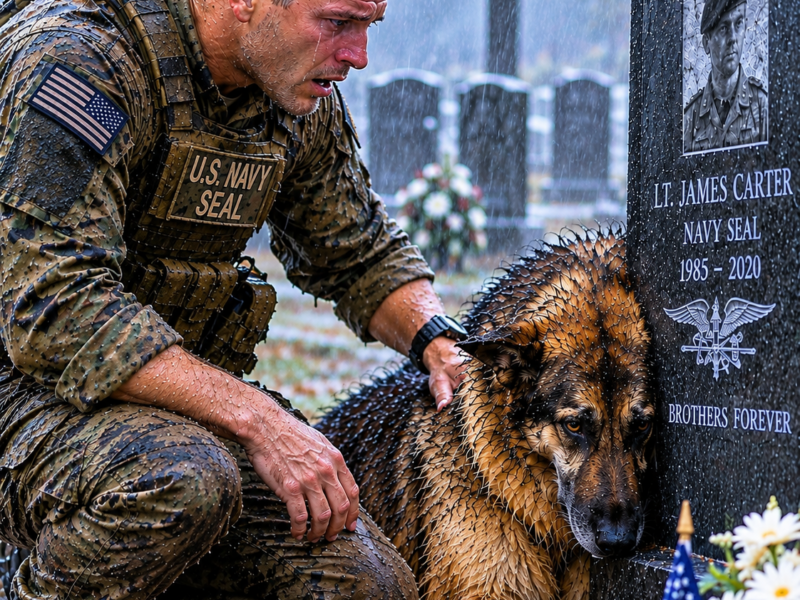
“At my younger brother’s grave in Arlington National Cemetery, I found a German Shepherd chained to the iron fence, soaked from the rain and guarding a folded photograph
Duke pulled so hard that the chain scraped against the iron fence.
I dropped the photograph into my jacket and followed his gaze toward the road.
The black SUV was gone.
But whoever had been inside it knew exactly where to find us.
I called Daniel Price back.
He answered before the first ring finished.
“Tell me you didn’t open the collar.”
“I haven’t.”
“Good. Keep it that way.”
“Who was in that SUV?”
“I don’t know. But if they saw Duke with you, we don’t have much time.”
I looked at the dog.
He had settled beside Andrew’s headstone again, his body pressed against the marble base as if he were trying to protect it.
“Start explaining,” I said. “You told me my brother might have been alive after his funeral. I want to know what that means.”
Daniel exhaled.
“Not over the phone. There’s a diner on Columbia Pike, about twenty minutes from Arlington. Come alone.”
“I’m not leaving this dog.”
“Then bring him. But don’t go home, and don’t let anyone take him.”
I almost asked why.
Then I remembered the man photographing us.
“Where exactly?”
He gave me an address and hung up.
The cemetery groundskeeper had called animal control by then. I explained that Duke was wearing my brother’s military identification and that I was taking responsibility for him.
The man hesitated, then handed me a piece of paper with the number of a local veterinary clinic.
“Get him checked out,” he said. “He’s been out here in the cold too long.”
I unclipped the chain from the fence.
Duke followed me without hesitation.
That was the first thing that frightened me.
He didn’t behave like a dog who had just met a stranger.
He behaved like a dog who had finally found the person he’d been sent to find.
At the diner, Daniel was waiting in a booth near the back.
He was in his late forties, broad-shouldered, with gray hair and a faint scar running from his left temple toward his ear.
He stood when he saw me.
“Matthew.”
I didn’t shake his hand.
“Tell me about Andrew.”
Daniel glanced at Duke, who had positioned himself between the booth and the entrance.
Then he looked at me.
“Your brother was my medic during our last deployment together. He was also one of the best men I’ve ever served with.”
“I know who my brother was.”
“I’m not questioning that.”
“Then explain why his dog has a tag dated three years after his death.”
Daniel looked down at the table.
For a few seconds, the only sound between us was the coffee machine behind the counter.
“Because Duke was still with Andrew three years after the military told your family he was dead.”
I leaned forward.
“Where?”
Daniel rubbed his hands together.
“An operation outside Kandahar. Your brother’s unit was assigned to recover a missing intelligence officer. The mission was supposed to last one night. It turned into something else.”
“What happened?”
“Andrew found records showing that equipment was being moved through a private contractor’s facilities without proper authorization. Weapons, communications gear, things that weren’t supposed to be there.”
“Who was responsible?”
“People with enough influence to make reports disappear.”
I thought of Commander Mitchell.
“Was he involved?”
Daniel didn’t answer immediately.
That was answer enough.
“Andrew collected evidence,” Daniel continued. “He believed the contractor was using military transport routes to move restricted equipment. When he tried to report it, the operation was abruptly shut down.”
“And the explosion?”
Daniel’s jaw tightened.
“There was an explosion. But Andrew wasn’t in the vehicle they identified as his.”
I stared at him.
“You’re telling me the military buried an empty casket?”
“I’m telling you the remains were never positively identified as Andrew’s.”
My hands curled around the edge of the table.
“My mother stood beside that casket.”
“I know.”
“My father folded that flag.”
“I know, Matthew.”
“Then why didn’t you tell us?”
Daniel looked up.
“Because I was ordered not to.”
The answer landed harder than I expected.
“By Mitchell?”
Daniel nodded.
“He told us Andrew had been killed during the explosion. He said the identification was confirmed and that anyone questioning it would compromise an ongoing investigation.”
“And you believed him?”
“I was younger. I was still on active duty. I had a family, a career, and orders that came from people I trusted.”
He paused.
“That doesn’t excuse it.”
For the first time, his voice cracked.
“I should have called your mother. I should have found a way.”
I watched him for a long moment.
Then I asked the only question that mattered.
“Where is my brother now?”
Daniel looked toward Duke.
The dog had lifted his head at the sound of Andrew’s name.
“I don’t know.”
I pushed back from the booth.
“Then we’re done.”
“Matthew, wait.”
“No. You don’t get to sit here and tell me my brother might have been alive while my family spent three years grieving him.”
Daniel reached into his jacket and removed a small photograph.
It showed Andrew standing beside a military transport truck, wearing a tan uniform and holding Duke’s leash.
He looked older than he did in the photograph from the cemetery.
Not much older.
But old enough that the date printed in the corner couldn’t be mistaken.
It was taken eleven months after the date on his death certificate.
On the back, Andrew had written:
“If anything happens, Duke knows the route. Don’t trust the official report.”
I sat down again.
“Where did you get this?”
“Andrew sent it to me through a contact. It arrived six months after the funeral.”
“Why didn’t you bring it to my family?”
“I tried to verify it first. By the time I understood what it meant, the person who delivered it had disappeared.”
Daniel slid another item across the table.
A folded piece of paper.
It contained a series of numbers, a date, and a name.
R. MITCHELL.
Beneath the name was a handwritten note:
“Transfer authorization. Facility 19. Keep the dog out of official custody.”
I read it twice.
“Facility 19?”
“A private logistics and rehabilitation compound in West Virginia. It was used by the contractor involved in the operation.”
“Why would my brother be there?”
Daniel shook his head.
“I don’t know. But three months ago, I received a message from an encrypted account. It contained one sentence.”
He turned the paper over.
“If Duke reaches Matthew, the second record is still safe.”
I looked at him.
“Second record?”
“That’s what we’re trying to find.”
I glanced at Duke.
He had been quiet throughout the conversation, but now he was staring at the small photograph in my hand.
When I lowered it, he nudged my wrist.
Then he whined softly.
I had never heard a dog make a sound like that.
It wasn’t a bark or a request for food.
It sounded like recognition.
I folded the photograph carefully.
“Where did Andrew get this dog?”
Daniel’s expression changed.
“Andrew didn’t get Duke.”
“What do you mean?”
“He trained him. Duke was assigned to his unit before the deployment. They worked together for nearly four years.”
“Then why did the dog end up at my brother’s grave?”
Daniel leaned closer.
“Because Andrew made sure he would.”
I looked at the collar.
The stitched black fabric.
The hidden plate.
The date.
“What’s inside it?”
Daniel lowered his voice.
“I think that’s where the first record is.”
I took out my phone.
“I’m calling a veterinarian.”
“Good. Find one you trust. Don’t mention the collar.”
“And then?”
Daniel looked me straight in the eye.
“Then we find out why Andrew sent his dog to you instead of coming himself.”
I didn’t like the way he said it.
As if my brother had made a choice.
As if he had known he might never be able to return.
I drove Duke to an emergency veterinary clinic in Alexandria.
The veterinarian, Dr. Lena Brooks, was a middle-aged woman with a calm voice and a habit of speaking to animals before their owners.
She examined Duke carefully.
“He is dehydrated and underweight,” she said. “There are some old injuries, but nothing that looks immediately life-threatening.”
“Can you tell how old he is?”
“About nine, maybe ten.”
She looked at his paws.
“He’s been walking a lot recently. The pads are worn, and there’s some irritation between his toes.”
I glanced at the chain marks around his neck.
“Can you remove the collar?”
Dr. Brooks touched the leather but didn’t pull.
“Is there a reason you don’t want me to?”
I hesitated.
“There’s something inside it that may belong to my brother.”
She looked at me for a moment.
“Then I suggest we document everything before we open it.”
I nodded.
She photographed the collar from every angle and carefully examined the stitching.
When she found the hidden pocket, she stopped.
“There’s something sewn inside.”
I felt my throat tighten.
She used a small surgical tool to loosen the thread.
A thin waterproof envelope slipped out.
Inside was a memory card, a folded strip of paper, and a small brass key.
The paper carried only six words.
“The truth is under the blue stone.”
I stared at it.
“What blue stone?”
Daniel, who had followed us to the clinic, leaned over my shoulder.
“Andrew’s old training site.”
I turned toward him.
“Where?”
“Fort A.P. Hill. There was a stone marker near the old working-dog course. It was painted blue years ago.”
“Why would he hide something there?”
“Because he knew the site better than anyone.”
Dr. Brooks placed the items into separate evidence bags.
“I don’t know what you’re involved in,” she said, “but if this is connected to something dangerous, you should contact the proper authorities.”
Daniel nodded.
“She’s right.”
I looked at him.
“You spent three years keeping quiet. Don’t tell me to trust the system now.”
He accepted that without arguing.
“I won’t. But I know one investigator who might help.”
“Who?”
“Special Agent Laura Bennett. Naval Criminal Investigative Service. She worked a case involving the contractor two years ago. It was closed before she could finish.”
“Why should I trust her?”
“Because she was removed from the investigation after refusing to sign a report she knew was false.”
That sounded like someone worth speaking to.
But I wasn’t ready to hand over the memory card.
Not yet.
We drove to Fort A.P. Hill the following morning.
The old training area had changed since my last visit. Several buildings had been demolished, and the dog course was overgrown.
Duke walked beside me, his nose close to the ground.
He wasn’t searching randomly.
He seemed to remember the route.
At the far end of the course stood a low stone marker, half-covered in weeds.
Its paint had faded, but a strip of blue remained near the base.
Duke approached it and sat.
I knelt beside the stone.
There were scratches along the back edge.
Three short lines.
Then a small circle.
I ran my fingers across the surface and felt a loose section.
With Daniel’s help, I shifted the stone just enough to reveal a narrow metal compartment beneath it.
Inside was a sealed plastic pouch.
I opened it.
There were several printed documents, a photograph, and a small audio recorder.
The photograph showed Andrew standing with a man in civilian clothes.
The man was holding a clipboard.
I recognized him.
Commander Robert Mitchell.
But the date on the photograph was what made my hands tremble.
It had been taken fourteen months after Andrew’s reported death.
On the back, Andrew had written:
“Mitchell knows I’m alive.”
Daniel stared at the picture.
“That can’t be right.”
I looked at him.
“You told me Mitchell was involved.”
“I knew he was involved in the operation. I didn’t know he had seen Andrew afterward.”
I unfolded the documents.
They were transport records, medical transfer forms, and a list of equipment shipments.
One entry appeared repeatedly.
FACILITY 19 — PATIENT TRANSFER 0047.
Beside it was Andrew’s name.
But the final page was different.
It was a handwritten statement.
Andrew’s handwriting.
“If you’re reading this, I couldn’t come home. I didn’t die in the explosion. I was moved after I found the shipment records. They told my family I was dead because a dead man cannot testify.”
I read the sentence again.
Then I read the next line.
“Duke is the only one who knows where the original files are. If he reaches Matthew, follow him. Don’t trust anyone who says this is over.”
My eyes blurred.
For three years, I had imagined my brother’s final moments.
I’d wondered whether he had been afraid.
Whether he had called for our mother.
Whether he had known he wasn’t coming home.
Now I was holding his handwriting.
Proof that he had survived.
Proof that someone had deliberately taken him away.
And proof that he had tried to reach us.
I turned on the recorder.
There was a burst of static.
Then Andrew’s voice filled the empty training area.
“Matt, if this is you, I’m sorry.”
I grabbed the edge of the stone.
His voice sounded tired.
But it was him.
My brother.
“There’s a reason I sent Duke to you. I couldn’t risk contacting the family directly. They’re watching everyone connected to me.”
A pause.
Then he continued.
“Mitchell knows what happened, but he isn’t the only one. The contractor has people inside the medical system, the transport network, and the command structure.”
I glanced at Daniel.
He had gone pale.
Andrew’s voice continued.
“The original shipment records are stored at Facility 19. But don’t go there without the second key. The brass key opens a locker at a storage site outside Winchester.”
I took the key from the evidence bag.
A tiny number had been stamped into it.
204.
Andrew continued.
“If you find the locker, you’ll find the name of the person who arranged my transfer. I need you to understand something, Matt. I didn’t stay away because I stopped wanting to come home.”
The recording crackled.
“I stayed away because they threatened to make sure none of you ever got to live a normal life again.”
Then his voice dropped.
“Tell Mom I still remember the pancakes she used to make. Tell Dad I kept his old compass.”
I closed my eyes.
The recording ended with a soft click.
For a moment, neither Daniel nor I spoke.
Duke leaned against my leg.
I placed my hand on his head.
“He remembered,” I whispered.
Daniel looked away.
“Yes.”
I put the recorder and documents back into the pouch.
“We’re going to Winchester.”
Before Daniel could answer, my phone rang.
The number was unfamiliar.
I answered.
A man’s voice spoke calmly.
“Matthew Hayes. You have something that doesn’t belong to you.”
I looked at the documents.
“Who is this?”
“You’ve been given incomplete information. Your brother was a danger to himself and others. His disappearance was handled to protect national security.”
“Then why did you tell my family he was dead?”
A pause.
“Because your family didn’t need to know more.”
My jaw tightened.
“Who are you?”
“Someone who can make this easier for you. Return the materials and the dog. You can go home.”
I looked at Duke.
He had raised his head and was staring at the phone.
“Did you send the men to the cemetery?”
The caller ignored the question.
“Don’t make the mistake of believing your brother’s choices were honorable.”
Then the line went dead.
Daniel took the phone from my hand.
“That was Mitchell.”
“How do you know?”
“Because he used the same phrase when he ordered me to stop asking questions.”
I stared at the empty screen.
Then I put the phone in my pocket.
“Let’s go.”
The storage facility outside Winchester was a row of low concrete buildings surrounded by a chain-link fence.
The brass key opened locker 204.
Inside was a metal case, a stack of photographs, and a small notebook.
The first photograph showed Andrew standing outside a medical transport van.
The second showed Mitchell shaking hands with a man I didn’t recognize.
The third showed a private facility entrance with a sign reading RIDGEWAY RECOVERY SERVICES.
The notebook contained names, dates, and transfer numbers.
One name appeared on almost every page.
Elliot Vance.
Daniel recognized it immediately.
“He’s the contractor’s regional director.”
“Where is he now?”
“Washington. He still has government contracts.”
I opened the metal case.
Inside was a small encrypted drive and a letter addressed to me.
My hands shook as I unfolded it.
“Matt,
If Duke made it to you, then something went wrong with the plan.
I wanted to come home. I wanted to stand in Mom’s kitchen and complain about her pancakes. I wanted to hear Dad tell the same stories about the boat he sold twenty years ago.
But I couldn’t risk bringing danger to the people I love.
I know you’ll be angry. You have every right to be.
I need you to find the original shipment files and get them to someone who can’t be pressured into hiding them.
The key is not the only thing in the locker.
Look inside the compass.”
I read the last line twice.
“The compass?”
Daniel pointed to the bottom of the case.
A familiar brass compass lay beneath the documents.
My father had given it to Andrew when he enlisted.
I opened the small hinge.
Inside the lid was a folded strip of paper with a sequence of letters and numbers.
It looked like a password.
I turned the compass over.
There was a tiny compartment in the back.
Inside it was a second memory card.
Daniel looked at me.
“That’s probably the original record.”
I held it up.
“Then we take it to Bennett.”
We met Special Agent Laura Bennett in a federal office building in Alexandria.
She was in her early forties, with dark hair tied back and an expression that suggested she had spent years listening to people explain why nothing could be done.
She examined the documents without touching the memory card.
“Where did you get these?”
“My brother.”
She looked up.
“Andrew Hayes?”
I nodded.
She leaned back.
“I was assigned to the contractor investigation two years ago. We found irregularities in medical transfers, but every record connected to Facility 19 had been altered.”
“Who altered them?”
“I couldn’t prove it. My supervisor told me the files were incomplete.”
“Was Mitchell involved?”
Her eyes narrowed.
“Why do you ask?”
I showed her the photograph.
She studied it for several seconds.
“That’s Commander Mitchell. And that’s Elliot Vance.”
“Can you use this?”
“I can start an inquiry. But if the drive contains what I think it does, I need to handle it carefully.”
“Why?”
“Because this involves more than one contractor and one officer. If I move too quickly, the people responsible will know we’re close.”
I placed Andrew’s letter on the table.
“He has been missing for three years. My family buried him. If he’s alive, I want him found.”
Bennett looked at the letter.
Then she looked at Duke.
“Is this the dog?”
“His name is Duke.”
She crouched slightly.
Duke approached her, sniffed her hand, then returned to my side.
Bennett stood.
“I’ll have the memory card examined by a digital forensics team. I can’t promise what we’ll find.”
“I don’t need a promise.”
I leaned forward.
“I need you not to bury it.”
She held my gaze.
“I won’t.”
For the next two days, I barely slept.
Duke stayed close to me.
He ate small meals, drank water, and slept on the floor beside the bed in the hotel room Daniel had arranged.
Every time I moved, his ears lifted.
On the third morning, Bennett called.
“We’ve recovered files from the drive.”
I sat upright.
“What do they show?”
“Your brother was transferred through three private medical facilities under a false identity. The last confirmed location was Ridgeway Recovery Services.”
“Is he there?”
“We don’t know yet.”
“Then find out.”
“Matthew, listen to me. The records also show that someone authorized the transfer using Commander Mitchell’s credentials.”
I looked at Daniel, who was sitting across the room.
“Can you arrest him?”
“Not yet. We need to establish who gave the orders and where Andrew was taken.”
“How long?”
“I can’t give you a timeline.”
I pressed my fingers against my forehead.
“He’s been gone for three years.”
“I understand.”
“No, you don’t.”
I ended the call before I said something I couldn’t take back.
Daniel stood.
“She’s trying to build a case.”
“So am I.”
He nodded.
“Then we need to get ahead of them without making a mistake.”
That afternoon, Duke began pacing.
He moved from the hotel door to the window, then back again.
I thought he needed to go outside.
But when I reached for his leash, he turned toward the metal case containing Andrew’s compass.
He nudged it.
Then he looked at me.
“What is it?”
He nudged the case again.
I opened it and took out the compass.
Duke sniffed the lid, then gave a small whine.
I examined the paper strip again.
The sequence of letters and numbers was unfamiliar, but the final four digits looked like a date.
I called Bennett.
“Can you check a sequence for me?”
She listened while I read it.
A few minutes later, she called back.
“Matthew, that code corresponds to an internal patient file at Ridgeway.”
My grip tightened around the phone.
“Andrew?”
“Yes.”
“Is he alive?”
There was a pause.
“We found a recent medical entry. The patient is still listed as active.”
I sat down.
For a moment, the room seemed to lose its edges.
“Where is he?”
“Ridgeway Recovery Services. A restricted wing. We’re coordinating with federal authorities now.”
“Then I’m going there.”
“Absolutely not.”
“He’s my brother.”
“And I need you to understand that if we enter without the proper authorization, we could compromise the entire operation.”
I stared at Duke.
He was standing beside the door, his tail low, waiting.
“How long?”
“We’re working on a warrant.”
I ended the call.
Daniel watched me carefully.
“Don’t do anything reckless.”
I looked at him.
“Three years ago, everyone told me to accept that my brother was dead. I did what they asked. I buried him. I watched my mother break apart.”
I picked up Andrew’s letter.
“I’m not doing that again.”
The warrant came the next morning.
Bennett called before sunrise.
“We’re going in at eight. Federal agents will secure the facility. I want you to stay back until the building is safe.”
“I’ll be there.”
“Matthew—”
“I’ll stay outside. But I’m coming.”
She was quiet for a moment.
“Fine. Do not enter unless I tell you.”
Ridgeway Recovery Services stood behind a row of pine trees on a quiet road in West Virginia.
From the outside, it looked like a private rehabilitation center.
A white sign advertised long-term recovery programs for injured service members.
There was nothing about the place that suggested it was holding a man against his will.
Federal vehicles arrived shortly after eight.
Agents entered through the front and side doors.
Daniel stood beside me near the parking area.
Duke was in the back seat of my truck, watching the building.
Then a woman came out of the entrance.
She was carrying a clipboard.
She saw me.
For a second, her expression didn’t change.
Then she turned and hurried back inside.
I recognized her from the photograph in the storage locker.
She was the medical administrator who had signed Andrew’s transfer forms.
Bennett followed her.
A moment later, an agent came out and waved us toward the entrance.
“Stay behind me,” Bennett said.
We entered a corridor that smelled of disinfectant and stale coffee.
There were locked doors on either side.
An agent was speaking to a nurse near the reception desk.
Bennett checked a list.
“Room 17.”
We moved down the hall.
At the end was a gray door with a small window.
An agent unlocked it.
Inside, a man sat beside a narrow bed.
His hair was longer than I remembered.
His shoulders were thinner.
A pale scar crossed his forehead.
But when he lifted his head, I knew him.
Andrew.
My little brother.
For several seconds, I couldn’t move.
He stared at me as if he were looking at someone from a dream.
Then his eyes shifted past my shoulder.
To Duke.
The dog had slipped away from the agent and entered the room.
Andrew made a sound that wasn’t quite a laugh or a sob.
“Duke?”
The dog crossed the room in three quick steps and pressed his head against Andrew’s chest.
Andrew wrapped both arms around him.
“Oh, buddy.”
His voice broke.
“You’re still here.”
I stood in the doorway, unable to find a single word.
Andrew looked up.
His eyes filled.
“Matt?”
I stepped forward.
He tried to stand, but his legs gave way.
I caught him before he hit the floor.
For a moment, we held each other without speaking.
Then I pulled back just enough to look at his face.
“You’re alive.”
He nodded.
“I’m sorry.”
I shook my head.
“Don’t.”
“I wanted to come home.”
“I know.”
“I tried.”
“I know.”
He looked toward Duke.
“Did he find you?”
I nodded.
“He brought me to your grave.”
Andrew closed his eyes.
“I told him to.”
I sat beside him.
“Why didn’t you tell us?”
He looked down at his hands.
“They told me they would hurt you. They knew where Mom worked. They knew Dad’s routine. They knew where you were stationed.”
His voice was barely audible.
“I thought staying away would keep you safe.”
I took his hand.
“You let us bury you.”
Andrew’s face crumpled.
“I know.”
“My mother still sets out your coffee mug.”
He began to cry.
“I know, Matt.”
I didn’t know whether I wanted to hit him or hold him.
So I did the only thing I could.
I stayed beside him.
Bennett gave us time before asking Andrew to make a formal statement.
She explained that the medical staff had been instructed to keep him under a false identity and that several people involved in his transfer were now in custody.
Andrew nodded, but his attention kept returning to Duke.
“Where did you find him?”
“At Arlington.”
“Was he alone?”
“Chained to the fence near your grave.”
Andrew looked away.
“He must have waited there.”
“For how long?”
He didn’t answer.
Daniel entered the room a few minutes later.
Andrew looked at him.
“You came.”
Daniel lowered his head.
“I should have come sooner.”
Andrew studied him.
Then he gave a small nod.
“Yeah. You should have.”
Daniel accepted it.
“I know.”
There was no dramatic forgiveness.
No embrace.
Just two men acknowledging a debt that couldn’t be settled in one conversation.
When the agents finished their initial interviews, Andrew was taken to a secure medical facility for evaluation.
I rode beside him.
Duke lay across the floor near his feet.
At the hospital, doctors confirmed that Andrew was severely undernourished and had untreated injuries from his time at Ridgeway.
He would need weeks of physical rehabilitation.
But he was alive.
That was enough for the first night.
I called my mother from the hospital parking lot.
She answered on the second ring.
“Matthew? Is everything all right?”
I looked through the glass doors.
Andrew was sitting beside the window, watching Duke sleep.
“Mom,” I said, “I need you to sit down.”
She went quiet.
“What happened?”
I swallowed.
“Andrew’s alive.”
I heard a sharp breath.
Then nothing.
“Mom?”
Her voice came back as a whisper.
“Don’t say that unless it’s true.”
“It is.”
“Matthew…”
“He was being held at a private medical facility. He’s safe now. He’s hurt, but he’s alive.”
I heard my father in the background asking what was wrong.
Then my mother began to cry.
Not the quiet crying I’d heard at the funeral.
This was different.
It sounded like three years of grief breaking open all at once.
“Can I see him?”
“Yes.”
“When?”
“As soon as the doctors say he can have visitors.”
She started crying harder.
“Tell him I still have his mug.”
I closed my eyes.
“I will.”
My father took the phone.
His voice was rough.
“Is it really him?”
“Yes, Dad.”
A long pause followed.
Then he said, “Tell your brother I still have his compass.”
I looked down at the empty place where the compass had been in my jacket.
“He knows.”
My father cleared his throat.
“Good.”
He handed the phone back to my mother.
Neither of us spoke for a while.
Then she said, “Thank you for finding him.”
I looked at Duke.
“I didn’t find him, Mom.”
I watched the dog lift his head when Andrew shifted in the hospital bed.
“Duke did.”
The investigation continued for months.
The evidence from the shipment records connected Elliot Vance and several senior officials to an illegal transport network.
Commander Mitchell was arrested after investigators recovered communications showing that he had authorized Andrew’s false transfer and ordered the death report to be maintained.
The medical administrator at Ridgeway cooperated with prosecutors.
She admitted that Andrew had been kept under a false identity and that his family had been told he died to prevent him from testifying.
Daniel provided a full statement.
He also accepted responsibility for the part he had played in remaining silent.
Andrew’s testimony became central to the case.
He didn’t speak publicly about everything that happened.
Some details were too painful, and some belonged to an investigation that was still underway.
But he made one thing clear.
He had never abandoned his family.
He had believed he was protecting them.
Whether that choice had been right was something we would have to live with.
Andrew’s recovery was slow.
Some mornings, he could walk down the hospital corridor without help.
Other days, the smallest noise sent him back into a memory he couldn’t explain.
Duke stayed with him whenever the doctors allowed it.
The dog had his own recovery to make.
Dr. Brooks helped arrange his care, and he gained weight steadily.
The old injuries in his paws healed.
His coat became thick again.
But he never liked closed doors.
And he never slept far from Andrew.
Three months after the rescue, Andrew came home.
My parents had kept his bedroom exactly as it was.
The old baseball glove still sat on the shelf.
His books were stacked beside the window.
And on the kitchen counter, my mother had placed his favorite coffee mug.
Andrew stood in the doorway for a long time.
“I thought I’d never see this again,” he said.
My mother didn’t try to answer.
She simply reached for his hand.
My father stood near the kitchen table, holding the old brass compass.
He placed it in Andrew’s palm.
“I kept it safe,” he said.
Andrew looked at the compass, then at him.
“I know.”
My father nodded once.
Then he pulled his son into an awkward, powerful embrace.
I stepped outside while they held each other.
Not because I didn’t want to see it.
Because some moments belong to the people who have waited longest.
Duke followed me onto the porch.
He sat beside my boots and looked toward the driveway.
I rubbed the fur behind his ears.
“You did good, old man.”
He leaned against my leg.
For the first time since I had found him at Arlington, he seemed able to rest.
A week later, Andrew and I returned to the cemetery.
We brought fresh flowers.
Duke walked between us, no chain around his neck.
We stopped at the headstone bearing Andrew’s name.
It was still there.
The military had begun the process of correcting the official record, but the stone hadn’t yet been removed.
Andrew stood in front of it for a long time.
Then he crouched and touched the engraved letters.
“I hated knowing you were here,” he whispered.
I stood beside him.
“I hated thinking you were gone.”
He nodded.
“I know.”
We didn’t have to say anything else.
Duke lowered himself beside Andrew’s knee.
The three of us remained there while the rain began to fall softly through the trees.
Andrew looked down at the dog.
“Come on, buddy. We’re going home.”
Duke stood immediately.
I glanced once more at the marble headstone.
For three years, my family had believed it marked the end of Andrew’s life.
But it had never been his ending.
It had been the place where the one living soul who refused to forget him waited until someone finally came looking.
And when we walked away, Duke stayed close to my brother—not because he was guarding a grave anymore, but because he had finally brought his soldier home.
THE END.









