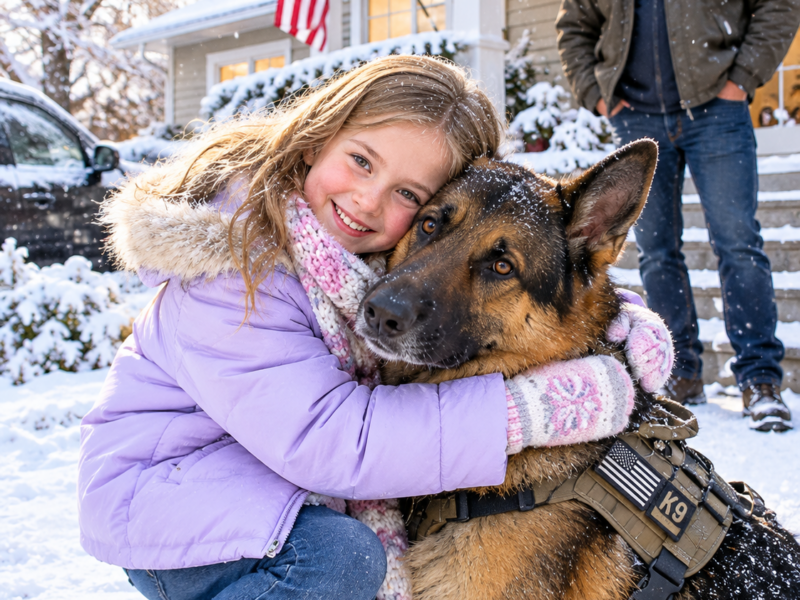
“At my wife’s funeral in Virginia Beach, my eight-year-old daughter refused to let go of the folded American flag in her lap, but three days later
I stared at the message until the screen dimmed in my hand.
“Stop looking into Emily’s death if you want your daughter to stay safe.”
I read it again, then checked the number. No name, no caller ID, nothing that told me who had sent it.
My first instinct was to call the police.
My second was to wonder how much they already knew.
I hated that second thought. I hated that a stranger had managed to put suspicion between me and the people I was supposed to trust.
Then Ranger nudged my wrist.
I looked down at him. His ears were forward, and his eyes kept moving between the phone and the hallway.
“Okay, buddy,” I whispered. “We’re going to do this carefully.”
I went to Lily’s room.
She was sitting cross-legged on her bed, arranging her stuffed animals in a circle around Emily’s blue cardigan. When she saw me, she smiled faintly.
“Daddy, Ranger can sleep in here tonight, right?”
I looked at the dog waiting behind me.
“Absolutely.”
“Can he sleep on Mommy’s side of the bed?”
The question caught me off guard.
“Of course, sweetheart.”
She patted the blanket beside her, and Ranger climbed up gently, settling against her legs.
For a moment, I watched them together and tried to remember what it felt like to believe the world was a place where bad things happened for understandable reasons.
Then I kissed Lily’s forehead.
“I need to make a few phone calls. You’ll stay with Ranger, okay?”
She nodded, but her fingers tightened around the cardigan.
“Daddy?”
“Yeah?”
“If someone is mad at Mommy, are they mad at us, too?”
I felt the blood drain from my face.
I crouched beside the bed.
“Why would you ask me that?”
She looked down at the blanket.
“Mommy told me that if a man ever came to the house asking about her, I should tell you first.”
I waited, afraid to interrupt.
“What man, sweetheart?”
“I don’t know his name. I saw him in the driveway one time. Mommy told me to go inside, and when I looked out the window, he was talking to her by the mailbox.”
“When was this?”
She shrugged.
“Before she went away.”
My mind immediately went to Emily’s final week.
“Did you see him again?”
Lily shook her head.
“Mommy looked different afterward. She kept checking the windows, even when it was daytime.”
I forced myself to keep my voice calm.
“Did she tell you why?”
“She said grown-ups sometimes make mistakes they have to fix.”
Lily looked up at me.
“Was Mommy in trouble, Daddy?”
I wanted to tell her no.
I wanted to take away the question before it could become another memory she carried around.
But I had spent my career learning that false reassurance could be more dangerous than an uncomfortable truth.
“I don’t know, sweetheart,” I said. “But I’m going to find out.”
She nodded slowly, then wrapped both arms around Ranger’s neck.
I stepped into the hallway and called Marcus.
He answered on the second ring.
“Danny?”
“Something’s happened.”
I explained the message, the notebook, and the memory card.
I didn’t mention Lily’s question until I had finished.
Marcus listened without interrupting.
When I stopped, he exhaled.
“First, save that message. Take screenshots. Don’t reply, and don’t delete anything.”
“Already done.”
“Second, get Lily somewhere secure. Somewhere the person sending that message wouldn’t expect you to go.”
“I’m not leaving my house because somebody sent a text.”
“That’s the stubbornest thing you’ve said all week, and you brought home a retired attack dog because your kid was sad.”
“Ranger is a working dog.”
“Right now, he’s also the only one in your house who seems to know something’s wrong.”
I looked toward the master bedroom.
The memory card was still on the dresser.
“I need to see what’s on it.”
“Then we’ll see what’s on it. But not by plugging it into your personal laptop.”
Marcus worked with a former military intelligence technician who now helped veterans with cybersecurity and digital investigations. He offered to contact him.
Before hanging up, Marcus added, “Danny, one more thing. Don’t assume that message came from whoever caused the accident. It could be someone trying to make you jump to the wrong conclusion.”
That was the first sensible thing anyone had said since the warning appeared.
I needed evidence, not theories.
And I needed to remember that grief could turn every coincidence into a conspiracy.
An hour later, Marcus arrived at my house.
He brought a small equipment case, a spare phone, and a paper bag containing sandwiches neither of us would remember eating.
He also brought a compact camera to photograph the notebook’s pages before we moved anything else.
We worked at the kitchen table while Lily watched a movie in the living room with Ranger beside her.
Marcus examined the notebook without touching the pages more than necessary.
“Have you seen these names before?”
I shook my head.
One name appeared repeatedly: Graham Voss.
Beside it were several amounts of money, ranging from five hundred dollars to nearly ten thousand.
The dates stretched back almost six months.
Some entries included short notes.
“Initial payment.”
“Copies delivered.”
“Second location.”
And finally, the words I couldn’t stop seeing.
“If Daniel finds out, run.”
Marcus leaned back.
“Does your wife work with confidential information?”
“Emily managed accounts for a local medical supply company. Nothing that should involve this kind of money.”
“Could she have been helping someone?”
“Maybe.”
The word tasted awful.
I wanted to defend her, but I couldn’t explain the notebook.
Marcus glanced at the memory card.
“Let’s find out what she was trying to protect.”
He connected the card to an isolated computer using equipment designed to inspect unfamiliar digital media without exposing his own files.
A handful of folders appeared.
Most contained ordinary photographs, scanned documents, and spreadsheets.
One folder was named simply LILY.
I stopped breathing for a second.
Marcus clicked it.
Inside were three video files and a collection of photographs.
The first video showed Emily sitting in our kitchen.
She wore the gray sweater I remembered from the week before her death. Her hair was pulled back, and a mug sat between her hands.
She looked tired.
Not sleepy, but worn down in a way I hadn’t noticed at the time.
She glanced toward the camera, then spoke.
“If you’re watching this, Daniel, something has happened, and I need you to listen before you decide what to believe.”
Marcus paused the video.
“Do you want to continue?”
I nodded.
He pressed play.
“I didn’t tell you everything because I was afraid you’d try to solve this the way you solve everything else. You’d go looking for the person responsible, and you wouldn’t stop until you found him.”
Emily rubbed her thumb along the mug’s handle.
“I know you think I’m safe because I live in Virginia Beach, because I have a job, because I drive the same roads every week. But I made a decision months ago, and I underestimated what it would cost.”
She looked away from the camera.
“If anything happens to me, please don’t let Lily believe I chose to leave her.”
The video ended.
For several seconds, neither Marcus nor I spoke.
Then I played it again.
This time, I watched Emily’s hands.
They were shaking.
I had lived with that woman for eleven years. I knew how she looked when she was worried about a bill, when she was angry with me, when she was trying not to laugh at one of my terrible jokes.
I’d never seen her look like this.
She hadn’t been afraid of me.
She’d been afraid of something she couldn’t tell me about.
Marcus opened the second video.
It showed a man in a gray coat standing beside a black SUV in a parking garage. The camera angle was distant, but the man’s face was visible when he turned toward the light.
He appeared to be in his late forties, with short silver hair and a narrow scar near his chin.
The clip lasted eleven seconds.
At the end, he handed Emily a thick envelope.
The third video was even shorter.
Emily was sitting in her car, speaking to someone outside the frame.
“I gave you what you asked for,” she said. “You said this would be over.”
A man’s voice answered, too faint to identify.
Emily’s face tightened.
“You promised my family wouldn’t be involved.”
Then the recording ended.
Marcus looked at me.
“That doesn’t look like a normal business transaction.”
“No.”
I studied the man’s face.
Graham Voss.
I was almost certain.
But almost wasn’t enough.
Marcus made copies of the files and wrote down their digital details so the originals could be preserved for investigators.
Then he opened the photographs.
One showed Emily leaving a downtown office building.
Another showed the same black SUV parked across the street from her workplace.
A third showed a document on a desk, its upper corner displaying a corporate logo I recognized from a local news story.
I leaned closer.
The company was called Atlantic Meridian Logistics.
Six months earlier, federal investigators had announced an inquiry into missing medical equipment from government supply contracts.
The company had denied wrongdoing.
At the time, I’d barely paid attention to the story.
Now I remembered Emily asking me a strange question over dinner.
“If you discovered someone you trusted had been stealing from the government, would you report them?”
I’d assumed she was talking about a news story.
I’d laughed and said, “Of course.”
She’d put her fork down.
“Even if reporting them put your family at risk?”
I’d told her the truth as I understood it.
“Especially then. You don’t protect your family by letting dangerous people do whatever they want.”
She hadn’t said another word about it.
I had thought the conversation was over.
Now I wondered if she’d been trying to tell me something and I’d been too busy answering the question to hear what she was asking.
Marcus found a name in one of the spreadsheets.
Graham Voss was listed as a senior operations director at Atlantic Meridian Logistics.
The payment records appeared to correspond with dates on which shipments had gone missing.
Emily had not simply been keeping secrets.
She might have been collecting evidence.
But one question still bothered me.
If she’d been gathering proof of wrongdoing, why had she hidden it from me?
And why had someone threatened Lily less than an hour after I began looking?
My phone rang.
The caller ID showed a number from the Virginia Beach Police Department.
I answered.
“Mr. Mercer? This is Detective Sarah Collins. I’d like to speak with you about your wife’s accident.”
My grip tightened around the phone.
“It’s been several weeks. Why now?”
“We received information that may be relevant to the investigation. Are you available to come to the station?”
I glanced at Marcus.
He silently gestured for me to ask her to put everything in writing.
“Can you tell me what kind of information?”
“Not over the phone.”
“Then I’ll come in tomorrow morning.”
There was a pause.
“Mr. Mercer, I’d prefer you come in today.”
Something in her voice made me sit straighter.
“Why?”
“Because we believe your wife may have been involved in a matter that extends beyond the traffic collision.”
I looked at the notebook.
“Was her death an accident?”
Another pause.
“I didn’t say that.”
After the call ended, Marcus and I stared at each other.
For the first time, the warning on my phone felt less like a stranger trying to frighten me and more like a deadline.
That night, I took Lily to Marcus’s house.
I told her we were having a sleepover because I needed to help a friend with something.
She didn’t ask questions until we reached the driveway.
“Are we leaving because of the man Mommy was scared of?”
I turned off the engine.
The porch light cast a warm circle across the steps.
“I don’t know if it’s the same person,” I said. “But I want to make sure you’re safe while I find out.”
She looked through the windshield.
“Will Ranger come, too?”
I opened the back door.
Ranger was already standing, waiting patiently.
“He’s coming with us.”
Lily managed a small smile.
“Good. He knows when something bad is happening.”
I didn’t correct her.
The next morning, I met Detective Collins at the station.
She was in her early forties, with tired eyes and a manner that suggested she’d learned not to promise things before she had proof.
She took me into a small interview room and placed a folder on the table.
“Your wife’s vehicle was examined after the crash,” she said. “Initially, the evidence was consistent with a loss of control on a wet road.”
“Initially?”
“Two days ago, a mechanic reviewing the vehicle for an insurance claim noticed damage that didn’t fit the original assessment.”
She slid a photograph toward me.
It showed a damaged component from the steering system.
“Someone may have tampered with the vehicle before the collision. We’re waiting for a specialist’s report, so I can’t tell you more than that yet.”
I stared at the picture.
Emily’s car had been inspected at the scene. The investigators had found no obvious signs of tampering.
“Who had access to the vehicle?”
“We’re checking that. Your wife had the car serviced three days before the accident.”
I remembered the receipt on our kitchen counter.
Emily had told me she’d taken the car in because of a warning light.
I’d been away at a training seminar and had barely registered the information.
“Which shop?”
Collins gave me the name.
I knew the place. It was a family-owned garage near the highway.
“Is there any connection to Graham Voss?” I asked.
Her expression changed slightly.
“Why do you know that name?”
I decided not to hide the notebook.
I told her about the memory card, the videos, and the warning message.
I didn’t hand over the original card, but I provided copies of the files and showed her the photographs of the notebook.
She watched Emily’s videos without interrupting.
When the final one ended, Collins closed the laptop.
“Your wife contacted us about missing equipment six weeks ago,” she said.
I leaned forward.
“She contacted the police?”
“She spoke with an officer, but she didn’t provide enough information for us to establish a case at the time. She was frightened. She said she had documents that could implicate several people, but she wasn’t ready to hand them over.”
“Why didn’t anyone tell me?”
“Because she was an adult who had not given us permission to contact her family. And until we had evidence of a threat, we had no basis to tell you that you were in danger.”
I felt anger rise in my chest.
“You knew she was scared.”
“We knew she was concerned. We did not know her life was at risk.”
The distinction might have mattered to the case.
It did nothing for the empty chair at my kitchen table.
Collins opened another folder.
“There’s something else. The man in your wife’s videos, Graham Voss, has been questioned in connection with the missing shipments. He claims your wife was accepting money from him in exchange for confidential information.”
I stared at her.
“That’s a lie.”
“Possibly. But we need to establish what the payments were for.”
“Then establish it.”
“We’re trying.”
I wanted to pound my fist against the table.
Instead, I took a breath and asked the question that had been following me since I saw Emily’s handwriting.
“Did she die because she was going to expose him?”
Collins met my eyes.
“We don’t know yet. But we now have reason to investigate that possibility.”
She asked me to provide the original memory card through a documented evidence transfer, and I agreed after arranging to preserve an untouched copy with my attorney.
Before I left, she gave me a case number and her direct contact information.
“We’ll look into the threat against your daughter, too,” she said. “Don’t respond to the sender. Keep your phone available, and contact us if anything changes.”
Outside the station, I called Marcus.
He answered immediately.
“What’s the verdict?”
“Emily reported missing equipment. Voss says she was selling information. The car may have been tampered with.”
He went silent.
Then he said, “So your wife may have been trying to expose something, and someone may have killed her to stop her.”
“That’s what it looks like.”
“Danny, we need to be careful about saying that until the evidence is in.”
“I know.”
I knew it intellectually.
Emotionally, I wanted to find Voss and demand that he explain why my wife had died.
But I also knew that charging toward a suspect without a plan could destroy the very case I needed to build.
For the first time in years, the most difficult mission I faced required me to do nothing reckless.
I had to wait.
And waiting became harder that afternoon when Marcus called to say someone had been asking questions about me at the garage.
The man had arrived in a black SUV.
Silver hair.
A narrow scar near his chin.
Graham Voss.
He had asked whether Emily’s husband had visited the shop.
The mechanic, unsettled by the questions, had written down the license plate before Voss left.
Marcus had already passed the information to Detective Collins.
Then he told me something else.
“The mechanic said Voss didn’t come alone. There was another man waiting in the passenger seat.”
“Did he recognize him?”
“No. But he said the guy kept looking at his phone, like he was waiting for someone to tell him when to move.”
I pictured the black SUV in the photographs.
Two men.
A woman who had hidden evidence.
A child who had seen a stranger in her driveway.
And a threat that had arrived almost immediately after I uncovered the memory card.
I called Collins.
She told me not to approach Voss and assured me that investigators were working to locate him.
I hated every second of that answer.
But I agreed.
That evening, I sat on Marcus’s back porch while Lily played with Ranger in the yard.
The dog had become her shadow. Whenever she wandered too close to the fence, he moved beside her. Whenever she sat down, he settled at her feet.
I watched her toss a tennis ball across the grass.
She laughed when Ranger brought it back and dropped it directly into her lap.
Then she looked toward the house.
“Daddy, can I tell you something?”
I went to her.
“Always.”
She hesitated.
“Mommy gave me something before she died.”
My entire body went still.
“What did she give you?”
Lily glanced at Ranger, then back at me.
“A little silver key. She told me to keep it somewhere safe and not show anyone unless you asked me about the blue bird.”
I felt a strange pressure in my chest.
“The blue bird?”
She nodded.
“It’s on the picture Mommy kept beside her bed. The one with the lighthouse.”
I knew the picture.
Emily had bought it at a craft fair years ago. A small watercolor of a lighthouse on a rocky shore, with a blue bird painted near the bottom corner.
I’d never thought much about it.
“Where’s the key now?”
Lily reached into the pocket of her jeans and pulled out a tiny silver key attached to a piece of red thread.
I stared at it.
“Why didn’t you tell me earlier?”
“Mommy said not to tell anyone unless you asked. I thought maybe you were supposed to ask me about the blue bird.”
She looked frightened, as if she’d failed a test she hadn’t understood.
I took her hand.
“You did exactly what Mommy asked you to do. You kept it safe.”
Her shoulders relaxed.
“Am I in trouble?”
“No, sweetheart.”
I kissed her forehead and held her for a moment.
Then I called Detective Collins.
She arranged for an officer to meet us at the house while another investigator documented the key and the picture.
We returned to Virginia Beach the following morning under police guidance.
Nothing appeared disturbed.
The front door was locked. The windows were intact. Emily’s cardigan still lay folded on the bed.
But Ranger refused to enter the master bedroom until I walked ahead of him.
Once inside, he moved directly to the dresser and sniffed the space beneath the bottom drawer.
I crouched beside him.
“You’ve been here before, haven’t you?”
He looked at me, then turned toward the wall.
The painting hung above the nightstand.
I lifted it carefully from its hook.
The blue bird was barely larger than my thumbnail, painted near the base of the lighthouse.
I ran my fingers along the frame.
On the back, behind the cardboard backing, I found a narrow slot.
The silver key fit.
Inside the frame was a small folded sheet of paper and a second memory card.
The paper contained a short note in Emily’s handwriting.
“Daniel, if you found this, then I couldn’t tell you in person. I’m sorry I kept this from you. I wasn’t trying to shut you out. I was trying to keep the danger away from our door.”
I had to stop reading for a moment.
The next line was harder.
“I found out that medical supplies intended for military hospitals were being diverted and resold. At first, I thought it was a bookkeeping error. Then I discovered that someone was altering the shipment records to hide what was happening.”
I read on.
“I copied the records and followed the money. Graham Voss found out. He offered to pay me to destroy what I had collected. When I refused, he threatened to make it look as though I had been stealing from the company.”
The note ended with a sentence that made my knees feel weak.
“If anything happens to me, please understand that I was trying to do the right thing. I was scared, Daniel. Not because I doubted you, but because I knew you would come after them, and I couldn’t bear the thought of Lily losing both of us.”
I sat on the edge of the bed with the paper in my hands.
For months, Emily had carried this alone.
She had watched me leave for work, listened to me talk about the importance of duty, and tucked our daughter into bed while wondering whether someone was watching our house.
She had been afraid of losing me.
And I had mistaken her silence for ordinary worry.
I pressed the note against my forehead.
“I would have helped you,” I whispered.
The room offered no answer.
Ranger rested his head against my knee.
I reached down and rubbed the scar along his ear.
“Good boy.”
I didn’t know whether he had recognized a scent, heard something I couldn’t hear, or simply noticed a change in the room that made him uneasy.
I only knew that, without him, I might never have found the first memory card.
And without Lily’s little key, I might never have found the evidence Emily had hidden for us.
I handed the second card to Detective Collins when she arrived.
She arranged for it to be examined by the same forensic team handling the first.
This time, the files included shipment logs, recorded conversations, scanned invoices, and copies of internal emails.
There were enough details to establish a clear pattern.
Medical equipment had been diverted through a chain of shell companies, then sold to private buyers. The false records made it appear that the supplies had reached their intended destinations.
Several people were involved.
One of them was Graham Voss.
Another was a logistics supervisor who had access to the shipping database.
The files also included a recording of a meeting between Emily and Voss.
His voice was unmistakable.
“You don’t understand what you’re threatening,” he said.
Emily answered, “I understand exactly what I’m threatening. I’m going to the authorities.”
“You have a husband and a daughter.”
“Don’t talk about my family.”
“Then stop making choices that put them in danger.”
The recording ended with the sound of a chair scraping across the floor.
It wasn’t proof that Voss had caused the crash.
But it established that he had threatened Emily and knew about her family.
Detective Collins obtained warrants and coordinated with federal investigators.
The next two days passed in a blur of phone calls, interviews, and sleepless nights.
I stayed with Marcus and kept Lily away from the house while the investigators worked.
I told her that Mommy had left us some important information and that the police were helping us understand it.
She listened carefully.
“Was Mommy a good person?”
The question nearly broke me.
I knelt in front of her.
“Yes, sweetheart. She made mistakes, and she kept secrets from me. But she was trying to protect people who needed help.”
“Even when she was scared?”
“Especially when she was scared.”
Lily thought about that for a long moment.
“Then I want to be brave like Mommy.”
I pulled her into my arms.
“You already are.”
The following afternoon, Detective Collins called.
The forensic report had confirmed deliberate damage to a steering component in Emily’s vehicle. Investigators had also found evidence that someone had accessed the car while it was at the repair shop.
The garage’s security footage showed a man entering the service area after closing.
The footage was grainy, but the man’s build and clothing matched a contractor who had worked for Atlantic Meridian.
His phone records placed him near the garage that night.
When investigators questioned him, he initially denied being there.
Then they showed him the footage.
He asked for a lawyer.
Two hours later, he changed his story.
He admitted that Voss had paid him to tamper with the vehicle.
He claimed he had been told to make the car unsafe, not to guarantee that Emily would die.
The distinction made no difference to the evidence.
It did, however, raise a question the investigators still needed to answer: whether Voss had intended to kill Emily or had simply been willing to accept whatever happened.
I didn’t care what he had told himself.
My wife was dead.
Our daughter would grow up without her mother.
And no explanation could return the ordinary moments we had lost.
Detective Collins told me they were preparing to arrest Voss.
She also warned me not to contact him, not to respond to any messages, and not to do anything that could compromise the investigation.
I promised her I wouldn’t.
For the first time since the funeral, I felt that the truth might finally have somewhere to go.
Then Voss disappeared.
His house was empty.
His phone had been switched off.
His vehicle was found abandoned in a parking garage near the interstate.
Investigators believed he was trying to leave the state.
A warrant was issued, and federal agents began coordinating with other agencies.
I spent the next forty-eight hours trying to keep my mind occupied.
I repaired a loose fence board at Marcus’s house. I cooked dinner. I helped Lily with her reading homework.
Every time my phone vibrated, I checked it.
Every time a car slowed outside, I looked through the window.
I hated what fear was doing to our lives.
Lily noticed.
One night, she found me sitting at the kitchen table long after everyone else had gone to bed.
She climbed into the chair beside me.
“Daddy, are we going to be scared forever?”
I set my phone facedown.
“No.”
“How do you know?”
I thought about giving her the answer she wanted.
Instead, I told her the truth.
“I don’t know how long it will take. But I know we won’t let this man decide what the rest of our lives look like.”
She leaned against my arm.
“Can Ranger stay with us forever?”
I looked toward the living room, where the dog was sleeping beside her blanket.
“Yes,” I said. “He’s family now.”
She smiled faintly.
“Then we’ll be okay.”
I wished I had her certainty.
Three days later, Detective Collins called again.
They had located Voss at a small airport outside Richmond.
He had been preparing to board a private charter under another name.
When officers approached him, he tried to leave through a service entrance. He was arrested before he reached the parking area.
His phone and luggage were seized.
Investigators later recovered messages discussing the vehicle tampering, payments to the contractor, and plans to destroy the remaining records.
The case against him was stronger than anyone had expected.
Still, I knew an arrest wasn’t the same as justice.
There would be hearings, legal arguments, and months of waiting.
I would have to learn how to live in the space between knowing what had happened and seeing the consequences.
When I finally saw Voss in court, he looked smaller than he had in Emily’s videos.
He wore a dark suit and sat beside his attorney, his silver hair neatly combed.
For a moment, I remembered the man in the parking garage handing my wife an envelope.
Then I remembered Emily’s shaking hands.
I wanted him to look at me.
I wanted him to see what his choices had done.
But he kept his eyes on the table.
I realized that I had spent weeks imagining the confrontation as though it would give me something back.
An apology.
A confession.
Some visible sign that he understood the damage he had caused.
Instead, there was only a man trying to protect himself.
The evidence did the talking.
The recordings, financial records, vehicle inspection, and contractor’s testimony established the scheme and the deliberate tampering with Emily’s car.
Voss was eventually convicted of multiple federal offenses related to the conspiracy and the stolen medical supplies. He was also convicted in connection with the scheme that led to Emily’s death.
The contractor who tampered with the car pleaded guilty and cooperated with investigators.
Other employees were charged for their roles in the diversion of medical equipment.
The case drew attention because the missing supplies had been intended for hospitals treating military personnel and veterans.
For me, the public headlines were almost impossible to read.
Emily’s name appeared in newspapers beside words like whistleblower, conspiracy, and murder.
People called her courageous.
They called her a hero.
I understood why.
But I also remembered her sitting on the edge of our bed, rubbing her wedding ring when she couldn’t sleep. I remembered her singing off-key while making pancakes and falling asleep during movies she insisted on choosing.
She had been brave.
She had also been frightened, lonely, and imperfect.
I didn’t want the world to turn her into a symbol and forget the woman she had been.
At the sentencing hearing, I read a statement about the person I had lost.
I spoke about Emily’s devotion to Lily, her stubborn refusal to ignore wrongdoing, and the ordinary kindnesses that had never made the news.
I didn’t ask Voss to explain himself.
I didn’t ask him to apologize.
I told the court what Lily had lost.
When I finished, I sat down beside Marcus.
He placed a hand on my shoulder, and I let myself breathe.
Justice did not feel like victory.
It felt like finally being able to set down a weight I had carried so long that I had forgotten what my hands were supposed to do without it.
Months passed.
Spring came to Virginia Beach, bringing warmer afternoons and the sound of children playing outside.
Lily began sleeping in her own room again, though Ranger still took up his usual position outside her door.
Some nights, she asked about Emily.
Some nights, she didn’t.
We visited the beach on Mother’s Day and carried a small bouquet of daisies to the water.
Lily wore her mother’s blue cardigan over a yellow dress.
She stood beside me as the waves moved over the sand.
“Do you think Mommy knows we found her things?” she asked.
I looked out at the water.
“I don’t know, sweetheart.”
She slipped her hand into mine.
“I think she’d be happy Ranger found them.”
I glanced down at the dog.
He stood beside her, ears relaxed, watching the waves.
“Me too.”
Lily crouched and wrapped her arms around his neck.
“Thank you for helping us, Ranger.”
He licked her cheek, and she laughed.
It was a real laugh this time, bright enough to make me smile before I could stop myself.
For the first time in months, I didn’t feel guilty about being happy.
I understood then that grief didn’t disappear when the truth came out.
It stayed in the empty chair, in the familiar songs, in the moments when I reached for my phone to tell Emily something and remembered I couldn’t.
But it no longer had to share every room with fear.
We returned home that evening.
The house was quiet, but it no longer felt as though we were waiting for someone to come through the door and take something else from us.
I rehung the lighthouse painting above the nightstand.
The little blue bird was still there, almost invisible unless the light caught it just right.
I stood looking at it for a long time.
Emily had hidden the truth in a place I had passed every day without noticing.
She had trusted that, if she couldn’t tell me herself, the things she left behind might eventually lead me to it.
I wished she had trusted me enough to tell me sooner.
I wished I had listened more carefully when she tried.
Both things could be true.
That night, I found Lily asleep with one hand resting on Ranger’s back.
Her mother’s cardigan was folded beside her pillow.
I pulled the blanket over her shoulders and turned off the lamp.
Ranger lifted his head as I reached the door.
“Stay with her,” I whispered.
He settled again.
I paused in the hallway, listening to the familiar sounds of our home: the refrigerator humming, the floorboards creaking, the soft breathing of the child who had become my entire world.
For years, I had believed protecting my family meant standing between them and every danger I could identify.
Emily had taught me something harder.
Sometimes love meant telling the truth before fear made the decision for you.
Sometimes it meant accepting help.
And sometimes it meant letting the people you loved see that you were frightened, too.
I couldn’t give Lily her mother back.
I couldn’t undo the secrets Emily had carried or recover the ordinary days we had lost.
But I could give my daughter a home where questions were welcome, where fear didn’t have to be hidden, and where no one had to carry the truth alone.
I went downstairs and set two mugs on the kitchen counter out of habit.
Then I put one away.
The small gesture hurt more than I expected, but I let it hurt.
Outside, a breeze moved through the trees, and Ranger’s collar jingled softly upstairs as he shifted beside Lily’s bed.
I turned off the kitchen light.
For the first time since Emily died, the darkness in our house felt like night again, not something waiting to take us.
THe End.









