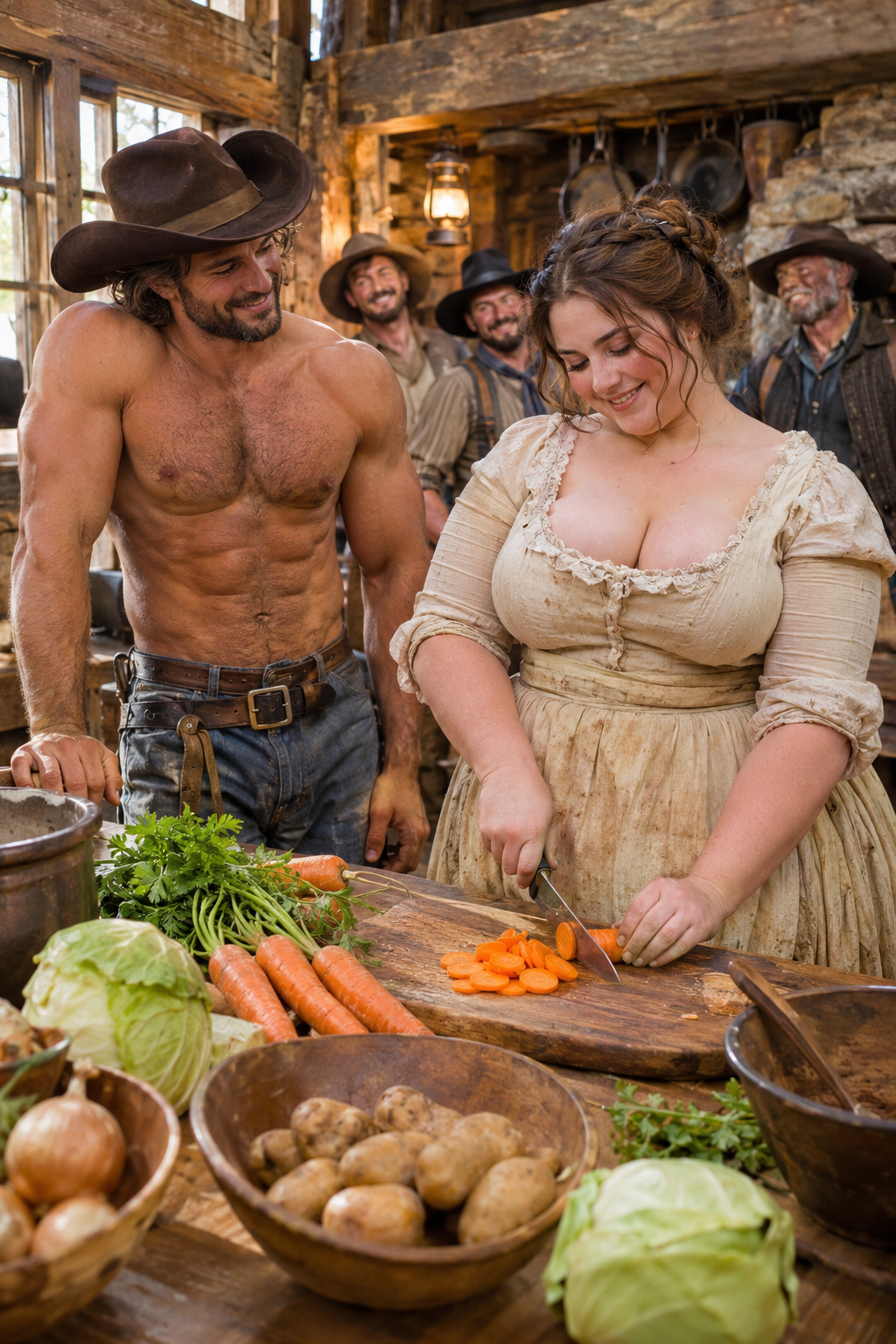
When I stepped off the stagecoach at High Ridge Ranch, fourteen cowboys laughed, and my future husband stared coldly, unaware of the secret behind my arrival.
The footsteps outside our front door grew louder, and I instinctively folded my father’s letter against my chest as Grant moved between me and the entrance.
The wind howled through the cracks in the old ranch house, carrying the unmistakable sound of someone struggling across the frozen porch.
Grant reached for the heavy iron latch, but before he could lift it, three sharp knocks echoed through the room.
“Mercer, open this door before I freeze to death out here.”
The voice belonged to Tommy, one of our youngest ranch hands, but something in his frightened tone made my stomach tighten.
Grant pulled the door open, and Tommy stumbled inside with snow clinging to his eyelashes and blood darkening the sleeve of his coat.
Behind him stood an exhausted horse, its reins dragging through the snow.
“There’s a man down by the eastern fence,” Tommy gasped.
“He says he came all the way from Missouri looking for Mrs. Mercer.”
My breath caught so sharply that Grant turned toward me.
For one terrible moment, I imagined the lawyer who had stolen my inheritance standing somewhere in the darkness, waiting to finish what he had started.
But Tommy shook his head before I could speak.
“He’s an older fellow, maybe sixty, and he’s hurt bad enough that I couldn’t get him onto my horse.”
Grant was already reaching for his coat.
“Arthur, get blankets and heat some water.”
Arthur Dean appeared from the kitchen, his expression suddenly serious.
“I’ll have the stove burning hot enough to warm the whole county.”
Grant looked at me.
“Stay inside, Lillian.”
I stepped forward and caught his sleeve.
“If that man traveled from Missouri because of my father, I’m not hiding while he freezes outside.”
For a moment, Grant looked ready to argue, but then he saw the determination in my face.
He nodded once.
“Then stay close to me.”
We took the small wagon, wrapped ourselves in heavy blankets, and followed Tommy into the storm.
Snow swept across the ranch yard in silver sheets, swallowing the lantern light almost as quickly as it appeared.
I sat beside Grant, clutching the wooden seat while the horses fought their way through drifts that reached their knees.
The eastern fence stood nearly a mile from the house, where the land sloped toward a narrow creek.
We found the stranger beneath a cottonwood tree, curled around a leather satchel as though it contained something more precious than his own life.
Grant lifted him carefully while Tommy held the lantern.
The man’s face was gray with cold, and one side of his forehead was badly bruised.
But when the light touched his features, I recognized him.
“Mr. Whitcomb?”
His eyelids fluttered.
“Lillian Brooks?”
I dropped to my knees in the snow.
“Thomas Whitcomb, what happened to you?”
He had been my father’s closest friend for nearly thirty years, a quiet carpenter who had helped repair our farmhouse whenever the roof leaked or the porch steps rotted.
He had stood beside me at my father’s funeral.
And then, only weeks afterward, he had disappeared from Missouri without explanation.
His cracked lips moved.
“Your father was right.”
Before I could ask what he meant, his eyes closed.
Grant carried him into the wagon, and we hurried back toward the ranch while the wind rose around us.
By the time we reached High Ridge, Arthur had prepared the downstairs bedroom, and several cowboys were waiting with warm blankets.
We discovered that Whitcomb had a badly sprained ankle, a cut above his eyebrow, and bruises suggesting he had fallen from his horse.
He was conscious enough to drink broth, but exhaustion quickly pulled him into sleep.
Arthur remained beside him while Grant and I returned to the sitting room.
My father’s letter lay on the table where I had left it.
I picked it up again, reading the final warning until the words seemed carved into my memory.
Someone had altered his financial records.
Someone had frightened him during the final weeks of his life.
And somehow, that same person had convinced me to surrender everything he owned.
“Grant, I need to know exactly what happened to the money you sent.”
He pulled a chair beside mine and opened the bundle of letters from his desk.
The documents showed that Grant had sent enough money to settle every recorded debt against my father’s estate.
The funds had gone through a bank in St. Louis, with instructions that they be delivered to our family attorney, Charles Bellamy.
Bellamy had acknowledged receiving the money.
He had even written a formal receipt.
But the documents he gave me after my father’s death told an entirely different story.
According to Bellamy, the estate owed nearly four thousand dollars, an enormous sum that had seemed impossible for me to repay.
I had sold our furniture, surrendered the farmhouse, and accepted the matrimonial agency’s offer because I believed poverty was closing around me.
Now I understood that the poverty might have been manufactured.
“I trusted him,” I whispered.
Grant’s hand covered mine.
“That doesn’t make you foolish.”
I stared into the fire.
“It makes me angry.”
He nodded.
“Then let’s find out what he did.”
The following morning, the storm finally weakened, leaving High Ridge buried beneath a brilliant white silence.
Thomas Whitcomb woke shortly after sunrise.
I carried him a tray of cornbread and hot coffee, trying not to show how desperately I needed answers.
He looked older than I remembered, with deep lines around his eyes and a trembling hand that struggled to hold the cup.
“I’m sorry I frightened you, Lillian.”
“You frightened me when you disappeared from Missouri.”
He lowered his gaze.
“I know.”
For several moments, he seemed unable to continue.
Then he reached beneath his pillow and withdrew the leather satchel he had refused to release during the night.
“Your father gave me something before he died.”
Inside were several folded documents, a small brass key, and a narrow ledger bound in brown leather.
I recognized the ledger immediately.
My father had kept it in the bottom drawer of his writing desk, recording every payment he made and every dollar he earned.
He had been meticulous about money, especially during his illness.
Whitcomb opened it near the final pages.
There, in my father’s careful handwriting, were several entries marked with question marks.
Payments to unfamiliar companies.
Interest charges that seemed to multiply without explanation.
And a mortgage against our farmhouse that my father had apparently never authorized.
“Samuel asked me to investigate,” Whitcomb explained.
“He thought Bellamy had made a mistake.”
I turned the pages slowly.
“But he hadn’t.”
Whitcomb shook his head.
“Bellamy was working with a land buyer named Edwin Price, a man who wanted your father’s property.”
The name struck me like a physical blow.
Edwin Price had purchased our farmhouse three days after I surrendered it.
I remembered him standing beside Bellamy in the attorney’s office, wearing a fine gray suit and speaking with exaggerated sympathy.
He had told me that selling quickly was the only sensible choice.
I had thanked him for his kindness.
The memory made me feel sick.
“Why would anyone go to so much trouble for a little farmhouse?”
Whitcomb looked toward Grant before answering.
“Because your father owned more than the house.”
He unfolded a survey map across the blanket.
Our property had included forty acres of wooded land behind the farmhouse, stretching toward a narrow railroad corridor.
For years, the land had seemed nearly worthless because the ground was rocky and difficult to farm.
But a railroad company had recently begun considering a freight connection through that part of Missouri.
If the route was approved, the corridor would become valuable.
Very valuable.
“Price started buying property along the proposed line,” Whitcomb said.
“Your father refused to sell.”
I remembered that argument.
A stranger had visited our farmhouse during the summer before my father’s death, offering money for the back acreage.
My father had sent him away.
At the time, I thought he was simply being stubborn.
Now I understood.
“He wanted to keep the land for me.”
Whitcomb nodded.
“He said you deserved something permanent after spending so many years caring for him.”
My eyes burned.
I had spent the last months of my father’s life believing that he was ashamed of the debts he would leave behind.
All that time, he had been fighting to protect my future.
Whitcomb continued quietly.
When Samuel became too ill to examine his accounts, Bellamy had begun presenting documents that showed increasing obligations against the property.
Some were genuine medical expenses.
Others appeared to be fabricated charges connected to businesses controlled by Price.
Whitcomb had discovered enough irregularities to become suspicious, but before he could confront Bellamy, Samuel died.
Then Bellamy told him the estate had been settled and that I had voluntarily sold the property.
“I believed him at first,” Whitcomb admitted.
“Until I found out Grant Mercer had paid the debts.”
He had traveled to St. Louis, obtained copies of bank records, and begun asking questions.
Someone had followed him.
His rented room had been searched.
Then an unsigned warning appeared beneath his door, telling him to forget Samuel Brooks and leave Missouri.
Instead, Whitcomb had boarded a train west.
“I should have come sooner,” he said.
I reached for his hand.
“You came.”
His eyes filled.
“Your father was the finest man I ever knew.”
For the first time since the funeral, I allowed myself to cry without trying to hide it.
Grant stood quietly beside the bed, giving me the space to grieve.
Later that afternoon, we gathered around the dining table with Whitcomb’s documents spread between plates of untouched food.
Arthur joined us, along with Caleb Turner, Grant’s oldest ranch hand, who had once worked as a county clerk.
Caleb examined the papers carefully.
“These records could prove fraud,” he said.
“But you’ll need the original property filings and the bank’s confirmation.”
Grant leaned forward.
“Then we’ll get them.”
I looked at him.
“We?”
He met my eyes.
“You’re my wife, Lillian, not someone I’m helping out of charity.”
Something inside me softened.
For weeks, I had wondered whether Grant married me because he felt indebted to my father.
Now, watching him study those papers with the same determination he brought to protecting his cattle, I began to understand that gratitude had only opened the door.
What we were building together had become something neither of us expected.
But the next morning brought a problem that threatened to stop us before we could begin.
A rider arrived from the nearest town carrying a telegram addressed to Grant.
It came from the bank in St. Louis.
Grant had requested confirmation of his original payment.
The bank’s reply stated that the funds had been received and transferred according to Bellamy’s instructions.
But it also revealed something extraordinary.
A second payment had been issued from the estate account three weeks later.
The recipient was Edwin Price.
The amount was almost exactly what Grant had sent.
I read the telegram twice.
“Bellamy gave Price the money?”
Caleb shook his head.
“Not necessarily all of it, but someone used the estate account to pay him.”
Whitcomb closed his eyes.
“Then they took the land and the money.”
The room fell silent.
It was no longer simply a matter of an unfair sale.
Someone had used my father’s illness, his death, and my ignorance to strip away everything he had worked for.
That evening, I sat alone in the kitchen, staring at the rolling pin Grant had carved for me.
Arthur entered carrying a sack of flour.
“You’ve been looking at that same spot for twenty minutes.”
I tried to smile.
“I’m thinking.”
“That much thinking usually burns the biscuits.”
He set the flour down and pulled out a chair.
For a while, neither of us spoke.
Then Arthur told me about his own mother, a widow who had lost her boardinghouse after trusting a man who promised to manage her finances.
“She spent years believing she’d failed,” he said.
“But she hadn’t failed.”
He tapped the table.
“Somebody lied to her.”
I looked at him.
“Did she ever get her boardinghouse back?”
“No.”
My heart sank.
Arthur smiled gently.
“But she opened another one, and this time she kept the books herself.”
He stood and returned to the stove.
“Don’t let the man who robbed you decide what the rest of your life looks like.”
Those words stayed with me long after the kitchen lamps were extinguished.
The following week, Grant and I traveled to town to meet a lawyer recommended by the county judge.
Her name was Margaret Ellis, a sharp-eyed woman in her forties who had built a reputation handling difficult property disputes.
She examined our documents without interruption.
When she finished, she folded her hands.
“Mrs. Mercer, I believe you have grounds to challenge the sale.”
My heart leaped.
“Then we can get the farmhouse back?”
“Possibly, but it won’t be simple.”
She explained that the original deed, the alleged mortgage, and the transfer records would need to be examined.
If Bellamy had forged signatures or concealed the payment, the transaction could be challenged.
But Price might claim he had purchased the property in good faith.
“And if he does?” I asked.
Margaret’s expression hardened.
“Then we’ll make him prove it.”
She wrote several letters that afternoon, requesting certified records from Missouri.
Whitcomb agreed to provide a sworn statement.
Grant supplied his bank correspondence.
And I signed a detailed account of everything Bellamy had told me after my father’s death.
For the first time, I felt less like a frightened woman running from disaster and more like someone capable of confronting it.
Still, the waiting was difficult.
Winter tightened its grip on Wyoming.
Snow covered the fences, the cattle needed constant care, and the ranch hands worked until their faces were raw from the cold.
Life at High Ridge continued around the uncertainty.
Arthur and I prepared enormous breakfasts, preserved what vegetables remained, and taught Tommy to make biscuits without turning them into stones.
Grant began coming into the kitchen every evening, sometimes carrying small repairs he could complete while I worked.
We spoke about Missouri, his childhood, and the mother whose absence had left the ranch so painfully quiet.
One night, while I kneaded bread, he asked a question that made my hands stop.
“Do you regret marrying me?”
I turned toward him.
“Why would you ask that?”
He looked uncomfortable.
“Because you didn’t know the truth when you agreed.”
I wiped flour from my fingers.
“Grant, did you marry me because you owed my father something?”
He considered the question carefully.
“At first, I thought helping you would settle an old debt.”
My chest tightened.
“But when your letters arrived, I started waiting for them.”
He smiled faintly.
“I read them after supper, sometimes twice.”
I remembered the long evenings in Missouri when I had written to him beside my father’s empty chair.
“I waited for yours, too.”
Grant stepped closer.
“I fell in love with the woman who argued about books, worried about strangers, and told me my handwriting looked like a chicken had crossed the page.”
I laughed through sudden tears.
“Your handwriting is terrible.”
“I know.”
He took my hands.
“I didn’t marry you because of your father, Lillian.”
His voice grew softer.
“I married you because I couldn’t bear the thought of spending another winter without you.”
I leaned against him, feeling the steady beat of his heart beneath my cheek.
For the first time, I stopped wondering whether I belonged at High Ridge.
I knew.
Three weeks later, Margaret Ellis arrived at the ranch carrying a thick packet of documents.
Her expression told me the news was serious before she removed her coat.
“We found the mortgage.”
She placed a certified copy on the table.
The signature at the bottom was supposed to be my father’s.
But the handwriting was wrong.
The letters leaned sharply to the right, and the final stroke of his surname curled upward.
My father had suffered an injury to his writing hand years earlier.
His signature had always ended with a short, downward line.
“That’s not his signature.”
Margaret nodded.
“I thought you might say that.”
Then she showed me the witness section.
Charles Bellamy had witnessed the document.
Edwin Price had signed as the lender’s representative.
The supposed loan had been recorded only two months before my father’s death.
Margaret had also obtained a letter from the railroad company confirming that Price had been negotiating to sell portions of the land along the proposed route.
He stood to earn several times what he had paid for the entire property.
“We have enough to bring a serious challenge,” she said.
“But there’s something else.”
She unfolded a second document.
It was an authorization allowing Bellamy to act on behalf of my father’s estate.
The signature was mine.
Except I had never signed it.
I stared at the page, remembering the stack of papers Bellamy had placed before me after the funeral.
He had rushed me through them, saying the creditors were growing impatient.
I had signed some documents.
But not this one.
Then I noticed the date.
It was dated two days before my father’s death.
I had been sitting beside his bed that entire week.
And I had never visited Bellamy’s office.
“He’s forged my name.”
Margaret looked directly at me.
“Yes, Mrs. Mercer, and that may be the mistake that brings his entire scheme down.”
We filed the necessary statements and sent the evidence to the authorities in Missouri.
For several days, nothing happened.
Then a telegram arrived from Bellamy himself.
It was addressed to me.
The message was short.
He claimed the documents were being misunderstood and urged me to withdraw my accusations before innocent people suffered.
At the bottom, he added a sentence that made my skin crawl.
YOUR FATHER WOULD NOT HAVE WANTED THIS.
I stood in the ranch office holding the telegram while anger rose through me like fire.
For months, Bellamy had used my father’s memory to frighten and manipulate me.
Now he was trying to do it again.
Grant read the message and reached for his coat.
“Where are you going?” I asked.
“To send a reply.”
I caught his arm.
“No.”
He stopped.
“I’ll answer him myself.”
I sat at the desk and wrote a brief telegram.
MY FATHER TAUGHT ME TO TELL THE TRUTH, EVEN WHEN IT IS DIFFICULT.
I WILL NOT WITHDRAW ANYTHING.
LILLIAN MERCER.
Grant read it over my shoulder.
Then he kissed the top of my head.
“That’s my wife.”
The investigation moved slowly through the remainder of winter.
Officials questioned witnesses, reviewed the bank records, and examined the disputed signatures.
Bellamy denied wrongdoing.
Price insisted he had purchased the property legally.
Their lawyers claimed that I was a disappointed seller attempting to profit from the railroad’s interest.
Some days, the uncertainty felt unbearable.
But Margaret kept working, and Whitcomb remained at High Ridge, helping Arthur repair shelves and telling stories about my father that I had never heard.
Then, near the end of February, the truth finally began to unravel.
A former clerk from Bellamy’s office came forward.
Her name was Evelyn Carter, and she had copied several documents before leaving her position.
She testified that Bellamy had instructed her to prepare a mortgage after Samuel Brooks became too ill to visit the office.
When she questioned the missing signature, Bellamy told her the matter had already been authorized.
Later, she witnessed Price deliver a sealed envelope containing cash.
She had remained silent because Bellamy threatened to ruin her employment prospects if she spoke.
But after learning that I had lost my home, she could no longer live with what she knew.
Her testimony connected the forged mortgage, the concealed payment, and the sale of the farmhouse.
More importantly, it gave investigators a reason to examine Bellamy’s other transactions.
They discovered that several elderly clients had suffered similar losses.
Some had been charged invented fees.
Others had unknowingly transferred property through documents they never understood.
My father had not been Bellamy’s only victim.
He had simply been one of the few who noticed something was wrong.
When Margaret told me, I sat silently for a long time.
I thought about my father’s final weeks, the fear he had tried to conceal, and the way he had apologized whenever another bill arrived.
He had believed he was losing his mind.
Bellamy had encouraged that belief.
The realization hurt more than the stolen money.
A man my father trusted had made him doubt himself when he was most vulnerable.
Grant found me crying beside the kitchen window that evening.
He didn’t ask me to stop.
He simply wrapped his arms around me and waited.
“I wish he had known,” I whispered.
“Known what?”
“That he wasn’t imagining things.”
Grant rested his cheek against my hair.
“He knew enough to leave you the truth.”
I closed my eyes.
“And I almost never found it.”
“But you did.”
By spring, the case had reached a turning point.
Bellamy was arrested on charges connected to forged documents and the misappropriation of estate funds.
Price faced legal action over his involvement in the fraudulent transfer.
The disputed sale was challenged, and the court ordered that the property could not be transferred again while the case was pending.
The railroad company suspended its negotiations with Price.
For the first time, the men who had frightened me into leaving Missouri were the ones facing consequences.
But the most difficult decision still waited.
Margaret sent word that I would need to return to Missouri to testify.
I had not seen my hometown since the day I boarded the train west.
I had left believing I was a failure.
Now I would return as a married woman determined to reclaim the truth.
Grant insisted on accompanying me.
Arthur promised to keep the ranch running, although he warned us that Tommy might destroy the kitchen if left unsupervised.
Whitcomb traveled with us, carrying the old ledger and my father’s final letter.
The journey took several days.
When we finally arrived in Missouri, the familiar streets made my chest ache.
The bakery where my father bought Sunday rolls still stood on the corner.
The church bell rang at the same hour.
And beyond the town, the narrow road to our farmhouse disappeared between bare trees.
I asked Grant to take me there before the hearing.
He agreed without hesitation.
The house looked smaller than I remembered.
The porch railing had been repaired, and someone had painted the shutters green.
But the old apple tree still leaned toward the kitchen window.
My father had planted it when I was ten.
I stood beside the fence, unable to move.
Grant waited quietly behind me.
“I thought I’d never see it again.”
He touched my shoulder.
“Would you like to go closer?”
I shook my head.
“Not yet.”
Then I noticed something beneath the apple tree.
A small wooden bench stood where my father used to sit in the evenings.
He had built it himself.
I remembered him calling me outside after supper, asking me to sit beside him while the sun disappeared behind the fields.
Sometimes we talked.
Sometimes we simply listened to the crickets.
I had believed those ordinary evenings would last forever.
Now I understood how precious they had been.
The hearing began two days later.
Bellamy sat across the room wearing an expensive black suit, his expression carefully composed.
He looked almost exactly as he had when he told me I had no choice but to surrender the farmhouse.
For a moment, the old fear returned.
Then Grant squeezed my hand.
I stood, walked to the witness chair, and told the truth.
I described my father’s illness, the unexplained debts, and Bellamy’s repeated warnings that creditors would seize everything.
I explained how I had signed documents while grieving, trusting the man who had advised our family for years.
Then I described discovering Grant’s payment and learning that the supposed mortgage carried a forged signature.
Bellamy’s attorney questioned me sharply.
He suggested that I had misunderstood the documents.
He asked whether I had been desperate to leave Missouri.
He even implied that my marriage to a wealthy ranch owner had made me greedy.
I felt my face grow hot.
But I remembered Arthur’s words.
Someone else’s dishonesty did not make me a failure.
“I didn’t come here because I want to become wealthy,” I said.
“I came because my father spent his life working honestly, and these men tried to make his final days look like a disgrace.”
The room became very quiet.
I looked directly at Bellamy.
“He trusted you.”
For the first time, he lowered his eyes.
Whitcomb testified next.
Then Evelyn Carter described the forged documents and the threats that had kept her silent.
The bank records were entered into evidence.
The handwriting differences were examined.
And the chain of transactions that had once seemed impossible to understand became painfully clear.
Bellamy had used fabricated debts to pressure my father.
After Grant’s payment arrived, he concealed the settlement and arranged for Price to acquire the property at a fraction of its potential value.
The two men expected the railroad negotiations to make them rich.
They had counted on my grief, my isolation, and my lack of legal knowledge to keep me silent.
They had never counted on Thomas Whitcomb carrying an old ledger across the country.
They had never counted on a quiet rancher remembering the man who saved his life.
And they had certainly never counted on me returning.
The court proceedings continued over several weeks, but the evidence against the fraudulent transfer proved overwhelming.
The deed to the farmhouse was eventually restored to my father’s estate, with the estate’s lawful ownership rights recognized.
Separate criminal proceedings against Bellamy and Price continued, and the financial records exposed losses suffered by other families.
I did not receive every dollar that had been taken.
Some of the money had disappeared into debts and expenses that could not easily be recovered.
But the farmhouse was mine again.
And my father’s name was cleared.
When Margaret delivered the final papers, I stared at them until the ink blurred through my tears.
Grant stood beside me, smiling.
“You did it, Lillian.”
I shook my head.
“We did.”
That evening, I returned to the farmhouse alone for a little while.
The rooms were empty, and dust floated through the late afternoon sunlight.
I walked into the kitchen where my father had taught me to knead bread.
I touched the windowsill where he used to leave wildflowers in a chipped blue jar.
Then I sat on the wooden bench beneath the apple tree.
For years, I had believed that losing the house meant losing the last piece of him.
But sitting there, I finally understood something.
My father had not loved me because I could preserve his possessions.
He had loved me because I was his daughter.
And he had wanted me to live, not spend the rest of my life guarding memories.
When Grant found me, the sun was setting.
He sat beside me without speaking.
After a while, he asked what I wanted to do with the property.
I looked toward the house.
“I don’t want to sell it.”
He nodded.
“Then don’t.”
“But I don’t want to leave High Ridge either.”
Grant smiled.
“I was hoping you’d say that.”
I leaned against his shoulder.
“I think I know what I want.”
Over the following months, Margaret helped me arrange for the farmhouse to be maintained and used as a small boardinghouse for widows and women who needed temporary shelter.
Evelyn Carter, whose courage had helped expose Bellamy, agreed to oversee the household.
Whitcomb offered to repair the building and remain nearby.
The railroad negotiations were still uncertain, but any future agreement involving the land would be made openly and on fair terms.
For the first time, the property would serve the purpose my father had always believed in.
Helping people who had nowhere else to turn.
Before leaving Missouri, I placed a small wooden sign beside the front door.
It read Samuel Brooks House.
I stood looking at it for a long time.
Then I whispered, “You kept your promise, Papa.”
The journey back to Wyoming felt different from the one I had made months earlier.
I was no longer running from a life I believed had collapsed.
I was returning to a life I had chosen.
When our wagon finally reached High Ridge, fourteen cowboys gathered in the yard to welcome us.
Tommy waved his hat so enthusiastically that it flew into a snowbank.
Arthur stood on the porch with his arms folded, pretending he hadn’t been watching the road for hours.
“About time you came home,” he announced.
I laughed and hurried up the steps.
The kitchen smelled of fresh bread and beef stew.
The shelves were spotless.
And on the table stood a vase filled with the first wildflowers of spring.
Arthur glanced toward Grant.
“Don’t look at me. That was his idea.”
Grant’s ears turned red.
The cowboys roared with laughter.
That night, we gathered around the long dining table, sharing food and stories while the mountain wind whispered beyond the windows.
Whitcomb had decided to remain in Missouri, but he promised to visit when the roads improved.
Evelyn wrote regularly, telling me about the women finding safety at Samuel Brooks House.
Margaret continued helping other families challenge suspicious property transactions.
And High Ridge grew into something neither Grant nor I could have imagined when I first stepped off the stagecoach.
Arthur became more than our cook.
He became family.
Tommy eventually learned to make biscuits that could be eaten without risking a broken tooth.
The cowboys repaired the old sitting room and built additional shelves for the growing collection of books Grant and I shared.
Every Sunday, we opened our table to travelers who needed a meal.
Sometimes they stayed only an hour.
Sometimes they stayed through a storm.
Nobody was turned away simply because they had little money.
One evening in early summer, Grant and I sat on the porch watching the sun sink behind the Wind River Mountains.
The sky glowed pink and gold, and the scent of fresh-cut hay drifted across the yard.
Grant held my hand.
“Do you remember what you said when we first met?”
I smiled.
“That your letters were considerably warmer than your welcome?”
He chuckled.
“I deserved that.”
“You certainly did.”
He turned toward me.
“I was terrified that day.”
I looked at him in surprise.
“You?”
He nodded.
“I’d spent years managing cattle, surviving blizzards, and facing men twice as mean as any bull on this ranch.”
His fingers tightened around mine.
“But when you stepped off that stagecoach, I realized I had no idea how to make someone happy.”
I rested my head against his shoulder.
“You didn’t have to make me happy, Grant.”
He looked down at me.
“You gave me somewhere safe enough to find happiness for myself.”
For a long moment, neither of us spoke.
Then Grant reached into his pocket and withdrew a small envelope.
Inside was a photograph of my father, taken many years earlier.
He stood beside a skinny teenage boy with dark hair and solemn eyes.
I recognized Grant immediately.
My father had one arm around his shoulders, smiling proudly.
On the back, in my father’s handwriting, were seven words.
A kindness is never truly lost.
I pressed the photograph against my heart.
All those years, my father had believed that helping a frightened boy in a snowstorm was simply the right thing to do.
He never expected repayment.
He never imagined that boy would grow into the man who would one day become my husband.
And he certainly never imagined that his kindness would return to protect his daughter when she needed it most.
Tears slipped down my cheeks, but they were different from the tears I had cried in Missouri.
They carried gratitude instead of despair.
Grant kissed my forehead.
“I wish he could see you now.”
I looked toward the glowing windows of our home, where Arthur’s laughter mingled with the voices of fourteen men who had become my family.
“Maybe,” I whispered, “he already can.”
Years later, people would ask how a Missouri woman who knew nothing about ranching had managed to make a home in the Wyoming mountains.
They expected stories about courage, hard work, or the wealthy rancher who rescued a penniless bride.
But I always told them something different.
I told them about a father who helped a stranger without asking for anything in return.
I told them about a quiet man who learned that love could not be purchased with gratitude.
I told them about a frightened woman who discovered that being deceived did not mean she was weak.
And I told them about a kitchen where fourteen hungry cowboys first learned that a home was more than four walls and a roof.
Because the greatest thing I recovered was never the farmhouse, the money, or even my father’s good name.
It was the belief that my life still belonged to me.
I had arrived at High Ridge carrying a battered suitcase and the terrible conviction that I had nothing left to offer.
But I had brought something no thief could steal.
The love my father had given me, the strength hardship had taught me, and the courage to begin again.
And as Grant wrapped his arm around me beneath the summer stars, I finally understood the truth my father had spent his entire life trying to teach me.
A good deed may disappear from sight for years, but its consequences can travel farther than we ever imagine.
Sometimes it returns as a stranger offering shelter.
Sometimes it returns as a friend carrying the truth through a winter storm.
And sometimes, when the world has convinced you that you have lost everything, it returns as a quiet man standing beside a stagecoach, too frightened to smile because he already knows that the woman stepping down from it might change his life forever.
I once believed that home was the place where my father had lived and died.
Now I knew that home was wherever love made room for us to become ourselves again.
That night, I placed his photograph on our mantel, beside the little wooden box Grant had carved for me.
Then I went into the kitchen, where bread was rising and the people I loved were waiting for supper.
And for the first time in longer than I could remember, I did not feel as though I was trying to recover the life I had lost.
I was living the beautiful, unexpected life that had grown from it.
Because sometimes the most precious inheritance a parent leaves behind isn’t land, money, or a family name.
It’s the kindness that survives them, quietly finding its way into the lives of people they will never meet.
And every time I looked across our crowded dinner table and saw Grant smiling, I knew my father’s greatest gift had finally come home.
I thought our story had finally reached its peaceful ending, but one last surprise was waiting for us at High Ridge Ranch.
It arrived on a cool September morning, nearly a year after I had first stepped off the stagecoach and into Grant Mercer’s life.
Arthur was preparing breakfast when Tommy came rushing through the kitchen door, carrying a telegram and wearing the bewildered expression of a man who had just witnessed something extraordinary.
“Mrs. Mercer, there’s news from Missouri, and I think you’d better sit down.”
My heart tightened as I took the envelope, remembering how much sorrow had once arrived in messages bearing that familiar address.
The telegram was from Evelyn Carter, who had been managing Samuel Brooks House since its opening.
She wrote that the railroad company had finally reached an agreement concerning the land behind my father’s farmhouse.
The company had offered a fair price for a narrow right-of-way, leaving the house, orchard, and most of the property untouched.
But that wasn’t the news that made my hands tremble.
Evelyn had discovered another letter hidden inside the old writing desk, sealed in an envelope bearing my name.
She had sent it west with Thomas Whitcomb, who was already traveling to Wyoming for a visit.
Three days later, Whitcomb arrived at High Ridge, carrying a small wooden box that I recognized immediately.
It had belonged to my father.
The brass hinges were tarnished, and one corner still bore the scratch I had made as a child when I accidentally dropped it.
Whitcomb placed it gently in my hands.
“Samuel asked me to make sure you received this when you were ready.”
I looked at him through gathering tears.
“Why didn’t he give it to me himself?”
Whitcomb’s expression softened.
“He hoped he would have more time.”
That evening, Grant and I sat together beside the fireplace while I opened the box.
Inside lay my mother’s wedding ring, several faded photographs, and a letter written in my father’s familiar handwriting.
My mother had died when I was twelve, and for years I believed her ring had been sold to pay for her medical care.
Seeing it again made me cover my mouth to keep from crying.
Grant gently took the box while I unfolded the letter.
My father had written it during the final weeks of his illness, when he already suspected that his strength was failing.
He told me that he had spent too many years worrying about what he could leave behind.
He had wanted to give me security, a comfortable home, and enough money that I would never have to depend on another person’s generosity.
But as his health declined, he began to understand that the most important things he had given me could never be measured in dollars.
He remembered the little girl who carried injured birds into the kitchen and insisted that every creature deserved a chance to heal.
He remembered the young woman who sat beside his bed through sleepless nights, reading aloud even when her voice grew tired.
And he remembered how often I had sacrificed my own happiness because I believed loving someone meant never leaving their side.
Then I reached the final paragraph.
“My darling Lillian, if you are reading this, I hope you have finally stopped believing that your life must be spent paying debts of gratitude.”
The words blurred before my eyes.
“You owe me nothing for raising you, just as I owed you nothing for the love you gave me.”
I pressed my trembling fingers against the paper.
“Go where your heart is welcomed, build something beautiful, and never mistake being needed for being loved.”
Grant drew me close as the tears finally came.
For years, I had believed that my duty was to repay every kindness, every sacrifice, and every moment of care my father had given me.
But my father had never wanted repayment.
He had wanted freedom for me.
And somehow, across all those miles and all those months, his final words had reached me exactly when I was ready to understand them.
The next morning, I carried my mother’s ring into the kitchen.
Arthur was kneading bread, and the cowboys were gathering for breakfast when Grant entered behind me.
I slipped the ring onto my right hand, where it rested beside the simple gold band Grant had placed on my finger during our wedding.
Tommy noticed immediately.
“That’s a pretty ring, Mrs. Mercer.”
“It belonged to my mother.”
He smiled.
“Then I reckon she’d be pleased to see where it ended up.”
I looked around the kitchen at the faces that had once regarded me as an unwelcome stranger.
Now they were my family.
That autumn, Grant and I made a decision that changed High Ridge forever.
We converted the unused eastern bunkhouse into a small lodging house for travelers, widows, and families stranded along the mountain roads.
Arthur helped design the kitchen, insisting that nobody should ever have to sleep hungry beneath our roof.
The cowboys repaired the walls, built beds, and painted the windowsills.
Whitcomb stayed through the season, using his carpentry skills to turn the neglected building into a warm, welcoming place.
We named it Brooks House, in honor of the man whose kindness had brought Grant and me together.
By the first snowfall, three families had already found temporary shelter there.
One was a young widow traveling west with two children.
Another was an elderly couple whose wagon had broken down in the mountains.
The third was a former ranch hand who had lost his job after a serious injury.
Each arrived frightened, ashamed, or uncertain of what would happen next.
And each discovered that High Ridge had a place for them.
One evening, I found Grant standing outside the lodging house, watching warm light spill from its windows.
Children’s laughter drifted through the doorway.
Arthur was inside arguing cheerfully with Tommy about whether the stew needed more salt.
Grant slipped his arm around my waist.
“Your father would have liked this.”
I leaned against him.
“So would your mother.”
He smiled, and for a while we simply stood together beneath the falling snow.
Then he turned toward me with an expression I had come to recognize.
It was the same nervous look he wore whenever he had something important to say.
“Lillian, there’s something I’ve been meaning to ask you.”
I raised an eyebrow.
“If you’ve invited another fourteen cowboys to supper, I expect advance warning.”
He laughed, then reached into his coat and withdrew a small folded paper.
It was a drawing of a house.
Not the existing ranch house, but a larger home with a wide kitchen, a sunny sitting room, and several bedrooms upstairs.
I studied it in surprise.
“Grant, what is this?”
He took my hand.
“I thought we might need more room someday.”
My breath caught when I saw the small handwritten words beneath one upstairs window.
Nursery.
I looked up at him.
His cheeks had turned red despite the cold.
“I don’t know what the future holds,” he said softly.
“But if we’re fortunate enough to have children, I want them to grow up knowing this house is full of love.”
I touched the drawing, overwhelmed by the tenderness of his hope.
“And if we don’t?”
Grant answered without hesitation.
“Then we’ll fill those rooms with people who need a home.”
I threw my arms around him.
For the first time, I understood that our happiness did not depend on everything happening exactly as we imagined.
We had already built something stronger than any dream.
We had built a life where love was freely given, where mistakes could be forgiven, and where nobody had to earn the right to belong.
The following spring, a little girl named Rose arrived at Brooks House with her widowed mother.
She was six years old, painfully shy, and frightened of the enormous horses in the ranch yard.
One afternoon, I found Grant kneeling beside her near the stable, patiently showing her how to offer an apple to his gentlest mare.
Rose giggled when the horse’s soft nose brushed her palm.
Grant looked up and caught me watching.
His smile was so open and joyful that I barely recognized the stern man who had once greeted me beside a stagecoach.
Later, Rose asked whether she could help me bake cornbread.
I gave her a wooden spoon and showed her how to stir the batter.
She worked with such serious concentration that Arthur declared her the finest apprentice he’d ever seen.
When the bread came out of the oven, Rose carried the first piece to Grant.
He accepted it as though she had presented him with a priceless treasure.
Watching them together, I felt something settle quietly inside my heart.
I had spent so much of my life afraid of losing people that I had almost forgotten how wonderful it was simply to love them.
That evening, Grant found me standing beside the kitchen window.
“Are you happy, Lillian?”
I looked at the long table, the freshly baked bread, and the familiar faces gathering for supper.
Then I looked at my husband.
“More than I ever thought possible.”
He kissed my forehead.
“Good.”
Outside, the Wind River Mountains glowed beneath the setting sun.
The same mountains that had once seemed cold and frightening now surrounded the place I loved most in the world.
I remembered arriving with one suitcase, a broken heart, and the desperate hope that a stranger might give me somewhere to belong.
I remembered the fourteen cowboys who laughed when I stepped from the stagecoach.
I remembered Grant’s awkward silence, Arthur’s kindness, Whitcomb’s courage, and my father’s final letter.
Every painful moment had led me toward a truth I could never have understood when I first left Missouri.
Home was not something another person could simply give me.
It was something we created through trust, courage, forgiveness, and the willingness to care for one another.
My father had saved Grant’s life during a winter storm without knowing what would become of the frightened boy he rescued.
Years later, that boy had grown into the man who helped me discover my own strength.
And together, we had turned an isolated ranch into a refuge for people who needed another chance.
As I carried the cornbread to the table, Tommy stood and pulled out my chair.
Arthur brought in the stew.
Grant waited beside me, his enormous hand resting gently against my back.
The room filled with laughter, conversation, and the comforting sound of people who knew they were welcome.
Before we began eating, I looked toward the photograph of my father hanging above the fireplace.
For one brief moment, I imagined him standing in the doorway, smiling at the life I had finally allowed myself to build.
And in my heart, I thanked him.
Not for the farmhouse he had fought to protect.
Not for the money that had eventually been recovered.
But for teaching me that kindness is never wasted, even when the world seems determined to prove otherwise.
I had once believed my story ended when I lost everything in Missouri.
Instead, that loss had carried me toward the beginning of a life filled with more love than I had ever dared to expect.
And when Grant reached beneath the table and took my hand, I knew there was nowhere else on earth I wanted to be.
Because the greatest miracle of High Ridge Ranch was never that a lonely woman found a husband or that a silent rancher found a wife.
It was that two people who had almost forgotten how to hope learned to build a home where hope could flourish for everyone.
And every autumn, when the mountains turned gold and the first cold winds swept across the Wyoming plains, I remembered the frightened woman who had stepped down from that stagecoach.
If I could have spoken to her, I would have told her not to be afraid of the man waiting beside the black horse.
I would have told her that his silence concealed a gentle heart, that the neglected kitchen would soon be filled with laughter, and that the family she thought she had lost would grow in ways she could never imagine.
Most of all, I would have told her that the end of one life does not mean the end of happiness.
Sometimes it means the beginning of a story more beautiful than anything we could have planned.
And as the evening settled over High Ridge, with the windows glowing warmly against the mountains and the people I loved gathered around our table, I finally understood my father’s greatest lesson.
We cannot always choose what life takes from us, but we can choose what we build with the love that remains.
That was the legacy he left me.
And that was the legacy Grant and I would spend the rest of our lives passing on.
THE END.