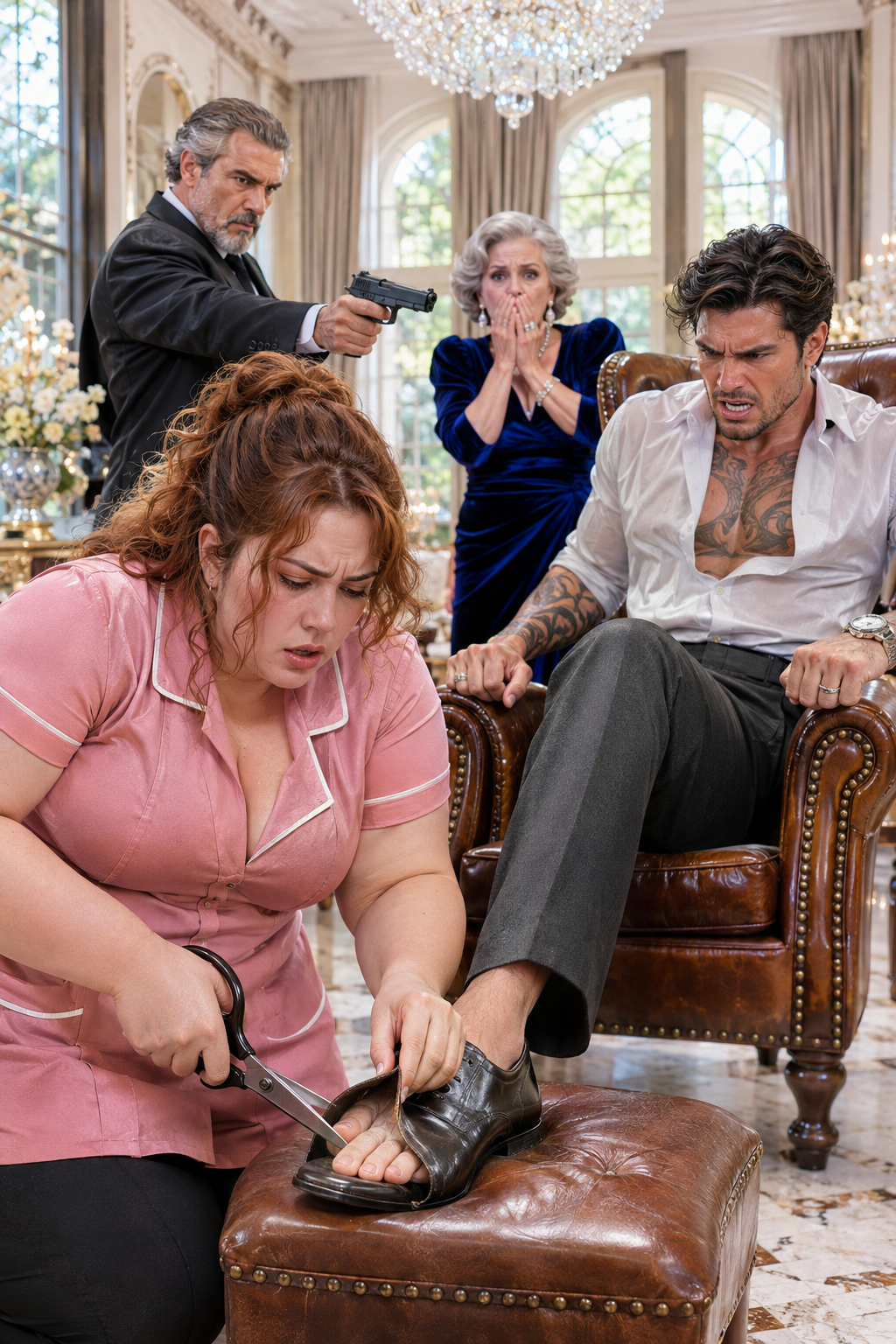
The most feared crime boss in Providence had a gun pointed at the woman trying to save his life. All because she wanted to cut off his $2,000 Italian shoe.
“I wasn’t supposed to let you walk again,” Turner whispered.
For several seconds, nobody moved. Gloria covered her mouth with both hands. Cory stared at the doctor, while Patrick struggled to understand what he had just heard.
“What did you say?” Patrick asked.
Turner swallowed hard. “You’re confused, Patrick. You have a high fever. We shouldn’t be having this conversation right now.”
“Then why did you say it?”
Turner looked at Monica. “She’s putting ideas into your head. This woman lost her nursing license for a reason.”
Monica stood slowly. For seven years, she had imagined confronting the man who destroyed her career. She had rehearsed angry speeches while washing dishes, driving between appointments, and lying awake at night wondering how everything had gone so wrong.
But now that he was standing in front of her, she felt something stronger than anger.
She wanted the truth.
“Tell him about the original X-ray, Gary.”
Turner’s face tightened.
“I don’t know what you’re talking about.”
“Yes, you do. There was a metal fragment near his big toe. I noticed it after his first surgery. You told me it was nothing, and when I requested another examination, you reported me for stealing medication.”
Patrick looked between them.
“You two worked together?”
“We did,” Monica answered. “Until I questioned your treatment.”
Turner opened his mouth, but Patrick suddenly cried out. His body began shaking uncontrollably, and Monica immediately returned to his side.
“Enough talking. Cory, where’s that ambulance?”
“On its way.”
Monica checked Patrick’s condition. His skin was clammy, and he seemed increasingly confused. The infection was more serious than anyone in the house had realized.
Gloria knelt beside her son and held his hand.
“Please, Monica. Don’t let him die.”
“I’ll do everything I can.”
Turner stepped forward with his medical bag.
“I can give him something for the pain.”
“No,” Monica said firmly. “He needs emergency treatment, not another dose of whatever you’ve been giving him.”
Patrick weakly pushed the doctor’s hand away.
“Get him away from me.”
Cory grabbed Turner’s arm and escorted him toward the opposite side of the room.
Monica examined the wound again. A small piece of metal was visible beneath the damaged tissue. She recognized its unusual shape from the image she had studied years earlier.
She couldn’t believe it had remained there for so long.
When the paramedics arrived, Monica explained Patrick’s symptoms and the suspected foreign object. Under their supervision, the loose fragment was carefully removed and preserved for examination.
It was smaller than a fingernail.
Yet that tiny piece of metal had controlled Patrick Marshall’s life for seven years.
Monica stared at it inside the medical container. Her eyes filled with tears.
“That’s it,” she whispered. “That’s what I saw.”
Patrick turned his head toward her.
“You lost your job because of that?”
Monica nodded.
“I tried to tell them.”
The paramedics prepared Patrick for transportation. Before they lifted him onto the stretcher, he reached for Cory’s sleeve.
“Find out what Turner has been hiding.”
Cory nodded.
“And Cory?”
“Yes, boss?”
“Don’t kill him. I want answers.”
At the hospital, Patrick was rushed into emergency care. Doctors confirmed that the infection had spread beyond the original wound and that he was at risk of developing life-threatening complications.
Gloria sat in the waiting room, clutching her handbag against her chest. Monica stayed beside her, still wearing the simple uniform she used for house calls.
For nearly three hours, neither woman spoke much.
Finally, Gloria broke the silence.
“He used to dance with me.”
Monica looked up.
“Patrick. Every Christmas, he’d put on my favorite record and make me dance with him in the kitchen. After the accident, he stopped. He said standing hurt too much.”
She wiped her eyes.
“I watched my son become a different person. Angry. Tired. Always taking those pills. And every time I asked Gary whether something could be done, he told me we should be grateful Patrick survived.”
Monica gently squeezed her hand.
“You trusted his doctor.”
“I recommended Gary myself,” Gloria whispered. “His father was a friend of my husband.”
Her voice cracked.
“I brought that man into our family.”
Before Monica could answer, a surgeon approached them.
“Mrs. Marshall?”
Gloria stood so quickly that her handbag fell to the floor.
“Your son is stable. We’ve cleaned the infected area and started treatment. He’ll need close monitoring, but we’re hopeful we can save his foot.”
Gloria began crying.
The surgeon turned to Monica.
“Were you the woman who recognized the infection?”
“Yes.”
“You may have saved his life. Another day without treatment could have ended very differently.”
Monica lowered her head.
It had been seven years since a doctor had thanked her for helping a patient.
She hadn’t realized how badly she needed to hear those words.
Meanwhile, back at the Marshall estate, Cory was having a very different conversation with Gary Turner.
The doctor sat in a chair inside the study. His expensive jacket was wrinkled, and his hands wouldn’t stop shaking.
“I made a mistake,” Turner insisted. “Doctors make mistakes.”
Cory placed Patrick’s medical records on the desk.
“A mistake lasts seven years?”
Turner remained silent.
“A mistake gets an innocent nurse fired?”
Still nothing.
Cory leaned forward.
“Who paid you?”
Turner’s eyes widened.
That reaction told Cory everything he needed to know.
He had worked for Patrick long enough to recognize fear. Turner wasn’t simply afraid of losing his medical license. He was afraid of someone else.
Someone who had been paying him to keep a terrible secret.
“You don’t understand,” Turner finally said. “These people will destroy me.”
“Then you’d better start explaining.”
Turner looked toward the windows.
“The Danvers family.”
Cory’s expression changed.
The Boston Danvers crew had been fighting the Marshall organization for years. Patrick’s original injury had occurred during an attack connected to that rivalry, although investigators had never established who was responsible.
“They approached me after Patrick’s surgery,” Turner continued. “They knew there was still a fragment inside his foot.”
“And?”
“They offered me money to leave it there.”
Cory stared at him in disbelief.
“How much?”
“Fifty thousand dollars at first.”
“At first?”
Turner nodded miserably.
“They kept paying me. They wanted Patrick dependent on medication. They wanted him weak enough that he couldn’t manage his business properly.”
Cory walked away from the desk, struggling to control his anger.
For seven years, he had watched Patrick struggle to climb stairs, cancel meetings, and lose control of important decisions because of constant pain.
Everyone had believed those problems were unavoidable consequences of his injury.
They had been deliberately maintained.
“What about Monica Dunn?”
Turner closed his eyes.
“She noticed the fragment. She was going to report it.”
“So you framed her?”
“I changed the medication records. I made it appear that she had signed out medication that was missing.”
Cory’s jaw tightened.
“You destroyed her entire life.”
“I didn’t think it would go that far.”
“You knew exactly what you were doing.”
Turner had no answer.
By the following morning, Patrick was awake in his hospital room. He looked exhausted, but his fever was beginning to improve.
Monica stood near the window while Gloria slept in a chair beside his bed.
Patrick motioned for Monica to come closer.
“Cory told me everything.”
She remained quiet.
“The payments. The medication. What Turner did to you.”
Monica looked down at her hands.
“I spent seven years trying to prove I didn’t steal anything.”
“Why didn’t you sue him?”
“I tried to fight the accusations. But the records supported his story, and nobody wanted to believe a nurse over a respected physician. Eventually, I ran out of money.”
She told him about losing her apartment, selling her car, and accepting whatever work she could find. She explained how former colleagues stopped returning her calls and how she avoided driving past the hospital because seeing nurses in their uniforms hurt too much.
Patrick listened without interrupting.
“Did you know who I was back then?” he asked.
“Not really. You were unconscious most of the time. To me, you were just a patient who needed help.”
Patrick looked toward the ceiling.
“People usually want something from me.”
“I wanted you to receive proper medical care.”
“And yesterday?”
“The same thing.”
He turned back toward her.
“Even after Cory pointed a gun at you?”
Monica gave him a tired smile.
“I wasn’t particularly happy about that part.”
Patrick laughed softly, then winced.
For the first time since she had entered his mother’s house, Monica saw something other than suspicion in his eyes.
Respect.
Later that afternoon, Cory arrived carrying a thick envelope.
Inside were copies of financial ledgers Turner had surrendered, along with records of payments from businesses linked to the Danvers organization.
There were also old medical documents, including a copy of Patrick’s original X-ray.
Monica unfolded it with trembling fingers.
There it was.
The fragment she had reported.
Beside the image was a handwritten note in Turner’s handwriting acknowledging that further treatment was necessary.
He had known.
There could no longer be any question about it.
Monica sat down and began crying.
Patrick watched her carefully.
“I thought I was going crazy,” she said. “After a while, I started wondering whether I had remembered everything wrong.”
“You didn’t.”
“I knew what I saw. But everyone kept telling me I was mistaken.”
Patrick reached for the envelope.
“Not anymore.”
He instructed Cory to contact an attorney and arrange for the evidence to reach federal prosecutors.
Cory looked surprised.
“Federal prosecutors?”
“You heard me.”
“Patrick, some of those records could bring unwanted attention to our own business.”
Patrick glanced at his injured foot.
“I’m aware of that.”
For a man who had spent much of his life avoiding law enforcement, the decision carried real risks. But he understood that private revenge would never restore Monica’s reputation or expose the full extent of Turner’s corruption.
He wanted the truth entered into an official record where nobody could bury it again.
Two days later, federal investigators began examining the documents.
Turner initially attempted to withdraw his confession. His attorney claimed he had spoken under pressure and that his financial records were being misunderstood.
For a brief moment, Monica feared history was repeating itself.
Then investigators uncovered independent bank records that matched the ledgers. They found emails, medical documents, and evidence of altered hospital records.
One former hospital employee came forward and admitted that Turner had pressured her to approve changes to the medication inventory seven years earlier.
She had remained silent because she feared losing her job.
When investigators asked whether Monica had actually stolen medication, the employee began crying.
“No,” she admitted. “She never took anything.”
The investigation quickly expanded beyond Patrick’s treatment.
Turner’s financial records revealed connections to several businesses used by the Danvers crew to conceal illegal payments.
Federal authorities obtained additional evidence, made arrests, and disrupted a major part of the organization’s operation.
Gary Turner was arrested on multiple charges.
Monica watched footage of his arrest on television from her small apartment.
She expected to feel victorious.
Instead, she felt strangely quiet.
Seven years of suffering couldn’t be returned to her simply because the man responsible was finally facing consequences.
She thought about the patients she could have helped, the opportunities she had lost, and the nights she had cried because she couldn’t afford her bills.
Then her phone rang.
It was Gloria.
“Are you watching the news?”
“Yes.”
“Good. Now turn it off and come have dinner with us.”
Monica smiled through her tears.
Patrick returned home several weeks after his hospitalization. His recovery was slow, and he needed physical therapy, regular medical appointments, and careful wound monitoring.
He hated being dependent on other people.
But this time, he followed his doctors’ instructions.
One afternoon, Monica arrived for Gloria’s pedicure and found Patrick standing beside the staircase with a physical therapist.
He took several careful steps across the living room.
Then he stopped.
“Something wrong?” Monica asked.
Patrick looked down at his feet.
“No.”
He took another step.
His expression changed.
“It’s gone.”
“What is?”
“That pain. The sharp pain I’ve had every time I put my foot down.”
Gloria rose from her chair.
Patrick walked a little farther. There was still discomfort from his healing wound, but the terrible stabbing pain that had followed him for seven years was no longer there.
Gloria began applauding.
Cory, standing near the doorway, smiled.
Patrick looked at Monica.
“You have any idea how much I hated walking into this room?”
“Probably more than you hated losing that expensive shoe.”
He laughed.
“Best two thousand dollars I ever wasted.”
A few months later, Monica received a letter from the state nursing board.
She recognized the return address immediately.
Her stomach tightened.
The last official letter she had received from that office had informed her that her nursing license was being revoked.
She sat at her kitchen table for several minutes before opening the envelope.
Inside was a formal decision acknowledging newly established evidence, the falsification of the medication records, and the wrongful disciplinary action taken against her.
Her nursing license had been fully restored.
Monica read the final paragraph three times.
Then she pressed the letter against her chest and cried.
She called Gloria first.
“I got it back.”
“Got what back, sweetheart?”
“My license.”
Gloria screamed so loudly that Monica had to move the phone away from her ear.
Within an hour, Patrick called.
“Come to the house. We have something for you.”
When Monica arrived, she found Gloria, Cory, and several members of the household waiting in the dining room.
On the table was a beautifully wrapped box.
Inside was a new set of navy-blue nursing scrubs.
Beneath them lay a card signed by everyone in the room.
Patrick handed her another envelope.
Monica opened it and discovered a check large enough to change her life.
She immediately tried to return it.
“Patrick, I can’t accept this.”
“Why not?”
“Because I didn’t help you for money.”
“I know. That’s precisely why I want you to have it.”
Monica shook her head.
Patrick took the envelope back.
“Fine. Then let my attorney help you recover what you’re legally owed. No favors. No strings.”
She considered his offer before nodding.
“That I can accept.”
Months later, with her professional reputation restored, Monica returned to work at a hospital in Rhode Island.
On her first morning, she stood outside the employee entrance wearing her new scrubs and holding a cup of coffee.
Her hands were shaking.
A younger nurse noticed her hesitation.
“First day?”
Monica smiled.
“Something like that.”
Inside, the familiar sounds surrounded her. Rolling carts, ringing phones, hurried footsteps, and patients calling for assistance.
She had missed every bit of it.
Her first patient was an elderly man recovering from orthopedic surgery. He apologized repeatedly for needing help.
Monica adjusted his pillow and smiled.
“You don’t have to apologize for being a patient.”
Later that day, a young nurse approached her with concerns about a medication discrepancy.
“I’m probably overthinking it,” the nurse said nervously. “I don’t want to cause trouble.”
Monica immediately put down her paperwork.
“Show me what you found.”
Together, they reviewed the records and reported the discrepancy through the proper channels.
It turned out to be an innocent documentation error.
But Monica made sure the young nurse understood something important.
“Never be ashamed of asking a question that could protect a patient. A good hospital should want you to speak up.”
The nurse thanked her and walked away with noticeably more confidence.
Monica watched her go, realizing that her experience had given her something she hadn’t possessed before.
She understood exactly how frightening it could be to challenge someone with more authority.
And she intended to make sure the nurses working beside her never felt alone when they raised legitimate concerns.
That December, Monica received an invitation to Christmas dinner at the Marshall estate.
When she arrived, Gloria was waiting at the door.
“You’re family now,” she announced, pulling Monica into a hug.
During dinner, Patrick seemed more relaxed than Monica had ever seen him.
After dessert, he walked over to an old record player and selected a record.
Gloria recognized the music immediately.
Her eyes widened.
“Patrick?”
He extended his hand.
“May I have this dance, Ma?”
Gloria began crying before she even stood up.
Patrick took her hand and gently guided her across the living room.
His steps were slow, but steady.
There was no cane. No grimace. No desperate reach for a chair.
Just a mother dancing with her son after seven long years.
Monica watched from the doorway, her eyes filling with tears.
Cory stood beside her.
“Funny how all this started with a pedicure.”
Monica smiled.
“It started with someone refusing to listen.”
Cory nodded.
“And ended with someone who wouldn’t stop asking questions.”
When the music finished, Patrick approached Monica.
“You gave me my life back.”
She shook her head gently.
“I helped you get the treatment you needed. What you do with your life now is up to you.”
Patrick looked toward his mother.
For once, he had nothing to say.
Monica never forgot the seven years she had lost. She couldn’t change the past, and she didn’t pretend that everything she had suffered was necessary or fair.
But she refused to let Gary Turner’s actions determine the rest of her life.
She returned to the profession she loved, protected patients who couldn’t protect themselves, and encouraged others to speak when something felt wrong.
The woman who had once been dismissed as dishonest became someone younger nurses trusted with their most difficult concerns.
And the powerful man who had once believed money could buy him the best medical care learned that wealth meant very little when the people around him couldn’t be trusted.
Sometimes, the most valuable person in the room isn’t the one with the greatest authority, the most expensive education, or the biggest bank account.
It’s the person willing to tell the truth when everyone else finds it easier to remain silent.
Seven years earlier, Monica Dunn had lost everything because she refused to ignore what she knew was wrong.
Seven years later, that same courage saved a man’s life, exposed a criminal conspiracy, and finally restored the future someone had stolen from her.
She hadn’t needed to become powerful to defeat the people who had wronged her.
She simply needed to remain the woman they had failed to silence.