My ex-husband invited me to a Manhattan charity gala just to humiliate me in front of his wealthy friends. But neither of us expected the most powerful man in the room to get involved.
“I’m withdrawing my company’s funding from the Mercer development project,” Dante announced.
For a moment, nobody moved. Derek stared at him as though he had misunderstood the words. His boss, Richard Whitmore, nearly dropped the glass he was holding.
“Dante, surely we can discuss this,” Richard said. “We’re talking about a forty-million-dollar development.”
“I’m aware of the numbers.”
“Then you understand what this means for everyone involved.”
Dante glanced at Derek before answering.
“I understand perfectly. I also understand that trusting the wrong man with that kind of money would be a terrible mistake.”
Derek stepped forward, his confident smile completely gone.
“Mr. Moretti, please. Whatever happened here tonight has nothing to do with my professional abilities.”
“Doesn’t it?”
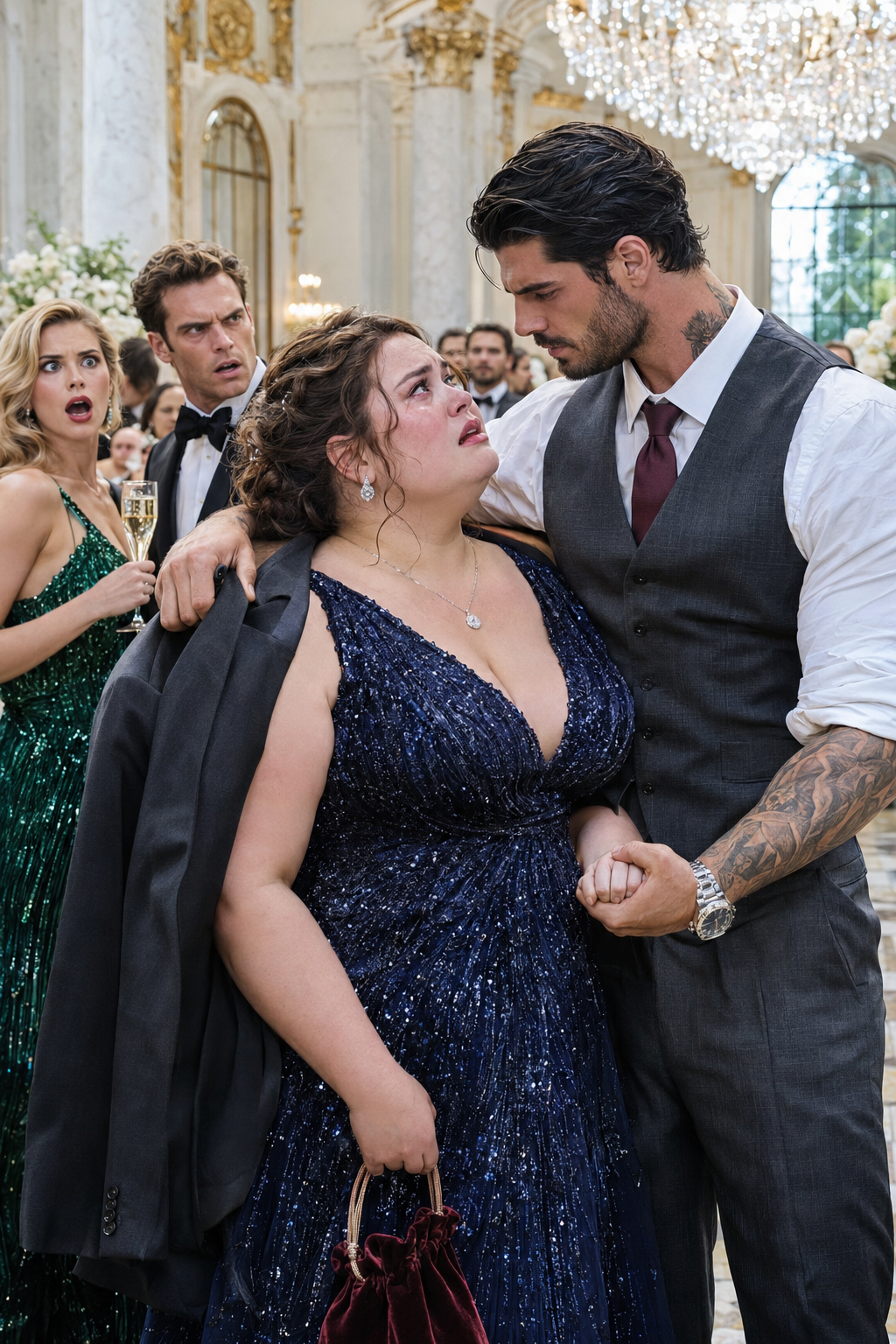
Dante looked at the champagne stains covering my dress.
“You invited a woman who once supported you through difficult years, used something precious to lure her here, and allowed your girlfriend to humiliate her for your entertainment. If that’s how you treat someone who helped build your future, why should I trust you with mine?”
Derek opened his mouth, but nothing came out.
Richard turned toward him.
“Is that true?”
“It was a joke,” Derek insisted. “Everyone’s taking this way too seriously.”
“A joke?” I finally spoke. “You told me my grandmother’s locket would be thrown away if I didn’t come tonight. You knew how much it meant to me.”
Richard’s expression changed.
Until that moment, he had probably believed he was dealing with an embarrassing misunderstanding. Now he was looking at Derek like a man discovering something unpleasant about an employee he had trusted.
“Come with me,” Richard ordered.
“Richard, let me explain.”
“Not another word.”
Derek looked around desperately, searching for someone willing to defend him. The same people who had laughed at me minutes earlier suddenly found their drinks and conversations far more interesting.
Tiffany quietly moved away from him.
“Where are you going?” Derek demanded.
She adjusted the strap of her designer purse.
“I think I’ve had enough excitement for one evening.”
“You’re leaving?”
“Call me when you’ve sorted this out.”
She walked away without looking back.
I should have felt satisfied. Instead, I felt exhausted. Watching Derek lose control didn’t erase the years I had spent believing everything he said about me.
Dante seemed to notice.
“Would you like to sit somewhere quieter?”
I nodded.
He guided me toward a private table near the tall windows overlooking Manhattan. Two men stood when we approached, and Dante introduced me to them before asking for some privacy.
Within minutes, someone brought me sparkling water, a warm towel, and a small plate of food.
I looked at the jacket covering my shoulders.
“I’m probably ruining this.”
“It’s a jacket, Hannah.”
“An expensive one.”
“Still a jacket.”
Something about his answer made me smile.
He sat across from me, studying my face with an expression I couldn’t quite understand.
“You really don’t remember me, do you?”
I shook my head.
“Should I?”
“Three winters ago. You were walking home from a bakery in Queens. There was a terrible snowstorm.”
The memory returned slowly.
I had been working a double shift at a neighborhood bakery. Derek was preparing for an important business school exam, and I had volunteered for extra hours because we were behind on rent.
The snow was coming down so heavily that night that buses had stopped running along several streets. I remembered carrying a paper bag filled with leftover bread and pastries.
And then I remembered the man.
“Oh, my God,” I whispered.
Dante smiled.
“There you are.”
I had discovered him collapsed near the entrance of an alley. His face was bruised, his shirt was soaked with blood, and he was barely conscious.
At first, I had been terrified. The street was almost empty, and I had no idea whether whoever had hurt him was still nearby.
But I couldn’t leave him there.
I called emergency services, wrapped my scarf around him, and stayed beside him until help arrived.
He had repeatedly tried to tell me to go home.
I had repeatedly refused.
“You were that man?” I asked.
“The very same.”
“But you looked completely different.”
“I certainly hope so.”
I laughed softly, remembering his swollen face and the way he had struggled to keep his eyes open.
“You kept asking me why I was helping you.”
“And you told me something I’ve never forgotten.”
“What?”
“You said nobody deserved to die alone in the snow.”
My throat tightened.
I remembered sitting beside him, holding his freezing hand and talking about anything I could think of to keep him awake.
I had told him about my grandmother, my dream of owning a bakery, and the ridiculous price of butter.
When the ambulance finally arrived, he had asked for my name.
The following week, a well-dressed man visited the bakery where I worked and offered me an envelope containing a large amount of money.
He explained that it was a gift from the man I had helped.
I refused it.
At the time, Derek had been furious when I told him.
“We could have paid off my student loans!” he shouted.
I had tried to explain that helping someone in need wasn’t a business transaction.
He called me foolish.
Now, sitting across from Dante Moretti, I understood where that envelope had come from.
“You tried to pay me,” I said.
“I did.”
“And I refused.”
“You also sent my employee back with a box of cinnamon rolls.”
I covered my face, laughing.
“I remember that.”
Dante leaned forward.
“Most people who discover my name immediately want something from me. You had an opportunity to ask for anything, and all you wanted was to know whether I had recovered.”
“Anyone would have done the same.”
“No, Hannah. Several people passed me that night before you stopped.”
His words settled heavily between us.
I looked down at my grandmother’s locket.
For years, Derek had convinced me that my kindness was a weakness. He complained that I gave away too many pastries, helped too many people, and cared too much about things that didn’t make money.
Yet the very quality he despised had brought Dante into my life.
“Thank you for remembering me,” I said.
“I never forgot.”
Before I could respond, a familiar voice interrupted us.
“Hannah, we need to talk.”
Derek stood beside the table. His tie was loose, and his forehead was covered in sweat.
Dante’s expression immediately became guarded.
“She’s having a conversation.”
“Please,” Derek said. “Just five minutes.”
I looked at him and realized something had changed. For the first time since our divorce, he wasn’t speaking to me like someone who owned the room.
He looked frightened.
“What do you want?”
“Richard fired me.”
I stared at him.
“He said I embarrassed the company and damaged our relationship with its most important investor. He won’t even let me return to the office on Monday.”
Derek pulled out a chair without asking.
“Hannah, you’ve got to help me.”
“Help you?”
“Tell Mr. Moretti that this was a misunderstanding. Tell him I’m not really like that.”
I almost couldn’t believe what I was hearing.
“You want me to lie for you?”
“No! I just need you to explain that we have a complicated history.”
“We certainly do.”
He lowered his voice.
“Think about everything we’ve been through together.”
I did.
I thought about the mornings I woke before sunrise to prepare hundreds of pastries. The nights I returned home with swollen feet and still cooked dinner because Derek was studying.
I remembered selling a bracelet my mother had given me to help pay his tuition.
I remembered celebrating his graduation with a homemade cake because we couldn’t afford a restaurant.
And I remembered the evening he told me he wanted a divorce.
He had stood in our kitchen, barely looking at me, and explained that his career was taking him in a different direction.
“You don’t fit the life I’m building,” he had said.
When I asked what that meant, he told me that successful men needed wives who looked the part.
I had cried in the bathroom for hours.
Now that same man was asking me to save the career he had once considered more valuable than our marriage.
“Do you remember what you said when I asked you to reconsider the divorce?” I asked.
Derek shifted uncomfortably.
“Hannah, this isn’t the time.”
“You told me I needed to accept the consequences of not being good enough.”
“I was angry.”
“You weren’t angry. You were proud.”
His eyes dropped to the table.
“I made mistakes.”
“Yes, you did.”
“I can make things right.”
I looked toward the ballroom, where Tiffany had disappeared.
“Would you be saying that if Mr. Moretti hadn’t withdrawn his funding?”
Derek remained silent.
That silence told me everything.
He reached for my hand, but I pulled it away.
“Please, Hannah. I could lose everything.”
I took a deep breath.
“I know what that feels like, Derek. You taught me.”
He stared at me.
“But I’m not going to humiliate you. I’m not going to laugh at you, and I’m not going to celebrate your suffering. I’m simply not going to rescue you from the consequences of your own choices.”
“Hannah—”
“No.”
It was such a small word, yet saying it felt like opening a door that had been locked for years.
Derek turned toward Dante.
“Sir, please reconsider.”
Dante calmly set down his glass.
“My decision is final.”
Derek stood there for several seconds before walking away. Nobody followed him.
I watched him disappear through the ballroom doors.
Then, unexpectedly, I started crying.
Dante didn’t tell me to stop. He didn’t offer some clever speech about revenge or victory. He simply handed me a clean handkerchief and waited.
“I don’t understand why I’m crying,” I admitted.
“Perhaps because you’ve been carrying something heavy for a long time.”
I pressed the handkerchief against my eyes.
“I really loved him once.”
“I’m sure you did.”
“And I spent years wondering what was wrong with me.”
Dante looked at me seriously.
“Hannah, a person who cannot recognize your worth doesn’t get to decide it.”
I looked away, afraid I might cry even harder.
“Tonight, I almost didn’t come because I was embarrassed about my dress.”
“Why?”
“It was cheap. I knew everyone here would be wearing something expensive.”
“Did you like it when you bought it?”
I nodded.
“Then that should have been enough.”
He stood and offered me his hand.
“Come on. Let’s get you out of here.”
Outside, the city lights reflected across the wet pavement. A black car waited near the entrance, but Dante didn’t immediately ask me to get inside.
“Are you hungry?”
“A little.”
“Good. I know somewhere.”
I expected an exclusive restaurant with crystal glasses and a menu I couldn’t afford.
Instead, we stopped at a small Italian restaurant tucked between two buildings. The elderly owner greeted Dante with a hug and brought us fresh pasta.
Nobody cared about my stained dress.
Nobody asked what I earned or who I knew.
For the first time that evening, I felt comfortable.
We talked until the restaurant was nearly empty. Dante asked about my work, my family, and the bakery I had once dreamed of opening.
“I gave up on that idea,” I admitted.
“Why?”
“After the divorce, I barely had enough savings to start over. Opening a business seemed impossible.”
“Impossible or difficult?”
“Both.”
He smiled.
“There’s a difference.”
When he dropped me outside my apartment, he asked whether he could see me again.
I hesitated.
Dante Moretti was not an ordinary man. His reputation frightened people, and rumors about his family’s connections to organized crime followed him everywhere.
I wasn’t looking for another complicated relationship.
“I don’t know what you’re expecting from me,” I said.
“Coffee,” he answered. “And perhaps one of those cinnamon rolls.”
Despite myself, I laughed.
“Coffee sounds reasonable.”
Over the following weeks, Dante surprised me.
He never appeared without calling first. He respected my working hours and didn’t complain when I canceled dinner because the bakery needed me.
Sometimes, he visited just before closing and waited patiently while I finished cleaning.
One evening, he found me sitting beside a stack of unpaid bills.
“Bad day?” he asked.
“The owner is selling the bakery. The new owners might replace the entire staff.”
He sat beside me.
“What are you going to do?”
“Find another job, I suppose.”
“Or?”
I knew exactly what he meant.
“Dante, I can’t afford my own bakery.”
“Have you actually calculated what it would cost?”
I hadn’t.
He encouraged me to prepare a business plan. He offered to introduce me to an independent accountant and a commercial real estate agent, but he made it clear that the decisions would be mine.
For the next month, I spent my evenings researching equipment, rental costs, permits, and ingredients.
It was overwhelming.
There were moments when I wanted to abandon the entire project.
Then I found a small storefront in SoHo.
The windows were dusty, the walls needed painting, and the kitchen equipment was outdated. But standing inside, I could almost smell fresh bread and hear customers laughing.
It felt like the place I had imagined for years.
Unfortunately, the startup costs were higher than I expected.
Dante offered to invest.
I immediately refused.
He didn’t argue.
Instead, he asked, “What arrangement would make you comfortable?”
Together with an independent attorney and accountant, I eventually agreed to a formal business loan with clear repayment terms. I contributed my savings, and the bakery would belong entirely to me.
I wanted to build something that nobody could take away.
Dante understood.
The renovation took several weeks. I painted walls, tested recipes, interviewed employees, and spent countless nights adjusting the menu.
Dante occasionally arrived carrying coffee, rolled up his sleeves, and helped assemble furniture.
Watching a billionaire struggle with a stubborn wooden shelf was one of the funniest experiences of my life.
“You’re enjoying this,” he complained.
“Very much.”
“Remind me never to buy furniture that requires instructions.”
Slowly, our friendship became something deeper.
He told me about his difficult upbringing, the mistakes he regretted, and the responsibilities that came with his family name.
I told him about my fear of trusting someone again.
He never demanded that I forget the past.
He simply gave me reasons to believe the future could be different.
One evening, while we stood outside the unfinished bakery, he reached for my hand.
“May I kiss you?”
I smiled.
“Yes.”
It was the beginning of something neither of us had planned.
Six months after the charity gala, Gallagher’s Bakery opened its doors.
I named it after my family and placed a framed photograph of my grandmother beside the register.
The first morning, I stood behind the counter, wearing an apron dusted with flour and my grandmother’s locket around my neck.
I was terrified nobody would come.
By nine o’clock, there was a line outside.
By noon, we had sold every cinnamon roll, nearly all our croissants, and every slice of our signature chocolate cake.
My employees cheered when we finally closed.
I sat in the kitchen and cried again, but this time, the tears felt different.
Dante arrived carrying flowers.
“Congratulations, boss.”
I laughed and threw my arms around him.
“You have no idea how good that sounds.”
“I think I do.”
As the weeks passed, business continued growing. Customers returned with friends, local offices placed large orders, and people began sharing photographs of our pastries online.
I hired two additional employees and started a program that donated unsold baked goods to a nearby shelter.
Then, one afternoon, I noticed someone standing across the street.
It was Derek.
He wore a wrinkled shirt and an old coat. He looked tired, older somehow, and nothing like the confident man who had mocked me at the gala.
He stared at the bakery sign before looking through the window.
Our eyes met.
For a moment, neither of us moved.
Then he crossed the street and entered.
The little bell above the door rang.
“Hi, Hannah.”
“Hello, Derek.”
He looked around at the busy tables, the glass display cases, and the employees preparing orders.
“You actually did it.”
“I did.”
He nodded slowly.
“I heard about the bakery. I wanted to see it for myself.”
I waited.
“Tiffany left me,” he continued. “I’ve been working for a smaller company. Starting over hasn’t been easy.”
“I’m sorry to hear that.”
He looked surprised.
“You really mean that?”
“Yes.”
He swallowed.
“I owe you an apology. Not because I need something this time. I just… I finally understand how badly I treated you.”
I studied his face.
There had been a time when those words were all I wanted to hear.
Now they no longer had the power to change my life.
“Thank you for saying that.”
“Do you think you could ever forgive me?”
“I already have, Derek. But forgiveness doesn’t mean we have to become part of each other’s lives again.”
He nodded, his eyes filling with tears.
“I wish I’d understood what I had.”
I touched my grandmother’s locket.
“I hope you treat the next person who loves you better.”
He bought a cinnamon roll, thanked me, and left.
I watched him walk down the street without feeling anger or regret.
A few minutes later, Dante entered carrying lunch for both of us.
“Everything okay?” he asked.
I smiled.
“Everything’s wonderful.”
He kissed my forehead and helped me carry a fresh tray of pastries to the counter.
As I looked around my bakery, I realized that the most important thing Dante had given me wasn’t money, protection, or revenge.
It was the reminder that I had always been capable of building a beautiful life.
The courage had been mine. The kindness had been mine. The dream had been mine.
I had simply spent too many years allowing someone else to convince me otherwise.
My grandmother used to say that good bread needed time, warmth, and patience to rise.
Perhaps people weren’t so different.
Sometimes, we need to leave the places that keep us small before we discover how much we can grow.
I had walked into that Manhattan ballroom wearing a forty-nine-dollar dress, believing I was worth less than everyone around me.
I walked out with something far more valuable than an expensive necklace or a wealthy man’s attention.
I walked out knowing that I never again had to earn the right to be treated with dignity.
And every morning, when I unlocked the doors of my little bakery, I reminded myself of one simple truth:
Never let someone else’s inability to appreciate you become the reason you stop believing in yourself. Your worth was never theirs to give, and it will never be theirs to take away.
A year later, on the anniversary of the night Dante and I met again, I arrived at the bakery to find him standing outside with two cups of coffee.
“You’re early,” I said.
“So are you.”
“Some of us have businesses to run.”
He smiled and handed me my coffee.
“And some of us have something important to ask.”
I raised an eyebrow, but he refused to explain.
Instead, he followed me inside and helped prepare the bakery for another busy morning. By seven, the smell of cinnamon and freshly baked bread filled the room.
Business had grown beyond anything I had imagined. I had paid off a significant portion of my loan, hired more employees, and started offering paid training to women who needed a fresh start after difficult marriages.
One of those women was named Emily.
She had arrived three months earlier with almost no money and a little boy who depended entirely on her. Her former husband had convinced her that she was incapable of supporting herself.
Watching her learn new skills reminded me of the woman I had once been.
That morning, Emily approached me with an envelope.
“I got approved for an apartment,” she announced, barely containing her excitement.
“Emily, that’s wonderful!”
She hugged me tightly.
“Thank you for giving me a chance.”
“You earned it,” I told her.
Dante watched us from across the room.
Later, when we were alone, he said, “Do you realize how many lives you’ve changed?”
“I just gave her a job.”
“And once, you thought you were just helping a stranger in the snow.”
I smiled.
He had a point.
That evening, Dante asked me to close the bakery a little earlier than usual.
When the last customer left, he turned off the main lights, leaving only the warm lamps above the tables.
Then he placed a small velvet box on the counter.
My heart began racing.
“Dante?”
He took my hands.
“When I met you, I was lying in the snow, wondering whether I would live to see another morning. You stayed with me when you had every reason to walk away.”
His voice grew softer.
“Years later, I found you standing in a ballroom surrounded by people who couldn’t see what an extraordinary woman you were. Since then, I’ve watched you build something beautiful without losing the kindness that makes you who you are.”
He opened the box.
Inside was a delicate diamond ring.
“I don’t want to own your dreams, Hannah. I want to stand beside you while you live them. Will you marry me?”
Tears filled my eyes.
For a moment, I remembered my first marriage and the promises that had slowly turned into demands. I remembered how often I had made myself smaller to keep someone else happy.
But standing before Dante, I felt no pressure to become someone different.
I felt free to be myself.
“Yes,” I whispered.
His smile widened.
“Is that a definite yes?”
I laughed through my tears.
“Absolutely.”
He slipped the ring onto my finger and pulled me into his arms.
We married the following spring in a small garden surrounded by close friends, family, and the people who had supported us along the way.
I made our wedding cake myself.
Dante insisted that I should take the day off, but some traditions were too important to surrender.
I wore my grandmother’s locket with my wedding dress.
Before the ceremony, I opened it and looked at her tiny photograph.
“I finally did it, Grandma,” I whispered. “I found my happiness.”
Two years later, Gallagher’s Bakery opened its second location.
On opening day, a letter arrived without a return address.
Inside was a handwritten note from Derek.
“Hannah, I saw the news about your second bakery. Congratulations. I used to think success meant having people admire me. Losing everything taught me how wrong I was. I’m learning to become a better person. I hope life continues to be kind to you.”
I folded the letter and placed it in my desk drawer.
I didn’t need to answer it.
I was glad he was learning, but his journey was no longer mine.
That afternoon, Dante arrived with flowers and our little daughter, Sophie, who immediately demanded a chocolate cupcake.
I picked her up and kissed her cheek.
“Only after lunch.”
She looked at Dante for support.
“Your mother is the boss,” he told her.
We laughed together.
As I watched my daughter happily explore the bakery, I thought about the lessons I wanted her to learn.
I wanted her to understand that kindness did not mean accepting disrespect. That loving someone did not require sacrificing her identity. That forgiveness did not mean reopening doors that needed to remain closed.
Most importantly, I wanted her to know that she never needed anyone’s permission to believe in herself.
The night Derek humiliated me, I thought I had reached the lowest point of my life.
I couldn’t have imagined that the woman standing there in a champagne-stained dress would eventually become a successful business owner, a loving wife, a mother, and a source of hope for other women.
But life has a remarkable way of changing when we stop chasing the approval of people who refuse to value us.
Derek had once told me that I didn’t belong in the successful life he was building.
He was right about one thing.
I didn’t belong in his life.
I belonged in the beautiful life I was capable of building for myself.
And in the end, my greatest victory wasn’t watching the man who hurt me lose everything.
It was becoming so happy that I no longer needed him to lose anything at all.
I had found peace, purpose, love, and the courage to remain kind in a world that had given me plenty of reasons to become bitter.
That was the ending I deserved.
And it was a beginning I would cherish for the rest of my life.
THE END.