The ranch hands laughed when Wade Prescott saw my three children standing outside his Montana barn, but none of them knew who had stolen his ranch.
The voice above us belonged to Walter Granger, the banker who had threatened to take Cottonwood Bend Ranch before Christmas.
And as I stood in that dark cellar with my dead husband’s secrets trembling in my hands, I realized he had been afraid of this man long before I ever knew his name.
“Put the papers down, Hattie,” Granger ordered, his rifle pointed toward Wade’s chest.
Wade moved slightly in front of me, but I grabbed his sleeve.
“Don’t,” I whispered, because I couldn’t bear the thought of another good man dying while trying to protect me.
Granger descended the first wooden step, his polished boots looking strangely expensive against the rotting boards.
“I warned Thomas that digging into old business would destroy his family,” he said.
My stomach tightened at the sound of my husband’s name.
“You knew Thomas?”
Granger gave a small, humorless laugh.
“Better than you did, apparently.”
Those words struck harder than any insult I’d endured since arriving in Montana.
I thought of Thomas holding our newborn daughter, whispering promises over her tiny fingers.
I thought of his final winter, when he had barely possessed enough strength to lift a spoon.
And suddenly, I wondered how much of our marriage had been built around a truth he had never dared tell me.
“Tell me what happened to my husband,” I demanded.
Granger’s face hardened.
“Your husband should have learned when to mind his own business.”
Beside me, Wade’s breathing changed.
“Did you kill him?”
For the first time, Granger hesitated.
Then his mouth twisted into an ugly smile.
“People die, Prescott, especially people who refuse to understand how the world works.”
He raised the rifle another inch.
The stranger who had delivered Thomas’s letter stood near the back wall, completely still.
I had almost forgotten he was there.
But then I saw his eyes shift toward a narrow opening beside the cellar stairs.
“Mr. Granger,” the stranger said carefully, “Thomas wanted you to know something before he died.”
Granger turned his head.
“What?”
“He never trusted you with the original agreement.”
Something flickered across the banker’s face.
“The original agreement was destroyed.”
“That’s what you were supposed to believe.”
Granger stepped farther into the cellar, and in that instant, the stranger kicked the lantern from the wooden shelf.
Glass shattered against the dirt floor.
Flames leaped across spilled oil, and Granger shouted as smoke rushed between us.
Wade seized my hand.
“Run!”
I stumbled toward the stairs while the stranger threw a heavy blanket over the burning oil.
A gunshot exploded through the cellar.
Wood splintered beside my face.
Wade pushed me upward, shielding me with his body as we scrambled into the freezing morning air.
Behind us came another shout, followed by the terrible sound of someone falling.
I turned back.
The stranger lay across the cellar steps, one hand pressed against his shoulder.
Blood spread between his fingers.
Granger stood below him, coughing through the smoke, still clutching the rifle.
Wade grabbed a shovel leaning against the bunkhouse wall and struck the rifle from Granger’s hands.
The weapon landed in the mud.
Before Granger could recover it, Silas came running from the barn with two ranch hands.
“What’s going on?”
“Get the sheriff!” Wade shouted.
But Granger was already scrambling toward his horse.
He shoved past Silas, climbed into the saddle, and disappeared behind the cottonwoods before anyone could stop him.
For several seconds, nobody moved.
Then I heard the stranger groan.
I dropped to my knees beside him, pressing my apron against his wounded shoulder.
“Stay with me,” I begged.
His face had gone pale.
“Don’t worry about me, Mrs. Winslow.”
“What’s your name?”
“Samuel Reed.”
I held the blood-soaked cloth more tightly.
“Samuel, you didn’t come all this way to die in my arms.”
He managed a faint smile.
“Thomas said you’d be stubborn.”
My breath caught.
“He said that?”
Samuel nodded weakly.
“He said you were the bravest woman he’d ever known, even when you couldn’t see it yourself.”
Something broke inside me.
For months, I had carried the shame of poverty like a stone beneath my ribs.
I’d believed my husband’s debts proved that we had somehow failed.
But Thomas had remembered me differently.
He had remembered the woman who could endure.
And now I was beginning to understand why he had kept fighting, even when his body was failing him.
We carried Samuel into the ranch house while Silas rode for the doctor and sheriff.
I boiled clean water, tore strips from an old bedsheet, and helped Wade stop the bleeding.
When the doctor finally arrived, he removed the bullet and declared that Samuel would live if fever didn’t set in.
Only then did I realize how badly my hands were shaking.
Wade found me outside beside the water pump, scrubbing blood from my fingers.
The cold water turned pink and disappeared into the dirt.
“Hattie,” he said softly.
I kept scrubbing.
“I should have known something was wrong.”
He moved closer.
“With what?”
“Thomas.”
My voice cracked.
“He was frightened during those last months, and I thought it was because we were losing the store.”
I stared at my reddened hands.
“He would wake in the night and ask whether the doors were locked.”
Wade said nothing.
“He sold his father’s watch and told me the money was for medicine.”
Tears blurred the pump handle.
“What if he was trying to protect us all that time?”
Wade gently caught my wrists.
“Then he did what he thought he had to do.”
“He should have trusted me.”
“Yes,” Wade answered.
I looked up, surprised by his honesty.
“He should have told you, Hattie, because you deserved the truth.”
Those words undid me.
I began crying against his coat, not because I was weak, but because I had spent too many months pretending I wasn’t exhausted.
Wade held me without asking anything in return.
For the first time since Thomas’s funeral, I allowed myself to lean on someone.
But the danger was far from over.
By afternoon, Sheriff Amos Turner arrived with two deputies and a face that told me he already knew more than he intended to reveal.
We showed him the bank records, the photographs, and the agreement bearing Thomas’s name.
He examined the pages beneath the kitchen lamp.
“Where did you get these?”
“From the old cellar,” Wade answered.
Turner’s jaw tightened.
“That cellar was sealed by court order.”
“Whose court order?”
The sheriff avoided my eyes.
“County business.”
I felt a cold certainty settle over me.
“Did Granger tell you to seal it?”
Turner folded the document.
“Mrs. Winslow, you need to understand that accusations against respected men can have consequences.”
Wade stepped forward.
“A man fired a rifle at us this morning.”
“And I intend to investigate,” Turner replied.
But when he reached for the documents, I placed my hand firmly over them.
“These are copies.”
It was a lie.
The sheriff stared at me.
I stared back.
“Samuel knows where the originals are hidden,” I added.
Turner said nothing for several seconds.
Then he slowly withdrew his hand.
“Keep your children close, Mrs. Winslow.”
After he left, Wade shut the door and turned toward me.
“Those weren’t copies.”
“No.”
“Samuel doesn’t know where any originals are.”
“No.”
Wade studied my face, then gave the smallest smile.
“Remind me never to play poker against you.”
I almost smiled back.
But my heart was pounding.
Because the sheriff’s warning had not sounded like concern.
It had sounded like a threat.
That evening, I moved my children into the room closest to the kitchen.
My oldest boy, Benjamin, was thirteen and had already learned to recognize worry on my face.
“Mama, are we leaving again?”
I sat beside him on the bed.
His younger brother, Caleb, was pretending to sleep, but I could see his eyes shining beneath the quilt.
Ellie held her rag doll against her chest.
“No, sweetheart,” I said.
“Are they going to take this house too?”
The question nearly crushed me.
I thought of every rented room we’d abandoned, every meal I’d stretched, every night I’d listened to my children breathe because I was afraid hunger might finally steal even that sound.
I brushed Benjamin’s hair from his forehead.
“Not if I can help it.”
He looked down at his hands.
“Mr. Prescott says I can help train the horses next spring.”
Caleb sat up.
“And Silas said I could have the little brown pony.”
Ellie whispered, “I don’t want another place, Mama.”
Neither did I.
Cottonwood Bend had become more than employment.
It had become the first place where my children laughed without worrying what tomorrow might take away.
And I would not surrender it to a thief.
The following morning, Samuel was strong enough to speak.
Wade and I sat beside his bed while the wind rattled the windows.
“Thomas didn’t inherit the ranch from Wade’s father,” Samuel explained.
“He inherited an interest in the land through his mother.”
Wade leaned forward.
“My father told me he bought the entire property.”
“He bought the buildings, cattle, and most of the grazing rights,” Samuel said.
“But the northern acreage belonged jointly to two families.”
He looked toward me.
“Your husband’s mother was born Margaret Prescott.”
Wade’s eyes widened.
“Margaret was my father’s sister.”
The room went still.
I remembered Thomas speaking occasionally of an aunt who had raised him after his mother died.
He had never mentioned the Prescott name.
“Then Thomas and Wade were cousins,” I whispered.
Samuel nodded.
“They were.”
Wade leaned back, struggling to absorb the news.
“My father never told me.”
“Your father and Thomas had only recently found each other when the trouble began.”
Samuel paused to catch his breath.
“The northern acreage contains valuable deposits of copper and silver.”
Granger had discovered the mineral rights years earlier.
Rather than purchase them fairly, he had arranged false loans, inflated ranch expenses, and forged documents designed to force the Prescotts into foreclosure.
“Once the bank owned the ranch,” Samuel continued, “Granger planned to sell the mineral rights to an eastern mining company.”
I looked at Wade.
The debt threatening his father’s legacy had not been caused entirely by poor cattle prices or bad management.
Someone had been deliberately bleeding the ranch dry.
Samuel reached beneath his pillow and removed another folded paper.
“Thomas found out.”
I took it carefully.
It was a letter written by Wade’s father, dated only weeks before his sudden death.
In it, he described Granger’s scheme and named Sheriff Turner as a man who had accepted payments to suppress the investigation.
At the bottom was a line that made Wade close his eyes.
“If my son ever learns the truth, tell him I wasn’t ashamed of losing money; I was ashamed of trusting the wrong men.”
Wade pressed his fingers against his mouth.
For years, he’d believed his father had left him a failing ranch because he hadn’t been careful enough.
Now he knew the older man had died trying to save it.
“Why didn’t Thomas expose them?” I asked.
Samuel’s expression darkened.
“Because Granger found out that Thomas had a wife and three children.”
My stomach turned.
“He threatened us.”
Samuel nodded.
“Thomas gave up the investigation after that, but he continued hiding evidence.”
“And then he got sick.”
“Yes.”
I waited for Samuel to say something more.
He hesitated.
“What aren’t you telling me?”
He looked at Wade.
Then back at me.
“Thomas believed someone had tampered with the medicine he received during his final illness.”
The walls seemed to tilt.
I remembered the brown bottles beside our bed.
The bitter smell when I measured out his doses.
The way he sometimes became confused after taking them.
“He was already ill,” Samuel said carefully.
“But he feared someone was making it worse.”
I could barely breathe.
“Who supplied the medicine?”
Samuel’s silence was answer enough.
Granger had arranged it through a physician connected to his bank.
For a long moment, I heard nothing but the wind.
Then Wade said, “We need someone outside this county.”
Samuel agreed.
“There’s a federal land investigator in Helena named Charles Whitcomb.”
“He’d been corresponding with Thomas before he died.”
I looked at the papers scattered across the bed.
“Then we take everything to him.”
Wade shook his head.
“Granger has men watching the roads.”
“Then we’ll make him look somewhere else.”
That afternoon, I returned to the kitchen and began preparing supper.
The smell of roasting beef drifted through the house while my mind worked through every possibility.
Wade came downstairs to find me kneading bread.
“You should be resting.”
I pushed the dough against the flour-covered board.
“Resting won’t save this ranch.”
He leaned against the doorway.
“What are you thinking?”
I looked up.
“Granger believes I’m frightened.”
“You are frightened.”
“Yes, but he thinks that makes me helpless.”
Wade waited.
“I want you to announce that we’re selling cattle early to satisfy the bank.”
His brow furrowed.
“That’ll make him think we’re surrendering.”
“Exactly.”
“And while he’s watching the cattle?”
“We send the evidence to Helena.”
Wade stared at me for a moment.
Then he smiled.
“Your husband was right about you.”
For the next three days, Cottonwood Bend became a stage.
Wade publicly complained about falling prices.
Silas spread word that the ranch would soon be sold.
I visited the general store and deliberately purchased less flour than usual.
By Saturday, half the town believed Wade Prescott was finished.
Granger arrived that evening wearing a clean black coat and the confident smile of a man who thought he had already won.
He sat at my kitchen table while I poured coffee.
“I understand the ranch is having difficulties,” he said.
Wade looked exhausted.
“We can’t keep carrying the debt.”
Granger stirred his coffee.
“A sensible man knows when to accept defeat.”
I stood beside the stove, listening.
Then Granger looked at me.
“You’ve done admirable work here, Mrs. Winslow, but I hope you’ve considered what happens to your children when this place closes.”
My fingers tightened around the coffeepot.
“I’ve survived worse.”
“Of course,” he said smoothly.
“Though I imagine you’d prefer not to repeat the experience.”
Wade’s hand curled into a fist beneath the table.
I spoke before he could.
“Perhaps you could allow us one more week.”
Granger smiled.
“Unfortunately, business has no room for sentiment.”
He slid a document across the table.
It was a demand for immediate repayment.
By Monday morning, Cottonwood Bend would belong to the bank.
Unless we paid everything.
Or surrendered the property.
I looked at the sum.
Even selling every cow would barely cover half.
Granger rose.
“I’ll expect your decision at the courthouse.”
As he reached the door, he leaned close enough that only I could hear him.
“Your husband could have spared his family considerable suffering if he’d listened to me.”
I met his eyes.
“And you could have spared yourself trouble if you’d learned not to underestimate a woman holding a coffeepot.”
He frowned.
Then he left.
Wade turned toward me.
“What did you mean by that?”
I set the pot down.
“His coffee was ordinary.”
Wade blinked.
“But his gloves smelled of the same medicinal chemical I remember from Thomas’s sickroom.”
A heavy silence followed.
It wasn’t proof of murder.
But it was one more reason to keep digging.
That night, Samuel slipped out through the rear pasture with the original documents sewn into the lining of his coat.
Benjamin and Caleb helped Silas create wagon tracks leading toward the western road.
Wade and I remained in the kitchen, watching the lantern burn lower.
Near midnight, a rider thundered into the yard.
Silas burst through the door.
“Granger’s men stopped the wagon!”
My heart dropped.
“Samuel?”
“He’s safe.”
I closed my eyes.
Silas grinned.
“They stopped an empty wagon, just like you planned.”
Samuel had taken the mountain trail instead.
By sunrise, he was beyond the county line.
For the first time, I allowed myself to believe we might win.
But Granger wasn’t finished.
On Sunday evening, Ellie disappeared.
I was preparing supper when I realized the kitchen had grown too quiet.
Her doll lay abandoned beside the back door.
I searched the pantry, the bedrooms, and the chicken coop.
Then Benjamin came running from the barn.
“Mama, there’s a note.”
He handed me a folded scrap of paper.
My eyes moved across the message.
“Bring the land agreement to the old mill before midnight, or you’ll never see your daughter again.”
The world narrowed to those words.
Wade read the note over my shoulder.
“Hattie.”
I couldn’t answer.
Somewhere outside, the wind moved through the cottonwoods.
I thought of Ellie’s small hands, her bedtime prayers, and the way she always saved the prettiest biscuit for me.
Granger had taken my child.
And this time, I didn’t care about the ranch.
I cared only about bringing her home.
“We have to go,” I whispered.
Wade caught my shoulders.
“We’ll get her back.”
“You don’t understand.”
My voice rose.
“She’s six years old, Wade.”
His face tightened.
“I understand.”
“No, you don’t.”
The words escaped before I could stop them.
“You’ve never had to bury someone you loved while wondering whether you could have saved them.”
Wade stepped back as though I’d struck him.
Then he quietly said, “My wife died giving birth to our son, Hattie.”
I stared at him.
He had never spoken of a wife.
“The baby lived eleven hours.”
His eyes filled.
“I buried them together beneath the cottonwoods.”
I covered my mouth.
All this time, I’d believed Wade had never married because he loved his ranch more than anything else.
I hadn’t known the ranch was where he’d hidden his grief.
“I’m sorry,” I whispered.
He shook his head.
“Don’t apologize.”
Then he took my hand.
“Let’s bring your girl home.”
We rode toward the old mill beneath a moon hidden by storm clouds.
Silas followed at a distance with two ranch hands.
The mill stood beside a narrow creek, its broken wheel creaking in the wind.
A single lantern glowed behind the shattered windows.
Wade dismounted first.
I followed, clutching the empty leather folder Granger expected me to surrender.
Inside, Ellie sat tied to a chair.
Her cheeks were wet, but when she saw me, she whispered, “Mama.”
I nearly ran to her.
Granger stepped from the shadows.
“Not another step.”
He held a pistol in one hand.
Sheriff Turner stood beside him.
My last hope of help from local law enforcement vanished.
“Where are the papers?” Granger demanded.
I raised the folder.
“Let her go first.”
He laughed.
“You don’t negotiate very well.”
“Neither do you.”
My voice surprised even me.
Granger’s smile disappeared.
“Careful.”
I looked directly at him.
“Thomas died because he knew what you were doing.”
Granger said nothing.
“You threatened his family, stole from honest people, and used the sheriff to hide it.”
Turner’s face turned red.
“That’s enough.”
But I kept speaking.
“You were so afraid of a dying man that you followed his widow halfway across Montana.”
Granger approached.
“You think your husband was innocent?”
My heart pounded.
“He helped create the original accounts that concealed the mineral rights,” Granger said.
“He worked for me before he learned what the documents really meant.”
I felt my breath catch.
“Then he tried to undo it.”
Granger sneered.
“By betraying me.”
“No,” I whispered.
“By choosing to become a better man.”
Granger pointed the pistol toward Wade.
“Hand over the folder.”
I took one step forward.
“Let Ellie go.”
He lunged and snatched the folder from my hands.
As he opened it, his expression changed.
Inside was nothing but a recipe written in my handwriting.
He stared at the page.
“What is this?”
“My mother’s biscuit recipe.”
For one stunned moment, nobody spoke.
Then I heard Silas’s whistle outside.
Three sharp notes.
Granger turned toward the window.
Wade moved.
He struck Granger’s wrist, sending the pistol skidding across the floor.
Turner drew his revolver, but a voice thundered from the doorway.
“Drop your weapon, Sheriff!”
Armed men entered the mill, their badges shining in the lantern light.
At their center stood Charles Whitcomb, the federal investigator Samuel had contacted.
Turner froze.
Granger tried to reach the fallen pistol.
One of the men forced him to the floor.
I barely noticed.
I ran to Ellie.
Her little arms wrapped around my neck with desperate strength.
“Mama, I was brave.”
I held her so tightly she squeaked.
“Oh, sweetheart.”
I kissed her forehead again and again.
“You were braver than anyone should ever have to be.”
She began crying against my shoulder.
And I cried with her.
Behind us, Whitcomb ordered Granger and Turner arrested.
Samuel stepped into the doorway, pale but smiling.
He had returned with the investigator after delivering Thomas’s evidence.
The trap had worked.
But I knew how close we’d come to losing everything.
Outside, Wade lifted Ellie into the saddle before helping me mount behind her.
As we rode toward home, the moon emerged from the clouds.
For the first time in months, the night didn’t seem endless.
The investigation lasted six weeks.
Whitcomb uncovered forged mortgages, stolen mineral royalties, and years of false invoices.
Several men who had remained silent finally testified.
The physician who had supplied Thomas’s medicine admitted that Granger had pressured him to prescribe dangerous additional doses.
The records could not prove exactly how much those doses had shortened my husband’s life.
That uncertainty would remain with me.
But the physician admitted that he’d continued despite knowing Thomas was dangerously weak.
Granger was charged with fraud, conspiracy, kidnapping, and offenses connected to the attack in the cellar.
Turner faced charges for corruption and helping conceal the scheme.
By Christmas, the bank’s fraudulent claims against Cottonwood Bend had been frozen, and the family land agreement had been recognized as genuine.
Wade stood beside me in Whitcomb’s office when we received the news.
The northern acreage legally belonged to Thomas’s estate.
Which meant it now belonged to my children and me, subject to the estate’s settlement.
I stared at the documents, unable to speak.
For months, I’d begged for enough work to buy bread.
Now my children had inherited an interest in land more valuable than anything I’d ever imagined.
But the money mattered less than the truth.
Thomas had been flawed.
He had made mistakes and hidden things he should have shared.
Yet when he discovered the harm being done, he’d tried to stop it.
He hadn’t been a perfect husband.
He had been a frightened man struggling to do something right.
And somehow, knowing that allowed me to love his memory without pretending he had never failed.
When we returned to Cottonwood Bend, snow covered the pastures like a white quilt.
The cowboys greeted us with cheers.
Silas removed his hat and wiped his eyes.
Benjamin ran toward the barn, where his favorite horse waited.
Caleb shouted that he wanted to stay forever.
Ellie slipped her hand into mine.
“Does this mean nobody can make us leave?”
I knelt beside her.
“It means we have a place here, sweetheart.”
She smiled.
Then she looked toward Wade.
“Does Mr. Prescott get to stay too?”
I laughed through tears.
“Yes, darling.”
Wade crouched beside her.
“Only if your mama keeps making those cinnamon biscuits.”
Ellie threw her arms around his neck.
For a moment, his face changed.
I saw the father he might have been, and the grief that would always remain part of him.
But I also saw something else.
Hope.
Over the following months, Wade and I rebuilt the ranch together.
We renegotiated legitimate debts, paid overdue wages, and established a separate account for my children’s inheritance.
I insisted that every transaction be recorded clearly.
No secret agreements.
No hidden promises.
Not ever again.
Wade agreed.
One evening in early spring, we stood beside the pasture fence watching the sunset spill gold across the mountains.
He took off his hat.
“Hattie, I’ve been meaning to ask you something.”
I smiled.
“If it’s about supper, we’re having beef stew.”
He laughed softly.
“No.”
Then his expression grew serious.
“I don’t want you to stay here because you feel you owe me anything.”
I turned toward him.
“You gave my children shelter when nobody else would.”
“And you saved everything my father worked for.”
He looked toward the ranch house, where laughter drifted through the open windows.
“I used to think losing my family meant I’d never have another chance at happiness.”
My throat tightened.
“Wade.”
He reached for my hand.
“I’m not asking you to forget Thomas.”
“I never could.”
“I wouldn’t want you to.”
He hesitated.
“But if there’s room in your heart for another beginning, I’d like to find out what that might look like.”
I looked at the man standing beside me.
He had seen me frightened, exhausted, angry, and grieving.
He had watched me stretch soup to feed hungry children.
He had trusted my judgment when others questioned my worth.
And not once had he asked me to become smaller, quieter, or different to deserve his respect.
I squeezed his hand.
“Then we’ll take it slowly.”
He smiled.
“As slowly as you need.”
Behind us, Ellie called from the porch.
“Mama, Silas ate the last biscuit!”
We both burst out laughing.
Wade put his hat back on.
“That man’s going to ruin us.”
I slipped my hand into his.
“Not while I’m keeping the books.”
The following Sunday, I visited Thomas’s grave beneath a small stand of pine trees.
I carried wildflowers and a letter I’d written the night before.
For a long while, I sat in silence.
Then I read the letter aloud.
I told him the children were healthy.
I told him Benjamin could saddle a horse, Caleb had finally learned to whistle, and Ellie had stopped waking from nightmares.
I told him that his mistakes had hurt us, but his final efforts had helped give us a future.
And I told him something that had taken me months to understand.
“I don’t have to spend the rest of my life suffering to prove that I loved you.”
The wind moved gently through the branches.
I folded the letter and placed it beneath a stone.
Then I stood.
My heart still carried grief.
Perhaps it always would.
But grief no longer felt like a locked door.
It felt like a room I could visit without being forced to live there.
When I returned to Cottonwood Bend, the kitchen windows glowed against the approaching dusk.
My children were setting the table.
Silas was arguing with Caleb about who had stolen the biscuits.
Wade stood on the porch, waiting for me.
He didn’t ask whether I’d cried.
He simply opened the door.
And I walked inside.
Sometimes I think about the woman who arrived at that ranch with forty-three dollars and three frightened children.
She believed she was asking for a job.
She thought survival meant enduring every humiliation without complaint.
She didn’t know that courage could look like demanding fair wages, protecting her children, or asking difficult questions about the people she loved.
She didn’t know that kindness offered without conditions could change the course of a life.
And she certainly didn’t know that a kitchen full of hungry cowboys would become the place where she found her strength again.
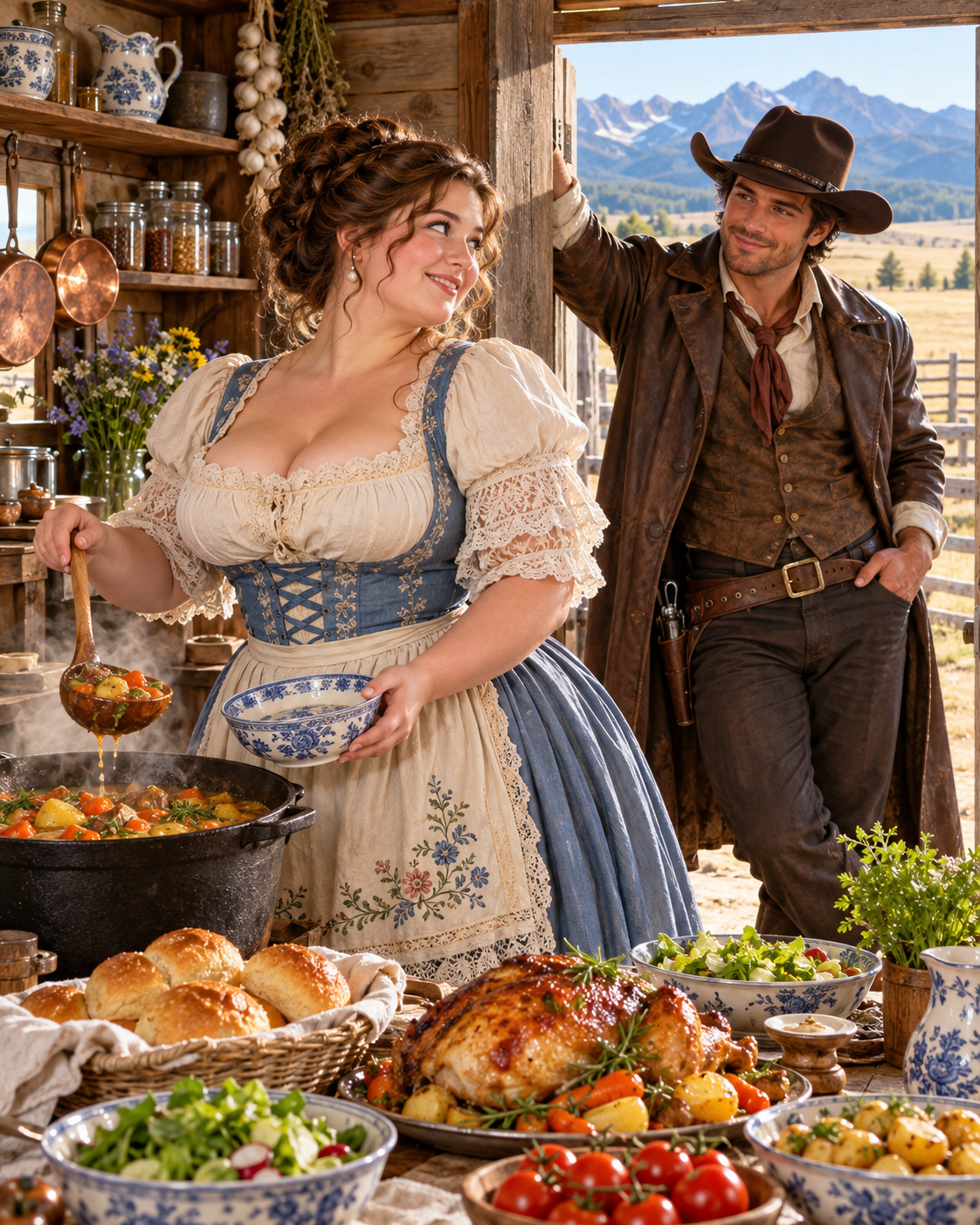
A year after my arrival, we held a harvest supper at Cottonwood Bend.
The tables stretched from the barn to the cottonwood trees.
Neighbors who had once whispered about me now brought pies and helped serve dinner.
Some apologized.
Others never found the courage.
I learned I didn’t need every person to understand my journey.
The people who mattered had already made room for me at their table.
When supper was nearly finished, Wade stood and raised his glass.
“To Hattie Winslow,” he said.
I felt my cheeks warm as the cowboys turned toward me.
“The woman who came here asking for work and taught us what it means to stand together.”
I shook my head.
But he wasn’t finished.
“And to three children who reminded this old ranch that a home isn’t built from timber and fences.”
Ellie beamed.
Benjamin sat taller.
Caleb grinned around a mouthful of pie.
Wade looked directly at me.
“It’s built by the people who refuse to give up on one another.”
The applause rose beneath the Montana stars.
I looked around at the faces gathered beneath the lanterns.
Some belonged to people who had doubted me.
Some belonged to people who had fought beside me.
And some belonged to children who had once believed their mother could not protect them from the world.
I thought of every cruel word I’d swallowed.
Every night I’d gone hungry so my children could eat.
Every door that had closed because I was poor, widowed, or judged by the size of my body.
For years, I’d believed those things made me less worthy of respect.
But standing there, surrounded by laughter and warm light, I finally understood something important.
My worth had never depended on whether someone was willing to recognize it.
It had been mine all along.
Wade came to stand beside me.
“Are you happy, Hattie?”
I looked toward the mountains, where the last streaks of daylight rested against the snow.
Then I looked at my children.
“Yes,” I whispered.
And this time, I didn’t feel guilty saying it.
Because life had taught me that love wasn’t a prize reserved for the young, the beautiful, or the fortunate.
It belonged to anyone brave enough to keep their heart open after heartbreak.
And home wasn’t always the place where your story began.
Sometimes it was the place you reached after losing nearly everything, where someone finally opened the door and gave you the chance to discover who you could still become.
That night, as Wade’s hand found mine beneath the lantern light, I remembered the words Thomas had written before his death.
He had called me the bravest woman he’d ever known.
For so long, I hadn’t believed him.
But as my children laughed around the table and the ranch settled peacefully beneath the stars, I finally understood.
Being brave doesn’t mean you never fall apart; it means that even after life breaks your heart, you still find a reason to stand up, open the door, and let love come in again.
THE END.