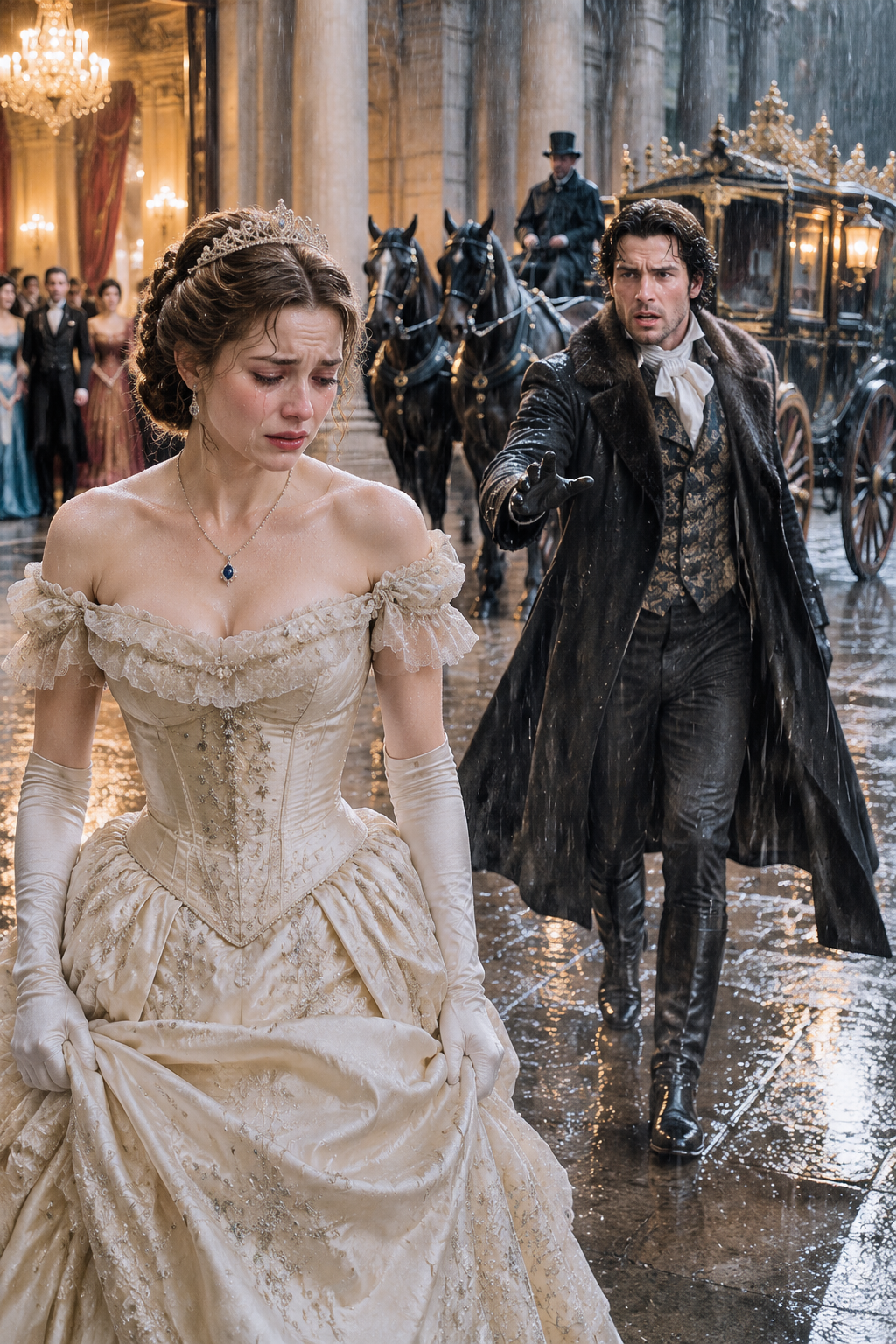
The man who had promised to marry Evelyn Hartwell for four years announced his engagement to another woman while Evelyn was still standing beside him.
The Duke of Ravenshire kept his hand resting on the sealed envelope, watching Evelyn Hartwell with an expression that suggested the truth inside would be considerably more painful than the humiliation she had endured the previous evening.
“Julian Everheart did not forge your signature,” he repeated quietly. “But someone very close to him did.”
Evelyn looked from the envelope to the contract spread across the mahogany desk. Her name appeared at the bottom in graceful, familiar handwriting. Every curve seemed correct. Even the slight backward slant of the final letter had been reproduced.
Clara moved closer to her sister.
“Who?”
The duke hesitated before answering.
“Lady Margaret Everheart.”
Evelyn stared at him.
Julian’s mother.
For four years, Lady Margaret had welcomed Evelyn into her drawing room, corrected her posture at dinner, and spoken warmly of the wedding she supposedly anticipated. She had even helped Evelyn choose the stationery for her marriage announcements.
Evelyn remembered the older woman’s elegant hands arranging flowers beside a sunlit window, her voice gentle as she explained that a wife must sometimes sacrifice her personal ambitions for her husband’s success.
Now those memories seemed to contain a meaning Evelyn had never recognized.
“How can you be certain?” she asked.
The duke withdrew a second document.
“Because Lady Margaret witnessed the authorization herself. Her signature appears here, and the clerk who processed the agreement has confirmed that you were never present.”
Clara’s expression hardened.
“Then she knew.”
“She knew considerably more than that.”
The duke unfolded a letter bearing the Everheart family crest.
Three months earlier, Lady Margaret had written to the financial trustees responsible for the proposed drainage project. In that letter, she described Evelyn as an inexperienced young woman whose intellectual contributions had been exaggerated by family affection.
She recommended that all future negotiations be conducted exclusively through Julian.
Evelyn read the paragraph twice.
The words themselves were polite. Almost affectionate.
Their purpose was unmistakable.
Lady Margaret had not merely stolen her work. She had deliberately constructed a reason why Evelyn should never be permitted to defend it.
For a moment, the only sound in the study came from the ticking clock above the fireplace.
Then Evelyn carefully placed the letter on the desk.
“Why would she do this?”
The duke glanced toward the drawings.
“Because the Everheart estate is in serious financial difficulty.”
He explained that Julian’s family had spent years maintaining an appearance of wealth while their debts accumulated. Several properties were mortgaged, creditors had begun demanding repayment, and the family needed a profitable venture to restore its position.
Evelyn’s engineering proposal had offered precisely that opportunity.
The design could reduce flooding across agricultural land, preserve harvests, and increase the value of estates that suffered repeated seasonal damage.
More importantly, it could attract investors.
Julian had presented the calculations as his own.
Lady Margaret had supplied the forged authorization.
And together, they had persuaded several wealthy landowners to finance the project.
“Then why abandon me?” Evelyn asked.
The duke looked at her steadily.
“Because Miss Arabella Whitmore possesses something they need more urgently than your calculations.”
“Money,” Clara said.
“Access to it,” the duke corrected. “Her father controls one of the largest private investment partnerships in the county.”
Evelyn thought of Arabella standing beneath the ballroom chandeliers, her emerald necklace flashing as she accepted Julian’s hand.
She had looked triumphant.
But Evelyn suddenly wondered how much the young woman actually understood about the arrangement she had entered.
“Does Miss Whitmore know?”
“I have reason to believe she does not.”
Evelyn lowered her gaze toward the copied diagrams.
The duke continued.
“Her family has already advanced a substantial sum against the proposed engineering contract. If the project fails, the Whitmores may lose their investment. If the fraud becomes public, Julian’s family could face criminal proceedings.”
“And you?” Evelyn asked.
The question surprised him.
“What about me?”
“You were searching for the author of these calculations. Surely you had some financial interest in the project.”
A faint expression of approval crossed his face.
“My estate was intended to be the first demonstration site. I declined to release the final payment because the calculations submitted by Julian contained inconsistencies.”
Evelyn studied him.
“You suspected him.”
“I suspected that the person presenting the work did not understand it.”
That distinction mattered.
She looked again at the plans.
“Then we should establish who does.”
The duke’s expression shifted.
For the first time since entering the study, Evelyn saw something resembling genuine anticipation in his eyes.
“What do you propose?”
She drew the notebook toward her.
“Give me the original survey records.”
Within an hour, the mahogany table had disappeared beneath maps, drainage measurements, and handwritten calculations.
Clara sat beside the window while Evelyn examined the engineering plans with the concentration she had once reserved for private evenings in her father’s library.
The duke watched her move between the documents.
She did not hesitate when identifying errors.
She did not apologize when correcting his assumptions.
And when she discovered that the copied design omitted a crucial overflow channel, she placed her finger directly on the map.
“This is where the failure would occur.”
The duke leaned closer.
“Explain.”
“The northern fields slope toward the old millstream. During heavy rainfall, water will collect here faster than the proposed channels can carry it away.”
She traced the narrow valley.
“The pressure would eventually break the retaining embankment.”
“How serious would the damage be?”
Evelyn looked toward the villages marked along the lower river.
“Serious enough that I would never permit construction to begin.”
The duke remained silent.
Then he turned toward his secretary.
“Have the contractors suspend all preparations immediately.”
The secretary hesitated.
“Your Grace, the agreement has already been announced.”
“Then announce that it is suspended.”
When the man departed, Evelyn closed her notebook.
“You understand what this means?”
“Yes,” the duke replied. “Julian Everheart has not simply stolen your work. He has endangered everyone who trusted it.”
That afternoon, Evelyn returned home with copies of the relevant contracts and a request from the duke that she prepare a corrected technical report.
Clara accompanied her upstairs.
For several minutes, neither spoke.
Then Clara stopped outside Evelyn’s bedroom.
“You are remarkably calm.”
Evelyn removed her gloves.
“I am trying to decide whether I am angry enough to become careless.”
“And?”
“I think I would rather become difficult to deceive.”
Clara smiled, though her eyes remained troubled.
That evening, Evelyn sat at her desk until the candles burned low.
She reviewed the original calculations, reconstructed the missing drainage channels, and prepared a detailed explanation of the errors in Julian’s proposal.
Yet one question continued to trouble her.
How had Lady Margaret obtained such an accurate imitation of her signature?
The answer came unexpectedly.
While searching through old correspondence, Evelyn discovered a letter she had written to Julian’s mother nearly a year earlier.
It concerned a charitable subscription for families displaced by flooding.
At the bottom, Evelyn had signed her full name.
The signature matched the forged authorization almost perfectly.
She remembered Lady Margaret asking her to sign several additional subscription cards that afternoon.
Evelyn had thought nothing of it.
Now she understood why the older woman had insisted on using the same pen.
The realization left her sitting motionless beneath the lamplight.
There had been no sudden betrayal.
Only a long sequence of small permissions she had given to people she trusted.
The following morning, a visitor arrived before breakfast.
Julian Everheart.
Clara found him standing in the entrance hall, his immaculate coat unable to conceal the exhaustion around his eyes.
He asked to speak with Evelyn privately.
Clara refused.
When Evelyn appeared at the staircase, Julian straightened.
“Evelyn. Thank heaven.”
She descended slowly.
“What do you want?”
His gaze moved toward Clara.
“Could we speak alone?”
“No.”
The answer was so immediate that he seemed momentarily uncertain how to proceed.
He lowered his voice.
“I understand you’ve been meeting with Ravenshire.”
“I have.”
“You cannot possibly understand the consequences of interfering in his business arrangements.”
Evelyn stopped on the final stair.
“His business arrangements?”
Julian swallowed.
“You know what I mean.”
“I believe I do.”
He stepped forward.
“Evelyn, whatever happened at the ball, surely we can behave reasonably.”
Clara folded her arms.
“You announced your engagement to another woman in front of half the county.”
Julian ignored her.
“I never intended to hurt you.”
Evelyn studied his face.
For years, she had searched that face for reassurance.
Now she saw a man carefully selecting the words most likely to restore his control.
“Did your mother forge my signature?” she asked.
His expression changed.
Only slightly.
But enough.
“Where did you hear that?”
“Answer me.”
Julian glanced toward the front door.
“My mother was trying to protect our future.”
“Our future ended yesterday.”
“You know what I mean.”
“No, Julian. I don’t think I ever did.”
He lowered his voice.
“The project belongs to the family now. Your involvement was understood.”
“My involvement was concealed.”
“You gave me those calculations willingly.”
“I gave them to you to be reviewed.”
“And they were reviewed.”
“Under your name.”
Silence settled between them.
Then Julian made a mistake.
He smiled.
It was the familiar, patient smile he used whenever Evelyn questioned something he considered beyond her understanding.
“My dear, you are allowing your feelings to complicate a matter of business.”
Evelyn looked at him for several seconds.
Then she stepped aside and opened the front door.
“You should leave.”
His smile disappeared.
“Evelyn—”
“The next conversation we have about my work will take place in front of witnesses.”
Julian’s face tightened.
“You are making a very serious mistake.”
“Then you should have no difficulty proving it.”
She waited until he had crossed the threshold before closing the door.
Only then did she notice that her hands were trembling.
Clara reached for them.
Evelyn gave a small, tired laugh.
“I thought I would feel better.”
“You will,” Clara said. “But perhaps not immediately.”
Three days later, the Duke of Ravenshire convened a private meeting at his London residence.
Representatives of the Whitmore investment partnership attended, along with two solicitors, an independent engineer, and several estate trustees.
Julian arrived with Lady Margaret.
Arabella Whitmore accompanied them.
Evelyn entered last.
She wore a simple dark-blue gown, her hair neatly arranged, with her original notebooks carried beneath one arm.
Conversation stopped when she appeared.
Lady Margaret’s eyes narrowed.
“Miss Hartwell. How unexpected.”
Evelyn inclined her head.
“Lady Margaret.”
Julian looked toward the duke.
“Your Grace, surely this is unnecessary.”
The duke gestured toward the table.
“Please sit down.”
For the next hour, Evelyn presented her calculations.
She explained the original design, identified the omissions in Julian’s submitted proposal, and demonstrated how the altered plans could cause flooding rather than prevent it.
The independent engineer examined her notebooks.
He compared their dated entries with the submitted documents.
Then he asked Julian to explain the missing overflow channel.
Julian cleared his throat.
“That detail was addressed during subsequent revisions.”
“Which revisions?” the engineer asked.
“The later ones.”
“Could you identify them?”
Julian reached for a document.
His fingers hesitated.
Evelyn watched without speaking.
The engineer waited.
Finally, Julian said, “I would need to consult my drafts.”
The duke placed a sealed folder on the table.
“Those drafts have already been examined.”
Lady Margaret leaned forward.
“This is becoming an unnecessary attack on my son’s reputation.”
“No,” Evelyn said quietly. “It is an examination of the work.”
Every face turned toward her.
She opened her notebook to the earliest dated page.
“The original design is mine. The calculations are mine. The corrections are mine. And the authorization bearing my signature was executed without my knowledge.”
Lady Margaret’s expression remained composed.
“A serious accusation.”
“Yes.”
“Do you possess evidence?”
Evelyn withdrew the original charitable subscription letter.
“Your handwriting appears beside my signature on this document. The clerk who witnessed the later authorization has confirmed that I was absent. The handwriting expert retained by His Grace has also identified differences between the genuine signature and the copy.”
Lady Margaret’s fingers tightened around her fan.
For the first time, she did not answer immediately.
Then Arabella Whitmore spoke.
“Julian.”
He turned toward her.
She looked pale beneath the elaborate arrangement of pearls at her throat.
“Did you know?”
“Arabella, this is not the place.”
“Did you know the work belonged to her?”
Julian glanced toward his mother.
That glance was enough.
Arabella slowly removed her hand from his arm.
Her father, Sir Edmund Whitmore, rose from his chair.
“I believe we have heard sufficient evidence to suspend all further payments.”
Lady Margaret stood abruptly.
“You cannot simply withdraw from a binding agreement.”
Sir Edmund looked at the duke.
“Can we?”
One of the solicitors opened the contract.
“Where authorization has been obtained through material misrepresentation, the agreement may be challenged. We shall need to investigate the financial transfers.”
Lady Margaret’s face lost its color.
Julian pushed back his chair.
“This is absurd. Evelyn has always been overly sensitive about her little projects.”
The words hung in the room.
Evelyn felt an old instinct urging her to explain herself, to soften her position, to avoid embarrassing him.
She resisted it.
Instead, she opened the final page of her report.
“If my projects are so insignificant, Julian, perhaps you can explain why your family borrowed against them.”
No one spoke.
The duke turned to the solicitor.
“Please proceed with the financial review.”
The meeting ended without the dramatic confrontation Julian had apparently expected.
There were no raised voices.
No public accusations shouted across the room.
Only documents gathered, signatures examined, and arrangements made for an independent investigation.
Yet by the time Julian left, the position he had carefully constructed was collapsing.
Arabella did not accompany him.
She remained behind with her father.
Evelyn was collecting her notebooks when Arabella approached.
For a moment, the two women stood facing one another.
Only days earlier, one had been publicly celebrated while the other had been discarded.
Now neither appeared particularly victorious.
“I owe you an apology,” Arabella said.
Evelyn looked at her.
“For what?”
“For the way I spoke to you at the ball.”
Evelyn remembered the emerald necklace, the possessive hand on Julian’s arm, the carefully arranged smile.
“You believed you had won something.”
Arabella lowered her eyes.
“Yes.”
“And now?”
Arabella looked toward the empty doorway.
“Now I am beginning to understand what I was offered.”
Evelyn considered her answer.
Then she said, “You can still choose differently.”
Arabella’s eyes filled, though she quickly looked away.
“Thank you.”
The investigation continued for several weeks.
The Everheart family’s creditors demanded explanations. Several investment agreements were suspended, and the financial records revealed that Lady Margaret had used the forged authorization to secure advances against the engineering proposal.
Julian had known the work was not his.
But the evidence also established that his mother had arranged the fraudulent documentation and directed the payments.
Both faced legal consequences.
The Whitmore family withdrew its financial support and pursued recovery of the funds already transferred.
Arabella ended her engagement.
Julian sent Evelyn three letters.
She returned the first unopened.
The second contained an apology carefully divided between regret and justification.
The third asked whether they might meet to discuss what had happened between them.
Evelyn placed it beside the fire.
She did not burn it.
She simply left it unanswered.
By then, her days had become occupied with work that demanded far more attention than Julian’s explanations.
The duke had offered her a professional commission to revise the drainage system for Ravenshire’s northern estates.
Evelyn accepted on one condition.
Her name would appear on every technical document, and her compensation would be established in writing.
The duke read the proposed terms.
Then he smiled.
“I had hoped you would insist.”
The work was not easy.
Several landowners objected to receiving engineering advice from a woman.
One contractor refused to take instructions from her.
Another questioned whether her calculations had been prepared by a male relative.
Evelyn answered each objection with measurements, drawings, and evidence.
When a surveyor challenged her assessment of a waterlogged meadow, she accompanied him into the field despite the bitter weather.
Her boots sank into the mud.
Her hem became soaked.
She examined the slope, checked the drainage levels, and demonstrated where his measurements had gone wrong.
By the time they returned to the carriage, the surveyor had stopped questioning her competence.
He began asking for her recommendations instead.
The duke watched these encounters without intervening unless necessary.
Evelyn noticed.
One afternoon, while reviewing a revised embankment plan, she asked him why.
“Why what?”
“Why do you allow them to challenge me?”
He set down his pen.
“Would you prefer I prevent it?”
“I would prefer they listened.”
“As would I.”
“Then why not insist?”
The duke considered her.
“Because I can require their obedience. I cannot give you their respect.”
Evelyn looked toward the drawings.
“And you believe I can earn it?”
“I believe you already are.”
She said nothing.
But later, when the contractor returned with a question about the northern channel, Evelyn noticed that he addressed her directly.
Winter gradually surrendered to spring.
The first sections of the drainage system were completed, and the results exceeded expectations.
Fields that had previously remained waterlogged began to dry.
Farmers reported healthier soil.
The old millstream, once prone to dangerous overflow, carried heavy rainfall through the newly reinforced channels without flooding the nearby cottages.
Evelyn visited the site after a week of persistent rain.
She stood beside the completed embankment while workers inspected the stonework.
An elderly farmer approached, removing his cap.
“Miss Hartwell?”
“Yes?”
He pointed toward a small farmhouse beyond the fields.
“My family has lived there for thirty-seven years. Every spring, we’ve carried our furniture upstairs because the water came through the doors.”
Evelyn looked toward the house.
“And this year?”
He smiled.
“This year, my wife planted flowers by the front steps.”
For a moment, Evelyn could not speak.
She had spent months defending equations on paper.
Now she understood what those numbers could protect.
The duke approached as the farmer departed.
“You seem pleased.”
Evelyn watched the water moving steadily through the channel.
“I am.”
“You should be.”
She turned toward him.
“I spent four years believing my greatest achievement would be becoming someone’s wife.”
The duke said nothing.
“And now a woman I’ve never met can plant flowers without fearing they’ll be washed away.”
He followed her gaze toward the farmhouse.
“That seems a considerably better measure of success.”
Evelyn smiled.
Their friendship developed quietly.
There were conversations over architectural plans, long carriage journeys to inspect distant properties, and occasional evenings when Clara joined them for dinner.
The duke never asked Evelyn to abandon her work.
He never suggested that her ambitions were inconvenient.
And when she disagreed with him, he listened.
That, more than his title or wealth, began to matter.
One evening, as summer approached, he invited Evelyn to walk through the gardens at Ravenshire House.
The air smelled of roses and freshly cut grass.
Beyond the terrace, the last sunlight rested against the distant hills.
“I have received an offer,” Evelyn said.
The duke glanced toward her.
“From whom?”
“A consortium of northern landowners. They want me to design a drainage system for three estates.”
“That is excellent news.”
“It would require several months away.”
He stopped beside a stone fountain.
“Do you intend to accept?”
“I think so.”
“Then you should.”
Evelyn studied his face.
“You make it sound simple.”
“Isn’t it?”
She looked toward the fountain.
“Not entirely.”
The duke remained quiet.
After a moment, she continued.
“I have grown rather fond of Ravenshire.”
His expression softened.
“And Ravenshire has grown rather fond of you.”
The words settled between them.
Evelyn felt warmth rise to her cheeks.
He did not step closer.
He did not take her hand.
Instead, he said, “There is something I should tell you before you leave.”
She turned.
“I have come to care for you, Evelyn.”
The simplicity of the statement surprised her.
He continued before she could answer.
“But I will not ask you to exchange one set of expectations for another. You have only just begun discovering what your life can become.”
Evelyn looked at him for a long moment.
“And if I wished you to be part of that life?”
His gaze met hers.
“Then I would consider myself extraordinarily fortunate.”
She smiled.
“Even if I spend half my time arguing with contractors?”
“Especially then.”
Their laughter was quiet, almost lost beneath the sound of the fountain.
Evelyn extended her hand.
The duke took it.
Nothing more was promised that evening.
Nothing needed to be.
In the months that followed, Evelyn traveled north and completed the new commission.
She established a small professional office, employed two young assistants, and began corresponding with scholars who had previously been inaccessible to her.
Clara helped manage the growing business.
Together, the sisters created a fund to support young women pursuing mathematics, surveying, and practical engineering.
The first applicant was a seventeen-year-old farmer’s daughter who had taught herself geometry from an old schoolbook.
Evelyn recognized the careful handwriting and crowded margins immediately.
She offered the girl a position.
By autumn, Evelyn’s work had attracted attention far beyond Ravenshire.
Her designs were discussed at agricultural meetings, and several publications began acknowledging her contributions to improvements in rural land management.
Not every response was favorable.
Some commentators questioned whether a woman should participate in engineering at all.
Others suggested that the Duke of Ravenshire must be responsible for her success.
Evelyn learned to distinguish criticism worth answering from criticism that merely demanded her attention.
She answered the first.
She ignored the second.
Nearly a year after the night of the ballroom humiliation, Evelyn received news that the legal proceedings involving the Everheart family had concluded.
Lady Margaret had been held responsible for fraudulent representations and ordered to surrender property and financial assets toward restitution.
Julian’s involvement had also been established, leaving him burdened by debts, damaged professional prospects, and the loss of the social position he had once guarded so carefully.
Evelyn read the report in her office.
Then she folded it and returned to her calculations.
Clara, sitting nearby, looked up.
“Does it feel like justice?”
Evelyn considered the question.
“I suppose it does.”
“You don’t sound particularly satisfied.”
Evelyn looked toward the window, where sunlight fell across the courtyard.
“For a long time, I imagined that seeing Julian regret his choices would make me feel whole again.”
“And now?”
“Now I realize I stopped waiting for that months ago.”
Clara smiled.
“That sounds rather like freedom.”
Evelyn returned the smile.
“Yes. I believe it does.”
That winter, the Duke of Ravenshire hosted a gathering to celebrate the successful completion of the northern drainage works.
The ballroom was filled with landowners, engineers, scholars, and families whose properties had benefited from the improvements.
Evelyn arrived wearing a deep-blue silk gown.
Clara accompanied her.
For a moment, standing beneath the chandeliers, Evelyn remembered another ballroom, another evening, and the terrible silence that had followed Julian’s announcement.
She remembered the freezing rain.
The empty road.
The carriage that had stopped beside her.
Then the duke approached.
“Miss Hartwell.”
She turned.
“Your Grace.”
He offered his arm.
“May I have this dance?”
Evelyn looked at him with amusement.
“I thought you invited me to discuss the completed engineering works.”
“I did.”
“And now?”
“Now I am hoping you might forgive me for wanting one dance before we return to drainage calculations.”
She placed her hand on his arm.
“One dance.”
He smiled.
“I shall attempt to make it memorable.”
As they moved across the ballroom, Evelyn noticed that no one whispered behind their fans.
No one looked at her with pity.
But the greatest difference was not the admiration surrounding her.
It was the absence of any need to earn it.
When the music ended, the duke led her toward the terrace.
Beyond the windows, snow drifted gently through the gardens.
He stopped beneath the archway.
“Evelyn, I have something to ask you.”
She raised an eyebrow.
“Should I be concerned?”
“Possibly.”
He took a small velvet box from his coat.
For a moment, she looked at it without speaking.
Then she looked at him.
“I thought you were a patient man.”
“I have been extraordinarily patient.”
She laughed softly.
He opened the box.
Inside lay a simple diamond ring, elegant without unnecessary ornament.
“I love you,” he said. “Not because you endured what happened to you, and not because of what you have accomplished since. I love the woman who questions me, challenges me, and sees possibilities where others see obstacles.”
Evelyn’s eyes shone.
He continued.
“I would be honored if you chose to share your life with me. But your work, your independence, and your ambitions will always remain yours.”
She looked at the ring.
Then at the man holding it.
A year earlier, she had believed marriage meant surrendering pieces of herself until she became acceptable to someone else.
Now she understood that love could ask for companionship without demanding disappearance.
“Yes,” she whispered.
The duke’s expression changed.
“Truly?”
Evelyn smiled through her tears.
“Yes. But I have one condition.”
“Only one?”
“My name remains on my engineering contracts.”
He laughed.
“I would never dream of removing it.”
“And I intend to continue traveling for my work.”
“I shall miss you when you do.”
She tilted her head.
“Then perhaps you should occasionally accompany me.”
He slipped the ring onto her finger.
“I would like that very much.”
Their wedding took place the following spring in the gardens of Ravenshire House.
It was neither the grandest celebration the county had witnessed nor the most expensive.
But it was filled with people who had come because they genuinely cared for the couple.
Clara stood beside Evelyn.
The young assistants from her engineering office attended.
So did the elderly farmer whose wife had finally planted flowers beside her front steps.
Arabella Whitmore arrived with her father, offering Evelyn a warm embrace and a sincere wish for happiness.
No one mentioned Julian.
There was no need.
After the ceremony, Evelyn and her husband walked beneath the flowering trees while their guests gathered on the terrace.
He paused beside a stone bench.
“Do you ever think about that night?”
Evelyn knew which night he meant.
“Sometimes.”
“Does it still hurt?”
She considered her answer.
“A little. Not because I lost Julian. Because I remember how easily I believed his opinion mattered more than my own.”
The duke took her hand.
“And now?”
She looked toward the gardens, where Clara was laughing with the guests and sunlight shone across the spring flowers.
“Now I know better.”
Years later, when Evelyn’s engineering practice had expanded across several counties, a young woman visited her office seeking advice.
She had been discouraged from pursuing mathematics by a family who believed her ambitions unsuitable.
Evelyn listened as the girl explained her fears.
Then she opened a drawer and removed an old leather-bound notebook.
Its cover was worn.
Several pages had faded.
But the calculations inside remained carefully preserved.
“I nearly abandoned this,” Evelyn said.
The young woman examined the pages.
“Why?”
“Because someone convinced me that being loved required becoming less than I was.”
The girl looked up.
“What changed your mind?”
Evelyn glanced toward the window.
Outside, her husband was crossing the courtyard with their children, pausing to help the youngest retrieve a dropped ribbon.
She smiled.
“I discovered that the people who truly love you do not need you to become smaller.”
She pushed the notebook gently across the desk.
“Now, show me what you’ve been working on.”
And as the young woman opened her drawings, Evelyn remembered the freezing road, the ruined silk gown, and the woman who had walked away from a ballroom believing she had lost everything.
That woman had not known where the road would lead.
She had only known that she could not remain where she was no longer respected.
Sometimes, that was enough.
Because dignity was not something Julian Everheart had given Evelyn, and it was never something he had possessed the power to take away.
Her future had not begun when a duke opened his carriage door.
It had begun when she found the courage to walk through the ballroom doors alone.
And the life she built afterward proved something she would spend the rest of her years teaching others:
The right love does not rescue you from becoming yourself. It gives you room to become everything you were meant to be.
THE END.