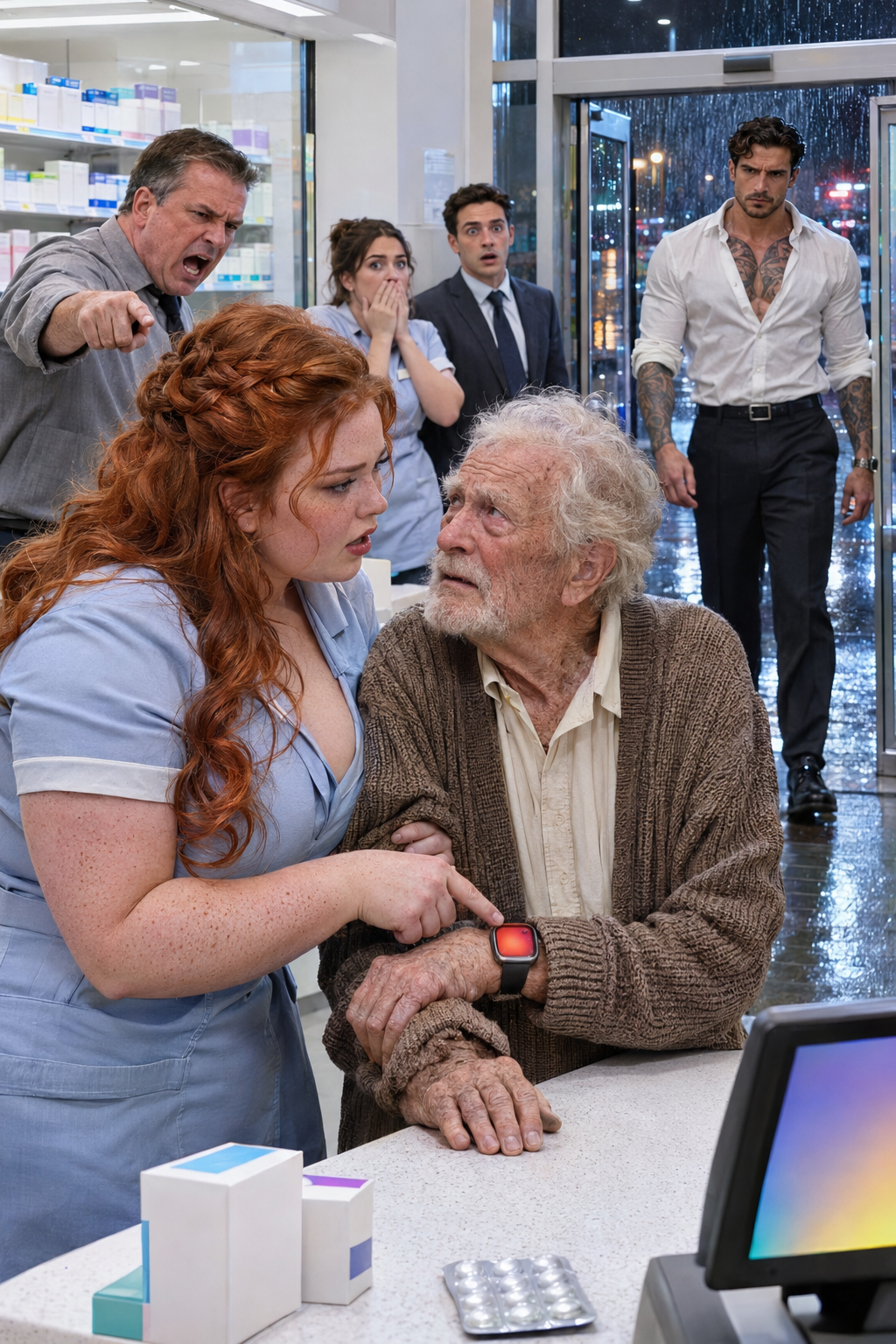
The eighty-four-year-old man had been sitting outside the pharmacy for nearly forty minutes when Annie noticed the blood on his shirt.
That night, additional security personnel were stationed around the estate, and Annie was advised not to travel alone until the authorities could assess the threat.
Bakisio found her sitting in the kitchen long after midnight.
He lowered himself into the chair beside her.
“Are you frightened?” he asked in Sardinian.
“Yes.”
“So am I.”
Annie looked at him, surprised.
The old man smiled sadly.
“Being old doesn’t make fear disappear.”
He covered her hand with his.
“But you don’t have to face it alone.”
Annie understood then that saving someone wasn’t always a single heroic moment.
Sometimes it meant staying present through the uncertainty that followed.
Sometimes it meant accepting help when you had spent your whole life trying to survive without it.
She had walked into a pharmacy that afternoon believing she had lost everything.
Instead, she had found a family willing to make room for her.
And whatever happened next, she knew one thing with certainty.
She would never regret helping Bakisio.
Upstairs, Luca stood in his study, reviewing the security footage from the convenience store.
The recording showed Annie leaving the building after her dismissal.
Across the street, a familiar black SUV waited at the curb.
But Luca wasn’t watching the vehicle.
He was watching the passenger who stepped out moments later.
The man’s face was partially obscured, yet the distinctive silver ring on his hand was unmistakable.
Luca had seen that ring at his own dinner table three nights earlier.
He paused the footage and reached for his phone.
The police needed to see this immediately.
Because whoever had orchestrated Bakisio’s kidnapping might have been much closer to the Gorini family than anyone had imagined.
And somewhere inside the estate, Annie’s smartwatch vibrated with a notification from an unknown sender.
There was no message.
Only a photograph of the garden, taken less than an hour earlier.
The danger wasn’t over.
But this time, Annie knew she wouldn’t have to face it alone.
Annie stared at the photograph glowing on her smartwatch, her fingers growing cold around the edge of the kitchen counter. The image showed the estate garden, the stone fountain, and the bench where Bakisio had sat that afternoon. In the corner, almost hidden behind the climbing roses, stood a dark figure holding a phone.
The photograph had been taken less than an hour earlier.
Someone had been watching them.
Annie looked toward the kitchen windows. Beyond the glass, the garden lights illuminated the gravel paths, but the trees farther away remained swallowed by darkness.
“Bakisio,” she whispered, “we need to find Luca.”
The old man studied her expression and immediately understood that something was wrong. He rose carefully, leaning on his cane, while Annie took his arm.
They had barely reached the hallway when Luca appeared at the bottom of the staircase, accompanied by his security chief, Marco Bellini.
“Annie, come with me,” Luca said.
She showed him the photograph.
For the first time since meeting him, she saw genuine fear cross his face.
Marco examined the image, then spoke into his radio.
“Lock down the perimeter. Nobody enters or leaves without my authorization.”
Luca turned toward Annie.
“Did the sender include anything else?”
“No. Just the picture.”
“Did you recognize anyone?”
She shook her head.
Luca exchanged a troubled glance with Marco.
“What is it?” Annie demanded.
Luca hesitated.
“I found something on the convenience store footage.”
He led them into his study, where a large monitor displayed a frozen image of a man standing beside the black SUV.
The man’s face was partially hidden, but his hand rested against the open passenger door.
On his finger was a silver ring bearing a distinctive engraved crest.
Annie leaned closer.
“Who is he?”
Luca’s jaw tightened.
“His name is Matteo Rinaldi.”
Bakisio suddenly gripped the back of a chair.
“No,” he whispered.
Annie turned toward him.
“You know him?”
Bakisio’s expression had gone pale.
“Matteo is my sister’s grandson.”
The room fell silent.
Luca closed his eyes briefly.
“He attended dinner here three nights ago,” he said. “He sat beside my grandfather. He asked about his health.”
Annie remembered the elegant man who had arrived carrying expensive wine and kissed Bakisio on both cheeks.
Matteo had seemed charming, almost excessively attentive.
“Why would he want to hurt his own family?” she asked.
Luca looked at the frozen image.
“That’s what we’re going to find out.”
Before anyone could speak again, Marco’s radio crackled.
“South gate. We have movement near the service road.”
Marco responded immediately.
“Send two officers to investigate. Do not approach alone.”
Luca turned to Annie.
“I want you and my grandfather in the interior guest suite until we understand what’s happening.”
Annie opened her mouth to object, then stopped.
She had already learned that courage did not mean refusing sensible protection.
“All right,” she said. “But I want to know what’s going on.”
“You will.”
The guest suite had reinforced doors, independent communications, and windows overlooking an enclosed courtyard. Annie helped Bakisio settle into an armchair while two security officers remained outside.
For several minutes, neither spoke.
Then Bakisio said something in Sardinian that made Annie turn sharply.
“My sister warned me about that boy.”
“What did she say?”
Bakisio rubbed his forehead.
“She said Matteo was always counting what belonged to other people.”
Annie sat opposite him.
“Did he ever threaten you?”
“Not directly.”
“Then what happened?”
The old man looked down at his hands.
“Six months ago, Matteo asked me to sign some papers. He said they concerned an investment account belonging to our family.”
“Did you sign?”
“No. I asked my attorney to review them.”
“And?”
“The documents would have transferred control of several properties to a company I had never heard of.”
Annie felt a chill.
“Did you tell Luca?”
“I told him there had been a misunderstanding. I thought Matteo was simply being foolish.”
Bakisio’s voice cracked.
“I didn’t want another family argument.”
Annie reached across the table.
“You were trying to protect everyone.”
“Perhaps,” he replied sadly. “But silence can protect the wrong person.”
Meanwhile, downstairs, Luca was speaking with Detective Rebecca Hayes, the investigator assigned to Bakisio’s kidnapping.
Hayes had arrived with two uniformed officers after receiving the photograph and the convenience store footage.
She studied Matteo’s image carefully.
“Are you certain that’s him?”
“The ring is his,” Luca replied. “He inherited it from his grandfather.”
“That isn’t enough to establish his identity beyond doubt.”
“I understand.”
“Good. Because I need you to understand something else. If your family attempts to handle this privately, you could destroy the case.”
Luca looked at her.
“My grandfather was kidnapped.”
“And the people responsible will be prosecuted if we gather admissible evidence. Let us do our jobs.”
For a moment, Marco expected Luca to argue.
Instead, Luca nodded.
“Tell me what you need.”
Hayes requested copies of the security footage, the threatening photographs, and records of Matteo’s visits to the estate.
She also asked for the names of employees who had access to the garden and security schedules.
Marco stiffened.
“You think someone inside helped him?”
“I think whoever took that photograph knew where your cameras were positioned.”
That observation changed everything.
The estate had dozens of cameras covering its entrances, driveways, and public grounds. Yet the photograph had been taken from a narrow area between the greenhouse and the western garden wall.
It was one of the few places where the cameras overlapped imperfectly.
Only someone familiar with the system would know that.
Marco immediately ordered an audit of access logs.
Twenty minutes later, he discovered something disturbing.
At 8:43 that evening, a maintenance credential had opened the greenhouse service door.
The credential belonged to a groundskeeper named Daniel Price.
But Daniel had been visiting his hospitalized mother since noon.
Someone had copied his access card.
When Luca heard the news, his expression darkened.
“Matteo knows the estate,” he said.
Hayes shook her head.
“Knowing the property isn’t the same as having access to its systems. We need to find out who helped him.”
Upstairs, Annie was listening as Bakisio told her about his childhood in Sardinia.
His stories had always comforted her, but tonight something about his words seemed different.
He described a small stone house overlooking the mountains, a family vineyard, and a locked wooden chest that his father had kept beneath the stairs.
“My father said the chest contained the things people would fight over after he died,” Bakisio explained.
“What happened to it?”
“I brought it to America.”
Annie smiled faintly.
“Let me guess. It’s somewhere in this enormous house.”
Bakisio nodded.
“In my old study.”
“What was inside?”
“Letters. Property records. Family agreements.”
He paused.
“And something Matteo asked me about last Christmas.”
Annie leaned forward.
“What?”
“A document my father signed before leaving Sardinia. It established that certain family assets could never be transferred without the consent of every surviving beneficiary.”
“Would that include Matteo?”
“Yes.”
“Then why would he need you to sign anything?”
Bakisio looked toward the door.
“Because my signature would have made his plan appear legitimate.”
Annie’s pulse quickened.
“Does Luca know about the document?”
“I don’t believe so.”
She stood.
“We need to tell him.”
At that moment, the lights flickered.
Once.
Twice.
Then the room went dark.
Emergency lighting illuminated the hallway outside, but the suite remained dim.
Bakisio gripped his cane.
Annie immediately reached for the telephone beside the bed.
No dial tone.
She tried her smartwatch.
The connection failed.
A moment later, someone knocked.
“Miss Annie? Mr. Gorini? Security needs to relocate you.”
The voice sounded unfamiliar.
Annie moved toward the door but stopped before touching the handle.
“Who is this?”
“Officer Daniels. We have a problem with the electrical system.”
Annie glanced at Bakisio.
The old man shook his head.
She had met both officers assigned to the suite. Neither was named Daniels.
“What’s your identification number?” Annie asked.
A pause followed.
“Ma’am, we don’t have time for this.”
“Then call Luca and tell him to come himself.”
The handle moved.
Someone tested the lock.
Annie stepped backward.
“Move away from the door,” she said.
A hard impact shook the frame.
Bakisio rose with difficulty.
“There’s another way out,” he whispered.
Annie looked at him.
“What?”
“The old servants’ passage. Behind the wardrobe.”
She followed him into the adjoining dressing room.
At the far wall stood a massive antique wardrobe built into the paneling.
Bakisio pressed a small brass latch beneath one of its shelves.
A narrow door swung inward.
Annie stared.
“You’ve been hiding this?”
“My grandfather designed houses in Italy,” Bakisio said. “He believed every important room should have two exits.”
Another impact echoed from the suite.
Annie helped him through the opening and closed the panel behind them.
The passage smelled of old wood and dust.
A narrow staircase descended toward the ground floor.
Bakisio moved slowly, gripping the handrail.
Annie kept one arm around his waist.
They had descended only a few steps when they heard shouting above.
“Where are they?”
A second voice answered.
“The room’s empty.”
Annie recognized the first voice.
Matteo.
Her stomach tightened.
He was inside the house.
And he had come for them personally.
They reached a small landing overlooking the old library through a decorative ventilation grille.
Below, Annie saw Luca speaking urgently with Detective Hayes.
She tried to call out, but Bakisio caught her sleeve.
“Wait.”
Two armed men entered the library from the opposite doorway.
Luca immediately raised his hands.
Hayes stepped sideways, placing herself behind a heavy desk as she reached for her radio.
“Police! Drop your weapons!”
One intruder hesitated.
The other aimed toward Luca.
A sharp command came from the hallway.
“Nobody fires.”
Matteo entered.
He wore a dark overcoat, his silver ring catching the library light.
Luca stared at him.
“Matteo.”
His cousin smiled without warmth.
“You always were difficult to surprise.”
Hayes kept her voice steady.
“Put your weapons down. You’re under arrest.”
Matteo glanced at her.
“Detective, I suggest you remain calm.”
“You are making your situation considerably worse.”
“That depends on what happens next.”
Luca took one step forward.
“What do you want?”
Matteo’s expression hardened.
“You know what I want.”
“No. I know you kidnapped my grandfather. I know you threatened Annie. What I don’t understand is why.”
Matteo laughed bitterly.
“Because you inherited everything that mattered.”
Luca frowned.
“We inherited responsibilities. Not the same thing.”
“Easy to say when everyone bows when you enter a room.”
“Nobody gave me this position without conditions.”
“Your grandfather gave you control. My branch of the family got promises.”
Luca shook his head.
“Your family received its share.”
“Shares I couldn’t sell without permission. Properties I couldn’t leverage. Accounts watched by lawyers who treated me like a child.”
Matteo’s voice rose.
“I spent fifteen years being told to wait.”
“So you decided to steal?”
“I decided to take what should have been mine.”
Hayes quietly activated the emergency signal on her radio.
Matteo didn’t notice.
Above them, Annie listened with growing horror.
The argument wasn’t simply about money.
It was about years of resentment that Matteo had allowed to become an obsession.
Bakisio closed his eyes.
“I should have spoken sooner,” he whispered.
Annie squeezed his hand.
“There’s still time.”
But then Matteo said something that changed her plan.
“Bring me the old man. And the girl.”
One of his accomplices headed toward the staircase.
Annie knew they could not remain hidden indefinitely.
She looked down at the library.
The old ventilation grille was secured by two small screws.
Beside the landing stood a narrow maintenance cabinet containing cleaning supplies and a flashlight.
Annie took the flashlight and examined the passage.
A second staircase led toward the kitchen.
She turned to Bakisio.
“Can you make it downstairs?”
He nodded, though his breathing had become strained.
“Then we’re going to get you somewhere safe.”
They descended slowly until they reached a locked service door near the pantry.
Annie tested the handle.
It wouldn’t move.
She searched the surrounding wall and found an old mechanical release concealed beneath a wooden cover.
Her grandmother had once taught her how to repair stubborn household latches. Annie remembered watching her work patiently with a small screwdriver.
She removed the cover using a loose metal shelf bracket and pressed the release.
The door opened.
They stepped into the pantry.
Annie heard footsteps in the kitchen.
She pulled Bakisio behind a row of storage shelves.
A man entered, speaking into his phone.
“No sign of them downstairs.”
He listened.
“Matteo says the old man has to sign tonight.”
The man paused.
“And the girl?”
Another silence.
“Understood.”
He left.
Annie waited until his footsteps faded.
Then she led Bakisio toward the staff entrance.
Through its glass panel, she could see two police vehicles beyond the courtyard gate.
Help was close.
But the door was secured by an electronic lock that had failed during the power interruption.
Annie searched for the manual override.
Before she found it, a voice spoke behind her.
“Going somewhere?”
Matteo stood at the kitchen entrance.
His gun was pointed toward the floor, but his expression was unmistakably dangerous.
Bakisio stepped in front of Annie.
“Enough, Matteo.”
The younger man stared at him.
“Grandfather.”
“I am not your grandfather.”
“You were the closest thing I had.”
“Then why have you treated me like an enemy?”
Matteo’s face twisted.
“Because you chose Luca.”
Bakisio straightened despite his exhaustion.
“I chose the person who accepted responsibility.”
“Responsibility?” Matteo snapped. “He controls millions.”
“And you could have built something worthwhile with what you had.”
Matteo looked away.
For one brief moment, Annie saw the wounded pride beneath his anger.
Then he raised the gun.
“Both of you. Back to the library.”
Annie stepped forward.
“You’re not going to get what you want.”
Matteo turned toward her.
“You should have stayed out of this.”
“Probably,” she replied. “But you made that impossible when you left an injured man outside a pharmacy.”
“You think you’re important because Luca gave you a job?”
“No. I think you made a terrible mistake because you believed nobody would care about him.”
Matteo’s jaw tightened.
Annie continued carefully.
“You planned everything around people being afraid. The driver, the pharmacy staff, me. You expected everyone to look away.”
“Stop talking.”
“But somebody didn’t.”
For a second, Matteo’s attention shifted toward the courtyard.
Annie heard distant shouting.
Police officers were moving into position.
Matteo heard them too.
He grabbed Bakisio by the arm.
The old man stumbled.
Annie immediately caught him.
“Let him go!”
Matteo pulled harder.
Bakisio cried out in pain.
Then a voice rang from the hallway.
“Matteo, release him.”
Luca stood at the entrance with Detective Hayes several feet behind him.
Her weapon was drawn, but her finger remained outside the trigger guard.
Matteo turned sharply, pulling Bakisio between himself and the officers.
“Stay back!”
Luca stopped.
“Nobody is coming closer.”
“Tell them to leave!”
“I can’t order the police around.”
“Then make them listen!”
Hayes spoke calmly.
“Matteo, we can resolve this without anyone getting hurt. Let Mr. Gorini sit down.”
Matteo’s breathing became ragged.
He looked from Luca to Annie, then toward the courtyard.
For the first time, he seemed to understand that his plan had collapsed.
Annie noticed Bakisio struggling to remain upright.
His face had become gray.
“He’s going to fall,” she said.
Matteo ignored her.
“Matteo,” she repeated, “look at him.”
The old man’s knees buckled.
Matteo instinctively tightened his grip, but Bakisio’s weight dragged them both sideways.
His gun hand dropped.
Hayes moved forward.
“Drop the weapon!”
Matteo hesitated.
Luca spoke quietly.
“It’s over.”
The words seemed to reach something deep inside him.
His shoulders sagged.
Slowly, he lowered the handgun to the floor.
Hayes ordered him to step away.
Two officers rushed forward, secured the weapon, and placed Matteo in handcuffs.
Annie barely noticed.
Bakisio had collapsed against her.
“Call an ambulance!” she shouted.
Luca dropped to his knees beside them.
“Nonno?”
The old man opened his eyes.
“I’m tired,” he whispered.
“Stay with me.”
Bakisio managed a faint smile.
“You’re becoming very demanding.”
Luca laughed once, shakily, before tears filled his eyes.
Paramedics arrived within minutes.
They placed Bakisio on a stretcher and transported him to the hospital, where doctors discovered that dehydration, stress, and an irregular heartbeat had caused his collapse.
He would recover, but he needed rest.
Annie remained at the hospital until sunrise.
Luca sat beside her in the waiting room, his suit jacket folded over one arm.
Neither had spoken for nearly an hour when he finally said, “I owe you an apology.”
Annie looked at him.
“For what?”
“I brought you into my family because I thought I could protect you.”
“You gave me a job.”
“And you nearly died because of our problems.”
Annie considered his words.
“Matteo made those choices, Luca. You didn’t.”
“I should have recognized what he was becoming.”
“Maybe. But you can’t control every person you love.”
Luca stared at the floor.
“My grandfather tried to warn me that Matteo was unhappy. I thought it was ordinary family jealousy.”
“Sometimes we only understand a warning after something terrible happens.”
He looked at her.
“Are you leaving?”
Annie was quiet for a long moment.
“I haven’t decided.”
He nodded.
“Whatever you choose, I’ll make sure you receive the compensation you’re owed. And I’ll help you find another position if that’s what you want.”
She smiled faintly.
“That’s the first sensible thing you’ve said all night.”
Three days later, Bakisio returned home.
The estate had changed.
Security procedures were reviewed, compromised credentials were canceled, and outside specialists examined the entire system.
More importantly, Luca cooperated fully with the police investigation.
Matteo’s accomplices were identified through phone records, financial transactions, and security footage.
Investigators discovered that he had accumulated enormous debts through failed investments and had secretly borrowed money from a criminal group operating across several states.
The kidnappers had intended to force Bakisio to authorize transfers that would allow Matteo to gain control of restricted family assets.
When the first attempt failed, Matteo panicked.
The threatening photographs were meant to frighten Annie into silence.
The second attack had been his desperate attempt to complete the scheme before investigators connected him to the kidnapping.
But the evidence uncovered something else.
Matteo had not been acting entirely alone.
A financial adviser named Stephen Vale had helped prepare the fraudulent documents and arrange the transfers.
He had also paid the convenience store manager to dismiss Annie after learning that she had overheard Victor discussing Bakisio’s planned abduction near the store.
Annie remembered the conversation now.
Two men had stood beside the refrigerated drinks, speaking quietly about an elderly passenger and a pharmacy pickup.
She hadn’t understood its significance at the time.
But she had noticed one man looking sharply toward her when she approached.
The next morning, she was accused of stealing.
The seventy dollars had never been missing.
The accusation was simply a way to remove her from the neighborhood before the kidnapping.
When Detective Hayes explained this, Annie sat motionless.
“So losing my job wasn’t an accident?”
“No,” Hayes replied. “It appears they wanted you gone.”
Annie looked down at her hands.
For weeks, she had wondered whether she had somehow failed at the simplest task in her life.
Now she understood that someone had deliberately tried to destroy her reputation.
“Can I testify?” she asked.
Hayes nodded.
“Your testimony could be important.”
“Then I will.”
Over the following months, Annie worked closely with prosecutors.
She gave detailed statements, identified Victor and Matteo, and described everything she remembered about the pharmacy confrontation.
Her testimony was not dramatic.
She didn’t deliver speeches or try to humiliate anyone.
She simply told the truth.
When the defense attorney questioned why she had remained beside Bakisio despite the danger, she answered without hesitation.
“Because he asked me for help.”
“Even though you didn’t know him?”
“Yes.”
“Even though you understood he might be connected to dangerous people?”
Annie looked toward Bakisio, who sat quietly in the courtroom beside Luca.
“I knew he was frightened and injured. That was enough.”
The courtroom fell silent.
Months later, Matteo pleaded guilty to conspiracy, kidnapping-related offenses, and attempted fraud as part of a negotiated agreement.
Victor and Stephen Vale faced their own criminal proceedings.
The court imposed substantial prison sentences and ordered restitution where legally appropriate.
For Luca, the outcome brought relief but no satisfaction.
Matteo had been family.
He had shared birthdays, holidays, and childhood summers with him.
Seeing him led away in handcuffs was not a victory.
It was the painful conclusion of choices that might have been different.
After the sentencing, Luca visited Bakisio in the garden.
“I keep wondering whether I could have helped him sooner,” he admitted.
Bakisio watched the fountain.
“Perhaps you could have. Perhaps I could have too.”
“Do you forgive him?”
The old man considered the question.
“I hope one day I can. But forgiveness doesn’t mean pretending he did nothing wrong.”
Luca nodded slowly.
“And it doesn’t mean giving him another chance to hurt people.”
“No,” Bakisio agreed. “Love without boundaries can become another kind of harm.”
Annie overheard those words from the terrace.
They stayed with her long afterward.
She had spent much of her life believing kindness required endless sacrifice.
Her grandmother had taught her to help others, but Annie had sometimes mistaken that lesson for an obligation to accept unfair treatment.
Now she understood the difference.
Helping Bakisio had been an act of compassion.
Allowing someone to exploit her would not have been.
That understanding shaped her next decision.
One afternoon, Luca invited her into his study.
“I’ve been thinking about your future,” he said.
Annie raised an eyebrow.
“That sounds ominous.”
He smiled.
“I’d like to offer you a permanent position overseeing our family’s community assistance program.”
She blinked.
“What program?”
“The one we’re creating.”
Luca placed a folder on the desk.
Inside were plans for a nonprofit organization providing emergency transportation, prescription assistance, and short-term support for vulnerable older adults.
The idea had come from Bakisio’s experience.
An elderly man had been abandoned outside a pharmacy, and the person who helped him had been an unemployed cashier with almost no money.
Luca wanted to make sure that ordinary people facing similar situations had somewhere to turn.
“We’ll have professional staff, licensed partners, and independent oversight,” he explained. “I don’t want this to become another family favor system.”
Annie studied the documents.
“You want me to run it?”
“Not alone. You’d work with experienced social workers and administrators while receiving training. But I want you involved in shaping it.”
“Why?”
“Because you understand what it feels like to need help without knowing where to find it.”
Annie turned another page.
There were proposed partnerships with pharmacies, hospitals, and senior centers.
A transportation service would help older patients attend appointments.
An emergency fund would cover essential medications for people who couldn’t afford them.
A multilingual assistance line would connect callers with trained interpreters.
She looked up.
“Could we include people who don’t speak English well?”
“Absolutely.”
“And make sure nobody has to prove they’re desperate before someone listens?”
Luca smiled.
“That’s exactly why I asked you.”
Annie accepted.
Over the next year, the program grew from a small office into a respected community organization.
They named it the Open Door Foundation.
Annie spent her mornings meeting with staff and her afternoons visiting pharmacies and neighborhood centers.
She learned budgeting, nonprofit management, and the complicated rules governing medical privacy and patient assistance.
She made mistakes.
Sometimes she approved an expense too quickly or underestimated how long a partnership agreement would take.
But she asked questions, accepted guidance, and improved.
Luca never treated her lack of a college degree as a reason to doubt her intelligence.
Instead, he encouraged her to take evening courses in nonprofit administration.
Bakisio became the foundation’s most enthusiastic volunteer.
He insisted on visiting the office every Thursday, where he greeted everyone in Sardinian before switching to English.
He brought homemade pastries, complained about the coffee, and told anyone who would listen that Annie had saved his life.
She always corrected him.
“We saved each other.”
He would shake his head.
“Stubborn girl.”
“Stubborn old man.”
Their laughter became a familiar sound in the office.
One winter afternoon, nearly eighteen months after the kidnapping, Annie received a telephone call from a woman named Margaret Ellis.
Margaret was seventy-nine and had missed three medical appointments because she could no longer drive.
Her son lived across the country, and her neighbors were unable to help.
Annie arranged transportation through one of the foundation’s partner services.
Two weeks later, Margaret visited the office carrying a small container of homemade cookies.
“I wanted to thank the person who answered the phone,” she said.
Annie smiled.
“You didn’t have to bring anything.”
“I know.”
Margaret placed the cookies on the desk.
“But sometimes people need to know that what they do matters.”
After Margaret left, Annie sat quietly for several minutes.
She remembered the day she had lost her job.
The humiliation of being accused of theft.
The long afternoon spent wondering how she would pay her bills.
The old man sitting outside the pharmacy.
And the moment she had chosen to stop.
Her life had changed because she had helped a stranger.
But she had also learned that the value of that decision did not depend on the reward that followed.
Even if Bakisio had been an ordinary pensioner with no powerful grandson, she would have made the same choice.
That realization brought her a peace she had never expected.
The following spring, Bakisio turned eighty-six.
Luca organized a modest celebration in the estate garden.
There were no extravagant decorations or enormous guest lists.
Just family, close friends, foundation employees, and a long table covered with food.
Annie baked the bread her grandmother had taught her to make.
When Bakisio tasted it, his eyes filled with tears.
“Just like home,” he whispered.
Later that evening, as the guests drifted toward the house, Bakisio asked Annie to walk with him.
They stopped beside the fountain where the threatening photograph had once been taken.
For a moment, Annie remembered the fear of that night.
Then she looked around.
The garden was peaceful.
Children laughed near the terrace.
Luca was helping an elderly guest down the steps.
The place that had once represented danger had become a home.
Bakisio reached into his jacket and withdrew a small wooden box.
“I have something for you.”
Annie frowned.
“You already gave me a birthday present.”
“This isn’t a birthday present.”
Inside the box lay a delicate silver pendant shaped like an olive branch.
“It belonged to my mother,” Bakisio explained. “She wore it when our family left Sardinia.”
Annie stared at him.
“I can’t accept this.”
“Of course you can.”
“It’s a family heirloom.”
“Exactly.”
Her eyes filled with tears.
Bakisio gently closed her fingers around the pendant.
“Family is not always determined by blood, Annie. Sometimes it is determined by who stays when leaving would be easier.”
She embraced him carefully.
For a long time, neither spoke.
When they returned to the terrace, Luca noticed the pendant.
He smiled.
“He’s been planning that for months.”
Annie laughed through her tears.
“You knew?”
“Everyone knew except you.”
She shook her head.
“You people are impossible.”
Luca offered his arm.
“Come inside. There’s cake.”
Annie glanced once more at the garden.
The danger that had threatened them was finally behind them.
The investigations had ended, the people responsible had been held accountable, and the family had begun healing from wounds that money could never repair.
But the greatest change was not in the estate or the foundation.
It was in Annie herself.
She no longer measured her worth by the job she held, the money in her account, or the opinions of people who had underestimated her.
She had learned that courage could be quiet.
That kindness could coexist with boundaries.
That asking for help was not weakness.
And that a person did not need wealth, influence, or an important surname to make a difference.
Years later, whenever someone asked how the Open Door Foundation had begun, Annie never started with the kidnapping, the courtroom, or the powerful Gorini family.
She told them about an elderly man sitting alone outside a pharmacy.
About a language her grandmother had taught her.
And about a simple decision that had changed two lives.
“I didn’t know who he was,” she would say. “I only knew he needed someone.”
Then she would smile.
“Sometimes the smallest act of kindness opens a door you never knew existed.”
And every Thursday, when Bakisio arrived at the foundation carrying pastries and complaining about the coffee, Annie was reminded that the most important things in life were rarely the things people fought hardest to possess.
They were the people who made us feel safe, the promises we chose to keep, and the courage to do what was right even when nobody was watching.
Because real power was never about making others afraid.
It was about making sure they no longer had to be.
And for Annie, the woman who had once believed she had lost everything, that was the greatest fortune of all.
Three years after the night Annie found Bakisio outside the pharmacy, the Open Door Foundation had become one of the most trusted community organizations in Philadelphia. Its small office had expanded into a renovated brick building, its transportation program served hundreds of elderly residents, and its emergency assistance fund had helped families who once believed nobody would answer their calls.
But on a cold Thursday morning in November, Annie received a letter that threatened to bring back everything she had worked so hard to leave behind.
There was no return address.
Inside was a single photograph of the pharmacy where she had first met Bakisio.
On the back, someone had written five words.
“You never learned the truth.”
Annie stood motionless beside her desk.
For a moment, she was twenty-eight again, unemployed, frightened, and standing between an injured old man and a stranger carrying a gun.
Then she turned the photograph over.
A date had been printed along the bottom.
It was the day before Bakisio’s kidnapping.
Annie studied the image more closely.
Through the pharmacy window, she could see a familiar figure standing beside the prescription counter.
It was Stephen Vale, the financial adviser who had helped Matteo organize the kidnapping.
But Stephen wasn’t alone.
Beside him stood a woman with silver hair and a dark blue coat.
Annie recognized her immediately.
It was Evelyn Mercer, the former manager of the foundation’s first pharmacy partner.
Evelyn had retired the previous summer after nearly forty years in the pharmaceutical industry.
She had attended the foundation’s opening ceremony.
She had even hugged Bakisio and thanked Annie for everything she had done.
Annie felt her stomach tighten.
She immediately called Detective Rebecca Hayes, who had remained in occasional contact with the family.
“Rebecca, I think someone has sent me evidence connected to the kidnapping.”
Hayes arrived within an hour.
She examined the photograph, placed it in an evidence sleeve, and asked Annie to describe exactly how it had arrived.
“Do you think Evelyn was involved?” Annie asked.
“I don’t know,” Hayes replied. “Being photographed with Stephen doesn’t prove anything. We need to establish when this was taken and why someone sent it now.”
Annie nodded.
She had learned enough from the earlier investigation to understand that suspicion was not proof.
But she also knew the photograph had been sent for a reason.
That afternoon, Hayes contacted Evelyn.
The retired pharmacist agreed to speak with investigators and appeared genuinely shaken when shown the image.
“I remember that day,” she said.
“Why was Stephen Vale there?” Hayes asked.
“He came asking questions about an elderly patient. He claimed he was helping arrange transportation.”
“Did you give him any information?”
Evelyn hesitated.
“I told him we couldn’t discuss patient records without authorization.”
“Did he leave?”
“Eventually.”
“And the photograph?”
Evelyn stared at it.
“Someone must have been watching us.”
Then she revealed something she had never mentioned during the original investigation.
Stephen had returned later that afternoon.
This time, he had threatened to report the pharmacy for alleged billing irregularities unless she cooperated.
Evelyn had refused, but she had been frightened.
She had told her supervisor, who advised her to document the encounter.
Those records had remained in the pharmacy’s archives.
Hayes requested them immediately.
When investigators reviewed the documentation, they discovered that Stephen had been attempting to gather information about Bakisio’s prescriptions and medical appointments before the kidnapping.
The discovery did not change the convictions already secured, but it clarified how carefully the scheme had been planned.
More importantly, it raised a new question.
Who had kept the photograph for three years?
The answer arrived two days later.
A lawyer representing Stephen Vale contacted Detective Hayes.
Stephen, who was serving his sentence, had recently learned that an associate possessed photographs taken during the planning stages of the kidnapping.
He had provided the information to his attorney, hoping to cooperate with investigators in an unrelated financial fraud case.
The anonymous envelope had apparently been mailed by someone who wanted Annie to know the truth without becoming publicly involved.
Hayes continued investigating the sender, but the evidence pointed toward a former employee of Stephen’s consulting firm.
For Annie, the revelation brought an unexpected sense of closure.
There was no mysterious new enemy waiting in the shadows.
No hidden mastermind preparing another attack.
Only the lingering consequences of crimes committed years earlier.
When she told Luca what had happened, he listened quietly.
“Does it frighten you?” he asked.
“A little.”
“Do you want additional security?”
Annie considered the question.
“I want reasonable precautions. But I don’t want to spend the rest of my life treating every unfamiliar envelope like a threat.”
Luca smiled.
“That sounds like something my grandfather would say.”
Annie laughed.
“He’s a bad influence.”
“An extremely stubborn one.”
Their laughter faded when Luca glanced toward the garden.
Bakisio had been growing weaker over the past several months.
His doctors had explained that his heart condition was progressing, and although treatment helped him remain comfortable, he no longer had the strength he once possessed.
He still visited the foundation when he could.
He still complained about the coffee.
But sometimes he needed to rest after walking only a short distance.
Annie had begun noticing how often he paused before standing and how carefully Luca watched him when he thought nobody was looking.
One evening, Bakisio asked Annie to join him in the library.
She found him sitting beside the fireplace, a folded blanket across his knees.
“Come here, my girl,” he said in Sardinian.
Annie sat beside him.
“What’s wrong?”
“Nothing.”
She raised an eyebrow.
“That’s what you always say when something is wrong.”
He chuckled.
“Then perhaps you know me too well.”
He reached for a small leather notebook on the table.
“I’ve been writing down stories about my childhood.”
Annie opened it.
The pages were filled with careful handwriting, old family recipes, memories of Sardinia, and expressions in the dialect her grandmother had taught her.
Some entries were written in English.
Others were written in Sardinian, with translations beneath them.
“I don’t want these words to disappear,” Bakisio explained.
Annie turned another page.
There was a story about his mother baking bread during a winter storm.
Another described his father repairing a broken fishing boat for a neighbor who couldn’t afford to pay.
And another told of a young Bakisio arriving in America with one suitcase and less than twenty dollars.
Annie smiled.
“You never told me you were that poor.”
“Most people who have money now were not born knowing what to do with it.”
He looked toward the fire.
“My father taught me that wealth should make a person more useful, not more important.”
Annie closed the notebook gently.
“Why are you giving this to me?”
“Because you listen.”
Her throat tightened.
“Bakisio…”
He raised one hand.
“Don’t look so sad. I’m still here.”
She laughed softly, wiping her eyes.
“I know.”
“Then promise me something.”
“Anything.”
“Keep speaking our language. Teach it to someone else. And never let this family convince you that money is more valuable than character.”
Annie nodded.
“I promise.”
Several weeks later, Bakisio was admitted to the hospital after developing difficulty breathing.
Luca called Annie shortly after midnight.
She arrived to find him sitting outside his grandfather’s room, his face pale with exhaustion.
“The doctors are doing everything they can,” he said.
Annie sat beside him.
For a long time, neither spoke.
Then Luca whispered, “I don’t know how to do this without him.”
Annie took his hand.
“You don’t have to know tonight.”
Inside the room, Bakisio lay beneath a white blanket, his breathing assisted by oxygen.
When Annie approached, he opened his eyes.
“There she is,” he murmured.
She smiled through her tears.
“You’ve been causing trouble again.”
“Only a little.”
He reached for her hand.
“Did you bring the notebook?”
“It’s safe at home.”
“Good.”
He closed his eyes briefly.
Then he whispered something in Sardinian.
Annie leaned closer.
“What did you say?”
He repeated the words.
“Leave every place kinder than you found it.”
Annie felt tears slide down her cheeks.
“I’ll try.”
Bakisio squeezed her fingers.
“You already have.”
Luca entered quietly and stood beside the bed.
His grandfather looked at him.
“My boy.”
“I’m here, Nonno.”
“Take care of each other.”
“We will.”
Bakisio smiled faintly.
For a moment, he seemed to be looking beyond them, toward some distant memory of mountains, olive trees, and a stone house overlooking the sea.
Then he closed his eyes.
He died peacefully the following morning, with Luca and Annie beside him.
The funeral was held four days later.
Hundreds of people attended, including employees from the family businesses, neighbors, foundation volunteers, and elderly residents who had benefited from the programs Bakisio inspired.
Annie stood beside Luca throughout the service.
When it was her turn to speak, she carried the small leather notebook to the front of the chapel.
“I met Bakisio on the worst day of my life,” she began.
Her voice trembled, but she continued.
“I had lost my job. I had almost no money. I didn’t know what I was going to do next.”
She looked toward the photograph beside the flowers.
“Then I saw an old man who needed help.”
She paused.
“I thought I was helping him survive one frightening evening. I didn’t understand that he was about to teach me how to live the rest of my life.”
Several people wiped their eyes.
“Bakisio believed that family was something we built through loyalty, kindness, and responsibility. He taught me that being brave doesn’t mean never being afraid. It means choosing what matters even when fear is standing beside you.”
Annie opened the notebook.
“His final lesson was simple. Leave every place kinder than you found it.”
She looked toward Luca.
“That’s what he did for me. And that’s what I hope we can continue doing for others.”
After the funeral, Luca and Annie returned to the estate.
The house felt strangely quiet.
For the first time, there was no familiar voice complaining about the coffee or asking whether Annie had remembered to eat lunch.
The empty chair beside the library fireplace seemed almost unbearable.
But grief did not erase the life Bakisio had lived.
It reminded them how much that life had mattered.
In the months that followed, Luca established a permanent endowment for the Open Door Foundation in his grandfather’s memory.
Annie expanded its services to include language assistance for elderly immigrants and transportation for patients receiving long-term medical treatment.
She also began organizing weekly storytelling gatherings where older residents could share memories, recipes, and traditions with younger volunteers.
The first gathering attracted only eleven people.
By the end of the year, more than a hundred residents were participating.
Annie often brought Bakisio’s notebook and read one of his stories aloud.
Sometimes she laughed.
Sometimes she cried.
But she never stopped telling them.
On the fifth anniversary of the pharmacy rescue, the foundation opened a new community center.
The building included medical consultation rooms operated by licensed partners, a transportation coordination office, classrooms, and a bright communal kitchen.
Above the entrance was a modest bronze plaque.
THE BAKISIO GORINI COMMUNITY CENTER
A PLACE WHERE NO ONE IS LEFT BEHIND.
Annie stood outside before the opening ceremony, watching volunteers arrange chairs.
Luca approached carrying two cups of coffee.
“Still nervous?” he asked.
“Terrified.”
He handed her a cup.
“Good. That means you care.”
She smiled.
“Your grandfather used to say that.”
“I know.”
They stood quietly for a moment.
Across the street, an elderly woman struggled to lift a shopping bag onto the sidewalk.
A young volunteer immediately hurried over to help.
Annie watched as the woman smiled and accepted his assistance.
It was such a small moment that nobody else seemed to notice.
But Annie felt something settle peacefully inside her.
Five years earlier, she had stopped to help a stranger because she couldn’t bear to leave him alone.
She had never imagined that one decision would grow into an organization capable of helping thousands.
She had never imagined finding a family, rebuilding her confidence, or learning that her grandmother’s forgotten language could become the bridge between two frightened people.
Most of all, she had never imagined that the man she rescued would leave her something more valuable than money.
He had left her a purpose.
When the ceremony began, Annie stepped toward the microphone.
She looked at the volunteers, the families, the elderly residents, and the people who had helped turn a painful memory into something beautiful.
Then she smiled.
“Five years ago, an eighty-four-year-old man was abandoned outside a pharmacy,” she said. “He was frightened, injured, and convinced nobody was coming to help him.”
The crowd grew quiet.
“I happened to be walking past.”
She paused.
“I didn’t have a job. I didn’t have money. I didn’t have any special power. But I had two hands, a little courage, and a language my grandmother had taught me.”
Her voice strengthened.
“That was enough to begin.”
She looked toward the plaque bearing Bakisio’s name.
“Today, this building exists because we believe that nobody should have to be wealthy, influential, or connected to deserve kindness.”
Applause filled the courtyard.
Annie waited until it faded.
“Sometimes people ask me whether I would make the same decision if I knew how dangerous that evening would become.”
She smiled gently.
“The answer is yes.”
Then she added, “But I also learned that helping others doesn’t mean facing danger alone. It means knowing when to ask for help, when to stand firm, and when to let other people stand beside you.”
After the ceremony, Annie walked into the community center.
Near the reception desk, a young woman was helping an elderly man complete a transportation request.
The man seemed embarrassed.
“I don’t want to be a burden,” he said.
The volunteer smiled.
“You’re not a burden. That’s why we’re here.”
Annie stopped.
For a moment, she heard Bakisio’s voice as clearly as if he were standing beside her.
Leave every place kinder than you found it.
She touched the silver olive-branch pendant around her neck.
Then she continued down the hallway, passing classrooms filled with conversation and a kitchen where volunteers were preparing lunch.
Outside, the afternoon sunlight fell across the bronze plaque.
The words would remain there long after the people who had placed them were gone.
And perhaps, years from now, someone who had never heard of Annie or Bakisio would walk through those doors feeling frightened, forgotten, or alone.
Someone would offer them a chair.
Someone would listen.
Someone would help.
That was the legacy Bakisio had wanted.
Not a fortune.
Not a powerful family name.
Not a monument to everything he had owned.
Just the certainty that because he had lived, other people would suffer a little less.
Annie finally understood that the greatest stories do not always end when the danger disappears or the villain is punished.
Sometimes they end when the people who survived choose to build something better from what happened.
And the woman who once believed she had nothing left to give had discovered that the most valuable thing she possessed had been hers all along.
Her willingness to care.
Because kindness does not become powerful when someone rewards it.
It becomes powerful when someone receives it, remembers it, and passes it on.
And somewhere in Philadelphia, every time an elderly stranger walked through an open door and found a helping hand waiting, Bakisio’s story began again.
THE END.