The Duke Returned Home With His Mistress After Eight Months—But His Wife Had Already Prepared Something Far More Dangerous Than a Divorce.
The name written beneath the transfer date was not Lady Caroline Ashford’s.
It was Evelyn Harrington’s.
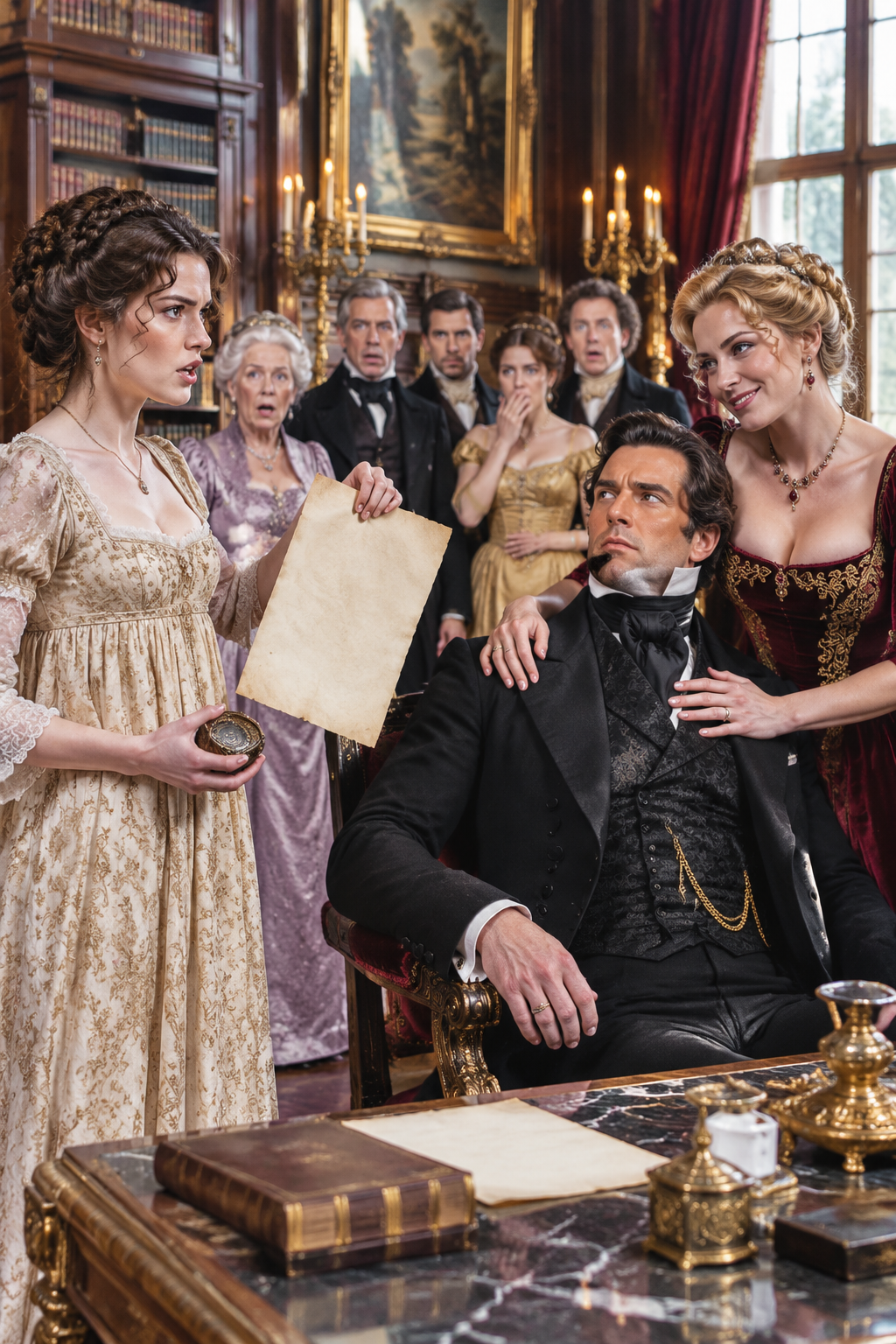
For several seconds, the drawing room remained silent. Evelyn stared at the ledger, then at the carefully written signature beneath the declaration of ownership. Her name appeared twice, once as the woman surrendering the northern lands and again as the trustee supposedly receiving them.
But the second signature was followed by three unfamiliar words.
Evelyn Harrington, deceased.
She lifted her eyes toward Mr. Pembroke.
“Would you explain that?”
The solicitor removed his spectacles and examined the entry beneath the light of the window.
“According to this document, Your Grace, the transfer was executed under provisions intended to take effect upon your death.”
William turned away.
Caroline looked at him with growing alarm.
Evelyn placed the ledger on the table.
“But I am standing here.”
“Yes,” Pembroke answered quietly. “And that is precisely why this document should never have existed.”
The grandfather clock struck seven.
Each measured chime seemed to make William’s silence more conspicuous.
Evelyn examined the transfer again. The document did not simply pledge her northern lands against a loan. It placed them under the administration of a private trust, with authority passing to an appointed representative upon confirmation of her death.
That representative was William.
Her husband had arranged to control her inheritance while she was alive and to retain control if she died.
She looked toward the man she had married eleven years earlier.
“Were you expecting me to die, William?”
He turned sharply.
“Don’t be absurd.”
“Then why prepare the paperwork?”
“It was a precaution. Nothing more.”
Pembroke closed the ledger.
“A precaution against what, Your Grace?”
William gave no answer.
Caroline sank into the nearest chair. Her expensive gown spread across the carpet, and she pressed both hands against her knees to conceal their trembling.
Evelyn noticed a faint crease across Caroline’s forehead, the expression of someone beginning to reconsider months of conversations.
“William told me you had been unwell,” Caroline said.
Evelyn turned toward her.
“How unwell?”
“He said your physicians were concerned. That you had become forgetful. That you sometimes failed to recognize people.”
Evelyn remembered the letters William had sent during his absence. Short, affectionate notes asking whether she was sleeping properly, whether she had experienced headaches, whether she continued taking the restorative drops prescribed by the London physician.
She had found those questions irritating at the time.
Now they felt deliberate.
“Which physician?” Pembroke asked.
Caroline hesitated.
“Dr. Edmund Vale.”
Evelyn’s expression changed.
Vale had visited Whitmore Estate twice during the previous winter. He had recommended a medicinal tonic after she complained of fatigue. When Evelyn refused further treatment because it made her dizzy, William had accused her of neglecting her health.
She had dismissed the incident.
Until now.
“Mr. Pembroke,” Evelyn said, “I want every document bearing Dr. Vale’s name examined.”
William moved toward the table.
“This has become ridiculous. You are allowing jealousy to turn ordinary household matters into accusations.”
Evelyn looked at him steadily.
“You brought another woman into my home, forged my signature, borrowed against my inheritance, and prepared a document concerning my death. Jealousy is rather far down my list of concerns.”
Caroline lowered her eyes.
Pembroke gathered the papers into separate folders.
“There will be an independent investigation,” he said. “Until then, I advise everyone present to preserve all correspondence.”
William laughed without amusement.
“You cannot simply investigate a duke.”
“No,” Pembroke replied. “But the courts may investigate a man.”
The distinction settled heavily between them.
Evelyn moved toward the bell beside the fireplace and summoned the steward.
“Mr. Ellis, please prepare the east guest rooms for Lady Caroline. His Grace will occupy the west wing until further arrangements are made.”
William stared at her.
“You presume to assign me a room in my own house?”
“The house belongs to the Harrington estate,” Evelyn answered. “The furnishings in this room were purchased with my marriage settlement. And the northern lands, which you have apparently attempted to steal, belong to me.”
She paused.
“You may choose which fact you would prefer to discuss first.”
William opened his mouth, then closed it.
Mr. Ellis bowed.
“Very good, Your Grace.”
For the first time in eleven years, William watched his wife issue an instruction without looking toward him for approval.
And the servants obeyed.
By morning, Whitmore Estate had changed.
Not visibly. The same silver trays appeared at breakfast. The same fires burned in the corridors. The same horses stamped in the stables beneath the cold November sky.
But William’s authority no longer moved through the house unquestioned.
The steward delivered correspondence directly to Evelyn. The household accounts were removed from William’s study. Two clerks from Pembroke’s office arrived before noon and began examining the estate ledgers.
Evelyn spent the morning at her desk, reading figures until her eyes ached.
She discovered that William had borrowed against three parcels of inherited land, concealed interest payments, and diverted money into accounts she had never authorized.
Some of the transactions were merely reckless.
Others were unmistakably fraudulent.
By afternoon, a more troubling pattern emerged.
The northern estate had been valued at considerably less than its actual worth.
The receiving trust had then arranged a private sale to an investment company registered in London.
Pembroke placed the company’s records before her.
“Do you recognize the name Harcourt Agricultural Holdings?”
“No.”
“The company was established seven months ago.”
“Who owns it?”
“That is what we are attempting to determine.”
Evelyn studied the signature of the company’s managing director.
Sir Reginald Harcourt.
She knew the name.
Reginald had been William’s closest companion since their university days. He had attended their wedding, hunted on the estate, and sat at their dining table countless times.
He had also encouraged William’s increasingly expensive investments.
“Reginald,” she said quietly.
Pembroke nodded.
“It appears His Grace was not acting alone.”
That evening, Evelyn found Caroline in the conservatory.
The glass walls were silvered with condensation. Beyond them, frost had begun to gather along the garden paths.
Caroline stood beside a neglected orange tree, turning a small diamond bracelet around her wrist.
“I thought you would ask me to leave,” she said.
“I considered it.”
“Why didn’t you?”
“Because I would rather know what happened than pretend you were never here.”
Caroline gave a small, uncomfortable smile.
“I suppose I deserve that.”
Evelyn did not answer.
For a while, they listened to the wind moving through the bare branches outside.
Then Caroline removed the bracelet.
“William gave me this in March.”
She placed it on the stone ledge.
“He said he had finally made a profitable investment.”
Evelyn examined the delicate setting. The diamonds were unusually fine, the workmanship unmistakably expensive.
“Did you ever ask where his money came from?”
“Once.”
“And?”
“He told me that gentlemen did not discuss financial arrangements with ladies.”
Evelyn looked at her.
“An extraordinarily convenient rule.”
Caroline swallowed.
“I believed him.”
“Believing someone does not excuse signing a document you have not read.”
“No.”
The admission came without resistance.
Evelyn studied her for a moment.
“Why did you keep his letter?”
Caroline looked toward the darkened garden.
“Because I began to be afraid of him.”
She explained that William’s behavior had changed during the final weeks in London. He had become impatient, secretive, and increasingly anxious about correspondence arriving from Whitmore.
One evening, she had entered his sitting room and found him burning papers in the fireplace.
He had shouted at her for interrupting.
The following morning, he apologized with the diamond bracelet.
“After that,” Caroline said, “I kept anything that seemed important.”
Evelyn considered the small collection of letters Caroline had already surrendered.
“Is there anything else?”
Caroline hesitated.
“There is a name.”
Evelyn waited.
“A woman named Mrs. Agnes Bell. William met her twice at a house near St. James’s Square.”
“Who is she?”
“I don’t know. But after their second meeting, he told me we could return to Whitmore.”
Evelyn felt a faint tightening in her stomach.
“Why would that matter?”
Caroline looked directly at her.
“Because before that meeting, he said we could not return until everything concerning you had been settled.”
The next morning, Pembroke sent a clerk to London to locate Mrs. Bell.
Evelyn continued examining the accounts.
She discovered that the estate’s northern tenants had received notices instructing them to redirect their rents to Harcourt Agricultural Holdings.
Several had refused.
One tenant, a widowed farmer named Thomas Reed, had written three letters asking whether Evelyn had truly sold the land.
None had reached her.
William’s secretary had intercepted them.
Evelyn read the letters in silence.
Reed had worked the same fields for thirty-two years. His father had served Evelyn’s grandfather. His youngest daughter had been born in a cottage Evelyn’s mother had personally helped restore.
In the final letter, Reed wrote that Harcourt’s agents had threatened eviction unless he signed a new tenancy agreement.
Evelyn folded the paper carefully.
“Arrange a carriage for tomorrow morning.”
Pembroke looked concerned.
“The roads are becoming difficult.”
“Then we shall leave early.”
The following day, she traveled north through a landscape of frozen hedgerows and pale fields.
Pembroke accompanied her, along with Mr. Ellis and two estate employees.
At Reed’s farmhouse, the old tenant met her with a mixture of relief and embarrassment.
“Your Grace, I did not mean to cause trouble.”
“You wrote to me three times, Mr. Reed.”
“Yes, ma’am.”
“I received none of them.”
His weathered face tightened.
He invited her inside, where his wife had prepared tea beside a modest fire.
On the kitchen table lay a notice bearing Harcourt’s seal.
Evelyn read it twice.
The new company intended to consolidate the farms, terminate several longstanding tenancies, and sell timber from the northern woodland.
The land her mother had protected for generations was being dismantled for immediate profit.
“Have they begun cutting?” she asked.
Reed nodded.
“Near the old mill. Three days ago.”
Evelyn rose.
“Show me.”
They reached the woodland shortly before noon.
Freshly cut trunks lay beside the narrow track. Men were loading timber onto wagons beneath the supervision of a heavyset stranger in a dark riding coat.
He approached when he recognized Evelyn.
“Your Grace, this is private property.”
Evelyn stepped down from the carriage.
“Yes,” she replied. “Mine.”
The man produced a folded authorization.
“The land has been transferred.”
“That transfer is disputed.”
“I have instructions from Sir Reginald Harcourt.”
“And I have instructions from the lawful owner.”
The man hesitated.
Pembroke approached, carrying a formal notice.
“Until the ownership proceedings are resolved, further removal of timber may expose your employers to substantial liability.”
The supervisor examined the document.
Behind him, the workers stopped lifting logs.
Evelyn looked toward the damaged woodland.
She remembered walking there as a girl with her mother, who could identify every tree along the stream.
Her mother had once told her that land was not merely something a family possessed.
It was something entrusted to them.
Evelyn turned toward the workers.
“You will be paid for today’s labor. But no more timber leaves these woods until the court has determined who authorized its removal.”
The supervisor protested.
She did not raise her voice.
“Then you may explain your objections to my solicitor.”
By sunset, the wagons stood empty.
When Evelyn returned to Whitmore, William was waiting in the entrance hall.
“You have embarrassed me before my associates.”
She handed her gloves to Mr. Ellis.
“Then your associates have been remarkably fortunate until now.”
“Reginald is furious.”
“I imagine he is.”
William followed her toward the staircase.
“You have no understanding of the obligations attached to my position.”
Evelyn stopped.
“Then explain them.”
He stared at her.
“Explain why your position required you to forge my signature. Explain why it required you to threaten families who have served my estate for generations.”
William’s expression hardened.
“You have been sheltered from the realities of managing wealth.”
“No, William. I have been deliberately excluded from them.”
He lowered his voice.
“Reginald can make this very unpleasant.”
Evelyn studied him.
For the first time, she recognized that his threats were not expressions of strength.
They were requests for protection disguised as commands.
“Is that why you are frightened of him?”
William looked away.
That was answer enough.
Three days later, the clerk returned from London.
Mrs. Agnes Bell had been found.
She was not a physician, banker, or solicitor.
She was a former companion to elderly ladies, occasionally employed to care for women recovering from illness.
She had recently received a substantial payment from an account controlled by Reginald Harcourt.
More importantly, she had agreed to speak with Pembroke.
The meeting took place in a private office in London.
Evelyn attended despite the solicitor’s suggestion that she remain at Whitmore.
Mrs. Bell was a thin woman with tired eyes and hands roughened by years of work.
She sat rigidly on the edge of her chair.
“I was told Her Grace required supervision,” she began.
“By whom?” Evelyn asked.
“Sir Reginald.”
“And my husband?”
“He was present.”
Mrs. Bell twisted her handkerchief.
“They said you were becoming confused. That you refused treatment. I was to be engaged as your companion once the physician confirmed your condition.”
Evelyn felt a cold pressure beneath her ribs.
“What condition?”
Mrs. Bell looked at Pembroke.
He nodded for her to continue.
“An illness of the mind, Your Grace.”
The room seemed suddenly smaller.
Evelyn remembered William’s questions about headaches, forgetfulness, and the tonic.
“They intended to have me declared incapable of managing my affairs.”
Mrs. Bell lowered her head.
“Yes.”
“And the document concerning my death?”
“I knew nothing about that.”
Pembroke leaned forward.
“Why did you accept the payment?”
Mrs. Bell’s eyes filled.
“My son was injured. I had debts. Sir Reginald offered enough to settle them.”
“Did you ever meet the duchess before today?”
“No.”
“Then how could you confirm her condition?”
Mrs. Bell looked toward Evelyn.
“I couldn’t.”
The confession was scarcely louder than a whisper.
Evelyn sat very still.
The woman before her had accepted money to participate in a scheme she did not fully understand. Yet she had also come forward when she realized what might follow.
“Will you give a sworn statement?”
Mrs. Bell nodded.
“Yes, Your Grace.”
“Then tell the truth. All of it.”
The investigation accelerated.
Pembroke obtained an order preventing further disposal of the disputed lands while the proceedings continued. The bank agreed to preserve the relevant accounts, and an independent examiner began tracing the forged transactions.
Dr. Vale was questioned.
At first, he insisted that his recommendations had been medically justified.
Then investigators discovered that he had received payments from Harcourt shortly before each visit to Whitmore.
His professional records contained descriptions of symptoms Evelyn had never reported.
One entry claimed she had failed to recognize her own husband.
Another suggested she suffered from persistent delusions concerning household finances.
Evelyn read the statements without speaking.
The cruelty of the arrangement lay in its precision.
Had she protested William’s spending, her objections might have been presented as evidence of confusion.
Had she become angry, her anger could have been described as instability.
And had she remained silent, the transactions would have continued.
They had designed a situation in which every response might be used against her.
But they had overlooked one thing.
Evelyn had kept records.
For years, she had maintained private correspondence with her mother’s former estate agent, documenting repairs, rents, and property boundaries.
She had retained copies of household expenses and preserved letters concerning the northern tenants.
What William considered a harmless domestic habit became the foundation of her defense.
By early December, Harcourt’s financial position began to unravel.
The company had borrowed heavily against land it did not lawfully control. Its creditors demanded explanations. Several transactions were suspended.
Then a messenger arrived at Whitmore carrying a letter from Sir Reginald.
He requested a private meeting with Evelyn.
Pembroke advised against it.
Evelyn agreed to meet him only in the solicitor’s presence.
Reginald arrived the following afternoon.
He entered the drawing room with the polished confidence of a man accustomed to being welcomed.
“Evelyn,” he said warmly. “How unfortunate that matters have reached this stage.”
“Your Grace,” she corrected.
His smile faded slightly.
“Of course.”
He sat opposite her and placed his hat on the adjoining chair.
“I believe we can resolve this without further embarrassment.”
Pembroke opened his notebook.
“Please proceed.”
Reginald glanced at him.
“My proposal is intended for the duchess.”
“Then you may speak plainly,” Evelyn said.
Reginald offered to return a portion of the northern estate in exchange for Evelyn withdrawing her allegations and acknowledging the validity of the original loans.
The remaining land would be retained by Harcourt Agricultural Holdings as compensation for its supposed losses.
Evelyn listened until he finished.
“And the tenants?”
“Those arrangements can be negotiated.”
“The woodland?”
“A regrettable commercial necessity.”
“The forged signatures?”
Reginald’s expression cooled.
“I suggest you consider your husband’s position.”
Evelyn leaned back.
“Is William your partner or your debtor?”
For the first time, Reginald seemed uncertain.
She continued.
“You have spoken repeatedly about protecting him, yet every document we examine places more responsibility on his shoulders and less on yours.”
Reginald stood.
“I will not be interrogated in this manner.”
“Then perhaps you should have accepted the invitation to answer questions under oath.”
He stared at her.
Evelyn took a sealed paper from Pembroke.
“This is a copy of the petition filed this morning. It identifies your company as the recipient of property transferred through fraudulent instruments.”
Reginald reached for his hat.
“You are making powerful enemies.”
Evelyn rose.
“No, Sir Reginald. I am discovering who they have been.”
He left without another word.
That evening, William requested an audience with his wife.
Evelyn found him in the library, seated beneath the portrait of his father.
The room smelled of extinguished candles and old leather.
He looked older than he had upon his return.
“Reginald has abandoned me,” he said.
Evelyn remained near the doorway.
“What did you expect?”
“He promised the investments would recover. The loans were meant to be temporary.”
“And the forged documents?”
William rubbed his forehead.
“I signed what he placed before me.”
“You signed my name.”
He looked down.
“Yes.”
The admission was so quiet that Evelyn almost missed it.
William explained that his debts had begun years earlier, following a series of failed investments. Rather than acknowledge the losses, he had borrowed more.
Reginald had offered increasingly elaborate arrangements.
Each new transaction was intended to conceal the previous one.
Eventually, the debts became too large to repay.
“And Caroline?” Evelyn asked.
William closed his eyes.
“She was an escape.”
“From what?”
“From being reminded of everything I had ruined.”
Evelyn looked at the man before her.
Once, she might have mistaken that confession for remorse.
Now she understood that regret and accountability were different things.
“You could have told me.”
“I was ashamed.”
“So you chose to humiliate me instead.”
William had no answer.
She approached the desk.
“Did you know about the plan to have me declared incapable?”
He hesitated.
Evelyn waited.
“Yes,” he said.
The word seemed to exhaust him.
“Reginald said it would only be temporary. Until the accounts were settled.”
“And the document concerning my death?”
“I knew it existed. He said it was a contingency.”
Evelyn stared at him.
“Did you ever ask what would happen to me?”
William looked toward the fire.
“No.”
For a long moment, neither spoke.
Then Evelyn removed her wedding ring.
She placed it on the desk between them.
“I spent eleven years believing that loyalty meant standing beside you regardless of what happened.”
William looked at the ring.
“Evelyn—”
“But loyalty without honesty is simply another way of surrendering yourself.”
She turned toward the door.
“Mr. Pembroke will bring the final agreement tomorrow.”
William rose.
“Will you ever forgive me?”
Evelyn paused.
“I don’t know.”
Then she left him alone.
The legal proceedings continued through the winter.
William eventually provided sworn testimony detailing his involvement in the fraudulent loans and naming Reginald as the organizer of several transactions.
His cooperation did not erase his responsibility.
The court invalidated the forged transfers and confirmed Evelyn’s ownership of her inherited lands. The disputed debts were separated from her legitimate obligations, and Harcourt’s company was ordered to account for the timber already removed.
Further proceedings followed against those responsible for the false documents.
Reginald’s reputation collapsed as evidence of similar dealings emerged.
Dr. Vale faced professional disciplinary proceedings.
Mrs. Bell’s testimony proved important in establishing the intended misuse of Evelyn’s supposed illness.
Caroline surrendered the jewelry and other assets traced to the unauthorized loans, cooperating with the financial inquiry.
She left Whitmore before Christmas.
On the morning of her departure, Evelyn met her beside the carriage.
Caroline wore a plain traveling coat.
“I owe you an apology,” she said.
Evelyn studied her.
“Yes, you do.”
Caroline accepted the words without protest.
“I thought he loved me.”
“Perhaps he loved the person he could pretend to be when he was with you.”
Caroline looked toward the house.
“And you?”
Evelyn considered the question.
“I loved the person I believed he was.”
The two women stood in silence.
Then Caroline offered her hand.
Evelyn took it briefly.
There was no friendship between them, but neither was there any need for another cruelty.
Caroline climbed into the carriage.
Evelyn watched until it disappeared beyond the gates.
By spring, the northern estate was recovering.
The disputed tenancy notices were withdrawn. Families threatened with eviction remained in their homes. The damaged woodland was placed under a restoration plan funded partly through recovered assets.
Evelyn established an independent estate office and appointed a professional manager accountable directly to her.
She insisted on reviewing every major contract.
She also created a small fund to support tenants facing illness, crop failure, or unexpected hardship.
Some neighboring families considered her involvement improper.
A duchess, they argued, ought not concern herself with ledgers, timber contracts, or the details of agricultural leases.
Evelyn listened politely.
Then she returned to work.
One April morning, Thomas Reed arrived with his youngest daughter.
The girl carried a small basket containing three young oak saplings.
“My father says these belong in the northern woods,” she told Evelyn.
Evelyn knelt beside her.
“Then we shall plant them there.”
They traveled to the woodland together.
The ground was damp beneath their boots, and new leaves had begun to unfold along the hedgerows.
At the clearing where the timber had been taken, Evelyn helped the child place the first sapling into the earth.
Reed stood nearby, holding his hat.
“Your mother would have been pleased, Your Grace.”
Evelyn pressed the soil firmly around the roots.
“I hope so.”
The little girl looked at her.
“Will the trees grow as tall as the old ones?”
“Perhaps taller.”
“But you won’t see them when they’re very old.”
Evelyn smiled.
“No. I don’t suppose I will.”
“Then why plant them?”
Evelyn glanced toward the surrounding woodland.
“Because someone else will need their shade.”
That summer, the formal separation was completed.
William retained his title, but much of his remaining personal fortune was consumed by debts and legal obligations. He withdrew from public life, living quietly on a reduced allowance from assets that remained legally his.
Evelyn did not celebrate his humiliation.
There was nothing satisfying about watching someone she had once loved diminish through choices he could have avoided.
But neither did she rescue him from their consequences.
She had spent too many years confusing compassion with the obligation to repair another person’s mistakes.
One afternoon, William sent a final letter.
It arrived without the familiar ducal seal.
Inside were only a few lines.
He wrote that he had finally understood the difference between losing a fortune and losing someone’s trust.
He did not ask her to return.
He did not request money.
He simply apologized.
Evelyn read the letter beside the conservatory window.
For several minutes, she held it in her hands.
Then she placed it in a drawer with the other correspondence from their marriage.
She did not destroy it.
Some things deserved to be remembered, even when they no longer deserved a place in one’s future.
Months later, Whitmore Estate hosted its first harvest gathering under Evelyn’s independent management.
The great dining hall, once reserved almost exclusively for titled guests, welcomed tenant families, estate workers, and their children.
Long tables stood beneath the chandeliers. Fresh bread, roasted vegetables, and warm cider filled the room with familiar scents.
Mr. Ellis moved between the guests with a satisfaction he made little effort to conceal.
Pembroke attended as well, though he insisted he was there only because Evelyn had promised not to discuss legal matters over dinner.
She laughed.
It was a sound the household had rarely heard during the previous winter.
Later that evening, Evelyn stepped onto the terrace.
The gardens stretched beneath a clear autumn sky. Beyond the lawns, the northern hills lay dark against the horizon.
She remembered the evening William had returned with Caroline.
The carriage wheels.
The cold air entering through the open doors.
The leather portfolio waiting on the marble table.
At the time, she had believed she was preparing to defend her inheritance.
She had not understood that the more difficult struggle would be reclaiming her confidence in her own judgment.
For years, she had been praised for her patience, her restraint, and her willingness to overlook discomfort.
Those qualities were not weaknesses.
But they had become dangerous when others began to depend upon her silence.
Behind her, the doors opened.
Mr. Ellis appeared.
“Your Grace, the guests are asking whether you will join them for the final toast.”
Evelyn looked once more toward the distant woodland.
“Of course.”
As she turned, Ellis hesitated.
“There is something I have wanted to say.”
She waited.
“Your mother once told me that this estate would be safest in your hands.”
Evelyn’s expression softened.
“She never said that to me.”
“No, Your Grace. I believe she hoped you would discover it for yourself.”
For a moment, Evelyn could not speak.
Then she thanked him and returned to the dining hall.
The conversations quieted as she entered.
Thomas Reed rose, lifting his glass.
“To the duchess,” he said.
Others followed.
Evelyn stood beneath the chandelier, looking at the faces gathered around her.
These were not people who required her to be perfect.
They needed her to be fair, attentive, and willing to act when something was wrong.
She raised her glass.
“To everyone who has helped this estate endure.”
The room answered with warm applause.
And as the gathering continued, Evelyn realized she no longer felt the need to prove that she belonged in her own home.
She had never needed anyone’s permission.
The following morning, she returned to her desk.
There were accounts to review, repairs to authorize, and letters waiting for replies.
Sunlight crossed the polished surface of the table.
Beside the papers stood a small framed photograph of her mother, taken years before Evelyn’s marriage.
She touched the frame lightly.
Then she opened the first ledger.
Outside, the estate was already awake.
Workers crossed the courtyard. Horses moved through the stables. Somewhere beyond the gardens, children laughed as they hurried toward the village school.
Life continued, not because the past had been erased, but because it no longer governed every decision.
Evelyn dipped her pen into the ink.
For the first time in many years, the future before her belonged to no one else.
And she understood something her mother had tried to teach her long ago.
A person’s worth cannot be measured by the title they carry, the fortune they inherit, or the loyalty they offer to someone who refuses to honor it.
True dignity is found in the courage to recognize injustice, the discipline to confront it without becoming cruel, and the wisdom to know when walking away is not defeat.
William had believed that power belonged to whoever controlled the money, the documents, and the doors of the house.
Evelyn had discovered a different kind of power.
The power to tell the truth.
The power to protect what had been entrusted to her.
And, perhaps most importantly, the power to choose a life in which love would never again require her to surrender herself.
She signed the final page of the morning’s correspondence.
Evelyn Harrington.
No forged hand.
No borrowed authority.
Only her own name, written firmly beneath a decision she had made herself.
THE END.