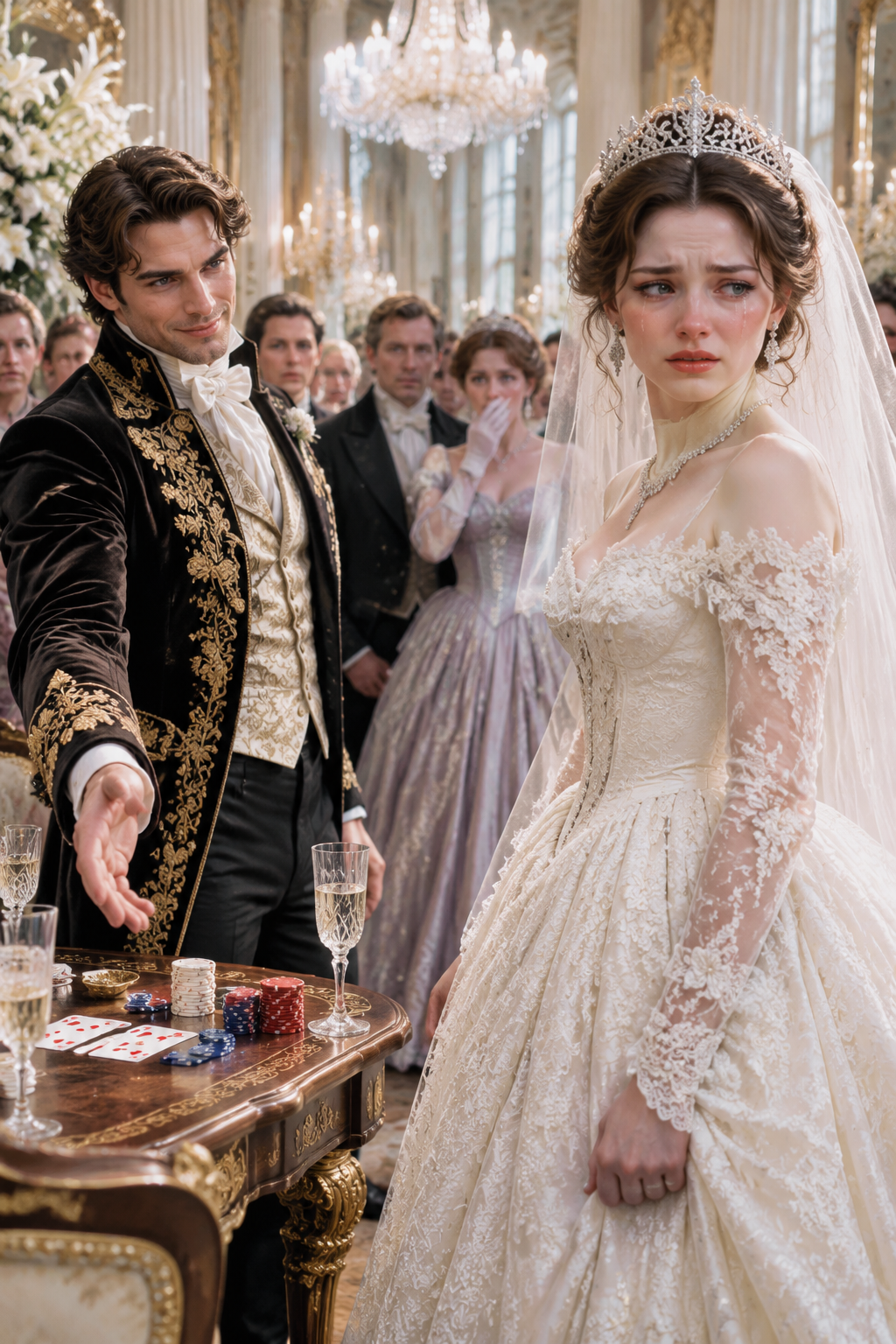
The Duke of Faircross waited until three hundred wedding guests had raised their champagne glasses before announcing that his new wife was worth exactly five hundred guineas.
The first payment had been made four months before Ara Whitmore ever received an invitation to Faircross House. The second followed three weeks later. By the time she reached the seventh entry, her fingers had gone cold against the polished leather of the account book. Each transaction carried her name, a date, and an amount large enough to support an ordinary household for several years. Yet Ara had never received a penny.
The Duke stood opposite her, his face rigid beneath the ballroom chandeliers. Behind him, three hundred wedding guests remained suspended in an uncomfortable silence. Even the musicians had abandoned their instruments.
“Explain these payments,” Ara said.
Her husband glanced at Mr. Bellamy before answering.
“They concern a private arrangement.”
“An arrangement made in my name?”
“Your name was merely used for identification.”
Ara turned another page. The entries continued, accompanied by references to shipping contracts, insurance certificates, and advances secured against expected inheritance.
She recognized one company immediately.
Whitmore Maritime Holdings.
Her late uncle’s business.
The Duke reached across the table and closed the account book with unnecessary force.
“That is enough.”
Ara did not move.
“Open it.”
For several seconds, neither spoke. Then the steward quietly lifted the cover again.
A low murmur traveled through the ballroom.
The Duke looked toward the doors, where two footmen stood beside the silver-haired solicitor. His expression suggested that he was beginning to understand how carefully the afternoon had been arranged.
Mr. Bellamy adjusted his spectacles.
“Your Grace, these transactions require an explanation. Several appear to have been authorized using documents belonging to Miss Whitmore’s late uncle.”
The Duke’s eyes narrowed.
“Her uncle was a businessman. Businessmen make arrangements.”
“Indeed,” Bellamy replied. “But they generally sign them.”
Ara looked up.
The solicitor removed a folded sheet from his case and placed it beside the ledger.
It bore her uncle’s signature.
Or something resembling it.
She had seen that handwriting hundreds of times, on birthday letters, household instructions, and the small notes he enclosed with books he thought she might enjoy.
This signature was almost perfect.
Almost.
Her uncle always finished the final letter of his surname with a slight upward stroke. On the document before her, the pen had stopped abruptly.
Ara touched the paper.
“Who witnessed this?”
Bellamy hesitated.
“A gentleman named Frederick Vale.”
The Duke’s expression changed.
It was a small movement, barely more than a tightening around his mouth, but Ara noticed.
“Where is Mr. Vale now?” she asked.
“No longer in England, according to the information supplied to my office.”
“How convenient,” Ara murmured.
The Duke leaned closer.
“You are making accusations you cannot possibly prove.”
She met his eyes.
“Then you have nothing to fear from an examination of the records.”
He said nothing.
Ara turned toward the guests, whose curiosity had begun to overcome their discomfort.
“Ladies and gentlemen, I apologize for interrupting our wedding breakfast. It appears my husband and I have discovered several matters requiring private attention.”
Her voice remained calm.
“Please enjoy the refreshments.”
The Duchess of Marlow, an elderly woman with sharp eyes and an enormous emerald necklace, rose from her chair.
“My dear,” she said, “I believe most of us have lost our appetites.”
A few guests lowered their heads to conceal their expressions.
Ara inclined her own.
“Then I hope you will forgive me.”
She turned and walked toward the adjoining library.
For one extraordinary moment, the Duke remained where he stood.
Then he followed her.
The library smelled of polished walnut, old paper, and the faint smoke of a neglected fire. Rain had begun tapping against the tall windows, turning the gardens beyond into blurred shades of green.
Ara stood beside the writing desk while Bellamy arranged the documents.
The Duke shut the door.
“Have you any idea what you have done?”
Ara removed her wedding gloves one finger at a time.
“I have asked questions.”
“You have humiliated me before half the peerage.”
“You announced that our marriage was a gambling prize.”
“That was foolish.”
“Yes.”
He waited for her to say more.
She did not.
His shoulders lowered slightly.
“Ara, listen carefully. Whatever you believe you have discovered, these affairs began long before our engagement.”
“Four months before we met.”
“Precisely.”
“Then why was my name attached to them?”
He walked toward the fireplace, where the flames reflected against the brass fender.
“Your uncle had enemies.”
Ara watched him.
“He also had friends,” the Duke continued. “Men who helped him manage certain financial difficulties.”
“My uncle left an extraordinarily prosperous shipping company.”
“Prosperity can conceal obligations.”
“Then show me the obligations.”
The Duke turned.
“You cannot simply demand access to every private transaction because you have inherited money.”
Bellamy cleared his throat.
“With respect, Your Grace, my client is now the lawful owner of the assigned debts. She is entitled to inspect the records relevant to their security.”
The Duke stared at him.
Then he laughed once, without amusement.
“You have been planning this.”
Ara folded her gloves and placed them on the desk.
“For nine days, I have been trying to understand why a man who appeared to possess everything would marry a woman he openly despised.”
“I never despised you.”
“You wagered on my willingness to marry you.”
His silence answered more clearly than any protest.
Ara moved toward the window.
Outside, a gardener hurried across the terrace, shielding his face from the rain.
“When I discovered the wager, I thought you wanted my dowry. Then I learned about your debts. This morning, I learned about my uncle’s fortune.”
She turned back.
“But these payments suggest you knew something about that fortune before I did.”
The Duke looked away.
It was enough.
“Who told you?” she asked.
He remained silent.
“Who told you my uncle was dying?”
The question struck him visibly.
Bellamy looked up from the documents.
Ara had not intended to ask it so directly. Yet the answer was already forming in the room.
Her uncle had died unexpectedly after a brief illness. His final letter had reached her three days after his funeral, its envelope bearing a shipping-office seal rather than his personal crest.
At the time, she had thought nothing of it.
Now she remembered another detail.
The letter had contained no mention of his estate.
Only a warning.
Be careful whom you allow to speak for you.
The Duke moved toward the desk.
“Your uncle was not the man you believed him to be.”
Ara felt her fingers tighten around the back of a chair.
“Then tell me who he was.”
Before the Duke could answer, someone knocked.
Bellamy opened the door.
A young footman stood outside, pale and breathless.
“Forgive me, sir. There is a gentleman requesting Lady Faircross.”
“Who?”
“He says his name is Thomas Whitmore.”
Ara gripped the chair.
Thomas Whitmore had been her uncle’s chief accountant.
He had disappeared six weeks before the funeral.
And according to the solicitor who first informed her of the inheritance, he had drowned at sea.
The Duke’s face lost its remaining color.
“Do not admit him.”
Ara turned slowly.
“Why?”
“Because the man is a fraud.”
“Then I shall enjoy hearing him explain himself.”
She passed her husband and opened the door.
Thomas Whitmore waited in the entrance hall, rainwater dripping from his dark traveling coat onto the marble floor. His hair had turned almost entirely gray since Ara last saw him, and a narrow scar crossed the skin beneath his left ear.
When he recognized her, his expression softened.
“Miss Ara.”
She approached cautiously.
“Mr. Whitmore?”
He bowed his head.
“I am sorry I could not come sooner.”
Behind her, the Duke stopped at the threshold.
Thomas saw him.
The older man’s expression hardened.
“You,” he said quietly.
The Duke’s hand closed around the doorframe.
Ara looked between them.
“You know each other.”
Thomas reached inside his coat.
The Duke moved sharply.
“Keep your hands where I can see them.”
Thomas withdrew a sealed oilskin packet.
“I believe this belongs to you, Your Grace.”
Ara took it before her husband could respond.
Inside lay a collection of letters, shipping manifests, and a small notebook filled with her uncle’s unmistakable handwriting.
The first page contained a list of names.
The Duke of Faircross appeared near the bottom.
Beside it was a single word.
Compromised.
Ara looked up.
“What does this mean?”
Thomas glanced toward the servants gathered discreetly near the staircase.
“May we speak somewhere private?”
The Duke stepped forward.
“This man has no right to enter my house.”
Thomas regarded him steadily.
“Considering what happened to the last man who trusted you, Your Grace, I would advise against discussing rights.”
The Duke raised his hand.
Ara stepped between them.
“Enough.”
Neither man moved.
She turned to Thomas.
“Come with me.”
Back in the library, Thomas refused the chair Bellamy offered. He remained standing beside the fireplace, his wet coat darkening the carpet beneath him.
Ara opened the notebook.
Her uncle’s entries described a series of maritime investments made through intermediaries connected to the Duke’s creditors. Several ships had been insured for sums far exceeding their actual value.
One vessel, the Saint Adelaide, had supposedly been lost in a storm.
Yet its cargo appeared in another company’s inventory three weeks later.
Another ship had been reported damaged beyond repair, although its crew had received wages for months afterward.
Ara read until the words began to blur.
“Insurance fraud?”
Thomas nodded.
“Among other things.”
The Duke stood beside the door.
“You have no evidence connecting me to any criminal activity.”
Thomas looked at him.
“Then perhaps you can explain why your private secretary collected the insurance proceeds.”
A heavy silence followed.
The Duke’s secretary, a narrow-faced man named Edmund Price, had attended the wedding ceremony.
Ara remembered seeing him near the gaming table.
She had not seen him since.
“Where is Mr. Price?” she asked.
The Duke did not answer.
Bellamy opened the account book and examined several entries.
“These payments bearing Miss Whitmore’s name,” he said slowly, “appear to correspond with advances made against the shipping company’s future revenues.”
Thomas nodded.
“They were intended to make it appear that Miss Whitmore had authorized the transactions.”
Ara stared at him.
“Why?”
“Because your uncle discovered the irregularities and threatened to expose them. Whoever controlled the documents could attempt to shift responsibility onto you after his death.”
The Duke struck the desk with his palm.
“That is a monstrous accusation.”
Thomas did not flinch.
“It is also incomplete.”
Ara closed the notebook.
“What else?”
Thomas looked toward the Duke.
“Your uncle believed someone was preparing to sell controlling interests in his company using forged authority.”
Ara felt the room grow strangely quiet.
“My inheritance?”
“Yes.”
“Who?”
Thomas hesitated.
Then he answered.
“Edmund Price.”
The Duke turned away.
Ara studied him.
“You knew.”
He shook his head.
“I knew Price was involved in certain transactions. I did not know their full extent.”
“Yet you borrowed money from the same men.”
“I was desperate.”
The word escaped before he could stop it.
For the first time, his voice sounded entirely different.
Not polished.
Not amused.
Simply exhausted.
Ara waited.
The Duke lowered himself into a chair.
“My father left the estate burdened with obligations. Every year, the repairs cost more than the rents produced. I borrowed to preserve the property. Then I borrowed again to repay the first loans.”
His gaze dropped to his hands.
“Price promised an investment that would clear everything.”
“And you believed him?”
“I wanted to.”
Ara glanced toward the wedding ring on her finger.
“Then you learned about my uncle.”
The Duke closed his eyes.
“Price told me that marrying you would secure an alliance with the Whitmore fortune.”
“And the wager?”
He swallowed.
“My friends knew I was courting you for money. I made the wager to persuade them that I was the one in control.”
Ara stared at him.
“You humiliated me because you were ashamed of being desperate.”
He did not answer.
The admission did not absolve him. It merely revealed the smallness beneath his carefully maintained grandeur.
Thomas moved toward the window.
“Mr. Price will not remain in England once he realizes these documents have surfaced.”
Bellamy checked his watch.
“The afternoon train leaves in forty minutes.”
Ara looked up.
“How do you know he intends to leave?”
Thomas reached into his pocket and produced a railway receipt.
“I followed him from London this morning. He purchased passage under another name.”
The Duke rose.
“He has the original company seals.”
Bellamy went still.
“Then he may still possess the means to execute further fraudulent transfers.”
Ara looked toward the door.
“Send someone to the station.”
The Duke shook his head.
“Price will recognize my servants.”
“Then we shall send someone he does not expect.”
She turned to Thomas.
“Can you identify him?”
“Certainly.”
Bellamy gathered the notebook.
“I shall accompany you and arrange for the appropriate authorities to be notified.”
The Duke stepped forward.
“I am coming.”
Ara studied him.
“Why?”
“Because I helped create this disaster.”
She held his gaze.
“That does not mean you are entitled to repair it on your own terms.”
He lowered his eyes.
“No.”
The carriage departed Faircross House beneath a curtain of rain. Ara sat opposite her husband while Thomas and Bellamy occupied the remaining seats.
No one spoke during the first mile.
The wheels struck a deep rut, and the Duke instinctively reached to steady Ara.
She withdrew her hand before he touched it.
He looked away.
At the station, steam rolled beneath the iron canopy. Porters shouted over the noise of arriving trains, and passengers hurried through the damp afternoon carrying trunks and umbrellas.
Thomas spotted Edmund Price near the first-class waiting room.
The secretary wore a dark traveling cloak and carried a narrow leather case.
He was speaking to a railway clerk.
Ara approached before the Duke could stop her.
“Mr. Price.”
The secretary turned.
His face became perfectly still.
“Your Grace.”
She noticed his eyes move toward the carriage entrance.
“Leaving so soon?”
“Business in London.”
“With my uncle’s company seals?”
Price smiled faintly.
“I do not understand.”
Ara held out her hand.
“The case.”
His smile disappeared.
The Duke stepped beside her.
“Give it to her, Edmund.”
Price looked at him with open contempt.
“You always were easily frightened.”
Then he moved.
Not toward the train.
Toward the side exit.
Thomas caught his arm, but Price twisted free, sending the leather case skidding across the wet platform.
It struck a luggage trolley and burst open.
Papers scattered across the stones.
A porter shouted.
Bellamy hurried toward the stationmaster, calling for assistance.
Price stopped when two railway constables blocked the exit.
For a moment, he seemed ready to resist.
Then he slowly raised his hands.
Ara knelt beside the fallen case.
Among the papers lay several company seals, unsigned transfer documents, and a packet of letters bearing the Duke’s crest.
She opened the packet.
The first letter contained instructions from Price to a London broker.
The second concerned the sale of shipping shares.
The third made her hands go still.
It described a plan to persuade the Duke to marry Ara before the inheritance became public, allowing Price to pressure the newlyweds into signing documents that would place substantial company interests under his control.
At the bottom was a handwritten note.
The bride must remain unaware until the transfer is complete.
Ara looked toward her husband.
He was staring at the letter.
“Did you know about this?”
“No.”
She searched his face.
This time, she believed that he was telling the truth.
It did not make the truth easier to bear.
Price laughed softly as the constables restrained him.
“Your Grace, surely you did not imagine you were the clever one.”
The Duke looked at him without speaking.
Price turned toward Ara.
“Your uncle was equally sentimental. He believed a gentleman’s word meant something.”
Ara folded the letter.
“My uncle kept records.”
Price’s expression shifted.
“Not all of them.”
Thomas stepped forward.
“Enough to establish what happened to the Saint Adelaide.”
For the first time, Price appeared genuinely frightened.
The stationmaster led him away while Bellamy secured the documents for the authorities.
Ara remained beneath the canopy, listening to the departing train whistle.
The Duke approached quietly.
“I owe you an apology.”
She looked at the tracks.
“You owe several people considerably more.”
“I know.”
“And I will not accept an apology offered merely because you have lost the advantage.”
He stood beside her in silence.
At last, he said, “Then I shall have to become someone capable of offering a better one.”
Ara turned toward him.
“That will be your responsibility. Not mine.”
The investigation lasted nearly five months.
Price’s arrest exposed a network of fraudulent shipping transactions, forged authorizations, and concealed financial interests. Several brokers faced prosecution. Insurance companies demanded restitution. The Whitmore company recovered assets that had been improperly transferred, although the legal proceedings consumed considerable time and money.
The Duke was questioned repeatedly.
He surrendered correspondence, financial records, and evidence of his own reckless borrowing. Investigators found no proof that he had knowingly participated in the forged transfers, but his negligence and concealed dealings had helped Price operate without scrutiny.
Society was less interested in such distinctions.
Invitations ceased arriving at Faircross House.
Old acquaintances crossed the street rather than acknowledge him.
The same gentlemen who had laughed at his wedding wager now described his conduct as unforgivable.
Ara observed the change without satisfaction.
She had learned how quickly fashionable society could turn humiliation into entertainment, regardless of who suffered it.
But she refused to allow gossip to determine what she would do next.
She took an active role in the shipping company, appointing Thomas to oversee its accounts and retaining Bellamy to establish stricter financial controls.
She visited the docks, spoke with captains, examined insurance agreements, and insisted that the families of sailors lost at sea receive every payment properly owed to them.
Some directors initially regarded her presence as an inconvenience.
That changed when she discovered discrepancies they had overlooked for years.
At Faircross, she also began examining the estate’s finances.
She learned that several tenant cottages required repairs, that wages had been delayed, and that the Duke’s late father had borrowed heavily to maintain the appearance of wealth.
Ara authorized necessary work through carefully documented agreements, using her position as creditor to protect the estate’s income rather than conceal its losses.
The Duke did not protest.
Instead, he began visiting the tenants himself.
At first, they greeted him with stiff bows and guarded expressions.
Then, gradually, they began telling him the truth.
One afternoon, Ara found him standing beside a damaged cottage roof, his coat damp with rain and his boots covered in mud.
He was listening to an elderly tenant explain how water entered the upstairs bedroom every winter.
The Duke took notes.
He did not make promises he could not keep.
Ara watched from the carriage.
When he noticed her, he approached.
“The roof will need replacing.”
“I know.”
“I have arranged for the work to begin next week.”
“With whose money?”
He met her gaze.
“Mine. I sold the remaining horses from my racing stable.”
Ara looked toward the cottage.
For a moment, neither spoke.
Then she nodded.
“That seems a sensible decision.”
It was not forgiveness.
But it was the first conversation they had shared in months that did not leave them both wounded.
Winter arrived quietly.
The gardens turned silver beneath the frost, and the grand ballroom remained closed. Ara preferred the smaller morning room, where sunlight reached the windows and the furniture carried no memories of their wedding breakfast.
One evening, the Duke entered carrying a sealed envelope.
He placed it beside her tea.
“What is this?”
“A proposal.”
She looked up.
He remained standing.
“I have asked Bellamy to prepare arrangements allowing you to live independently, with full control over your property and income. I will not contest whatever legal separation you choose to pursue.”
Ara opened the envelope.
The documents contained no demand for reconciliation.
No attempt to bargain.
No hidden condition.
She read them carefully.
“Why now?”
The Duke looked toward the fireplace.
“Because I have spent most of my life believing that possession was the same as security.”
He paused.
“I treated the estate as something to defend at any cost. I treated my reputation the same way.”
His eyes returned to hers.
“And I treated you as though your consent mattered only until I obtained it.”
Ara remained silent.
“I cannot undo that afternoon,” he continued. “But I can stop asking you to pay for it.”
She folded the papers.
For months, she had imagined what she would feel when he finally understood.
Victory, perhaps.
Relief.
Instead, she felt the quiet exhaustion of someone who had carried a heavy object for so long that setting it down seemed unfamiliar.
“Thank you,” she said.
He bowed his head and left.
Ara remained beside the fire until the candles burned low.
The following morning, she wrote to Bellamy.
She would accept the independent financial arrangements.
She would retain her position as creditor until the debts were lawfully settled.
And she would make her own decision about the marriage without pressure from the Duke, his family, or society.
Spring brought changes neither had anticipated.
The shipping company prospered under its new management. Faircross’s accounts stabilized as unnecessary expenses disappeared and neglected properties were repaired.
The Duke sold several valuable possessions to reduce his obligations. He began keeping his own records, reviewing every expenditure, and meeting regularly with the estate steward.
He no longer hosted extravagant gatherings.
He no longer gambled.
More importantly, he stopped speaking of those changes as sacrifices deserving admiration.
One afternoon, nearly a year after their wedding, Ara returned from London to find a small gathering in the garden.
Several tenants had come to celebrate the completion of repairs to their cottages.
Children ran across the lawn while their parents shared bread, fruit, and warm cider beneath the blossoming trees.
The Duke stood near the terrace, carrying a wooden crate for the gardener.
He looked up when Ara approached.
“Welcome home.”
She glanced toward the guests.
“What is all this?”
“A thank-you.”
“For whom?”
“The people who kept this estate alive while I was too occupied pretending it needed no help.”
Ara watched an elderly tenant press a small bunch of spring flowers into the Duke’s hand.
He accepted them with an awkward smile.
Then he brought them to Ara.
“These were meant for you.”
She took the flowers.
“They are lovely.”
He nodded.
For a moment, they stood together in the afternoon sunlight.
Then Ara spoke.
“I have made a decision.”
The Duke’s expression became attentive.
“I shall remain at Faircross for the present. Not because society expects it, and not because I have forgotten what happened.”
He waited.
“But because I would like to discover whether two people who began with such dishonesty can learn to live truthfully.”
His eyes lowered.
“I would be grateful for the opportunity.”
Ara shook her head gently.
“Do not be grateful yet. Trust is not something you receive because you have asked politely.”
A faint smile touched his face.
“No. I suppose it isn’t.”
She looked toward the garden, where the children were laughing beneath the apple trees.
“It is something you demonstrate.”
He followed her gaze.
“Then I shall begin there.”
Years later, people still spoke of the extraordinary wedding at Faircross House.
Some remembered the five-hundred-guinea wager.
Others remembered the bride who had purchased her husband’s debts before he could claim his winnings.
A few insisted that Ara Whitmore had married solely to take revenge.
They were wrong.
Revenge would have required her to make his humiliation the center of her life.
Ara had chosen something more difficult.
She had refused to let another person’s cruelty determine the limits of her future.
Her marriage did not become perfect. There were arguments, difficult memories, and occasions when the Duke’s old pride returned unexpectedly. But there were also honest conversations, responsibilities shared without resentment, and promises kept when no one was watching.
The five hundred guineas were eventually recovered from the gentleman who had made the wager.
Ara directed the entire amount toward establishing a fund for the widows and children of sailors employed by Whitmore Maritime Holdings.
When the Duke learned of her decision, he asked whether she wished to keep the purse as a reminder of what had happened.
Ara looked at the small leather object resting on her desk.
“No,” she said. “I have no need to preserve the price someone once placed upon me.”
She handed it to Bellamy.
“Let it become something useful.”
And so the wager that had begun as an act of cruelty became the first contribution to a fund that would support families for years afterward.
One evening, long after the scandal had faded from fashionable conversation, the Duke found Ara standing beside the library window.
The gardens were quiet beneath the setting sun.
He approached and placed a cup of tea on the table beside her.
“Do you ever regret marrying me?”
Ara considered the question.
“Sometimes I regret the circumstances.”
He nodded slowly.
“And the marriage?”
She looked at him.
“I have learned that a marriage is not made honorable by a title, a ceremony, or the promises spoken before witnesses.”
He waited.
“It becomes honorable through the choices made afterward.”
The Duke reached for her hand, then stopped, leaving the decision to her.
Ara looked down at his open palm.
After a moment, she placed her hand in his.
Outside, the last sunlight moved across the gardens of Faircross House, touching the repaired roofs, the young trees, and the windows of a home that no longer depended upon appearances to preserve its dignity.
The Duke had once believed that five hundred guineas could measure his victory over a woman.
He eventually learned that no fortune could purchase her trust, no title could command her respect, and no apology could replace the patient work of becoming worthy of either.
And Ara discovered something equally important.
Power was not merely the ability to defeat someone who had wronged her.
It was the freedom to decide what came afterward.
She had entered Faircross House as a bride whose husband believed he had won a wager.
She remained as a woman who understood that her worth had never been his to determine.
And that was the one victory no one could ever take from her.
THE END.