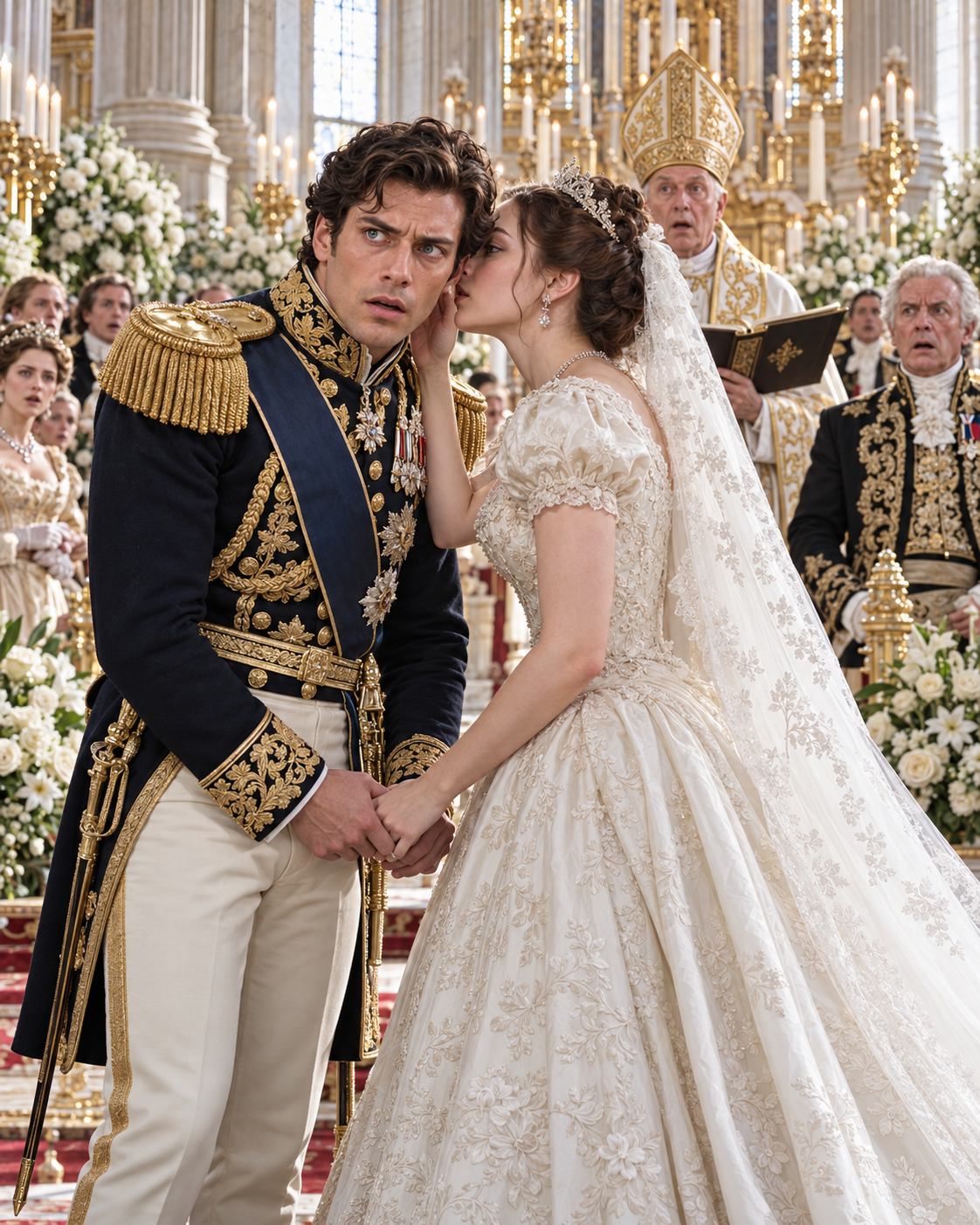
The Duke of Ashborne had just married the woman who owned his debts.
The name written beneath the threat was Edmund Hail.
Gideon read it twice, his fingers tightening around the rain-soaked paper.
His younger brother had been missing for eleven days.
According to the last letter received at Ashborne, Edmund was visiting friends in Bath, recovering from an illness that had left him too weak to travel.
Gideon had believed every word.
Now, inside the darkened carriage, he looked at Claraara and saw something in her expression that disturbed him more than the message itself.
Recognition.
“You knew Edmund was in danger.”
Claraara did not immediately answer.
Outside, rain slipped down the carriage windows, blurring the gas lamps into pale, trembling circles.
“I suspected someone had reached him,” she said.
“And you said nothing?”
“I had no proof.”
“He is my brother.”
“I know.”
Gideon leaned back, staring at the woman he had married for money, only to discover that money was the least dangerous thing she possessed.
“How much of my family’s ruin was arranged before you entered that church?”
The question struck harder than he intended.
Claraara looked toward the window.
For a moment, she seemed ready to accept the accusation without defending herself.
Then she opened the small brass key in her palm.
“Your father came to me because he believed someone within the Crown was stealing from the Crown itself.”
Gideon said nothing.
“He had evidence,” she continued. “Documents proving that military supplies were being diverted through private vessels and sold overseas. Men were growing wealthy while government warehouses reported losses that never existed.”
“And you helped him?”
“I agreed to transport a sealed chest to a safe location. Nothing more.”
“Blackwater Pier.”
She nodded.
“But the vessel never reached its intended destination.”
A sudden knock struck the carriage door.
Gideon moved instinctively, placing himself between Claraara and the sound.
“Your Grace,” the driver called, his voice shaking. “There is a gentleman asking after the duchess.”
Claraara closed her fingers around the key.
“Don’t answer him.”
The door handle turned.
Gideon caught it before the latch released.
“We are not receiving visitors.”
A man’s voice came from the other side.
“Then perhaps you would prefer I deliver your brother’s finger instead.”
The silence that followed seemed to swallow even the rain.
Gideon slowly opened the door.
A narrow-faced stranger stood beneath a black umbrella, his coat dripping onto the stones.
He held a small parcel wrapped in linen.
Gideon’s eyes fixed on it.
The stranger smiled.
“Only a demonstration, Your Grace.”
Before Gideon could reach him, the man dropped the parcel onto the carriage step and disappeared between two waiting coaches.
Gideon tore away the cloth.
Inside lay Edmund’s silver signet ring.
The family crest had been scratched almost beyond recognition.
Wrapped around it was a strand of dark hair.
Claraara took one look and reached for Gideon’s hand.
“He’s alive,” she said.
Gideon turned toward her.
“How can you possibly know?”
“Because if they had killed him, they would have sent something that could not be mistaken.”
For once, her cold reasoning offered no comfort.
But it gave him something to hold on to.
A possibility.
And for the moment, that was enough.
By the time they reached Ashborne House in London, the household had been awakened and the front entrance secured.
Gideon dismissed the servants and followed Claraara into his private study.
She locked the door behind them.
On the desk lay the shipping manifest, Edmund’s ring, and the brass key.
Three objects that seemed to belong to entirely different lives.
“Tell me everything,” Gideon said.
Claraara removed her pearl necklace, placing it carefully beside the documents.
“There is a warehouse near the eastern docks,” she began. “Number seventeen. My father leased it through an intermediary years ago. The key opens a private compartment beneath the floor.”
“What is inside?”
“I don’t know.”
He stared at her.
“You have risked my brother’s life for something you have never seen?”
“Your father made me promise not to open it unless someone came asking for the Blackwater shipment.”
“And now someone has.”
She nodded.
Gideon crossed the room, stopping beside the unlit fireplace.
“Why did you marry me, Claraara? The truth this time.”
She watched him for several seconds.
“Because Thorne had begun investigating my father’s company, and I needed time to protect the people who worked for us.”
“That is not the entire answer.”
“No.”
Her voice softened.
“Your father told me that if anything happened to him, I should find you.”
Gideon turned.
The words seemed to disturb the room itself.
“My father barely trusted me with the estate accounts.”
“He believed you would refuse to take part in something dishonorable, even if it cost you everything.”
Gideon looked down at the scattered papers.
His father’s final months had been filled with arguments, unpaid debts, and increasingly bitter silences.
He had died before either of them found a way to speak without anger.
Now Claraara was telling him that beneath those failures lay a secret his father had trusted him to uncover.
“Why didn’t he tell me himself?”
“He intended to.”
Gideon closed his eyes.
He remembered the last letter his father had written.
A brief request to return home.
He had ignored it for three weeks.
By the time he arrived, the old duke was dead.
Claraara watched his face but offered no easy consolation.
Instead, she moved closer.
“We can still find Edmund.”
Gideon opened his eyes.
“Then we begin tonight.”
The warehouse stood beside a deserted stretch of river where the Thames moved black beneath the fog.
Two hours before dawn, Gideon and Claraara approached through a narrow passage lined with damp brick.
They had brought only one trusted servant, Thomas Vale, an aging former soldier who had served the Hail family for thirty years.
Vale carried a lantern and a pistol.
He had asked no questions when Gideon ordered the carriage prepared.
But as they approached the warehouse, he glanced toward the river.
“Someone has been here recently, Your Grace.”
A fresh boot print marked the mud beside the entrance.
Claraara crouched to examine it.
“More than one person.”
Gideon drew her gently back.
“Stay behind me.”
She raised an eyebrow.
“That arrangement has not served either of us particularly well.”
“Indulge me.”
For the first time that night, the corner of her mouth moved.
“Very well.”
Inside, the air smelled of rope, salt, and old timber.
Rows of empty crates stood beneath beams darkened by years of river mist.
Claraara crossed toward a narrow staircase and counted seven floorboards from the wall.
She knelt.
The brass key slipped into a concealed lock.
A quiet metallic click echoed through the warehouse.
Beneath the loosened board lay a small iron box.
Gideon lifted it onto a crate.
Inside were shipping records, coded correspondence, and a leather-bound ledger.
There was also a letter addressed to him.
He recognized his father’s handwriting before breaking the seal.
“My dear Gideon,” it began.
“If you are reading this, I have failed to bring the truth into daylight.”
Gideon swallowed.
The letter described government supplies purchased at inflated prices, fictitious shipments, and payments moving through accounts controlled by men who claimed to serve the Crown.
His father had discovered the fraud after wagering against a shipping syndicate whose members later used his debts to silence him.
The eighty thousand pounds had not been lost entirely at gaming tables.
Some had been deliberately manufactured.
A chain of fraudulent loans had been built around the old duke until his estate became collateral for keeping him quiet.
Gideon’s hands went cold.
The shame that had followed his father’s death suddenly took on another shape.
Not innocence.
His father had certainly been reckless.
But someone had turned that weakness into a weapon.
At the bottom of the letter was a final warning.
“Do not trust the man who comes bearing lawful authority. His master wears a judge’s robes.”
Claraara read the line over Gideon’s shoulder.
“Thorne.”
Before Gideon could reply, Vale extinguished the lantern.
Footsteps sounded beyond the warehouse door.
Three men entered carrying lamps.
One wore a naval officer’s coat without insignia.
“Search the floor,” he ordered.
Gideon pulled Claraara behind a stack of crates.
Vale raised his pistol.
The first shot shattered a lantern.
Darkness exploded across the warehouse.
Someone shouted.
A second shot struck timber above Gideon’s head.
Claraara seized the ledger and pushed it inside her cloak.
“Through the river door,” she whispered.
They ran.
Vale remained behind long enough to overturn a heavy rack of crates, blocking the passage.
Gideon heard a cry of pain.
He turned.
“Vale!”
“Go, Your Grace!”
The old soldier appeared through the darkness, one hand pressed against his shoulder.
Blood ran between his fingers.
Gideon caught him, and together they stumbled toward the narrow dock.
A small boat was tied beneath the warehouse.
Claraara untied it with practiced hands.
They pushed away just as armed men reached the doorway.
A bullet struck the water beside them.
Then another.
Gideon threw himself over Claraara as the boat drifted into the fog.
For several minutes, none of them spoke.
Only Vale’s strained breathing broke the silence.
Claraara tore a strip from her petticoat and bound his wounded shoulder.
“Will he live?” Gideon asked.
“He intends to,” Vale muttered through clenched teeth.
Claraara almost smiled.
But when she examined the ledger beneath the lantern of a passing riverboat, her expression changed.
There were dozens of names.
Officials.
Merchants.
Members of Parliament.
And beside several entries, a single repeated mark.
A small crown drawn inside a circle.
She turned another page.
Then stopped.
Gideon noticed her stillness.
“What is it?”
She held out the ledger.
At the bottom of the final column was a name neither of them expected.
Hastings.
Her father’s signature.
For the first time since Gideon had met her, Claraara seemed unable to speak.
The boat rocked gently beneath them.
“My father told me he had stopped dealing with those men,” she whispered.
Gideon looked at the signature.
“Perhaps he lied.”
She closed the ledger.
“Or perhaps someone made certain it looked that way.”
The morning brought little clarity.
By noon, Vale was recovering under the care of a discreet physician, and the warehouse had been burned to its foundations.
The fire had begun shortly after their escape.
No official report mentioned armed men or stolen documents.
Instead, a newspaper described an unfortunate industrial accident.
Claraara read the article twice.
Then she placed it beside the ledger.
“They are erasing the evidence.”
Gideon stood at the window, watching carriages pass along the street.
“Not all of it.”
The ledger remained locked inside his desk.
But the document was only part of their problem.
Edmund was still missing.
And Thorne now knew they had found something worth killing for.
That afternoon, an unexpected visitor arrived.
Claraara’s father.
Nathaniel Hastings entered the drawing room with his usual immaculate appearance, his silver-headed cane tapping against the polished floor.
He greeted Gideon politely.
Then he looked at his daughter.
“You should have left matters alone.”
Claraara remained standing.
“Where is Edmund Hail?”
Nathaniel’s eyes flickered.
“I don’t know.”
“Father.”
“I swear it.”
Gideon moved toward him.
“Your signature appears in a ledger recording payments connected to stolen Crown property.”
Nathaniel lowered himself into a chair.
For several moments, he stared at the cane between his knees.
Then he spoke.
“I signed those papers to keep her alive.”
Claraara’s expression tightened.
“What?”
Nathaniel looked up.
“Thorne knew about your involvement with the Blackwater shipment. He knew you had moved records he wanted destroyed.”
“You told me he suspected nothing.”
“Because I thought I could settle the matter.”
He reached inside his coat and withdrew a folded letter.
“The payments were protection money. I paid him to keep your name out of the investigation.”
Claraara took the document.
Her father’s handwriting filled the page, but at the bottom was Thorne’s acknowledgment of receipt.
Gideon studied the signature.
It matched a mark recorded beside several transactions in the ledger.
“Why did you continue paying him?”
Nathaniel’s hands trembled.
“Because every time I paid, he found another reason to demand more.”
Claraara sank slowly into a chair.
For years, she had believed she was protecting her father from the consequences of her decisions.
Now she understood that he had been trying to protect her from the same men.
Neither had trusted the other with the truth.
And that silence had made them easier to control.
Nathaniel leaned forward.
“There is something else.”
Gideon waited.
“Croft came to see me yesterday. He said the magistrate would release Edmund if Claraara surrendered the ledger.”
“Where?”
“At Blackwater Pier. Tomorrow at midnight.”
Claraara rose immediately.
“We cannot hand it over.”
Gideon looked toward her.
“We cannot abandon my brother either.”
“I know.”
The words were quiet, but the conflict in her face was unmistakable.
For the first time, the woman who could calculate the movement of fortunes across oceans had no simple answer.
That evening, Gideon found her alone in the library.
A single candle burned beside the ledger.
She had been copying its pages by hand.
He stood in the doorway for a moment.
“You should rest.”
“So should you.”
Neither moved.
Gideon approached the table.
“How many copies?”
“Three.”
“Where will they go?”
“One to a solicitor outside London. Another to a newspaper editor my father trusts.”
“And the third?”
She looked at him.
“To someone who has spent years trying to expose corruption within the Admiralty.”
Gideon studied her face.
“You planned this without asking me.”
“I thought you might object.”
“I might have.”
“Would you have stopped me?”
He pulled out the chair opposite her.
“No.”
She lowered her pen.
For several seconds, the silence between them held none of the hostility that had once defined their marriage.
“Your brother may die because of me,” she said.
Gideon shook his head.
“My brother is in danger because men believe they can own other people’s lives.”
Claraara looked down at her ink-stained fingers.
“I used your debts to force you into a marriage.”
“Yes.”
“I concealed the investigation.”
“Yes.”
“And I would have continued concealing it if Croft had not appeared.”
Gideon rested his hands on the table.
“Probably.”
She looked up, surprised by his calmness.
“Why are you still here?”
He considered the question.
Then he reached for the final sheet of paper and began helping her copy the names.
“Because you are no longer carrying this alone.”
Claraara watched him for a moment.
Then she dipped her pen into the ink.
Neither spoke again until the candle burned low.
The following night, Blackwater Pier lay beneath a cold autumn mist.
Gideon arrived shortly before midnight, carrying a leather case.
Claraara walked beside him.
Far behind them, hidden along the river road, waited two men sent by a solicitor who had agreed to deliver the copied evidence.
A third messenger had already departed for the Admiralty.
They could not be certain the documents would reach anyone trustworthy.
But it was the only chance they had.
Croft stood beneath a lantern at the end of the pier.
Beside him were two armed men.
And between them stood Edmund.
His face was bruised.
One eye had swollen nearly shut.
But when he saw Gideon, he straightened.
“Brother.”
Gideon stopped.
“Are you hurt?”
“Not as badly as their pride.”
One of the guards struck Edmund across the shoulder.
Gideon took a step forward.
Croft raised his hand.
“Let us avoid unnecessary unpleasantness.”
Claraara looked past him.
“Where is Magistrate Thorne?”
A figure emerged from the shadows.
The magistrate was taller than Gideon expected, with pale eyes and a narrow mouth.
He wore a dark coat, neatly buttoned despite the damp.
“Your Grace,” he said with a slight bow. “And Duchess. I had hoped we might conduct this discussion privately.”
Gideon lifted the leather case.
“The ledger. Release my brother.”
Thorne smiled.
“First, I should like to know whether you made copies.”
Claraara answered before Gideon could speak.
“Of course.”
The magistrate’s smile disappeared.
“That was unwise.”
“Perhaps.”
She stepped forward.
“But killing us will no longer make the evidence disappear.”
Thorne studied her.
Then he laughed softly.
“You misunderstand the nature of influence, Duchess. Evidence matters only when it reaches someone willing to act upon it.”
Claraara held his gaze.
“Then you must be very confident in the loyalty of your friends.”
“I am confident in their fear.”
He extended his hand.
“The ledger.”
Gideon opened the case.
Inside lay the original book.
Thorne glanced at the pages and nodded.
“Now the copies.”
“They have already left London,” Gideon replied.
The magistrate’s expression hardened.
A long silence followed.
Then he made a small gesture.
One of the guards pressed a pistol against Edmund’s temple.
Claraara drew a sharp breath.
Gideon remained still.
“Call them back,” Thorne said.
“Too late.”
“Then your brother dies.”
Gideon looked at Edmund.
His younger brother met his eyes.
And with the faintest movement of his head, Edmund told him not to surrender.
Gideon understood.
But understanding did not make the choice easier.
He took one slow step forward.
“Your quarrel is with me.”
Thorne tilted his head.
“Your father said something similar.”
The words struck Gideon like a physical blow.
“You knew him.”
“Quite well.”
“Did you kill him?”
Thorne examined the ledger in his hands.
“Your father was an inconvenient man. Unfortunately, inconvenient men often suffer unexpected misfortunes.”
Claraara moved closer to Gideon.
Her hand brushed his sleeve.
A warning.
Not yet.
Gideon forced himself to remain still.
“Then you admit responsibility.”
Thorne smiled again.
“To whom, Your Grace?”
A distant bell sounded from the river.
Midnight.
Thorne turned toward his guards.
“Finish it.”
The first gunshot came from behind the warehouse.
One of the armed men collapsed.
The second spun toward the sound.
Edmund drove his elbow into the man’s ribs and dropped to the boards.
Gideon rushed forward.
A pistol fired.
Wood splintered beside his shoulder.
Claraara seized the lantern and hurled it against a stack of empty barrels.
Flames spread across spilled oil.
For a moment, orange light swallowed the pier.
Men shouted.
Croft drew his weapon.
Then stopped.
Through the smoke emerged several armed officers in naval uniform.
At their center walked an older gentleman wearing the insignia of a senior Admiralty commissioner.
“Magistrate Thorne,” the man called. “By order of the Crown, you will surrender your weapons.”
Thorne stared at him.
Then at Claraara.
“You.”
She stood beside Gideon, her dress darkened by rain and soot.
“One of the copies reached the Admiralty yesterday,” she said.
The magistrate’s gaze shifted toward Croft.
“You assured me she had no allies.”
Croft slowly lowered his pistol.
“I assured you she had no allies within your office.”
Thorne lunged toward Claraara.
Gideon caught him before he reached her.
The two men crashed against the railing.
Rotten wood cracked beneath their weight.
For one terrifying instant, both stood balanced above the black river.
Thorne struck Gideon across the face.
Gideon lost his grip.
The magistrate stumbled backward.
His heel slipped.
Then his body vanished into the water.
Gideon caught the broken rail, staring into the darkness below.
A moment later, officers rushed past him, lowering ropes toward the river.
Thorne surfaced beside a piling, choking and struggling against the current.
He was hauled aboard a patrol boat moments before the tide carried him beneath the pier.
Alive.
And under arrest.
Gideon turned away.
Edmund stood nearby, supported by two sailors.
Claraara was beside him.
She looked at Gideon across the smoke.
For a moment, neither moved.
Then she crossed the pier and placed both hands against his face.
Blood ran from a cut above his eyebrow.
“You’re hurt.”
“So are you.”
“It’s nothing.”
“Then neither is this.”
She almost laughed.
Instead, she rested her forehead briefly against his.
Around them, orders were shouted and prisoners were taken away.
But for several seconds, the world seemed to narrow to the space between them.
The investigation that followed lasted through the winter.
Thorne’s arrest exposed a network of fraudulent contracts, diverted naval supplies, and payments disguised as ordinary shipping expenses.
Several officials resigned before they could be questioned.
Others were prosecuted.
The Crown recovered a considerable portion of the stolen property.
And the forged debts that had nearly destroyed Ashborne were finally examined.
Not every pound could be recovered.
Not every dishonest man faced punishment.
But enough evidence survived to establish that Gideon’s father had been deliberately ruined after attempting to expose the conspiracy.
The old duke’s reputation was not entirely restored.
He had made mistakes.
He had gambled recklessly.
He had trusted people who used his weaknesses against him.
Yet the truth of his final efforts reached the public.
For Gideon, that mattered more than the newspapers’ carefully worded apologies.
One afternoon in February, he visited his father’s grave.
Snow rested along the edges of the stone.
He stood there without an umbrella, holding the last letter discovered in the iron box.
For years, he had remembered their final argument.
The anger.
The accusations.
The door he had closed without looking back.
Now he remembered something else.
The tired expression on his father’s face when he had asked Gideon to stay.
Gideon unfolded the letter once more.
Near the bottom, beneath the warning about Thorne, his father had written a final sentence.
“I hope one day you will understand that a man’s worth is not measured by the fortunes he inherits, but by what he chooses to protect.”
Gideon stood motionless.
Then he folded the letter and slipped it inside his coat.
“I understand,” he said quietly.
When he returned to Ashborne, the estate was changing.
The eastern wing had been restored.
The tenants’ cottages had new roofs.
Fields once neglected were being leased under fairer agreements.
Claraara had overseen most of the improvements with the same precision she had once brought to shipping contracts.
But something else had changed.
She no longer worked behind closed doors.
Gideon attended meetings beside her, learning the figures, questioning the arrangements, and signing only what he fully understood.
And when visitors addressed their proposals solely to him, he had developed a habit of turning toward his wife.
“The duchess will want to examine that.”
Some guests found it amusing.
Others found it improper.
Gideon paid neither group much attention.
One evening, as the last light faded across the gardens, Claraara entered his study carrying a sealed document.
He was sitting beside the fire, reviewing plans for a new school on the estate.
“Another shipping contract?” he asked.
“No.”
She placed the paper before him.
It was a legal declaration.
The document transferred every remaining private claim she held against Ashborne into a trust for the estate’s tenants and future improvements.
Gideon read it carefully.
Then looked up.
“What is this?”
“Your freedom.”
He frowned.
“Claraara.”
“The debts were the reason you agreed to marry me. They should not be the reason you remain.”
She stood very still.
For once, she seemed uncertain what to do with her hands.
“I have instructed the solicitor to prepare whatever arrangements you consider appropriate.”
Gideon set down the paper.
“Are you asking for a separation?”
“I am giving you a choice.”
He rose slowly.
Outside, the wind stirred the bare branches against the windows.
“Did you believe I stayed because I was afraid of losing Ashborne?”
She looked away.
“At first, you had no other reason.”
“At first.”
The two words lingered.
Claraara drew a breath.
“I know what I did to you. I bought your debts, concealed my intentions, and made your title part of a bargain you never fully understood.”
“Yes.”
“I cannot undo that.”
“No.”
Her eyes lifted toward his.
“Then perhaps this is the only honest thing I have left to offer.”
Gideon approached her.
He took the document from the desk and examined it once more.
Then he placed it carefully inside a drawer.
“You are right about one thing,” he said.
“Our marriage began as a transaction.”
She waited.
“But the mistake we made was believing a transaction could tell us everything about the person standing on the other side.”
Claraara’s lips parted slightly.
Gideon reached for her hand.
There was still a faint scar across her palm from the night at Blackwater Pier.
He touched it with his thumb.
“You gave me back my estate,” he said. “But that is not why I want you here.”
She searched his face.
“And why do you?”
He smiled faintly.
“Because when everyone else saw a ruined duke, you saw a man who might still become useful.”
A quiet laugh escaped her.
“I saw a man who was extraordinarily difficult to negotiate with.”
“And yet you married him.”
“A questionable investment.”
“One you may find difficult to dispose of.”
She lowered her head, smiling despite herself.
Then the smile faded into something gentler.
“Gideon, I never expected you to forgive me.”
“I haven’t forgotten.”
“I know.”
“But I have learned that forgiveness is not pretending the injury never happened.”
He lifted her hand.
“It is deciding what we will build after it.”
For a long moment, Claraara could not answer.
Then she stepped closer and rested her forehead against his shoulder.
Gideon held her without speaking.
There were no witnesses.
No vows.
No gold rings newly exchanged beneath a church ceiling.
Only two people standing beside a quiet fire, finally free to choose one another.
By spring, the new school at Ashborne had opened its doors.
Children whose parents had worked the estate for generations entered classrooms bright with morning sunlight.
Claraara established a fund to educate daughters as well as sons, despite the objections of several neighboring families.
Gideon supported the decision without hesitation.
When one elderly gentleman protested that teaching girls mathematics would give them unsuitable ambitions, Claraara merely handed him the school’s financial records.
“Then perhaps you would prefer to explain these figures to the duchess yourself,” Gideon suggested.
The gentleman declined.
Edmund, fully recovered, began working alongside the estate’s solicitors, determined to help other families challenge predatory creditors.
Nathaniel Hastings retired from daily control of his shipping company, finally acknowledging publicly that his daughter had been responsible for much of its success.
And Claraara, now openly directing both the company’s lawful operations and the estate’s investments, discovered that respect earned in daylight felt very different from power exercised in secret.
One evening in early summer, Gideon found her standing on the terrace overlooking the gardens.
The last sunlight lay across the grass.
From the distant schoolhouse came the faint sound of children singing.
He approached without speaking.
She leaned against him as naturally as if she had always belonged there.
“Do you ever regret it?” she asked.
“What?”
“That morning in the church.”
Gideon looked toward the western horizon.
“I regret that I mistook your silence for obedience.”
Claraara smiled.
“And I regret that I mistook your pride for weakness.”
He turned toward her.
“Then we were both very poor judges of character.”
“Terrible.”
“Fortunately, we have had time to improve.”
She laughed softly.
The sound was small, unguarded, and entirely different from the controlled politeness of their early marriage.
Gideon took her hand.
Below them, the windows of Ashborne glowed with warm evening light.
Once, he had believed preserving those walls was the most important duty of his life.
Now he understood that a house could survive for centuries and remain empty in every way that mattered.
Wealth could purchase comfort.
A title could command attention.
Fear could compel obedience.
But none of those things could buy the quiet trust of someone who had seen a man’s failures and still chosen to stand beside him.
Claraara turned toward the open doors.
“Come inside. You promised to help me review the accounts.”
Gideon sighed.
“Must we discuss money on such a beautiful evening?”
“Your Grace, that is precisely the sort of attitude that nearly ruined your family.”
He looked at her.
She raised an eyebrow.
And then, laughing, he followed his wife into the house.
The doors closed gently behind them, leaving the garden still beneath the evening sky.
Their marriage had begun with a debt neither could afford to ignore.
It endured because, when they were finally free of that debt, they discovered something more valuable than either fortune or title.
They had learned to tell each other the truth, even when the truth threatened everything they hoped to keep.
And in the end, that was the lesson Ashborne would pass from one generation to the next:
A life built on power may command loyalty, but only a life built on trust can inspire someone to stay when they are free to leave.
THE END.