The Duchess had arranged to disappear before her husband could discover she was carrying his child.
The words remained suspended in the drawing room, accompanied only by the rain striking the tall windows.
Claraara stared at the butler, certain she had misunderstood him.
“Whether I agree or not?”
The elderly servant lowered his eyes.
“Those were his exact instructions, Your Grace.”
Alistister rose slowly from beside her chair.
“Who sent him?”
“The driver claims to have a written authorization bearing Her Grace’s signature.”
Claraara felt the warmth leave her hands.
She had arranged for a carriage to collect her at dawn, three days from now, from the eastern entrance. Only three people knew of the arrangement.
And she had signed no authorization permitting anyone to take her against her wishes.
“Bring the document,” Alistister said.
The butler hesitated.
“And have the driver remain outside. He is not to approach the Duchess.”
“Very good, Your Grace.”
When the door closed, Claraara attempted to stand.
Alistister immediately turned toward her, but stopped himself before reaching for her arm.
“Don’t,” she whispered.
His hand fell to his side.
For several seconds, neither moved.
Then he asked, “Who helped you make these arrangements?”
Claraara looked toward the writing desk.
“My companion, Mrs. Veyne, assisted with the correspondence. The physician at Northmere agreed to receive me.”
“And who else?”
“No one.”
Alistister’s expression darkened.
“Where is Mrs. Veyne?”
“She left yesterday to prepare the house.”
He looked toward the door through which the butler had disappeared.
Something was wrong.
The carriage had arrived too early. The instructions were too forceful. And whoever had sent it knew precisely where Claraara intended to go.
“Claraara, I need you to tell me something.”
She lifted her face.
“Did you ever tell anyone that I knew about the child?”
“No.”
“Did anyone ask?”
She hesitated.
Three weeks earlier, Mrs. Veyne had asked whether the Duke might object to her departure.
Claraara had dismissed the question at the time.
Now she remembered the woman’s fingers tightening around her sewing basket when Claraara answered that her husband would not care.
“Mrs. Veyne asked whether you would try to stop me.”
“And what did you say?”
“That you wouldn’t notice until I was gone.”
Alistister looked away.
The answer struck him harder than she intended.
But he had little right to protest.
A knock interrupted them.
The butler returned with a folded document, its edges damp from the rain.
Alistister unfolded it beneath the lamplight.
Claraara watched his eyes move across the page.
Then he handed it to her.
Her name appeared at the bottom in elegant, slanting handwriting.
It was an almost perfect imitation.
Almost.
“That’s not my signature,” she said.
“I know.”
She looked up sharply.
“How?”
“You never cross the second letter of your name that way.”
Claraara stared at him.
He offered no explanation.
He merely took the document back and examined the seal.
The red wax bore the crest of Northmere.
But beneath the raised impression lay a second mark, faint and nearly invisible.
Alistister moved closer to the lamp.
His face went still.
“What is it?” Claraara asked.
He folded the paper.
“Something I hoped never to see again.”
Before she could question him, a sharp crash sounded outside.
Glass shattered somewhere below.
Then came a shout.
Alistister crossed the room in three strides and opened the door.
The butler was already running toward the staircase.
“Your Grace! The driver has forced his way into the servants’ entrance!”
Alistister turned back.
“Lock this door behind me.”
Claraara rose.
“I’m coming with you.”
“No.”
The word came too quickly.
Her expression changed.
For one terrible instant, he recognized the look she had worn whenever he had dismissed her from his study or ended a conversation before she had finished speaking.
He drew a slow breath.
“There may be someone downstairs intending to harm you,” he said. “I need you somewhere safe while I find out who sent him.”
She held his gaze.
“Then tell me what that seal means.”
His hesitation was brief, but unmistakable.
“I will.”
“When?”
“As soon as I know you are safe.”
Claraara looked toward the corridor.
“That sounds very much like another promise to explain something later.”
He absorbed the accusation without answering.
Then he removed a small key from his pocket and placed it on the table.
“The adjoining library has a concealed passage to the west gallery. If anyone enters this room, use it.”
She looked at the key.
“You’ve never told me about that passage.”
“There are many things I should have told you.”
He left before she could respond.
Claraara stood listening to his footsteps descend the staircase.
A door slammed.
Men shouted.
Then a sudden, startling silence.
She crossed to the window.
Through the rain-blurred glass, she could make out a carriage standing crookedly beneath the entrance lamps.
Two horses stamped against the wet stones.
A man in a dark coat struggled between the Duke’s footmen.
Another figure stood near the carriage, holding something beneath his cloak.
Claraara leaned closer.
The figure lifted his face.
For an instant, the light caught a familiar profile.
Her stomach tightened.
She knew that man.
He had visited her husband’s study last winter.
Alistister had introduced him as a distant cousin.
Lord Edmund Vale.
The memory returned with uncomfortable clarity.
Edmund had been charming, attentive, and unusually interested in whether the Duke intended to establish a nursery.
At the time, Claraara had thought him merely intrusive.
Now she watched him disappear into the darkness before anyone could stop him.
A hand suddenly touched her shoulder.
Claraara turned with a gasp.
Mrs. Hensley, the senior housekeeper, stood behind her.
“Your Grace, we must move away from the windows.”
“Lord Vale was outside.”
The housekeeper’s expression altered.
“Are you certain?”
“Yes.”
Mrs. Hensley glanced toward the door.
Then she lowered her voice.
“Come with me.”
She guided Claraara into the adjoining library and locked the door.
The room smelled of leather bindings and wood smoke. A single lamp burned beside the Duke’s desk.
Mrs. Hensley crossed to a cabinet and withdrew a small wooden box.
“I was instructed to give you this if anything happened to His Grace.”
Claraara stared at her.
“By whom?”
“His Grace himself.”
The housekeeper opened the box.
Inside lay a bundle of letters tied with faded blue ribbon.
The uppermost envelope bore Claraara’s name.
She recognized Alistister’s handwriting immediately.
But the date astonished her.
It had been written four years earlier.
With unsteady fingers, she unfolded the first letter.
“My dearest Claraara…”
She stopped reading.
Alistister had never called her that.
Not aloud.
Not in writing.
She looked at Mrs. Hensley.
“What is this?”
“Letters His Grace never sent.”
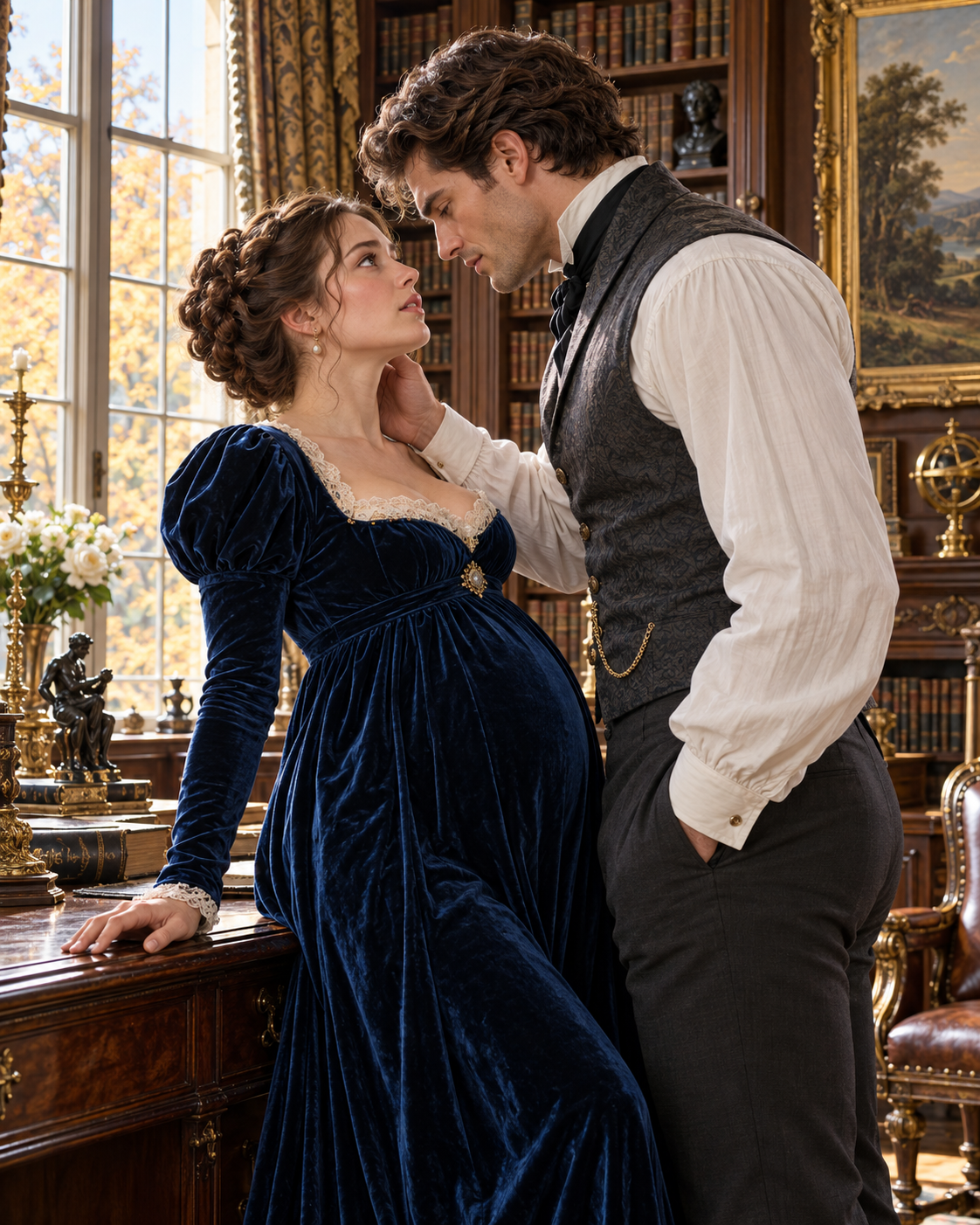
Claraara lowered her eyes to the page.
He had written about finding her asleep in the conservatory with a book resting against her cheek.
About the way she spoke gently to servants whom other members of the household scarcely noticed.
About how he had wanted to ask her to remain beside him after dinner, but had convinced himself that she would rather be elsewhere.
There were no extravagant declarations.
Only observations.
Small, painfully particular things.
Things she had never imagined he noticed.
At the bottom of the letter, one sentence had been crossed out so heavily that she could barely decipher it.
She brought the page closer to the lamp.
“I am beginning to fear that the only person I cannot bear to disappoint is the one I keep at a distance.”
Claraara sat down.
Another letter lay beneath it.
Then another.
Twenty-seven in total.
None had been delivered.
“Why?” she whispered.
Mrs. Hensley folded her hands.
“His Grace has not had an easy life, but that is his story to tell.”
Claraara looked toward the locked door.
“Then why show them to me?”
“Because I have watched two people live as strangers in the same house for five years.”
The older woman’s voice trembled slightly.
“And because tonight, I fear silence may cost more than either of you can afford.”
A distant gunshot broke through the rain.
Claraara sprang to her feet.
The letters slipped from her lap.
Mrs. Hensley hurried toward the door, but Claraara caught her sleeve.
“Was that inside the house?”
Neither woman answered.
Footsteps thundered along the corridor.
Then came Alistister’s voice.
“Claraara!”
She unlocked the door before Mrs. Hensley could protest.
He stood on the other side, breathing hard, rainwater dripping from his hair.
A dark stain marked his left sleeve.
Claraara’s eyes fixed on it.
“You’re hurt.”
“It’s a graze.”
She reached for his arm.
He flinched before he could conceal it.
“Alistister.”
“It’s nothing that requires your worry.”
She looked at him.
“Do not decide that for me.”
He fell silent.
For a moment, something almost like a smile touched his exhausted face.
Then he saw the letters scattered near her feet.
His expression changed.
Mrs. Hensley quietly withdrew.
Alistister stepped into the library.
“You read them.”
“Some.”
He looked toward the desk.
“I never intended—”
“Why didn’t you send them?”
His gaze returned to her.
The rain softened against the windows.
“I thought they would be unwelcome.”
Claraara gave a small, incredulous laugh.
“Twenty-seven letters?”
He lowered his eyes.
“I wrote more than that.”
She stared at him.
Then, despite everything, tears gathered unexpectedly along her lashes.
“You let me believe there was nothing.”
“I know.”
“For five years.”
“I know.”
She looked at the letters.
“Did you think I would laugh at you?”
“No.”
“Then what?”
Alistister rested his uninjured hand against the back of a chair.
“My father married a woman he loved. After she died, he treated every remaining member of the family as though affection itself had betrayed him.”
Claraara listened.
“I grew up watching him turn grief into punishment. I promised myself I would never place that kind of weight on another person.”
His fingers tightened against the wood.
“When our marriage was arranged, you were nineteen. You looked frightened on our wedding day.”
“I was frightened.”
“I thought the kindest thing I could give you was distance.”
She studied his face.
“And when I tried to come closer?”
“I convinced myself you were only being polite.”
Claraara remembered all those evenings when she had entered his study with some insignificant question, hoping he might invite her to remain.
He had always answered courteously.
Always dismissed her before she could find another reason to stay.
“I thought you wanted me gone,” she said.
“I thought you wanted to be free of me.”
The admission rested between them.
Neither tried to soften it.
At last, Claraara bent to collect the letters.
Alistister knelt to help, but she caught his wounded sleeve.
“Sit down.”
He looked surprised.
“Claraara—”
“That is not a suggestion.”
For once, he obeyed without argument.
She found a clean linen cloth in the cabinet and pressed it gently against his arm.
He watched her hands.
“You shouldn’t have had to discover those letters this way,” he murmured.
“No,” she replied. “I shouldn’t.”
She tied the cloth securely.
Then she looked at him.
“And you should not have had to discover our child by watching me struggle to breathe.”
His expression tightened.
She rested her hand over his.
“But we are here now.”
He turned his palm upward beneath hers.
A hesitant gesture.
A question without words.
For the first time, she allowed their fingers to remain intertwined.
Then the library door opened.
The butler entered, accompanied by two footmen.
“Your Grace, the driver has confessed.”
Alistister stood.
“Speak.”
The butler glanced toward Claraara.
Alistister noticed.
“You may speak in front of the Duchess.”
The servant bowed.
“The man was promised fifty pounds to deliver Her Grace to Northmere before midnight. His instructions came from Lord Vale.”
Claraara felt the room tilt.
Alistister’s hand tightened around hers.
“Where is Vale now?”
“He escaped through the orchard.”
“And Mrs. Veyne?”
The butler hesitated.
“She has been found in the carriage house.”
Claraara stepped forward.
“Is she injured?”
“She is alive, Your Grace, but someone tied her to a chair. She says she never reached Northmere.”
Alistister went very still.
“Bring her inside. Send for the magistrate. Double the guards.”
The butler departed.
Claraara looked at her husband.
“Why would Edmund want me taken to Northmere?”
Alistister crossed to the window.
His reflection appeared in the dark glass, drawn and older than it had been that afternoon.
“Because Northmere belongs to the family trust.”
“I know that.”
“And if I die without a legitimate child, the greater part of the estate passes to Edmund.”
Claraara’s hand moved instinctively to her abdomen.
The Duke turned.
“Until today, I believed he had no idea you were pregnant.”
She looked at the forged letter on the desk.
“Then the child changes everything.”
“Yes.”
A cold realization passed between them.
Edmund had not sent men merely to frighten her.
He wanted control over where the child would be born.
And over who would witness it.
“Could he claim the baby wasn’t yours?” she asked.
Alistister nodded grimly.
“If he could isolate you, control the household records, or prevent me from acknowledging the birth, he might attempt it.”
Claraara looked toward the door.
“And if that failed?”
Her husband did not answer.
He didn’t need to.
She pressed a hand against the small movement beneath her gown.
Alistister came closer.
“We’ll leave for my mother’s old residence tomorrow. The magistrate can investigate while you’re somewhere secure.”
Claraara slowly shook her head.
“No.”
“Claraara—”
“No more decisions made around me.”
He stopped.
She lifted her chin.
“I spent months planning an escape because I believed this house was a place where my voice meant nothing.”
His expression tightened with recognition.
“If I remain your wife only to be moved from one guarded room to another, nothing has changed.”
Alistister stood before her, silent.
Then he asked, “What would you have us do?”
The question surprised her.
She had prepared herself for another argument.
Instead, he waited.
Claraara looked at the forged document.
“We find out how Edmund obtained my correspondence. We speak to Mrs. Veyne, and we make certain he cannot return.”
Alistister considered her words.
Then he nodded.
“Together.”
She held his gaze.
“Together.”
For the first time that evening, the word sounded like something they might actually mean.
By midnight, Mrs. Veyne had been carried to a guest chamber.
Her wrists were bruised, and a shallow cut marked her temple.
Claraara sat beside her bed while Alistister questioned her gently.
The older woman described being intercepted on the northern road by men wearing the Duke’s livery.
They had claimed Alistister had sent them.
When she refused to surrender Claraara’s travel instructions, they took her papers by force.
“Lord Vale came to the carriage house,” Mrs. Veyne whispered.
“He asked whether the Duchess had told His Grace about the child.”
Claraara leaned closer.
“What did you tell him?”
“Nothing.”
Mrs. Veyne’s eyes filled.
“He said it didn’t matter. He already knew.”
Alistister’s face hardened.
“How?”
The woman swallowed.
“He had a letter from Vienna.”
For a moment, the room seemed to grow colder.
“From Vienna?” Claraara repeated.
Mrs. Veyne nodded.
“He said the Duke would not return in time to interfere.”
Alistister moved toward the window.
Claraara watched him.
“What is it?”
He turned slowly.
“My negotiations in Vienna concerned the family trust.”
She waited.
“I was preparing to transfer Northmere and its revenues into a separate settlement for you.”
Claraara stared at him.
“Why?”
“Because I wanted you to have somewhere that belonged entirely to you, regardless of what happened to me.”
He looked briefly at her abdomen.
“I did not know about the child.”
She remembered the estate she had chosen for her escape.
Northmere had seemed remote, quiet, and sufficiently removed from the social world that exhausted her.
She had selected it without knowing that her husband was trying to give it to her.
The irony left her speechless.
“But Edmund must have intercepted the legal correspondence,” Alistister continued. “He knew the transfer would end his claim.”
Mrs. Veyne gripped the blanket.
“He said the papers would never be signed.”
Alistister closed his eyes briefly.
Claraara saw him recognize the implication.
Edmund had planned to remove her before the settlement could be completed.
And perhaps remove Alistister afterward.
“Where are the original documents?” she asked.
“In my traveling case.”
“Then we must protect them.”
He looked at her.
“They are already locked away.”
“Then we must make certain the right people know what they contain.”
A faint expression of respect crossed his face.
“My wife,” he murmured, “appears to be thinking more clearly than her husband.”
“Your wife,” she replied, “has had considerable practice planning around him.”
His mouth curved briefly.
It was the first time she had seen him smile without restraint.
By morning, the storm had passed.
Pale sunlight spread across the wet lawns, catching in the branches of the orchard.
But the house remained restless.
Two constables arrived shortly after breakfast.
The magistrate followed, carrying a leather case and a face that suggested he had been awakened far too early.
Alistister presented the forged letter, the driver’s confession, and Mrs. Veyne’s testimony.
Claraara sat beside him.
When the magistrate initially directed his questions toward the Duke, Alistister interrupted.
“The Duchess arranged the original journey. You will need her account.”
The magistrate turned toward her.
Claraara answered every question carefully.
She described her planned departure, the forged signature, and the suspicious carriage.
She did not conceal why she had intended to leave.
When asked whether her husband had known of the pregnancy, she answered simply, “No.”
Alistister remained beside her, his face composed.
But beneath the table, his hand found hers.
The magistrate finally closed his notebook.
“Lord Vale will be detained for questioning as soon as he is found.”
“And until then?” Claraara asked.
“We will maintain officers on the grounds.”
Alistister nodded.
“Make certain every entrance is watched.”
The magistrate departed shortly before noon.
Claraara had barely risen from her chair when a sudden tightening swept across her abdomen.
She stopped.
Alistister noticed immediately.
“What is it?”
“Nothing.”
He looked at her.
She exhaled slowly.
“A little pain.”
His expression changed.
“Where?”
She placed a hand against the lower curve of her stomach.
“It may be nothing.”
He reached for the bell.
Within minutes, the physician arrived.
Dr. Ashcombe was a quiet man with silver spectacles and a manner that became particularly deliberate whenever he had unwelcome news.
He examined Claraara while Alistister waited outside the chamber.
When the physician finally emerged, his face was grave.
“The Duchess is exhausted. The prolonged pressure of restrictive clothing, insufficient nourishment, and yesterday’s distress have placed considerable strain upon her.”
Alistister looked toward the closed door.
“Is the child in danger?”
“At present, I detect no immediate cause for alarm. But she requires proper food, rest, and freedom from further disturbance. Any worsening pain or bleeding must be reported at once.”
Alistister nodded.
Then he asked the question he had been avoiding.
“Could she lose the child?”
Dr. Ashcombe paused.
“Pregnancy always carries uncertainty, Your Grace. We should not increase that uncertainty through preventable risks.”
Alistister leaned against the wall.
For the first time in years, there was nothing he could command, negotiate, or purchase that would guarantee the outcome.
Inside the bedchamber, Claraara heard their voices through the door.
She could not distinguish every word.
But she recognized the silence that followed.
When Alistister entered, she was sitting against the pillows, one hand resting over her stomach.
He stopped beside the bed.
“The physician says you must rest.”
She gave him a tired look.
“I heard.”
He pulled a chair closer.
Then, carefully, he placed the unopened velvet bracelet case on the bedside table.
Claraara glanced at it.
“Why did you buy it?”
He sat down.
“Because I remembered you once said that flowers were most beautiful just before they opened.”
She looked at the tiny gold blossom.
“I said that three years ago.”
“I remember.”
She studied his face for a long moment.
“Alistister, remembering something isn’t the same as telling someone it matters.”
He lowered his gaze.
“No.”
She reached for the bracelet.
The clasp was delicate, almost hidden beneath the petals.
“Would you put it on me?”
He looked up.
“Of course.”
His fingers were careful against her wrist.
When the clasp clicked shut, she turned her hand toward the light.
The little flower opened slightly as she moved.
Claraara smiled.
Alistister watched her with such quiet astonishment that she almost laughed.
“What?”
“I don’t think I’ve seen you smile at something I’ve given you in years.”
“Most of your gifts came with a secretary’s note.”
He winced.
She touched his hand.
“I’m not saying it to hurt you.”
“I know.”
“I’m saying it because I don’t want to live that way anymore.”
He looked at their joined hands.
“Neither do I.”
A knock interrupted them.
The butler entered carrying a letter.
It bore Lord Edmund Vale’s seal.
Alistister took it without speaking.
Inside lay a single sheet.
There were only three sentences.
Claraara watched his face harden as he read.
“What does it say?”
He handed it to her.
The handwriting was bold and hurried.
“You have until sunset to surrender the trust documents. Refuse, and the Duchess will learn why her marriage was arranged in the first place.”
Claraara read the final sentence twice.
Then she looked at her husband.
“What does he mean?”
Alistister’s expression had gone very still.
For one dreadful moment, she thought he would retreat behind silence again.
Instead, he sat beside her.
“There is something I should have told you before we married.”
Claraara set the letter down.
“Then tell me now.”
He took a slow breath.
“Your father was facing financial ruin.”
She nodded.
That much she had known.
“The debts were worse than you were told. Edmund had purchased several of them through intermediaries.”
Her brow furrowed.
“Why?”
“He wanted control over your family’s lands. They bordered Northmere, and he intended to use both estates as security for a much larger speculation.”
Claraara remembered the winter before her engagement.
Her father had become withdrawn, her mother anxious.
Then the proposal from Alistister had arrived.
An extraordinary offer from a man who had scarcely spoken to her at two previous gatherings.
“You paid the debts,” she whispered.
“Yes.”
“And married me in exchange?”
“No.”
She looked sharply at him.
Alistister held her gaze.
“I could have settled the debts without marrying you. I intended to do exactly that.”
“Then why the proposal?”
He looked toward the window.
“Because your father told me you were about to be promised to Edmund.”
Claraara felt a chill.
“That cannot be true.”
“He had threatened to force the sale of your family’s property unless the marriage proceeded.”
She remembered Edmund attending dinners at her father’s house.
His compliments.
His persistent attention.
The way her father had once asked whether she found him agreeable.
“I never knew.”
“I asked your father to tell you everything,” Alistister said. “He refused. He was ashamed of the situation and afraid that you would feel obligated to accept me out of gratitude.”
Claraara looked at him.
“So you offered to marry me.”
“I asked whether you would consider it. Your father said he would present the proposal without pressure.”
She remembered receiving the news.
A Duke had asked for her hand.
Her parents had been relieved almost to the point of tears.
She had assumed it was a practical arrangement.
She had never imagined the danger moving quietly behind it.
“Why didn’t you tell me afterward?”
Alistister’s answer came slowly.
“At first, I believed your father’s shame was not mine to expose. Later, I was afraid you would think I had purchased your affection.”
Claraara looked down at the bracelet.
“You never gave me the chance to decide what I thought.”
“No.”
He reached toward her hand, then paused.
“I am sorry.”
She let the silence linger.
There was something unexpectedly difficult about hearing him apologize without justification.
Five years of distance could not be undone by one confession.
But the truth had finally entered the room.
And this time, he had not tried to keep it outside.
“Edmund thinks this will turn me against you,” Claraara said.
“Perhaps.”
She folded the letter.
“Then he understands very little about what has actually hurt us.”
Alistister looked at her.
She met his eyes.
“It wasn’t that you helped my family. It was that you kept deciding what I could bear to know.”
He absorbed her words.
Then he nodded.
“You’re right.”
Outside, a carriage rolled across the gravel.
The sound made them both turn.
A servant entered hurriedly.
“Your Grace, the magistrate has returned. Lord Vale has been found.”
Alistister rose.
“Where?”
“At the old hunting lodge.”
Claraara looked toward the window.
The lodge stood less than two miles beyond the northern boundary.
Edmund had never truly left.
The magistrate arrived moments later, accompanied by two constables.
But his news was not what they expected.
Lord Vale had surrendered voluntarily.
He insisted on speaking with the Duke and Duchess together.
And he claimed to possess evidence that the forged document was only one part of a much larger conspiracy.
Alistister’s jaw tightened.
“He wants to delay the investigation.”
“Possibly,” the magistrate admitted. “But he has named two men in your household who may have assisted him.”
Claraara glanced toward the door.
The thought of someone within the house helping Edmund made the familiar walls seem suddenly unfamiliar.
“Who?”
The magistrate hesitated.
“Your former estate solicitor, Mr. Bellamy, and a junior clerk who disappeared from Vienna last week.”
Alistister’s expression changed.
Bellamy had managed the family trust for nearly twenty years.
He had access to documents, seals, and correspondence.
And he had been the person who recommended Northmere as a suitable retreat when Claraara first inquired about its availability.
“Bellamy,” Alistister said quietly.
Claraara remembered the solicitor’s polite smile.
The way he had assured her that the northern estate was wonderfully secluded.
A convenient place to disappear.
She pressed her hand against the coverlet.
“Will you speak to Edmund?” she asked.
Alistister looked at her.
“I would rather spare you the encounter.”
“I know.”
She paused.
“But I want to hear what he has to say.”
Dr. Ashcombe objected immediately when the plan was discussed.
Claraara was in no condition to travel.
The magistrate agreed.
So they arranged for Edmund to be brought to the house under guard the following morning, provided the physician permitted a brief interview.
That evening, Alistister remained in Claraara’s chamber.
He moved his papers to a small table beside the window, but scarcely touched them.
Instead, he read aloud from a book she had once left in the library.
His voice was low, slightly uneven, as though he had forgotten the simple pleasure of reading for another person.
Claraara lay against the pillows, listening.
After several pages, she interrupted him.
“Alistister?”
He lowered the book.
“Yes?”
“Did you ever wish you hadn’t married me?”
The question remained between them.
He did not answer immediately.
Then he closed the book.
“I have regretted many things about our marriage.”
She looked away.
He leaned forward.
“But marrying you was never one of them.”
Claraara’s eyes returned to his.
“I regret that I made you feel alone in a house full of people. I regret every time you came to my study and I sent you away. I regret that you learned to hide pain because you believed I would find it inconvenient.”
His voice lowered.
“And I regret that our child has been growing beneath your heart while I behaved as though nothing in this world could reach mine.”
Claraara swallowed.
He extended his hand.
She took it.
For a long while, they sat without speaking.
Outside, the clouds parted, revealing a narrow stretch of stars.
The following morning brought another visitor.
But it was not Edmund.
A constable arrived with news that the former solicitor, Bellamy, had been apprehended while attempting to leave the district.
His traveling bag contained forged trust documents, several thousand pounds in bank drafts, and a small notebook recording payments to servants at three estates.
One entry bore the date of Claraara’s intended departure.
Beside it was written a brief instruction.
“Obtain the Duchess before acknowledgment.”
Alistister read the line twice.
Then he turned to the magistrate.
“Before acknowledgment of what?”
“The pregnancy,” the magistrate answered. “Lord Vale intended to challenge the legitimacy of the child by claiming the Duke had no knowledge of it.”
Claraara felt cold despite the fire.
She had hidden the pregnancy to escape a marriage she believed empty.
In doing so, she had unknowingly provided Edmund with the very circumstance he needed.
The magistrate continued.
“Bellamy admits that the forged carriage order was intended to isolate Her Grace at Northmere. He claims he believed the plan involved only fraud and unlawful confinement.”
“And Edmund?” Alistister asked.
“He denies ordering any physical harm.”
Claraara looked at the notebook.
“But he knew I was pregnant.”
“Yes, Your Grace.”
“Then he knew there were two lives at risk.”
The magistrate lowered his eyes.
There was no answer that would improve the truth.
When Edmund was finally brought into the drawing room, he looked remarkably composed.
His coat was clean.
His hair neatly arranged.
Only the iron restraints at his wrists disrupted the appearance of a gentleman paying an ordinary morning call.
He bowed toward Claraara.
“Your Grace.”
She did not acknowledge the greeting.
Alistister stood beside her chair.
“Speak quickly, Edmund.”
The younger man smiled faintly.
“You always were impatient when you believed yourself in control.”
The magistrate positioned himself near the door.
Edmund glanced at the documents spread across the table.
“So Bellamy has confessed.”
“He has,” Alistister replied.
“An unfortunate weakness.”
Claraara watched him carefully.
There was no fear in his manner.
Only irritation.
“Why did you send the carriage?” she asked.
Edmund turned toward her.
“Because you were leaving anyway.”
“Not with you.”
“No,” he admitted. “But you were doing half my work for me.”
Alistister moved slightly.
Claraara raised her hand.
He stopped.
She looked directly at Edmund.
“You believed I would be easier to control because my husband and I were strangers.”
Edmund’s smile thinned.
“Your marriage made certain assumptions possible.”
“Such as?”
“That the Duke had little interest in your private affairs.”
The room grew quiet.
Claraara felt Alistister’s gaze upon her.
She did not look away from Edmund.
“You made a mistake.”
Edmund gave a short laugh.
“Did I?”
“Yes.”
She leaned forward slightly.
“You believed indifference meant absence. And you believed silence meant there was nothing worth defending.”
For the first time, his expression shifted.
Claraara continued.
“You did not account for the possibility that two people could misunderstand each other and still refuse to surrender the life they share.”
Edmund looked toward Alistister.
The Duke remained silent.
He did not need to answer for her.
The magistrate stepped forward.
“Lord Vale, you will be transferred to the county court pending formal charges.”
Edmund’s composure finally cracked.
“You cannot intend to ruin me over a disputed inheritance.”
Alistister looked at him.
“You attempted to imprison my wife and exploit her pregnancy.”
“There was never any intention to harm her.”
Claraara’s voice cut through the room.
“You gave instructions that I be taken whether I agreed or not.”
Edmund turned toward her.
She met his gaze steadily.
“You do not get to call that harmless.”
The magistrate signaled to the constables.
As Edmund was led away, he looked back once.
“You think this ends with me?”
Alistister’s expression remained unchanged.
“It ends with the truth being examined in court.”
The door closed.
Claraara exhaled.
Only then did she realize how tightly she had been gripping the arms of her chair.
Alistister knelt beside her.
“Are you all right?”
She considered the question.
For so long, she had answered automatically.
Yes.
Of course.
Nothing is wrong.
Now she looked at him and said, “I’m frightened.”
His face softened.
“I know.”
“And tired.”
“Then we will rest.”
She shook her head slightly.
“Not just today.”
He understood.
She was speaking of years.
Of dinners eaten in silence.
Of cold corridors and unanswered hopes.
Of the loneliness that had turned an ordinary household into a place she longed to escape.
Alistister placed his hand over hers.
“Then we will not pretend it can all be repaired today.”
That afternoon, the Duke made a decision that startled the entire household.
He dismissed the remaining formal engagements for the season.
He appointed independent trustees to protect Claraara’s interests and completed the settlement granting her Northmere as her own property.
The document made no reference to whether she remained at his side.
When he brought it to her chamber, she read every page.
“You’re giving me the estate?”
“Yes.”
“Even if I choose to leave?”
He met her eyes.
“Especially then.”
Claraara looked at the signature beneath the final paragraph.
It was unmistakably his.
For several moments, she said nothing.
Then she folded the document carefully.
“I don’t want to leave today.”
Alistister remained very still.
She continued.
“But I need to know that staying is my choice.”
He nodded.
“It is.”
“And that I may disagree with you without losing your affection.”
“You may.”
“And that when something troubles you, you will tell me rather than burying it beneath another stack of papers.”
He gave a small, rueful smile.
“That may require practice.”
“Then practice.”
He laughed softly.
The sound surprised them both.
Claraara held out her hand.
He took it.
Winter approached slowly.
The trees surrendered their leaves, and frost began gathering along the edges of the garden paths.
Inside the house, small things changed.
A second chair appeared permanently beside the Duke’s study desk.
The breakfast table was moved closer to the windows because Claraara enjoyed watching the early light.
Alistister learned that she preferred weak tea, hated boiled pears, and could become unexpectedly fierce when discussing poetry.
Claraara discovered that he disliked crowded rooms, had an absurd fondness for sugared almonds, and sometimes stayed awake worrying over matters he would never mention unless asked.
They argued.
Sometimes over household decisions.
Sometimes over whether she ought to walk in the garden on a cold afternoon.
Once, rather spectacularly, over his attempt to replace every staircase runner in the house because he feared she might slip.
She accused him of trying to wrap the entire estate in wool.
He accused her of underestimating the dangers of polished marble.
Mrs. Hensley overheard the exchange and spent the rest of the afternoon smiling into her apron.
But the arguments no longer ended in closed doors.
They returned to the conversations.
They apologized.
They listened.
And slowly, the immense distance between them became a space they knew how to cross.
At seven months, Claraara began sleeping badly.
The child seemed particularly fond of moving whenever she settled comfortably.
One night, Alistister woke to find her sitting near the window, wrapped in a shawl.
Moonlight touched her face.
He rose quietly.
“Is something wrong?”
She shook her head.
“I couldn’t sleep.”
He brought another blanket and sat beside her.
For a while, they watched the moonlight spread across the frozen garden.
Then Claraara spoke.
“Do you think we’ll be good parents?”
Alistister looked down at his hands.
“I don’t know.”
She turned toward him.
He continued.
“I know what I don’t want to be.”
She understood.
His father had loved fiercely and then withdrawn from everyone who remained.
Alistister had inherited the fear of causing pain, but not yet learned that withholding love could wound just as deeply.
Claraara rested her head against his shoulder.
“Perhaps that’s where we begin.”
He kissed her hair.
“With what we refuse to repeat?”
“And what we choose to do differently.”
He was silent for a moment.
Then he placed his hand gently against her stomach.
“Then our child will never have to guess whether he is loved.”
Claraara smiled faintly.
“Or she.”
“Or she,” he agreed.
A sudden movement pressed against his palm.
He looked down.
Claraara laughed softly.
“I think someone approves.”
For the first time, the future did not feel like a duty waiting to be fulfilled.
It felt like a room they were preparing together.
But peace did not arrive without one final test.
Near the end of her eighth month, Claraara received a letter from her father.
He had learned of Edmund’s arrest and wished to visit.
The letter was filled with apologies.
Some were for things she had known.
Others concerned decisions made long before she understood them.
She read it twice.
Then handed it to Alistister.
He did not open it.
“Do you want me to read it?”
“Yes.”
He read quietly.
When he finished, he looked at her.
“What would you like to do?”
Claraara watched the fire.
For years, the men around her had made choices while telling themselves they were protecting her.
Her father had concealed his debts.
Her husband had concealed his devotion.
Edmund had tried to turn her life into a legal advantage.
She thought of the frightened young woman who had walked down the aisle believing that obedience was the price of security.
Then she looked at the man waiting beside her.
“I want to see my father,” she said.
Alistister nodded.
“But I want him to understand that forgiveness is not the same as pretending nothing happened.”
“I think that is fair.”
When her father arrived, he seemed older than she remembered.
His shoulders were stooped.
He held his hat with both hands.
Claraara received him in the morning room.
Alistister remained nearby, but did not speak for her.
Her father began with an apology.
He admitted that fear of disgrace had persuaded him to hide the true circumstances of her engagement.
He had believed he was securing her future.
Instead, he had denied her the opportunity to understand it.
Claraara listened until he finished.
Then she said, “I know you wanted to protect me.”
His eyes filled.
“But protection without honesty can become another kind of prison.”
He bowed his head.
“I know that now.”
She reached across the table and touched his hand.
It was not immediate forgiveness.
It was the beginning of an honest conversation.
And for the first time, that was enough.
The child arrived during the first heavy snowfall of the season.
It began just after midnight.
Claraara woke to a deep tightening that was unlike anything she had experienced before.
She lay still, waiting for it to pass.
Then another followed.
Alistister stirred beside her.
“Claraara?”
She turned toward him.
“I think we should send for Dr. Ashcombe.”
He was out of bed before she finished speaking.
Within minutes, the household had awakened.
Footsteps hurried along the corridor.
Water was heated.
Clean linens were carried into the birthing chamber.
The physician arrived with snow clinging to his coat.
And Alistister, who had faced hostile negotiators without blinking, discovered that he could barely fasten his own waistcoat.
Claraara caught sight of him struggling with a button.
Despite the pain, she laughed.
He looked at her helplessly.
“This is not particularly amusing.”
“It is from where I’m sitting.”
He crossed to her.
“Tell me what you need.”
She reached for his hand.
“Stay.”
He did.
Through the long hours that followed, he remained beside her whenever the physician and midwife permitted.
He held her hand when the contractions intensified.
He brought water to her lips.
He wiped the damp hair from her forehead.
And whenever she looked toward him, he made certain she found him there.
By morning, the snow had covered the gardens in white.
Claraara was exhausted.
The room seemed to narrow around the sound of her own breathing.
Dr. Ashcombe exchanged a quiet glance with the midwife.
Alistister noticed.
“What is it?”
“The child is taking longer than expected,” the physician replied.
Claraara closed her eyes.
Another contraction came.
She gripped Alistister’s hand so tightly that his fingers went numb.
He leaned closer.
“I’m here.”
She shook her head.
“Don’t promise what you cannot control.”
He swallowed.
Then he answered, “I can promise that I will not leave you willingly.”
Her eyes opened.
The words were simple.
And true.
She tightened her grip.
“Then don’t.”
The next hour passed in fragments.
The physician’s instructions.
The midwife’s steady encouragement.
The sound of snow sliding from the roof.
Alistister’s voice, low and constant beside her.
Then, just as dawn brightened the windows, a thin cry broke through the room.
For one suspended instant, no one moved.
Then the midwife smiled.
“A daughter, Your Graces.”
Claraara opened her eyes.
Alistister stood motionless beside the bed.
The child was placed carefully against her mother’s chest.
Small.
Warm.
Her dark hair damp against her head.
One tiny fist opened and closed beneath the linen.
Claraara looked down at her.
A tear slipped silently along her cheek.
“Hello,” she whispered.
Alistister sank into the chair beside them.
He stared at the child as though the world had narrowed to the movement of her little fingers.
Claraara looked at him.
“Would you like to hold her?”
He lifted his eyes.
“May I?”
She smiled.
“She is your daughter.”
He reached out with extraordinary care.
The midwife guided the child into his arms.
Alistister lowered his face toward her.
The little girl stirred.
Her hand opened.
One tiny finger curled around his.
He stopped breathing.
Claraara watched him.
She had seen this man sign important treaties.
She had seen servants bow before him, lawyers consult him, and wealthy men seek his favor.
But she had never seen him look so completely without defense.
“She’s very small,” he whispered.
“She is.”
“She has your mouth.”
“And your serious expression.”
He gave a broken little laugh.
Then he bent and pressed his lips against their daughter’s forehead.
Claraara saw the tears before he could turn away.
She did not mention them.
Some moments deserved to remain untouched by words.
They named the child Eleanor.
Not for an ancestor.
Not for an inheritance.
But because Claraara loved the sound of it, and Alistister loved the way she said it.
The weeks after Eleanor’s birth were neither simple nor effortless.
Claraara needed time to recover.
There were nights when the baby cried for hours.
There were mornings when neither parent had slept.
Alistister occasionally found himself standing helplessly in the nursery, holding a daughter who appeared deeply unimpressed by his title.
Claraara would watch from the doorway, trying not to laugh.
“She doesn’t care that you’re a Duke.”
“I am beginning to suspect that.”
“She may be the first person in your life who cannot be persuaded by reason.”
He looked down at Eleanor.
“She has inherited that quality from her mother.”
Claraara raised an eyebrow.
He smiled.
And the nursery filled with a kind of laughter the house had never known before.
One afternoon in early spring, Claraara returned to the drawing room where Alistister had discovered her pregnancy.
Sunlight fell across the same table.
The fireplace was cold.
And the writing desk stood exactly where it had been that rainy Thursday.
She opened the bottom drawer.
Inside lay the original letter arranging her departure.
She had kept it.
Not because she still intended to flee.
But because she never wanted to forget the woman who had written it.
Alistister entered carrying Eleanor, who slept peacefully against his shoulder.
He noticed the letter.
For a moment, his expression grew quiet.
“Do you want it destroyed?” he asked.
Claraara looked down at the familiar handwriting.
Then she shook her head.
“No.”
She folded the paper carefully.
“I want to remember why I wrote it.”
He stood beside her.
“And I want to remember why you felt you had to.”
She looked up.
There was no defensiveness in his face.
No attempt to make the memory gentler than it was.
Only understanding.
Claraara returned the letter to the drawer.
Then she closed it.
Alistister adjusted the sleeping child against his chest.
“There’s something I wanted to ask you,” he said.
She smiled.
“That sounds ominous.”
“Perhaps.”
He glanced toward the garden.
“Northmere is nearly ready. The repairs are complete, and the new nursery overlooks the orchard.”
Claraara studied him.
“You’ve been making arrangements?”
“Only preliminary ones.”
He hesitated.
Then added, “I thought you might like to spend part of the summer there.”
“With Eleanor?”
“Of course.”
She tilted her head.
“And you?”
He looked at her.
“Only if you would like me to come.”
Claraara was silent.
Once, she had imagined arriving at Northmere alone.
She had pictured a quiet house where no one expected her to smile through dinner or hide her discomfort beneath elegant clothing.
She had wanted distance.
Air.
A place where her child would be born without the weight of a loveless marriage.
Now the same estate waited for her.
But everything about the journey had changed.
She stepped closer and straightened the blanket around Eleanor’s shoulders.
“I would like you to come,” she said.
Alistister smiled.
“Then I will.”
Claraara looked toward the sunlit windows.
“On one condition.”
His expression turned cautiously amused.
“Only one?”
“You are not to spend the entire visit working.”
He considered this.
“That may be difficult.”
“Then you may stay behind.”
He laughed.
“An efficient negotiation, Duchess.”
“I learned from a very demanding husband.”
He leaned down and kissed her forehead.
“And I married a remarkably formidable wife.”
Later that evening, they walked together through the garden.
The air smelled of damp earth and new blossoms.
Eleanor slept in Alistister’s arms, bundled against the spring breeze.
Claraara rested one hand lightly on his sleeve.
They passed the old stone bench where she had once spent long afternoons reading alone.
Alistister stopped.
“What is it?” she asked.
He looked toward the bench.
“I used to watch you from my study window.”
She turned to him.
“You did?”
He nodded.
“You always brought two books.”
“One to read and one in case I finished the first.”
“I know.”
She smiled.
“I thought you never noticed.”
His expression softened.
“I noticed more than I knew how to say.”
Claraara looked down at their daughter.
Then she touched his hand.
“Then perhaps we should teach her something better.”
“What?”
“That love shouldn’t have to be guessed.”
Alistister was quiet for a moment.
Then he looked at Eleanor.
“No,” he said softly. “It shouldn’t.”
They continued along the garden path.
No grand declaration followed.
No perfect promise that life would never hurt them again.
They both knew better.
Love had not erased their mistakes.
It had required them to face those mistakes without hiding behind pride, fear, or good intentions.
Claraara had learned that being loved meant little if she could not speak freely.
Alistister had learned that protecting someone did not mean deciding everything for them.
And together, they had discovered that affection held in silence could become indistinguishable from its absence.
At the end of the path, Eleanor stirred.
Her small hand emerged from the blanket, reaching blindly into the evening air.
Alistister caught it gently between his fingers.
Claraara leaned against his shoulder.
The windows of their home glowed warmly behind them.
For years, that house had been filled with wealth, order, and quiet loneliness.
Now it held unfinished conversations, occasional disagreements, a baby’s cries, and the ordinary tenderness of people learning to choose one another.
Claraara looked up at her husband.
“Are you happy?”
Alistister considered the question with the seriousness he once reserved for matters of state.
Then he looked at their daughter.
At the woman beside him.
At the house they were finally learning to inhabit together.
“Yes,” he said.
And after a moment, he added, “But this time, I intend to tell you when I am.”
Claraara laughed and slipped her hand into his.
As the last light faded over the garden, they turned toward home.
Not because duty required them to remain together.
Not because an heir had finally been born.
But because, after five years of mistaking silence for peace, they had discovered something far more difficult and far more precious.
A marriage was not made secure by keeping every fear hidden, nor was love proved by sacrifices the other person never knew had been made.
It was built in the courage to speak, the humility to listen, and the freedom to stay without being afraid to leave.
And when Eleanor grew old enough to ask her parents how they had fallen in love, Claraara would sometimes smile at Alistister across the dinner table.
He would smile back.
Neither would tell their daughter that theirs had been a perfect beginning.
Instead, they would tell her something worth remembering.
That two people can live beneath the same roof and still lose sight of one another.
That kindness without understanding may leave wounds no one intends.
And that the most meaningful promise is not simply to love someone forever, but to make certain they never have to spend their life wondering whether they are loved.
On a quiet evening many years later, Claraara would find the old departure letter again, its edges yellowed and its ink beginning to fade.
Beside it would lie twenty-seven letters tied with blue ribbon, each one written by a man who had once been too afraid to speak.
She would place them together in a wooden box.
Not as evidence of the happiness they had almost lost.
But as a reminder of the choice that had saved it.
For the woman who once planned to disappear had finally found a home where she could be seen.
And the man who once believed love was safest when left unspoken had learned that the gentlest words could sometimes require the greatest courage.
The greatest tragedy of their marriage had never been the absence of love. It was that both had carried it alone, until they nearly lost the chance to share it.
THE END.