The day I arrived at Long Kettle Ranch, Abel Ro humiliated me before twenty-one hungry cowboys, unaware his trusted bookkeeper was hiding a devastating betrayal.
The sound of Clement loading his rifle outside Clara’s kitchen sent a terrible chill through my body.
Abel heard it too, and the color slowly drained from his face.
For several seconds, neither of us dared to move.
Then I reached for the lantern and quietly lowered its flame.
“Don’t go outside,” I whispered, watching the darkness beyond the window.
Abel’s jaw tightened as he reached toward the shotgun hanging beside the door.
“He’s worked for me for nine years, Theodora.”
“Then perhaps you should ask yourself why he’s carrying a rifle outside your kitchen at midnight.”
The words seemed to wound him more deeply than I intended.
He stood motionless, staring at the door as though the entire world he understood had suddenly become unfamiliar.
Outside, heavy footsteps crossed the gravel.
A shadow passed slowly beneath the window.
Then Clement’s voice broke the silence.
“Mr. Ro, we’ve got trouble near the north pasture.”
Abel looked at me, and I shook my head.
“Stay here,” he whispered before stepping toward the door.
I caught his sleeve.
“If he’s lying, don’t let him separate us.”
Something changed in Abel’s eyes.
Perhaps it was the fear in my voice, or perhaps he finally understood that the danger threatening his ranch had been living beneath his own roof.
He opened the door only a few inches.
“What kind of trouble?”
Clement stood outside holding his rifle, his face partially concealed beneath his hat.
“Someone cut the north fence, and a few cattle have wandered.”
“Then wake Walter and take two men.”
Clement hesitated.
“I thought you’d want to see it yourself.”
“Not tonight.”
For the first time since I had met him, Abel sounded like a man reclaiming authority over his own land.
Clement’s expression hardened.
“As you wish, sir.”
He walked away, but I did not believe for a moment that he had accepted defeat.
Only after his footsteps faded did I unfold Clara’s mysterious message.
“Look beneath the third pantry floorboard,” I repeated.
Abel stared at the handwriting.
His lips parted, but no sound came.
“That’s Clara’s writing.”
I nodded.
He reached for the paper with trembling fingers.
For three years, he had mourned his wife while trusting the very man she had feared.
Now her warning had reached him from beyond the grave.
“Why didn’t she tell me?” he whispered.
I remembered his confession about dismissing her concerns.
“Maybe she tried.”
He closed his eyes.
The silence that followed was worse than anger.
At last, he whispered, “Then I should have listened.”
We entered the pantry together, carrying the lantern between us.
The little room smelled of dried apples, flour, and the lavender Clara had once hung from the rafters.
I counted the floorboards from the doorway.
The third board looked ordinary except for a small scratch near one nail.
Abel fetched a narrow iron tool and carefully lifted it.
Beneath the board was a shallow hollow wrapped in oilcloth.
Inside lay a thin leather notebook, several folded letters, and a small silver locket.
Abel recognized the locket immediately.
He sank against the pantry wall.
“I gave her this on our wedding morning.”
His fingers closed around it as though he could still feel her warmth.
I wanted to leave him alone with that moment, but something about the letters frightened me.
One envelope carried the seal of the Plat Valley Loan and Cattle Company.
Another bore Clement Voss’s name.
The notebook contained carefully written dates, cattle counts, supply purchases, and payments.
Clara had been keeping her own accounts.
Abel watched as I turned the pages.
Then I found a line that made my breath catch.
On September 14, 1884, Clara had written that Clement received two hundred dollars from the loan company without Abel’s knowledge.
Three weeks later, she recorded another payment.
Beside it were five words.
“He is selling us slowly.”
I read the entry aloud.
Abel stared at the page.
“That’s impossible.”
But his voice carried no conviction.
I turned another page and discovered several cattle brands drawn beside columns of numbers.
Some belonged to Long Kettle Ranch.
Others were marked with an unfamiliar symbol resembling a broken horseshoe.
Clara had circled those entries repeatedly.
Then I found a letter addressed to her from a former company clerk named Samuel Bell.
He claimed Clement had secretly arranged to place Long Kettle cattle under a mortgage far larger than the money Abel actually received.
The company had advanced only three thousand dollars.
Yet the debt recorded against the herd was six thousand.
The remaining amount appeared to be composed of unexplained fees, false advances, and charges connected to cattle Abel had never purchased.
I felt my stomach twist.
“Abel, how much money did they give you?”
He looked at the floor.
“Three thousand.”
“And how much have you repaid?”
“Nearly two thousand, including interest.”
I slowly laid the letter on the table.
“Then someone is making you pay for money you never borrowed.”
Abel pressed his hands against his face.
When he spoke again, his voice sounded old and broken.
“I thought the winter ruined us.”
I looked at Clara’s notebook.
“The winter hurt you, Abel, but someone was already bleeding this ranch dry.”
We searched the remaining letters until the lantern burned low.
One contained an account of missing cattle supposedly lost during the previous autumn.
Another described payments made to freight contractors who had never delivered supplies.
The final letter troubled me most.
Samuel Bell had asked Clara to meet him privately in Cheyenne.
He claimed he could prove that Clement had arranged fraudulent documents with a company official named Horace Kline.
But at the bottom, Clara had written that Bell failed to appear.
Beside those words, she had added a date.
It was the same week she first complained of feeling ill.
Abel stared at the page for a long time.
“Are you thinking what I’m thinking?”
I could not bear to answer.
There was no proof that Clara’s death had been anything except a terrible illness.
But the possibility that her final days had been shadowed by fear made the little kitchen feel unbearably cold.
Suddenly, a horse thundered across the yard.
We rushed to the window.
Clement was riding toward the eastern trail, his rifle strapped beside the saddle.
Abel reached for his boots.
“I’ll bring him back.”
“No,” I said sharply.
He looked startled.
“If he knows we found these papers, confronting him alone could destroy our only chance.”
Abel swallowed his anger.
“Then what do you suggest?”
“We keep the papers safe, find Samuel Bell, and learn what happened to your original mortgage.”
Before sunrise, Walter gathered four trustworthy ranch hands in the barn.
I showed them the receipts and explained what we had discovered.
None of the men spoke until Walter examined the cattle marks Clara had drawn.
Then his face darkened.
“I’ve seen that broken-horseshoe brand.”
We all turned toward him.
“Where?”
“On cattle being driven through the eastern valley last fall.”
Abel frowned.
“Those were supposed to be Carson’s cattle.”
Walter shook his head.
“The animals wore fresh brands, but one steer still carried part of our old mark beneath the burn.”
A terrible understanding passed between us.
The herd had not simply disappeared during the winter.
Some of Abel’s cattle had been stolen before the first snow.
And Clement had probably helped make them disappear.
By breakfast, I knew we could no longer trust the ordinary rhythms of ranch life.
Every approaching rider seemed dangerous.
Every creaking door sounded like a warning.
Yet I still cooked biscuits, stirred beans, and served twenty-one hungry men.
The work steadied me.
The smell of bread reminded me that fear could not be allowed to swallow everything worth protecting.
Around noon, one of the younger hands, Tommy Reed, came running toward the cookhouse.
“Miss Theodora, your smokehouse is burning!”
I dropped the dishcloth and ran.
Flames were climbing the wooden walls of the little building behind the barn.
Thick black smoke poured through the roof.
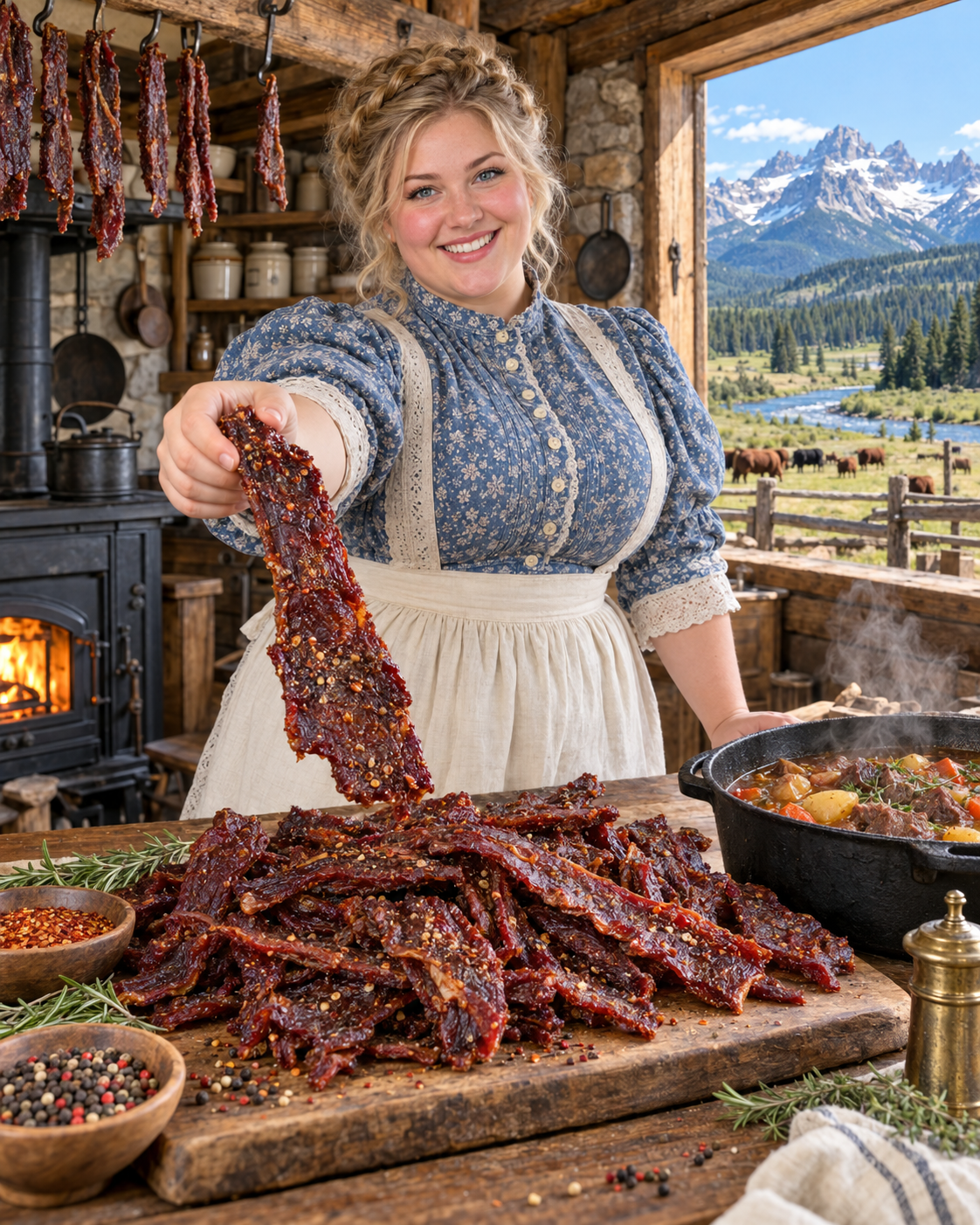
Inside hung the first jerky I had prepared from my three cattle.
Every penny I had invested was in that building.
For one terrible moment, I could not move.
Then I seized a bucket and joined the men fighting the fire.
Walter broke down the door while Tommy carried water from the trough.
Abel grabbed my arm as I tried to rush inside.
“Stay back!”
“My meat is in there!”
“Your life is worth more than three cattle!”
His words cut through the roaring flames.
I stumbled backward, coughing as sparks landed across my apron.
The men eventually extinguished the fire.
But most of the meat was ruined, and the wooden racks had collapsed into blackened splinters.
I stood in the ashes, unable to speak.
Three cattle.
Years of savings.
The beginning of the only business I had ever dared to build.
All of it lay smoking at my feet.
Then Walter crouched beside the doorway.
“Boss, look at this.”
He lifted a broken glass bottle from the dirt.
It smelled strongly of kerosene.
The fire had not started by accident.
Someone had wanted to destroy my livelihood.
Abel approached me, his face hard with rage.
“I’ll replace every dollar.”
I shook my head.
“That’s not what matters.”
He looked confused.
I swallowed the tears burning behind my eyes.
“Whoever did this wants me frightened enough to leave.”
Abel stared at the ruined smokehouse.
“Are you?”
I looked at my blistered hands.
“Terrified.”
Then I lifted my eyes.
“But I’m staying.”
That evening, the cowboys gathered without being called.
Walter placed a small leather pouch on the kitchen table.
Inside were coins, folded banknotes, and a few silver dollars.
“What’s this?” I asked.
Tommy looked embarrassed.
“We heard you lost your business.”
Another cowboy cleared his throat.
“We figured you fed us when we had almost nothing, so we ought to do something useful.”
I opened the pouch.
There was more money than I could accept without crying.
“I can’t take your wages.”
Walter gently closed my fingers around the pouch.
“Then consider it payment for all those biscuits you’ve given us without charging extra.”
I laughed through my tears.
For years, I had believed that needing help was a kind of weakness.
That night, twenty-one rough Wyoming cowboys taught me otherwise.
Two days later, Abel and I traveled to Cheyenne.
Walter remained behind to guard the ranch, while Tommy supervised rebuilding the smokehouse.
We carried Clara’s notebook beneath a false bottom in my traveling trunk.
The railroad station was crowded with merchants, soldiers, miners, and families heading west.
Every unfamiliar face made me nervous.
Abel noticed.
“You don’t have to do this.”
I looked at him.
“Clara didn’t get the chance to finish what she started.”
He said nothing.
“But we do.”
Our first stop was the office where Samuel Bell had once worked.
The company had dismissed him nearly three years earlier.
The clerk behind the counter claimed not to know his whereabouts.
But when I mentioned Clara’s name, an elderly woman sorting papers near the back suddenly looked up.
“Mrs. Ro?”
Abel stepped forward.
“She was my wife.”
The woman’s expression changed.
She waited until the younger clerk left the room.
Then she closed the office door.
“My name is Margaret Ellis,” she whispered.
“Samuel Bell was my brother.”
Abel gripped the back of a chair.
“Where is he?”
Her eyes filled with tears.
“Dead.”
The word struck the room like a gunshot.
She explained that Samuel had discovered suspicious loans, forged cattle transfers, and missing company funds.
He had planned to testify before the county authorities.
But before he could deliver his records, he had been found beside the Platte River with a shattered skull.
The authorities called it a riding accident.
Margaret never believed them.
“He was terrified during his final weeks,” she said.
“He told me a man named Clement Voss knew everything.”
Abel turned away, breathing heavily.
Margaret opened a locked drawer and removed a small packet tied with faded ribbon.
“Samuel left this with me.”
Inside were copies of company account entries and a sworn statement Samuel had signed before a notary.
His statement identified Horace Kline as the official who approved fraudulent ranch mortgages.
It also described Clement’s role in arranging false invoices and secretly transferring livestock.
But one detail made my blood run cold.
Samuel had written that Clara Ro possessed information proving the fraud.
He intended to meet her before taking the matter to the territorial authorities.
He never reached her.
Margaret looked directly at Abel.
“My brother believed your wife was in danger.”
Abel lowered himself into a chair.
For a moment, I feared his grief would swallow him whole.
Then he reached into his coat and removed Clara’s silver locket.
“She tried to protect me,” he whispered.
Margaret gently touched his shoulder.
“Then let her finish protecting you.”
That afternoon, we went to a reputable attorney named Jonathan Mercer.
He examined the documents while Abel paced beside the window.
Mercer was a careful man with silver spectacles and a voice that rarely rose above a murmur.
After nearly an hour, he removed his glasses.
“You have evidence of serious fraud.”
Abel stepped forward.
“Can we stop them?”
“Possibly, but the original mortgage remains the most important document.”
Mercer explained that the lender could attempt foreclosure if the recorded debt remained unpaid.
The notebook and sworn statement could help challenge the claim, but an examination of the original instrument and company books would strengthen the case.
“There’s another difficulty,” he added.
“Horace Kline has powerful acquaintances.”
I felt Abel tense beside me.
“Then we need someone who cannot be bought.”
Mercer considered my words.
“I know a territorial investigator who has been examining dishonest livestock transfers.”
His name was Daniel Whitcomb.
He was due to arrive in Cheyenne the following morning.
But before Mercer could arrange our meeting, a messenger entered carrying an urgent telegram.
It came from Walter.
CLEMENT RETURNED WITH SIX ARMED MEN.
CLAIMS COMPANY NOW OWNS HERD.
COME QUICKLY.
Abel read it once.
Then he read it again.
His face turned the color of ashes.
“They’ve gone after the ranch.”
We caught the next available train and hired a wagon for the final stretch.
Mercer traveled with us, bringing Samuel’s statement and a written notice disputing the mortgage.
He also sent word to Whitcomb, asking him to follow with lawful assistance.
The journey felt endless.
Rain began falling after sunset, turning the prairie road into thick mud.
Abel barely spoke.
I knew he was imagining his men injured, his cattle stolen, and Clara’s kitchen destroyed.
Near midnight, we saw a dull orange glow rising beyond the hills.
My heart stopped.
“The ranch,” Abel whispered.
He urged the horses forward.
But when we reached Long Kettle, we found no burning buildings.
The glow came from lanterns hanging around the cattle pens.
Six armed riders stood near the gate.
Clement waited beside them, holding a document against his chest.
Walter and the cowboys had gathered outside the bunkhouse.
Nobody had fired a shot.
Yet the entire yard felt ready to explode.
Clement smiled when he saw Abel.
“You’re just in time.”
Abel climbed down from the wagon.
“What have you done?”
“Protected the lender’s interests.”
Clement unfolded the document.
“Your mortgage has been declared in default, and the company has authorized the seizure of its collateral.”
Walter stepped forward.
“Not one steer leaves this ranch tonight.”
One of Clement’s men raised his rifle.
Abel’s voice thundered across the yard.
“Lower that gun!”
For several seconds, nobody moved.
Then Mercer stepped between the two groups.
“I am Jonathan Mercer, representing Abel Ro.”
He held up his papers.
“The debt is formally disputed, and any attempt to remove livestock by force without lawful authority will be challenged.”
Clement gave a cold laugh.
“A lawyer’s words won’t erase a signed mortgage.”
“Then perhaps you would like to explain the missing advances and fraudulent cattle transfers.”
Mercer’s calm voice carried farther than any shout.
Clement’s smile vanished.
I watched his right hand drift toward his coat.
Suddenly, he recognized the leather notebook beneath my arm.
His face changed completely.
“Where did you get that?”
I stepped forward.
“From a woman you thought could no longer speak.”
Clement stared at me.
“You should have stayed in your kitchen.”
“And you should never have mistaken a kitchen for a place where women stop thinking.”
His eyes filled with hatred.
Then everything happened at once.
Clement drew a revolver from beneath his coat.
Abel lunged toward me.
A shot cracked through the night.
I fell against the wagon, feeling something hot tear across my upper arm.
The cowboys scattered for cover as another gunshot echoed from the barn.
For a moment, I could hear nothing except a high, terrible ringing.
Abel knelt beside me.
“Theodora!”
I looked down at my sleeve.
Blood was spreading across the fabric.
But the bullet had only grazed my arm.
“I’m all right,” I gasped.
Abel pulled me behind the wagon wheel.
Across the yard, Clement had seized Tommy and pressed the revolver against the young cowboy’s throat.
“Nobody move!”
Walter stood frozen with his rifle half-raised.
Clement’s expression was wild.
“The notebook,” he shouted.
“Give me the notebook, and the boy walks away.”
I saw Tommy trembling.
He was barely nineteen.
He had spent the previous afternoon repairing my smokehouse because he believed I deserved another chance.
I could not let him die for helping me.
I rose slowly.
“The notebook isn’t worth his life.”
Abel caught my wrist.
“Theodora, don’t.”
I gently pulled away.
I held the leather book above my head.
“Let him go.”
Clement stared at me with desperate hunger.
“Bring it here.”
I walked across the muddy yard, my injured arm burning.
Every step seemed to last a lifetime.
When I reached the cattle trough, I stopped.
“First, tell Abel what happened to Clara.”
The night became silent.
Even Clement’s men looked uncertain.
He tightened his grip on Tommy.
“She died of fever.”
“Then why was she afraid of you?”
“Because she was interfering in matters she didn’t understand.”
I swallowed hard.
“Did you kill her?”
For the first time, Clement looked genuinely shaken.
His eyes flickered toward Abel.
“I never touched her.”
“Then what happened?”
His lips trembled.
“She found the company papers and threatened to take them to the authorities.”
Abel stepped from behind the wagon.
“What did you do to my wife?”
Clement looked almost pleading.
“Kline told me to frighten her.”
Abel’s face twisted with pain.
“How?”
Clement lowered his eyes.
“I told her you would lose everything if she spoke.”
The confession seemed to cost him something.
“She was already ill when I went to the house. I didn’t know she’d die.”
I searched his face for the truth, but fear had made it unreadable.
Then Clement whispered something that shattered the remaining silence.
“Kline sent her medicine.”
Abel staggered backward.
I felt sick.
“Who gave it to her?”
Clement shook his head.
“I don’t know what was in it.”
Before anyone could respond, a rifle cracked from beyond the corrals.
Clement cried out and dropped his revolver.
Tommy twisted free and threw himself behind the trough.
Walter rushed forward with two ranch hands.
They wrestled Clement into the mud and secured his wrists with rope.
The shot had struck his shoulder.
From the darkness emerged Daniel Whitcomb and two armed officers.
Mercer’s message had reached them, and they had ridden hard after finding signs of trouble along the road.
Whitcomb surveyed the yard.
“Which one is Clement Voss?”
Walter hauled the wounded bookkeeper upright.
“This snake right here.”
Whitcomb removed his hat.
“Mr. Voss, you’re being detained in connection with suspected livestock fraud, forged financial instruments, and the death of Samuel Bell.”
Clement stared at him.
Then he began laughing.
It was a terrible, broken sound.
“You think I’m the worst of them?”
Whitcomb stepped closer.
“Who else was involved?”
Clement looked toward the eastern hills.
“Horace Kline owns men you’ve never even met.”
His voice dropped.
“And he won’t let me stand trial if he thinks I’ll talk.”
Whitcomb ordered his officers to watch Clement closely.
By sunrise, the armed riders had surrendered their weapons and left under escort.
Tommy was shaken but unharmed.
My arm had been bandaged by Walter, who insisted that I sit down before I fainted.
But Abel remained beside the empty cattle pens long after everyone else returned to work.
I found him standing beneath the same sky that had watched him lose nearly everything.
“Clara died believing I didn’t trust her,” he said.
I stood beside him.
“You didn’t know what she knew.”
“I knew she was frightened.”
His voice broke.
“And I turned away.”
There was nothing I could say to erase that pain.
So I simply stayed.
Sometimes companionship is not the art of finding the right words.
Sometimes it is refusing to leave someone alone with the worst moment of their life.
The investigation that followed lasted several weeks.
Whitcomb and Mercer uncovered falsified loan entries, forged cattle transfers, and evidence that Horace Kline had used company funds to enrich himself.
Clement eventually agreed to testify after Whitcomb placed him under close guard.
He admitted arranging the theft and sale of Long Kettle cattle.
He also admitted setting fire to my smokehouse after discovering that I was examining the ranch’s accounts.
But Clara’s death remained the darkest part of his testimony.
Clement claimed Kline had instructed him to deliver a bottle of medicine when Clara developed a fever.
He insisted he never knew whether the medicine contained anything harmful.
The old doctor could not remember its exact ingredients.
No bottle survived.
No honest investigator could establish that Clara had been poisoned.
Abel found that uncertainty almost harder to endure than an answer.
He wanted someone to blame for every hour of her suffering.
But the truth did not always arrive whole.
Sometimes it came in broken pieces that would never fit together.
Kline was eventually arrested while attempting to leave the territory.
The original mortgage was recovered from company records.
Its figures differed substantially from the transaction Abel had authorized.
With Samuel’s statement, Clara’s notebook, and the recovered company accounts, Mercer challenged the inflated debt.
The false charges were removed, and the remaining legitimate balance was reduced to an amount Abel could manage through scheduled payments.
Several stolen cattle were also traced and recovered.
Long Kettle Ranch was not suddenly wealthy.
The fences still needed repairing.
The herd was still smaller than it had been before the winter.
And Abel still woke some nights reaching for a woman who wasn’t there.
But the ranch was his again.
The first time Mercer brought the corrected account statement, Abel carried it straight into Clara’s kitchen.
He laid it beside her notebook.
Then he sat silently for nearly an hour.
When he finally spoke, his voice was barely audible.
“You were right, Clara.”
I quietly returned to the stove.
Some moments belonged only to the living and the dead.
As summer deepened, the ranch slowly began healing.
The men repaired the barns, cleared the winter’s damage, and rebuilt my smokehouse with thick stone walls.
This time, they added a proper iron stove and strong drying racks.
Walter insisted on painting a sign above the doorway.
PUIT’S PRAIRIE PROVISIONS.
I laughed when I saw it.
“That’s an awfully grand name for dried beef.”
Walter leaned against the doorway.
“Then you’d better make enough to deserve it.”
And I did.
My first successful batch sold to a wagon party heading toward the mining settlements.
The second sold to railway workers.
Before long, travelers began stopping at Long Kettle specifically to purchase my smoked jerky, salted beef, and preserved beans.
I hired Tommy’s widowed sister, Ruth, to help with packaging and accounts.
She had two young children and had spent years being told that respectable work for women was difficult to find.
I gave her the same chance Abel had once reluctantly given me.
“One week,” I told her with a smile.
She looked frightened.
“What if I’m not good enough?”
I placed Clara’s old measuring cup in her hands.
“Then we’ll teach each other.”
Within a month, Ruth was organizing orders better than I ever could.
Her children played outside the summer kitchen while the smokehouse filled the prairie air with the fragrance of seasoned meat.
Sometimes Abel stood on the porch watching us.
The first time I caught him smiling, he looked almost ashamed.
“What?” I asked.
He shook his head.
“Clara would have liked this.”
I glanced toward the climbing roses.
“I think she would have liked having her kitchen full of laughter again.”
His smile softened.
“She always said a house wasn’t alive unless someone was making a mess in it.”
We both laughed.
Then his eyes filled with tears.
I pretended not to notice.
By September, the ranch had earned enough from cattle sales and my provisions business to meet its next payments without borrowing more.
Abel offered me a permanent position as head cook.
I thanked him.
Then I told him I would no longer work only for wages.
He looked surprised.
“Are you leaving?”
“No,” I answered.
“But I’m building something of my own.”
I explained that I wanted to lease the smokehouse land, purchase cattle directly, and expand the business.
I wanted written agreements, separate accounts, and the freedom to decide my own future.
Abel listened carefully.
Then he smiled.
“You’re a stubborn woman, Theodora.”
“I’ve been called worse.”
He held out his hand.
“Then let’s write the agreement.”
I shook it.
For a moment, I remembered the day he had humiliated me before twenty-one cowboys.
The man standing before me now was different.
And perhaps I was different too.
That autumn, the first snow arrived early.
I watched it settle across the fence posts while warm light spilled from Clara’s kitchen windows.
Abel entered carrying a small wooden box.
“I found this while sorting her belongings.”
Inside lay a folded piece of paper tied with blue ribbon.
It was addressed simply to whoever might someday use her kitchen.
Abel watched as I opened it.
Clara had written the note years before her death, long before fear and sickness entered her life.
The handwriting was neat and cheerful.
It spoke of the joy she found in feeding hardworking people, the comfort of a warm stove, and her hope that the room would always welcome anyone in need of kindness.
At the bottom, she had written a final sentence.
“A good home is not measured by what it owns, but by how many people find courage beneath its roof.”
My vision blurred.
Abel gently touched the edge of the paper.
“That’s how she lived.”
I nodded.
“And that’s how we’ll keep her here.”
He looked at me for a long moment.
There was affection in his eyes, quiet and uncertain.
But neither of us hurried to name it.
We had both learned what happened when fear, pride, and silence kept people from understanding one another.
Some things deserved time.
That evening, all twenty-one cowboys crowded into the dining room.
Ruth and her children sat beside Walter.
Tommy brought in a fresh tray of biscuits.
Abel carved the roast while I poured gravy into Clara’s old blue serving bowl.
Outside, the Wyoming wind howled across the frozen prairie.
Inside, the room glowed with firelight, laughter, and the wonderful noise of people who knew they belonged.
Walter raised his coffee cup.
“To Miss Theodora, who arrived with one suitcase and somehow turned this whole place upside down.”
The cowboys cheered.
I laughed until tears ran down my face.
Then Abel stood.
“To Clara,” he said quietly.
Every cup rose again.
For a brief, beautiful moment, I imagined her standing in the doorway, smiling at the kitchen she had loved.
Later that night, after everyone had gone to bed, I stepped outside.
Snow was falling softly over the rebuilt smokehouse.
My little business stood beside a ranch that had nearly been stolen from its owner.
Inside the house lived people who had endured grief, betrayal, hunger, and fear.
Yet somehow, we had found our way back to hope.
I thought about the woman who had arrived months earlier with nothing but a suitcase and one desperate chance.
She had believed her worth depended on convincing others to let her stay.
Now I understood something she had not.
A person’s value is not decided by those who reject them, laugh at them, or underestimate them.
It is revealed in the courage to keep working, the strength to speak when something is wrong, and the kindness to lift others when they fall.
Abel joined me on the porch and draped a wool blanket around my shoulders.
“You’ll freeze standing out here.”
I smiled.
“I’ve survived worse.”
He looked toward the warm kitchen windows.
“Yes,” he whispered.
“We both have.”
We stood together as snow settled over the dark prairie.
Neither of us knew what the coming years would bring.
There would be more hard winters, more debts to pay, more cattle to tend, and more difficult days.
But there would also be bread rising before dawn, children laughing near the stove, and the quiet dignity of work done honestly.
I thought of Clara’s courage, Walter’s loyalty, Ruth’s determination, and twenty-one men who had given part of their wages to help a woman they barely knew.
Then I realized the greatest treasure at Long Kettle had never been the cattle or the land.
It was the people who refused to abandon one another.
And when Abel gently took my hand beneath the falling snow, I did not pull away.
For the first time in my life, the future did not feel like a road I had to travel alone.
It felt like a door standing open, with warmth and light waiting on the other side.
Because sometimes the people who arrive when everything is broken are not there to replace what was lost.
They are there to remind us that even after the harshest winter, life can grow again.
And sometimes, the most extraordinary beginnings come from the simple courage to say, “Give me one week.”
THE END.