Phineas Cobb slapped my face before twenty men at the Cheyenne freight yard, never realizing the worthless land deed in my pocket concealed his darkest crime.
The messenger’s final words froze me where I stood, while his blood spread slowly across the white ribbon tied around our wedding flowers.
“Your father is still alive.”
I had spent seven years believing those words could never be spoken.
Seven years of remembering the terrible day I stood beside his coffin, too broken to question why the undertaker had forbidden me from opening it.
Another gunshot shattered the window above my head, sending glass raining across the wooden floor.
Jericho grabbed my shoulders and pulled me behind the heavy kitchen stove.
“Stay down, Josie!” he shouted, reaching for the rifle mounted beside the pantry.
Outside, the horses screamed, and a dark figure moved between the stable and the barn.
I knew those broad shoulders and the expensive black coat long before the man stepped into the moonlight.
Phineas Cobb had returned.
And this time, he wasn’t interested in stealing my station.
He wanted to bury every secret hidden beneath it.
“Come outside, Mrs. Flint!” Cobb shouted, his voice carrying through the cold Wyoming night.
“I’ll spare your husband if you give me what belongs to me.”
Jericho pressed a finger against his lips and carefully raised his rifle.
I looked toward the fallen messenger, whose young face had already turned pale.
He couldn’t have been more than nineteen.
Someone’s son had died carrying a truth that might change my entire life.
And suddenly, my fear hardened into something much more dangerous.
Anger.
“You’ve killed enough innocent people, Cobb!” I shouted through the broken window.
His laughter echoed across the yard.
“Innocent people don’t survive long in Wyoming, sweetheart.”
A rifle flashed near the stable, and Jericho fired before the sound reached us.
A man cried out and collapsed behind a watering trough.
Cobb immediately disappeared into the darkness.
Jericho turned toward me, breathing heavily.
“We cannot hold this place all night.”
I looked at the messenger’s bloodstained coat and remembered the brass key wrapped in my mother’s blue cloth.
There was only one place left where the answers might be waiting.
My childhood home.
Forty miles east, beyond the frozen creek and the abandoned copper mine.
“I know where we have to go,” I whispered.
Jericho followed my gaze toward the key in my hand.
Then he understood.
“Your mother’s cabinet.”
I nodded.
“But first, we have to get out alive.”
We crawled toward the cellar, where Jericho’s son, Samuel, was already waiting beneath a blanket.
At eleven years old, that boy had learned more about fear than any child deserved.
“Are they going to kill us, Pa?” he whispered.
Jericho knelt beside him and brushed the hair from his forehead.
“Not if I can help it.”
I took Samuel’s cold hands between mine.
“Remember how you helped me make biscuits yesterday?”
He nodded uncertainly.
“Remember what I told you when the dough wouldn’t rise?”
His lower lip trembled.
“That sometimes things need patience before they become strong.”
I smiled despite the terror clawing at my chest.
“That’s right, sweetheart.”
Behind the cellar shelves was the narrow drainage tunnel we had used during Cobb’s first attack.
Jericho moved the wooden crates while I gathered medicine, blankets, and the small revolver my father had taught me to use.
We slipped into the tunnel as another volley of bullets struck the station.
The passage smelled of wet earth and old roots.
Samuel crawled ahead while Jericho guarded our retreat.
Halfway through, I heard footsteps crossing the kitchen above us.
Then Cobb’s voice came through the floorboards.
“Find the woman, and don’t damage her hands.”
I stopped breathing.
There was something deeply unsettling about those words.
Why would a man planning to murder me care about my hands?
Jericho pushed gently against my back.
“Keep moving.”
We emerged behind the stable, where the snow had swallowed most of our footprints.
My old draft mare, Ruth, stood trembling beneath the shelter.
Jericho saddled the two remaining horses while I helped Samuel climb onto Ruth’s broad back.
We were nearly ready when a familiar voice came from behind us.
“Leaving without saying goodbye, Josie?”
Cobb stood ten feet away, holding a revolver.
Two hired gunmen appeared beside him.
For a moment, nobody moved.
The moonlight made Cobb’s pale face look almost skeletal.
“You should have stayed a cook,” he said.
I slowly raised my hands.
“And you should have learned that cooks know exactly where to cut.”
Before he could answer, I hurled the little leather medicine bag straight into his face.
The powdered cayenne pepper I kept for warming poultices burst across his eyes.
Cobb screamed and fired blindly.
Jericho lunged forward, knocking one gunman against the stable wall.
I grabbed Samuel’s reins and slapped Ruth’s flank.
“Ride toward the cottonwoods!” I shouted.
Samuel obeyed.
A bullet ripped through my sleeve as I swung onto the second horse.
Jericho climbed behind me, and we galloped into the darkness while Cobb’s furious curses followed us across the prairie.
We rode until the station disappeared beneath the horizon.
Only then did I realize Jericho was bleeding.
His old shoulder wound had reopened during the struggle.
I stopped beside a sheltered creek and pulled his coat aside.
Blood soaked the bandage beneath his shirt.
“You stubborn fool,” I whispered, fighting tears.
He managed a weak smile.
“I married a woman who threatened a murderer with a skillet.”
“And you’re beginning to regret it?”
“Not for a heartbeat.”
I cleaned the wound with boiled water and dressed it as carefully as my trembling fingers allowed.
Samuel slept beside the horses while the stars glittered above the frozen plains.
When I finally sat beside Jericho, the silence between us felt different.
The secrets he had kept still hurt.
I could feel them like thorns beneath my skin.
“Tell me everything about my father,” I said.
Jericho stared into our tiny fire.
“Your father wasn’t only a doctor, Josie.”
I waited.
“He worked with federal investigators who were examining stolen railroad funds and fraudulent supply contracts.”
My father had always traveled to distant settlements, claiming that sick families needed him.
Sometimes he disappeared for weeks.
I had never questioned those journeys.
“He discovered that Cobb was working with a man named Silas Mercer, a government purchasing agent who approved railroad-related payments.”
The name struck me with unexpected force.
Silas Mercer.
I remembered a tall gentleman who visited our house when I was seventeen.
He wore a gold watch chain and brought my mother a box of expensive chocolates.
My father hated him.
I remembered hearing them arguing behind a closed door.
“You don’t understand what you’re asking me to sacrifice,” my father had shouted.
And Mercer had answered with words I had forgotten until that moment.
“Every great enterprise requires sacrifices, Doctor.”
I looked at Jericho.
“Mercer knew my mother.”
Jericho’s expression darkened.
“He knew your entire family.”
The fire cracked between us.
“Did he kill my parents?”
Jericho swallowed.
“I don’t know what happened to your mother, Josie, but I helped your father disappear.”
For several seconds, I could only stare at him.
“You let me bury an empty coffin.”
His silence was answer enough.
I rose so suddenly that pain shot through my wounded arm.
“Do you have any idea what that did to me?”
“Josie—”
“I cried until I couldn’t breathe!”
My voice broke across the sleeping prairie.
“I sold his instruments because I couldn’t bear to look at them.”
Jericho stood, but he didn’t try to touch me.
“Your father believed Mercer would kill you if anyone knew he was alive.”
“And nobody thought I deserved the truth?”
He lowered his head.
“No.”
That single word hurt more than any excuse could have.
I turned toward the creek, where black water moved beneath a thin crust of ice.
For years, I had believed my father’s death was the greatest cruelty life could offer.
Now I knew that being loved by frightened people could sometimes feel terribly similar to being abandoned.
We reached my childhood home shortly after sunset the following day.
The house stood beneath two dead cottonwoods, its windows dark and its porch sagging beneath years of neglect.
I hadn’t returned since selling the property to a distant cousin.
The cousin had abandoned it after a fever swept through the settlement.
I pushed open the front door and stepped into the place where I had once been happy.
Dust covered everything.
The dining table still stood crooked near the window.
A broken china plate lay beneath the stove.
And against the wall hung the faded outline where my mother’s portrait had once been.
I touched the wallpaper.
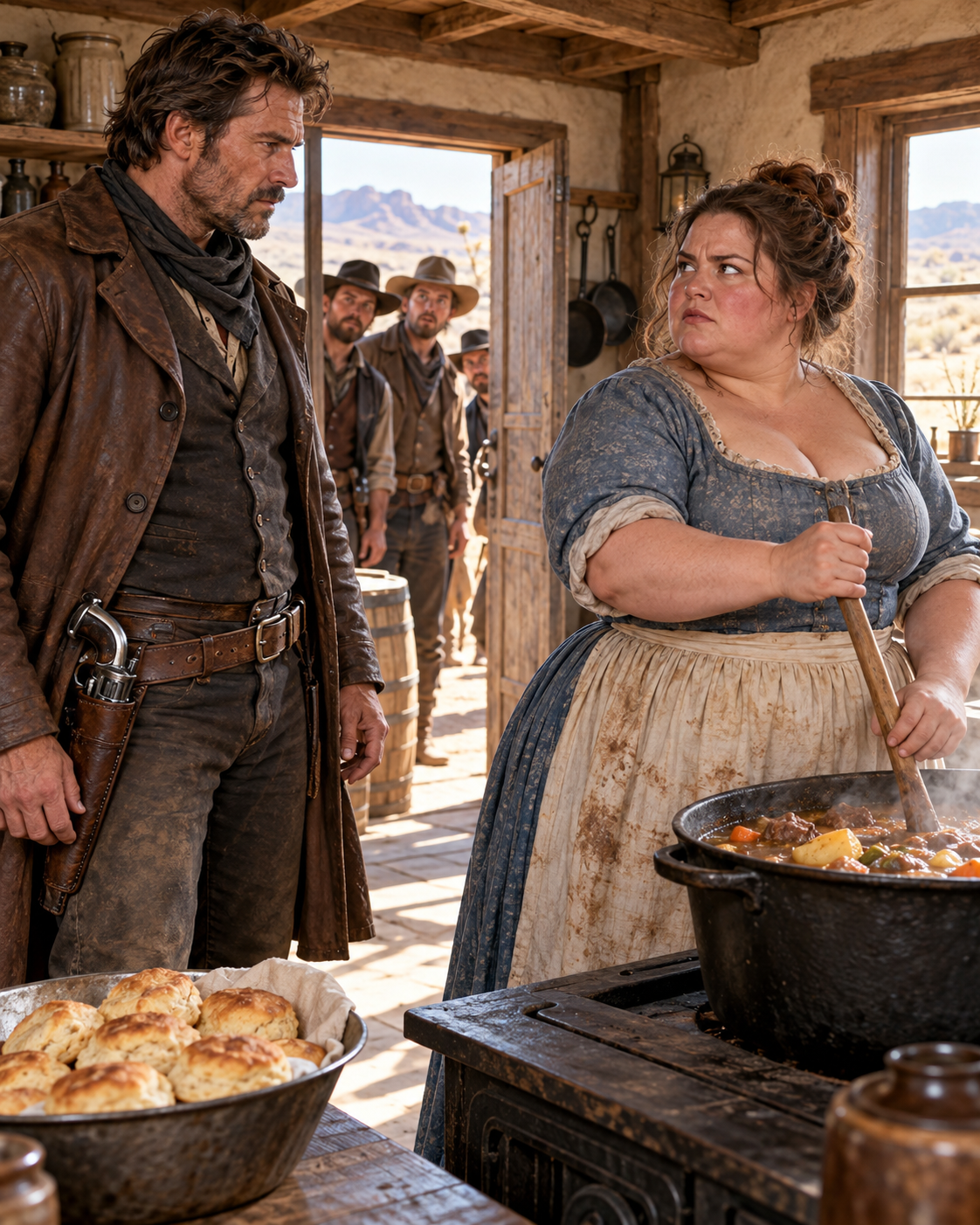
For one beautiful, terrible instant, I could almost smell her cinnamon bread.
“Ma,” I whispered.
Samuel slipped his small hand into mine.
I squeezed it gently.
Then I led Jericho toward the staircase.
The cabinet was still there.
Its dark walnut doors were scratched, but the brass lock remained untouched.
I inserted the key.
It turned with a sharp metallic click.
Inside lay a leather medical case, three sealed letters, and a small wooden box.
I recognized my father’s handwriting on the first envelope.
“To my beloved Josephine, when the truth can no longer remain buried.”
My hands shook so violently that Jericho offered to open it.
I shook my head.
Whatever waited inside belonged to me.
The letter began with an apology.
My father explained that he had uncovered evidence of a network of officials and contractors profiting from stolen supplies, forged transport records, and the deaths of men who refused to cooperate.
He had agreed to disappear after receiving a threat against my life.
But then came the words that made my heart stumble.
“Your mother’s death was not the fever the doctor claimed it was.”
I pressed the letter against my chest.
My mother had died after weeks of weakness, headaches, and stomach pain.
I had nursed her myself.
I had prepared every broth, every herbal tea, and every cool cloth.
The memory rushed back with sickening clarity.
One afternoon, Mercer had visited with a bottle of expensive medicinal tonic.
He said it would restore her strength.
She drank a spoonful every evening.
And every evening, she became weaker.
I looked down at the paper.
My father’s next sentence seemed to burn beneath my eyes.
“Mercer poisoned your mother because she discovered where he concealed his financial records.”
I made a sound I had never heard from my own throat.
Jericho caught me before my knees struck the floor.
For years, I had blamed myself.
I had wondered whether another remedy or an earlier diagnosis might have saved her.
Now I knew the terrible truth.
My mother hadn’t died because I failed to heal her.
She had been murdered by a man who smiled at our dinner table.
Samuel knelt beside me.
“Miss Josie?”
I pulled him close and wept against his hair.
When my tears finally slowed, Jericho handed me the wooden box.
Inside lay a small brass printing plate engraved with a series of numbers.
Beneath it was a folded railway map.
Several stations were marked with red circles.
Widow’s Crossing was one of them.
My father’s final letter explained that the numbers corresponded to fraudulent payment certificates.
The printing plate had been used to authenticate forged supply vouchers.
With it, investigators could compare the false records against genuine government accounts.
But one passage frightened me more than everything else.
“Silas Mercer is not the leader of this operation.”
I read the next line twice.
“The man directing them is someone trusted to investigate their crimes.”
Before I could speak, the front door creaked.
Jericho raised his revolver.
A shadow moved through the hallway.
Then an old man’s voice whispered my childhood nickname.
“Little Sparrow?”
My breath stopped.
Only one person had ever called me that.
A thin figure stepped into the candlelight.
His hair was completely white.
His cheeks were hollow, and a deep scar crossed his forehead.
But I knew those eyes.
I would have known them after a hundred lifetimes.
“Papa?”
He opened his mouth, but no words came.
I crossed the room with a cry and threw myself into his arms.
He smelled of wool, cold rain, and the faint lavender soap he had always used.
For a moment, I was a little girl again, safe in the arms of the man who could mend anything.
Then I remembered the coffin.
The lonely years.
The empty chair beside every Christmas supper.
I pulled away and struck his chest with both fists.
“You left me!”
He didn’t defend himself.
He simply stood there and let me cry.
“I know, Josephine,” he whispered.
“I know.”
His name was Elias Weaver, and he had spent seven years moving between remote settlements under false identities.
He told me Mercer had hired men to follow me after my mother’s death.
My father’s disappearance had convinced them the evidence was lost.
But when I bought Widow’s Crossing, they became suspicious.
The station had once been used to conceal stolen shipments.
They believed I had returned deliberately to uncover their crimes.
“Cobb wasn’t trying to destroy the station because it was valuable,” my father explained.
“He wanted to find the original freight records hidden beneath its foundations.”
I stared at him.
“Then the ledger I discovered wasn’t everything?”
He shook his head.
“It was only the beginning.”
Jericho moved closer to the window.
A horse whinnied outside.
My father’s face went pale.
“We were followed.”
Jericho extinguished the candle.
Through the darkness, we saw six riders approaching the house.
At their center rode Silas Mercer.
Even after all those years, I recognized his straight posture and polished riding boots.
He dismounted slowly.
“Doctor Weaver,” he called.
“I believe our arrangement has expired.”
My father reached for the medical case.
From a hidden compartment, he withdrew an old revolver.
I caught his wrist.
“No more hiding, Papa.”
He looked at me with heartbreaking sadness.
“I never wanted this life for you.”
I thought of my mother, dying beneath a quilt she had stitched herself.
I thought of the messenger bleeding onto my wedding flowers.
And I thought of the travelers who had trusted my station as a place where no one would turn them away.
“This life came for me whether I wanted it or not,” I answered.
Mercer’s men surrounded the house.
Jericho counted the riders through the window.
“We have three guns and six men outside.”
Samuel looked toward the kitchen.
“There’s a trapdoor beneath the pantry.”
I stared at him.
He shrugged.
“I found it when we came in.”
My father nodded slowly.
“That passage leads toward the old smokehouse.”
We moved quietly through the darkness.
But before we reached the pantry, a burning bottle smashed through the front window.
Flames climbed the curtains.
Mercer shouted from outside.
“Bring me the plate, Weaver, or I’ll burn your daughter alive!”
My father stepped toward the door.
I caught his coat.
“Don’t you dare leave me again.”
His eyes filled with tears.
“I’ve spent seven years trying to keep you alive.”
“Then help me live instead of deciding everything for me.”
Something changed in his face.
Perhaps he finally saw that the frightened girl he remembered had become a woman capable of protecting others.
Together, we carried water from the kitchen pump and smothered the flames.
Jericho fired through the broken window, forcing Mercer’s men behind the wagon.
I guided Samuel into the passage and handed him the wooden box.
“Take this to the smokehouse and stay hidden.”
“But what about you?”
I kissed his forehead.
“I promised your father I’d never let this family be taken from us.”
Samuel swallowed his fear and disappeared beneath the floorboards.
Then the front door exploded inward.
A gunman rushed through the smoke.
I swung the fireplace poker against his arm, sending his revolver across the floor.
Jericho struck him with the butt of his rifle.
My father dragged the unconscious man behind the table.
Another attacker appeared at the kitchen window.
I fired once.
The shot shattered the window frame, and the man dropped out of sight.
Suddenly, everything went quiet.
Too quiet.
Mercer’s voice drifted through the smoke.
“Josie, your mother begged for mercy too.”
I felt something cold settle inside my chest.
He wanted me angry.
He wanted me reckless.
But my mother had taught me something more useful than hatred.
She had taught me to think carefully while others lost control.
I looked toward the back wall.
Beyond it stood the old smokehouse, the well, and a narrow trail leading toward the county road.
If we could reach the horses, we might escape.
But Mercer had placed men behind the house.
My gaze fell upon the abandoned flour sacks beneath the pantry shelves.
I opened one and threw a handful into the air near the burning curtain.
A thick white cloud spread through the smoky room.
Jericho understood.
He fired two shots toward the front yard while my father opened the rear door.
The sudden burst of dust and smoke concealed our movement long enough for us to reach the smokehouse.
Samuel was already waiting beside the horses.
But Mercer had anticipated the escape.
He stepped from behind the stone well, holding a pistol against Samuel’s head.
“Drop your weapons,” he ordered.
Jericho froze.
My father raised his hands.
I felt the world narrow to the trembling boy standing beside the well.
Samuel’s eyes searched mine.
He was trying desperately not to cry.
Mercer smiled.
“Such a touching family.”
“Let him go,” I said.
“Give me the printing plate.”
I pulled the brass plate from my pocket.
Jericho stared at me in surprise.
He hadn’t seen me retrieve it from Samuel before leaving the smokehouse.
Mercer extended his free hand.
“Slowly.”
I approached him one step at a time.
My heart was beating so hard I thought it might crack my ribs.
When I stood close enough, I looked into his eyes.
“Did my mother know you were poisoning her?”
His smile faltered.
“Your mother was an unfortunate complication.”
“She fed you at our table.”
He shrugged.
“She should have minded her business.”
Something inside me broke open.
But I didn’t scream.
I didn’t strike him.
I simply lowered the plate into his waiting palm.
The instant his fingers closed around it, I seized Samuel’s coat and pulled him down.
Jericho fired.
Mercer staggered backward as the bullet struck his gun arm.
His revolver fell into the snow.
Samuel scrambled toward his father.
Mercer lunged for the weapon, but I reached it first.
For seven years, I had imagined what I might say to the man responsible for destroying my family.
Now he lay in front of me, bleeding and helpless.
I aimed the revolver at his chest.
He looked up, suddenly terrified.
“Josie, be reasonable.”
My hands trembled.
I could end his life with one movement.
I could make him suffer as my mother had suffered.
But then I remembered her voice.
“Josephine, never confuse making someone hurt with making something right.”
I lowered the revolver.
“You don’t get an easy death, Mercer.”
Jericho bound his wrists while my father pressed a bandage against the wound.
Even then, my father could not bear to let a wounded man bleed to death.
We tied Mercer across a saddle and rode through the darkness toward Cheyenne.
By dawn, we reached a military patrol traveling beside the railroad.
The commanding officer examined the printing plate and my father’s documents.
His face tightened as he read.
“These accusations reach into federal offices,” he said.
My father nodded.
“And Cobb is still free.”
The officer ordered Mercer transported under armed guard.
He also promised to send men to Widow’s Crossing.
But I had learned enough about promises to know that good intentions could be buried alongside good people.
I insisted on accompanying the evidence to a federal hearing.
Jericho protested because my arm was swollen and my father was barely strong enough to stand.
I refused.
Too many men had spoken for me already.
Three days later, we entered the crowded hearing room in Cheyenne.
Officials, railroad representatives, freight merchants, and curious townspeople filled every bench.
At the front sat a silver-haired federal investigator named Augustus Bell.
My father went rigid when he saw him.
“Josie,” he whispered, “that’s the man.”
Bell greeted us with a kind smile.
“Doctor Weaver, you’ve caused us considerable trouble.”
I recognized the careful smoothness of his voice.
It was the voice of a man accustomed to being obeyed.
Bell had been placed in charge of investigating fraud connected to the freight contracts.
And according to my father’s letter, he was the very man directing it.
My stomach turned.
We had delivered the evidence straight into the hands of the criminal we needed to expose.
Bell examined the brass plate.
Then he looked toward the guards.
“Arrest Doctor Weaver and his accomplices for conspiracy and falsifying government records.”
Jericho reached for his gun.
I gripped his wrist.
“No.”
The room erupted in shocked whispers.
Bell leaned back in his chair.
“You are a remarkable cook, Mrs. Flint, but you know nothing about federal affairs.”
I thought of Cobb humiliating me at the freight yard.
Of the laughter.
Of all the times men had mistaken my size and silence for stupidity.
Then I smiled.
“You’re right about one thing, Mr. Bell.”
He raised an eyebrow.
“I am a cook.”
I opened the little cloth bag hanging from my belt.
Inside lay several folded sheets of paper.
“And cooks know how to make copies of recipes.”
The room grew quiet.
Before entering Cheyenne, I had visited a newspaper printer and paid him to reproduce every document my father carried.
I had also sent duplicate packets to a Union Pacific superintendent, a military commander, and a newspaper editor in Laramie.
Bell’s smile disappeared.
“You foolish woman.”
“Maybe,” I answered.
“But the truth doesn’t belong to you anymore.”
The newspaper editor stepped forward from the crowd.
He was holding one of my packets.
“Mr. Bell,” he announced, “your signature appears on thirty-two fraudulent approvals.”
An attorney rose beside him.
“And I have sworn statements identifying the men who received those payments.”
Several guards looked uncertainly toward their commander.
Bell stood abruptly.
“This hearing is adjourned.”
But the military officer who had escorted us stepped into his path.
“No, sir,” he said quietly.
“I believe it’s just beginning.”
Bell tried to draw a pistol from beneath his coat.
The officer struck his hand aside.
Two soldiers seized him before he reached the door.
For the first time since I had learned my mother’s killer’s name, I felt the ground beneath me become steady.
The investigation lasted for months.
Mercer confessed to the poisoning after witnesses corroborated the evidence and investigators traced the purchase of the tonic.
Bell’s financial records exposed the conspiracy.
Several officials lost their positions, and freight contractors were arrested.
Cobb was captured near Fort Laramie while attempting to flee north.
When they brought him through Cheyenne in chains, I stood outside the courthouse beside Jericho.
Cobb stopped when he saw me.
His eyes dropped to my broad waist, then rose slowly toward my face.
“All this trouble because of a woman like you,” he muttered.
I stepped closer.
“No, Mr. Cobb.”
My voice was calm.
“All this trouble because you thought a woman like me wouldn’t fight back.”
He turned away.
And I discovered that victory didn’t always feel like triumph.
Sometimes it felt like finally being able to breathe.
The following spring, Widow’s Crossing reopened with a new roof, stronger doors, and a proper sign beside the road.
I called it Weaver’s Haven.
The railroad arranged lawful access for travelers and supplies, while the local community helped restore the station.
My father moved into the little room overlooking the herb garden.
He walked with a cane and carried seven years of regret in his tired eyes.
Forgiveness didn’t come quickly.
Some mornings, I still woke furious with him.
Some evenings, we sat together without speaking.
But slowly, we learned how to become father and daughter again.
Jericho never asked me to forget the secrets he had kept.
He simply stayed.
He chopped wood, repaired wagons, helped Samuel with his lessons, and kissed my forehead each night as though it were the most natural thing in the world.
One afternoon, I found him standing behind the kitchen doorway, watching me knead bread.
“What?” I asked, brushing flour from my hands.
He smiled.
“I was just thinking how close I came to losing you.”
I looked at the scars on his shoulder.
“And I was thinking how close I came to never trusting you again.”
His smile faded.
I crossed the kitchen and took his hands.
“But love isn’t the absence of mistakes, Jericho.”
He searched my face.
“It’s what we do after we make them.”
He pulled me gently against him.
For the first time, I felt no need to hide my body or apologize for the space I occupied.
I belonged exactly where I stood.
Years passed, and Weaver’s Haven became known across the Wyoming frontier.
Wagon drivers arrived hungry and left fed.
Sick children found clean beds and careful hands.
Lonely travelers discovered that a warm supper could sometimes save more than an empty stomach.
I kept a little wooden box beneath the counter for those who couldn’t pay.
Inside were coins donated by people who remembered what it meant to have nothing.
Above the fireplace, I hung my mother’s favorite saying, embroidered on a piece of faded blue cloth.
“A table grows larger whenever another hungry soul is welcomed.”
And beside it hung my father’s silver pocket watch.
One cold evening, a frightened young woman arrived carrying a baby and asking whether I needed a kitchen helper.
She was heavy-set, poorly dressed, and so ashamed of her appearance that she barely raised her eyes.
The freight driver who brought her laughed.
“She’s strong enough to pull a wagon, but I doubt anyone wants her serving supper.”
I stepped onto the porch.
The driver immediately stopped laughing.
I looked at the young woman and saw myself standing in that freight yard years earlier.
Her hands were shaking.
Her baby was crying.
And in her eyes lived the same terrible question I had once carried.
Was there a place in this world for someone like her?
I opened the door wider.
“Come inside, sweetheart.”
She hesitated.
“I don’t have money.”
“I didn’t ask for any.”
Tears filled her eyes.
“What if I’m not good enough?”
I smiled and placed a warm loaf of bread in her hands.
“Then we’ll learn together.”
Behind me, Jericho was setting another place at the table.
Samuel, nearly grown, carried a blanket toward the fire.
My father sat by the window, smiling quietly.
And suddenly, I understood something that had taken me a lifetime to learn.
The cruelest people I had known believed power meant deciding who deserved safety, kindness, and dignity.
They measured human worth by money, beauty, influence, and the fear they could inspire.
But my mother had understood a different kind of power.
The power to feed someone who was hungry.
To care for someone who was suffering.
To protect someone everyone else had abandoned.
To build a home where nobody had to earn the right to be treated like a human being.
I had once believed my greatest accomplishment would be proving Phineas Cobb wrong.
But standing in that warm kitchen, surrounded by the family I had fought to keep, I realized my greatest victory was something far simpler.
I had become the kind of woman my younger self desperately needed to meet.
Outside, the Wyoming wind howled across the endless prairie.
Inside, fresh bread filled the air, the fire burned brightly, and another frightened stranger discovered that the world still held kindness.
I looked toward Jericho, and he reached for my hand.
For seven years, grief had taught me how to survive.
Love had taught me how to live again.
And the home I once defended with a shotgun had become a place where others could finally put their weapons down.
Because sometimes the strongest thing a person can build isn’t a fortress that keeps enemies out.
It’s a door that remains open for those who have nowhere else to go.
THE END.