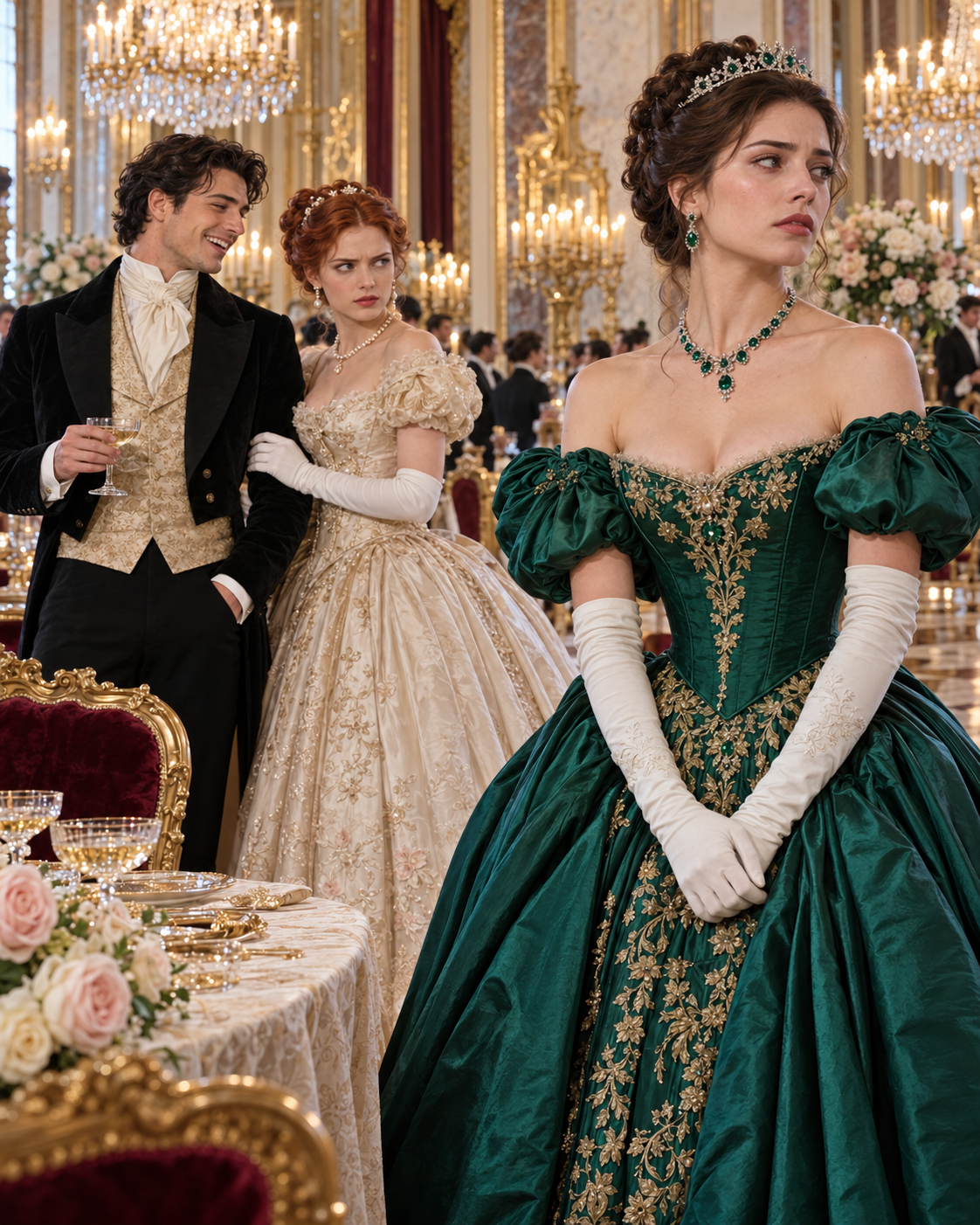
On the night of their eighth wedding anniversary, Arthur gave his wife’s chair to his mistress. By morning, he would discover that the woman he had humiliated was the only reason he still had a home.
The words on Arthur’s card lay before Eleanor like a warning she had been expecting without knowing its shape.
“Clara has taken the original documents.”
For several seconds, she did not move.
Beyond the study windows, afternoon sunlight rested on the wet branches of the garden trees, while the distant sound of carriage wheels drifted through the street.
Mr. Whitmore studied her face.
“Shall I ask the servants to refuse him entry?”
Eleanor turned the card between her fingers.
“No. Show him into the morning room.”
The solicitor looked surprised.
“Are you certain, my lady?”
“If Arthur has come here himself, something has frightened him more than the prospect of facing me.”
She rose, straightened the cuffs of her dark blue dress, and placed the questionable bank documents inside a locked drawer.
“Let us discover what it is.”
Arthur was standing beside the fireplace when she entered.
He looked as though he had slept in his clothes.
The immaculate appearance that had once seemed inseparable from him was gone, replaced by an unshaven jaw, a crooked collar, and the restless movements of a man who could no longer control his surroundings.
For a moment, neither spoke.
Arthur’s eyes traveled across the familiar room before settling on his wife.
“You look well.”
Eleanor closed the door.
“That is an unusual opening, considering what you wrote.”
He looked toward the windows.
“Clara has disappeared.”
“Disappeared?”
“She left her rooms this morning. Her maid says she departed before sunrise.”
“And the documents?”
Arthur hesitated.
“Several papers are missing from my study.”
“Which papers?”
“I haven’t established that yet.”
Eleanor watched him.
Eight years of marriage had taught her to recognize the slight movement of his mouth whenever he was withholding something.
“Arthur.”
He exhaled sharply.
“The bank agreements. Some private correspondence. Certain estate records.”
“And the document bearing my forged signature?”
His expression changed.
Only slightly, but enough.
“You’ve seen it.”
“Yes.”
Arthur lowered himself into a chair without being invited.
Eleanor remained standing.
“I can explain,” he said.
She looked at him for a long moment.
“That is what you said when the first creditors arrived. And when the eastern tenants went unpaid. And when my income disappeared for three consecutive months.”
“This is different.”
“I am listening.”
Arthur rubbed a hand across his forehead.
“The estate was in worse condition than I admitted. After the failed harvest, I borrowed against the next year’s income. Then the repairs cost more than expected, and the interest became impossible.”
“You had sixty-three thousand pounds of mine.”
“I know.”
“You asked for more.”
His eyes dropped.
“I thought I could recover everything.”
“And when you couldn’t?”
Arthur said nothing.
Eleanor moved toward the window, where a narrow beam of sunlight illuminated the dust floating above the carpet.
“Did you forge my signature?”
“No.”
The answer came too quickly.
She turned.
“Then who did?”
Arthur swallowed.
“Clara arranged the paperwork.”
A faint sound escaped Eleanor, almost a laugh, though there was no amusement in it.
“You permitted your mistress to handle financial arrangements secured against your wife’s inheritance?”
“I didn’t know she’d gone that far.”
“But you knew she was involved.”
Arthur’s silence answered.
Eleanor approached the fireplace.
“Tell me something honestly, Arthur. When you placed Clara in my chair that evening, did you intend to humiliate me?”
His expression tightened.
“Not deliberately.”
“Then you simply didn’t consider that I might be humiliated.”
He looked away.
That answer required no words.
For years, Eleanor had searched his face for the man she had married, collecting small moments of kindness as proof that he remained somewhere beneath his carelessness.
Now she saw only a tired man accustomed to being forgiven.
“Why are you here?” she asked.
Arthur looked up.
“Because we need to stop Clara before she destroys us.”
Eleanor’s voice remained level.
“There is no ‘us’ in those documents.”
He stared at her.
“She’s taken papers that could send me to prison.”
“And you believe that is my responsibility?”
“Eleanor, please.”
She studied his trembling hand.
It was the first time she could remember seeing him afraid of anything he could not purchase, dismiss, or command.
“I will instruct Mr. Whitmore to investigate,” she said.
Relief flickered across Arthur’s face.
“But not to protect you.”
It vanished.
“We will recover those documents because my name is on them, and I intend to know precisely how it got there.”
Arthur rose.
“You’re my wife.”
“Yes,” Eleanor said softly. “And that has been remarkably convenient for you.”
She opened the door.
“Our conversation is finished.”
He stood motionless.
Then he took one step toward her.
“Eleanor, I never stopped caring for you.”
Her hand rested on the brass handle.
“I believe you cared for having me there.”
He could find nothing to say.
She left him standing beside the cold fireplace.
By evening, Mr. Whitmore had sent inquiries to three banks, two former estate employees, and a London solicitor whose name appeared repeatedly in Arthur’s private correspondence.
The responses began arriving sooner than expected.
One bank confirmed that a substantial sum had been transferred into an account controlled by a company called Ashcombe Holdings.
The name meant nothing to Eleanor.
Yet when Mr. Whitmore examined its registration, he discovered that the company had been established only seven months earlier.
Its principal representative was Clara’s older brother, Edward Vale.
Eleanor placed the registration papers on the table.
“So the money was not simply borrowed.”
“Apparently not.”
“It was redirected.”
“That is one possibility. We cannot yet establish whether the transaction was fraudulent or whether your husband authorized it knowingly.”
Eleanor considered the distinction.
Arthur had always treated financial matters as tedious inconveniences beneath his attention.
But someone had paid extraordinary attention to his carelessness.
“And Edward Vale?” she asked.
“His business history is inconsistent. Several ventures dissolved while creditors remained unpaid.”
“Does he know we’re investigating?”
“I suspect he will soon.”
Eleanor folded her hands.
“Then we should find Clara before her brother does.”
Mr. Whitmore raised an eyebrow.
“You believe she may be in danger?”
“I believe a woman who leaves before sunrise carrying incriminating documents is either running toward protection or away from something.”
That night, a letter arrived without a return address.
The envelope was damp, and one corner had been torn.
Inside was a single sheet written in a hurried hand.
Lady Eleanor, there are matters your husband has not told you. I cannot trust anyone connected with him. If you wish to know what happened to your money, come to St. Anne’s Church tomorrow at eleven. Come without Arthur.
There was no signature.
But Eleanor recognized the handwriting.
Clara.
Mr. Whitmore advised against the meeting.
Eleanor listened carefully, then asked him to arrange for a trusted clerk to remain nearby.
“I have no intention of walking into an unknown situation without protection,” she said.
“But I am tired of allowing other people to decide which truths I am permitted to hear.”
The following morning, a cold wind moved through the churchyard.
The trees were almost bare, and fallen leaves gathered against the weathered gravestones.
Eleanor arrived shortly before eleven.
Inside the church, sunlight passed through colored windows and fell in narrow bands across the wooden pews.
Clara sat near the back.
She wore an ordinary brown coat rather than the expensive gowns Eleanor remembered, and her hair had been pinned without its usual care.
When Eleanor approached, Clara rose abruptly.
“Thank you for coming.”
Eleanor stopped at the end of the pew.
“Where are the documents?”
Clara’s face tightened.
“You sound like Arthur.”
“I have been lied to by both of you. You will forgive me if I have little patience for introductions.”
Clara lowered her eyes.
For several moments, only the faint creak of the old building disturbed the silence.
“Edward has them,” she said.
“Your brother?”
Clara nodded.
“He discovered that Arthur had been borrowing against your income. He said there was a way to reorganize the debts and save the estate.”
“And you believed him?”
“I wanted to.”
Eleanor studied her.
“That is not an answer.”
Clara’s fingers twisted around a handkerchief.
“Edward told me Arthur intended to marry me once he had obtained a separation from you.”
The words settled between them.
Eleanor did not move.
“Did Arthur tell you that?”
“Not directly.”
“Then your brother made you a promise using a marriage that was not his to offer.”
Clara’s face reddened.
“He said Arthur needed assistance securing the funds. He told me the signatures were only a formality.”
“Did you watch him sign my name?”
Clara looked toward the altar.
“Yes.”
Eleanor felt the wooden pew beneath her fingers.
The church seemed suddenly colder.
“Arthur signed it?”
Clara nodded.
“I was there.”
The confirmation did not strike Eleanor with the force she had imagined.
Instead, a quiet stillness settled over her, as though some final uncertainty had been removed.
For days she had wondered whether Arthur was weak, foolish, manipulated, or dishonest.
Now she knew he had been all four.
“Why tell me?” Eleanor asked.
Clara’s eyes shone.
“Because Edward never intended to save the estate.”
She reached into her coat and withdrew a narrow packet.
“These are copies of the correspondence between him and Arthur. Edward planned to use the debt to gain control of the western land.”
Eleanor accepted the packet but did not open it.
“Why steal the originals?”
“Because when I learned what he was doing, I threatened to expose him. He said the documents implicated me as well.”
“They do.”
Clara swallowed.
“I know.”
Eleanor looked at the woman who had occupied her chair beneath the ballroom chandeliers.
That evening, Clara had seemed confident, almost triumphant.
Now she stood in a cold church clutching a worn handkerchief, stripped of every assurance that had brought her there.
But Eleanor did not mistake fear for innocence.
“You witnessed a forged signature.”
“Yes.”
“And you knew the money belonged to me.”
Clara nodded again.
“I told myself Arthur had the right.”
“You told yourself whatever allowed you to continue.”
Clara accepted the words without protest.
Eleanor placed the packet inside her handbag.
“I will give these to my solicitor. If you intend to make a statement, it must be complete.”
“What will happen to me?”
“I cannot promise you protection from the consequences of your own actions.”
Clara drew a shaky breath.
For an instant, Eleanor saw that she wanted reassurance.
It was something Eleanor herself had spent years seeking from Arthur.
She would not manufacture it now.
“But if you tell the truth,” Eleanor added, “you may prevent your brother from doing further harm.”
Clara looked down at her hands.
“Arthur said you would ruin me.”
Eleanor considered that.
“No,” she said. “I have no interest in ruining you. I intend to recover what belongs to me.”
As she turned to leave, Clara spoke again.
“Lady Eleanor?”
Eleanor paused.
“He used to speak of you.”
She waited.
“He said you were sensible. Dependable. That you never made difficulties.”
A gust of wind pressed against the church doors.
Eleanor’s expression remained composed.
“Yes,” she said. “I believe that was the trouble.”
Outside, the sky had darkened.
Mr. Whitmore’s clerk emerged from a position near the gate and followed at a discreet distance as Eleanor entered her carriage.
She opened the packet before they reached the end of the street.
The first letters concerned ordinary loans.
The later ones were considerably more revealing.
Arthur had known the estate was approaching insolvency.
He had authorized transfers after being warned that Eleanor’s income could not lawfully be treated as his own without proper authority.
He had continued regardless.
Then Eleanor found a letter dated two weeks before their anniversary.
In it, Edward Vale proposed a new arrangement.
If Arthur could persuade Eleanor to sign over management of her remaining investments, the estate’s creditors would be paid, and the western land would remain under Arthur’s nominal control.
If she refused, Edward suggested that Arthur could use existing obligations to pressure her into compliance.
At the bottom of the letter was Arthur’s response.
She has always trusted my judgment. I expect no difficulty.
Eleanor read those words twice.
Something inside her settled into place.
For eight years, she had believed Arthur needed her help.
The letters suggested something far more deliberate.
He had counted on her obedience.
When she returned to the townhouse, Mr. Whitmore was waiting with further news.
Edward Vale had already attempted to register a claim against part of the estate’s western lands.
The application referred to obligations secured by the document bearing Eleanor’s forged signature.
“If that claim proceeds unchallenged,” the solicitor explained, “recovering the property could become considerably more complicated.”
Eleanor removed her gloves.
“Can we stop it?”
“We can formally dispute the instrument, notify the relevant parties of the alleged forgery, and seek urgent protection while the matter is examined.”
“Then do so.”
He hesitated.
“There is another complication. Your husband has requested a private meeting with Edward Vale.”
Eleanor looked up.
“When?”
“This evening.”
For a moment, she considered allowing Arthur to face the consequences of his decisions alone.
Then she remembered the forged signature.
The money taken from her inheritance.
The countless people whose livelihoods depended upon the estate.
Arthur was entitled to destroy his own reputation.
He was not entitled to destroy what remained of hers.
“Prepare the documents,” she said. “I intend to attend.”
The meeting was held in Arthur’s library shortly after dusk.
A fire burned in the grate, but the room retained a chill.
Edward Vale stood beside the desk, examining a silver paperknife as though he were considering purchasing it.
He was a handsome man in a polished, forgettable way, with immaculate cuffs and an expression that seldom reached his eyes.
Arthur stood opposite him, visibly agitated.
“You gave me your assurance,” Arthur said.
“I gave you an opportunity,” Edward replied.
“You said the debts would be consolidated.”
“They will be, provided your wife signs the remaining authorization.”
“She won’t.”
Edward placed the paperknife down.
“Then perhaps you should have managed your household more effectively.”
Arthur took a step toward him.
Before he could respond, the door opened.
Eleanor entered with Mr. Whitmore.
Both men turned.
Arthur stared at her.
“Eleanor? What are you doing here?”
She removed her gloves slowly.
“Attending a discussion concerning my property.”
Edward recovered first.
“Lady Eleanor. I was unaware you had an interest in these proceedings.”
“I understand you have been doing your best to ensure that remained the case.”
His smile faded.
Mr. Whitmore placed a portfolio on the desk.
“Mr. Vale, we have reviewed the financial instruments associated with Ashcombe Holdings.”
Edward folded his arms.
“And?”
“We have notified the bank that Lady Eleanor disputes the signatures and has never authorized these transactions.”
Arthur’s face drained.
Edward’s expression hardened.
“You should be careful making allegations without evidence.”
Eleanor stepped forward.
“Would correspondence bearing your own signature constitute evidence?”
Silence.
Mr. Whitmore opened the portfolio.
“Copies of your instructions have been preserved. We also have a witness prepared to confirm how the documents were executed.”
Edward’s gaze shifted briefly toward the door.
“Clara,” he said.
Eleanor watched him.
“Your sister has decided to speak for herself.”
For the first time, Edward appeared uncertain.
Then he laughed softly.
“My sister is easily influenced.”
“Perhaps,” Eleanor replied. “But I suspect the banks will be more interested in the signatures than in your opinion of her.”
Edward turned to Arthur.
“You understand what happens if this arrangement collapses?”
Arthur said nothing.
“Your creditors will demand settlement. The estate may be sold. Your reputation will not survive.”
Arthur’s fingers tightened against the desk.
For years, that threat would have been enough to force him into another compromise.
Eleanor watched him wrestle with it.
Finally, he looked toward her.
“What would you have me do?”
It was the first time he had asked that question without already expecting her to agree with his answer.
“Tell the truth.”
Arthur stared at her.
Edward gave a small, dismissive smile.
“An admirable sentiment. Not particularly useful when one owes this much money.”
Eleanor turned to him.
“Neither is a forged document.”
Mr. Whitmore produced a formal notice.
“Mr. Vale, you are advised that any further attempt to enforce the disputed instrument will be contested. All relevant correspondence has been preserved for the authorities.”
Edward looked from the notice to Eleanor.
His expression was no longer pleasant.
“You cannot imagine the complications you’re inviting.”
Eleanor met his gaze.
“I have spent eight years paying for complications I was never permitted to examine.”
She moved toward the door.
“I think I can manage those that come with knowing the truth.”
Edward left without another word.
Arthur remained beside the desk.
The fire snapped softly behind him.
After a long silence, he looked at the documents Mr. Whitmore had left.
“Is it over?”
Eleanor turned.
“No. This is where the accounting begins.”
The weeks that followed were neither simple nor merciful.
Investigators examined the disputed signatures and financial records.
Clara gave a formal statement acknowledging her role in witnessing documents she knew Eleanor had not signed.
Edward’s dealings came under scrutiny, and the banks suspended reliance on the disputed authorizations while their validity was contested.
But none of this erased the estate’s genuine debts.
Arthur still owed money to tradesmen, agricultural suppliers, and lenders whose agreements had been properly executed.
The grounds that had once hosted summer parties were neglected.
The stables required repairs.
Several tenants had spent months waiting for work to be completed on their cottages.
When Eleanor visited the estate with an independent surveyor, she found the reality worse than the accounts suggested.
Rainwater had stained the walls of two tenant houses.
A barn roof had partially collapsed.
The estate steward confessed that wages had sometimes been delayed while Arthur continued entertaining guests.
Eleanor stood in the muddy courtyard listening to him.
“Why was I never told?”
The older man twisted his cap in his hands.
“His Lordship said you were not to be troubled, my lady.”
She looked toward the great house rising above the fields.
“How thoughtful of him.”
Then she asked for a complete list of the outstanding repairs.
The steward hesitated.
“Will the estate be sold?”
“Some of it may have to be.”
He glanced toward the cottages.
“And the families?”
Eleanor watched a little boy carrying firewood across the yard, his boots sinking into the mud.
“We will examine their circumstances before any decision is made.”
It was the first time in years that someone had asked her what she intended to do with the estate rather than what she intended to contribute to it.
She found the difference unexpectedly significant.
Later that afternoon, Arthur joined her in the library.
He had grown thinner.
His clothes were clean, but he no longer carried himself with the confident ease she remembered.
“I’ve been told you’re arranging repairs to the cottages.”
“The roofs cannot wait until spring.”
“There isn’t enough money.”
“There is money from the sale of your racing horses.”
Arthur looked startled.
“You intend to sell them?”
“I intend to recommend that you sell them. The animals belong to you, and so do the debts incurred keeping them.”
He looked toward the floor.
“They were my father’s.”
“So was the estate. Yet you were prepared to risk the land to preserve your comforts.”
Arthur walked to the fireplace.
“I know what you think of me.”
Eleanor closed her notebook.
“I don’t think you’ve understood that at all.”
He looked at her.
“For years, I thought you were incapable of managing the estate,” she continued. “I believed every difficulty was an unfortunate circumstance, and every request for money was temporary.”
Arthur’s face tightened.
“You never asked to see the accounts.”
“No. I trusted you.”
She stood.
“You treated that trust as permission.”
He rubbed his forehead.
“I was ashamed.”
“Then you should have told me.”
“I couldn’t bear for you to discover how badly I’d failed.”
Eleanor studied him.
“And so you arranged for me to fail beside you, without knowing the danger.”
The words remained between them.
Arthur lowered himself into a chair.
“I don’t know how to repair this.”
She watched the man she had once loved sitting beneath a portrait of his father, surrounded by the remains of a life built on borrowed certainty.
For a moment, an old instinct urged her to comfort him.
To reassure him that matters would improve.
To take his hand and make the difficult part easier.
She allowed the feeling to pass.
“You begin by accepting that some things cannot be repaired simply because you regret breaking them.”
Arthur covered his face.
Eleanor returned to her papers.
By early winter, the legal and financial arrangements had begun to take shape.
With Mr. Whitmore’s assistance, Eleanor asserted independent control over her remaining inheritance and disputed every unauthorized charge.
A settlement was negotiated concerning the sums properly traceable to Arthur’s use.
Certain estate assets were sold to satisfy legitimate creditors, and arrangements were made for repayment where funds could be recovered.
The western land remained under dispute until the challenged claims were withdrawn.
Edward Vale’s financial dealings continued to be investigated, with Clara’s testimony forming part of the evidence.
Clara herself wrote Eleanor a letter.
It contained no excuses.
She acknowledged the forged signature, the false assurances she had accepted, and the harm she had helped cause.
She did not ask to be forgiven.
Eleanor read the letter beside the study window one cold morning.
Then she placed it in the file containing the other evidence.
She felt neither triumph nor satisfaction.
Only the quiet relief of no longer being required to make another woman’s mistakes the center of her own life.
Arthur wrote frequently.
At first his letters were filled with explanations.
Then apologies.
Finally, they became shorter.
One contained only a simple account of the creditors he had paid that week and the work completed on the tenant cottages.
For the first time, he had written about what he had done rather than what he wished Eleanor to believe.
She kept that letter.
But she did not return.
The next spring arrived slowly.
The garden behind her father’s townhouse filled with new green leaves, and sunlight returned to the rooms that had seemed so cold when she first arrived.
Eleanor began managing her investments directly, consulting advisers when necessary and making decisions under her own authority.
She also established a modest fund to assist the families most affected by the estate’s neglected repairs, with proper records and independent oversight.
It was not an attempt to rescue Arthur from the consequences of his actions.
It was a decision made for people who had never been offered a choice in the matter.
One afternoon, Mr. Whitmore brought the final documents concerning her financial settlement.
He placed them on the desk where her father had once worked.
“Everything is in order, Lady Eleanor.”
She read each page carefully.
No hurried signatures.
No assurances that she need not trouble herself with the details.
When she reached the last page, she took up her pen.
Her signature flowed across the paper, steady and unmistakably her own.
Mr. Whitmore watched her set the pen down.
“Your father would have been pleased to see you take such an interest in these matters.”
Eleanor smiled faintly.
“My father hoped I would never need to fight for what he left me.”
“Perhaps.”
She glanced toward the window.
“But he also made certain I would have the means to do so.”
A week later, Arthur requested one final meeting.
Eleanor agreed to see him in the garden.
He arrived without a carriage bearing the family crest.
The horses had been sold months earlier, along with several pieces of furniture and a collection of paintings.
He wore an ordinary dark coat.
For a moment, Eleanor remembered the young man who had stood beside her at the altar eight years earlier, promising to honor and cherish her.
That memory was no longer painful in quite the same way.
It belonged to a woman who had not yet learned the difference between being needed and being valued.
Arthur stopped beside the garden bench.
“May I sit?”
She inclined her head.
They remained silent while a breeze moved through the branches overhead.
“I received the final settlement papers,” he said.
“As did I.”
“Whitmore tells me the remaining disputed claims have been resolved.”
“Yes.”
Arthur looked down at his hands.
“The estate is smaller now.”
“But it is no longer being supported by promises no one can fulfill.”
He nodded.
“The cottages have been repaired. The steward says the tenants are better settled.”
“I’m glad.”
Another silence followed.
Then Arthur turned toward her.
“I used to think losing the estate would be the worst thing that could happen to me.”
Eleanor watched a bird settle on the garden wall.
“And now?”
“I think the worst thing was believing I could keep everything simply because someone else was willing to pay the price.”
She looked at him.
There was no grand declaration in his voice, no theatrical desperation.
Only a statement spoken by a man who had finally been forced to understand it.
“I’m sorry,” he said.
Eleanor folded her hands in her lap.
“I know.”
“Is there any possibility that one day—”
He stopped.
She waited.
“That we might begin again?”
For a moment, she saw the hope in his expression.
Once, that hope would have been enough to make her question her own judgment.
Now she could acknowledge it without surrendering to it.
“Arthur, I loved you.”
He lowered his eyes.
“I know.”
“But for years, I confused endurance with loyalty. I thought staying silent made me a good wife, and that giving more would eventually make you value what I gave.”
She paused as a breeze lifted a loose strand of hair from her cheek.
“I cannot spend the rest of my life proving that I deserve consideration.”
Arthur looked toward the house.
“So this is goodbye.”
“It is the end of our marriage as we knew it. The remaining arrangements can be handled through our solicitors.”
He nodded slowly.
Then he stood.
For a moment, he seemed about to reach for her hand.
Instead, he stepped back.
“I hope you find happiness, Eleanor.”
She looked up at him.
“So do I.”
He walked down the garden path without turning.
Eleanor remained on the bench until the gate closed behind him.
She felt the sadness of what had ended, but she did not mistake sadness for regret.
Some losses were necessary, even when they involved people once deeply loved.
Some departures were not failures.
They were decisions made when staying had become another form of disappearing.
That evening, Eleanor returned to her father’s study.
On the desk stood a small silver-framed photograph taken during the first year of her marriage.
Arthur stood behind her, one hand resting lightly on her shoulder.
She remembered that day.
The sunshine.
The laughter.
The certainty that the future would unfold exactly as they had imagined.
She lifted the photograph and looked at it for a long time.
Then she placed it in a drawer.
Not because the happiness had been false.
But because happiness once experienced did not oblige her to remain where it had ended.
Several months later, Eleanor attended a charity gathering in London.
It was a smaller occasion than the grand anniversary ball, held in a bright hall filled with flowers and afternoon conversation.
When she arrived, the hostess approached with a welcoming smile.
“Lady Eleanor, we have reserved a place for you.”
She gestured toward the central table.
There was a chair beside the window, where sunlight rested on a white linen cloth.
Eleanor followed her.
For an instant, she remembered another chair beneath hundreds of candles.
Another room filled with people who had watched her dignity being tested.
Another evening when she had stepped aside rather than demand consideration from someone determined to deny it.
The hostess pulled out the chair.
“I hope this will be comfortable.”
Eleanor smiled.
“Perfectly.”
She sat down.
There was no confrontation, no astonished audience, no need for anyone to recognize the significance of the moment.
She simply took her place.
And this time, she had not been invited to sit because she belonged to someone else.
She was there because of what she had chosen to do, the work she had undertaken, and the life she was building for herself.
Outside, the city moved beneath a clear spring sky.
Eleanor unfolded her napkin, greeted the woman beside her, and joined the conversation.
The past remained part of her.
It had taught her caution, discernment, and the importance of asking questions even when the answers might be painful.
But it no longer decided where she belonged.
Eight years earlier, she had entered marriage believing that love meant giving without keeping account.
Now she understood that generosity required freedom, and that trust could not survive without honesty.
Forgiveness did not require the restoration of access.
Compassion did not demand the surrender of boundaries.
And a promise, however beautifully spoken, was worth little without the conduct that sustained it.
Arthur had once given Eleanor’s chair to another woman, believing she would quietly endure the insult and return to her accustomed place.
He had been right about one thing.
She had left quietly.
What he had failed to understand was that she had not left to make him come after her.
She had left because, at last, she understood she was allowed to choose a different life.
And perhaps that was the most important lesson of all:
A person does not become worthy of respect by sacrificing everything to earn it. Respect is the foundation on which love must stand, not the reward for how much someone is willing to endure.
Eleanor had lost the marriage she once believed would define her future.
But she had recovered something far more difficult to replace.
Her judgment.
Her independence.
Her right to decide what became of her own life.
And when the afternoon sunlight fell across the table, illuminating the place set before her, Eleanor reached for her glass with a steady hand.
For the first time in years, there was nothing she needed to prove.
She was exactly where she had chosen to be.
THE END.