For six months, the Duke of Ashworth had shared a bedchamber wall with his wife without once asking why she cried on the other side.
The Duke stared at the date beneath his mother’s handwriting, his face growing so pale that Clara instinctively reached for his arm. He did not seem to feel her touch. His eyes remained fixed on the envelope, on those carefully formed numbers that contradicted everything he had believed for more than twenty years.
“That isn’t possible,” he whispered.
Clara turned the envelope toward the candlelight. The ink had faded slightly, but the date was unmistakable. Three days after the former Duchess of Ashworth had supposedly died, someone had written a letter addressed to her only son.
“Perhaps the date was mistaken,” Clara suggested gently.
The Duke shook his head. “My mother never made mistakes with dates. She used to tell me that a letter was a promise, and promises deserved to be remembered.”
He reached for the envelope, then hesitated.
Clara placed it carefully in his hand.
For several moments, he simply held it. The candle flame trembled between them, throwing restless shadows across the room where a frightened little boy had once hidden the last possessions of someone he loved.
Finally, he broke the seal.
Inside was a single sheet of cream-colored paper, folded twice. A faint scent of lavender lingered in its fibers.
He unfolded it with unsteady fingers.
“My dearest Edward,” he began, and his voice failed.
Clara had never heard anyone call him Edward. In six months of marriage, even she had addressed him by his title more often than his name.
He swallowed and continued reading silently.
As his eyes moved down the page, his expression changed. Confusion gave way to disbelief, then to something Clara could not immediately identify.
He lowered himself into his mother’s chair.
“She knew,” he murmured.
“Knew what?”
He looked up at Clara.
“That my father intended to send me away.”
Clara remained beside him while he read the letter aloud, slowly, as though each sentence required him to recover a piece of himself.
His mother had written that she was being taken to a private residence in the countryside because her husband considered her nerves unsuitable for society. She had protested the separation, especially his decision to send Edward to a distant boarding school.
She had begged to see her son before leaving.
Her husband had refused.
The letter ended with a promise.
Whatever they tell you, my darling boy, remember that I did not choose to leave you. If I am kept away, I shall spend every day finding my way back.
Edward stopped reading.
The paper slipped into his lap.
For years, he had remembered a funeral beneath gray winter skies, a closed coffin, and his father’s cold hand resting upon his shoulder.
He had been told his mother died suddenly of fever.
He had believed it because children believed the people who controlled their world.
Clara crouched beside his chair.
“Edward, the letter doesn’t prove she survived for long. But it proves you were not told everything.”
He looked at her with an expression so unguarded that she almost reached to embrace him.
Instead, she waited.
“Why would he lie?”
The question emerged with the bewilderment of the nine-year-old boy he had once been.
Clara glanced toward the letter.
“Perhaps because he knew you would never willingly leave her.”
Edward pressed his fingers against his eyes.
For a long time, neither spoke.
Then he stood abruptly.
“There must be records.”
“At this hour?”
“My father’s papers. His correspondence. The household accounts.”
He moved toward the door, already retreating into the familiar safety of action.
Clara watched him go.
“Edward.”
He stopped.
“You don’t have to discover everything tonight.”
He turned, and for an instant she saw the old Duke of Ashworth returning: controlled, distant, determined to manage uncertainty through authority.
Then his gaze fell upon her empty ring finger.
His shoulders lowered.
“Would you come with me?”
The simple question changed something between them.
He had not commanded her. He had asked.
Clara considered the open traveling trunk waiting in her chamber, the carriage she had arranged for morning, and the six months she had spent hoping to be invited into his life.
“Yes,” she said. “But tomorrow, we must also speak about us.”
Edward nodded.
“I won’t avoid it.”
They left the west wing together.
By midnight, the Duke’s study had become a landscape of open ledgers, scattered correspondence, and dust-covered account books.
Clara sat opposite him at the enormous mahogany desk, examining household expenses from the winter of his mother’s supposed death.
Edward searched through his father’s private correspondence.
At first, they found nothing unusual.
Then Clara noticed a recurring payment.
Every quarter, for eleven years, a substantial sum had been transferred to a property called Rosemere House.
The payments began two weeks before the Duchess’s reported death.
They continued long after.
“Edward, look at this.”
He came around the desk.
The entries were written in a steward’s precise hand, each marked under the same heading: Private medical arrangements.
“Rosemere,” he repeated.
“Do you know it?”
He frowned.
“It’s an old estate near the northern boundary. My father owned it, but I was told it had been abandoned.”
Clara traced the final payment with her fingertip.
“It was certainly expensive for an abandoned house.”
Edward leaned closer.
The last entry had been made eleven years after his mother’s funeral.
And beside it, in his father’s handwriting, were four words.
Services terminated upon death.
Edward read them twice.
Then he stepped away from the desk.
Clara understood before he spoke.
His mother might have lived for eleven years after he believed she was gone.
Eleven years during which he had grown from a grieving child into a young man who no longer expected tenderness from anyone.
Eleven years during which she might have waited for him.
The clock struck one.
Edward gripped the edge of the mantel.
“I have to go there.”
Clara rose.
“Then we will go in the morning.”
He looked at her.
“You needn’t accompany me.”
“I know.”
Her answer was gentle but firm.
“I am choosing to.”
For the first time that night, he reached for her hand.
He stopped halfway, uncertain whether he had the right.
Clara noticed.
After a moment, she placed her hand in his.
He held it carefully, as though trust were something that could be broken by careless pressure.
They remained that way until the candle burned low.
By morning, the rain had stopped, leaving the countryside washed in pale silver light.
Rosemere House stood beyond a neglected avenue of chestnut trees, its windows dark beneath a roof covered in moss.
The iron gates hung crookedly from their hinges.
Edward stepped from the carriage before the footman could open the door.
Clara followed, gathering her cloak against the cold.
The house appeared deserted, but a narrow path through the overgrown garden suggested someone had visited recently.
At the entrance, Edward knocked.
No answer came.
He tried the handle.
The door opened.
Inside, dust covered the furniture, and faded wallpaper peeled from the walls. Yet the hallway contained several signs of careful preservation.
A small vase stood upright on a table.
A blanket had been folded neatly beside the fireplace.
And beneath the staircase, someone had placed fresh flowers in a chipped porcelain jug.
Clara touched one of the petals.
“These were cut yesterday.”
A floorboard creaked above them.
Edward turned.
An elderly woman stood at the top of the staircase, gripping the banister with both hands.
She wore a plain gray dress, and her silver hair was pinned tightly beneath a lace cap.
When she saw Edward, her expression changed.
The color drained from her face.
“Master Edward?”
He stared at her.
“Mrs. Bell?”
The woman descended one step, then stopped.
Clara watched recognition pass between them.
Edward had not seen his mother’s former maid since childhood.
He had been told she left service shortly after the funeral.
Mrs. Bell covered her mouth.
“Oh, my dear boy.”
Edward approached the staircase.
“Where is she?”
The old woman’s eyes filled.
For several seconds, she could not answer.
“Mrs. Bell,” he said, his voice strained, “where is my mother?”
The woman slowly lowered herself onto the stairs.
“She died here, Your Grace. Eleven years after they told you she had passed.”
Edward remained motionless.
Clara saw his hand tighten around the banister.
“Why?”
Mrs. Bell looked toward the shuttered windows.
“Because your father wanted her forgotten.”
The truth emerged slowly, in fragments interrupted by tears and long silences.
The former Duchess had suffered periods of profound sadness after years of isolation within her marriage. She had challenged her husband’s treatment of their son, insisting that Edward deserved affection rather than relentless discipline.
The old Duke had interpreted her resistance as instability.
When she threatened to take Edward to her family, he arranged for a physician willing to declare her unfit to manage her affairs.
She was removed to Rosemere House under the pretense of medical care.
Within days, the household was informed that she had died.
A funeral was arranged.
The coffin remained closed.
Edward sat heavily on the bottom stair.
Mrs. Bell continued.
His mother had written letters constantly. Some were addressed to her son, others to relatives, lawyers, and anyone she believed might help.
Most never left the property.
The physician controlled her correspondence, and the old Duke controlled the physician.
“She never stopped asking for you,” Mrs. Bell whispered.
Edward stared at the floor.
Clara sat beside him, close enough that their shoulders touched.
“Did she know I believed her dead?”
Mrs. Bell nodded.
“Eventually.”
His breathing changed.
“She thought you might hate her,” the old woman continued. “But she never blamed you. Not once.”
Edward bent forward, resting his elbows on his knees.
Clara could see the effort it took for him to remain composed.
Then Mrs. Bell reached into the pocket of her apron.
“She left something.”
She produced a small brass key.
“Your mother made me promise that if you ever came here, I would give you this.”
Edward accepted it.
“What does it open?”
“Her writing cabinet.”
They followed Mrs. Bell upstairs to a narrow room overlooking the gardens.
Unlike the rest of the house, it had been kept almost perfectly intact.
A pale blue shawl lay across the back of a chair. Several books stood beside a window. On the writing desk rested a polished wooden cabinet.
Edward unlocked it.
Inside were dozens of letters, tied in bundles with faded ribbon.
Each bundle bore a year.
Clara watched him lift the first.
The handwriting was unmistakable.
He opened a letter written shortly after his tenth birthday.
His mother had described the roses blooming outside her window and wondered whether he still liked the stories she once read beside his bed.
Another letter, written when he was fifteen, expressed hope that he had found friends who made him laugh.
A third, written when he turned eighteen, contained a single request.
Please do not become so strong that you forget you are allowed to be loved.
Edward pressed the letter against his mouth.
His shoulders began to shake.
Clara moved closer.
This time, when she placed her arms around him, he did not withdraw.
He held her tightly.
For several minutes, he wept without speaking.
Mrs. Bell quietly left the room.
Outside, sunlight moved across the neglected gardens.
When Edward finally lifted his head, his eyes were red.
“I spent my entire life trying to become the man my father demanded.”
Clara brushed a tear from his cheek.
“And what kind of man do you want to become?”
He looked at the letters scattered across the desk.
“I don’t know.”
“Then perhaps you can begin by finding out.”
He gave a faint, unsteady smile.
It was the first genuine smile Clara had seen from him.
They remained at Rosemere until late afternoon.
Before leaving, Edward asked Mrs. Bell why she had continued caring for the empty house.
The old woman looked toward the garden.
“Because your mother loved this place once. Before it became a prison.”
Edward studied the peeling walls and broken windows.
“Then it shouldn’t remain one.”
He promised to restore the property, not as a monument to suffering, but as a home where people could find the care his mother had been denied.
Mrs. Bell wept again.
This time, she smiled through her tears.
On the journey back to Ashworth Manor, Edward sat beside Clara rather than opposite her.
Their hands rested together between them.
But when the carriage approached the estate, Clara gently withdrew hers.
Edward noticed.
“Have I upset you?”
“No.”
She looked through the window at the familiar stone towers.
“But we mustn’t confuse what happened today with what happened between us.”
He remained silent.
Clara turned toward him.
“I am sorry for what you endured. I am sorry your mother was taken from you. But I cannot spend the rest of my life proving that I am different from the people who hurt you.”
Edward lowered his gaze.
“I know.”
“Do you?”
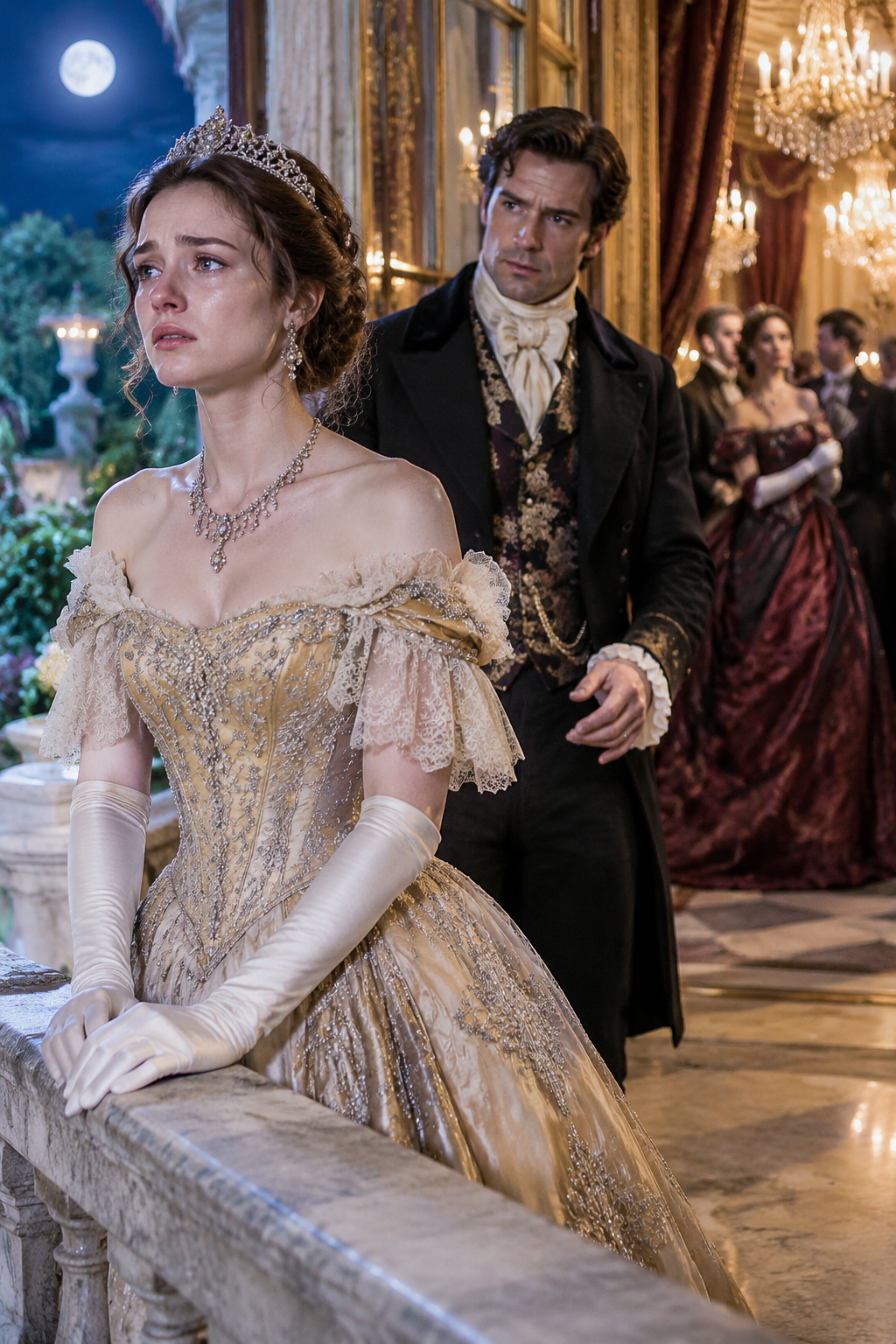
He looked up.
She continued carefully.
“I cannot be your wife only when you are frightened of losing me. I need a husband who remembers I exist when the world is ordinary.”
The carriage wheels rattled over the bridge.
Edward considered her words.
Then he nodded.
“You deserve that.”
Clara looked away.
She had expected him to argue.
Instead, he said something that surprised her.
“If you still wish to leave tomorrow, I won’t stop you.”
She turned back.
“And if I stay?”
“Then I must give you reasons to want to.”
That evening, Clara returned to her chamber and found her traveling trunk exactly where she had left it.
Edward did not ask her to unpack.
He sent a note requesting permission to dine with her.
She read it twice.
Then she wrote a brief reply.
You may come at seven.
At precisely seven, he arrived carrying a small bouquet of white roses from the conservatory.
Clara opened the door herself.
He looked almost embarrassed.
“I wasn’t certain which flowers you preferred.”
She accepted them.
“These are lovely.”
He hesitated.
“Would you tell me your favorites?”
Clara studied him.
“Lilacs.”
He nodded, as though committing the answer to memory.
They ate beside a small fire, without servants standing nearby.
For the first time, Edward asked about her childhood.
Clara told him about her father’s merchant ships, her mother’s habit of singing while arranging flowers, and the little garden behind their London home.
She described the excitement she had felt when Edward first proposed.
Then she described the disappointment that followed.
He listened.
He did not defend himself.
When she finished, he said quietly, “I was cruel to you.”
Clara looked down at her plate.
“You were absent.”
“That was cruelty too.”
She met his eyes.
He continued.
“I cannot undo those months. But I would like to stop adding to them.”
Clara felt the familiar urge to forgive him immediately.
She resisted it.
Forgiveness, she was beginning to understand, did not require pretending that pain had disappeared.
“Then we begin slowly,” she said.
Edward nodded.
“Slowly.”
Over the following weeks, the manor changed in ways so small that the servants initially wondered whether they were imagining them.
The Duke began appearing at breakfast.
Sometimes he arrived awkwardly early and sat reading the same page of a newspaper while waiting for Clara.
He asked whether she had slept well.
He listened to her answers.
When she mentioned wanting to visit the village school, he offered the carriage.
She declined.
Instead, she asked him to accompany her.
He agreed.
At the school, Edward stood stiffly among the children until a little girl offered him a drawing of the manor.
He accepted it with solemn gratitude.
Later, Clara discovered he had placed it on his study desk.
One afternoon, she found him standing before his mother’s portrait in the western corridor.
The shutters had been opened.
Sunlight illuminated the painted woman’s face.
Edward held one of her letters.
“I used to hate this portrait,” he admitted.
“Why?”
“Because she looked happy in it. I thought she had been happy to leave.”
Clara stood beside him.
“And now?”
“Now I think she was happy because I was there.”
He slipped the letter into his pocket.
Clara took his hand.
For a while, that was enough.
But healing did not proceed without difficulty.
One evening, a dispute arose concerning repairs to Rosemere House.
The estate steward warned that restoring the building would require considerable expense.
Edward’s expression hardened.
He dismissed the man’s objections sharply and ordered him from the room.
Clara watched in silence.
Afterward, she said, “You sounded like your father.”
Edward turned toward her.
The words struck him visibly.
For a moment, anger flashed across his face.
Then he looked at the closed door.
“You’re right.”
Clara had expected an argument.
Instead, Edward went after the steward.
She later learned that he had apologized.
It was not a grand gesture.
There were no witnesses gathered to admire his humility.
But Clara remembered it longer than she remembered the flowers.
As winter approached, Rosemere House began to recover.
Broken windows were replaced. The gardens were cleared. Warm fires burned in rooms that had stood cold for decades.
Edward arranged for the property to become a residence for women and children who needed safety, education, or temporary shelter.
He consulted Clara about every decision.
At first, she offered suggestions cautiously.
Then she began bringing plans of her own.
She proposed a library, a small schoolroom, and gardens where residents could grow flowers and vegetables.
Edward approved the plans without hesitation.
One evening, as they examined drawings beside the study fire, Clara noticed him watching her.
“What is it?”
He smiled.
“I like hearing you speak about things you care for.”
She lowered her pencil.
“You used to leave the room whenever I spoke too long.”
“I remember.”
“Then you must find this exhausting.”
“Not nearly as exhausting as pretending I didn’t want to listen.”
Clara laughed.
The sound surprised them both.
Edward looked at her as though he had discovered something precious.
She smiled again, less cautiously this time.
Yet the deepest change came on a cold December morning.
A solicitor arrived carrying documents recovered from the former Duke’s private records.
Among them was evidence that the physician responsible for Edward’s mother’s confinement had knowingly falsified medical statements.
The solicitor explained that the physician was still alive, though elderly, and that several witnesses could confirm the deception.
Edward listened without interruption.
When the solicitor finished, he asked whether the truth could be formally recorded.
“It can, Your Grace. But the proceedings may attract considerable attention.”
Edward looked toward Clara.
She said nothing.
This was his decision.
He turned back to the solicitor.
“Then let it attract attention.”
The man hesitated.
“Your father’s reputation—”
“My father’s reputation was built upon my mother’s silence.”
Edward’s voice remained calm.
“I will not preserve it at her expense.”
The proceedings took months.
There were uncomfortable questions, unpleasant discoveries, and newspaper reports that transformed private grief into public discussion.
Some acquaintances quietly withdrew their invitations.
Others expressed sympathy Edward neither requested nor welcomed.
Through it all, Clara remained beside him.
Not because he required her to stand there.
Because he never again treated her presence as something owed.
On difficult evenings, he told her when he was afraid.
When memories overwhelmed him, he no longer disappeared behind locked doors.
Sometimes he needed solitude.
But now he explained.
And he always returned.
One night, after receiving particularly distressing testimony about his mother’s confinement, Edward found Clara reading beside the fireplace.
He sat beside her without speaking.
She closed her book.
“Was today difficult?”
“Very.”
“Would you like to tell me?”
He considered the question.
“Not yet.”
Clara nodded.
“Then we can sit.”
He reached for her hand.
They remained together until the fire burned low.
It was a simple evening.
No dramatic confession.
No extraordinary promise.
Yet Clara felt closer to him than she had on their wedding day.
By spring, the legal proceedings had established the former Duchess’s wrongful confinement and exposed the deliberate deception surrounding her supposed death.
The physician’s misconduct was formally documented, and the surviving records were corrected.
Edward arranged for his mother to be buried in the family chapel beneath a stone bearing her true date of death.
He refused the grand ceremony suggested by several relatives.
Instead, he invited only those who had genuinely cared for her.
Mrs. Bell stood beside Clara as the chapel bells rang.
Edward placed a small wooden horse near the flowers covering his mother’s grave.
Its missing wheel had been carefully repaired.
Clara watched him kneel.
For several moments, he remained still.
Then he whispered, “I’m sorry I didn’t come sooner.”
The wind moved gently through the chapel garden.
Mrs. Bell approached and rested a hand upon his shoulder.
“She never stopped loving you, Master Edward.”
He closed his eyes.
When he rose, he looked different.
Not because grief had vanished.
But because he no longer seemed determined to carry it alone.
That afternoon, Edward and Clara walked through the gardens at Ashworth Manor.
The first lilacs had begun to bloom.
Their fragrance drifted across the gravel path as they approached the small stone fountain.
Clara paused beside a flowering tree.
Edward turned toward her.
“Are you cold?”
She shook her head.
For a moment, she seemed uncertain how to begin.
Then she said, “I never unpacked the last dress.”
Edward looked at her.
“The blue one?”
She nodded.
It had remained folded in her traveling trunk since the night she intended to leave.
He understood what she was telling him.
He also understood that she was not asking to be persuaded.
“Would you like to unpack it?” he asked.
Clara looked toward the manor.
Six months earlier, she had stood in a beautiful room feeling utterly alone.
Now the same house contained shared breakfasts, unfinished conversations, laughter, disagreements, apologies, and evenings when silence no longer felt like rejection.
She turned back to him.
“Yes.”
Edward’s expression softened.
“May I help?”
Clara smiled.
“I think you may.”
They returned to her chamber together.
The trunk stood near the wardrobe, smaller than she remembered.
Edward opened it while Clara lifted out the carefully folded gown.
Beneath it lay her wedding ring.
She had placed it there after leaving the western room, uncertain whether she would ever wear it again.
Edward saw it.
He did not reach for it.
Clara held the ring in her palm.
“I thought this meant I belonged to you,” she said.
Edward shook his head.
“I hope it can mean that we belong beside each other.”
She looked at him for a long moment.
Then she placed the ring in his hand.
“Would you?”
He took her fingers gently.
“Are you certain?”
Clara nodded.
“I am not certain we will never hurt each other again.”
“Neither am I.”
“But I believe we can learn to be kinder when we do.”
Edward slipped the ring onto her finger.
Then he raised her hand and kissed it.
There was no audience.
No orchestra.
No elaborate ceremony.
Only two people standing beside an open wardrobe, choosing a marriage neither had known how to build when it began.
Months later, Rosemere House opened its doors to its first residents.
Clara stood in the entrance hall as children hurried through the restored rooms, their footsteps echoing beneath freshly painted ceilings.
A little boy paused beside Edward, studying the Duke’s formal coat with open curiosity.
“Are you the man who owns this house?”
Edward crouched to meet his eyes.
“I help look after it.”
The boy considered this.
“Will you make us leave?”
Edward glanced toward Clara.
She stood beside the doorway, holding a basket of books.
He turned back to the child.
“Not because you’re frightened. Not because you’re sad. And certainly not because you need someone.”
The boy seemed satisfied.
He hurried away toward the schoolroom.
Clara approached her husband.
“Your mother would have liked that answer.”
Edward looked around the hall.
“I hope so.”
She slipped her hand into his.
Together, they watched the children disappear into rooms that had once held only silence.
Years passed, and Ashworth Manor became known for something quite different from its former grandeur.
Visitors still admired the marble staircases, the gardens, and the ancient portraits.
But those who stayed long enough noticed the smaller things.
The Duke who listened when his wife spoke.
The Duchess who challenged him without fear.
The study door that remained open in the evenings.
The sound of laughter drifting from rooms that had once seemed impossibly quiet.
Edward never became a man without sorrow.
There were still mornings when memories troubled him and evenings when he struggled to explain what he felt.
Clara never became someone who could endure neglect without pain.
She still needed tenderness, honesty, and the reassurance of being seen.
But they learned to recognize the distance before it became a wall.
They learned that an apology mattered only when followed by change.
And they learned that love was not proved by how desperately one person begged another to remain.
It was proved by the ordinary care that made remaining a choice worth making.
On the anniversary of the night Clara had nearly left, Edward found her standing beside the western corridor window.
The portrait of his mother hung nearby, illuminated by the last golden light of evening.
He approached quietly.
“Do you ever regret staying?”
Clara turned.
She considered the question seriously.
“I regret that we lost so much time.”
Edward nodded.
“So do I.”
She stepped closer.
“But I don’t regret what we chose to do with the time afterward.”
He took her hand.
Beyond the window, the gardens stretched beneath a pale evening sky.
Clara rested her head against his shoulder.
For a while, neither spoke.
Then Edward said, “I used to believe love was dangerous because it gave another person the power to hurt you.”
Clara looked up.
“And now?”
He brushed a loose strand of hair from her cheek.
“Now I think the greater danger is refusing to love anyone at all.”
She smiled.
“Your mother would have agreed.”
Edward glanced toward the portrait.
“I think she would have liked you.”
Clara laughed softly.
“I hope she would have told you to behave better.”
He smiled.
“Frequently, I imagine.”
They walked downstairs together as the lamps were being lit.
At the foot of the staircase, Edward paused and offered Clara his arm.
She accepted.
There was nothing remarkable about the gesture.
That was precisely why it mattered.
Once, Clara had mistaken a magnificent wedding for the beginning of happiness.
Edward had mistaken emotional distance for strength.
Both had been wrong.
Their marriage had not been saved by a single confession, a discovered letter, or even the painful truth about his mother.
Those things had opened a door.
What saved them was everything that followed: the willingness to listen, the courage to apologize, the patience to change, and the daily decision not to let old wounds become excuses for new ones.
And in the great house where a lonely bride had once packed her belongings by candlelight, love finally became something neither wealth nor title could purchase.
It became a place where two imperfect people could be honest without fear, vulnerable without shame, and certain that being loved did not require becoming someone else.
Because the greatest inheritance Edward’s mother left him was not the truth hidden inside her letters.
It was the understanding that tenderness was never weakness.
And the greatest gift Clara gave him was not her forgiveness.
It was the chance to discover that he could become worthy of it.
That evening, when the last lamp was extinguished and the manor settled into peaceful silence, Edward reached across the bed and found Clara’s hand.
She turned toward him.
“Goodnight, Edward.”
He kissed her forehead.
“Goodnight, my love.”
And for the first time in either of their lives, the silence that followed felt entirely like home.
Hãy viết tiếp tục câu chuyện này giúp tôi thêm một đoạn ngắn bằng tiếng Anh dài đúng 50 dòng. Viết thành nhiều đoạn, đoạn nào không phải là thoại thì viết liền mạch ko xuống dòng, câu nào là thoại thì mới xuống dòng. thoại vừa phải, thiên về kể hơn. Giữ đúng ngôi kể, văn phong, lối viết, ko viết quá dài, nhưng một dòng ko nên quá ngắn, không cách dòng, ko cách nhau bởi một dòng trắng nào. Trước khi viết thì hãy ghi câu”# NEXT PART: “, sau đó xuống dòng và bắt đầu viết. Thêm dấu ba chấm “…to be continue!” vào ngay sau câu cuối cùng, sau đó thì xuống dòng, cách xuống 1 dòng và ghi câu này:
“_____________________________________
𓂃✦ 𝐖𝐨𝐮𝐥𝐝 𝐲𝐨𝐮 𝐥𝐢𝐤𝐞 𝐭𝐨 𝐫𝐞𝐚𝐝 𝐭𝐡𝐞 𝐟𝐮𝐥𝐥 𝐬𝐭𝐨𝐫𝐲?
Leave us a little note below — we’d love to hear from you ♡”
# NEXT PART:
The following morning, Clara awakened to the sound of rain brushing against the bedroom windows, but the familiar warmth of Edward’s hand resting beside hers made the gray dawn feel unexpectedly peaceful.
For several moments, she watched him sleep, noticing how different his face appeared when the burdens of his title no longer demanded his attention.
The man who had once treated affection as an inconvenience now reached for her even in sleep, his fingers closing gently around hers.
Yet beneath that quiet happiness, Clara understood that a peaceful marriage was not a story that ended simply because two people had learned to love.
There would always be difficult mornings, painful memories, and moments when the past attempted to reclaim its place between them.
Edward stirred, opening his eyes to find her watching him with an expression he had gradually learned to recognize.
“You’re thinking about something,” he murmured.
Clara smiled faintly, brushing a loose strand of dark hair away from his forehead before answering.
“Only how strange it is that this house finally feels smaller.”
Edward glanced toward the high ceiling and enormous windows, clearly uncertain whether she meant the observation as criticism.
She laughed softly at his confusion, then rested her palm against his cheek.
“It no longer feels as though we live at opposite ends of it.”
He caught her hand and kissed her fingers, a gesture that had become familiar without losing its quiet significance.
They breakfasted together beneath the conservatory windows, where sunlight gradually broke through the clouds and illuminated the first flowers of the season.
A servant entered carrying the morning correspondence, including a thick cream-colored envelope bearing the official seal of the county magistrate.
Edward examined the unfamiliar handwriting before opening it, while Clara noticed the brief tightening of his shoulders.
The letter concerned Rosemere House, which had recently attracted the attention of several influential families unhappy with its new purpose.
Some objected to the presence of women seeking refuge, while others questioned whether an aristocratic estate should be used for charitable accommodation.
Edward read the final paragraph twice, his expression becoming increasingly guarded as he set the paper beside his untouched tea.
“Someone has requested a formal inquiry into Rosemere’s management.”
Clara placed her cup down carefully, remembering the frightened children who had finally begun sleeping peacefully beneath its restored roof.
She reached for the letter and read the accusations, noticing how little evidence accompanied the elaborate complaints.
At the bottom appeared the name of Lord Pembroke, a distant relation of Edward’s father who had attended their wedding without once speaking kindly to Clara.
The name stirred an unpleasant memory of a man who had regarded her merchant upbringing as an embarrassment to the Ashworth family.
“He never approved of our marriage,” Clara observed.
Edward looked toward the gardens, where the wind moved through the flowering lilacs that she had planted the previous spring.
“He approved of your fortune well enough.”
The bitterness in his voice was restrained, but Clara recognized the old instinct to protect himself through anger.
She placed her hand over the letter, drawing his attention back to the table before he could retreat into silence.
“Then we should discover what he actually wants before deciding how to answer him.”
Edward studied her for a moment, then nodded, accepting the wisdom of a partnership he once would have mistaken for a challenge to his authority.
They traveled to Rosemere that afternoon, arriving beneath a bright sky that made the restored white windows shine against the surrounding gardens.
Children played beside the fountain, while Mrs. Bell supervised the planting of young rosebushes along the eastern path.
The old woman greeted them warmly, but her smile faded when Edward mentioned the magistrate’s letter.
She glanced toward the house, where a visiting gentleman had apparently spent the morning questioning servants about the institution’s finances.
Clara noticed that Mrs. Bell’s hands had begun twisting the edge of her apron, an old habit that appeared whenever memories of the former Duke returned.
“Did the gentleman leave his name?” Edward asked.
Mrs. Bell hesitated before explaining that the visitor had refused to identify himself, claiming only that he represented an interested party.
She led them into the small office, where several account books lay open on the desk despite having been locked away the previous evening.
Clara examined the papers and immediately noticed that one ledger had been removed from its usual position.
The missing volume contained the earliest records of Rosemere’s restoration, including the funds Edward had personally contributed after discovering his mother’s imprisonment.
Edward checked the cabinet, his jaw tightening when he found the lock scratched around its brass plate.
Someone had entered the office deliberately, searching for documents rather than valuables, and had apparently known exactly where the records were kept.
Clara turned toward the window, noticing a carriage disappearing beyond the distant gates, its dark curtains concealing whoever sat inside.
Before Edward could summon the estate steward, Mrs. Bell produced a folded note that had been slipped beneath the office door.
The message contained no signature, only a brief warning written in an unfamiliar hand.
Clara unfolded the paper beneath the afternoon light, and Edward watched her expression change as she reached the final sentence.
“Your mother’s letters were not the only documents your father ordered hidden,” she read quietly.
Edward reached for the note, but Clara had already noticed the final line, written in smaller letters beneath the warning.
And when she read it aloud, the peaceful world they had worked so carefully to rebuild suddenly seemed far less secure: “Ask Lord Pembroke why the original marriage settlement was never destroyed.”…to be continue!
_____________________________________
𓂃✦ 𝐖𝐨𝐮𝐥𝐝 𝐲𝐨𝐮 𝐥𝐢𝐤𝐞 𝐭𝐨 𝐫𝐞𝐚𝐝 𝐭𝐡𝐞 𝐟𝐮𝐥𝐥 𝐬𝐭𝐨𝐫𝐲?
Leave us a little note below — we’d love to hear from you ♡
Viết tiếp phần còn lại của câu chuyện này với độ dài khoảng 2500 – 3000 từ, viết trong 1 lần trả lời duy nhất.
Viết từ đoạn còn dang dở của câu chuyện tôi gửi cho đến kết thúc của câu chuyện.
Câu chuyện có nhiều tình tiết, có cao trào, lôi cuốn, hấp dẫn, khiến người đọc cảm thấy nghiện, thu hút.
kết thúc của câu chuyện phải có ý nghĩa hoặc 1 bài học gì đó hoặc mang lại một giá trị gì đó.
Viết đúng theo mạch cảm xúc, đúng phong cách, viết bằng tiếng Anh.
Không được viết 1 đoạn quá dài dính liền nhau mà hãy viết theo cách của bạn sao cho hợp lý nhất, ko quá ngắn ko quá dài.
Tuyệt đối không được lặp đi lặp lại 1 câu nhiều lần liên tiếp nhau.
Giữa các dòng tuyệt đối ko cách nhau bởi bất kì một dòng trắng nào.
Edward read the final sentence three times before lowering the note. Outside the office window, the children continued playing beside the fountain, their laughter drifting through the open glass. The ordinary sound seemed strangely distant. Clara watched her husband’s expression change as he studied the words concerning his mother’s marriage settlement, a document neither of them had encountered during the investigation into her confinement.
“Do you know what it means?” she asked.
Edward folded the paper carefully. “A marriage settlement usually establishes the property and financial arrangements agreed upon before a wedding. My father controlled the family estates, but my mother brought considerable property into their marriage.”
“Property that might have belonged to her independently?”
“Possibly. I was told her fortune became part of the Ashworth holdings.”
Clara glanced toward the empty space in the cabinet where the missing ledger had stood. “And someone is suddenly very interested in what happened to it.”
Edward moved toward the door, but she touched his sleeve.
“Before you summon everyone, consider who might be listening.”
He stopped. A year earlier, he would have regarded such caution as interference. Now he looked at her and nodded.
“You’re right. We should speak with Mrs. Bell privately.”
They found the elderly woman in the garden, kneeling beside a young rosebush. When Edward mentioned the marriage settlement, her trowel slipped from her hand.
For a moment, she stared at the dark earth.
“Your mother kept a copy,” she whispered.
“Where?”
Mrs. Bell glanced toward the house. “I don’t know anymore. She was frightened someone would discover it. She said your father had taken something that was never his.”
Edward crouched beside her. “Why didn’t you tell me during the investigation?”
“Because I didn’t understand what she meant. And because I was afraid that speaking of it would bring trouble upon this house again.”
Clara knelt on the other side of the rosebush. “Someone has already brought trouble here. Whatever you remember may help us protect the people living inside.”
Mrs. Bell looked toward the schoolroom windows. A little girl waved from behind the glass. The old woman lifted her hand in reply before speaking.
“Your mother once told me that her marriage settlement contained a provision for women who had nowhere safe to go. She said her grandmother had insisted upon it.”
Edward frowned. “A charitable provision?”
“Something more permanent, I think. She spoke of land that could never be sold for private profit.”
Clara felt a sudden chill despite the afternoon sunshine. Rosemere had been chosen for its present purpose because Edward wanted to honor his mother. Neither of them had known that she might have intended something similar decades earlier.
“Did she mention Rosemere specifically?” Clara asked.
Mrs. Bell nodded slowly. “She called it her grandmother’s gift.”
Edward rose, looking toward the house that had once imprisoned his mother. “Then we need the original document.”
They returned to Ashworth Manor before sunset. Edward immediately wrote to the family solicitor, Mr. Harcourt, requesting every surviving record concerning his parents’ marriage. Clara examined the note again, searching for some indication of its author. The handwriting was small and deliberate, with an unusual backward curve on the capital letters.
She had seen that handwriting before.
Not in the household correspondence, but somewhere among the documents recovered during the earlier investigation.
She searched her memory until Edward noticed her silence.
“What is it?”
“The warning. I think whoever wrote it has contacted us before.”
They spent the evening examining old papers in the study. At last, Clara discovered a receipt from the physician who had supervised Edward’s mother’s confinement. The signature belonged to a clerk named Thomas Vale. The same backward curve appeared in the first letter of his name.
Edward studied the receipt.
“Vale disappeared after the proceedings began. Harcourt believed he had gone abroad.”
“Perhaps he never left.”
Before Edward could answer, a knock sounded at the study door.
The butler entered carrying a visiting card.
“Lord Pembroke requests an audience tomorrow morning, Your Grace.”
Edward looked at Clara.
“How considerate of him to save us the journey.”
Pembroke arrived precisely at ten, dressed in a dark green coat and carrying a silver-headed walking stick. He entered the drawing room with the confidence of a man accustomed to being welcomed, although his eyes briefly narrowed when he discovered Clara seated beside her husband.
“My dear Ashworth,” he began, “I had hoped we might discuss a delicate family matter privately.”
Edward remained seated. “My wife is part of this family.”
Pembroke’s smile tightened. “Naturally. Though certain matters concern ancestral obligations that may be difficult for outsiders to appreciate.”
Clara poured tea without looking away from him. “Then I shall appreciate the opportunity to learn.”
The older man accepted his cup but did not drink.
He spoke at length about reputation, public responsibility, and the dangers of allowing charitable enthusiasm to interfere with established property rights. Edward listened without interruption.
Finally, Pembroke placed a folded document on the table.
“I have reason to believe Rosemere was never properly transferred into your father’s estate. Its ownership may be subject to an older claim.”
Edward glanced at the paper. “Whose claim?”
Pembroke hesitated.
“That is precisely what must be established.”
Clara leaned forward. “Then why have you requested an inquiry into Rosemere’s accounts rather than its title?”
The question unsettled him. His fingers tightened around the porcelain handle.
“I am merely ensuring that the property is administered responsibly.”
“By removing its financial records?”
Pembroke set down his cup.
“I beg your pardon?”
“A ledger disappeared yesterday. Someone entered the office without permission.”
“I know nothing of that.”
Edward watched him carefully. “Then perhaps you can explain why you have taken an interest in my mother’s marriage settlement.”
For the first time, Pembroke lost his composure.
His eyes moved toward Clara, then returned to Edward.
“Where did you hear about that?”
“Does it matter?”
“It matters considerably.”
The room fell silent.
Pembroke rose and approached the fireplace, where a portrait of Edward’s father hung above the mantel.
“Your father was a difficult man,” he said at last. “But he understood the importance of keeping family affairs within the family.”
Edward stood. “My father used that principle to imprison my mother.”
Pembroke turned sharply. “You have already dragged his name through the courts. Must you destroy everything he built?”
“Only what was built upon deception.”
The older man studied him for several seconds.
Then he spoke quietly.
“If you pursue this matter, you may discover that Rosemere does not belong to you at all.”
Edward stepped closer.
“If that is true, I will return it to whoever owns it.”
Pembroke’s expression changed. He had expected fear, perhaps anger, but not indifference to the threat of losing property.
Clara set down her teacup.
“And if the rightful owner intended it to shelter vulnerable women, we will help fulfill that intention.”
Pembroke looked between them. His mouth tightened.
“You are both remarkably naive.”
He left without finishing his tea.
When the carriage disappeared beyond the gates, Edward returned to the drawing room. Clara was standing beside the fireplace, studying the portrait of his father.
“He’s frightened,” she said.
“Of losing Rosemere?”
“No. Of someone discovering why it was taken.”
That afternoon, Mr. Harcourt arrived with a leather case containing documents recovered from the family’s former legal offices. The solicitor was a thin, meticulous gentleman whose spectacles frequently slipped down his nose when he became absorbed in reading.
He spread the papers across Edward’s desk.
“The original marriage settlement is missing,” he admitted. “However, I found references to it in correspondence between your maternal grandfather and his solicitor.”
Clara examined the letters.
One passage mentioned a property held separately for Edward’s mother, with restrictions upon its sale or transfer. Another referred to a charitable trust intended to take effect upon her death.
Harcourt adjusted his spectacles.
“Under the terms described here, Rosemere should have remained under your mother’s independent control during her lifetime. Afterward, it was to be administered for the benefit of women and children requiring refuge.”
Edward stared at the papers.
“Then my father had no right to confine her there as though it were his private property.”
“Not if these provisions were properly executed.”
Clara turned another page. “What happened to the trust?”
“That is the difficulty. Without the signed settlement, proving the precise terms will be challenging.”
Edward looked toward the window.
Somewhere beyond the distant hills, Rosemere stood filled with children whose futures might depend upon a document hidden for decades.
“Find Thomas Vale,” he said.
Harcourt nodded. “I have already begun.”
Three days passed without news.
During that time, Clara continued visiting Rosemere, refusing to allow the uncertainty to interrupt its daily routines. She helped the schoolmistress arrange books, listened to the children’s lessons, and reassured anxious residents who had heard rumors about the inquiry.
Edward accompanied her whenever his duties allowed.
One afternoon, they found a young mother sitting alone beneath the chestnut trees, her little son asleep against her shoulder.
She rose nervously when she recognized them.
“Your Grace, is it true we may have to leave?”
Edward looked at Clara before answering.
“There are questions concerning the property’s ownership. But we are doing everything possible to ensure that no one here is abandoned.”
The woman lowered her eyes.
“I have nowhere else.”
Clara sat beside her.
“Then we will not make promises lightly. But whatever happens to this building, we will help you find somewhere safe.”
The young mother began to cry quietly.
Edward watched Clara place a hand over hers. He remembered his own mother waiting for someone to protect her, and the memory settled heavily upon him.
That evening, he instructed Harcourt to establish an independent fund for Rosemere’s residents, using his personal income rather than disputed estate assets.
Clara found him signing the documents.
“You’ve already decided?”
“Whatever the courts determine, those families must have somewhere to go.”
She smiled. “Your mother would have been proud.”
Edward looked down at the paper.
“I hope I am finally becoming someone she would recognize.”
The following morning, a sealed message arrived from Harcourt.
Thomas Vale had been found.
He was living in a small village forty miles away, under an assumed name, and had agreed to speak only if Edward came without police or servants.
Clara insisted upon accompanying him.
They reached the village near dusk, following a narrow lane toward a cottage surrounded by winter-bare hedges. A single lamp burned behind the curtains.
Vale opened the door before they knocked.
He was older than Clara expected, with hollow cheeks and trembling hands.
When he saw Edward, his eyes filled with something resembling shame.
“You look like your mother.”
Edward did not answer.
Inside, the cottage smelled of coal smoke and damp paper. Vale led them to a small table where several documents lay beneath a folded cloth.
“I wrote the warning,” he confessed. “I also removed the ledger.”
Clara’s expression hardened. “Why?”
“Because Pembroke’s agent was coming for it. I wanted to keep it safe.”
“Then why not tell us?”
Vale looked toward Edward.
“Because I helped your father.”
Silence filled the room.
Vale explained that as a young clerk, he had assisted the physician who confined Edward’s mother. He had copied correspondence, altered account entries, and witnessed documents being concealed.
At the time, he had convinced himself that obedience was necessary to preserve his employment.
Later, when he understood the full cruelty of what had occurred, fear kept him silent.
“Your mother knew I was ashamed,” he said. “She asked me to preserve one thing if I could.”
He lifted the cloth.
Beneath it lay a thick document bearing several seals.
Edward stepped forward.
“The settlement?”
Vale nodded.
“Your father ordered it destroyed. Lord Pembroke was present when he gave the instruction. I substituted another document and kept this hidden.”
Clara examined the signatures. The names matched those mentioned in the earlier correspondence.
“Why reveal it now?”
Vale’s hands trembled.
“Because I heard what you had done with Rosemere. I realized you had fulfilled her wishes without knowing they existed.”
Edward turned the pages.
The settlement established Rosemere as his mother’s separate property and provided that, upon her death, it would pass into a charitable trust for women and children without secure homes.
The trustees were to include a representative of her family and an independent legal officer.
Neither Edward’s father nor Lord Pembroke had been appointed.
A second document lay beneath the settlement.
It was a signed declaration from Edward’s mother, written during her confinement.
In it, she described the coercion used against her and stated that she had never willingly surrendered control of her property.
Edward read the final paragraph.
His mother’s words were clear.
If my son should ever learn the truth, I ask only that he not inherit the bitterness of those who harmed us. Let him use what remains to offer others the kindness denied to me.
He lowered the page.
Vale watched him anxiously.
“I cannot undo what I did.”
“No,” Edward replied.
The old man bowed his head.
“But you can testify.”
Vale looked up.
“Will you?”
For several seconds, he seemed unable to speak.
Then he nodded.
“Yes.”
The legal proceedings began the following month.
Pembroke challenged the settlement’s authenticity, questioned Vale’s credibility, and suggested that Edward’s charitable work had clouded his judgment.
But the original seals were examined, the signatures verified, and surviving correspondence confirmed the provisions.
The missing ledger revealed that Pembroke had benefited from payments made to the physician during Edward’s mother’s confinement. It also showed that he had later received money for assisting with the concealment of the property’s true ownership.
The revelation caused considerable scandal.
Pembroke’s solicitor attempted to negotiate a private settlement.
Edward refused.
At the final hearing, Pembroke approached him outside the courtroom.
“You would destroy your own family for the sake of a few strangers?”
Edward looked at the older man.
“My family was nearly destroyed by men who believed strangers mattered less than appearances.”
Pembroke’s face reddened.
“You speak as though you understand sacrifice.”
Edward’s expression remained calm.
“I understand that my mother paid for your comfort with eleven years of her life.”
Pembroke looked away.
Clara stood beside Edward, her gloved hand resting lightly against his arm.
For once, the older man had nothing to say.
The court upheld the settlement and confirmed Rosemere’s charitable purpose. Independent trustees were appointed, and the disputed funds were subjected to further examination.
Pembroke’s involvement in concealing the documents was formally exposed, ending his influence over the property.
Vale testified openly about his own misconduct and accepted the consequences of his actions.
When the proceedings concluded, Edward did not celebrate.
He stood outside the courthouse beneath a pale afternoon sky, watching people hurry through the streets.
Clara approached him.
“It’s finished.”
He shook his head gently.
“The case is finished.”
She understood the distinction.
No judgment could restore his mother’s stolen years.
No legal victory could return the childhood he had lost.
But the truth had finally been given a place where it could no longer be hidden.
They traveled directly to Rosemere.
Mrs. Bell was waiting beneath the entrance archway, surrounded by several residents and members of the staff.
Edward stepped from the carriage and handed her a copy of the court’s decision.
The elderly woman read the first page, then pressed the paper against her chest.
“She would have been so happy.”
Edward looked toward the windows.
“She should have seen it herself.”
Mrs. Bell touched his hand.
“Yes, my dear. She should have.”
There was no attempt to soften the injustice.
For that, Edward was grateful.
The following months brought changes throughout Rosemere. The charitable trust secured its future, allowing the schoolroom to expand and additional cottages to be restored for families needing privacy.
Clara supervised the creation of a library, while Edward worked with the trustees to establish transparent accounts and independent oversight.
He insisted that no single person should ever possess the authority his father had abused.
At the first trustees’ meeting, Clara noticed a vacant chair beside the chairman.
“Who is that for?” she asked.
Edward smiled.
“You.”
She stared at him.
“Edward, I am already involved in the daily management.”
“Precisely. You understand what the residents need better than anyone.”
Clara hesitated.
“Are you certain the trustees will approve?”
“They already have.”
She laughed softly.
“You arranged this without telling me?”
“I asked whether they would consider you. The decision is yours.”
Clara studied him for a moment.
Then she accepted.
It was not the position itself that moved her.
It was the knowledge that Edward no longer regarded her judgment as something to be tolerated, but something worth seeking.
Their marriage continued to grow through such ordinary moments.
They disagreed over household expenses, argued about whether Edward worked too late, and occasionally found themselves slipping into old habits.
But neither allowed silence to become punishment.
When Edward withdrew after a difficult day, he learned to explain that he needed time rather than leaving Clara to wonder whether she had offended him.
When Clara felt overlooked, she spoke instead of waiting for resentment to deepen.
Some conversations were uncomfortable.
Others ended in laughter.
All of them brought the couple closer to the marriage they had once imagined impossible.
One spring evening, Clara found Edward in the western room, sitting beside his mother’s writing desk.
The windows were open, and the scent of lilacs drifted through the curtains.
He held a letter she had written shortly before her death.
Clara approached quietly.
“May I sit?”
He nodded.
She settled beside him.
For a while, they watched the last sunlight move across the floor.
Then Edward spoke.
“I used to believe that if I understood everything my father had done, I would finally stop being angry.”
Clara looked at him.
“And have you?”
“No.”
He folded the letter.
“But I no longer want anger to decide what kind of husband I become.”
She reached for his hand.
“That seems a better beginning than forgetting.”
Edward smiled faintly.
“I think my mother would agree.”
He looked around the room, once locked against every living person.
“I’ve been considering something.”
Clara raised an eyebrow.
“Should I be concerned?”
“Possibly.”
She laughed.
Edward continued.
“I would like to turn this room into a place where we can keep the things that matter to us. Not merely the things we have lost.”
Clara glanced toward the writing desk.
“What would you put here?”
“Your books. The children’s drawings. Letters from our friends. Perhaps a few photographs when we have them.”
He hesitated.
“And anything you would like to remember.”
Clara looked toward the old wooden horse resting beside the fireplace.
For years, the room had preserved a child’s grief.
Now Edward wanted it to hold the life he was building.
“I think that’s a lovely idea.”
They spent the following weeks arranging the room together.
Clara brought her favorite novels and a small watercolor painted by her mother. Edward added letters from Rosemere’s residents, including a carefully written thank-you note from the young mother who had once feared losing her shelter.
The little boy who had asked whether Edward owned the house sent a drawing of the garden.
Edward placed it beside his childhood wooden horse.
One afternoon, Mrs. Bell visited and found the western room filled with sunlight.
She stood in the doorway for a long moment.
“Your mother used to say that rooms remember the people who live in them.”
Edward approached her.
“Do you think she would approve?”
The old woman smiled through sudden tears.
“I think she would be delighted to know this one has learned to welcome people again.”
Years later, visitors to Ashworth Manor would speak of the Duke and Duchess with quiet admiration.
They would mention Rosemere, its flourishing gardens, and the families who had found safety there.
Some would remember the scandal that exposed the former Duke’s cruelty.
Others would know only that the Ashworth estate had become associated with generosity rather than pride.
But the story that mattered most to Edward and Clara was never recorded in any newspaper.
It lived in the small rituals of their days.
The cup of tea Edward brought Clara when she worked late.
The way she reached for his hand when he grew quiet.
The apologies offered before resentment could harden.
The laughter that filled rooms once governed by formality.
And the understanding that neither person had to earn affection by concealing pain.
On the anniversary of their wedding, Edward arranged a private dinner in the conservatory.
There were no distinguished guests, no elaborate speeches, and no musicians waiting behind the doors.
Only candlelight, flowers, and a small table overlooking the gardens.
Clara arrived wearing the blue gown she had once packed into her traveling trunk.
Edward rose when she entered.
For a moment, he simply looked at her.
“You remember this dress?” she asked.
“Of course.”
She smiled.
“It nearly left this house forever.”
His expression softened.
“I remember that too.”
They sat together while the evening light faded beyond the glass.
After dinner, Edward placed a small wooden box beside her plate.
Clara opened it carefully.
Inside lay a delicate silver locket engraved with a spray of lilacs.
She lifted it from the velvet lining.
“It’s beautiful.”
Edward watched her.
“Open it.”
Inside were two miniature portraits.
One showed Clara on their wedding day.
The other depicted them together in the gardens at Rosemere, smiling beneath the chestnut trees.
Clara touched the second portrait.
“When was this painted?”
“From the sketch Mr. Harcourt’s niece made during the summer gathering.”
She looked up.
Edward’s voice grew quieter.
“I wanted you to have something that remembered us as we are now.”
Clara closed the locket gently.
For a moment, she could not speak.
Then she reached across the table and took his hand.
“I never needed you to become a perfect man, Edward.”
He smiled faintly.
“I should hope not. I would disappoint you before breakfast.”
She laughed.
Then her expression softened.
“I only needed to know that you wanted to share your life with me.”
He lifted her hand to his lips.
“I do. Even the difficult parts.”
“Especially those,” she whispered.
Later, they walked through the gardens beneath a sky scattered with stars.
The lilacs were beginning to fade, but their fragrance lingered in the warm evening air.
Edward paused beside the fountain.
“Do you remember the night you asked about the key?”
Clara nodded.
“I remember thinking that whatever lay behind that door might finally explain why you had kept me outside your heart.”
“And did it?”
“It explained your fear.”
She turned toward him.
“But it didn’t excuse what you did with it.”
Edward nodded.
“No.”
She smiled gently.
“What mattered was that you chose to change.”
He looked toward the illuminated windows of the manor.
“I could have spent my life blaming my father.”
“Perhaps.”
“But then I would have given him another victory.”
Clara slipped her arm through his.
They continued walking, their footsteps soft against the gravel.
Beyond the gardens, the distant lights of Rosemere glimmered among the trees.
Children were sleeping safely beneath its roof.
Women who had once been frightened of tomorrow were building new lives.
And a house intended to erase one woman’s voice had become a place where many others could finally be heard.
Edward stopped and looked toward those lights.
“My mother wanted me to understand that love wasn’t weakness.”
Clara rested her head against his shoulder.
“She was right.”
He kissed her forehead.
For a while, neither spoke.
The silence between them no longer carried the weight of unanswered questions.
It was simply the quiet of two people who knew they could speak whenever they needed to.
When they returned to the manor, Edward opened the door and stepped aside for Clara.
She smiled at the familiar gesture.
Once, he had been a man who believed his title entitled him to obedience.
Now he understood that respect could not be commanded and affection could not be purchased.
Clara had entered their marriage believing patience alone might eventually win his love.
She had learned that love required more than endurance, and that compassion did not mean surrendering her own needs.
Together, they had discovered something neither had been taught.
A marriage was not saved by one person forgiving everything or the other promising never to fail.
It was sustained by two people willing to face their mistakes, speak the truth, and choose kindness even when pride offered an easier path.
That night, as the last lamps were extinguished, Clara placed the silver locket beside her wedding ring.
Edward stood at the bedroom window, looking toward the distant hills.
She approached and slipped her hand into his.
“Come to bed,” she said softly.
He turned toward her.
There was no hesitation in his smile.
“Gladly.”
And as they walked together into the quiet warmth of their room, the great house settled around them, no longer a monument to loneliness or fear.
It had become what Edward’s mother had once hoped every home might be: a place where love was freely given, where sorrow could be spoken aloud, and where no one had to disappear in order to keep the peace.
The past could not be rewritten, and the years that had been stolen could never be returned.
But the future remained theirs to shape.
And sometimes, the most meaningful victory over cruelty was not revenge, punishment, or even justice.
It was refusing to pass that cruelty on.
It was opening the door that fear had kept locked.
It was learning to love without making another person pay for wounds they had never caused.
And in the quiet heart of Ashworth Manor, Edward and Clara finally understood that the strongest kind of love was not the one that had never been tested.
It was the one that had learned, through honesty and patience, how to become a safe place for two people to grow.
For the rest of their lives, they would remember the night a silver key opened a forgotten room.
But they would remember something else even more clearly.
The door had only revealed the truth.
They had chosen, together, what to build beyond it.
THE END.