At 11:47 p.m., in a quiet corner of New York City, a struggling optician received a phone call that would change her life forever.
THE MAN WHO STOOD IN THE SHADOW
Paola Merino stared at the faded photograph, her fingers trembling as the sounds of the Manhattan ballroom seemed to fade into the distance.
Two young men stood outside an old brick building in Brooklyn, their arms draped across each other’s shoulders. One was unmistakably Nico Falcone, nearly twenty years younger, smiling in a way Paola had never imagined possible.
The other man had dark, serious eyes and a familiar scar above his right eyebrow.
Paola recognized him immediately.
She had seen that face countless times in a framed photograph on her mother’s bedroom dresser.
It belonged to her father.
But that was impossible.
Her father had been a quiet optician named Rafael Merino, a man who repaired glasses, collected old jazz records, and died in a highway accident when Paola was twelve.
At least, that was what her mother had always told her.
“Where did you get this?” Paola whispered.
The mysterious gentleman in the charcoal suit studied her expression with unsettling satisfaction.
“Your father kept many secrets, Miss Merino. Unfortunately, your mother only told you the ones she thought you could survive.”
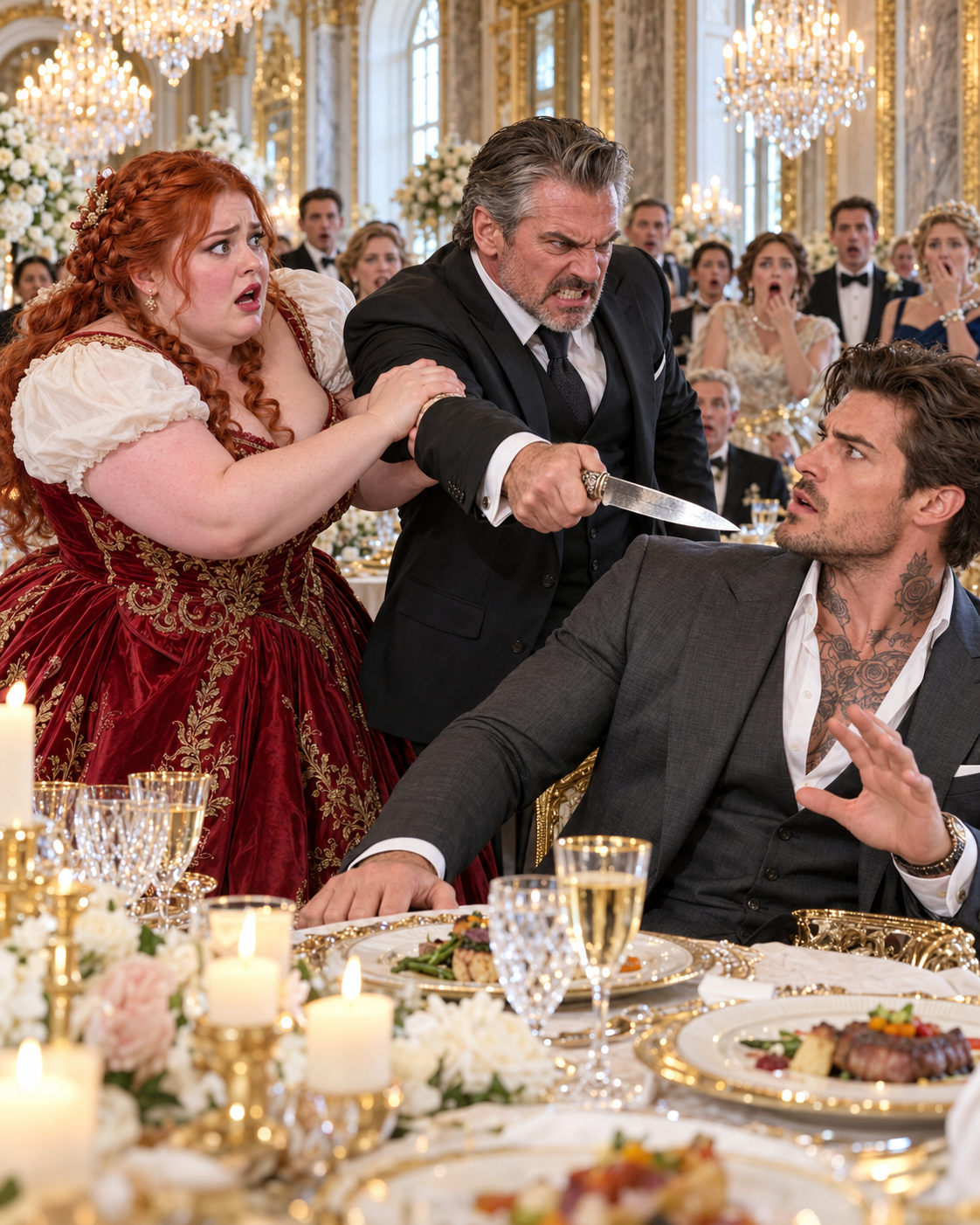
Nico stepped forward, placing himself between them.
“That’s enough, Adrian.”
The stranger’s smile widened.
“So you remember me, brother.”
A wave of shocked murmurs spread through the ballroom.
Paola looked from one man to the other, searching for a resemblance she had somehow overlooked.
Nico’s face was rigid, but beneath his carefully controlled expression was something far more painful than anger.
It was grief.
“You died nine years ago,” Nico said.
Adrian Falcone tilted his head.
“That’s what you were supposed to believe.”
Before Nico could respond, the ballroom doors opened and several private security officers entered.
Their supervisor, a broad-shouldered man named Vincent Russo, approached Nico with a troubled expression.
“Sir, we have a problem. The building’s private communication system has been disabled, and three members of our security team are missing.”
Corrado Lanzi, still restrained beside the marble column, began laughing softly.
Nico turned toward him.
“What have you done?”
Corrado looked past Nico toward Adrian.
“I only opened the door. Your brother brought the storm.”
Adrian’s expression did not change.
“Gentlemen,” he announced to the assembled family representatives, “I suggest everyone remain calm. Nobody needs to be harmed tonight.”
His words sounded reassuring, but Paola noticed several men near the exits subtly repositioning themselves.
They were not members of Nico’s security team.
And every one of them was watching Adrian.
The elegant gala had become a trap.
Nico immediately understood.
“You’ve been planning this for years.”
Adrian nodded.
“Nine years, actually. Almost to the day.”
He glanced toward Nico’s left eye.
“Funny how a single moment can change the direction of two lives.”
Paola felt Nico’s body stiffen beside her.
For the first time, she realized the secret behind his blindness was not merely a physical injury.
It was connected to something much darker.
“Tell her,” Adrian said.
Nico remained silent.
“Tell the young woman why her father disappeared. Tell her what happened at the warehouse on the East River.”
Paola turned toward Nico.
“What is he talking about?”
Nico looked at her with an expression that seemed almost unbearable.
“Your father was my friend.”
Adrian laughed bitterly.
“Friend? Rafael was more than your friend. He saved your life.”
Nico lowered his eyes.
“And I couldn’t save his.”
The words struck Paola harder than any accusation.
For years, she had imagined her father’s final moments as a tragic accident on a rain-soaked highway.
Now she was standing among men who seemed to know an entirely different story.
“Please,” she whispered. “Someone tell me the truth.”
Adrian slipped the photograph back into his jacket.
“Then perhaps it’s time we return to where everything began.”
He gestured toward the ballroom doors.
“There’s a car waiting downstairs.”
Nico moved closer to Paola.
“You’re not going anywhere with him.”
Adrian’s smile vanished.
“I’m afraid that isn’t your decision anymore.”
One of his men approached, holding a small tablet displaying a live security-camera feed.
On the screen was a modest apartment in Queens.
Paola recognized the patterned curtains, the blue kitchen cabinets, and the little porcelain angel standing beside the window.
Her mother’s home.
The camera showed Elena Merino sitting at her kitchen table, apparently unaware that someone was watching.
Paola’s breath caught.
“What have you done to her?”
“Nothing,” Adrian replied. “And I’d prefer to keep it that way.”
Nico took one measured step forward.
“If you involve her mother, whatever understanding you think exists between us ends tonight.”
Adrian met his gaze.
“There was never any understanding between us, Nico.”
For several seconds, the brothers stared at each other across the polished marble floor.
Then Paola spoke.
“I’ll go.”
Nico turned sharply.
“No.”
She faced him, her voice unsteady but determined.
“My mother is all the family I have left. I won’t stand here waiting for someone else to decide whether she’s safe.”
Nico looked at her for a long moment.
Then he nodded.
“Then I’m coming with you.”
Adrian appeared pleased.
“Just like old times.”
Outside, the October air carried the familiar chill of a New York autumn.
The streets of Manhattan glistened beneath the streetlights as two black SUVs departed from the hotel’s underground garage.
Paola sat beside Nico in the rear seat of the second vehicle.
Neither spoke for several minutes.
Finally, she turned toward him.
“Did you know who I was when you called my shop?”
Nico stared through the tinted window.
“Yes.”
The single word hurt more than she expected.
“You knew my father?”
“Yes.”
“And you let me believe we were strangers?”
Nico closed his eyes.
“I wanted to keep you out of everything connected to him.”
Paola swallowed.
“By lying to me?”
He looked at her.
“By making a mistake I thought was protection.”
She turned away, fighting the unexpected sting of tears.
All her life, she had struggled to keep her father’s small optical business alive because it was the only tangible piece of him she had left.
Now she was discovering that the most important parts of his life had been hidden from her.
“Tell me what happened nine years ago,” she said.
Nico remained silent until the vehicle crossed the Williamsburg Bridge.
Then he began.
“Your father wasn’t involved in my business. He repaired specialized optical equipment for hospitals and research laboratories. He was brilliant, stubborn, and almost impossible to impress.”
A faint smile touched Nico’s face.
“He also believed every problem could be solved if people stopped being afraid of the truth.”
Paola recognized the description immediately.
Her father had always said that honesty was like a clean lens: uncomfortable at first, but necessary to see clearly.
“One night,” Nico continued, “Rafael contacted me because he had discovered something he wasn’t supposed to find.”
Nico explained that a private medical foundation associated with several wealthy investors had been falsifying financial records and using charitable donations to conceal criminal payments.
Rafael had repaired equipment for one of its laboratories and accidentally received a storage device containing confidential files.
Among the names were several prominent businessmen, public officials, and members of New York’s criminal organizations.
Including Adrian Falcone.
“My brother was working with people who wanted to take control of everything I had built,” Nico said. “They were willing to destroy anyone who stood in their way.”
“And my father?”
“He refused to surrender the evidence.”
Paola felt her stomach tighten.
“What happened to him?”
Nico’s voice became quieter.
“We arranged to meet at a warehouse near the East River. I promised him protection.”
He touched the frame of his glasses.
“But Adrian arrived first.”
Nine years earlier, a confrontation had unfolded inside that abandoned warehouse.
Adrian demanded the storage device, insisting that exposing the foundation would ruin powerful people and place countless lives in danger.
Rafael refused.
During the chaos that followed, a shattered overhead light sent glass fragments across the room.
One fragment permanently damaged Nico’s left eye.
Rafael helped him escape through a service corridor before disappearing into the confusion.
By morning, authorities had discovered evidence suggesting Rafael had died in a vehicle accident and Adrian had perished in a warehouse fire.
Nico never found either man’s body.
“I searched for Rafael for months,” Nico said. “I never stopped looking for answers.”
Paola stared at him.
“Why didn’t you tell my mother?”
“Because everyone who had been connected to those files began disappearing. I believed silence was the only way to keep your family safe.”
Paola shook her head.
“You didn’t protect us from the truth. You protected us from knowing we had a choice.”
Nico accepted the words without defending himself.
“You’re right.”
The simple admission surprised her.
Before she could respond, the SUV slowed.
They had reached an industrial district along the Brooklyn waterfront.
Ahead stood an abandoned redbrick warehouse, its windows dark and its loading docks rusted by years of neglect.
A faded sign above the entrance read HARBOR MERCANTILE STORAGE.
Adrian’s vehicle stopped directly outside.
When Paola stepped onto the pavement, she recognized something that made her pulse race.
A small wooden sign hung crookedly beside a side entrance.
R. MERINO — PRECISION OPTICS.
Her father’s name.
She rushed toward it, but Nico gently caught her arm.
“Be careful.”
Paola looked at him.
“For once, please don’t ask me to be afraid.”
Inside, the warehouse smelled of dust, cold metal, and decades of forgotten machinery.
Old workbenches lined the walls.
A row of industrial windows overlooked the black waters of the East River.
And beneath a single hanging lamp stood a man Paola had not seen since childhood.
He was older now, with silver streaks in his hair and deep lines around his eyes.
But she knew that face.
She knew the way he tilted his head.
She knew the scar above his eyebrow.
“Dad?”
The man slowly turned.
For one impossible moment, neither moved.
Then Rafael Merino whispered her name.
“Paola.”
She crossed the warehouse before anyone could stop her.
Her arms wrapped around him, and the years between them seemed to collapse all at once.
He held her tightly, his shoulders trembling.
“My little girl,” he whispered. “You’ve grown so much.”
Paola buried her face against his chest.
She had dreamed of hearing that voice again for almost two decades.
But the happiness lasted only a moment before anger broke through.
“Where were you?”
Rafael closed his eyes.
“Sweetheart—”
“Where were you when Mom was crying every night? Where were you when we couldn’t pay the rent? Where were you when I graduated and saved an empty seat for you?”
He had no answer.
Only tears.
Adrian watched their reunion from several feet away.
“Touching, isn’t it?” he said. “Unfortunately, we’re running out of time.”
Rafael immediately stepped between him and Paola.
“You promised you wouldn’t bring her into this.”
Adrian shrugged.
“And you promised to tell me where you hid the original files.”
Nico’s gaze sharpened.
“So that’s what this is about.”
Adrian turned toward him.
“The foundation’s surviving partners are preparing to erase every trace of their involvement. Those files are the only evidence that can expose them.”
Paola looked at her father.
“You’ve had the evidence all this time?”
Rafael nodded reluctantly.
“But I couldn’t release it without putting innocent people in danger.”
Adrian stepped closer.
“Don’t pretend this is about innocent people. You wanted leverage, and I wanted justice.”
Nico’s expression darkened.
“You never wanted justice. You wanted control.”
Adrian’s eyes flashed.
“You left me to burn in that warehouse!”
“I thought you were dead!”
“You were relieved!”
The accusation echoed through the building.
For the first time, Paola saw the years of bitterness behind Adrian’s carefully polished appearance.
Whatever had happened between the brothers, it had consumed them both.
Rafael raised his hands.
“Enough. Both of you.”
He looked toward Paola with deep regret.
“I should have come home. I told myself staying away kept you safe, but eventually fear became an excuse.”
Paola struggled to hold back her tears.
“Then why are we here?”
Rafael glanced toward an old optical testing machine sitting beneath a dusty sheet.
“Because I kept a promise to myself. If the truth ever came out, I wanted it to come out completely.”
He removed the sheet, revealing a precision lens-measuring instrument.
Paola recognized the model.
Her father had taught her to use one when she was nine.
Rafael reached beneath the machine and released a hidden compartment.
Inside lay a small metal case.
Adrian stepped forward eagerly.
“Finally.”
But Rafael held up a hand.
“Before anyone touches this, you need to understand what it contains.”
He opened the case.
Inside were two encrypted storage drives and a handwritten notebook.
“The first drive contains the financial records,” Rafael explained. “The second contains the names of everyone who helped conceal the operation.”
Nico’s face grew serious.
“And the notebook?”
Rafael looked directly at Adrian.
“Proof of who ordered the warehouse confrontation nine years ago.”
Adrian suddenly went still.
Paola noticed the change.
It was subtle, but unmistakable.
Fear.
Rafael opened the notebook to a marked page.
“The man who arranged everything wasn’t Nico.”
He turned the notebook around.
“It was you, Adrian.”
The warehouse fell silent.
Adrian stared at the page.
Then he laughed.
“You think anyone will believe an old notebook?”
Rafael shook his head.
“It’s not just handwriting. There are recordings, bank transfers, and messages preserved on the second drive.”
Nico stepped forward.
“Why?”
Adrian’s expression twisted.
“Because Father left you everything!”
The confession burst from him with years of suppressed resentment.
“The businesses, the connections, the loyalty of people who should have respected both of us. I was always the younger brother standing behind you.”
Nico stared at him.
“You were my brother. I would have given you anything.”
“Except your place.”
Paola watched the two men, suddenly understanding how envy could turn love into something unrecognizable.
Adrian had spent nine years seeking revenge for a betrayal that existed largely in his own mind.
But he was not finished.
He reached inside his jacket and pulled out a compact black device.
A warning tone sounded from somewhere above the warehouse floor.
Rafael’s face drained of color.
“What did you do?”
Adrian looked toward the ceiling.
“Insurance.”
A series of heavy mechanical shutters began descending over the building’s exits.
At the same moment, an emergency alarm sounded.
Nico moved immediately toward Paola.
“Stay behind me.”
Adrian backed toward a side corridor.
“The men outside have orders to keep everyone here until I leave with those drives.”
He pointed at Rafael.
“You’ve spent nine years hiding the truth. Now you can watch what happens when it finally catches up with you.”
Before anyone could stop him, Adrian disappeared through a security door.
Nico’s bodyguards rushed after him, but the metal barrier slammed shut.
A sharp smell of smoke drifted from the far end of the warehouse.
Paola looked toward the ceiling.
A warning light flashed beside the ventilation system.
“There’s a fire somewhere in the building.”
Rafael quickly inspected the control panel.
“The emergency shutters are locked. The old system was modified.”
Nico reached for his phone, but the screen displayed no signal.
Then Paola remembered the small maintenance passage behind her father’s optical workstation.
When she was a child, Rafael had drawn diagrams of his workshop and taught her how to identify emergency exits.
She turned to him.
“The old service tunnel. Does it still lead to the waterfront?”
Rafael stared at her.
“You remember that?”
“Of course I do.”
He hurried toward the workbench.
“There should be an access panel beneath the floor.”
Together, they moved a heavy cabinet aside, revealing a square metal hatch.
Nico’s security chief forced it open with a crowbar.
Cold air rushed upward from the darkness.
One by one, the group began climbing down.
Paola waited until her father had entered before turning back toward Nico.
He was standing near the old workbench, staring at a photograph that had fallen from Rafael’s notebook.
It showed three young men smiling outside a Brooklyn diner.
Nico.
Adrian.
Rafael.
Before everything had gone wrong.
Paola approached quietly.
“You couldn’t have known what he would become.”
Nico shook his head.
“I knew he was angry. I just never believed he would let that anger destroy him.”
A faint crackling sound came from the far corridor.
Paola reached for his hand.
“Then don’t let his choices destroy you too.”
For a moment, Nico looked at her as though the words had reached somewhere he had kept sealed for years.
Then he followed her into the tunnel.
They emerged onto a narrow maintenance pier behind the warehouse.
The East River shimmered beneath the lights of passing boats, while distant sirens echoed between the Brooklyn buildings.
Several police vehicles were approaching from the main road.
Rafael looked toward Nico.
“You called them?”
Nico nodded.
“Before we left Manhattan. I sent the location and everything I knew to an attorney who has been working with federal investigators.”
Paola stared at him.
“You planned to surrender the evidence?”
“I planned to stop this from becoming another secret that ruined your life.”
Rafael slowly handed Nico the metal case.
But Nico did not accept it.
Instead, he turned toward Paola.
“This belongs with someone who understands what truth is worth.”
Paola held the case for a moment, then passed it directly to an approaching federal investigator.
“No,” she said. “It belongs where nobody can use it to control someone else.”
The investigator carefully secured the evidence.
For the first time that night, Rafael smiled with unmistakable pride.
But their relief was interrupted by a familiar voice.
“How touching.”
Adrian stood at the far end of the pier.
His charcoal suit was stained with soot, and his expression had lost every trace of its earlier elegance.
Two of his men stood behind him, but they looked uncertain.
Police sirens were drawing closer.
Adrian glanced toward the evidence case.
“It’s not over.”
Nico stepped forward.
“It can be.”
Adrian shook his head.
“You don’t understand what those people will do once their names become public.”
“Then they’ll face the consequences of their choices.”
Adrian laughed bitterly.
“You always believed you could decide what was right.”
Nico looked at him steadily.
“No. I spent most of my life convincing myself that power meant never admitting I was wrong.”
He glanced toward Paola.
“Someone reminded me that real strength begins when you stop hiding.”
Adrian’s eyes moved toward his brother’s glasses.
The tiny mirror caught a reflection of the river lights.
For a long moment, he said nothing.
Then he looked down at the water.
“I lost everything because I couldn’t stand being second.”
Nico’s expression softened.
“You lost yourself long before you lost anything else.”
One of Adrian’s men quietly stepped away, raising his hands as officers approached.
The second followed.
Adrian remained alone.
For a moment, Paola feared he would make one final desperate decision.
Instead, he slowly removed his watch and placed it on the wooden railing.
“I spent nine years imagining this night,” he murmured. “In every version, you were the one who lost.”
Nico answered softly.
“Look around, Adrian. We both did.”
Federal agents approached and placed Adrian under arrest.
He offered no resistance.
As they led him away, he looked back once at his brother.
Nico did not turn away.
He stood quietly beside Paola until the police vehicle disappeared into the Brooklyn night.
The following weeks brought headlines across New York.
A major financial investigation exposed the hidden operations of the charitable foundation and several powerful figures connected to it.
Corrado Lanzi cooperated with investigators after his arrest, providing information about the conspiracy against Nico.
Rafael Merino entered a formal witness-protection arrangement while authorities reviewed his involvement and the evidence he had preserved.
For Paola, however, the most difficult part was not the investigation.
It was learning how to have a father again.
Their first conversations were awkward.
Rafael wanted to explain everything.
Paola wanted to know why he had never sent a birthday card, never called, never found a way to tell her he was alive.
Some questions had answers.
Others had only regret.
One afternoon, they sat together inside her optical shop, surrounded by the familiar scent of lens-cleaning solution and polished metal frames.
Rafael picked up an old pair of reading glasses from the counter.
“I remember teaching you to repair these.”
Paola smiled faintly.
“You kept telling me not to tighten the screws too much.”
“And you never listened.”
She laughed despite herself.
Then her expression softened.
“I spent years thinking the worst thing that could happen was losing someone.”
Rafael looked at her.
“What do you think now?”
“I think sometimes it’s discovering they chose not to come back.”
He lowered his eyes.
“I know I can’t change that.”
“No,” she said. “You can’t.”
After a moment, she reached across the counter and placed her hand over his.
“But maybe you can choose differently from now on.”
Rafael began to cry.
And for the first time, Paola did not feel the need to hide her own tears.
Meanwhile, Nico made choices that surprised nearly everyone who knew him.
He began cooperating with investigators regarding his organization’s unlawful operations, accepting that accountability might cost him influence, wealth, and freedom.
Several longtime associates abandoned him.
Others remained loyal to the man rather than the power he once held.
When Paola asked why he was willing to dismantle everything he had spent his life building, Nico gave her a simple answer.
“Because I finally understand the difference between being feared and being respected.”
Months passed.
The investigation continued, and Nico faced legal proceedings without attempting to use his influence to escape scrutiny.
Paola returned to her shop, determined to make it successful through her own work.
One rainy afternoon, a familiar black Cadillac stopped across the street.
A man stepped out, carrying a small paper bag.
Nico Falcone.
He wore an ordinary dark coat instead of an expensive tailored suit.
There were no bodyguards at his side.
Only the custom glasses Paola had made for him.
He entered the shop as the little brass bell above the door rang.
“Excuse me,” he said politely. “I believe these glasses need an adjustment.”
Paola folded her arms.
“Are you going to pay this time?”
Nico smiled.
“I was hoping you’d offer a discount.”
“For a man who once paid five thousand dollars for an emergency repair, you certainly complain about prices.”
He laughed, and the sound was so unexpectedly genuine that Paola found herself smiling too.
She took the glasses and inspected them beneath her work lamp.
The left-side mirror was still perfectly aligned.
“You’ve taken good care of them,” she said.
“I had a good reason.”
She looked up.
“And what was that?”
Nico hesitated.
Then he answered quietly.
“They remind me that someone saw a weakness I was ashamed of and chose to help me instead of using it against me.”
Paola set the glasses down.
“You know, I used to think that your most dangerous secret was your blind eye.”
Nico raised an eyebrow.
“And now?”
“Now I think it was your belief that nobody could be trusted with the truth.”
He considered her words.
“You’re probably right.”
Outside, the rain began to slow, and late afternoon sunlight broke through the clouds above Brooklyn.
Nico glanced toward the window.
“I have something to ask you.”
Paola smiled.
“That sounds suspiciously like the beginning of another dangerous adventure.”
“Nothing dangerous this time.”
“Coming from you, that’s not particularly reassuring.”
He laughed softly.
Then his expression grew serious.
“I spent years keeping everyone on my right side because I was afraid of what I couldn’t see.”
He reached across the counter and gently took her hand.
“But you taught me that I don’t need to see everything if I’m willing to trust the person standing beside me.”
Paola’s heart tightened.
“Nico…”
“I’m not asking you to forget who I was. I’m not asking you to excuse the things I’ve done.”
He paused.
“I’m asking whether, when all of this is finally behind us, you might let me earn a place in your life without secrets.”
Paola studied him carefully.
Once, this man had commanded rooms filled with powerful people simply by entering them.
Now he stood inside her modest optical shop, asking for something he could neither buy nor demand.
A chance.
She squeezed his hand.
“Then start by telling me the truth about something.”
“Anything.”
“Did you really need your glasses repaired that first night?”
Nico smiled.
“The frames were damaged.”
“But?”
He looked almost embarrassed.
“But I’d heard that Rafael Merino’s daughter had become one of the finest opticians in New York, and I wanted to see whether you had his talent.”
Paola laughed.
“And?”
Nico glanced at the perfectly aligned lenses.
“You’re better than he ever was.”
She shook her head, smiling through sudden tears.
“You’re terrible at making ordinary conversation.”
“I’m learning.”
Outside, a mother and her young daughter stopped to examine the shop’s colorful window display.
Paola watched them for a moment.
Then she turned back toward Nico.
“There’s something I want to do.”
“What?”
“Expand the shop. Start a program providing free eye examinations and glasses for children whose families can’t afford them.”
Nico nodded.
“That sounds like something your father would be proud of.”
“I hope so.”
“Can I help?”
Paola smiled.
“Not by buying the whole building.”
He raised both hands in surrender.
“Understood.”
“And not by sending intimidating men to negotiate with suppliers.”
“Fair enough.”
“You can help by carrying boxes, assembling shelves, and learning how to make coffee without burning it.”
Nico considered the offer with theatrical seriousness.
“That sounds considerably harder than running an organization.”
“Good,” Paola replied. “You could use the practice.”
Six months later, the small optical shop reopened with a bright new sign above its entrance.
MERINO VISION CENTER.
Beneath the name, smaller letters carried a promise Paola had chosen herself.
EVERYONE DESERVES TO SEE A BETTER TOMORROW.
On opening day, families lined up along the sidewalk.
Children laughed while trying on colorful frames.
Volunteers assisted elderly residents with examinations.
Rafael, now able to visit under the conditions of his legal arrangements, quietly repaired glasses at a workbench near the back.
And Nico stood beside a table of donated frames, carefully sorting them by size.
He still wore his custom glasses.
The tiny mirror on the left side remained almost invisible.
But Paola knew it was there.
Sometimes she caught Nico looking at the reflection, not because he feared an approaching enemy, but because he wanted to make sure she was nearby.
One evening, after the last customer had left, Paola found him standing beside the front window.
The Brooklyn streets glowed beneath the golden light of sunset.
“Do you ever regret telling everyone about your eye?” she asked.
Nico thought for a moment.
“I regret waiting nine years.”
Paola slipped her hand into his.
He looked down at her, smiling.
“My father used to tell me that a cracked lens doesn’t mean the world is broken,” she said. “It only means we need to change the way we look at it.”
Nico nodded.
“Your father was a wise man.”
“He was also a man who made terrible mistakes.”
“Most of us are.”
Paola rested her head against his shoulder.
For the first time in years, Nico did not instinctively turn his body to protect his left side.
He simply stood beside her, watching the city grow quiet.
And somewhere between the passing traffic, the fading sunlight, and the ordinary sounds of a neighborhood settling into evening, he understood something his years of power had never taught him.
A weakness does not make a person unworthy of love.
A mistake does not have to define an entire lifetime.
And protecting someone does not mean making every decision for them.
Sometimes, the bravest thing a person can do is tell the truth, accept the consequences, and trust another human being enough to stand beside them.
Nico Falcone had spent nine years believing that the darkness on his left side was his greatest weakness.
But the darkness had never been the real enemy.
It was the fear that convinced him he had to face everything alone.
And when Paola Merino finally stepped into his life, she did not restore the sight he had lost.
She gave him something more important.
The courage to see himself clearly.
Because in the end, love is not about finding someone who has no scars, no regrets, and no broken pieces.
It is about finding someone who sees those imperfections, understands their weight, and still believes that a better future is possible.
And sometimes, the person who changes your entire world arrives not with a promise of forever, but with a small pair of glasses, a steady hand, and the simple decision to stand where everyone else was afraid to stand.
THE END.