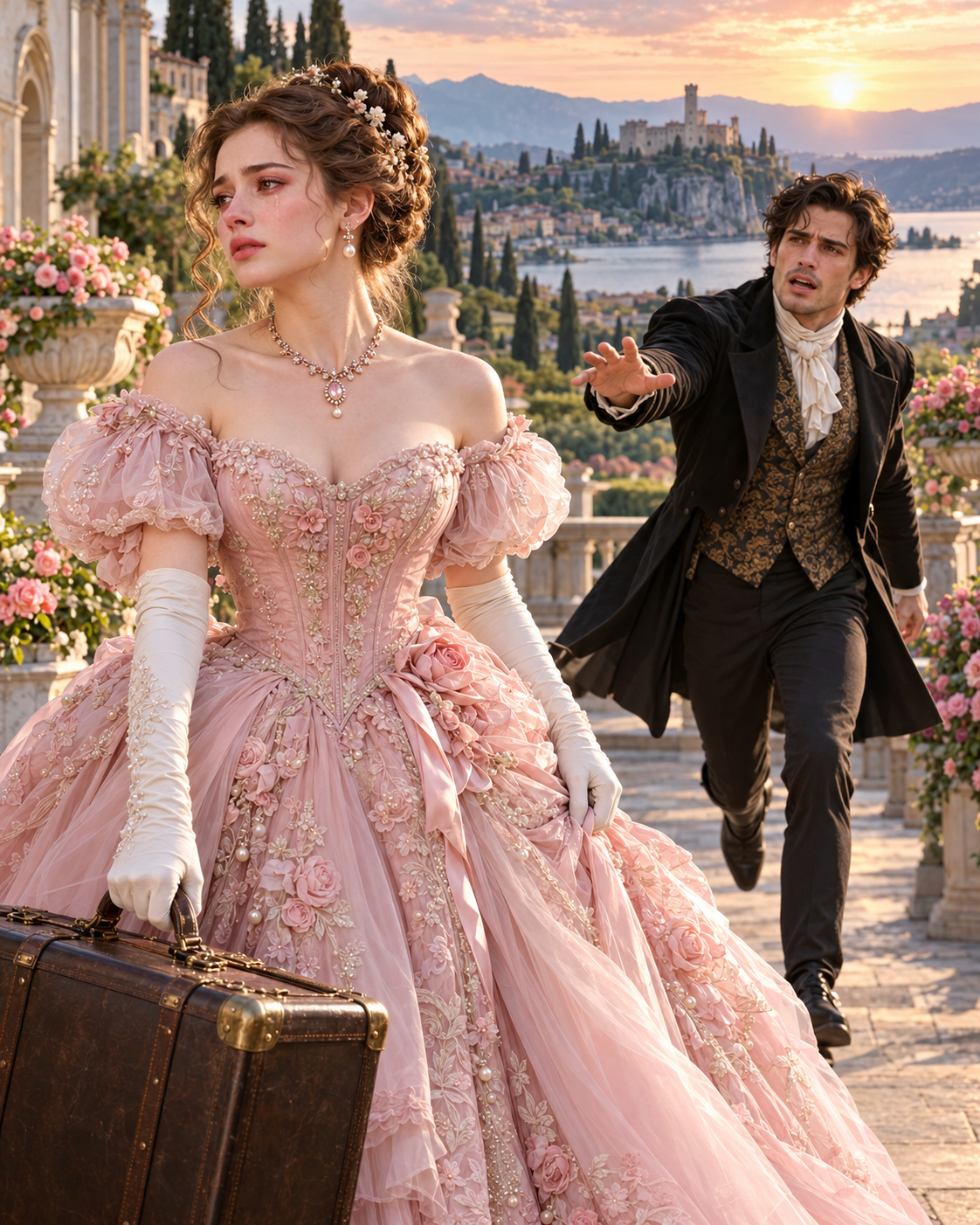
The Duke had spent years teaching his wife to forgive him. Then, one morning, he found her wedding ring on his desk—and discovered that she had finally learned to leave.
Clara’s question lingered in the cold afternoon air, and for the first time since arriving at Whitmore Hollow, Duke Alexander Ravenshshire seemed unable to find his voice.
Lady Evelyn Hartwell stood beside the black carriage, one gloved hand resting on the document she had brought, while Thomas Ashford quietly watched the Duke’s face.
Alexander looked from one paper to the other.
“My wife’s mother has been dead for twelve years,” he said sharply. “Whatever her name is doing on those documents, it has nothing to do with me.”
“An interesting defense,” Ashford replied. “Considering that the signature was added only six months ago.”
A sudden gust swept across the courtyard, stirring the fallen leaves around their feet.
Clara noticed Alexander’s right hand move toward his coat pocket, then stop.
It was a movement she knew well.
He always reached for his watch when he needed a moment to invent an answer.
“Perhaps,” Clara said, “we should continue this conversation inside.”
Alexander straightened immediately.
“At last, some sense.”
She looked at him without smiling.
“I wasn’t speaking to you.”
The silence that followed was brief, but it carried more weight than any raised voice.
Ashford stepped aside to let Evelyn pass, while the tenants slowly dispersed toward the cottages.
Only Mr. Bennett remained near the steps, his old cap pressed against his chest.
Clara paused beside him.
“Please tell the others that the repairs to their homes will begin as soon as we have reviewed the accounts.”
The old man bowed his head.
“My lady, we’ve waited a long time.”
“I know,” she answered.
Her voice was steady, but she could not quite meet his eyes.
Inside the drawing room, a fire burned beneath the marble mantelpiece.
The room looked almost exactly as Clara remembered it from childhood, except that her mother’s portrait had been removed from above the fireplace.
In its place hung an enormous landscape Alexander had purchased several years earlier.
Clara studied it for a moment.
“Mr. Ashford, please have that painting taken down.”
Alexander turned.
“That cost me three hundred pounds.”
“Then I hope you enjoyed looking at it.”
She walked to the window and pulled back the heavy curtains, allowing the pale daylight to fill the room.
Evelyn watched her with an expression Alexander had never seen before.
It was not amusement.
It was caution.
Ashford laid the documents across a small writing table.
“Six months ago,” he began, “a private agreement was prepared using the late Lady Whitmore’s name as security for a loan.”
Alexander folded his arms.
“That is impossible.”
“Quite impossible,” Ashford agreed. “Which is precisely why the matter deserves attention.”
He placed two signatures beside each other.
One came from an authenticated letter written by Clara’s mother shortly before her death.
The other appeared on the disputed loan agreement.
Even Alexander could see the difference.
The second signature was too neat, too deliberate, as though someone had copied each letter without understanding the movement of the original hand.
Clara stared at it.
Her mother had always written quickly, allowing the final stroke of her surname to rise slightly above the line.
The imitation curved downward.
She touched the genuine signature with one finger.
“I remember watching her write this.”
No one spoke.
Then Evelyn removed her gloves.
“Alexander told me the estate was already under his control.”
Clara slowly lifted her eyes.
“And you believed him?”
“I believed he had found a way to secure his debts.”
“Using a dead woman’s signature?”
Evelyn’s composure faltered.
“I did not know about that signature until Crane sent me the complete papers.”
Alexander stepped forward.
“Enough. Evelyn, you and I can discuss this privately.”
She turned toward him.
“No, Alexander. We cannot.”
The words were quiet, but they stopped him.
Evelyn laid her own document beside Ashford’s.
“I purchased your debt because you promised that the sale of Whitmore Hollow would repay me.”
Clara felt the faint pressure of her fingernails against her palm.
“You purchased it knowing the property belonged to me.”
“I knew it had been inherited by you,” Evelyn admitted. “I did not understand that he had no authority to sell it without your consent.”
Ashford looked up.
“Then you were very poorly advised, Lady Evelyn.”
Her cheeks colored.
Alexander gave a bitter laugh.
“You are all behaving as though I have committed some extraordinary crime. Families borrow against property every day.”
“Not against property they do not own,” Ashford replied.
“And certainly not with the signature of someone who is buried in the family chapel.”
The room fell silent.
Beyond the windows, a bell rang from the village church.
Clara looked toward Alexander.
“Did you know?”
He met her eyes.
For one moment, she thought he might finally answer honestly.
Instead, he said, “You have no understanding of the pressures placed upon a man in my position.”
Clara lowered her gaze.
There it was.
Not an apology.
Not even a denial.
Only another explanation for why someone else should bear the cost of his choices.
Ashford gathered the papers.
“There is one further matter.”
Alexander’s expression hardened.
“What now?”
“The original estate settlement.”
Clara turned toward the solicitor.
“I thought you already had it.”
“I have a copy, Your Grace. The original was removed from my office shortly after your marriage.”
He glanced at Alexander.
“By a representative of His Grace.”
Alexander said nothing.
Ashford continued.
“The document contains a provision your mother insisted upon before she died.”
Clara felt the room grow strangely quiet around her.
“What provision?”
“Any attempt to transfer, mortgage, or otherwise dispose of Whitmore Hollow without your written consent would be invalid.”
A small breath escaped Clara.
She had suspected as much, but hearing it spoken aloud seemed to restore something she had lost years earlier.
“Then he cannot sell it.”
“No,” Ashford said. “He cannot.”
Alexander moved toward the fire.
“Then this is settled.”
“Not entirely.”
Ashford’s voice stopped him again.
“The forged security agreement has already been presented to a financial institution in London.”
Clara turned sharply.
“Presented by whom?”
Ashford hesitated.
“That is what we must establish.”
Evelyn looked down at her hands.
And Clara noticed something.
The woman who had once seemed so pleased to possess Alexander’s attention was trembling.
That evening, Whitmore Hollow was quieter than it had been in years.
Alexander had been asked to remain in the west drawing room while Ashford sent messages to London.
Evelyn had retired to a guest chamber, claiming a headache.
Clara sat alone in her mother’s old sitting room, surrounded by objects Alexander had never considered valuable enough to sell.
A faded blue cushion rested beside the hearth.
A small wooden sewing box stood near the window.
On the mantelpiece was a porcelain bird with a broken wing, repaired with a thin line of gold.
Clara remembered breaking it when she was seven.
Her mother had refused to throw it away.
“Things need not be perfect to deserve a place,” she had told her.
Clara lifted the bird carefully.
For years, she had mistaken those words for an instruction to endure anything.
Now, in the quiet room, she understood that her mother had been speaking about objects.
Not promises.
Not cruelty.
Not a marriage in which forgiveness had become permission.
A soft knock interrupted her thoughts.
“Come in.”
The Dowager Duchess entered, carrying a small traveling bag.
Clara rose immediately.
“Your Grace.”
The older woman waved away the formality.
“Please. I believe we have had quite enough ceremony in this family.”
She crossed the room and sat beside the fire.
For a while, neither spoke.
Then the Dowager looked toward the window.
“Alexander sent a message this afternoon.”
Clara remained standing.
“I imagine he did.”
“He said you had embarrassed him before the tenants.”
Clara gave a faint, tired smile.
“That sounds like Alexander.”
“He also asked me to come and persuade you to return.”
The smile disappeared.
“And will you?”
The Dowager studied her hands.
“No.”
Clara looked at her.
The older woman opened her bag and removed a slim leather-bound book.
“I brought you something.”
She held it out.
Clara recognized her mother’s handwriting on the cover.
It was a journal.
“Where did you find this?”
“In the library at Ravenshshire House. Your husband was having some of the older books cleared away.”
Clara opened the cover.
On the first page, written in fading ink, were the words:
“For Clara, when she is old enough to choose for herself.”
Her fingers stopped moving.
The Dowager looked into the fire.
“I should have given it to you years ago.”
“Why didn’t you?”
“Because I was afraid of what you might learn.”
Clara closed the book slowly.
“About my mother?”
“About your marriage.”
The room seemed to contract around them.
The Dowager drew a careful breath.
“Your mother was never entirely convinced that Alexander was the right husband for you.”
Clara stared at her.
“But she approved the marriage.”
“She approved your happiness. At the time, she believed the two were the same.”
Outside, rain began tapping against the glass.
The Dowager continued.
“Shortly before she died, your mother learned that Alexander had borrowed money from a relative. She asked him about it.”
Clara sat down.
“What did he tell her?”
“That it was a temporary difficulty.”
“And she believed him?”
“No.”
The Dowager’s answer was immediate.
“She arranged for Ashford to strengthen the protections surrounding Whitmore Hollow.”
Clara looked toward the journal.
“Then she knew.”
“She suspected. There is a difference.”
A long silence followed.
Finally, Clara asked the question that had been troubling her since leaving Ravenshshire House.
“Did you know what Alexander was doing to me?”
The older woman looked away.
“I knew he was careless with your feelings. I knew he kept company he should not have kept.”
“And Evelyn?”
The Dowager closed her eyes.
“Yes.”
Clara felt something settle heavily in her chest.
For years, she had sat beside this woman at family dinners, believing the Dowager’s polite smiles meant she approved of her son’s conduct.
“Why didn’t you tell me?”
“Because I thought preserving your marriage was the kindest thing I could do.”
Clara stared at the flames.
“And was it?”
“No.”
The word came so softly that Clara almost missed it.
The Dowager wiped a tear from the corner of her eye before it could fall.
“I spent thirty years protecting the reputation of a man who never once protected my peace.”
Clara looked at her.
The older woman’s shoulders seemed smaller beneath her dark traveling cloak.
“I thought if you stayed, things might become easier. I told myself that women of our position had duties.”
She paused.
“But I have begun to wonder whether duty has become a convenient name for our silence.”
Clara reached across the space between them and took her hand.
Neither woman spoke for a long time.
They did not need to.
The following morning, Ashford arrived with news from London.
Clara was in the breakfast room when the solicitor entered, his boots wet from the muddy road.
He held a telegram.
“Crane has agreed to meet us.”
Alexander, seated near the window, looked up sharply.
“Absolutely not.”
Ashford ignored him.
“The meeting will take place tomorrow afternoon.”
Clara set down her cup.
“Where?”
“Here.”
Alexander rose.
“You cannot invite a moneylender into my wife’s home to interrogate me.”
Clara turned toward him.
“My home, Alexander. You have been particularly insistent on that distinction lately.”
He approached the table.
“Clara, we need to speak privately.”
“We have spoken privately for years.”
“Then surely you can grant me five minutes.”
Something in his voice made her pause.
For once, he sounded less angry than exhausted.
Clara looked toward Ashford.
“Would you excuse us?”
The solicitor hesitated, then bowed and left.
Alexander waited until the door closed.
He stood with his hands resting on the back of a chair.
“How far do you intend to take this?”
“As far as the truth requires.”
His eyes narrowed.
“You mean to destroy me.”
“No.”
She folded her napkin.
“I mean to stop allowing you to destroy what belongs to me.”
Alexander pulled out the chair and sat down.
For several seconds, he stared at the untouched breakfast before him.
Then he spoke.
“I never intended for any of this to happen.”
Clara watched him.
“Which part?”
He looked confused.
“The debt? The forged signature? The sale of my mother’s land? Or the humiliation you found so entertaining?”
“Clara—”
“Which part was the accident?”
His mouth closed.
The clock on the mantelpiece ticked steadily.
Finally, he said, “I was frightened.”
She had expected anger.
She had expected another accusation.
The admission caught her off guard.
“Of what?”
“Of losing everything.”
Clara looked around the elegant room.
“Everything?”
“My investments failed. I lost money at the tables. Crane began demanding payment.”
Alexander rubbed a hand over his face.
“Every time I thought I could recover, I made it worse.”
“And Evelyn?”
He glanced away.
“She made me feel as though I was still someone worth admiring.”
Clara absorbed the words without moving.
“And I didn’t?”
“You knew me too well.”
It was perhaps the truest thing he had ever said to her.
For one brief moment, she saw the frightened man beneath the polished title and expensive coat.
Then she remembered the letters.
The leaking cottages.
The tenants who believed she had forgotten them.
Understanding him did not erase what he had done.
“Alexander,” she said quietly, “you could have told me you were in trouble.”
“I could not bear you seeing me as a failure.”
“So you chose to make me one instead.”
He looked down.
Clara rose from the table.
“I will listen when you are ready to tell the whole truth.”
She walked toward the door.
Behind her, his voice broke the silence.
“Do you still love me?”
Her hand rested on the handle.
For a moment, she remembered a younger Alexander standing beneath the summer trees at Whitmore Hollow, promising to spend his life making her happy.
She remembered believing him.
Then she opened the door.
“I loved the man I thought you were.”
Crane arrived the following afternoon in a dark traveling coat, carrying a polished black case.
He was smaller than Clara expected, with silver hair and sharp, observant eyes.
His gaze moved across the room, lingering briefly on Alexander.
“Your Grace.”
“Mr. Crane.”
Neither offered a handshake.
Ashford invited everyone to sit.
Evelyn occupied the chair nearest the fire, while Alexander remained standing.
Clara sat beside the window with her mother’s journal resting on her lap.
Crane opened his case.
“I understand there are questions regarding the security attached to His Grace’s debts.”
“Several,” Ashford replied.
The lender removed a bundle of papers.
“Then I suggest we begin with the original instruction.”
He placed a letter on the table.
Clara leaned forward.
The writing was familiar.
Alexander’s.
The letter instructed Crane to prepare a loan secured against Whitmore Hollow, describing Alexander as authorized to act on behalf of his wife.
Beneath it was a second instruction.
This one concerned the use of Lady Whitmore’s signature.
Clara read the words.
Her face grew pale.
Alexander did not move.
Ashford examined the paper carefully.
“Your Grace, is this your handwriting?”
Alexander stared at it.
“Yes.”
“And did you authorize the preparation of the false signature?”
A long silence followed.
Then Alexander nodded.
Evelyn closed her eyes.
Clara looked at her husband.
The man who had once commanded entire rooms with a glance could barely raise his head.
“Why my mother?” she asked.
His voice was almost inaudible.
“Because the original settlement was in her name.”
Clara pressed her fingers against the journal.
“She trusted you.”
Alexander looked up.
“I know.”
“No,” Clara whispered. “You knew she was dead and could not challenge you.”
He flinched.
Crane cleared his throat.
“There is another matter.”
Everyone turned.
The lender took out a smaller envelope.
“When Lady Evelyn purchased the debt, she requested certain additional assurances.”
Evelyn sat upright.
“Those were ordinary protections.”
“Not entirely,” Crane replied.
He withdrew a signed instruction.
“Lady Evelyn asked that, in the event of default, the proceeds from the proposed estate sale be transferred to an account under her sole control.”
Alexander stared at her.
“What?”
Evelyn’s face became rigid.
Crane continued.
“The arrangement would have left His Grace responsible for any remaining unpaid sums.”
Alexander turned toward Evelyn.
“You told me you were helping.”
“I was protecting my investment.”
“You promised the debt would be cleared.”
“And you promised me a fortune that did not belong to you.”
Her words cut through the room.
Alexander stepped back.
For the first time, he seemed to understand that the woman he had trusted with his schemes had been making plans of her own.
Evelyn stood.
“Do not look at me like that. You lied to me about the estate. You lied about your wife’s consent. You expected me to place my money in your hands and simply hope for the best.”
“And you expected to profit from my ruin.”
“I expected to survive it.”
Clara watched them without speaking.
There had been a time when seeing Alexander betrayed by Evelyn might have given her satisfaction.
Now, it only seemed terribly small.
Two people arguing over who had been more skillful at using the other.
Crane slid the papers toward Ashford.
“I am willing to provide the originals to the appropriate authorities.”
Alexander lowered himself into a chair.
“Then I am finished.”
Ashford looked at him.
“That will depend upon what you do next.”
The days that followed were filled with letters, legal consultations, and the quiet work of untangling years of deception.
Crane’s documents were submitted for formal examination.
The attempted sale was halted, and the forged security was challenged.
Alexander was advised to retain independent counsel and prepare for the consequences of his actions.
Evelyn returned to London.
Before leaving, she requested a private meeting with Clara.
They stood together in the entrance hall, where the morning sun cast long shadows across the floor.
Evelyn wore a dark green traveling dress and held her gloves tightly in one hand.
“I suppose you despise me.”
Clara considered the question.
“I don’t think about you nearly as often as you imagine.”
Evelyn looked down.
For once, she had no clever reply.
After a moment, she said, “I thought he loved me.”
Clara studied her.
“And did you love him?”
Evelyn’s fingers tightened around her gloves.
“I loved being chosen.”
The admission hung between them.
Clara glanced toward the open doorway.
Outside, servants were loading the luggage.
“Then I hope you learn the difference.”
Evelyn lifted her eyes.
There was no triumph in Clara’s expression.
Only a distance she could no longer cross.
“Goodbye, Lady Evelyn.”
Clara turned away.
She did not watch the carriage leave.
By the end of the week, Whitmore Hollow had begun to change.
The ruined roofs were inspected, the estate accounts reopened, and the oldest cottages scheduled for repair.
Clara visited the tenants herself.
She walked along muddy paths in sturdy boots, listening to grievances that had gone unanswered for years.
Some people greeted her warmly.
Others remained cautious.
She did not blame them.
Trust, she was discovering, could not be restored simply by speaking kindly.
It required returning the next day.
And the day after that.
One afternoon, she visited Mr. Bennett’s cottage.
His granddaughter sat beside the hearth, carefully mending a torn sleeve.
Rainwater had stained the ceiling above them.
Clara studied the damage.
“This should have been repaired long ago.”
Mr. Bennett shrugged.
“We made do, my lady.”
She looked at the little girl.
“Do you attend the village school?”
The child shook her head.
“There hasn’t been a teacher since spring.”
Clara turned toward the old man.
“Why was I never told?”
He gave her a sad smile.
“We wrote.”
The words struck more deeply than an accusation.
Clara knelt beside the girl.
“What is your name?”
“Rose, my lady.”
“Would you like to learn to read?”
Rose nodded eagerly.
Clara glanced at the small collection of books on the mantelpiece.
“Then we shall see about finding someone to teach you.”
As she rose, the girl caught her sleeve.
“Will you come back?”
Clara looked at the child’s hopeful face.
“Yes, Rose.”
And this time, she knew exactly what that promise required.
Three weeks later, Alexander returned to Whitmore Hollow.
He arrived without an escort, traveling in an ordinary carriage rather than the magnificent Ravenshshire coach.
Clara was in the garden when a footman announced him.
The last roses of autumn clung to the trellis, their petals darkened by the recent rain.
She found Alexander waiting beside the fountain.
He looked thinner.
There were lines around his eyes she had never noticed before.
“Clara.”
“Alexander.”
He removed his hat.
“I have come to tell you that I have given Ashford a full account.”
She remained still.
“Of everything?”
“Everything I can remember. The debts. The signatures. The letters.”
He swallowed.
“And Evelyn.”
Clara looked at the fountain, where a few fallen leaves floated on the water.
“That must have been difficult.”
“It was.”
He gave a faint, humorless smile.
“Although not nearly as difficult as hearing it all read back to me.”
She said nothing.
Alexander reached inside his coat and withdrew a small packet.
“These are copies of the remaining correspondence concerning the estate. I found them among my private papers.”
Clara accepted the packet.
There were more letters than she had expected.
Some bore her mother’s seal.
One was addressed in Clara’s own handwriting, a letter she had written years earlier asking to visit Whitmore Hollow.
She stared at it.
“You told me this had been sent.”
Alexander’s face tightened.
“I know.”
“Why did you keep it?”
“Because I thought if you came here, you might remember that you had a life outside mine.”
The garden seemed very quiet.
Clara looked at him.
“And you were afraid of that?”
“Yes.”
The simple answer left no room for excuses.
Alexander moved toward the fountain.
“I spent so long trying to make certain you needed me that I never considered whether you were happy with me.”
Clara held the letters against her chest.
“I was happy once.”
“I know.”
“But you treated my happiness as though it would survive anything.”
His gaze dropped.
For several moments, only the sound of water disturbed the silence.
Then Alexander asked, “Is there truly nothing I can do?”
Clara considered the man standing before her.
She could see that he was ashamed.
Perhaps even changed.
But shame was not restitution, and regret was not the same as repair.
“You can repay what you owe,” she said.
“You can tell the truth, even when it costs you.”
He nodded slowly.
“And us?”
Clara looked beyond him, toward the manor windows.
For years, she had imagined that the right apology might restore the marriage she remembered.
Now she understood that some things could not be returned simply because someone finally wished to give them back.
“I am seeking a separation, Alexander.”
He closed his eyes.
She continued gently.
“I cannot promise that forgiveness will lead me back to you.”
A breeze moved through the roses.
Alexander opened his eyes again.
“Do you hate me?”
“No.”
He looked almost relieved.
Then Clara added, “But you must stop mistaking that for an invitation.”
The relief faded.
He stood very still.
Finally, he bowed his head.
“Goodbye, Clara.”
She watched him walk toward the waiting carriage.
For the first time, he did not turn around to see whether she was following.
Winter came early to Whitmore Hollow.
Frost silvered the fields, and smoke curled from the newly repaired cottage chimneys.
The school reopened in a renovated building near the village church.
On the first morning, Clara stood at the doorway watching children hurry inside, their voices bright against the cold air.
Rose Bennett carried a slate almost as large as her arms.
She stopped when she saw Clara.
“My lady!”
Clara smiled.
“Good morning, Rose.”
The little girl held up her slate.
“I can write my name.”
Clara bent to look.
The letters were uneven, but unmistakable.
“That’s beautiful.”
Rose grinned and hurried after the others.
Beside Clara, Ashford cleared his throat.
“The estate accounts are improving.”
She straightened.
“Slowly.”
“Slowly is often the most trustworthy way.”
He handed her a report.
“The repairs are proceeding as planned, and several families who considered leaving have decided to remain.”
Clara looked across the village.
For the first time in years, she felt the quiet satisfaction of having accomplished something that could not be measured in jewels, invitations, or the approval of society.
Then Ashford added, “There is news from London.”
She turned.
“Alexander?”
“The authorities have proceeded with the matter of the forged documents. His Grace has acknowledged his involvement and is cooperating.”
Clara nodded.
“And the debt?”
“His personal assets are being examined as part of an arrangement with his creditors. Whitmore Hollow remains protected.”
She released a breath.
Ashford studied her.
“There is also a letter.”
He offered a sealed envelope.
Alexander’s handwriting appeared on the front.
Clara took it but did not open it immediately.
“Thank you, Mr. Ashford.”
The solicitor bowed and walked toward the schoolhouse.
Clara remained beneath the bare branches of an old chestnut tree.
Then she broke the seal.
The letter was short.
Alexander wrote that he had begun disposing of his unnecessary possessions to repay what he could.
He had sold the horses he once prized above almost everything else.
The London townhouse would follow.
He did not ask her to return.
Instead, he apologized for the years of letters he had hidden and the opportunities he had stolen from her.
At the bottom, he had written:
“I used to believe that being loved meant never being abandoned. I understand now that love was never a guarantee against the consequences of my actions.”
Clara read the sentence twice.
Then she folded the letter.
She did not weep.
She did not smile.
She simply placed it inside her coat and returned to the manor.
On Christmas Eve, the Dowager Duchess arrived at Whitmore Hollow.
This time, she brought no warnings and no requests on behalf of her son.
Only a small parcel wrapped in plain brown paper.
Clara welcomed her into the sitting room, where evergreen branches decorated the mantelpiece.
The older woman looked around with interest.
“The house is lovely.”
“It always was.”
“Yes,” the Dowager replied. “I suppose I was too occupied with other things to notice.”
They sat beside the fire.
After tea, the Dowager handed Clara the parcel.
“I found this among your mother’s belongings.”
Inside was a miniature portrait.
Clara recognized herself as a child, standing beside her mother beneath the apple trees of Whitmore Hollow.
On the back was a short inscription.
“May she always know where she belongs.”
Clara traced the words.
The Dowager watched her quietly.
“Your mother would be proud of what you’ve done here.”
Clara looked into the fire.
“I hope so.”
“She would.”
The older woman hesitated.
Then she said, “I have decided to leave Ravenshshire House.”
Clara turned in surprise.
“Leave?”
“I have a small property near Bath. It has stood empty for years.”
A faint smile touched her lips.
“I think I should like to see what it feels like to arrange my own breakfast without consulting three servants and a family tradition.”
Clara laughed softly.
It was the first time the Dowager had heard that sound without restraint.
“You should.”
“Perhaps I shall even learn to grow roses.”
“Then you’ll need patience.”
The older woman smiled.
“I believe I have spent enough of my life practicing that particular virtue.”
They sat together as darkness settled outside.
For once, the silence between them was not filled with things they were afraid to say.
Spring arrived with warm rain and the scent of freshly turned earth.
Whitmore Hollow awakened slowly.
The apple trees blossomed across the southern fields, and the school garden filled with small green shoots.
Clara stood beneath the trees one morning, watching the petals drift across the grass.
She wore a plain cream dress and carried a basket of cut flowers.
There were still difficult days.
There were letters from lawyers, estate accounts that demanded attention, and moments when old memories returned without warning.
Sometimes she missed the man Alexander had been when they first married.
Sometimes she wondered whether she could have saved him from himself.
But those thoughts no longer governed her choices.
She had learned that compassion did not require surrender.
That someone else’s unhappiness was not always hers to repair.
And that loving another person should never demand the abandonment of oneself.
A familiar voice interrupted her thoughts.
“My lady?”
Rose Bennett came running along the path, her shoes damp with morning dew.
Clara turned.
“Rose, whatever is the matter?”
The girl held out a folded paper.
“Our teacher asked us to write about someone we admire.”
Clara smiled.
“And whom did you choose?”
Rose suddenly looked shy.
“You.”
Clara lowered the basket.
“May I read it?”
The girl nodded.
The handwriting was careful, each word formed with great concentration.
The essay was only a few paragraphs long.
It spoke of repaired cottages, warm classrooms, and a lady who listened when people spoke.
But the final sentence made Clara stop.
“When I grow up, I want to be brave enough to choose what is right, even when everyone tells me to be quiet.”
Clara looked at Rose.
The girl waited anxiously.
“Is it good?”
Clara knelt beside her.
“It’s wonderful.”
Rose smiled.
Then she looked at Clara’s bare left hand.
“Are you lonely living here without the Duke?”
The question was so innocent that Clara could not help smiling.
She considered it carefully.
There were evenings when the manor seemed large and very quiet.
There were mornings when she wished someone were sitting opposite her at breakfast.
But loneliness, she had discovered, was not always the absence of another person.
Sometimes it was the feeling of disappearing while someone else occupied every corner of one’s life.
“No, Rose,” she answered gently. “Not in the way I used to be.”
The child seemed satisfied.
She took her essay and ran back toward the schoolhouse.
Clara watched until she disappeared beyond the orchard.
Then she turned toward the manor.
From the open windows came the distant sound of laughter.
The servants were preparing for the spring gathering, when the tenants and their families would come together beneath the apple trees.
There would be music, food, and children running through the grass.
Nothing particularly grand.
Nothing that would impress the fashionable society Alexander had once valued so highly.
Yet Clara could think of nowhere else she wished to be.
That evening, as the last guests departed, Clara walked alone to the small hill overlooking Whitmore Hollow.
The sky glowed softly above the fields.
Below her, the cottages stood warm and bright, their windows shining in the gathering dusk.
She opened her mother’s journal, which she had brought with her.
Near the final pages, she found an entry she had somehow overlooked.
It had been written shortly before her mother’s death.
“My dearest Clara, I cannot promise you a life without sorrow. I cannot promise that those you love will always be worthy of your trust. But I hope you will never confuse the courage to remain with the courage to leave. Both may require strength, and only you can know which one will preserve the person you are meant to become.”
Clara read the words slowly.
Then she closed the journal and rested it against her chest.
For a long time, she stood beneath the fading light.
She remembered the young woman who had entered Ravenshshire House as a bride, believing love meant giving everything without asking what might remain.
She remembered the years of careful smiles.
The quiet dinners.
The apologies she had accepted because challenging them seemed more frightening than forgiveness.
And she remembered the night she had removed her wedding ring.
At the time, her hand had felt painfully empty.
Now, as she lifted it toward the evening sky, she saw no emptiness at all.
Only the faint mark where the ring had once rested.
A mark that would eventually fade.
Clara turned toward the lights of her home.
Behind her lay a marriage that had taught her how easily devotion could become captivity when love was stripped of respect.
Ahead lay responsibilities, uncertainty, and a future she would have to build with her own hands.
She was no longer waiting for someone to give her permission to begin.
As she approached the manor, the front doors opened and Rose’s laughter drifted into the evening air.
Clara smiled and stepped inside.
Years later, people would still speak of the Duchess who walked away from one of the grandest marriages in England.
Some would call her proud.
Others would call her foolish.
A few would insist she had sacrificed a future many women would have envied.
But the families of Whitmore Hollow remembered something different.
They remembered the winter their roofs stopped leaking.
The school that opened its doors again.
The letters that finally received answers.
And a woman who returned to a place everyone believed she had abandoned.
Clara never tried to correct the stories told about her in distant drawing rooms.
She had spent too many years living according to the opinions of people who knew nothing of her suffering.
Instead, she allowed her life to become her answer.
And whenever Rose, now growing older and wiser, asked how she had found the courage to leave, Clara would look toward the apple trees and say:
“Leaving was not the moment I stopped loving him. It was the moment I understood that loving him did not require me to stop loving myself.”
For Clara Ravenshshire, freedom had not arrived with applause, vengeance, or the downfall of those who hurt her.
It had arrived quietly, in a carriage before dawn, when she chose an uncertain road over a familiar unhappiness.
And the greatest victory of her life was not that Alexander finally understood what he had lost.
It was that Clara no longer needed him to understand in order to know what she was worth.
THE END.