When Victoria Sterling stepped out of her black luxury SUV in front of my Tennessee garage and called my $12 million Ferrari
Part 2
By seven that evening, the garage had grown quiet enough for me to hear the refrigerator humming in the breakroom.
Lily sat at the small table near the back wall, coloring a picture of a red car beneath a purple sky.
Every few minutes, she looked up to make sure I was still there.
“I’m not going anywhere, sweetheart,” I told her.
“I know,” she said, without looking away from her crayons. “I just like checking.”
I turned back to the Ferrari before she could see what those words did to me.
The car had been transported with its original documentation, several boxes of replacement components, and a thick folder containing reports from the seventeen specialists who had attempted to revive it.
Their conclusions varied, but the pattern was unmistakable.
They had replaced sensors, tested fuel pressure, inspected the ignition system, and checked the usual suspects. Several had recommended replacing expensive components. One report suggested a partial rewiring of the engine management system.
None of them had found a fault that explained why the car had stopped so completely.
I began with the basics.
Battery condition. Ground connections. Harness continuity. Fuel delivery. Control signals.
I didn’t assume the previous technicians were careless. Most were probably excellent at what they did. But the more I studied the records, the more I suspected they had been looking for a fault that matched the published diagrams instead of questioning whether those diagrams told the whole story.
At eleven, Lily fell asleep on the breakroom couch, her rabbit tucked beneath her chin.
I carried a blanket over her and switched off the overhead light.
Then I returned to the car.
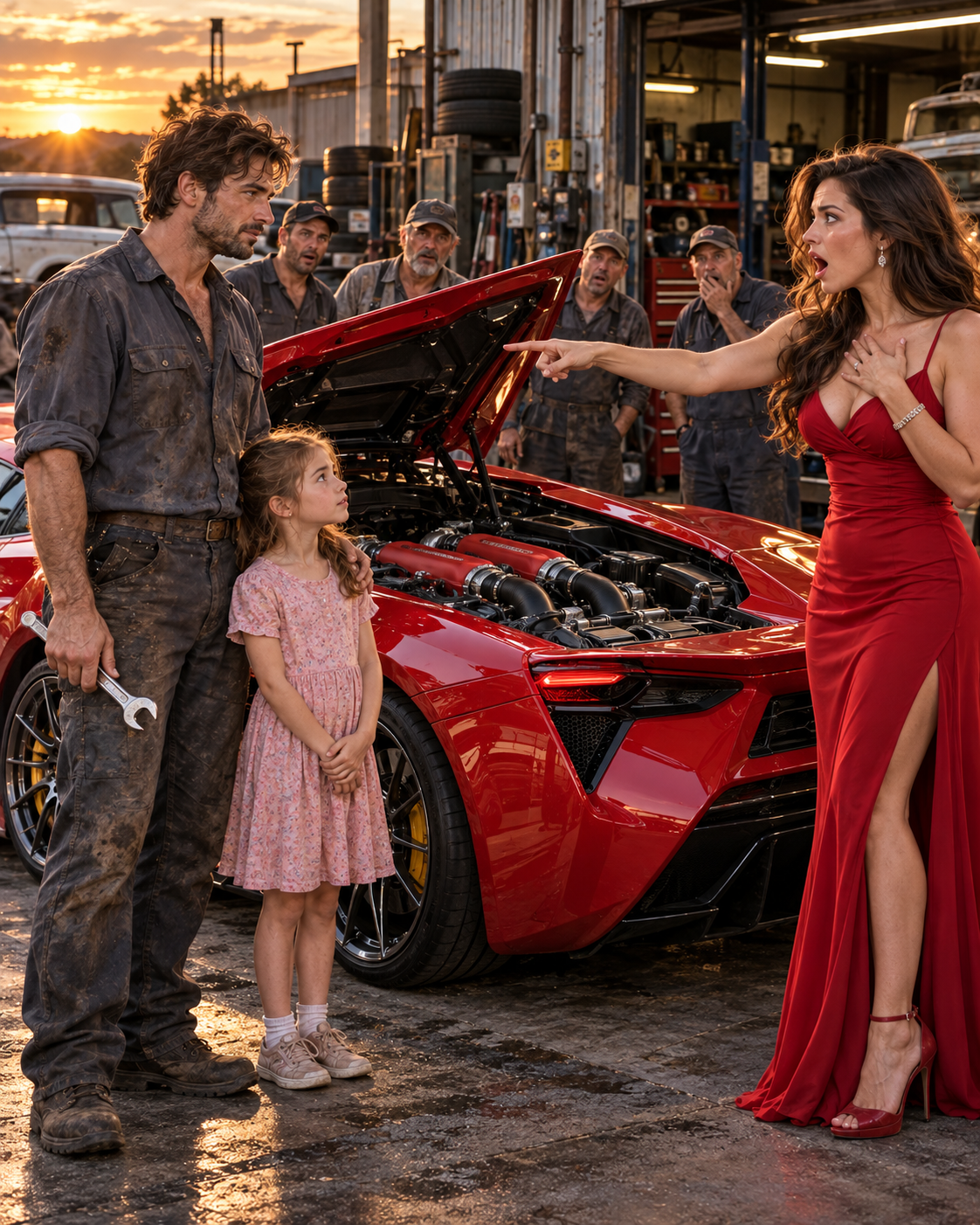
Outside, rain began tapping against the metal roof.
Inside, the red Ferrari sat beneath the fluorescent lamps while I followed its wiring harness one connection at a time.
The first discrepancy was small enough to dismiss.
A connector had continuity where I expected a different reading.
I tested it again.
Then a third time.
The result didn’t change.
I pulled the relevant page from the service manual and compared it with the circuit in front of me. The diagram showed one arrangement, but the car was wired differently.
I sat back on my stool.
“No,” I whispered.
I checked the chassis identification and the surviving production records.
Then I checked the circuit again.
A memory came back so sharply that I could almost smell the hot dust of the Maranello factory floor.
A workbench crowded with connectors.
A senior technician leaning over a diagram.
A hurried discussion about a change that couldn’t wait for the next documentation revision.
And nineteen cars whose electrical systems would forever contain a detail that the manuals did not.
I felt the hair rise along my arms.
The fault wasn’t random.
The car had been built with a revision that the people who later tried to repair it had no reason to expect.
I followed the affected circuit through its connectors and control points, measuring each section rather than trusting the printed diagram. The failure finally revealed itself as an incorrect connection in the revised fuel-delivery control path, a mismatch that prevented the system from operating as intended.
There it was.
A tiny piece of wiring, hidden beneath years of assumptions.
The kind of fault that could survive seventeen experts because each one had been given the same map.
I didn’t rush to fix it.
I photographed the existing connections, marked every wire, and wrote down the measurements. I checked the circuit against the configuration I remembered from the factory, then verified the proposed correction against the actual components in front of me.
By four in the morning, I had a solution.
I still needed to carry it out carefully, inspect the surrounding connections, and confirm that no secondary fault had developed during the six years the car had been sitting.
But for the first time, the problem made sense.
I sat on the stool beside the rear wheel and closed my eyes.
I thought about my father, who had taught me that a good mechanic never tried to impress a machine.
You listened to it.
You respected what it was telling you.
And when you didn’t understand, you kept asking questions until the answer became clear.
I wished he could have seen the car.
I wished Lily’s mother could have seen the little girl asleep beneath a blanket in my breakroom, trusting her father to solve a problem that had defeated men with bigger shops and more expensive tools.
The thought nearly broke me.
Instead, I stood, washed my hands, and went to check on Lily.
She was awake, blinking sleepily at me.
“Did you find it?”
“I think I did.”
“Will it run?”
“I’m going to try.”
She smiled and held up her drawing.
She had added a tiny person beside the red car, with dark hair, blue overalls, and hands drawn much too large for his body.
“That’s you,” she explained. “Your hands do the hard part.”
I laughed softly.
“Those hands need coffee.”
She giggled, and for a few seconds, the weight in my chest lifted.
Saturday passed in a rhythm of testing and preparation.
I inspected the relevant connectors, checked the grounding points, and laid out the tools I would need for the correction. I didn’t want to make a single hurried decision on a car that meant so much to its owner.
Every measurement mattered.
Every connection had to be secure.
By evening, I had verified the fault and documented the repair plan.
Then, just as I was preparing to complete the work, my phone rang.
Victoria Sterling.
I answered.
“Mr. Carter,” she said, her voice tight and controlled. “I’m having the car picked up tomorrow morning.”
I looked at the circuit diagram on my workbench.
“Why?”
“Daniel has found another specialist willing to inspect it. They have a facility with equipment you probably don’t have, and they can take it immediately.”
I kept my voice level.
“Have they reviewed the production revision on this car?”
There was a pause.
“What revision?”
“The fuel-delivery control circuit was modified during production in 1993. The change wasn’t fully incorporated into the service documentation. This car has that modification, and the fault is in the revised circuit.”
Silence settled between us.
When Victoria spoke again, the confidence had thinned from her voice.
“Are you certain?”
“I’ve traced the harness and tested the circuit. I can show you the readings, the discrepancy in the diagram, and the correction. I need until three o’clock tomorrow afternoon to finish the work and test it properly.”
“You’re asking me to ignore seventeen specialists.”
“No,” I said. “I’m asking you to look at the evidence before you pay an eighteenth.”
She didn’t answer immediately.
I could hear the faint murmur of voices behind her, then the click of a door closing.
“Why didn’t you tell me you knew about the factory?” she asked.
“Because you asked me whether I could fix your car. You didn’t ask for my life story.”
“That isn’t an answer.”
“It’s the one I have.”
I glanced toward the breakroom, where Lily was carefully packing her crayons into a plastic box.
“Ms. Sterling, I know what this car means to you. I also know what it means to have someone decide you’re incapable before you’ve had a chance to show your work.”
For several seconds, neither of us spoke.
Then Victoria said, “Three o’clock.”
“Three o’clock.”
“If it doesn’t run, the car leaves.”
“That’s fair.”
She hung up.
I set the phone down and stared at the workbench.
For the first time since she had arrived, I wasn’t worried about whether Victoria respected me.
I was worried about the moment she would hear the engine start.
Because some sounds are only sounds.
And some sounds carry a person back to the last place they were happy.
Part 3
Sunday morning arrived under a pale Tennessee sky.
I unlocked the garage before sunrise and began the final repair.
The workshop smelled of cold metal, electrical cleaner, and the coffee I’d forgotten to drink. My hands moved slowly and deliberately as I corrected the wiring, secured the connections, and checked the circuit against the readings I had recorded the night before.
There was no dramatic moment when the answer suddenly became obvious.
There was only careful work.
One connection verified.
One measurement recorded.
One more inspection before I allowed myself to move forward.
At nine, Lily appeared in the doorway wearing a yellow sweater and carrying two paper cups.
“Coffee for you,” she announced, holding up one cup. “Hot chocolate for me.”
I looked at the cups.
“Where did you get those?”
“Mom’s old recipe book said you need something warm when you work too long.”
The words caught me off guard.
Lily didn’t know what she’d touched. She had found the recipe book on the shelf at home and was trying, in her own small way, to take care of me.
I accepted the coffee.
“Thank you, sweetheart.”
She climbed onto the stool beside the workbench.
“Is today the day?”
I looked at the Ferrari.
“Today is the day we find out.”
I finished the electrical checks, then worked through the necessary inspections before attempting a start. I wasn’t going to let excitement outrun judgment. A car like this deserved more than a desperate twist of a key.
By noon, the repair was complete.
The circuit behaved as it should.
The fuel-delivery control system responded correctly during the checks.
I examined everything again, then stepped back and let the silence settle.
There was still a difference between a repaired circuit and a running engine.
At twelve forty-five, I prepared the car for the test.
At one fifteen, I stopped and checked a reading that had seemed slightly inconsistent.
At one forty, I checked it again.
At two, I was still working through the final verification.
Lily had fallen asleep in the breakroom, her head resting on her folded arms. The stuffed rabbit lay beside her crayons.
I looked at the clock.
Three o’clock was getting closer.
I thought about Victoria’s face when she had first stepped into my garage. I remembered the way she’d looked at my boots, the old equipment, and the peeling paint around the doors.
I could have resented her for it.
Part of me did.
But beneath the anger was something quieter.
She had lost her father, and she had spent six years trying to bring back a sound she feared she might never hear again.
Money could buy a rare car.
It could buy transportation across continents, specialized equipment, and the time of brilliant technicians.
But it couldn’t buy back one ordinary afternoon with someone who was gone.
I understood that better than I wanted to.
At two thirty, I completed the last checks.
At two thirty-five, I reviewed my notes.
At two forty, I sat behind the wheel.
The leather felt cool beneath my hands.
For a moment, I was twenty-four again, standing in the factory with the noise of machines all around me and the future stretching out farther than I could see.
Then I was back in Tennessee, in my own garage, with a little girl sleeping ten yards away and a dead Ferrari waiting for an answer.
I turned the key.
The starter engaged.
The engine coughed once, stumbled, and fell silent.
My heart dropped.
I waited, listening.
No smoke.
No strange sound.
No sign of a mechanical failure.
I checked the relevant readings, reviewed the fuel-delivery response, and found the signal was not behaving as expected under the starting conditions.
I didn’t force it.
I stopped, investigated, and traced the discrepancy to a secondary connection that had become unreliable during the years of storage.
I corrected it, secured it, and repeated the checks.
At two forty-six, I returned to the driver’s seat.
Outside, tires crunched over the gravel.
A black SUV was approaching the garage.
Victoria had arrived early.
Daniel stepped out first, looking at his watch. Victoria followed, her face already prepared for disappointment.
I lifted a hand through the open garage door.
“Give me one minute.”
She glanced at the clock on the dashboard.
“You have fourteen.”
“I know.”
I turned the key again.
For half a second, there was nothing.
Then the engine caught.
A deep, explosive roar tore through the garage, shaking the tools on the walls and sending a flock of birds scattering from the trees outside.
The Ferrari came alive.
Its engine settled into a hard, unmistakable rhythm, a mechanical heartbeat that filled every corner of the shop.
I kept my foot steady and watched the readings.
The engine held.
It held again.
And then the sound reached Victoria.
She stopped halfway across the driveway.
Daniel’s mouth fell open.
Victoria didn’t move at all.
Her face had gone pale, and the expression she wore was no longer the one she used in boardrooms or in front of people she expected to impress.
It was the face of a daughter hearing something she thought she had lost forever.
I eased the engine down and shut it off after confirming that the readings remained stable.
The sudden silence seemed almost physical.
Victoria walked toward the Ferrari slowly.
She reached the front fender and laid her palm against the red paint.
Then she bent her head.
I saw her shoulders tremble once.
She tried to speak, but nothing came out.
I stepped away from the driver’s seat and gave her room.
For several seconds, the only sound in the garage was the faint ticking of cooling metal.
Finally, she whispered, “My father used to start it every Sunday morning.”
I didn’t interrupt.
“He’d open the garage doors, sit in the driver’s seat, and let it run while he drank coffee. He said an engine like this had a voice, and you could tell how it was feeling if you listened long enough.”
She swallowed hard.
“When he became ill, he stopped driving. But he still went out there to start it. The last time he did, he came inside and told me it sounded perfect.”
Her hand tightened against the fender.
“I thought I’d have years to ask him to take me for a drive.”
She shut her eyes.
“Then I didn’t.”
I felt my throat tighten.
“My wife died when Lily was little,” I said quietly. “There are things I still catch myself wanting to tell her. Ordinary things. Something Lily said. Something funny that happened at the shop. Then I remember.”
Victoria looked at me.
For the first time, she wasn’t looking through my worn clothes or past my modest garage.
She was looking at a man who understood the weight of an unfinished conversation.
“I’m sorry,” she said.
“So am I.”
She wiped her face with the heel of her hand and looked back at the car.
“Six years,” she whispered. “Six years, and you brought him back to me for a moment.”
“I fixed the fault,” I said. “The memories were already here.”
She stared at me, and then she began to cry again, this time without trying to hide it.
Lily appeared in the breakroom doorway, her hair rumpled from sleep.
“Did it work?”
I smiled.
“It worked, sweetheart.”
She looked at Victoria, who was kneeling beside the Ferrari with one hand on its fender.
Then Lily walked over and stood quietly beside her.
“It’s a really nice sound,” she said.
Victoria let out a broken little laugh.
“Yes,” she replied. “It is.”
Lily considered the car for another moment.
“Your dad would probably like that you can hear it again.”
Victoria looked up at her.
“I think he would.”
She reached out, and Lily accepted her hand without hesitation.
For a while, the three of us stood beside the Ferrari, letting the silence become something gentle instead of empty.
Eventually, Victoria straightened and asked to see my notes.
I showed her the circuit discrepancy, the measurements, the corrected connection, and the documentation explaining why the published diagrams had led previous technicians away from the actual fault.
She examined everything carefully.
Then she looked at me.
“I owe you an apology.”
I waited.
“I judged you before you had a chance to show me what you could do. I saw the garage and your clothes, and I assumed you weren’t qualified.”
She glanced at the engine.
“You knew something seventeen specialists missed, and you never once tried to make yourself sound important.”
“I wasn’t trying to prove you wrong.”
“I know,” she said. “That’s what makes it worse.”
She asked for the invoice.
I wrote down my standard labor rate, the materials used, and the time I’d spent diagnosing and repairing the fault. I didn’t inflate the price because the car was valuable, and I didn’t discount the work because its owner had finally learned to respect me.
When I handed her the paper, she read every line.
Then she paid it without hesitation.
“It’s fair,” she said.
“That’s all I ask.”
She folded the receipt and placed it in her purse.
Daniel, who had spent the last several minutes standing in stunned silence, approached with a small leather folder.
“There’s one more thing,” Victoria said.
She took a sealed envelope from it and handed it to me.
“I run a foundation that supports vocational education in rural communities. My father believed that practical skills deserved the same respect as academic achievements. He used to say that the world depends on people who know how to make things work, even if nobody remembers their names.”
I looked at the envelope.
“Our foundation has been reviewing applications for equipment grants. I called the director this morning and asked her to look into the vocational program at Lily’s school.”
I hesitated.
“Victoria, I don’t want special treatment.”
“This isn’t payment for the repair,” she said. “You’ve already been paid for your work.”
She placed the envelope firmly in my hand.
“This is an investment in children who might never get access to the equipment they need. The grant will cover diagnostic tools, workshop lifts, safety equipment, and the machinery the program has been asking for. The commitment is in writing, with the funding details and implementation schedule.”
I opened the envelope.
The letter inside was official, signed, and addressed to the school district and its vocational education program. It committed the foundation to funding the equipment package in full, subject to the listed procurement and delivery arrangements.
I read it twice.
The numbers on the page blurred for a moment.
I thought of the school workshop with its aging tools and the instructor who made broken equipment last because replacing it wasn’t an option. I thought of the children who loved building things but had never touched a proper diagnostic scanner.
I thought of Lily, who sometimes came home with drawings of machines she wanted to understand.
“Why are you doing this?” I asked.
Victoria glanced toward the Ferrari.
“Because my father would have wanted it. And because you reminded me that the most important things in the world aren’t always the ones with the highest price tags.”
She paused.
“Your daughter said you fix things other people think are broken forever. I think there are a lot of children who need someone to believe that about them, too.”
I couldn’t find an answer.
So I folded the letter carefully and slipped it into my shirt pocket.
“Thank you,” I finally said.
Victoria shook her head.
“No. Thank you for giving me something I thought I’d lost.”
Before she left, she asked if she could start the engine one more time.
I stepped aside.
She settled behind the wheel, placed both hands on it, and sat quietly for a few seconds before turning the key.
The Ferrari roared to life again.
This time, Victoria smiled through her tears.
I watched her close her eyes, just as Lily had told her to do, and listen.
Perhaps she could hear her father in the familiar rhythm.
Perhaps she was simply allowing herself to remember him without the silence that had surrounded the car for six years.
Either way, she stayed there until I gently signaled that the engine had reached the point where we should shut it down and let it cool.
When she finally stepped out, she looked lighter.
Not healed. Grief doesn’t disappear because a machine starts.
But the past no longer seemed quite so far away.
Victoria and Daniel departed near sunset, the Ferrari secured for transport and its engine no longer a mystery.
I stood at the garage entrance with Lily beside me, watching the red taillights disappear down the road.
She tugged my sleeve.
“Daddy?”
“Yes?”
“Are we rich now?”
I laughed, surprised by the question.
“No, sweetheart. We’re still us.”
She thought about that.
“But the school gets all those tools?”
“It does.”
“Then maybe other kids can fix things, too.”
I looked down at her small face.
“That’s the idea.”
We closed the garage together.
I locked the side door, switched off the lights, and checked the pocket where the grant letter rested against my chest. The paper was only a few pages long, but it carried the possibility of something much larger than money.
It meant a child in a small Tennessee town might one day walk into a workshop and find the right tool waiting.
It meant an instructor wouldn’t have to explain why a broken machine had to remain broken because the school couldn’t afford the part.
It meant someone who had never been taken seriously might discover that their hands, their patience, and their curiosity were worth something.
As Lily and I walked home beneath the deepening evening sky, she reached up and took my hand.
The road was quiet, and the air smelled of rain and cut grass.
For years, I had believed that coming home meant leaving a part of myself behind. I had traded the factories of Italy for a little garage in Tennessee, and I had sometimes wondered whether the knowledge I’d gained overseas would ever matter again.
Now I understood that it had never been wasted.
The things we learn don’t always return to us in the form we expect. Sometimes they arrive disguised as a dead engine, a grieving daughter, or a child who believes in us more than we believe in ourselves.
My garage would still have its peeling paint.
My boots would still be worn.
Tomorrow, I would still unlock the doors, sweep the floor, and repair whatever the people of our town brought me.
But somewhere, in a school workshop that had been waiting too long for its chance, new equipment would soon arrive.
And a young kid with grease on their hands might discover that the world was bigger than anyone had told them.
Lily squeezed my hand.
“Daddy, when I grow up, can you teach me everything you know?”
I looked at her, at the child who had defended me before I had earned anyone’s trust, and felt the ache of all the years I had spent trying to build a good life for her.
“I’ll teach you everything I can,” I promised.
She smiled.
“And then I’ll learn the rest.”
We kept walking.
Behind us, the garage stood quiet beneath the Tennessee stars, holding the tools of an ordinary trade and the memory of an extraordinary afternoon.
I had spent eight years learning how to listen to machines.
It had taken a little girl, a grieving woman, and one long-dead Ferrari to remind me what that knowledge was really for.
Not to prove that I was better than seventeen experts.
Not to impress a wealthy stranger.
Not even to bring a priceless car back to life.
It was to make sure that when something seemed broken beyond repair, someone still had the courage to look closer.
Because sometimes the most valuable thing you can fix isn’t the machine in front of you.
Sometimes it’s the hope of the person standing beside it.
And sometimes, if you’re very lucky, the sound that brings a father back to his daughter for one more moment becomes the first note in a future that will belong to hundreds of children you’ve never even met.