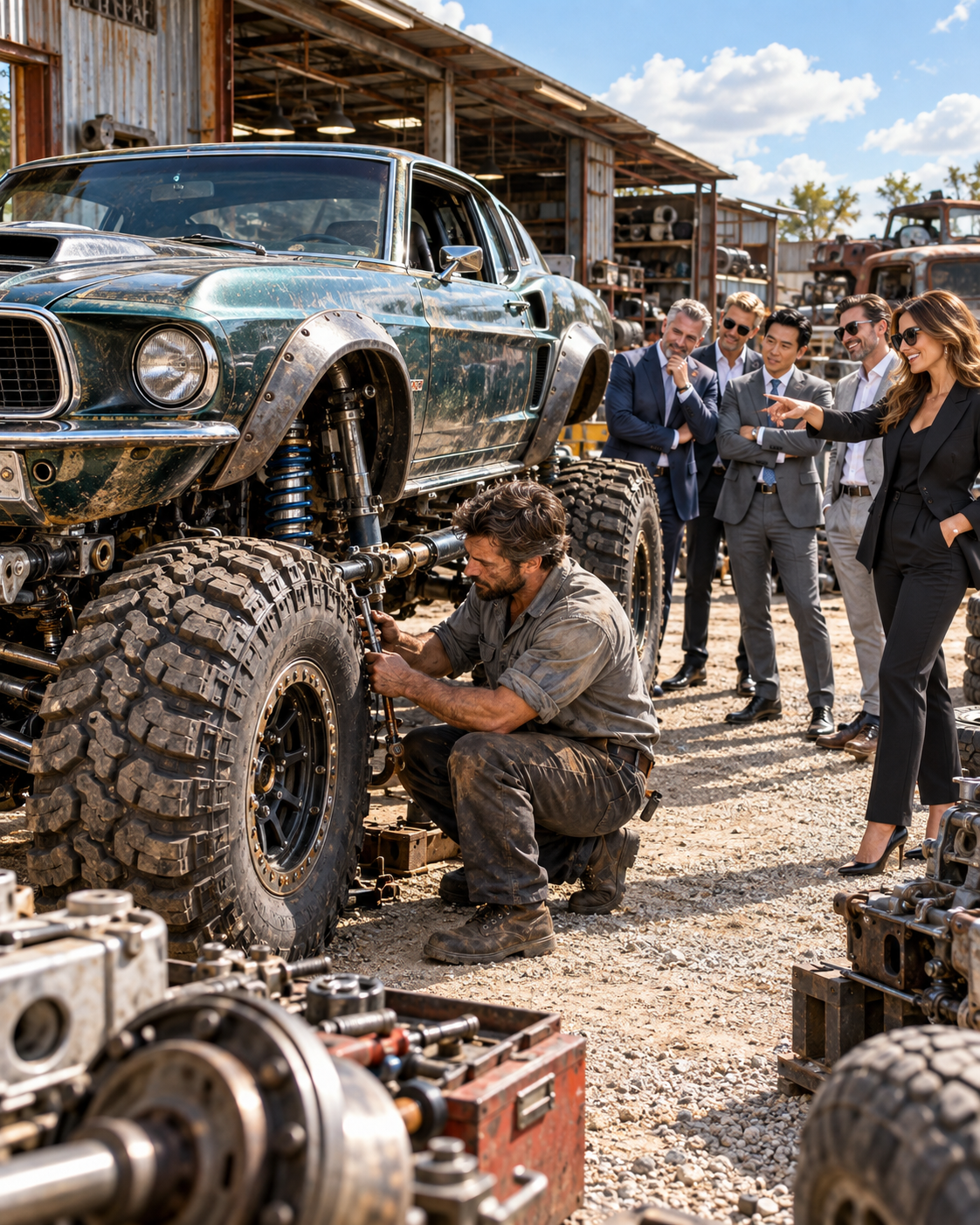
When Vespera laughed beside my battered car at the downtown Detroit Auto Expo
Part 2
The desert changed after the rocky corridor.
The ground flattened into hard-packed earth, and the course opened toward the final asphalt stretch.
My hands were aching.
My shoulders burned.
Every breath tasted like dust.
But the engine temperature remained steady.
That was the part I kept thinking about.
Three years of early mornings.
Three years of failed prototypes.
Three years of grief.
All of it had led to this one machine humming beneath me.
Then I saw Trevor in the mirror.
His car was closing fast.
I could hear his engine screaming.
He had pushed past the overheating warnings.
He was gambling everything.
The final straight appeared ahead.
For one moment, I thought the race was mine.
Then Trevor moved across my line.
His front bumper cut toward my lane.
My instinct was to fight him.
My foot tightened against the accelerator.
But I remembered the temperature.
The balance.
The tires.
The narrow margin between winning and destroying everything I had built.
So I yielded.
I let him pass into the inside line.
The crowd roared somewhere beyond the barriers.
Trevor had taken the position.
But he had also taken the tighter corner.
I stayed wide.
I kept my speed.
I trusted the machine.
Then the final turn arrived.
Trevor braked.
I didn’t.
Not completely.
Pebble swept through the wider arc, stable beneath me, the wind deflector catching the crosswind exactly as designed.
For half a second, the two cars were side by side.
Then I was ahead.
The finish line rushed toward me.
I crossed it seventeen seconds before Trevor.
For a moment, I heard nothing.
No engines.
No crowd.
No radio.
Nothing.
Then everything exploded.
People screamed.
Silas shouted so loudly through the radio that I had to pull the earpiece away.
“YOU DID IT!”
I stopped the car.
My hands were shaking.
I climbed out.
Mina ran toward me.
She hit my legs so hard I almost fell.
I dropped to my knees and wrapped my arms around her.
Pebble was squeezed between us.
I buried my face in Mina’s hair.
I smelled dust and sunscreen and the faint sweetness of the strawberry shampoo Lyra used to buy for her.
For one terrible second, grief struck me so hard that I could barely breathe.
Because Lyra should have been there.
She should have seen this.
She should have laughed.
She should have told me I was being ridiculous for crying in front of thousands of people.
Instead, I held our daughter tighter.
Mina whispered, “Mommy would be proud.”
I closed my eyes.
“Yeah.”
My voice broke.
“She would.”
On the winner’s platform, Trevor stood several feet away.
His face was pale.
Vespera stood beside him.
She did not look at me.
She looked at the car.
Then she looked at the crowd.
Then at the timing board.
Seventeen seconds.
The difference was small.
The meaning was enormous.
That evening, while the celebration continued, a journalist named Corinne approached Silas.
She had been covering the Desert Classic for years.
She had noticed something strange.
Trevor’s original thermal architecture, the one ApexTech had credited to him, looked remarkably similar to my system.
Silas had kept copies of everything.
Every sketch.
Every dated photograph.
Every materials invoice.
Every handwritten calculation.
He had even saved the old files I thought were gone forever.
Corinne spent the night comparing them.
By morning, she had the story.
Not a rumor.
Not an accusation.
Evidence.
She published the first article at 7:12 a.m.
By eight, it was everywhere.
By nine, ApexTech’s lawyers were calling.
By ten, the Desert Classic committee had opened an investigation.
The article included photographs of my original drawings, dated years before Trevor’s supposedly revolutionary design.
There were emails.
Messages.
Internal documents.
One document even contained a note from Trevor instructing a colleague to “clean up the language” before submitting my concept under his name.
I read that sentence three times.
Then I closed my phone.
I had imagined this moment for years.
I had dreamed about seeing Trevor exposed.
I had imagined shouting.
I had imagined humiliation.
Instead, I felt tired.
Mina was asleep on the couch.
Pebble was tucked beneath her chin.
Silas was sitting across from me with a cup of coffee.
“You okay?” he asked.
I looked at the sleeping child.
“I thought I’d feel better.”
Silas nodded.
“Truth doesn’t always feel like revenge.”
“What does it feel like?”
He stared into his coffee.
“Sometimes it just feels like the weight finally left the room.”
Later that afternoon, Vespera asked to meet me.
I expected lawyers.
Instead, she came alone.
She stood outside my trailer in the desert heat.
For a long moment, she said nothing.
Then she looked at the ground.
“I owe you an apology.”
I leaned against the door.
“Yes.”
She accepted the answer.
No excuses.
No corporate language.
No attempt to soften it.
“I judged your car because of how it looked,” she said.
“I judged you because Trevor told me who you were before I ever asked you.”
I said nothing.
She swallowed.
“And I laughed.”
That hurt more than I expected.
Not because she had laughed.
Because Mina had been standing there when she did.
Vespera looked toward the trailer.
“Your daughter heard me.”
“She did.”
“I’m sorry.”
The silence between us lasted several seconds.
Then she said, “Trevor is no longer with ApexTech.”
I nodded.
“And the company has agreed to cooperate with the investigation.”
“Good.”
She looked at me.
“You could have destroyed us publicly.”
“I didn’t.”
“Why?”
I thought about Lyra.
About the mornings.
About Mina.
About the envelope with twenty-five thousand dollars.
About all the years I had spent believing justice had to hurt someone before it could heal me.
“Because winning was enough.”
Vespera lowered her eyes.
For the first time, she looked less like a CEO and more like a tired human being who had finally discovered how badly she had been fooled.
“I hope someday you can forgive me.”
I looked at her.
“Maybe.”
She nodded.
“I’ll take maybe.”
She left before sunset.
The next morning, Mina asked me if we had won because Pebble was lucky.
I told her no.
“Then why?”
She thought for a moment.
“Because you didn’t give up.”
I smiled.
“That’s part of it.”
She held up the stuffed rabbit.
“Pebble helped.”
“Obviously.”
She giggled.
The prize money changed our lives.
But I did not buy a mansion.
I did not buy a supercar.
I did not put a giant sign on my garage.
Instead, I remembered every person who had told me they had a good idea but no money to build it.
Every teenager who had taken apart a broken lawn mower just to understand how an engine worked.
Every mechanic who had brilliant hands but no degree.
Every inventor who had been told that a garage project was not a real engineering project.
I set aside the money for something bigger.
A community workshop.
Tools.
Machines.
Materials.
Mentors.
A place where resource-strapped inventors could build without begging someone in a boardroom for permission to dream.
Silas agreed to help.
Mina insisted there should be a children’s corner.
“With a rabbit?”
“Of course.”
So we built it into the plan.
Three weeks after the race, Vespera came to my garage.
Alone.
She carried a thin black folder.
I was working beneath Pebble’s chassis when I heard her footsteps.
She stopped near the workbench.
“I brought something.”
I wiped my hands.
“Another envelope?”
She almost smiled.
“No.”
She opened the folder.
Inside was a contract.
Not an acquisition.
Not a licensing agreement designed to bury me.
A genuine co-ownership proposal.
Equal rights.
Transparent royalties.
Independent oversight.
Shared research.
Community funding.
I read every page.
“This is fair.”
“I made sure it was.”
I looked up.
“Why?”
“Because I finally understand what I should have understood before.”
She paused.
“You built something valuable without needing someone like me to validate it.”
I closed the folder.
“And you want to help?”
“I want to learn.”
That answer surprised me.
Before I could respond, Mina walked into the garage carrying Pebble.
She stopped when she saw Vespera.
Her expression became serious.
Vespera slowly lowered herself to one knee.
“Mina?”
Mina stared at her.
“I’m sorry.”
Mina said nothing.
Vespera continued.
“I laughed at your dad’s car.”
Mina looked at me.
Then at Vespera.
“You laughed at Pebble too.”
Vespera smiled sadly.
“Yes.”
Mina hugged the rabbit.
“Pebble doesn’t like being laughed at.”
“I understand.”
Mina studied her for a moment.
Then she asked, “Do you know why he’s called Pebble?”
Vespera shook her head.
Mina held up the rabbit.
“Because pebbles are tiny.”
She paused.
“People don’t notice them under tires.”
Then she smiled.
“Until they suddenly fly.”
Vespera laughed softly.
This time, there was no cruelty in it.
Just wonder.
I felt something loosen inside my chest.
Not forgiveness exactly.
Something quieter.
Something closer to peace.
Part 3
That evening, Vespera stayed for coffee.
The garage smelled like metal, dust, and the coffee I had forgotten on the warmer.
Above the workbench hung a photograph of Lyra.
She was smiling at the camera with sunlight in her hair.
Vespera noticed it.
“Your wife?”
I nodded.
“Lyra.”
“I’m sorry.”
I poured another cup.
“Thank you.”
I placed the warm mug in front of her.
Then I sat across the table.
For a while, neither of us spoke.
Outside, traffic moved along the street.
Somewhere down the block, a dog barked.
Mina was drawing beside the car.
Pebble sat beside her on the floor.
The world felt strangely ordinary.
And after everything, ordinary felt like a gift.
Vespera looked at the photograph again.
“Was she here when you started building it?”
“No.”
“Then why did you keep going?”
I looked at Mina.
“Because she left me a reason.”
Vespera waited.
I continued.
“She taught me that love isn’t only about keeping someone beside you.”
I touched the edge of the photograph.
“Sometimes it’s about carrying what they gave you into places they never got to see.”
Vespera looked down at her coffee.
“I think I’ve spent most of my life trying to prove I was right.”
“So did I.”
“What changed?”
I smiled faintly.
“I realized I would rather build something than spend my life explaining why someone else was wrong.”
She nodded slowly.
The garage became quiet again.
I looked at Pebble.
Three years earlier, I had named a machine after a child’s stuffed rabbit because I could not imagine giving it some grand racing name.
Now I understood why that name had mattered.
The car had never been about being the biggest.
Or the richest.
Or the most beautiful.
It had been about surviving forces that looked too powerful to overcome.
Heat.
Wind.
Grief.
Betrayal.
Poverty.
Fear.
Each one had pushed against us.
None had stopped us.
Mina suddenly looked up.
“Dad?”
“Yeah?”
“Are we keeping Pebble?”
I laughed.
“Of course.”
She nodded as if the question had never really needed an answer.
Vespera smiled.
“Can I see the workshop plans?”
I handed them across the table.
She studied the pages.
There were names on the margins.
Young inventors.
Local mechanics.
Students.
People who had sent me messages after the race.
People who had never won anything.
People who simply wanted a chance.
“This is bigger than the car,” she said.
“That’s the point.”
She looked at me.
“And the cooling technology?”
“We build it together.”
“Equal ownership?”
“Equal ownership.”
“Even if ApexTech puts more money into it?”
“Especially then.”
She smiled.
“Deal.”
I shook her hand.
It was not the triumphant handshake I had once imagined.
There were no cameras.
No crowd.
No headlines.
Just two people sitting beside an old workbench, finally understanding how much damage arrogance could cause, and how much good could begin with simply admitting it.
Later, after Vespera left, I stood alone beside Pebble.
The garage lights cast long shadows across the floor.
I placed my hand on the hood.
The metal was cool now.
I remembered the first morning I had touched that frame.
5:45 a.m.
A cold backyard.
A tarp snapping in the wind.
A little girl sleeping inside.
A photograph of a woman I loved more than I knew how to explain.
Back then, I thought I was building a car.
I was wrong.
I was building a way forward.
I was building something Mina could one day look at and understand.
Not that her father had won a race.
Not that he had beaten a man who betrayed him.
But that pain did not have to become poison.
That humiliation did not have to become hatred.
That being underestimated could become fuel, but it did not have to become your identity.
I looked toward Lyra’s photograph.
“I wish you could see this.”
The words disappeared into the quiet.
For a moment, I imagined her answering.
Not with anything dramatic.
Just the soft laugh I remembered.
The kind that made difficult things feel survivable.
Mina came over and slipped her hand into mine.
“Dad?”
“Yeah?”
“Mommy is still part of Pebble, right?”
I looked at the photograph.
Then at my daughter.
“Always.”
She leaned against me.
Pebble rested between us.
Outside, the city kept moving.
Cars passed.
People hurried home.
Lights flickered on in apartment windows.
The world had no idea that inside one small garage, three lives had changed direction.
Mine.
Mina’s.
And, perhaps, Vespera’s.
The race had ended weeks ago.
The investigation would continue.
Trevor would have to answer for what he had stolen.
The workshop would open soon.
There would be more designs.
More failures.
More mornings when something refused to work.
There would be new inventors standing where I once stood, afraid that their ideas were too small to matter.
And I would tell them what I had finally learned.
The world does not always recognize the thing that will change it when it first appears.
Sometimes it sees rough welds.
Sometimes it sees mismatched tires.
Sometimes it sees a grieving father working under a tarp at dawn and assumes he is wasting his time.
But beneath the ugly surface, something can be moving.
Something can be gathering heat.
Something can be finding its balance.
And sometimes the smallest things are the ones nobody notices until the moment they suddenly rise.
Mina squeezed my hand.
“Dad?”
“Yeah?”
“Can we go get pancakes tomorrow?”
I laughed.
“That might be the most important thing we’ve planned all week.”
She grinned.
We turned off the garage lights.
Before closing the door, I looked back one last time.
Pebble sat beneath the dim light.
Lyra’s photograph watched over the workbench.
The old car waited quietly in the dark.
And for the first time since losing her, the silence did not feel empty.
It felt peaceful.
Because some victories are measured in seventeen seconds.
Some are measured in five million dollars.
But the ones that stay with you forever are measured differently.
In a daughter’s hand inside yours.
In a warm cup of coffee offered without bitterness.
In a dream built from almost nothing.
And in the quiet moment when you finally realize that the people who tried to bury your story did not get to write its ending.
You did.