When Major Liam Caldwell publicly called me “a glorified computer operator” in front of an entire squadron at Nellis Air Force Base
Part 2
The first explosion happened outside the base perimeter.
A surveillance installation vanished from the tracking display, and the shock wave reached the operations building several seconds later.
The windows trembled.
Someone shouted for confirmation.
A controller reported that a remote communications relay had gone dark.
Then the base’s radar picture fractured.
The first drone had begun attacking the systems that allowed us to see it.
The second continued toward the airfield, adjusting its path whenever another sensor attempted to establish a track.
The exercise was over.
This was no longer a training scenario.
“All personnel, move to emergency defense stations,” the operations chief ordered. “Protective measures are now in effect.”
Liam was already heading toward the flight line.
His F-35 had been assigned to the exercise, and the ground crew had begun preparing it for a possible defensive launch.
He looked back at me as he passed the doorway.
For the first time since I had known him, he did not look amused.
“Can we intercept them?”
I studied the display.
“Not with the assumptions we’re using.”
“What does that mean?”
“It means they’re not following a fixed flight profile. They’re responding to our defenses in real time.”
“We know that.”
“No, Major. You know they’re fast. You haven’t accepted what that means.”
His jaw tightened.
“Then explain it.”
I pointed to the first track.
“Every time our system commits to a prediction, the drone changes its behavior just enough to invalidate the solution. It’s not merely evading us. It’s studying how we respond.”
The operations chief approached.
“Ms. Bennett, do you have a technical assessment?”
I hesitated.
The truth was locked behind classifications I was not authorized to discuss in that room.
But the drones were already inside Nevada airspace, and the second one was turning toward our fuel reserves.
“I’ve encountered this behavior before.”
“Where?”
I looked at the screen.
“Overseas.”
It was not enough, and everyone knew it.
The operations chief started to ask another question, but a new alert interrupted him.
The first drone had changed direction and was moving toward the aircraft staging area.
The command team ordered an emergency scramble.
Pilots ran toward their jets.
Ground crews disconnected equipment and cleared the taxi lanes.
Liam reached his F-35 and climbed the ladder.
For several moments, the airfield seemed to erupt into motion.
Then his aircraft’s warning system registered the approaching threat.
He paused.
The drone’s latest maneuver had made the planned interception geometry useless.
The control room watched as the F-35 attempted to establish a viable engagement position.
The target changed vector again.
Liam’s jet began turning to follow.
The drone anticipated the movement and cut across the projected path.
The controller’s voice sharpened.
“Major Caldwell, disengage that intercept. Your approach is compromised.”
Liam tried to reposition.
The drone moved again.
A second alert sounded.
The first object had acquired the aircraft’s active electronic signature.
“Break off!” the controller shouted. “Break off now!”
Liam abandoned the intercept and pulled away.
He had done the right thing.
Another few seconds in that engagement might have left him with no safe escape.
His jet returned toward the runway as the drone turned away from him and resumed its approach to the base.
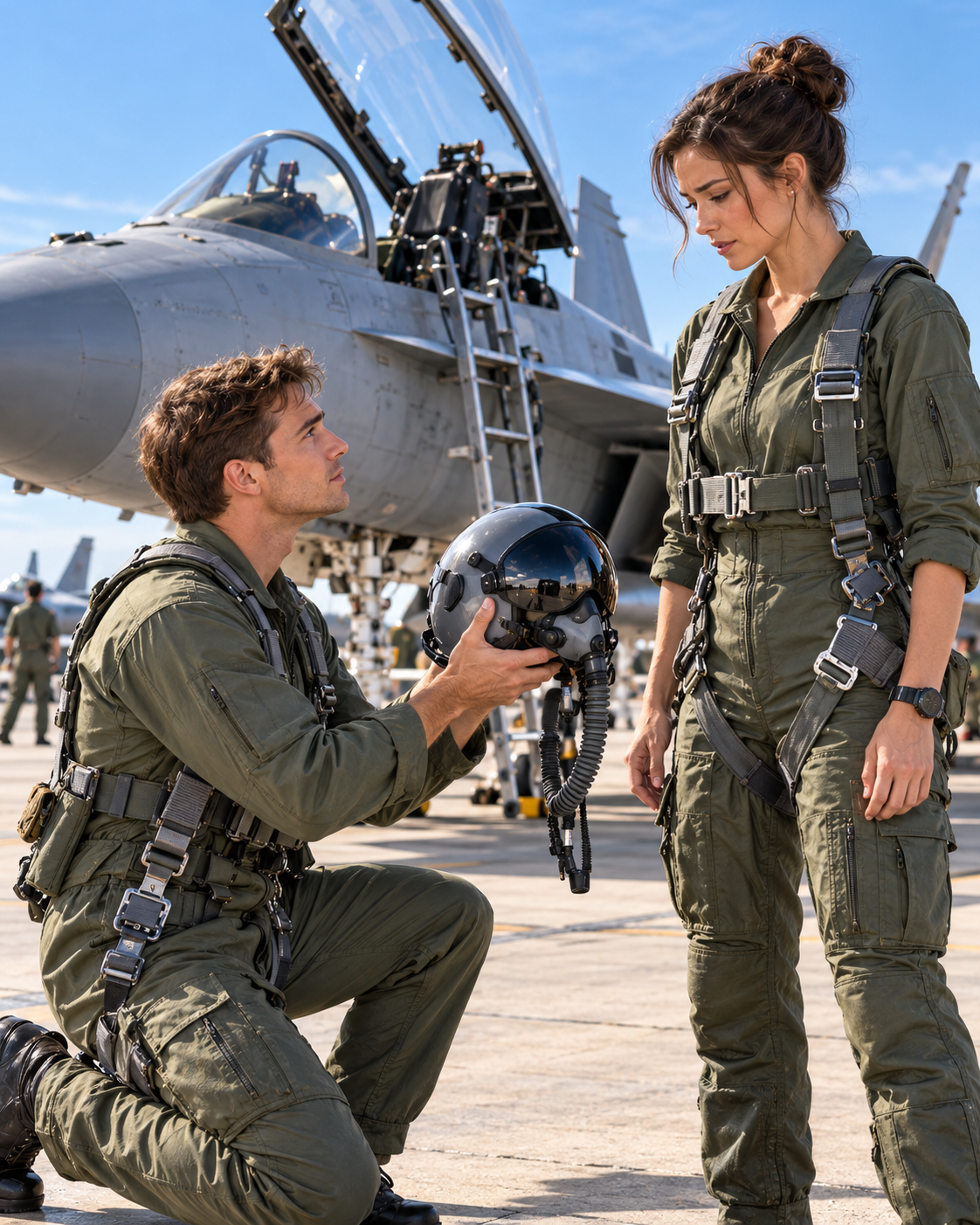
I watched Liam climb down the ladder.
He pulled off his helmet, breathing hard.
For the first time, he looked at me without the familiar trace of contempt.
“How did it do that?”
“It predicted your response.”
“Nobody predicts a fifth-generation fighter that easily.”
“Apparently, somebody built a machine that can.”
He stared at the screen.
The second drone was now moving toward the fuel storage complex.
If it struck the tanks, the resulting fire could destroy critical infrastructure and endanger everyone on the flight line.
The command team was rapidly exhausting its options.
Ground-based defenses were struggling to maintain reliable tracks.
Electronic countermeasures were producing uncertain results.
Conventional interception doctrine was designed around threats that could be detected, classified, and engaged within known limits.
These machines were turning those limits into weaknesses.
Then I noticed something on the display.
The first drone had briefly changed its tracking behavior when the base’s radar network shifted frequencies.
It had not been confused for long.
But it had hesitated.
A fraction of a second.
Enough to tell me that its adaptive system was not omniscient.
It still needed information.
It still had to make decisions based on what it could detect.
And anything that depended on detection could be deceived.
I leaned toward the operations chief.
“Do we still have an F-22 available?”
He looked at me.
“One aircraft is mission-capable, but the pilot assigned to it is not on the immediate launch roster.”
“Where is it?”
“Hangar Three.”
“Get it ready.”
He stared at me as though I had spoken another language.
“You’re not authorized to command an airborne interception.”
“I’m not asking for command authority. I’m asking whether the aircraft is available.”
“Ms. Bennett, this is an active hostile incursion.”
“I know.”
“Then you understand that we cannot launch an aircraft without a qualified pilot.”
I looked through the glass toward the flight line.
Liam was standing beside his F-35, watching the second drone approach the fuel complex.
He had flown into danger because he trusted his training.
He had pulled away because he understood when the engagement became unwinnable.
That mattered more than his pride.
I walked out of the operations building.
The desert wind struck my face as I crossed the apron toward Hangar Three.
People shouted into radios around me.
A security vehicle raced past.
Far above the base, an aircraft-shaped shadow flashed through the sunlight and disappeared into the haze.
I could feel my heartbeat in my throat.
Four years of silence.
Four years of telling myself that the person who had flown over Damascus was gone.
I had convinced myself that walking away was the only way to survive Evan’s death.
But the sky did not care what I had promised myself.
The F-22 sat inside the hangar, its gray skin reflecting the overhead lights.
Ground crews were already moving around it, preparing the aircraft for an emergency launch.
A young maintenance sergeant saw me approaching.
“Ma’am, this area is restricted.”
“I need the flight crew.”
“They’re trying to identify an available pilot.”
“Tell them to stop looking.”
He frowned.
“Ma’am?”
I reached for the edge of the ladder.
Behind me, footsteps pounded across the concrete.
Liam had followed.
He looked at me, then at the Raptor, then back at me.
Something had changed in his expression.
Perhaps it was the way I had assessed the threat without hesitation.
Perhaps it was the fact that I had walked toward the aircraft while everyone else was waiting for a decision.
Or perhaps he had finally recognized a kind of certainty that could not be learned from a simulator.
“Claire,” he said quietly, “what are you doing?”
I placed one hand on the ladder.
“What I should have done four years ago.”
His face tightened.
“What does that mean?”
I looked at him.
“It means I know these things.”
The distant warning sirens rose again.
The second drone was nearing the fuel complex.
There was no time left for the story of Damascus.
No time to explain the classified mission, the lost wingman, or the reason I had abandoned operational flying.
Liam glanced toward the operations building.
Then he looked back at the aircraft.
His pride fought with his judgment for one last second.
Judgment won.
He stepped aside, straightened, and gave me a look I had never seen on his face before.
Not admiration.
Not yet.
Something closer to trust.
“Ma’am,” he said, his voice low and urgent, “take my jet.”
I climbed the ladder.
As I settled into the cockpit, the smell of fuel, metal, and warm electronics carried me backward through four years of grief.
My hands found their familiar places.
The cockpit seemed to close around me like a memory.
For one moment, I heard Evan’s voice.
Get them out.
I closed my eyes.
“I’m here,” I whispered.
Then I opened them and began the preflight sequence.
The ground crew worked around the aircraft as the command team relayed the rapidly changing threat picture.
I did not pretend the mission would be easy.
The drones had already demonstrated that they could defeat ordinary tracking and anticipate conventional responses.
But they had also revealed something important.
They could be made to commit to a target.
And when they committed, they had to spend time correcting their course.
I intended to use that time.
The tower came over the radio.
“Unidentified pilot, confirm identity and authorization.”
I keyed the microphone.
“Captain Claire Bennett, previously assigned to classified flight-test operations. Requesting emergency authorization to launch.”
Silence.
Then the operations chief’s voice returned.
“Captain Bennett, your operational status is restricted. We need confirmation from command.”
“You have a hostile autonomous threat approaching critical base infrastructure. I can either launch now or wait while it chooses its next target.”
The tower went quiet.
I heard overlapping voices in the background.
Someone was checking records.
Someone else was arguing that my former status did not constitute current authorization.
Then a different voice came over the channel.
“Emergency authorization granted. Launch when ready.”
I exhaled slowly.
The engine started.
The aircraft trembled beneath me.
For the first time in four years, I was back in the sky’s doorway.
I pushed the throttle forward and felt the Raptor begin to move.
The runway stretched ahead beneath the desert sun.
I did not think about the headlines that might follow.
I did not think about the sealed files.
I did not even think about whether I would ever fly again.
I thought about the fuel tanks.
The people on the flight line.
The two machines that had entered our airspace believing everything they saw could be predicted.
Then I accelerated.
And the ground fell away.
Part 3
The first thing I noticed after takeoff was how much the sky had changed.
Not physically.
The Nevada mountains still cut dark shapes across the horizon, and the sunlight still burned white against the desert.
But the sky no longer felt like a place I had lost.
It felt like a place that had been waiting for me to stop running.
The Raptor climbed toward the threat area while the controllers fed me the latest tracks.
The first drone was moving across the northern sector, forcing the remaining surveillance systems to divide their attention.
The second was lower, its path carrying it toward the fuel complex.
Both were fast.
Both were unpredictable.
And both were still relying on sensors to understand the world around them.
“Captain Bennett,” the controller said, “we’re seeing intermittent tracking. You may lose the target picture as you approach.”
“Understood.”
“Your current interception geometry is not recommended.”
“I didn’t ask for a recommended geometry.”
There was a pause.
Then the controller answered, “Copy.”
I took a breath and settled into the flight.
I was not the pilot I had been four years earlier.
I was older, more cautious, and more aware of what could happen when a single mistake became irreversible.
But I had also spent years studying the encounter over Damascus, reviewing every available fragment of data and every decision I had made.
I knew the drones were adaptive.
I knew their tracking was strongest when they could combine multiple sources of information.
I also knew that no sensor system was perfect.
I requested a coordinated change in the base’s radar emissions, with authorization from the command team, to reduce the electronic signatures the drones could exploit.
The operations center confirmed the change.
On my display, the picture shifted.
The first drone turned toward the strongest remaining signal.
It was not a perfect deception.
It was an invitation.
I maneuvered to approach from a different angle, watching the drone’s track update in response to the changing signals.
It followed the pattern I had expected.
For a few seconds, it committed to a pursuit vector that narrowed its available options.
I brought the aircraft around and established a firing solution.
The weapon system gave me a brief confirmation.
I waited until the target’s movement matched the window I needed.
Then I fired.
The missile streaked away.
The drone reacted almost immediately, shifting its path as its sensors detected the launch.
For a terrifying instant, I thought it had found a way out.
Then the intercept succeeded.
A flash appeared against the pale sky, followed by a cloud of debris that scattered and vanished into the desert haze.
The first red track disappeared from my display.
The radio erupted with overlapping voices.
“First target destroyed.”
“Confirmed, first target destroyed.”
I did not answer.
One threat was gone.
The second was still moving toward the fuel complex.
And now it knew that something in the air could hurt it.
The drone changed course.
Its speed and trajectory forced the command team to recalculate the danger zone.
Ground personnel were being evacuated from the exposed sections of the airfield, but the fuel storage area could not be cleared quickly enough to remove the risk.
The drone was closing.
“Captain Bennett, the second target is accelerating toward the fuel facility.”
“I see it.”
“Can you establish another firing solution?”
I studied the track.
The first engagement had consumed time and energy.
The second drone had adjusted its approach to reduce its exposure to a conventional intercept.
It was no longer trying to draw my attention away from the base.
It was trying to force me into a position where I would have to choose between a dangerous intercept and allowing it to reach the target.
I could feel the old fear returning.
The same cold pressure in my chest.
The same memory of Evan’s voice breaking through the static.
For an instant, the cockpit over Damascus seemed to overlap the one around me.
I remembered the damaged instruments.
The warning tones.
The terrible certainty that the next few seconds would decide whether I lived.
I tightened my grip.
“Not this time,” I whispered.
I pushed the aircraft into a hard maneuver to change the engagement geometry.
The Raptor responded, but the stress warnings began to rise.
I could not simply force the aircraft beyond its limits and expect it to forgive me.
There was a difference between taking a calculated risk and pretending physics would make an exception for courage.
I needed the drone to commit to a path that reduced its ability to react.
I watched its track.
It was adjusting to my movement.
Then I saw a brief change in its projected course.
It had selected the fuel facility as its priority and was correcting toward the target.
The choice narrowed its options.
I moved to intercept, keeping the aircraft within a survivable envelope while the warning tones continued to pulse in my headset.
“Captain, your structural limits are approaching.”
“I know.”
“Recommend disengagement.”
“Negative.”
The drone’s track moved closer to the facility.
I needed a final opportunity.
A sharp maneuver could disrupt its solution, but I could not assume that an advanced autonomous system would react like a human pilot.
The aircraft shuddered as I altered its path.
For a moment, the world seemed to tilt sideways.
The drone adjusted, but not quickly enough to preserve its ideal approach.
Its trajectory changed.
I saw the opening.
I brought the Raptor around and launched the remaining weapon when the firing solution became viable.
The drone reacted, but its path had already narrowed.
The missile struck.
A bright flash erupted above the desert, and the second track broke apart on the display.
For several seconds, I could not hear anything except my own breathing.
Then the controller’s voice came through.
“Second target destroyed.”
I stared at the empty space where the red symbol had been.
“Confirm no remaining hostile tracks,” I said.
The operations center began checking the surrounding airspace.
One by one, the reports came back.
No additional targets detected.
No further hostile tracks.
The base was still standing.
I had not saved it alone.
The controllers had coordinated the response.
The ground crews had kept the aircraft ready.
The security teams had moved personnel out of danger.
And the command staff had made the decision to let me launch when there had been every reason to hesitate.
But the last few minutes had demanded something no simulator could fully teach.
Someone had to accept responsibility for a decision whose outcome was uncertain.
I turned toward the airfield.
The runway appeared beneath me, long and bright against the desert.
My aircraft had taken a beating from the maneuvers and the strain of the engagement.
I felt every vibration through the seat.
The landing gear deployed.
The runway lights drew closer.
I eased the Raptor down, and the wheels struck the tarmac with a jolt that ran through the airframe.
The aircraft rolled forward, shuddering as it slowed.
When it finally stopped, I sat in the cockpit with both hands resting on the controls.
I could not make myself move.
The radio was full of voices.
People were confirming the all-clear, checking damage, accounting for personnel, and relaying reports to command.
Somewhere, a siren continued to wail.
I listened until the words became understandable again.
Both drones were gone.
The base had survived.
I was still alive.
I shut down the aircraft and removed my helmet.
My hair was damp with sweat, and my hands trembled when I unfastened the harness.
For four years, I had imagined returning to a cockpit as a moment of triumph.
Instead, I felt grief.
Evan should have been there to see it.
He should have been leaning against the hangar wall, smiling that crooked smile and pretending he had expected nothing less.
I swallowed hard and climbed down the ladder.
The flight line had fallen strangely quiet.
Ground crews stood beside their equipment.
Pilots had gathered near the hangars.
Officers and technicians watched from the edge of the apron.
Even the people who had spent years treating me as an ordinary instructor seemed unsure what to say.
Liam stood near the front.
His helmet was tucked beneath one arm.
He looked at the aircraft, at the scorch marks and battered panels, and then at me.
I could see the questions in his face.
He had watched a woman he considered unqualified step into a cockpit and engage a threat that had defeated his own interception attempt.
He had seen the quiet instructor he mocked become the person the base needed.
But I did not want an apology delivered out of fear.
I did not want admiration that would disappear when the next crisis passed.
I wanted him to understand that the uniform, the aircraft, and the reputation were never the whole story.
I had not flown because I wanted to prove him wrong.
I had flown because people were in danger.
Liam took one step forward.
Then another.
He stopped in front of me and straightened his shoulders.
“Captain Bennett,” he said.
I waited.
He raised his hand and gave me a slow, crisp salute.
The movement was precise.
There was no smile, no attempt to turn it into a joke, and no trace of the arrogance he had carried into my classroom.
I returned the salute.
For a moment, neither of us spoke.
Then he lowered his hand.
“I’m sorry,” he said quietly.
I looked at him.
“For what?”
“For assuming I knew who you were because I knew your job.”
The words landed more deeply than I expected.
I had spent years allowing people to underestimate me because it was easier than explaining the past.
But there was a difference between choosing privacy and letting someone else’s contempt become the measure of your worth.
“You don’t need to know someone’s history to treat them with respect, Major,” I said.
He nodded.
“No, ma’am. I don’t.”
Behind him, the operations chief approached with several officers.
They wanted a full account of the interception, an immediate medical evaluation, and a detailed inspection of the aircraft.
There would be investigations, reports, and questions about how two autonomous weapons had entered restricted airspace.
There would be arguments over responsibility and classified information.
The Pentagon would want to know what I recognized, what I had done, and how much of the old Damascus mission had influenced my decisions.
I knew the questions would not be easy.
But this time, I would not have to face them by pretending the past had never happened.
The official investigation eventually confirmed that the drones were unauthorized autonomous platforms associated with a classified development program that had suffered a catastrophic control failure.
Their adaptive targeting systems had selected high-value electronic signatures and adjusted their approach when conventional defenses attempted to intercept them.
The exact chain of failure remained restricted, but the incident forced the Air Force to review how such systems were tested, controlled, and prevented from entering civilian or military airspace without authorization.
My role in the engagement was documented in a report that was not made public.
The old classification around Damascus remained in place, and Evan’s name could not be discussed outside authorized channels.
That part never changed.
There was no medal ceremony that could bring him back.
No salute could erase the years I had spent wondering whether I had survived because I was better than him, luckier than him, or simply the one who had been left to tell the story.
For a long time, I had believed that flying again meant betraying the promise I had made to myself after his death.
I finally understood that the promise had been born from grief, not wisdom.
Evan had not asked me to stop living.
He had asked me to get the team out.
And I had.
In the weeks that followed, Liam began attending my simulation sessions with a different attitude.
He asked questions.
He listened when I explained why a particular maneuver was dangerous.
He learned to separate confidence from certainty.
One afternoon, after a long session, he remained in the room while the other pilots filed out.
“Can I ask you something, ma’am?”
“Go ahead.”
“When you were up there, weren’t you afraid?”
I looked through the window toward the distant runway.
“Every second.”
He seemed surprised.
“But you still went after them.”
“Being afraid doesn’t mean you stop thinking. And it doesn’t mean you stop caring about what happens next.”
He considered that quietly.
Then he nodded and left.
I returned to my desk and opened the drawer where I kept an old photograph of Evan and me standing beside our aircraft.
His grin was as wide as ever.
My expression was more serious, but he had one arm draped over my shoulders as if he had already decided that I would eventually learn how to relax.
I ran my thumb along the edge of the photograph.
“I’m still here,” I whispered.
Outside, another pair of fighters rose into the sky.
Their engines rolled across the desert, growing louder and then fading into the distance.
I watched until they disappeared beyond the mountains.
For years, I had thought the ghost was the pilot I had been before Damascus, a woman who could fly into danger without carrying every possible loss in her heart.
Now I understood that the ghost was simply the part of me that had mistaken silence for healing.
I could honor Evan without remaining trapped in the last moment of his life.
I could respect the limits of an aircraft without allowing fear to dictate every decision.
And I could teach pilots to trust their training while reminding them that no machine, no doctrine, and no reputation could replace judgment.
The next morning, I walked into the simulation building carrying my battered coffee mug.
The same pilots were waiting.
The same screens glowed.
The same desert light spilled across the floor.
But when Liam saw me, he stood and offered a respectful nod.
“Morning, Captain.”
I nodded back.
“Morning, Major.”
Then I turned toward the simulator and began the day’s lesson.
I no longer needed the world to know that I had once been called Wraith.
I no longer needed to prove that the woman behind the desk had belonged in the sky.
The people who mattered had seen what they needed to see.
And when the next generation of pilots looked toward the horizon, I wanted them to remember something more important than my name.
The sky rewards skill, but it punishes arrogance.
Technology can make a machine faster, smarter, and harder to defeat, but it cannot make a human being wise.
And courage is not the absence of fear.
Sometimes, courage is the quiet decision to step forward when everyone else is still waiting for someone to tell them who you are.