When Major Julian Vance laughed beside my battered KC-135 at Elmendorf, calling me a washed-up fuel hauler in front of his squadron
I stared at those words until the fluorescent light above my locker began to buzz.
For four years, I had told myself that surviving was enough.
I had accepted the stripped wings, the interviews, the whispered jokes, and the strange looks from pilots who thought I had lost my nerve.
I had accepted becoming the man who flew fuel instead of combat missions.
But the sentence inside that envelope changed something in me.
It meant someone had been waiting for me to understand.
I locked the door to the changing room and read the message again.
There was nothing else inside.
No signature.
No explanation.
Only a small black memory card taped beneath the paper.
My hands went cold.
I knew exactly what that meant.
Someone had risked their career to put evidence in my hands.
I carried the card to the old maintenance office after midnight, where Ryan Cooper was finishing paperwork.
He looked at my face and immediately stopped typing.
“What happened?”
I placed the envelope on his desk.
He read the sentence.
His expression changed.
“You think this is connected to the old report?”
“I think the old report was never the whole story.”
Ryan looked toward the closed door.
“Then don’t open that card here.”
We drove across the base in silence.
Twenty minutes later, we were sitting inside a locked conference room with the blinds shut and the computer disconnected from the network.
Ryan inserted the card.
A single video file appeared.
The timestamp was four years old.
My stomach tightened.
The footage showed the mission that had ended my combat career.
I remembered that day perfectly.
I had been flying behind a pair of F-16s over the Pacific when my wingman, Lieutenant Daniel Reeves, pulled into a hard turn.
His aircraft rolled past ninety degrees.
Then one hundred.
Then one hundred and forty.
His head dropped.
He was unconscious from excessive G-forces.
I had called his name.
Nothing.
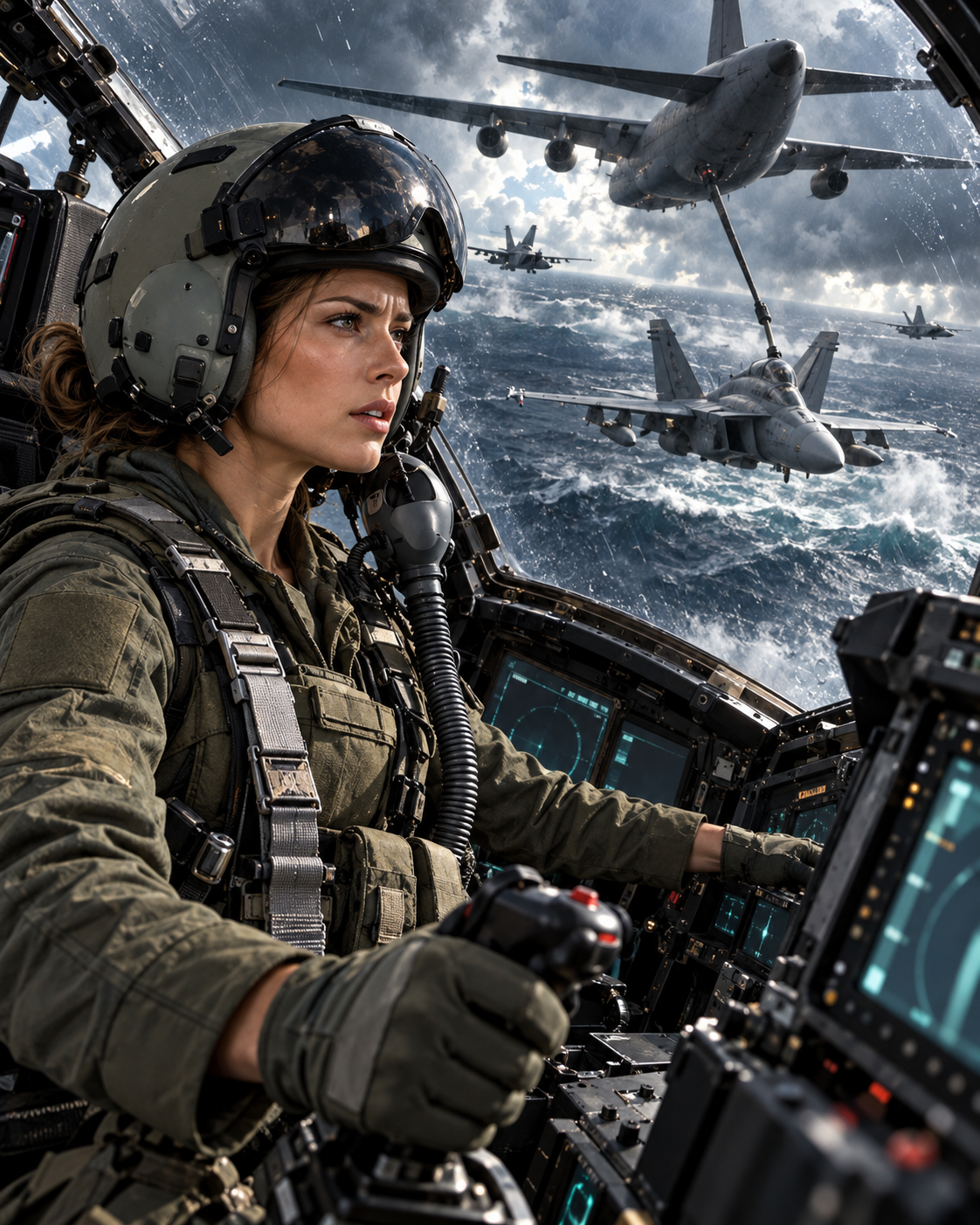
I had tried the radio again.
Nothing.
His jet was falling.
So I closed the distance and clipped his wing with mine just enough to jolt him.
His aircraft snapped upright.
He recovered.
We landed.
And two days later, I was accused of reckless flying.
The video on the memory card showed something I had never seen.
A second aircraft had been flying above us.
It wasn’t on the official mission roster.
Its transponder was disabled.
Its markings had been digitally blurred in the recording.
Ryan leaned toward the screen.
“That’s not one of ours.”
“No.”
The video continued.
The unknown aircraft descended behind Reeves.
A pulse of white light flashed from beneath its fuselage.
Reeves’s instruments went dark.
Then his aircraft rolled violently.
I watched myself react.
The entire incident suddenly made sense.
He had not simply G-locked.
His flight systems had been disrupted.
The reason I had scraped his aircraft was because his controls had become unresponsive.
I had saved him.
And someone had erased the evidence.
Ryan paused the video.
“Who had access to this?”
“Someone inside the program.”
He looked at me.
“Why send it now?”
I didn’t answer.
Because I already knew.
The storm over the Gulf of Alaska had produced the same electromagnetic signature.
Someone had tested the same technology on us.
The next morning, I drove to Kodiak before sunrise.
I found Major Julian Vance standing alone beside his damaged F-35.
The aircraft had been repaired, but a long scar remained along the fuselage.
He saw the memory card in my hand.
His face went pale.
“You received one too.”
I stopped.
“One what?”
He pulled a folded photograph from his flight suit.
It showed a black aircraft flying above a runway.
On the back was the same sentence.
YOU WERE NEVER SUPPOSED TO SURVIVE THAT DAY.
Vance looked older than he had months before.
The arrogance was gone.
“What do you know?”
He stared at the sea.
“My father knew.”
My chest tightened.
“General Vance?”
He nodded.
“My father was the officer who ordered you to stay clear of the storm.”
I felt anger rising.
“You knew about the technology.”
“No.”
“Then what did he know?”
Vance swallowed.
“That someone wanted us to die.”
For a moment, neither of us spoke.
Then he told me something that made the old wound inside me reopen.
His father had been part of a classified aerospace program designed to study electromagnetic effects on aircraft.
The program had started as defensive research.
The goal was to understand how an enemy could blind aircraft without firing a missile.
But somewhere along the way, the research had moved beyond defense.
They discovered that certain directed electromagnetic pulses could disrupt computerized flight controls.
They could make an aircraft appear to malfunction.
They could create failures that looked like pilot error.
And because modern fighters depended so heavily on computers, the pilot could be blamed for almost anything.
I thought about the official report that had destroyed my career.
“How many pilots?”
Vance looked away.
“Three.”
My throat tightened.
“Three what?”
“Three unexplained incidents.”
Ryan, who had been standing behind me, whispered a curse.
Vance continued.
“Your wingman was the first one they covered up.”
“And the other two?”
“One died.”
The words landed harder than I expected.
The other pilot had been declared responsible for losing control.
No enemy aircraft had ever been found.
No equipment failure had been proven.
The investigation had quietly closed.
I stared at Vance.
“Why did you fly into that storm?”
He gave a bitter laugh.
“I didn’t know what it was.”
“You knew something.”
“I knew my father was afraid.”
That frightened me more than anything else.
A man like General Arthur Vance did not frighten easily.
“What happened after our mission?”
Vance lowered his voice.
“My father ordered the rescue team to delay launch.”
I froze.
“Why?”
“He wanted to know whether the storm would kill you.”
The runway seemed to disappear beneath my feet.
For four years, I had wondered why rescue had taken so long during an emergency that should have triggered an immediate response.
Now I had the answer.
I looked at Vance.
“He used us as a test.”
“Yes.”
“And when we survived?”
“He realized the system wasn’t reliable enough.”
The anger inside me became strangely quiet.
That was when I understood the real horror.
We had not survived an accident.
We had survived an experiment.
Vance handed me another document.
It contained flight logs from the day of my old incident.
My name was circled in red.
Beside it was a handwritten note.
UNPREDICTABLE VARIABLE.
I laughed once, but there was no humor in it.
“They didn’t see me as a pilot.”
“No.”
“What did they see?”
“A problem.”
Ryan stepped forward.
“Then why are you helping us?”
Vance looked at me.
“Because I was supposed to die in that storm.”
I said nothing.
He continued.
“When my systems failed, I realized my father had known exactly what the electromagnetic discharge could do.”
His voice cracked.
“He knew the F-35 might become uncontrollable.”
“And he still sent you.”
“Yes.”
That was the moment I finally understood why Vance had saluted me on the tarmac.
He wasn’t just thanking me.
He was mourning the fact that his own father had been willing to sacrifice him.
We took the evidence to an inspector general outside the chain of command.
For three days, nothing happened.
Then my phone rang at 2:13 in the morning.
A blocked number.
I answered.
A man’s voice said, “You should have stayed retired.”
I sat up in bed.
“Who is this?”
“You don’t understand what you’re holding.”
“Then explain it.”
Silence.
Then the voice said something that chilled me.
“We didn’t build the storm.”
The line went dead.
I immediately called Ryan.
By sunrise, someone had broken into my storage unit.
Nothing valuable was taken.
Only the old flight helmet I had worn during the mission that ended my career was missing.
I stood in the open doorway, staring at the empty shelf.
Ryan looked around.
“They’re sending a message.”
“No.”
I picked up a tiny metal fragment from the floor.
“They’re looking for something.”
The fragment came from the helmet.
There was a compartment inside it I had never noticed.
We opened the remaining lining.
Inside was a second memory card.
This one contained audio.
My own voice played first.
“Reeves, you’re losing altitude.”
Then static.
Then another voice.
A calm male voice said, “Target aircraft responding.”
I felt every hair on my arms rise.
A second voice replied.
“Proceed.”
Then came the sound of an electromagnetic pulse.
The recording ended.
Ryan stared at me.
“That’s not a training range.”
“No.”
I listened again.
The first voice was unfamiliar.
The second was not.
I knew it.
I had heard it for years.
It belonged to General Arthur Vance.
The man who had ordered me to stay clear of the storm.
The man who had watched me risk everything to save his son.
The man who had once signed the report that destroyed my career.
I suddenly understood why the leaked recordings had cleared my name so quickly.
Someone had wanted me back in the cockpit.
Not because they respected me.
Because they needed to know whether the one variable their computers could not predict was still capable of surviving.
The next morning, General Vance requested a private meeting.
I went alone.
He was sitting in a dark office with the blinds closed.
He looked exhausted.
“You heard the recording.”
“Yes.”
He nodded.
“I knew you would eventually.”
“Did you put the card in my locker?”
“No.”
“Then who did?”
He didn’t answer.
Instead, he opened a drawer and placed a photograph on the desk.
It showed my KC-135 flying above the Gulf of Alaska.
The picture had been taken from another aircraft.
On the back was a date.
Tomorrow.
I looked at him.
“What happens tomorrow?”
“The program moves.”
“Where?”
He stared at me.
“Into active deployment.”
My stomach dropped.
The electromagnetic technology wasn’t being shut down.
It was being transferred.
The military intended to use it.
Not against test aircraft.
Against real aircraft.
General Vance leaned forward.
“I tried to stop it.”
“Then stop it.”
“I can’t.”
“You’re a general.”
His eyes filled with something I had never seen there before.
Fear.
“They have recordings of my authorization.”
I understood.
He wasn’t asking me to forgive him.
He was asking me to help expose him.
That was the hardest part.
For years, I had imagined confronting the man responsible for destroying my career.
I had imagined shouting.
I had imagined revenge.
Instead, he pushed a folder toward me.
“Everything is in there.”
I opened it.
Names.
Budgets.
Flight schedules.
Test locations.
And one final page.
A list of aircraft scheduled for tomorrow.
My refurbished KC-135 was at the top.
Ryan’s name was beneath mine.
So was Vance’s.
Mercer’s.
And six other pilots.
I looked up.
“You’re sending us into another test.”
“No.”
General Vance’s voice was barely audible.
“They’re sending us.”
The room went silent.
I closed the folder.
Then I remembered the first lesson I had ever learned in the cockpit.
A pilot’s job was not to obey a machine.
It was not even to obey an order.
It was to bring people home.
I stood.
“Then tomorrow, we fly.”
General Vance looked confused.
“You’re going to participate?”
I shook my head.
“We’re going to make sure nobody can hide what happens.”
The next morning, twelve aircraft launched.
My tanker climbed through a pale Alaskan dawn.
Ryan sat beside me.
Neither of us spoke about the possibility that we might not come back.
The other aircraft formed around us.
For twenty minutes, everything was normal.
Then my instruments flickered.
Ryan looked at me.
“Here we go.”
A blue pulse appeared on the horizon.
The storm was waiting.
But this time, we knew it wasn’t natural.
I keyed the radio.
“All aircraft, maintain visual formation.”
A voice answered.
“Captain, you’re violating mission parameters.”
I smiled.
“That isn’t the first time.”
The pulse struck.
Every computerized system began failing.
One aircraft rolled.
Another lost navigation.
But before panic could spread, I reached for the manual controls.
The old tanker responded.
Heavy.
Slow.
Human.
I ordered every pilot who still had control to switch to backup procedures.
Then I transmitted the entire evidence package on every available emergency frequency.
The secret program became public in less than six minutes.
News stations picked up the transmission.
Civilian aircraft heard it.
Military aircraft heard it.
Congressional investigators heard it.
And somewhere, millions of people heard a disgraced tanker pilot calmly explaining how pilots had been sacrificed to protect a secret.
General Vance tried to shut down the transmission.
Then his own son spoke over the radio.
“Dad, let them hear it.”
There was silence.
Then General Vance said, “Do it.”
The remaining files uploaded.
The program collapsed before sunset.
Arrests followed.
Investigations followed them.
The men who had buried the truth could no longer bury it.
Months later, General Arthur Vance stood before a military tribunal.
He admitted what he had done.
He admitted what he had hidden.
And he admitted that the day my career ended, I had been right.
Daniel Reeves was never a reckless pilot.
He had been the first victim of a weapon that was never supposed to exist.
His family received the truth.
It did not bring him back.
But sometimes truth is the only apology the dead will ever receive.
I never returned to combat status.
People asked me why.
I always gave the same answer.
“Because I don’t need a uniform to know who I am.”
My tanker flew for another seven years.
Ryan became a captain.
Mercer became an instructor.
Julian Vance left the fighter community and spent the rest of his career teaching emergency procedures.
He never again called my airplane old.
One evening, years later, I was sitting alone inside the cockpit of my refurbished KC-135 when I noticed something beneath the instrument panel.
A new envelope.
My hands stopped moving.
I opened it.
Inside was a photograph of Daniel Reeves smiling beside his F-16.
On the back were five words.
YOU WERE THE VARIABLE THEY FEARED.
I turned the photograph over.
There was one final line beneath it.
THEY WERE NEVER TESTING THE STORM.
I stared at those words until the cockpit lights blurred.
Then my phone rang.
The screen showed an unknown number.
I answered.
For several seconds, there was only static.
Then a voice whispered, “Captain, look at the sky.”
I looked through the windshield.
Far above the runway, a thin blue light appeared between the stars.
My old instincts returned before my fear could catch up.
I reached for the radio.
And somewhere beyond the darkness, something answered.