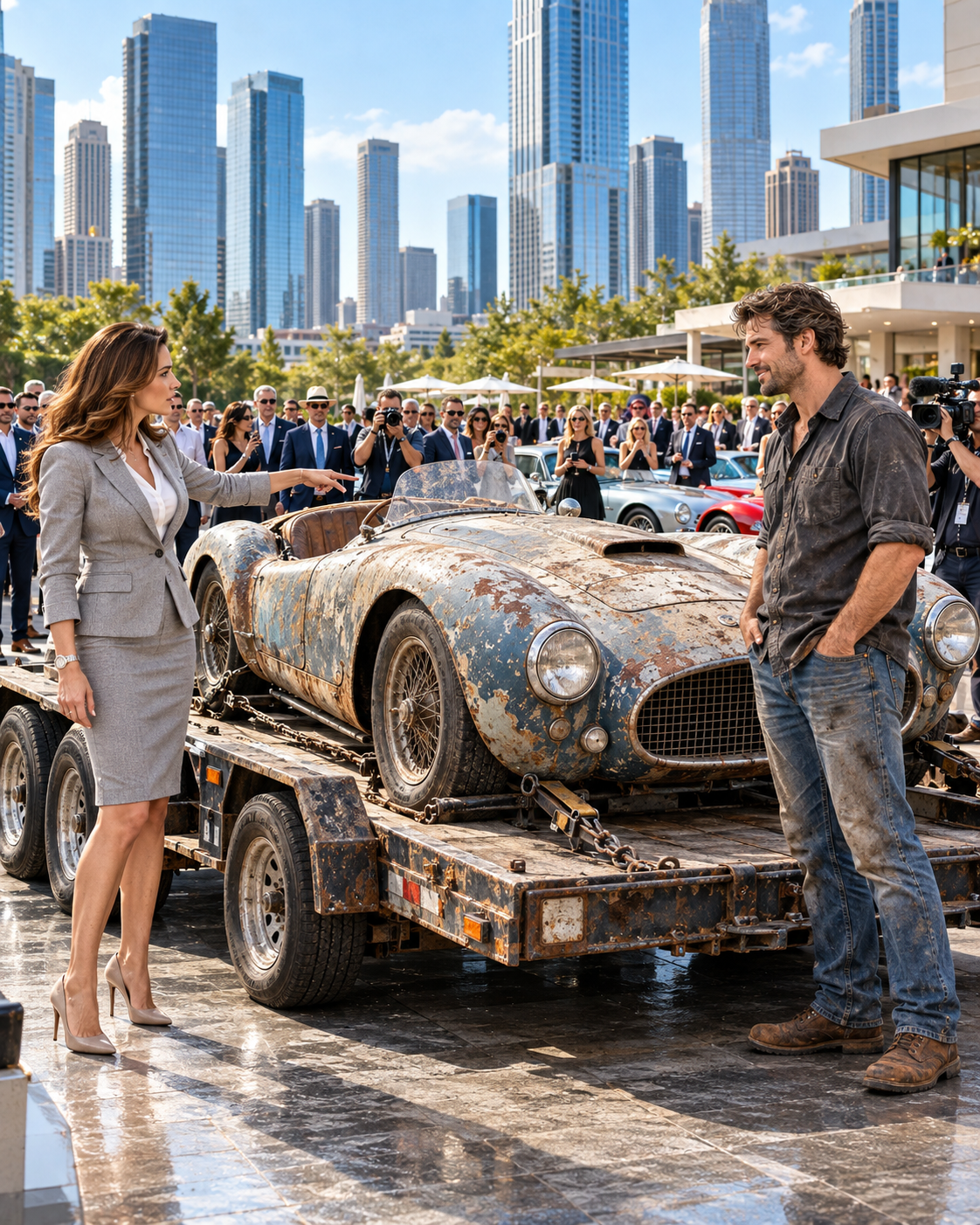
When Madeline Sterling pointed at my rust-covered trailer behind the Sterling Automotive Charity Showcase
The next morning, I woke before sunrise with Vivienne Mercer’s business card sitting on the kitchen table where I had left it.
I stared at the number for almost ten minutes before calling.
A tired voice answered on the third ring.
“Mercer Restoration.”
“This is the mechanic from yesterday.”
There was a pause.
Then the voice changed completely.
“You found the Cobra.”
I sat down.
“You knew about it?”
“No,” the man said. “But Vivienne called me last night and told me to expect you.”
His name was Elias Grant, and according to Vivienne, he had spent thirty-five years restoring historic race cars that other people had already declared dead.
He asked me for photographs.
I sent them.
He called back less than an hour later.
“I need to see the chassis in person.”
My stomach tightened.
“How bad is it?”
“Bad enough to make most people quit.”
“And?”
“And good enough to make me very interested.”
I looked toward the hallway.
Maisie was still asleep.
For years, I had measured every decision by one question: Could I afford to lose?
Now I was staring at something that might change our lives forever, and somehow the fear was greater than the excitement.
Because the more I learned about the Cobra, the more obvious one thing became.
A million-dollar car does not simply lose its body, engine, transmission, seats, and history and end up abandoned on a farm without someone noticing.
There had been a story before me.
I just didn’t know whose story it was.
Three days later, Elias arrived in a battered black pickup with a covered trailer behind him.
He was tall, gray-haired, and quiet in the way of people who had spent their lives around machines that could tell the truth better than humans.
He walked around my trailer without speaking.
Then he pulled off the canvas.
His hand hovered over the chassis rail.
“Beautiful.”
I laughed.
“You’re the first person to call it that.”
He looked at me.
“That’s because most people only see what happened to it.”
He crouched beside the tag.
“Did you notice these marks?”
I leaned closer.
There were tiny scratches beneath the identification plate, almost invisible beneath decades of grime.
“What are they?”
“Inspection marks.”
He looked at me again.
“Someone checked this car before it disappeared.”
My chest tightened.
“Disappeared?”
Elias nodded.
“That’s the word I would use.”
He photographed every inch of the chassis and began searching old records.
By the end of the afternoon, he had found something.
A racing registry from the late 1960s listed the same chassis number.
Then another document appeared from the early 1970s.
Then nothing.
Thirty-eight years of silence.
“No ownership records?”
“Not after 1974.”
“Could it have been stolen?”
“It could have.”
The room suddenly felt colder.
I remembered the farm auction.
The old barn.
The locked metal shed where the frame had been sitting beneath broken tarps.
I remembered the auctioneer saying, “Nobody knows what this thing used to be.”
At the time, I had assumed he meant it was junk.
Now I wasn’t so sure.
That evening, I drove back to the farm.
The property had already been sold, but the former owner, an eighty-four-year-old man named Walter Bell, still lived in a small house behind the barn.
When I showed him a photograph of the chassis, he didn’t speak.
His eyes moved to the number.
Then his face changed.
“You found it.”
I felt my pulse jump.
“You know what this is?”
Walter slowly lowered himself into a chair.
“I know what it became.”
I waited.
He looked toward the window.
“My brother brought that car home in 1974.”
“Your brother?”
“Caleb.”
He had died twenty years earlier.
Walter told me Caleb had been a mechanic and occasional racer who became obsessed with a Cobra that had vanished from the racing circuit.
“He said it was stolen by people who wanted the parts.”
“So how did he get it?”
Walter shook his head.
“He never told me.”
“Then why was it on your farm?”
“Because Caleb told me to hide it.”
My skin prickled.
“Hide the whole car?”
“No.”
Walter’s voice dropped.
“Only what was left of it.”
He disappeared into another room and returned carrying a small wooden box.
Inside were photographs.
The first showed a young man standing beside a battered Cobra.
The second showed the same car without its body panels.
The third showed Caleb kneeling beside a bare chassis.
On the back of one photograph, written in faded ink, were six words.
IF THEY COME, SAY YOU NEVER SAW IT.
I looked up.
“Who were they?”
Walter’s eyes filled with fear.
“I don’t know.”
“But someone did.”
He nodded.
“Caleb believed the car was connected to a racing scandal.”
“What kind of scandal?”
Walter stared at the photograph.
“One that could ruin powerful men.”
I took the pictures home that night.
Maisie was sitting at the kitchen table drawing.
She looked up.
“Did you find the people who owned our car?”
“I found someone who knew about it.”
She studied my face.
“Is it bad?”
I smiled weakly.
“I don’t know yet.”
She pushed her drawing toward me.
It showed our trailer.
The Cobra was underneath a huge yellow sun.
Above it, she had written, OUR SECRET CAR.
I hugged her.
For one second, everything felt simple.
Then my phone rang.
It was an unknown number.
I answered.
Nobody spoke.
I heard breathing.
Then a man’s voice whispered, “Sell the frame.”
The line went dead.
I didn’t sleep that night.
The following morning, Elias came over and examined the photographs.
His expression became serious.
“This is bigger than a restoration.”
“I know.”
“No, you don’t.”
He pointed to the photograph of Caleb.
“Look at the steering column.”
I zoomed in.
There was a small metal plate attached beneath it.
Elias stared.
“That’s not factory.”
“What is it?”
“A race scrutineering marker.”
“Meaning?”
“Meaning somebody inspected this car for competition.”
He opened an old archive database.
Then he found a result.
A 1965 Cobra with my chassis number had been entered in a private endurance event under a different driver’s name.
The driver had died in a crash two days later.
The official report blamed mechanical failure.
Elias looked at me.
“The report says the steering system failed.”
My throat tightened.
“But the photograph?”
“The photograph shows the steering system intact.”
We sat in silence.
Then Elias said something that made the entire room feel smaller.
“Someone may have wanted that crash to happen.”
The next week became a blur of documents, phone calls, and sleepless nights.
Vivienne joined the investigation.
She contacted historians, former racers, and archivists.
Piece by piece, the story began to emerge.
The Cobra had been owned by a wealthy industrialist named Raymond Voss.
He had loaned it to a private racing team.
During a major endurance event, Voss’s driver, Daniel Harper, died in a crash.
The official story said the car suffered a steering failure.
But archived photographs showed something different.
A week before the race, someone had removed the original steering assembly and replaced it with an unauthorized component.
After the crash, the team disappeared.
Voss claimed the car had been destroyed.
Then, apparently, he quietly recovered the chassis.
That was when Caleb found it.
And somehow, he had hidden it.
I asked Vivienne why anyone would still care fifty years later.
She looked at me sadly.
“Because secrets don’t become less dangerous just because the people who created them get old.”
Then she found one more name.
Raymond Voss’s legal counsel in 1974 had been a young attorney named Arthur Sterling.
I stared at the screen.
Sterling.
The same Sterling Automotive family whose CEO had publicly humiliated me.
Madeline’s company.
Madeline’s event.
Madeline’s father had been the attorney who handled the disappearance of the Cobra.
For several seconds, nobody spoke.
I didn’t know what frightened me more.
That the connection existed.
Or that Madeline might not know about it.
I refused to accuse her without proof.
But that evening, she called me.
“I need to talk to you.”
We met in a quiet diner outside the city.
She arrived without assistants, makeup, or cameras.
She looked exhausted.
“I heard you’re investigating the Cobra.”
“I am.”
She looked down at her coffee.
“My father used to talk about a car.”
I said nothing.
“He called it the mistake that wouldn’t stay buried.”
My heart began pounding.
“Did he know the chassis?”
She nodded.
“He kept a file.”
“What happened to it?”
“My father died before he could tell me everything.”
She reached into her bag and placed an old envelope on the table.
“I found this after the video of your daughter went viral.”
I didn’t touch it.
“Why give it to me?”
“Because I owe you more than an apology.”
I opened the envelope.
Inside was a handwritten note.
The handwriting belonged to Arthur Sterling.
I recognized the name immediately.
The note was dated 1974.
It said the Cobra had been recovered but could not be returned to its owner without exposing the events surrounding Daniel Harper’s death.
It also contained a second name.
Caleb Bell.
I looked at Madeline.
“Your father knew my frame was on that farm.”
Her eyes filled with tears.
“He knew.”
“Why didn’t you?”
“Because he buried it.”
She swallowed.
“And I spent my whole life believing my family had built everything honestly.”
The anger I expected to feel never arrived.
Instead, I felt tired.
Because suddenly the ugly little frame I had bought for one hundred and twenty dollars wasn’t just a car.
It was evidence.
It carried the memory of a dead driver.
A frightened mechanic.
A family secret.
And a truth that had survived half a century of silence.
The restoration began in earnest.
Elias worked slowly, refusing to replace anything that could be preserved.
Every bolt was documented.
Every layer of paint was photographed.
Every piece of corrosion was removed by hand.
Months passed.
Then the original engine block was found.
Not in a barn.
Not in a junkyard.
Inside a private collection in Arizona.
The collector had purchased it decades earlier without knowing its history.
When the serial number matched, he donated it to the project.
Then came the transmission.
Then the original dashboard.
Then a box of gauges.
The impossible car was becoming whole again.
But one piece was still missing.
The body.
Without it, the Cobra would never truly return.
I began to believe the body had been destroyed.
Then, one rainy afternoon, Elias called.
“I found something.”
I drove through the night.
He led me into a warehouse.
Under a gray tarp stood a battered aluminum body shell.
My knees nearly gave out.
The shape was unmistakable.
The same curves.
The same scars.
The same tiny weld mark visible in Caleb’s photograph.
“It was hidden in a collection in Pennsylvania,” Elias said.
“Who owned it?”
He handed me a file.
The original owner was Raymond Voss.
The paperwork contained one handwritten transfer.
From Voss.
To Arthur Sterling.
I looked at Madeline’s name on the file and realized the truth had finally come full circle.
Her family had not simply hidden the car.
They had preserved pieces of it for decades.
Maybe guilt had made them afraid to destroy it.
Maybe some part of Arthur Sterling had always hoped someone would eventually find it.
A year after the auction, the Cobra rolled onto the stage at the same Sterling Automotive Charity Showcase.
This time, the trailer was polished.
The car was finished.
Its paint gleamed beneath the lights.
The crowd went silent when the engine fired.
I stood beside Maisie.
She was wearing a small blue dress and holding Rusty under one arm.
Vivienne stood behind us.
Elias stood near the driver’s door.
And Madeline Sterling walked onto the stage.
She didn’t speak about value.
She didn’t mention her company.
She simply looked at the car and then at Maisie.
“I was wrong,” she said.
“I was arrogant.”
She paused.
“And I learned that sometimes the thing we are quickest to throw away is the thing carrying the truth we most need to hear.”
Then she turned toward the audience.
She told them everything.
The crash.
The cover-up.
Her father’s involvement.
The evidence that had been hidden for decades.
She announced that Sterling Automotive would fund a memorial scholarship in Daniel Harper’s name, but she made one thing clear.
“The car belongs to the family who found it and restored it.”
I looked at her.
She shook her head when I tried to speak.
“No payment.”
Then she smiled faintly.
“Some debts shouldn’t be settled with money.”
The crowd applauded.
But I barely heard them.
I was looking at Maisie.
She was staring at the Cobra with tears in her eyes.
“Can I sit in it?”
I laughed.
“Someday.”
She frowned.
“Why not today?”
“Because your dad spent too much money restoring it to let you spill juice in it.”
She burst out laughing.
For the first time, the sound didn’t carry fear.
It carried childhood.
Later that evening, after the lights went down, I found Madeline standing alone beside the car.
She touched the fender gently.
“My father spent fifty years afraid of this.”
I looked at her.
“Afraid of what?”
“The truth.”
She handed me a final envelope.
“There was one more thing in his safe.”
I opened it.
Inside was a photograph of Caleb Bell standing beside the Cobra.
On the back was a message.
IF THIS CAR IS EVER FOUND, TELL THE DRIVER’S FAMILY I TRIED.
I read it twice.
Then I understood.
Caleb hadn’t hidden the Cobra to protect the powerful men who wanted it buried.
He had hidden it because he was trying to preserve the evidence long enough for someone brave enough to uncover it.
I thought about the one hundred and twenty dollars I had paid.
The rusty frame.
The humiliation.
Maisie’s tears.
The cable dragging across the pavement.
And I realized the greatest thing I had recovered wasn’t a three-million-dollar car.
It was a piece of someone’s courage.
Years later, people would still talk about the Cobra.
Collectors would argue about its value.
Historians would write about Daniel Harper.
Museums would ask to display it.
But whenever Maisie and I drove past the old auction road, she would squeeze my hand and say, “That’s where we found it.”
And I would smile.
Because she was right.
We hadn’t really found the car that day.
We had found a story that had been waiting for someone to listen.
The world teaches us to judge quickly, to measure worth by shine, money, status, and appearances.
But some things spend years covered in dust because they are waiting for the right person to look closely enough.
That rusted frame taught me that value is not always visible.
Sometimes it is buried beneath neglect.
Sometimes it is hidden behind shame.
Sometimes it is carried quietly by people who never receive credit.
And sometimes, the greatest treasure you can rescue is not something you can sell.
It is the truth.
One autumn evening, Maisie and I stood beside the Cobra in our garage.
She held Rusty against her chest.
I turned the key.
The engine came alive with a deep, unmistakable roar.
Maisie smiled.
Then she looked at me and asked the question I had been avoiding for years.
“Dad, if Grandpa Sterling knew where the car was, who was he really hiding it from?”
I stopped breathing.
Because there was only one problem.
The name on the old envelope was not Arthur Sterling.
It was someone else.
And that person was still alive.
… The Story continues in the Comments! 👇