When Julian Vance locked the psychiatric observation-room door behind me and left me alone with a snarling
Captain Vance did not move for several seconds.
His eyes were fixed on the metal tags in my palm, and the color had drained from his face.
Then he said, “Apollo.”
Hearing his name from another soldier nearly broke me.
I closed my fingers around the tags and answered, “You knew him?”
Captain Vance nodded once.
“I knew the whole detachment, but I remember Apollo because he would not let anyone touch his handler except you.”
Behind him, Julian looked between us.
“You knew my dad?” he asked.
I stared at him.
The smug coworker who had locked me inside a room with a frightened combat dog suddenly looked much younger.
“Your father trained K9 teams before you ever learned how to hold a leash,” I said.
Julian swallowed.
Captain Vance turned on him.
“What exactly did you think you were doing?”
Julian’s mouth opened, but no sound came out.
Sunita stepped forward and pointed at the broken alarm panel.
“He locked her in there.”
Captain Vance’s expression hardened.
“You locked Tara Mercer in a room with a distressed police dog?”
“It was supposed to be a lesson,” Julian said quietly.
“A lesson?”
His father looked at him with a disappointment deeper than anger.
“You endangered two lives because you wanted to embarrass a nurse.”
Julian lowered his eyes.
For the first time since I had met him, he looked ashamed.
But shame could wait.
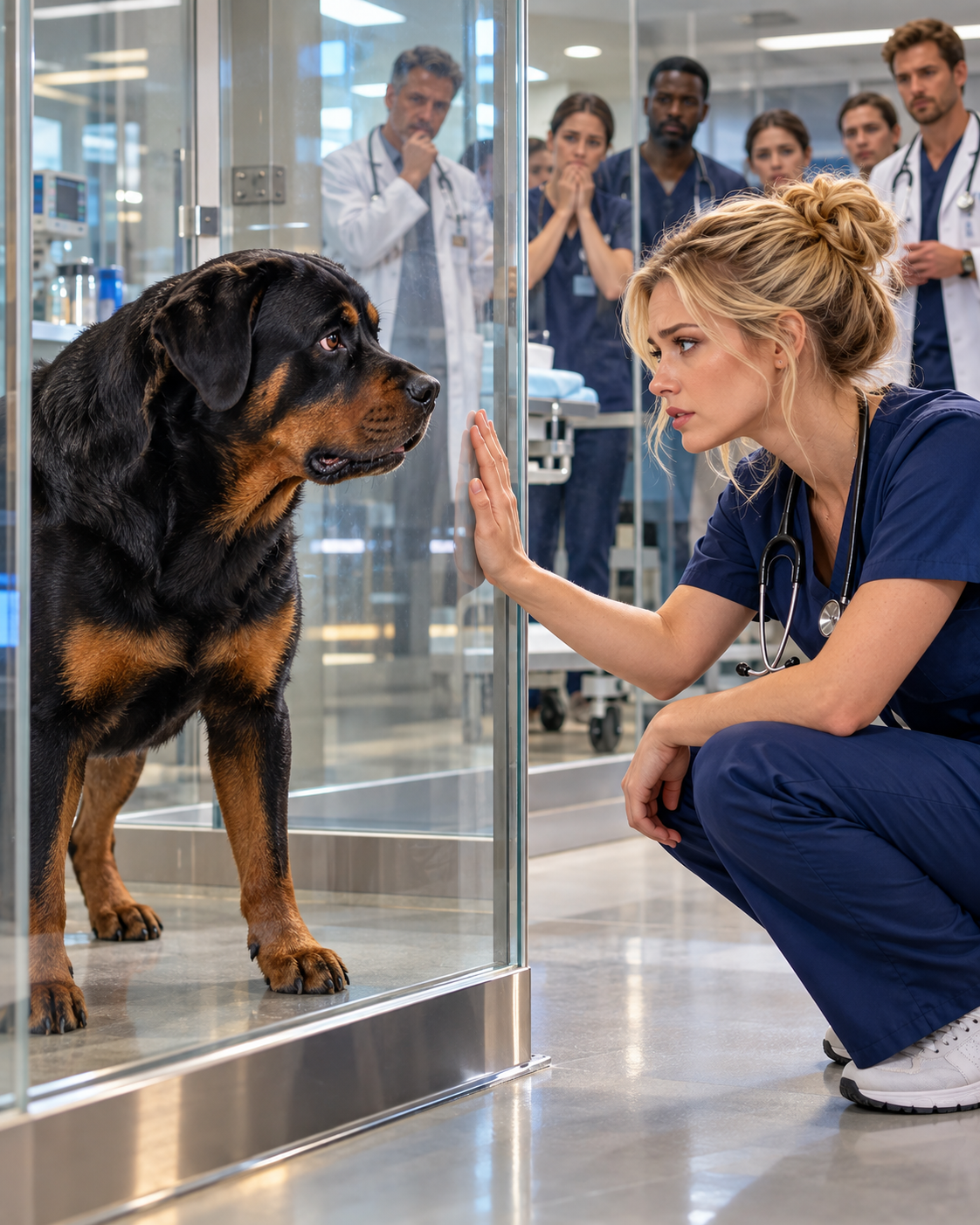
Mark Lawson was still unconscious.
The next hour was a blur of scans, blood, pressure checks, and whispered commands.
The bullet had missed his heart by inches, and the airway injury I had opened in the trauma bay had bought him a chance, but nobody knew yet whether his brain had gone too long without oxygen.
I stood outside his room with Zeus lying beside my boot.
Every time his chest monitor changed rhythm, my old instincts woke up.
Count.
Observe.
Anticipate.
Survive.
Those habits had kept me alive overseas.
Now they had followed me into a hospital where I had spent three years pretending they were gone.
A detective finally approached.
“The man who shot Lawson is named Kyle Mercer.”
I felt my stomach tighten.
“No relation,” he added quickly.
“You sure?”
“Different family records, but he had been following Lawson for weeks.”
He handed me a photograph.
The shooter had been inside a stolen county maintenance truck before forcing his way through the ambulance entrance.
“Lawson was investigating him?”
“Not exactly,” the detective said.
“He was investigating someone who paid him.”
That sentence stayed with me.
Someone wanted Mark silent.
The question was why.
Captain Vance found me later in a quiet stairwell.
He held a paper cup of coffee in both hands but never drank from it.
“I owe you an apology,” he said.
“You don’t owe me one.”
“I do.”
He looked toward Zeus.
“After Apollo died, your unit told us the blast had killed the dog and critically wounded his handler.”
I waited.
“The report said you requested medical separation and disappeared from the K9 community.”
“I did request medical separation.”
“But the rest was never right.”
He reached into his jacket and handed me a thin folder.
The first page carried my own name.
I turned it slowly.
There were medical records, transfer notes, and one red-stamped page I had never seen.
RESTRICTED.
My pulse changed.
“What is this?”
Captain Vance looked almost embarrassed.
“A casualty review.”
I read the first paragraph.
The report said the explosion had been caused by an IED planted beneath the convoy route.
That part was true.
Then I reached the last page.
The detonator had been triggered remotely from a vehicle that disappeared before the blast.
That part I had never been told.
Someone had known exactly when Apollo’s team would pass.
Someone had been watching us.
I lifted my eyes.
“Why did nobody tell me?”
“Because the investigation was classified, and because the case died before they could prove who ordered it.”
I stared at the folder until the words blurred.
For three years, I had believed Apollo died because war was cruel.
Now I understood that cruelty and betrayal were not always the same thing.
“Why show me this now?”
Captain Vance took a breath.
“Because the paperwork connected your name to the new tactical K9 medical pipeline.”
I almost laughed.
“The pipeline that has been stalled for years?”
“That one.”
He smiled faintly.
“Nobody could make the agencies agree on who should run it.”
I looked toward Zeus.
“That sounds like somebody’s problem.”
“I think it is yours.”
I shook my head.
“I am a floor nurse.”
“No,” he said. “You are a combat medic who learned how to hide inside a hospital.”
The words hit harder than they should have.
He continued.
“You know how to treat handlers, K9s, and trauma under fire.”
“You don’t know what I can do.”
“I do.”
His eyes moved to Apollo’s tags.
“I was there the week he was assigned to you.”
I looked away.
“You can’t ask me to go back.”
“I am not asking you to become who you were.”
He paused.
“I’m asking you to decide who you become next.”
That night, I sat beside Mark Lawson’s bed.
Zeus lay outside the glass because hospital policy would not allow him inside, and he watched me as if he understood that I was keeping another promise.
Mark’s fingers twitched near dawn.
His eyes opened for less than a second.
I leaned close.
“You made it.”
His lips barely moved.
“Dog?”
I glanced at Zeus.
“He’s here.”
Mark smiled.
Then he slipped back into sleep.
I cried in the hallway where nobody could see me.
Not because Mark was alive.
Because for the first time in three years, I had heard a wounded man ask about his dog before himself.
Apollo had done that too.
On the third day, Mark stabilized enough to speak.
His first real conversation was with me.
“You’re the nurse,” he whispered.
“I am.”
“The one who saved me.”
I shook my head.
“Your team bought time.”
He looked toward Zeus.
“No.”
He swallowed.
“You did.”
Then he surprised me.
“Don’t let them take him away.”
I promised I would not.
Two days later, the county sheriff held a press conference.
They praised the hospital.
They praised the officers.
They praised Zeus.
They praised courage.
Nobody mentioned the person who had been hiding behind a nurse’s badge.
Captain Vance did not correct them immediately.
Instead, he waited until the cameras were gone.
“You ready?”
“No.”
“Good.”
He smiled.
“People who think they are ready usually aren’t.”
The first training session happened in a warehouse behind the sheriff’s K9 division.
I walked inside in plain clothes and immediately stopped.
There were six dogs behind barriers.
Six handlers.
Three trauma mannequins.
A medical kit on the floor.
And a wall covered with faded photographs from deployments.
For a moment, I could not breathe.
Then I saw Apollo.
His photograph was tucked into a corner beneath a handwritten list of former handlers.
I walked closer.
Someone had written beneath his name:
Returned home with honor.
I touched the glass.
“Who put that there?”
Captain Vance answered, “His last handler.”
I turned.
“I was his last handler.”
“I know.”
He smiled.
“That’s why it stayed empty.”
I looked down.
Something inside me finally loosened.
Not healed.
Just loosened.
The training program began with twelve people.
By the third week, twenty-four had applied.
By the fifth, county EMS and neighboring departments were asking for seats.
I taught airway management, hemorrhage control, shock recognition, field triage, and the brutal mathematics of deciding what could wait.
I also taught something the manuals barely mentioned.
Dogs panic when their handlers panic.
Handlers panic when they believe they are alone.
So we trained together.
Not just K9s.
People.
Julian was there on the first Friday.
I nearly sent him home.
He stood near the doorway holding a clipboard.
“I signed up.”
“I can see that.”
“I don’t expect you to forgive me.”
“Good.”
He nodded.
Then he said, “I want to learn.”
It was the first honest thing I had ever heard from him.
I let him stay.
Weeks passed.
Mark began walking with a cane.
His first visit to the training center was quiet.
Zeus saw him before anyone else did.
The dog’s ears lifted.
Then he ran.
Mark dropped his cane as Zeus pressed his enormous head against his chest.
Everyone around us went silent.
Mark cried into the dog’s fur.
I looked away.
Some reunions deserve privacy.
Later, Mark found me outside.
“They told me what you did.”
“I did what anybody trained for trauma would do.”
“No.”
He shook his head.
“You did what somebody does when they refuse to let another person die.”
I did not know how to answer.
He reached into his pocket and handed me a small envelope.
Inside was a copy of a report from his investigation.
“The man who shot me wasn’t working alone.”
My heart sank.
“Who?”
“We don’t know yet.”
He pointed to a line near the bottom.
“There were payments routed through a private contractor that supplied security equipment overseas.”
I read the company name.
It was familiar.
Too familiar.
Captain Vance had once mentioned it during the classified review.
The same contractor had been near my convoy in Afghanistan.
I looked up.
Mark’s expression told me he had reached the same conclusion.
“The person who ordered the shooting may be connected to the person who ordered the IED.”
The air seemed to leave the world.
For three years, I had carried grief like a stone.
Now that stone had become a door.
And someone was standing on the other side.
Captain Vance called that evening.
“Come to my office.”
When I arrived, Julian was already there.
His face was pale.
His father placed a file on the table.
“I wanted both of you here because this affects both of you.”
Julian frowned.
“Why me?”
Captain Vance opened the file.
The first page contained a list of shell companies connected to the contractor.
One name was underlined.
Vance Tactical Services.
Julian stared.
“That’s not us.”
“Not anymore,” his father said.
“What does that mean?”
“It means someone has been using my family name.”
Julian looked at me.
“For how long?”
“Long enough to erase people,” I said.
Nobody spoke.
Captain Vance turned another page.
There, buried beneath invoices and transfer records, was a scanned military document.
My eyes locked onto a line beneath it.
Handler: Staff Sergeant Tara Mercer.
Status: Deceased.
I stopped breathing.
Julian whispered, “But you’re standing here.”
Captain Vance’s voice was low.
“That’s the point.”
Someone had officially declared me dead after the blast.
Someone had filed paperwork that should have been impossible.
Someone had wanted my identity buried.
I thought about the way Apollo had died.
The way Mark had been targeted.
The way the shooter knew exactly where to find him.
Suddenly the hospital incident did not feel like a random act of violence.
It felt like the latest loose end being cut.
I picked up Apollo’s tags.
They were warm from my hand.
“I spent three years thinking I survived by accident.”
Captain Vance shook his head.
“No.”
He looked me straight in the eyes.
“You survived because somebody failed.”
That sentence followed me for weeks.
The investigation widened.
Federal agents became involved.
My old unit was contacted.
Records were unsealed.
Names began surfacing.
Some people denied everything.
Some suddenly retired.
One disappeared.
And one finally agreed to talk.
He was an Army contractor named Daniel Reese, now living under a different surname in Arizona.
His statement confirmed what we feared.
The IED attack had been planned to destroy evidence tied to stolen military equipment contracts.
Apollo had not been the target.
But his presence had changed the route that day.
Tara Mercer had not been supposed to survive.
The contractor who planted the device had mistaken my destroyed identification pouch for my body.
The rest of the world did exactly what they had expected.
It declared me dead, buried the paperwork, and moved on.
I listened to the recording alone in my apartment.
When it ended, I was not angry.
I was tired.
So tired of giving the dead all the room inside me.
I placed Apollo’s tags on the kitchen table.
“You didn’t fail me,” I whispered.
For the first time, I believed it.
Months later, Mark returned to duty in a limited capacity.
Zeus retired from active service with honors.
He stayed with Mark.
I watched them leave the training center together one cold morning.
Mark stopped before getting into his truck.
“You coming with us?”
I smiled.
“I have work.”
He nodded toward the building.
“Then teach them well.”
“I will.”
He drove away.
Julian remained behind.
He had changed quietly.
He stopped making jokes about weakness.
He listened more than he spoke.
During his final evaluation, he froze beside a simulated trauma victim.
I walked over.
“What happened?”
He looked embarrassed.
“I don’t know.”
“Yes, you do.”
He took a breath.
“I’m afraid.”
I nodded.
“Good.”
He looked surprised.
I said, “Fear is information, Julian, not a verdict.”
He steadied himself and began the procedure.
He passed.
Afterward, he stood beside me outside the warehouse.
“I thought brave people weren’t scared.”
“They are.”
“Then what are they?”
I looked through the open doors at the handlers training with their dogs.
“They’re people who decide what deserves to be protected more than their fear.”
He nodded slowly.
I wondered whether he finally understood.
I hoped he did.
On the anniversary of Apollo’s death, I returned to Afghanistan.
The road had changed.
The walls were different.
The dust smelled the same.
I stood where the convoy had once stopped.
There was no ceremony.
No cameras.
Just me, the wind, and a set of tags in my hand.
I knelt and pressed my palm into the dirt.
“I came back,” I whispered.
The silence did not answer.
It did not need to.
I understood then that honoring the dead was not living inside the moment they were taken.
It was taking the life they never got to finish and carrying it forward with enough courage for two.
When I returned home, the new tactical K9 medical center opened its doors.
The first person through them was Mark.
The second was Julian.
The third was a young female handler holding the leash of a nervous German Shepherd.
She stopped when she saw me.
“Ma’am,” she said, “I heard you know dogs.”
I looked down at the tags around my neck.
Then at the animal trembling beside her.
I knelt.
The dog stared into my eyes.
I breathed slowly.
I remembered Apollo.
I remembered Afghanistan.
I remembered the hospital door clicking shut behind me.
Then I smiled.
“He’s not afraid of you,” I told her.
“He’s afraid of losing you.”
Her eyes filled with tears.
Mine did too.
I reached for the leash.
The dog stepped closer.
And when I gave the first command, my voice did not sound like the woman who had spent three years hiding from dogs.
It sounded like home.
Apollo’s tags rested against my heart as the dog sat at my side, and I finally understood the truth I had been running from all those years: courage was never the absence of fear, but the decision to keep loving, serving, and stepping forward while fear walked beside you.
And somewhere in the office behind me, a red light began blinking on a secure phone line connected to the old investigation, with one new message waiting under a name I had not heard since the day Apollo died.