When I volunteered for my first live combat rotation in front of an entire squadron, Captain Samuel Vance laughed
Part 2
My first live combat mission was scheduled for a bright morning that looked almost offensively peaceful.
The sky above the airfield was pale blue, the clouds thin and scattered, and the breeze carried the faint scent of damp earth from a storm that had passed during the night.
Ground crews moved between the aircraft with practiced efficiency while pilots checked their equipment and listened to their final instructions.
I had imagined the day of my first combat flight countless times, but in my imagination, everything had always felt larger and more dramatic.
There had been thunderous music in my mind, decisive gestures, and some sudden revelation that I was no longer a beginner.
In reality, there was a checklist, a briefing, a cup of coffee I barely tasted, and a knot of tension beneath my ribs that refused to loosen.
Captain Samuel Vance approached while I was reviewing my assignments.
He had been one of the loudest skeptics in the briefing room, and I had spent enough nights replaying his jokes to know the sound of his laughter by heart.
I straightened instinctively.
“Captain.”
“Lieutenant.”
For a moment, neither of us spoke.
Then he nodded toward the paperwork in my hands.
“First live rotation?”
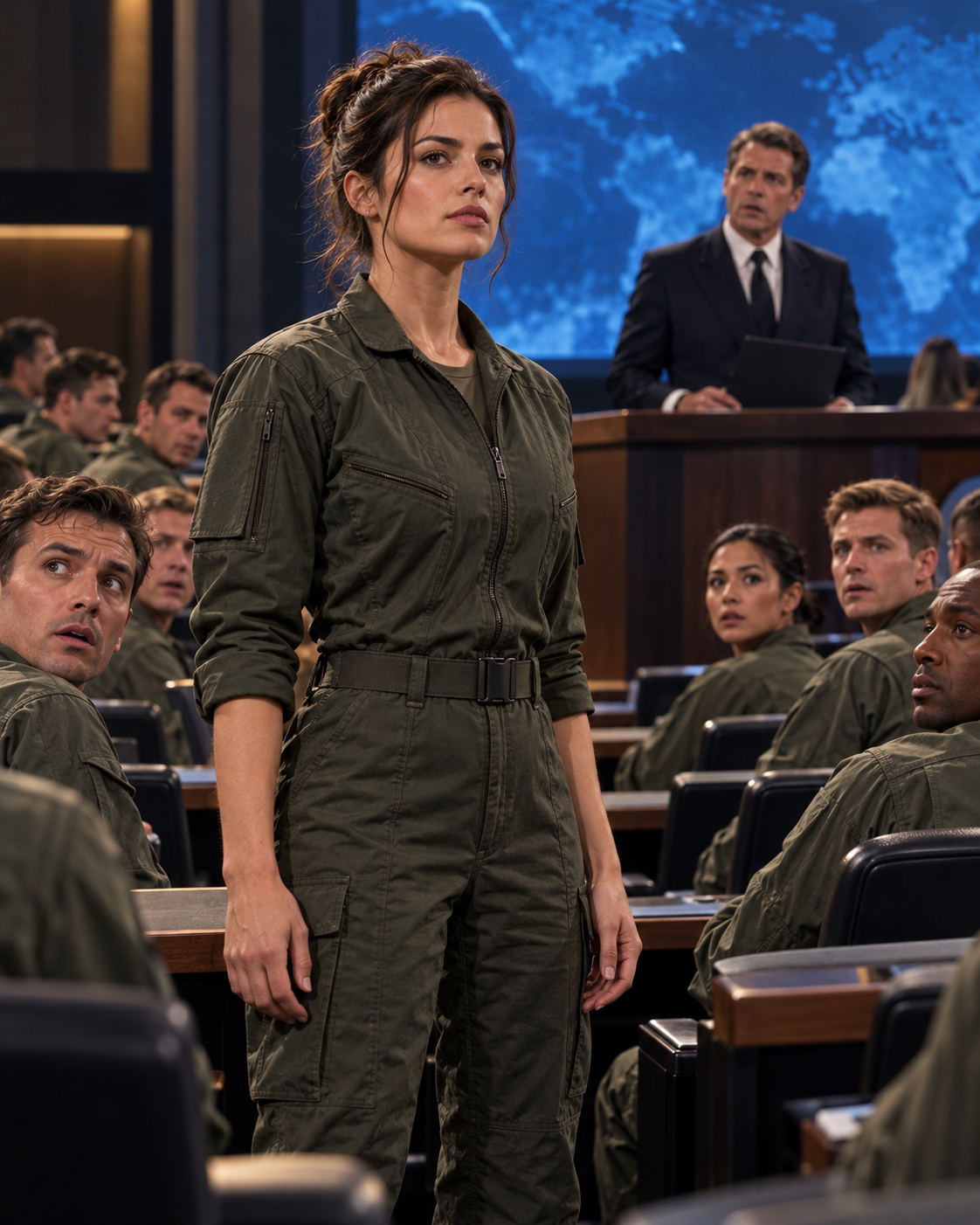
“Yes, sir.”
“Good.”
I waited, uncertain whether he intended to offer advice or another reminder that I was stepping into a world I had never experienced.
He looked toward the line of aircraft, his expression more serious than I had seen it before.
“Listen, I still think simulator scores can make people overconfident. There are things you don’t understand until you’re actually up there.”
“I agree.”
He glanced at me, apparently surprised that I had not argued.
“But,” he continued, “you’ve done the preparation, and Thorne doesn’t put someone on a mission because he feels sorry for them. If you’re on that roster, you’ve met the requirements.”
I tightened my grip on the folder.
“Thank you, Captain.”
He shifted his weight, seeming uncomfortable with the next part.
“And about the briefing room,” he said. “I was harder on you than I needed to be.”
I looked at him.
“I thought you believed I couldn’t do it.”
“I believed you hadn’t done it yet. Those aren’t the same thing.”
The distinction stayed with me.
He held out his hand, and I shook it.
“The squadron has your back in the air,” he said. “Stay disciplined, communicate clearly, and don’t let anyone—including yourself—talk you into doing something that doesn’t make sense.”
For the first time, I saw more than the arrogance that had made him laugh at me.
I saw a veteran who had learned that confidence could save a pilot, but that unearned confidence could destroy one just as easily.
“Understood,” I said.
He gave my shoulder a brief pat.
“Then let’s bring everybody home.”
The mission briefing was direct and serious.
We would operate as part of a larger flight supporting an assigned operation, with the route, responsibilities, and contingencies established by the command team and communicated through the proper channels.
Weather and changing conditions remained concerns, and our instructions emphasized coordination, disciplined communication, and the importance of following authorized procedures when unexpected circumstances arose.
There would be no improvisation simply to impress someone.
There would be no pursuit of glory at the expense of the mission.
When Captain Thorne finished speaking, he looked at each of us in turn.
“Your job is to make sound decisions with the information available to you. If conditions change, communicate. If something is unclear, ask. None of you will improve the outcome by pretending to be invulnerable.”
His eyes rested on me for half a second longer than on the others.
“Questions?”
Nobody spoke.
“Then gear up.”
I walked toward my aircraft with the rest of the pilots, hearing the familiar sounds of the airfield become louder as we approached the flight line.
The technicians completed their checks, verified the required systems, and gave their clearances.
I moved through my own checklist carefully, resisting the urge to rush simply because I could feel other people moving around me.
The cockpit was close and familiar in all the ways that mattered, and utterly different in the one way I could not fully prepare for.
This time, the aircraft was not attached to a training exercise I could reset.
This time, my decisions would travel with me into a world that did not care how many perfect scores I had earned.
I settled into the seat and began the final sequence.
My hands were steady.
My heart was not.
I could hear my own breathing inside the helmet, a little faster than I wanted, and for one brief moment I remembered standing in that stale briefing room while Vance’s laughter rolled across the tables.
I had thought I needed to defeat that memory before I could fly.
Now I understood that I could carry the memory with me without allowing it to take control.
I checked my instruments again.
I listened to the radio.
I followed the instructions.
When the signal came, I taxied into position and waited for clearance, feeling the aircraft vibrate beneath me as the engine settled into its working rhythm.
“Flight, confirm readiness,” Captain Thorne’s voice came through the radio.
I answered with my assigned call sign and a clear acknowledgment.
One by one, the others responded.
There was no cheering, no dramatic declaration of confidence, and no special ceremony for the youngest pilot in the squadron.
There was only a group of people preparing to do a dangerous job together.
We took off in sequence and climbed into the open sky.
The world below gradually shrank into fields, roads, and distant rooftops, until the horizon stretched around us in an unbroken line of blue.
I had flown training sorties in weather that looked far worse than this.
I had practiced communications until routine exchanges became automatic.
I had studied the mission profile enough times to recognize its structure without needing to stare at my notes.
Still, the first minutes felt strangely unreal.
Every sound was sharper than I expected, and every adjustment seemed to carry more meaning because there was no instructor sitting beside me to take over.
I focused on the next required action rather than the whole mission.
One check.
One communication.
One decision at a time.
The flight proceeded according to plan as we moved toward our assigned area.
Vance maintained his position nearby, while Captain Thorne coordinated the group and remained in contact with the appropriate command elements.
For a while, the hardest part was simply resisting the urge to interpret every unfamiliar sensation as a warning.
I had trained to manage pressure, but experiencing it in the air was different from discussing it in a briefing room.
The mind could invent a hundred dangers in the space between two radio calls.
I reminded myself to trust the training without becoming blind to what was actually happening around me.
Then the weather changed.
A bank of dense cloud had developed along a section of our planned route, while fresh information from the ground indicated that conditions in the assigned area had become less favorable than anticipated.
The original plan required reassessment.
Captain Thorne’s voice came over the radio, calm and precise as he passed along the revised instructions.
Our flight needed to adjust its course and maintain coordination while the mission’s changing requirements were confirmed.
No one panicked, but the radio became busier, and the familiar pattern of the flight shifted as each pilot acknowledged the information.
For an instant, the world seemed to narrow to the instruments in front of me and the voice in my headset.
My body remembered the simulator.
My mind remembered all the times a scenario had changed without warning and the only way forward had been to stop chasing the plan I had expected and respond to the situation I actually faced.
I acknowledged my updated instructions and made the required adjustments, maintaining communication and monitoring the changing conditions around the aircraft.
The task was neither glamorous nor dramatic.
It was a sequence of disciplined decisions made without the luxury of knowing whether the next piece of information would make the situation easier or harder.
I concentrated on the flight, listened carefully, and resisted the temptation to rush.
Vance checked in over the radio, his voice steady.
“How are you holding up, Lieutenant?”
“Managing the change, Captain. Following the updated plan.”
“Good. Keep talking to us.”
There was no mockery in his tone now.
His words reminded me that I was not alone, and that the purpose of a formation was not to prove which pilot could manage the most fear without showing it.
It was to keep the group coordinated when the situation became uncertain.
The revised plan brought us through the changing conditions and back onto a route the command team had approved.
The immediate tension eased, but I did not allow myself to mistake relief for the end of the work.
We still had the remainder of the mission to complete and a safe return to accomplish.
I continued monitoring the aircraft, communicating when required, and responding to instructions with the same care I had brought to the first minutes of the flight.
At one point, I realized that I was no longer thinking about what Vance might say when we landed.
I was no longer imagining the expressions on the faces of the pilots who had laughed in the briefing room.
I was thinking about the next check, the next communication, and the responsibility of bringing the aircraft back in the condition in which I had taken it up.
It was a small change, almost invisible from the outside.
But to me, it felt like the moment the work became more important than the judgment waiting at the end of it.
By the time we began our return, the weather had cleared enough for the flight to proceed under the revised instructions.
The radio traffic settled into familiar rhythms, and the airfield appeared in the distance beneath a bright afternoon sky.
I made my approach, followed the assigned procedures, and brought the aircraft down smoothly.
The wheels met the runway with a firm, controlled touch, and the aircraft rolled forward before slowing to taxi speed.
I released a breath I had not realized I was holding.
It was over.
Not the war, not the risks of the assignment, and certainly not the work of becoming a better pilot.
But my first live mission was complete, and I had returned with the rest of the flight.
As I taxied toward the designated position, I noticed my hands trembling slightly on the controls.
I let them tremble.
There was no one in the cockpit who needed me to pretend that the experience had been easy.
I had been frightened, and I had completed the mission without allowing fear to make my decisions for me.
For the first time, I understood that those two things could be true at once.