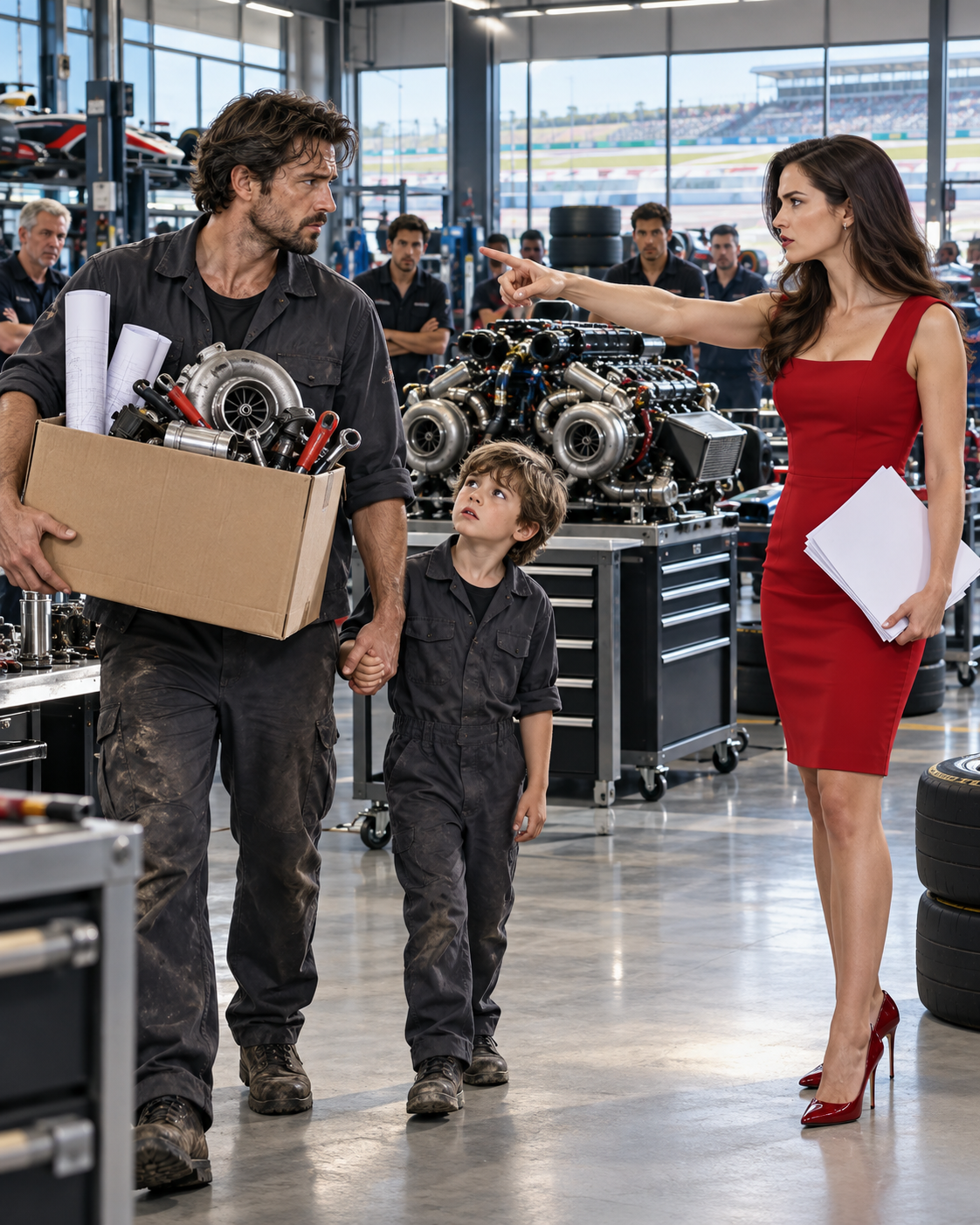
When Evelyn Reed fired me in her glass office overlooking downtown Detroit, she slid my termination letter across the desk
I stared at those six words until the ink seemed to move.
For eighteen months, I had believed Evelyn Reed fired me because she thought Project Ember was too risky.
That belief had kept me angry.
It had kept me hungry.
It had even kept me moving forward when every sensible part of me told me to quit.
But if she hadn’t fired me because the project was failing, then why had she done it?
I turned the photograph over again.
The building was unmistakable.
It was the old thermal research facility where Beverly and I had spent countless nights running simulations before private equity took control of the company.
At first, I noticed nothing unusual.
Then I saw the timestamp.
The photograph had been taken three days before my termination.
And in the lower corner of the image, almost hidden behind a chain-link fence, was a black SUV.
I knew that vehicle.
It belonged to Evelyn’s private security contractor.
I called Dennis.
He answered on the second ring.
“You sound like someone just died.”
“Maybe someone did.”
There was a pause.
“What happened?”
I told him about the photograph.
He came to the office within twenty minutes.
Beverly arrived shortly afterward, carrying the old laptop she had used during our original testing.
She looked at the photograph and went pale.
“I’ve seen that SUV before.”
“Where?”
“Outside the facility the night our final data disappeared.”
The room went silent.
“What data?” I asked.
Beverly looked at me.
“The complete thermal-cycle results.”
I felt something cold settle in my chest.
“Those were the results you sent me.”
“No,” she whispered.
“I sent you the backup set.”
I looked at Dennis.
He slowly lowered himself into a chair.
“Then what’s in the missing set?”
Beverly opened the old laptop.
The machine took forever to start.
When it finally did, she opened a folder buried beneath years of test logs.
There were numbers, temperature curves, pressure maps, and dozens of corrupted files.
Then she found one document that wasn’t corrupted.
It was an internal report dated four days before Evelyn fired me.
The title was simple.
PROJECT EMBER — COMMERCIAL VIABILITY CONFIRMED.
I stopped breathing.
Beneath the title was a projection showing exactly what our prototype eventually achieved at Caldwell.
Higher thermal efficiency.
Lower fuel consumption.
Reduced waste heat.
And something else.
A note at the bottom had been highlighted in red.
“The technology could materially alter the competitive position of the company within five years.”
I read it twice.
Then a third time.
“Why would they bury this?”
Beverly didn’t answer.
She didn’t have to.
We all knew.
Money.
Control.
Patents.
A breakthrough like Ember wouldn’t simply make engines better.
It could make entire production lines obsolete.
It could force manufacturers to abandon billions of dollars in existing technology.
And whoever controlled the patent could control the transition.
Dennis leaned forward.
“Who owned the original calculations?”
“The company,” I said.
Beverly shook her head.
“Not exactly.”
She pulled up another document.
My name appeared at the bottom.
Underneath it was a line I had never seen.
“Inventor contribution: independent technical development prior to formal corporate authorization.”
My stomach tightened.
“That means what I think it means?”
“It means they never owned all of it.”
For the first time since I had been fired, I wondered whether Evelyn had been trying to destroy Project Ember or protect something.
The next morning, I called Evelyn Reed.
She didn’t answer.
I left no message.
Instead, I drove to her office.
The receptionist tried to stop me, but I kept walking.
When Evelyn saw me enter, her face changed.
Not with anger.
With fear.
That frightened me more than anything.
“You received something,” she said.
I stopped.
“You know about the photograph?”
She closed the office door.
“Who sent it?”
“I don’t know.”
She walked to the window.
For several seconds, she said nothing.
Then she whispered, “I didn’t fire you because Ember was impractical.”
I felt my jaw tighten.
“I know.”
“No, you don’t.”
She turned around.
“When private equity installed me, they gave me a list of priorities.”
“Cut costs.”
“Sell assets.”
“Increase short-term margins.”
“Yes.”
She looked down.
“But there was another priority.”
“What?”
“Make sure Project Ember never reached production.”
I stared at her.
“Why?”
“Because the board already knew what it could do.”
She told me that two executives had quietly negotiated with a competing manufacturer before the acquisition was completed.
Their plan was to acquire our company, bury Ember, and later license similar technology through a separate entity they controlled.
My firing had been designed to make the project disappear.
But Evelyn had made one mistake.
She hadn’t expected me to keep building.
“You could have told me,” I said.
Her eyes filled with something I had never seen in that office before.
Regret.
“If I had told you, they would have watched you.”
“They watched me anyway.”
“Yes.”
“Then why did you call it a fantasy?”
She swallowed.
“Because I needed you to hate me enough to leave.”
The words hit harder than I expected.
I remembered walking out of her office carrying that cardboard box.
I remembered Chloe asking why I looked sad.
I remembered all those nights wondering whether I had failed her.
“You let me think I wasn’t good enough.”
“I know.”
“You let everyone think I was a fool.”
“I know.”
I stepped closer.
“Do you understand what that cost me?”
She didn’t answer.
Because there was no answer.
Some wounds don’t disappear just because the person who caused them finally explains why.
I left without shaking her hand.
Outside, the city looked exactly as it had eighteen months earlier.
But I wasn’t the same man.
I had spent so long chasing proof that I had forgotten something more important.
I didn’t need Evelyn to admit I had been right.
I needed to decide what I would do with the truth.
Attorney Evelyn Shaw helped us secure the legal position around Ember before anyone else could move.
Within weeks, our little company had become the center of a quiet industry war.
Competitors began calling.
Investment firms appeared.
Former executives suddenly wanted meetings.
People who had ignored us at Caldwell started using words like “visionary” and “transformational.”
I hated every one of them.
Because I remembered the nights when Dennis skipped his own bills to buy parts.
I remembered Beverly risking her career to send us data.
I remembered Marco sitting alone in the garage, studying telemetry while everyone else was celebrating.
And I remembered Chloe asleep beneath a workbench while I tried to make an impossible engine breathe.
So when the first billion-dollar acquisition offer arrived, I said no.
Dennis nearly choked on his coffee.
“You just turned down how much?”
“Enough.”
Beverly smiled.
“Good.”
Marco leaned back.
“Then what’s next?”
I looked at the engine sitting behind the glass wall of our workshop.
“Production.”
That word changed everything.
Building one prototype was obsession.
Building ten was engineering.
Building thousands was something else entirely.
It was logistics, quality control, manufacturing contracts, supply chains, regulations, insurance, hiring, financing, and hundreds of tiny problems that could destroy a company faster than any competitor.
We struggled.
Our first production batch failed inspection.
Our second developed a vibration issue.
A supplier disappeared with a deposit.
One of our investors walked away.
Then Chloe got sick the same week our manufacturing loan was nearly rejected.
I sat beside her hospital bed that night, watching the monitor blink in the dark.
She was older now.
Twelve years old.
Old enough to understand that her father was trying to build something bigger than a garage.
“Are you scared?” she asked.
“Every day.”
“Then why do you keep doing it?”
I smiled.
“Because being scared doesn’t mean you’re wrong.”
She thought about that.
Then she reached for my hand.
“Grandpa Dennis says you’re stubborn.”
I laughed.
“He’s right.”
She squeezed my fingers.
“But stubborn people finish things.”
That sentence stayed with me.
Three years after Caldwell, Ember-powered systems were being tested in commercial vehicles.
The national press finally noticed us.
Then international manufacturers came.
Then governments.
Then the same corporations that had once ignored us started competing for access.
Evelyn eventually left her old company.
She never asked for forgiveness again.
Instead, she became one of the people quietly helping us navigate the industry from the outside.
I respected that.
Not because it erased what happened.
Because it proved she had finally stopped pretending she had all the answers.
One evening, after another long day, I found her standing beside the original Ember prototype.
She touched the metal carefully.
“I used to think survival meant choosing the safest option.”
I looked at her.
“What do you think now?”
“Sometimes survival means protecting the thing everyone else thinks is impossible.”
For the first time, I smiled at her without anger.
“That’s a lesson I wish you’d learned sooner.”
“So do I.”
She walked away.
I stayed there alone.
The workshop lights reflected across the engine housing.
I could still remember its first violent ignition.
The sound had terrified me.
Then it had made me hopeful.
Now it was the heartbeat of a company that had nearly never existed.
I thought the story was finally over.
I was wrong.
Two weeks later, Evelyn Shaw called me into her office and placed a sealed file on the table.
She looked unusually serious.
“There is one more thing you need to know about Project Ember.”
I opened the file.
Inside was a patent application dated seven years before I had ever seen the technology.
The inventor’s name had been blacked out.
The original research location was listed as a private laboratory in Ohio.
And attached to the final page was a photograph of a much younger man standing beside an experimental engine.
I knew that face.
My father had died when I was eleven.
For years, my mother had told me he had been an ordinary mechanic who never finished anything he started.
But the photograph showed him beside an engine with the same thermal architecture I had spent my adult life trying to reinvent.
My hands began to shake.
On the back of the photograph was a handwritten note.
“David Reed — Project Ember, Phase One.”
I stared at my father’s name until the room disappeared around me.
All those years, I had believed I had created Ember from scratch.
Maybe I hadn’t.
Maybe I had been following a trail someone had left for me long before I understood what it meant.
Evelyn Shaw watched my face.
“There are twelve more files.”
“Twelve?”
She nodded.
“And someone has been trying to find them for twenty years.”
I looked toward the locked cabinet behind her desk.
“Who?”
She hesitated.
Then she said the one thing that made the blood drain from my face.
“The same people who tried to bury your work.”
That night, I drove home through the rain.
Chloe was asleep upstairs.
The house was quiet.
I placed the photograph of my father on the kitchen table and stared at it beneath the yellow light.
For the first time, Project Ember didn’t feel like the story of an engine.
It felt like the unfinished sentence of a man I barely remembered.
I picked up the photograph again.
On the back, beneath my father’s handwriting, was a second sentence I hadn’t noticed before.
“Do not let them finish what they started.”
I looked toward the dark hallway.
Then my phone rang.
The number was blocked.
I answered.
Nobody spoke for three seconds.
Then a man’s voice whispered, “You should have left Ember buried.”
The line went dead.
I stood alone in the kitchen, listening to the silence.
Upstairs, Chloe turned in her sleep.
Outside, rain tapped against the windows just as it had on the day Evelyn fired me.
But this time, I wasn’t afraid of losing my job.
I was afraid of discovering what my father had died trying to protect.
And somewhere beyond the reach of our little workshop, someone was still waiting for me to find out.