When Dr. Owen Slade laughed at my thirty-one-week pregnant belly in front of the entire Harmon Creek emergency department
I couldn’t move.
For eight years, I had convinced myself that Djibouti was behind me, that the memories haunting my sleep were simply the price of surviving something other people would never understand.
Now Commander Garrett Shen stood beside my car before sunrise, holding an envelope that threatened to tear open every scar I had spent years trying to heal.
“Who changed the report?” I asked.
He glanced toward the hospital entrance, where the first rays of morning caught the glass doors.
“I can’t tell you everything here.”
“Then tell me what you can.”
He handed me the envelope.
Inside was a photocopy of a military incident report, several pages of handwritten notes, and a photograph of a man standing beside an evacuation helicopter.
I recognized the helicopter first.
Then the date.
Then the signature at the bottom of the final page.
My fingers went cold.
The report claimed that our evacuation had been delayed because I had disobeyed a direct order, abandoned my assigned position, and diverted medical resources to an unauthorized rescue.
That wasn’t what happened.
I remembered the wounded sailor beneath the collapsed wall, his face gray, his hand gripping my sleeve as he begged me not to leave him.
I remembered calling for extraction while rounds struck the concrete around us.
I remembered the voice over the radio ordering me to withdraw without him.
And I remembered refusing.
The sailor survived.
So did Commander Shen and the rest of his team.
But the report described my decision as reckless misconduct, and the signature authorizing the final version belonged to Colonel Nathaniel Cross.
Cross had been the senior medical operations officer overseeing our mission.
He had also been the man who recommended that I receive a commendation before the deployment ended.
“What does this have to do with Harmon Creek?” I whispered.
Shen hesitated.
“Cross retired from active duty three years ago. He joined the hospital board last winter as a security and clinical risk adviser.”
I looked toward the emergency department.
For a moment, the building seemed unfamiliar, as though the walls had concealed something poisonous behind their clean white paint.
“You’re telling me the person who damaged my military record is here?”
“I’m telling you that I found evidence suggesting the report was deliberately altered, and Cross has been asking questions about your employment since last night.”
My hand moved instinctively to my stomach.
I had spent years protecting my unborn child from a past she could never understand, and now that past had followed me into the one place where I had hoped to feel safe.
“Why didn’t you come forward sooner?” I asked.
Shen’s eyes lowered.
“Because I trusted the official investigation. I was injured during the evacuation, and by the time I recovered, you had left the service. I thought you wanted your privacy.”
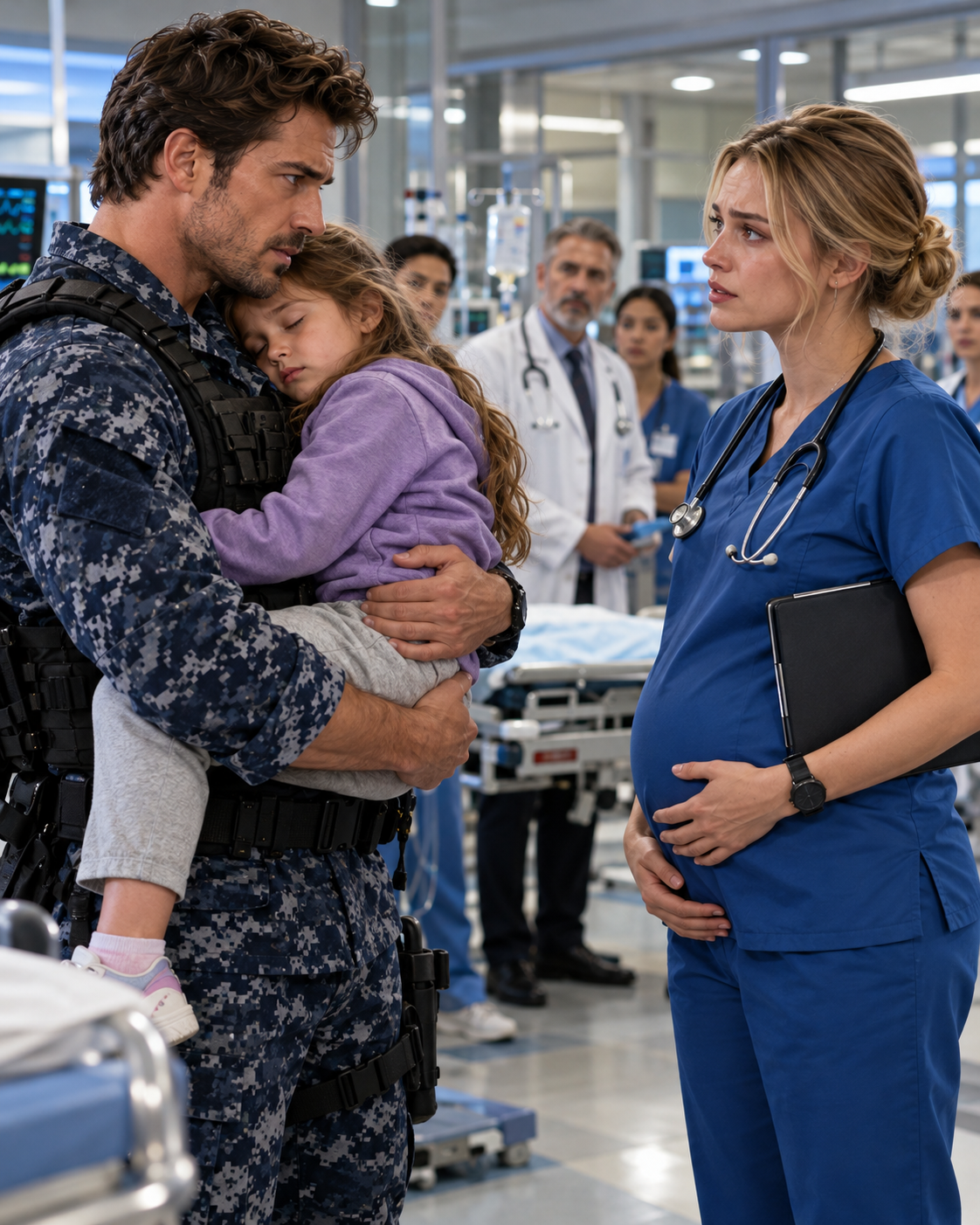
“I did.”
“I know.” He swallowed. “But I should have checked what happened to you.”
The apology hurt more than I expected because I knew he meant it.
I folded the papers and returned them to the envelope.
“I have a shift to finish.”
“You’ve already finished.”
“Then I have a daughter to get home to.”
He stepped aside.
I drove home beneath a pale morning sky, but I never made it past my apartment parking lot before my phone rang.
The hospital administrator wanted me in his office at noon.
He said it was about the previous night’s mass-casualty response.
I knew better.
By the time I arrived, three people were waiting around the conference table: Administrator Martin Hale, Dr. Owen Slade, and Colonel Nathaniel Cross.
Cross was older than in the photograph, with silver hair, a precise suit, and the kind of composure that made every room feel like a courtroom.
His gaze moved over me, paused briefly at my stomach, and settled on my face.
“Sergeant,” he said.
I hadn’t heard anyone use that title for years.
“Colonel.”
Slade looked between us.
“You two know each other?”
“Professionally,” Cross answered before I could speak.
Hale gestured toward an empty chair.
“Last night’s response raised questions about the scope of your qualifications. We want to understand your training, your military background, and whether your actions fell within hospital protocol.”
I sat down slowly.
“Which action are we discussing?”
“The airway intervention,” Hale said. “Your independent triage decisions. The blood protocol.”
“Those decisions were made in response to immediately life-threatening conditions.”
Slade shifted in his chair.
“The patient survived because she recognized deterioration before the rest of us did,” he said.
It was the first time I had heard him defend me.
Cross folded his hands.
“Competence under pressure does not excuse disregarding established authority. In military medicine, that distinction can mean the difference between a disciplined response and a dangerous improvisation.”
I studied him.
“Is that what the report said?”
His expression barely changed.
“Which report?”
“The Djibouti incident report.”
Silence settled over the table.
Slade’s eyebrows rose.
Hale glanced at Cross, who leaned back as though the conversation had finally become interesting.
“That matter was investigated years ago,” he said. “It has no bearing on your employment here.”
“Then you won’t mind explaining why my personnel file contains a misconduct finding that contradicts the evacuation logs.”
Cross’s jaw tightened.
For the first time, I saw something beneath his polished exterior.
Fear.
It disappeared quickly, replaced by a thin smile.
“You’re pregnant, recently returned to civilian practice, and clearly exhausted. I suggest you avoid making accusations you cannot substantiate.”
The old instinct rose in me: lower your eyes, make yourself smaller, survive the meeting, go home.
I could almost hear the younger version of myself whispering that fighting powerful people only created more damage.
Then I remembered Piper Shen’s tiny hand lying motionless on the trauma bed.
I remembered the man whose airway had closed while everyone waited for someone else to act.
And I remembered how many times I had mistaken silence for peace.
“I can substantiate what I saw,” I said. “And I can substantiate what I did.”
I stood.
“If the hospital wants a formal review of my clinical decisions, I’ll cooperate. If Colonel Cross wants to discuss my military service, he can do it through the appropriate official channels.”
I looked directly at Cross.
“But I won’t sit here and pretend a false report becomes true because the person who signed it has a better title.”
Nobody spoke as I left.
That afternoon, the hospital placed me on temporary administrative leave pending a review.
The explanation was neutral, carefully worded, and devastating all the same.
I drove home, locked my apartment door, and cried for the first time since arriving at Harmon Creek.
Not because I was afraid of losing my job.
Because I was tired of losing pieces of myself every time someone with authority decided that my truth was inconvenient.
My daughter kicked beneath my ribs.
I pressed both hands to my stomach.
“You’re going to have a better world than I did,” I whispered.
I wanted to believe it.
Two days later, Piper’s father called.
She had survived surgery and was awake, though the doctors were still monitoring her recovery.
“She keeps asking about the nurse who told everyone to hurry,” Shen said.
I smiled despite myself.
“Tell her I said she’s the toughest patient in the hospital.”
“I’ll tell her. There’s something else.”
I waited.
“One of the sailors from Djibouti saw the report. He still has a copy of the original radio transcript.”
My smile faded.
“How?”
“After the mission, he suspected something was wrong. He saved the documents he could access before the investigation closed.”
“Does he still have them?”
“Yes. He’s willing to make a statement.”
For the first time in years, the truth seemed less like a distant light and more like a door I might actually reach.
But when I returned to Harmon Creek for my scheduled review, I discovered that Cross had already begun shaping the story.
A confidential memo circulated among senior staff described me as a potentially unstable employee whose military background might have influenced her judgment during the mass-casualty incident.
It mentioned my pregnancy twice.
It did not mention the patients who had survived.
I read the memo in a small conference room, my face burning with humiliation.
Slade stood near the doorway.
“I didn’t write that,” he said quietly.
“But you signed the review request.”
“I requested an independent assessment of the clinical response. Cross added the personnel concerns afterward.”
I looked at him.
“Why are you telling me this?”
He seemed unable to find a comfortable place for his hands.
“Because I saw what you did that night. And because I spent months treating you like you were less capable simply because you weren’t interested in proving yourself to me.”
It was not a perfect apology.
It was, however, the first honest thing he had said to me.
“I thought confidence meant never questioning yourself,” he continued. “I thought the loudest person in the room was the one everyone should follow.”
“And now?”
He looked down.
“Now I’m wondering how many times someone like you saved a patient while people like me were too busy protecting our pride to notice.”
I had no answer that could make those words less painful.
He placed a folder on the table.
“The clinical review includes statements from the paramedics, the trauma team, and the receiving neurosurgeon who treated Piper. Their accounts support your decisions.”
I opened the folder.
Every page described the same thing: timely recognition, appropriate escalation, coordinated action, and clear communication under pressure.
For the first time, the evidence did not require me to defend myself alone.
Then Slade pointed to a final document.
“The board has scheduled a special hearing for Friday. Cross wants the military incident included.”
I looked up.
“Then Friday is when we discuss it.”
On Friday morning, I arrived at the hospital with my medical records, copies of my military certifications, and the original documents Shen had helped obtain.
I wore a simple navy dress that accommodated my pregnancy and carried no visible sign of the uniform I once wore.
The hearing room was crowded.
Hospital board members sat behind a long table, while physicians, nurses, and administrators filled the rows along the wall.
Cross stood near the screen at the front.
He presented the original military finding as evidence of a pattern of poor judgment, arguing that my decisions during the bus crash reflected the same disregard for command authority.
He spoke calmly, selecting words designed to sound reasonable.
He did not mention that the patients involved in the review had survived.
He did not mention that my decisions had followed established emergency principles.
He did not mention that the original report had been challenged.
When he finished, the chairwoman turned toward me.
“Do you wish to respond?”
I stood carefully.
“Yes.”
My voice sounded steadier than I felt.
“I served eight years as a special operations combat nurse. I worked in environments where medical resources were limited, evacuation routes changed without warning, and a delayed decision could cost someone their life.”
I paused.
“I came to Harmon Creek because I wanted to practice medicine without being defined by the worst moments of my life. I did not list every military qualification on my civilian application because I was applying for a nursing position, not asking anyone to admire my past.”
I looked at the people who had once laughed when I walked into the room.
“I never expected special treatment. I expected the same chance to do my job that everyone else received.”
Nobody moved.
“During the bus crash, I followed the evidence in front of me. I prioritized the patients most likely to die without immediate intervention. I used established emergency protocols. When a patient lost his airway, I acted because waiting would have placed his life at unnecessary risk.”
I turned toward Cross.
“If that is what he calls a disregard for authority, then we need to discuss what authority is supposed to protect.”
The chairwoman nodded to the hospital attorney, who displayed the original evacuation logs and radio transcripts.
The room changed as the documents appeared.
The transcript showed that the extraction order had been issued while the wounded sailor remained trapped beneath the collapsed wall.
A second message, recorded minutes later, confirmed that the field commander had ordered medical personnel to leave the area before the final casualty check was completed.
Then came the evidence that changed everything.
The original report had stated that I diverted the evacuation helicopter without authorization.
But the flight log showed that the pilot had received clearance from the command center before my team loaded the wounded sailor.
The report had not merely omitted context.
It had assigned responsibility for a decision I had not made.
Commander Shen took the witness chair.
He described the evacuation, the injuries, the radio traffic, and the moment I refused to abandon the last wounded member of his team.
“She did not act recklessly,” he said. “She made a decision under pressure based on the information available to her, and she saved a man who would otherwise have been left behind.”
Cross interrupted.
“Commander, your memory of the incident may be affected by your own injuries.”
Shen turned toward him.
“My injuries affected my ability to walk for several months. They did not erase the voice of the person who kept me alive.”
He placed a second envelope on the table.
Inside were the sailor’s sworn statement and an archived communications record that had never been included in the final investigation.
The documents established that Cross had received the authorization before the evacuation and had later approved a report that concealed it.
A board member leaned forward.
“Colonel, did you review these records before signing the original report?”
Cross said nothing.
For the first time since I had known him, he appeared unable to control the room.
The chairwoman called for a recess.
When the hearing resumed, the board announced that Cross would be referred for an independent investigation into the altered report and his subsequent conduct at Harmon Creek.
My military record would be formally reviewed, and the hospital’s inquiry into my emergency decisions would be closed without disciplinary action.
Hale apologized for the way the review had been handled.
Slade did not offer another speech.
He simply met my eyes and nodded, as if he finally understood that respect was not something a person should have to earn by surviving a catastrophe in front of an audience.
I thought the hardest part was over.
I was wrong.
Three days later, the sailor from Djibouti contacted Shen with a final piece of information.
The communications archive showed that Cross had not acted alone.
Someone else had requested that the evacuation report be revised before it reached the investigative board.
Someone with authority over the medical operation.
Someone whose signature appeared on the earliest version of the document.
Shen called me that evening.
“I need you to see something,” he said.
We met in a quiet café near the hospital, where he placed a scanned page between us.
At the bottom was a signature I recognized immediately.
It belonged to a senior officer who had mentored me during my first years in special operations medicine, the person who had encouraged me to trust my instincts and promised that my service would never be used against me.
For a long time, I stared at the page without speaking.
“Why would he do this?” I finally asked.
“I don’t know,” Shen said. “But the archive suggests he knew the report was wrong.”
The revelation reopened an older wound, one I had believed was finally beginning to close.
I had spent years blaming myself for the way my military career ended, wondering whether I had misunderstood an order, failed a superior, or made one unforgivable decision in the chaos.
Now I understood that the truth was more complicated than guilt.
But I also understood that uncovering it might cost me the last pieces of peace I had fought to protect.
I looked down at my stomach.
My daughter moved beneath my palm, quiet and insistent.
For eight years, I had believed courage meant standing in the middle of gunfire and refusing to run.
Now I knew it could also mean sitting across from a trusted friend, reading a painful truth, and deciding not to look away.
I would pursue the investigation.
Not for revenge, and not to reclaim a uniform I no longer needed.
I would do it because the wounded sailor deserved an honest record, because the truth mattered to the people who had served beside me, and because my daughter deserved to grow up knowing that silence was not the same thing as integrity.
Weeks later, I returned to Harmon Creek.
The nurses who once barely acknowledged me greeted me by name. Slade began asking for input instead of assuming he already had the answers, and the emergency department introduced new procedures for escalating concerns when a patient’s condition deteriorated.
No one treated me like a legend.
That was a relief.
I was still a nurse, still tired after long shifts, still learning how to live with memories that occasionally returned without warning.
And soon, I would be a mother.
On my first night back, I stood beside the nurses’ station with one hand resting against my belly when a new emergency call came through.
A child had been injured in a highway collision.
The ambulance was three minutes away.
The room began to move around me, people preparing equipment and clearing a trauma bay, and I felt the familiar tightening in my chest that came whenever the world began to fall apart.
Then I breathed.
I was not back in Djibouti.
I was not the frightened young nurse who had once believed a false report could define the rest of her life.
I was here, surrounded by people who knew that speaking up was not arrogance and that a quiet voice could carry the weight of an entire room.
When the doors opened, I stepped forward.
And for the first time, I did not feel the need to disappear.
I thought the past had finally loosened its grip on me, until a message arrived on my phone after the shift ended.
It contained no greeting, only a photograph of the original report and one sentence from an unknown number: “Cross was protecting someone, and now that you’ve found the truth, that person knows exactly where you work.”
I read it twice, then looked through the glass doors toward the dark parking lot.
My daughter stirred beneath my hand.
I slipped the phone into my pocket and called hospital security before walking outside.
Fear was still there, but it no longer made my decisions for me.
Whatever waited beyond those doors, I would face it with the same promise that had carried me through the worst night of my life: no one would be abandoned simply because telling the truth was dangerous.
And this time, I would make certain that the truth had witnesses.