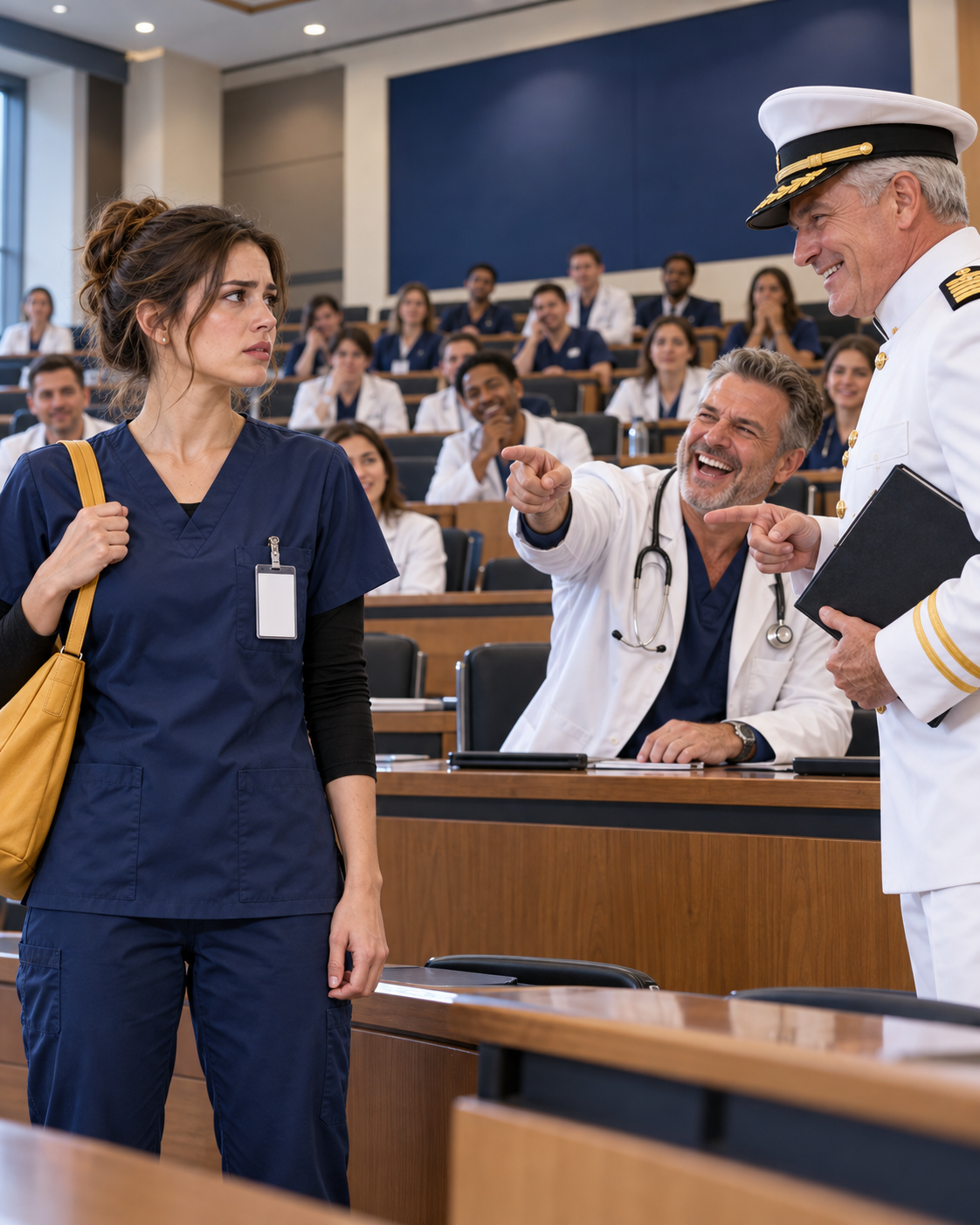
When Dr. Julian Vance humiliated me in front of 300 doctors at Bayou Crest Naval Medical Center, sneering at my oversized blue scrubs
Part 2
For half a second, three hundred people stared upward at the collapsing tower.
Then panic took over.
Doctors abandoned their stations. Residents shoved toward the main entrance. Someone knocked over a supply cart, sending metal instruments skittering across the floor.
The main exit became a bottleneck almost immediately.
“Move! Move!” a man shouted.
The crowd surged toward the doors.
I looked at the tower, then at the people rushing beneath it.
If they continued toward the main exit, dozens would be trapped in the narrow passageway when the structure hit the floor.
Hank Miller lay secured on the backboard, surrounded by instructors who couldn’t carry him until we had a safe route.
I raised my voice.
“EVERYONE, STOP MOVING TOWARD THE MAIN EXIT!”
Few people heard me.
I drew in a breath from somewhere deep in my chest.
“REAR SERVICE CORRIDOR! MOVE IN ORDERLY ROWS! NO RUNNING! KEEP THE CENTER AISLE CLEAR!”
My voice carried the unmistakable command of someone who had once directed frightened men through incoming fire.
Commander Hayes recognized it immediately.
“Listen to Hollister!” he shouted. “Rear corridor, now!”
The instructors moved first, establishing a clear passage.
I pointed toward the left side of the atrium.
“You two, redirect the people at the entrance. Keep them away from the tower. Medical staff, take the service corridor and keep the doors open. Nobody pushes.”
A young resident stood frozen beside a workstation, tears streaming down her face.
I caught her eye.
“Look at me. What’s your name?”
“Emily.”
“Emily, I need you to help the woman beside you. Take her arm and walk with her. You don’t have to be fearless. You just have to keep moving.”
She nodded.
Then she did exactly what I asked.
The crowd began to flow.
One group at a time, we moved three hundred people into the rear corridor. Hayes and his instructors guided the last of the candidates while I remained beside Miller, refusing to leave him until the evacuation path was clear.
The tower groaned again.
A long steel beam tore loose from the upper frame.
“Go!” Hayes shouted.
We pushed the backboard toward the service corridor.
The final group crossed the threshold.
I was the last person to leave the atrium.
Behind me, the rappel tower collapsed.
Steel crashed onto concrete with a thunderous roar, sending dust and fragments across the empty training floor. The impact shook the corridor walls, and someone began sobbing.
For several seconds, nobody spoke.
Then a resident whispered, “If we’d gone through the main doors…”
He couldn’t finish the sentence.
I looked back at the cloud of dust.
“We didn’t,” I said.
It was the only answer I had.
The evacuation had saved every person in the atrium, but Hank still had no feeling in his fingers.
And the clock was still running.
We transferred him to Trauma Bay 1, where the emergency team prepared for a rapid assessment. His oxygen saturation was falling, his breathing had become more labored, and the numbness in his hands had not improved.
Dr. Vance arrived moments later.
He had lost his earlier smirk.
“His airway is becoming a concern,” he said. “We need to secure it.”
“Agreed,” I replied. “But we need a controlled airway plan that protects his neck.”
He looked at the rigid collar.
“That collar is obstructing access. Remove it.”
“No.”
His eyes narrowed.
“Not now, Hollister.”
“Manual stabilization must be maintained throughout any necessary collar adjustment or airway procedure. You don’t remove it and leave his cervical spine unsupported.”
“I know how to manage an airway.”
“And I know what an unstable cervical fracture can do when someone moves the wrong way.”
A nurse glanced at the monitor.
Miller’s breathing was getting worse.
Every second mattered.
Vance reached toward the collar.
I stepped between him and the patient.
“Do not touch that collar until the team is ready to maintain alignment and manage his airway safely.”
The room went silent.
“You are obstructing a physician,” he said.
“I’m protecting a patient.”
For the first time since I’d entered the examination hall, Vance had no immediate reply.
Then the trauma bay doors opened.
Rear Admiral Charles Sterling entered with Dr. Maya Lindqvist, the center’s senior neurosurgeon. Both had been diverted from another building when reports came in about the collapse and the injured master chief.
Sterling took in the scene in a single glance.
“Report.”
Dr. Vance started speaking.
“Master Chief Miller fell from the rappel tower. We suspect a cervical injury. His airway is becoming compromised, and I was preparing to—”
“Who has been maintaining cervical stabilization?” Dr. Lindqvist interrupted.
“I have,” I said.
She looked at my hands, still positioned to support Miller’s head while the team prepared for the next step.
“How long?”
“Since the fall.”
Her expression sharpened.
“Good. Keep it there until we have a controlled plan.”
She moved to the bedside and assessed Miller, asking short, precise questions while the trauma team checked his breathing, circulation, and neurological function.
Sterling turned toward Vance.
“Who identified the anchor failure?”
“Hollister,” a resident answered.
“Who directed the evacuation?”
“Hollister.”
“Who prevented an uncontrolled transfer?”
Nobody answered for a moment.
Then Commander Hayes, standing in the doorway, said, “She did.”
Admiral Sterling looked at me.
“Your full name?”
“Grace Hollister, sir. Former Navy Hospital Corpsman First Class.”
Something flickered across his face at the word former, but he didn’t pursue it.
Dr. Lindqvist ordered urgent imaging and coordinated the next steps with the trauma team. Miller’s airway was managed with the cervical injury in mind, with trained personnel maintaining stabilization throughout the procedure.
I finally stepped away when the neurosurgeon confirmed that the team had control of the situation.
My fingers trembled as soon as I released the hold.
I hid them behind my back.
No one noticed except Commander Hayes.
“You all right?” he asked quietly.
“Yes.”
He studied my face.
“That’s not what your hands are saying.”
I looked through the glass at Miller.
“Later.”
Hayes didn’t press me.
The imaging results came back with a speed that seemed cruel.
Dr. Lindqvist stood at the workstation, reviewing the scans while the room gathered around her. A nurse placed a hand over her mouth.
The fracture was in Miller’s cervical spine.
A fragment lay less than two millimeters from the spinal cord.
Two millimeters.
That was the distance between a man whose future remained uncertain and a man who might have suffered devastating, permanent paralysis if the injury had been mishandled.
Dr. Lindqvist enlarged the image.
“There’s significant instability here. The neurological symptoms are consistent with what we’ve been seeing. He needs urgent surgical stabilization.”
Vance stared at the screen.
For the first time, he looked genuinely afraid.
Not of the examination.
Not of the admiral.
Of the possibility that his confidence had almost cost another human being everything.
He turned toward me.
“You knew?”
“I suspected.”
“You knew his spinal cord was at risk?”
“I knew his symptoms meant we had to treat his neck as potentially unstable. That’s why we didn’t move him.”
He looked back at the scan.
Two millimeters.
I remembered another man lying beneath an open sky, with blood on his lips and the sound of gunfire breaking across a mountain canyon.
I’d been younger then.
My hands had been covered in someone else’s blood, and I had been trying to keep a dying soldier alive long enough for help to reach us.
I hadn’t known whether my efforts would be enough.
I had only known that I couldn’t stop.
The memories pressed in so sharply that I stepped into the hallway.
I leaned against the wall and closed my eyes.
Seven years ago, I’d left the Navy believing that I had given everything I possessed to a job that would never stop asking for more.
I had spent those years trying to become someone who could sleep through the night.
Someone who could walk into a room without checking the exits.
Someone who could hear a metallic crack without feeling a mountain canyon open beneath her feet.
Yet the moment Miller fell, my body had remembered every lesson my mind had tried to bury.
I wasn’t proud of that.
I was grateful it had worked.
The operating team took Miller to surgery.
Before the doors closed, he turned his head as much as the stabilization allowed and found me with his eyes.
I stepped closer.
“You’re going to be in good hands,” I told him.
He managed a faint smile.
“So far, yours have been pretty good.”
I swallowed the ache in my throat.
“Save your strength, Master Chief.”
The doors closed between us.
For the first time that day, I had nothing left to do but wait.
And I hated waiting more than I hated the gunfire in my memories.
Part 3
The surgery lasted several hours.
I sat outside the operating suite with my yellow backpack between my feet, listening to the muffled movement beyond the doors. Every time someone emerged in scrubs, I looked up.
No one had news.
Commander Hayes eventually returned with two cups of coffee. He placed one beside me without asking whether I wanted it.
“You’ve been here the whole time,” he said.
“So have you.”
“I’m not the one pretending I’m fine.”
I wrapped my hands around the cup.
The coffee was too hot, but I needed something to feel real.
Hayes sat beside me.
“Admiral Sterling wants to know more about you.”
“There’s not much to tell.”
“Funny. That’s not what the Silver Star citation says.”
My hands stopped moving.
I looked at him.
He didn’t smile.
“Grace, I served with people who knew your name. Not everybody knew your face, but they knew the call sign.”
I turned toward the operating suite.
“That was a long time ago.”
“Not to the people you saved.”
I stared at the floor.
For years, I had told myself that leaving the service was the same as leaving the past behind.
But memories weren’t orders you could resign from.
They followed you into quiet rooms. They waited beside your bed. Sometimes they returned in the voice of a man who couldn’t feel his fingers.
Before I could answer, the operating suite doors opened.
Dr. Maya Lindqvist stepped out, pulling off her surgical cap.
Hayes stood so quickly that his coffee nearly spilled.
“Doctor?”
She looked tired, but the tension had left her face.
“The procedure went well. We stabilized the fracture and relieved the pressure as planned. It’s too early to make promises about his neurological recovery, but he’s stable, and we’ve given him the best possible chance.”
My breath caught.
I pressed my palm against my mouth.
For a moment, I couldn’t speak.
Then I lowered my hand.
“Thank you.”
Dr. Lindqvist studied me.
“You should understand something, Hollister. Keeping him immobilized didn’t solve every problem, but it helped prevent a potentially catastrophic secondary injury. That initial stabilization mattered.”
I nodded.
I didn’t want praise.
I wanted Hank Miller to wake up and discover that he still had a future.
Several hours later, he did.
His first words were a complaint about the hospital blanket.
His second were a request for water.
His third were for me.
When I entered his room, he lay pale against the pillows, a brace supporting his neck. A monitor traced his heartbeat in green lines across the screen.
His fingers moved weakly when I approached.
I stopped beside the bed.
“How are you feeling?”
“Like I fell off a twelve-foot tower.”
“That’s an accurate description.”
He gave a small laugh, then winced.
“Don’t make me laugh. Apparently, I’m held together with expensive hardware now.”
I smiled despite myself.
Then he looked at me more carefully.
“That voice.”
My smile faded.
“What about it?”
“I’ve heard it before.”
Commander Hayes stood at the foot of the bed, his arms folded.
Miller’s gaze moved between us.
“Grace Hollister?”
“Yes.”
He stared at me for several seconds.
Then his eyes filled.
“Red Canyon.”
I felt the floor tilt beneath me.
He remembered.
Seven years earlier, before my discharge, our unit had been sent into a mountain canyon after an ambush left several service members wounded and our evacuation route exposed.
Hank Miller had been there as a senior enlisted instructor attached to the operation.
He had been hit by debris during the attack and suffered a serious head injury.
I had reached him while enemy fire swept the rocky slope.
There had been no safe route to the landing zone.
No immediate extraction.
No guarantee that the next minute would be any kinder than the last.
His head had been bleeding, and every movement threatened to worsen his injuries. I had knelt behind a rock outcrop, braced his head between my hands, and held him as still as I could while rounds struck the ground around us.
Four hours.
Four endless hours of gunfire, dust, blood, and the terrifying silence that followed each burst.
I had kept talking to him because I feared that if I stopped, he would slip away.
I told him about the terrible coffee at our field station.
I told him that his commanding officer owed me a new pair of boots.
I told him to keep his eyes open.
And when he begged me to let him move because his neck hurt, I told him that I wouldn’t let him hurt himself trying to escape the pain.
I had been afraid every second.
I had simply refused to let fear make my decisions.
When the evacuation team finally reached us, my hands were so cramped that the corpsman beside me had to help me release my grip.
Miller survived.
The mission report praised the team’s coordination. My after-action report documented the stabilization methods we had used, the neurological signs we had observed, and the reasons we had avoided unnecessary movement.
Later, the report was reviewed by Navy medical specialists.
Its lessons became part of a broader effort to improve cervical trauma care in the field.
I never thought much about what happened after that.
I was busy trying to live with what had happened before it.
In the hospital room, Miller blinked away his tears.
“You kept my head still for four hours,” he whispered. “I thought you were going to die beside me.”
“I thought we both might.”
“You kept telling me not to worry.”
“I was lying.”
He laughed weakly, then covered his eyes.
Hayes turned away, giving him a moment.
I reached for Miller’s hand.
“You made it home, Master Chief. That’s what matters.”
He squeezed my fingers.
“No, Corpsman. You made sure I did.”
I didn’t know what to say.
So I stayed beside him until the room grew quiet.
The next morning, Admiral Sterling called an all-staff assembly.
Word had spread through Bayou Crest overnight. Surgeons, residents, nurses, technicians, and instructors packed the auditorium where Vance had mocked me less than twenty-four hours earlier.
This time, nobody laughed when I walked in.
I wore the same oversized blue scrubs.
The same yellow backpack rested over my shoulder.
But the room felt different.
Dr. Vance stood near the front, his hands clasped in front of him. His expression was difficult to read.
Admiral Sterling approached the podium.
“Yesterday, three hundred medical professionals witnessed an examination, a structural failure, a life-threatening injury, and an evacuation that could have ended in tragedy.”
The room fell silent.
“Three hundred people walked out of that training atrium alive. Master Chief Miller received timely care for a potentially devastating cervical injury. Both outcomes were made possible, in significant part, because one person recognized danger before others did and acted when hesitation would have cost precious time.”
He looked toward me.
“Grace Hollister.”
I stood still.
“During yesterday’s written examination, Ms. Hollister achieved the only perfect score in the history of the Surgical Excellence Examination.”
A murmur moved through the audience.
I hadn’t known the results were ready.
Sterling raised one hand, and the room quieted.
“However, I want to be clear. Her score is not the reason we are gathered here.”
He turned toward the large screen behind him.
A document appeared.
It was a combat after-action report bearing my name, its pages marked with official annotations and technical recommendations.
I recognized the words immediately.
I had written them in a field station after the canyon operation, with cramped fingers and a headache that had lasted three days.
Sterling continued.
“The Navy’s current cervical stabilization protocol incorporates lessons and recommendations drawn directly from Ms. Hollister’s documented battlefield experience. Her report helped shape the guidance that medical personnel now use to reduce the risk of secondary spinal injury.”
He paused.
“Yesterday, she applied those same principles under pressure, even when a senior physician challenged her judgment.”
I felt every eye in the auditorium turn toward me.
For seven years, I had believed that my service belonged to a chapter of my life that had closed.
I had assumed the report was one more document buried in a filing system.
I had never imagined that its lessons had traveled farther than I had.
Admiral Sterling stepped away from the podium.
“Competence is not measured by the uniform someone wears, the title on their office door, or the number of people who laugh at their jokes. It is measured by what they notice, what they know, and what they do when someone else’s life is in their hands.”
Then he invited Dr. Vance to speak.
Vance approached the microphone.
For the first time since I’d met him, he looked uncertain.
He glanced at the audience before turning toward me.
“Ms. Hollister,” he began, “yesterday, I judged you by your appearance, your career gap, and my assumptions about your qualifications.”
He stopped.
His jaw tightened as though the words were difficult to force out.
“I humiliated you publicly. I questioned your competence before I had seen your work, and when you challenged my decisions during Master Chief Miller’s treatment, I allowed my pride to interfere with my judgment.”
No one moved.
“I was wrong.”
The words were quiet, but the entire room heard them.
“I’m sorry.”
I studied him.
Part of me wanted to remember every insult, every laugh, every second I had spent trying not to let his contempt get under my skin.
Another part remembered his hand reaching toward Miller’s collar, not because he wanted the man to suffer, but because he was afraid and had mistaken urgency for certainty.
I knew the difference between a person who made a mistake and a person who refused to learn from one.
“Thank you for apologizing,” I said.
He nodded, visibly relieved that I hadn’t turned his confession into another public punishment.
“But there’s something I want you to understand, Doctor.”
He lifted his eyes.
“When I told you not to move Hank’s neck, it wasn’t because I wanted to prove you wrong. It wasn’t because I wanted control of your trauma bay. It was because he was lying on that table, frightened and injured, and he needed every person in that room to put his life ahead of their pride.”
Vance lowered his head.
“You’re right.”
“I hope we remember that the next time someone walks into a room who doesn’t look like what we expect.”
For a long moment, he said nothing.
Then he nodded again.
“I will.”
The assembly ended, but the day changed the direction of my life.
Admiral Sterling offered me a position helping train military medical personnel in emergency stabilization, trauma response, and the fundamentals of lifesaving care.
I didn’t accept immediately.
I went to see Hank first.
His recovery was slow, and the physicians were careful not to promise what time alone could determine. But he was awake, his condition was stable, and the team was beginning to assess the return of sensation and strength in his hands.
When I told him about the offer, he smiled.
“About time they put you where people can learn from you.”
“I don’t know if I’m ready to teach.”
He raised an eyebrow.
“Grace, you taught three hundred people how to get out of a collapsing building without losing your head. You taught me how to survive a canyon. What exactly do you think teaching is?”
I laughed, and for the first time in years, the sound came easily.
Three months later, I walked into a packed classroom at Bayou Crest.
I had traded the oversized scrubs for a clean uniform, though I still carried the same yellow backpack. Inside it was the worn notebook, the old photograph, and the Silver Star citation I had once believed belonged to another version of myself.
The students filled every seat.
Some were young corpsmen preparing for their first assignments. Others were nurses, residents, senior physicians, and experienced instructors who had come to learn how to recognize danger before it became disaster.
In the front row sat Dr. Julian Vance.
He arrived early.
He took notes.
He listened.
When our eyes met, he gave me a respectful nod.
I returned it.
Then I placed a training mannequin on the table and looked around the room.
“Before we begin,” I said, “I want you to remember something. The first person who reaches an injured patient is not always the most senior person in the room. It may be a junior corpsman, a nurse, a technician, or a frightened bystander who happens to notice what everyone else missed.”
I let the words settle.
“Your job is not to be the loudest person. Your job is to make the next decision safer than the last one.”
I demonstrated how to recognize a possible spinal injury, how to call for trained assistance, and why unnecessary movement can turn a survivable injury into a permanent one. I explained that airway management, stabilization, and emergency treatment require judgment, coordination, and appropriate training—not blind obedience to the first person who gives an order.
The students leaned forward.
Even Vance did.
Halfway through the lesson, a young corpsman raised his hand.
“What if the person giving the orders is wrong?”
I looked at him.
I thought of the auditorium, the collapsing tower, the canyon, and Hank Miller’s fingers resting weakly against the hospital blanket.
Then I answered.
“Respect the person. Question the decision when someone’s life depends on it. Explain what you’ve observed, state the risk, and offer a safer plan. Rank matters, but it doesn’t make anyone infallible.”
The corpsman nodded and wrote it down.
At the end of class, the students filed out slowly, talking among themselves.
Dr. Vance remained in the front row until the room was nearly empty.
“I’ve been thinking about what you said,” he told me.
“Which part?”
“That the next decision should be safer than the last one.”
He glanced at the mannequin on the table.
“I spent years believing leadership meant having the answer before anyone else did. Yesterday reminded me that sometimes leadership means recognizing who actually has the answer—and having the humility to listen.”
I adjusted the strap of my yellow backpack.
“That’s a lesson worth keeping.”
He gave a small, rueful smile.
“I’ll keep working on it.”
After he left, I stood alone in the classroom for a few minutes.
Sunlight fell across the empty seats, turning the polished floor gold. Somewhere down the corridor, a monitor beeped steadily, and a nurse called for assistance.
The sound no longer felt like a warning from a life I had abandoned.
It sounded like a reminder that someone, somewhere, would need help, and that the people around them deserved to be ready.
I took the old notebook from my backpack and opened it to the first page.
The handwriting was uneven, written years earlier with shaking hands.
At the bottom, beneath the notes from Red Canyon, I had written one sentence to remind myself why I kept going when I was afraid.
Keep them still. Keep them breathing. Get them home.
I traced the words with my thumb.
For years, I had thought surviving the battlefield meant leaving it behind. I had believed that if I could stop remembering the worst moments, I might finally become whole again.
But healing had not arrived as forgetfulness.
It had arrived as purpose.
The four hours I spent holding Hank Miller’s head still had not ended when the helicopter took him away. The report I wrote afterward had traveled farther than I knew. The lessons I carried had reached a room full of people who might one day stand beside another injured stranger and make a decision that mattered.
And the woman who had walked into an examination hall wearing faded scrubs and carrying a battered yellow backpack had finally understood something she had spent seven years trying to learn.
She had never needed to prove that she was a hero.
She had only needed to remember why she had become a corpsman in the first place.
Not for the medals.
Not for the applause.
Not for the moment when three hundred people finally learned her name.
For the person on the floor who couldn’t feel their fingers, for the frightened voice asking whether life would ever be the same, and for the fragile chance that careful hands and a clear mind might preserve a future someone else was about to lose.
I closed the notebook and put it away.
Then I turned off the classroom lights and walked toward the next call for help, carrying the past without letting it carry me.
Because the greatest measure of what I had done was never the number of people who knew my story.
It was the number of people who might live because someone had learned from it.