When Director Sullivan shoved me away from a dying general at Mercy General Hospital and called me “JUST A NURSE,”
For a moment, I forgot the general’s heartbeat was still fragile and listened only to the words he’d forced through his failing body.
The black case.
I turned toward the four operators standing beside the trauma bay, their uniforms soaked dark with blood and rain.
The tallest of them, a broad-shouldered man with a cut above his right eyebrow, slowly lowered his weapon.
“Major Cross,” he said, his voice rough with disbelief. “I thought they told us you’d died.”
“Apparently, a lot of people have been told a lot of things.”
His eyes flicked toward Sullivan.
“My name is Sergeant Marcus Vale. General Hackett ordered us to secure the case and bring it to you if anything happened to him.”
“Why me?”
Vale hesitated.
“Because he said you were the only person who would understand what’s inside.”
Across the room, Sullivan had stopped pretending he wasn’t listening.
“The general is disoriented,” he said. “Any material recovered from the facility belongs to the federal government and falls under national security restrictions.”
I glanced at the man lying on my operating table.
“Then why were four soldiers ordered to bring it into a civilian hospital?”
Sullivan’s jaw tightened.
“That is not your concern.”
“He’s my patient. His survival is my concern.”
I turned back toward the operating team, refusing to let Sullivan’s presence pull me away from the work that mattered.
“Keep him stabilized, notify the intensive care team, and document every intervention. I want blood products ready, continuous monitoring, and a clear record of his condition during transport.”
Dr. Aris stepped beside me.
“Evelyn, we need to talk about what just happened.”
“I know.”
“You performed an emergency thoracic procedure in a crowded trauma bay while federal agents threatened to remove you.”
“I know that, too.”
He stared at me with the same expression I had seen on the faces of young soldiers who had just discovered that the quiet person beside them was capable of something they could not yet comprehend.
“Who are you?”
I looked toward the next stretcher arriving through the emergency doors.
“Right now, I’m the person who needs you to keep these people alive.”
He held my gaze for another second, then nodded and turned back to his team.
I felt a small, painful gratitude for that.
He could demand answers later.
The injured could not wait.
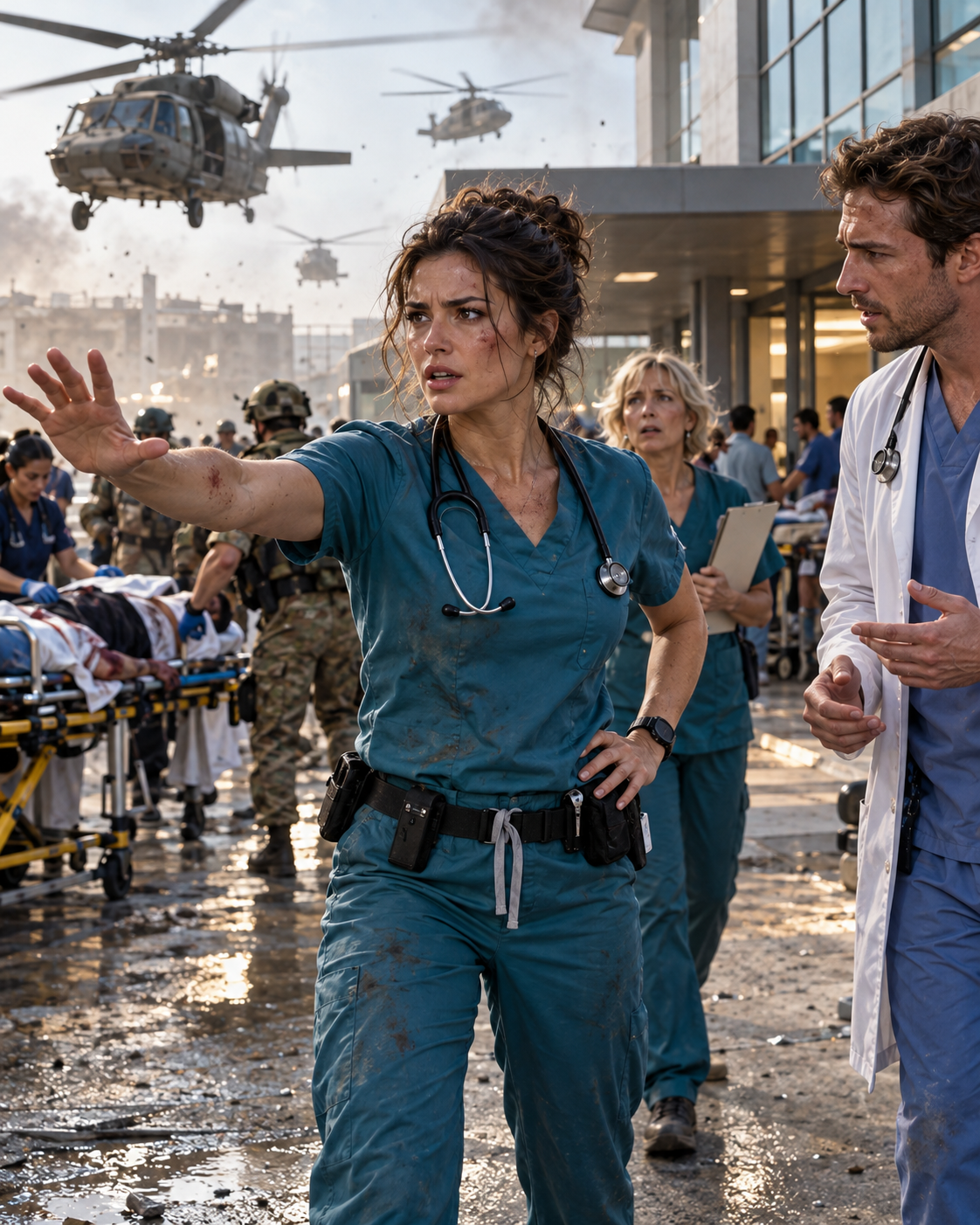
Within the next hour, Mercy General became a battlefield without weapons.
The hospital’s backup power was strained, outside communication was unreliable, and the normal pathways for transferring patients had nearly collapsed.
More casualties arrived in ambulances, military vehicles, and a battered utility truck driven by two facility workers who had refused to wait for official transport.
A young technician came in clutching his arm against his chest, apologizing repeatedly because his blood had dripped onto the floor.
An older security officer arrived with a piece of concrete embedded in his shoulder.
A woman in a gray laboratory uniform asked whether anyone had seen her brother, a maintenance electrician who had been working underground.
I gave her the only honest answer I had.
“Not yet, but we’re searching the incoming lists. Tell me his name and where he was assigned.”
She gave it to me with trembling lips.
I wrote it down and handed the information to the nurse managing our missing-person board.
At the end of the hallway, a child who had been brought in from a nearby road accident clung to his father’s coat while the adults around him tried not to look at the blood drying on their hands.
The scale of the disaster was larger than any single person could comprehend.
That was why I knew we had to keep working.
Panic could make sixty wounded people seem like an impossible number.
A sequence of individual decisions could make it a series of lives we might still save.
I sent one team to assess patients who could be stabilized in treatment rooms, another to prepare critical-care spaces, and a third to work with local emergency personnel as communication returned.
Thomas became my strongest ally, moving between the teams with the fierce concentration of someone who had finally understood the size of the responsibility in front of him.
At one point, he caught up with me beside a supply cart.
“How did you know what to do so quickly?”
I was checking a list of available blood products.
“Because I have seen what happens when people wait for someone else to take responsibility.”
“Where?”
I met his eyes.
“Somewhere I don’t have time to discuss right now.”
He looked as if he wanted to ask more.
Then a monitor began sounding in the next room, and we both ran toward it.
Across the emergency department, Sullivan was growing increasingly desperate.
He had positioned agents near the entrances and ordered the confiscation of electronic devices belonging to anyone who had worked at the testing facility.
He claimed he was protecting classified information, but he seemed far more interested in who had brought the black case than in how many people were still trapped beneath the collapsed structures.
Marcus Vale stood beside a supply cabinet with the case handcuffed to his wrist.
It was smaller than I had imagined, a hard-sided black container with reinforced corners and a narrow metal seal across its opening.
There was nothing remarkable about its appearance.
That made me trust it even less.
“Did you see what was inside?” I asked him.
“No, ma’am. The general carried the authorization key. We were told not to open it unless he became unable to make the delivery.”
“Did he tell you why?”
Vale glanced at the general’s treatment room.
“He said there was something in there people had already died trying to protect.”
A cold memory moved through me.
Five years earlier, I had heard almost the same words beneath a sky filled with smoke.
Back then, I had still been Major Evelyn Cross, a combat surgeon attached to an elite evacuation unit.
Our team had been sent to a remote military research site after an experimental system suffered a catastrophic failure.
The operation was later sealed under a classification so restrictive that even the families of several dead service members were given incomplete accounts of what had happened.
Officially, my team had abandoned its designated extraction route and delayed evacuation.
The report stated that our actions had contributed to the deaths of personnel who could not be recovered in time.
I had spent months fighting that conclusion.
I had records of evacuation requests, medical assessments, and messages showing that the route had been declared unsafe before our team reached it.
But each time I asked for an independent review, a different authority appeared to close the door.
When I finally understood that my testimony would be buried and my team exposed to further scrutiny, I accepted a quiet separation from service.
The official paperwork explained my departure with vague medical language.
My new civilian identity was intended to protect my privacy and keep me out of a controversy no one wanted reopened.
I had told myself that stepping away was the only way to live a life beyond the operation.
Yet some nights I still woke to the memory of a young medic named Daniel Bell, who had stayed beside an injured soldier while the evacuation clock ran down.
Daniel had been my friend.
He was twenty-six, endlessly sarcastic, and the kind of person who could make terrified people laugh without pretending their danger wasn’t real.
On the night everything went wrong, he had asked me whether I thought anyone back home would ever know what happened.
I told him the truth would eventually come out.
He smiled and said that was good enough.
Daniel never made it home.
For five years, I carried the fear that I had failed him, not because I had lacked the skills to save him, but because I had not managed to make anyone believe what we had witnessed.
Now a general was dying in my hospital, and a federal director was trying to control the one object he had specifically ordered his men to bring to me.
I looked at Vale.
“Do you know what happened at the facility today?”
“Only what we saw during extraction. The lower test levels were damaged, and sections of the underground complex collapsed.”
“Did General Hackett order the evacuation?”
“Yes, ma’am. He was trying to get the remaining staff out when the second blast hit.”
“Then why did Sullivan arrive with a quarantine order before the casualty count was established?”
Vale didn’t answer.
He didn’t need to.
I returned to the general’s bedside.
His condition remained critical, but the medical team had managed to keep his circulation stable while preparing for further intervention if he deteriorated.
I leaned close enough for him to hear me.
“General, I’m Evelyn Cross. Can you understand me?”
His eyelids moved.
He tried to speak, but the effort triggered a coughing fit, and the monitor began to climb.
I stepped back and let the team stabilize him.
“Not now,” I murmured. “You can tell me when you’re stronger.”
As I turned away, his hand moved weakly across the sheet.
His fingertips caught the edge of my sleeve.
Then he whispered something so faint I nearly missed it.
“Cinder Ridge.”
The name seemed to take all the warmth out of the room.
I bent closer.
“What about Cinder Ridge?”
His eyes opened a fraction.
“Sullivan… knew.”
His hand went slack, and the monitor sounded again.
The team crowded around him, and I stepped aside while they worked.
I knew that look on a patient’s face.
It was not the face of a man who had merely been injured.
It was the face of someone trying to deliver a truth before his body gave out.
Outside the treatment room, Sullivan was waiting.
“You will surrender the case,” he said. “You will provide a statement regarding General Hackett’s condition, and you will not discuss his comments with anyone.”
“I’ll provide an accurate medical record through the appropriate channels.”
“That is not sufficient.”
“It will have to be.”
His expression tightened.
“You seem to have forgotten that your former service record is classified, Major. Your presence here raises serious questions about how you obtained your current identity and whether you’ve been acting under unauthorized instructions.”
I studied him.
For years, that sort of threat would have sent me back into silence.
I had learned to imagine the consequences before asking questions, to anticipate every institutional door that could be shut in my face, and to believe that refusing to cooperate would somehow endanger the people I had tried to protect.
But I had also learned what happens when powerful people discover that fear is an efficient way to control a room.
They keep using it until nobody remembers that they can say no.
“Then ask your questions after the patients are safe,” I told him.
He leaned closer.
“You have no idea what you’re interfering with.”
“You’re right,” I said. “Not yet.”
His gaze moved toward Vale and the black case.
“That container contains classified federal property. If it is opened without proper authorization, you could compromise a national security investigation.”
I thought of Daniel.
I thought of the official report that had blamed us for a loss we had tried desperately to prevent.
Then I looked at the injured people lining the hallways.
“People are bleeding in my hospital. You can debate jurisdiction with my attorney after they’ve had a chance to survive.”
Sullivan made a small motion toward his agents.
Before they could approach, Marcus Vale stepped forward.
“General Hackett gave us a direct order to protect the case and Major Cross.”
“Your commanding general is incapacitated,” Sullivan said.
“He’s still our commanding general.”
The other three operators moved beside Vale, their faces exhausted but determined.
For the first time since he had arrived, Sullivan seemed uncertain about how much authority he truly possessed in this room.
I did not want a confrontation with armed men.
I wanted the hospital to remain a place where wounded people could be treated without fear of being turned into evidence.
“Nobody is taking anything until we’ve established the general’s condition and confirmed who has lawful authority over the material,” I said.
Sullivan gave a thin smile.
“You think a hospital nurse can stop a federal investigation?”
“No,” I replied. “I think a hospital full of witnesses can make it much harder to hide one.”
He stared at me for a long moment, then walked toward the entrance to speak privately with his agents.
I did not mistake his retreat for surrender.
I knew the difference between a threat that had disappeared and one that was waiting for a better moment.
Near midnight, the emergency department finally reached a fragile rhythm.
Some patients had been transferred to safer facilities, while others remained under our care because moving them posed too great a risk.
The number of dead was still being verified.
Every time a new name appeared on the board, I felt the familiar helplessness rise inside me, but I forced myself to stay present with the living.
Thomas found me washing blood from my wrists in a small utility room.
He had removed his mask, and deep lines stood out around his eyes.
“Twenty-three patients are stable enough for transfer,” he said. “We’ve got twelve still in critical care, and the incoming reports suggest there are more people being brought in from the facility.”
“Any word on the electrician?”
He nodded.
“He’s alive. Fractured pelvis, but conscious. We’ve located his family.”
I closed my eyes briefly.
“Thank you.”
Thomas leaned against the wall.
“I looked you up after the general came in. I know that wasn’t appropriate, but the name Evelyn Cross was all over the military medical citations I could access.”
I kept my hands beneath the running water.
“I was trying to understand who had been working beside me all these years.”
“And?”
He considered his answer.
“I found a lot about your awards and almost nothing about why you left.”
I shut off the tap.
“That was intentional.”
“Did something happen?”
I looked down at my scarred arms.
“Something happened, and people with more power than me decided what it was allowed to mean.”
Thomas was quiet.
Then he said, “You don’t have to tell me tonight.”
That simple sentence nearly undid me.
He wasn’t demanding my story as the price of trusting me.
He was allowing me to decide whether it belonged to him.
“Thank you,” I whispered.
I returned to the general’s room after dawn.
His eyes were open, and although his face remained pale, he was alert enough to follow my voice.
I asked the critical-care team to remain close before leaning over his bed.
“The case is safe,” I told him. “But Sullivan is still here.”
Hackett’s brow tightened.
“Open it,” he whispered.
“We need to establish the proper authorization.”
“Cross, listen to me. Every hour counts.”
He struggled for breath, and I waited until he could continue.
“The facility received warnings before the test. Engineers identified structural problems. They asked for a shutdown.”
“Who overruled them?”
His eyes shifted toward the door.
“Sullivan’s office.”
I felt my stomach tighten.
“Why?”
“They were behind schedule. The program was under review, and the demonstration was supposed to prove the technology was safe enough to expand.”
I thought of the explosions, the collapsed levels, and the people who had been carrying ordinary lunch bags when the ground opened beneath them.
“Did you know it was going to happen?”
“No,” he rasped. “I knew it could happen. That’s why I was there.”
He closed his eyes briefly, exhausted by the effort.
“I was bringing the evidence out. Sullivan’s people tried to stop the extraction. The second blast caught us before we reached the surface.”
“What’s on the case?”
“Original readings. The warning reports. The communications log. The orders that came down before Cinder Ridge.”
My heart seemed to miss a beat.
“Cinder Ridge wasn’t an accident?”
Hackett looked at me with a grief that made his rank seem irrelevant.
“Not the way the report said it was.”
I stood very still.
“What does that mean?”
“It means your team did what it was supposed to do. You asked for extraction. You reported the route was compromised. You tried to save Bell and the others.”
The room seemed to recede around me.
For five years, I had replayed that night in pieces, searching for one decision that could explain why Daniel had died.
I remembered his hand gripping my sleeve.
I remembered promising that I would come back.
I remembered being pulled toward the evacuation point while he stayed behind to help a wounded soldier whose breathing had become dangerously shallow.
I had never been able to separate the order to withdraw from the feeling that leaving him behind was a choice I had made.
Hackett watched my face.
“The report was changed after the incident,” he continued. “The original records show that your extraction requests were rejected. The decision to delay the rescue came from people who never entered that site.”
I gripped the bed rail.
“Who signed the report?”
His voice dropped.
“Sullivan.”
The name did not arrive like a revelation.
It arrived like a door finally opening onto a room I had spent years fearing.
I had imagined many reasons the truth had been buried.
Bureaucratic panic. Institutional shame. A need to protect a classified program.
I had never imagined that the same person who had spent the previous day telling me to step aside had helped construct the lie that had followed me out of the military.
“Why didn’t you release this earlier?” I asked.
“I spent years collecting enough evidence to challenge the original findings. Then I found out the program was still operating, under a new name. When I learned they were planning another full-scale test, I went to the facility myself.”
He swallowed painfully.
“I thought I could stop it before anyone else was hurt.”
I wanted to tell him that no single person could have carried that responsibility alone.
But I understood why he had tried.
Once you discover that people have died because a warning was ignored, it becomes difficult to trust anyone else to hear the next one.
A soft knock came at the door.
A member of the critical-care team stepped in to check the general’s monitoring equipment and asked us to keep the conversation brief.
Before I left, Hackett caught my hand again.
“The case has a sealed envelope inside,” he said. “Your name is on it.”
I frowned.
“Why would my name be on anything?”
“Because the person who prepared it insisted that you should see it before anyone else.”
“Who prepared it?”
His eyes began to close.
“I don’t know,” he whispered. “But I think they’ve been watching you for a long time.”
A chill passed through me.
Five years of anonymity suddenly felt less like a closed chapter and more like a fragile curtain someone had allowed me to believe was a wall.
I returned to Vale and told him the general had authorized the case to be reviewed with the appropriate oversight personnel.
Sullivan immediately objected.
“You don’t have authority to handle classified material.”
“Then bring in an independent investigator with the necessary clearance,” I said. “You can remain present, but you won’t be controlling the review.”
He laughed without humor.
“You think that will protect you?”
“No. I think it will protect the evidence.”
The next few hours were spent arranging the secure transfer of the case into the custody of an independent federal oversight team.
The process moved slowly, partly because the regional systems were still impaired and partly because Sullivan challenged every step.
But the general’s written authorization, the operators’ statements, and the growing list of witnesses made it increasingly difficult for him to claim the case was merely an unauthorized piece of equipment.
When the oversight officers arrived, they documented its condition and recorded the transfer.
Sullivan remained nearby, his expression fixed in a way that suggested he was calculating how much of the situation he could still control.
I watched as the case was opened under formal observation.
Inside were sealed data drives, paper reports, annotated facility diagrams, and a thick envelope bearing my name.
EVELYN CROSS.
For several seconds, I could not bring myself to touch it.
Then I remembered Daniel’s question about whether anyone would ever know what had happened.
I broke the seal.
The first page was a copy of an original incident report from Cinder Ridge, complete with timestamps and the names of personnel who had approved the emergency evacuation requests.
My own name appeared beside a list of medical decisions that had been omitted from the official version.
The second page contained a sequence of messages demonstrating that our team had requested extraction repeatedly while the designated route was classified as unsafe.
The third carried the signature of the officer who had authorized the delay.
I recognized it immediately.
Thomas Hackett.
The general had signed the order that kept our unit in place longer than the official report admitted.
For an instant, the anger I had held back for five years surged so sharply that my hands began to shake.
Then I noticed the handwritten note beneath his signature.
I objected to the delay. My objection was overruled. I accept responsibility for signing the final order, and I will testify to the full chain of command.
I read it twice.
The papers did not transform Hackett into an innocent man.
He had held authority, and his signature had been part of a decision that cost lives.
But the documents showed that he had tried to challenge the delay and later intended to tell the truth about his role.
Accountability, I was beginning to understand, was not the same as a perfect record.
It meant refusing to hide behind the parts of a story that made you look better.
I opened the envelope’s final sheet.
It was a brief letter, typed on plain white paper and signed by Hackett.
Major Cross,
If you’re reading this, I failed to bring these records out before the latest incident. I am sorry that the official account left you carrying blame that belonged to a chain of command.
You were ordered to preserve lives within the resources available to you. You asked for extraction when the route became unsafe. You did not cause the deaths that followed.
I cannot undo what happened to Bell or his family. I cannot ask you to forgive me for every decision I made. I can only place the truth where it can no longer be quietly rewritten.
You deserve to know that you were never the failure they described.
I lowered the letter.
The tears came quietly, without the dramatic collapse I had once imagined when I thought about finally hearing those words.
I cried for Daniel.
I cried for the years I had spent believing my grief was evidence of guilt.
I cried for the younger version of myself who had accepted a forced silence as the only way to protect other people.
Thomas Aris appeared beside me and said nothing.
He simply handed me a clean tissue and stood there until I was ready to look up.
By the end of the day, Sullivan’s authority over the immediate evidence review had been suspended pending an independent investigation.
The oversight team documented the original records, interviewed the operators, and secured statements from the facility staff who had reported the warnings.
The investigation was far from over.
Important questions remained about who had approved the test, who had altered the earlier report, and why the latest safety concerns had not resulted in a shutdown.
But the truth was no longer trapped inside a black case.
It had witnesses.
It had records.
And it had people who could no longer be dismissed as a single disgruntled surgeon with an inconvenient memory.
Sullivan left the hospital under escort for further questioning.
As he passed the trauma bay, he paused beside me.
“You have no idea how much damage this will cause,” he said quietly.
I looked at the exhausted nurses around us, the injured staff still waiting for transport, and the names on our casualty board.
“I know exactly how much damage has already been done.”
He seemed about to respond, but for once he had no answer that could make the people in front of him disappear.
Then he walked away.
General Hackett survived the night.
His recovery would be long, and the procedure that saved him would not undo the losses of that afternoon.
When I visited him several days later, he was still weak and attached to monitoring equipment, but he could speak without fighting for every breath.
“I owe you my life,” he said.
“You owe the truth to the families who never got it.”
He nodded slowly.
“I know.”
“Will you testify?”
“Yes.”
“Even if it costs you your career?”
He looked toward the window.
“That career has already cost other people enough.”
For a moment, neither of us spoke.
Then he added, “I wish I’d done more when you were still in uniform.”
I thought about Daniel, the original report, and the younger surgeon who had spent years wondering whether she had deserved the punishment that followed.
“So do I,” I said.
It wasn’t forgiveness.
It was an honest answer, and perhaps that was the only place either of us could begin.
The hospital eventually returned to something resembling its old rhythm.
The generators were repaired, patients were transferred, and the staff who had worked through the disaster took turns going home to sleep.
Dr. Aris never asked me to explain every part of my military past.
Instead, he offered me a permanent position coordinating emergency preparedness and trauma response, a role that would let me teach the hospital what we had learned without requiring me to become the center of every story.
I accepted after several days of consideration.
For the first time in years, I did not feel that my only choices were to disappear or to return to war.
I could use what I knew to prepare others, then go home when my shift ended.
The independent investigation continued for months.
The original records helped establish that warnings had been raised before the latest test and that decisions made above the facility level had prevented a full response.
Several senior officials were placed under review, and the earlier Cinder Ridge findings were reopened.
I learned that the truth rarely arrived in one dramatic announcement.
It came through interviews, document verification, disputed timelines, and people finally finding the courage to say what they had seen.
Some families received answers they had waited years to hear.
Others were left with gaps that no investigation could fill.
Daniel’s family received a copy of the corrected medical timeline and an offer for a formal meeting with the investigators.
I wrote his mother a letter before they met.
I told her how he made the frightened laugh.
I told her that he had never abandoned the soldier he was helping, even when staying had become dangerous.
I did not describe him as a hero who had never been afraid.
He had been afraid plenty of times.
That was one of the things I loved about him.
He had known what fear felt like and still refused to leave another person alone with it.
In the final lines, I wrote that I was sorry I had not been able to bring him home.
Then I crossed that sentence out.
I could be sorry he had died.
I could grieve the years his family had lost with him.
But I would not take responsibility for decisions that had been made beyond my authority simply because guilt had become familiar to me.
Instead, I wrote that I would remember him honestly, as a real person who had mattered, and that I hoped the truth would allow his family to remember him without the official report standing between them and the man they had loved.
I mailed the letter on a rainy Thursday morning.
Then I went to work.
My identification badge still said Clarice Hayes.
The name was part of the quiet life I had built, but it no longer felt like a hiding place.
I did not have to abandon it to prove that Evelyn Cross still existed.
Both names belonged to the woman who had survived those years.
One had taught me how to endure silence.
The other had taught me when silence became another kind of injury.
Several weeks later, General Hackett sent me a small envelope through the appropriate channels.
Inside was a photocopy of a photograph recovered from the Cinder Ridge records.
Daniel stood with one arm around my shoulders, grinning at the camera while I looked away, caught in the middle of saying something that clearly annoyed him.
On the back, in his untidy handwriting, were the words he had once used to tease me after a difficult shift.
Try remembering that you’re allowed to be human, Cross.
I carried the photograph to the staff room and sat with it until the break was over.
For years, I had thought being strong meant never letting the grief show.
I had treated sleep as a weakness, affection as a distraction, and every mistake as proof that I needed to work harder.
Daniel had understood something I had forgotten.
Saving lives did not make us invulnerable.
It made the time we had with one another more precious.
I placed the photograph in my locker, beside a fresh set of scrubs, and returned to the emergency department.
A frightened young nurse was standing over a patient’s chart, visibly overwhelmed by a complicated situation.
I recognized the look on her face.
It was the look of someone who believed that if she didn’t know every answer immediately, she had no right to be there.
I stood beside her and looked at the chart.
“Tell me what you know,” I said. “We’ll work through what we don’t know together.”
Her shoulders eased slightly.
She began speaking, and I listened.
Outside, the world continued to move through its ordinary emergencies and quiet acts of courage.
The investigation would continue without me in the room every hour.
There would be hearings, arguments, delayed reports, and people who would try to protect their reputations.
I could not guarantee that every person responsible would face the consequences they deserved.
I could not restore the years lost to false accusations.
I could not bring Daniel back.
But I could refuse to let the old lie define the rest of my life.
I had spent five years believing that survival meant leaving my past behind.
Now I understood that survival could also mean returning to the truth, looking directly at what had happened, and choosing what to carry forward.
The scars on my arms would remain.
So would the memories.
Neither had to control the rest of my story.
And when I walked into Mercy General each morning, I no longer felt the need to make myself invisible.
I was Clarice Hayes, the nurse who had learned how to help people through the ordinary hours of pain.
I was Evelyn Cross, the surgeon who had survived a war that never fully ended when she came home.
I was both, and neither name required me to apologize.
The general had survived because I acted before permission arrived.
The evidence survived because people finally chose to protect the truth instead of protecting the powerful.
And I survived because I stopped confusing silence with peace.
Sometimes courage is taking command in a room where everyone else is afraid.
Sometimes it is admitting that you made a mistake and accepting what comes next.
And sometimes it is a quieter act: refusing to carry another person’s lie just because you’ve carried it for a long time.
I thought the black case had brought me back to the worst night of my life.
Instead, it gave me a chance to stop living as though that night had been the final verdict on who I was.
I did not know what the next investigation would uncover, or how many people would have to answer for the choices they had made.
But I knew what I would do if the truth became inconvenient again.
I would speak.
I would listen.
And when another life depended on a decision, I would remember that my duty was not to the comfort of powerful people, or to the safety of my reputation, but to the human being in front of me.
That was the promise I had made when I first became a surgeon.
It was the promise I had kept even when the world insisted I had failed.
And it was the promise I intended to keep for the rest of my life.