When Desmond Hayes shoved a gun against a little girl’s forehead aboard Flight 408 and sneered at me for being too terrified to move
Part 2
I kicked the cart’s brake loose.
The heavy metal frame lurched forward, gathering speed down the steeply tilted aisle, its wheels rattling against the floor as terrified passengers flattened themselves against their seats.
The enforcer turned just in time to see it coming.
The impact drove him backward into the galley partition with a crash that shook the cabin.
His weapon skidded across the floor.
Before he could recover, I was on him.
I seized his wrist, forced the weapon away, and struck hard enough to leave him unconscious against the wall.
The whole encounter lasted only seconds.
To the passengers watching from their seats, it must have looked like an ordinary man suddenly becoming something else.
To me, it felt like opening a door I had spent eleven years trying to keep shut.
“Everybody stay down!” I shouted. “Keep your seat belts fastened!”
Desmond spun toward me, dragging his pistol away from Chloe.
I saw the instant he recognized that the balance of power had changed.
His expression wasn’t frightened.
It was offended.
He had expected a cabin full of helpless people, and now one of them had refused to play his part.
“You just made the biggest mistake of your life,” he snarled.
He fired.
The bullet tore past my upper arm, grazing the flesh and sending a hot line of pain down to my elbow.
I dropped behind the nearest row of seats as passengers screamed and ducked.
Julian pulled Chloe to the floor.
“Stay down!” I yelled at him.
Desmond moved toward the cockpit.
Arthur followed, shouting something I couldn’t hear over the alarms and the rising roar of the engines.
The aircraft shuddered so violently that the overhead bins rattled.
I knew enough about flying to understand that the dive was not a normal emergency descent.
The pitch was too severe, the acceleration too relentless, and the sounds coming from the engines too uneven.
Whatever had happened in the cockpit, we were losing the aircraft.
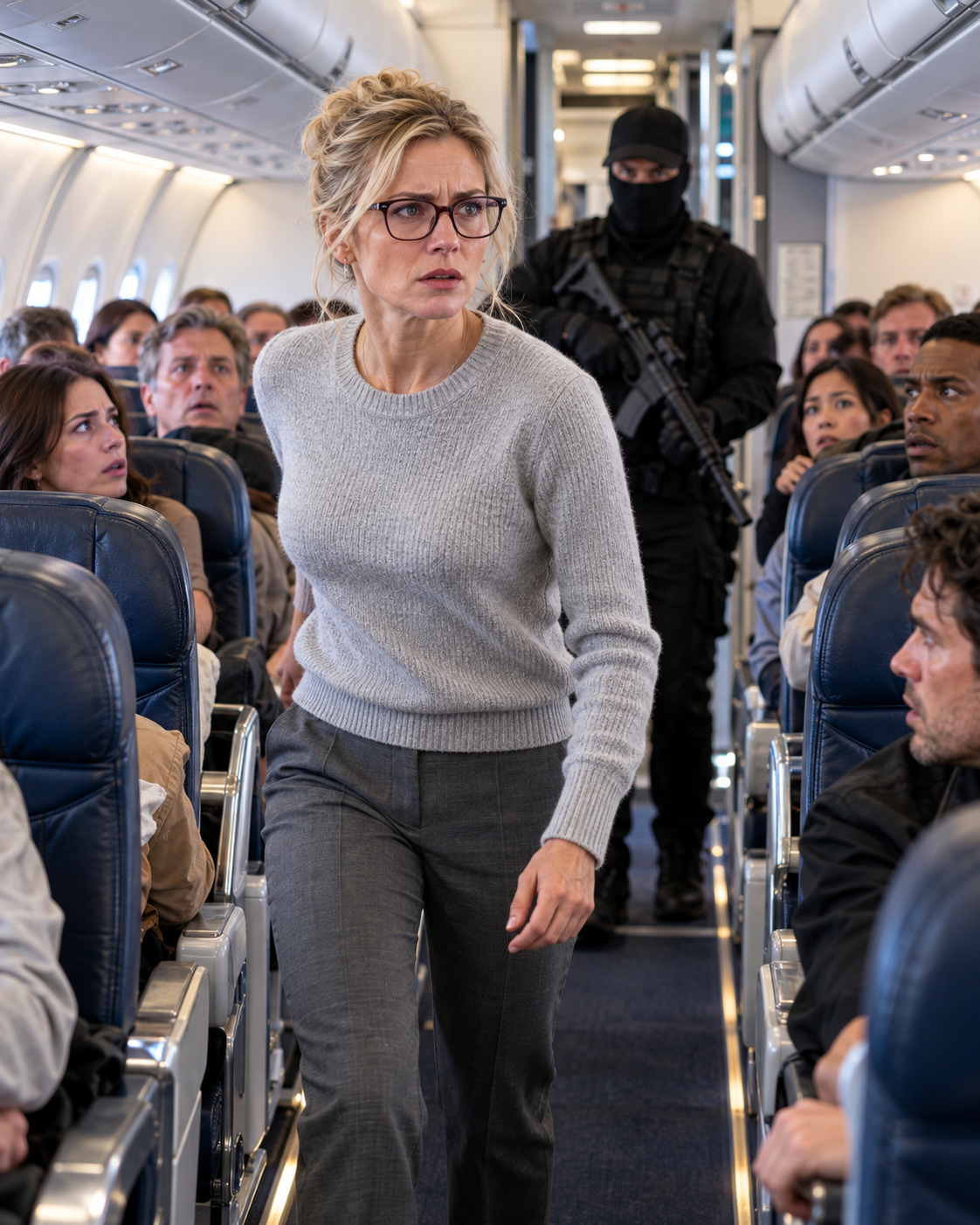
A woman in a dark blue uniform appeared beside me.
She was the lead flight attendant, Beatrice Higgins, and although her face had gone pale, her hands were steady.
She held a red crash axe against her chest.
“Whoever you are,” she whispered, “if you can stop them, please do it.”
I stared at the axe.
“How many people are in the cockpit?”
“Two pilots. I haven’t heard from either one.”
“Is the door locked?”
She nodded.
I looked toward the forward galley, where Desmond and Arthur had disappeared.
“Keep everyone away from the front. If we get this aircraft under control, I need you ready to evacuate.”
Her eyes searched my face.
“Are you a pilot?”
I hesitated for the smallest fraction of a second.
“Yes.”
“Commercial?”
“No.”
She understood that there was no time for more questions.
I took the axe and moved forward, bracing myself against seatbacks as the nose-down angle threatened to throw me off my feet.
Every instinct screamed that I was walking toward the most dangerous place on the aircraft.
I kept moving.
The cockpit door stood at the end of the galley, its electronic access panel flashing red.
I struck the panel with the axe, shattering its casing, but the door remained locked.
The aircraft dropped again.
My stomach rose into my chest, and the metal floor seemed to vanish beneath my shoes.
I struck the damaged panel once more.
A sharp electrical crackle came from inside the casing, followed by a sudden change in the indicator lights.
The lock released.
I shoved the door open.
The cockpit was a nightmare of alarms, warning lights, and broken glass.
Captain Richard Dawson lay motionless on the floor behind his seat.
First Officer Nathan Peterson was slumped against the controls, one hand pressed to his side, blood soaking his uniform.
Arthur stood near the center console, his eyes wide with panic.
Desmond was leaning over the captain’s seat, trying to manipulate the controls.
For one suspended second, all of us stared at one another.
Then Desmond reached for his weapon.
I fired the pistol I had taken from the unconscious enforcer.
The shot struck Desmond, and he collapsed against the side console with a cry.
Arthur lunged at me.
We crashed into the narrow space behind the seats, slamming against switches and armrests as the aircraft continued its descent.
He was stronger than he looked, and desperation made him dangerous.
I caught his wrist as he swung at me, forced him off balance, and drove him backward into the galley.
He screamed when his wrist gave way beneath the struggle.
I shoved him out of the cockpit and slammed the door behind him.
The lock engaged.
For the first time since the hijacking began, I was alone with the aircraft.
I looked at the captain.
I looked at the first officer.
Then I looked through the windshield.
The ocean was impossibly close.
White waves filled the lower half of the glass, racing toward us as though the Atlantic itself had opened its jaws.
A warning sounded from the instrument panel.
The engines were not responding evenly.
One was failing, and the aircraft was bleeding speed and altitude.
I grabbed the control column.
It barely moved.
The force against it was enormous, and the controls seemed to fight every attempt I made to raise the nose.
I tried the normal inputs.
Nothing useful happened.
The trim system was no longer responding as it should.
I remembered training rooms, emergency simulators, and instructors who had made us repeat the same procedures until our hands could perform them while our minds were overwhelmed.
But none of those exercises had involved a damaged Boeing 777, a cockpit full of blood, or nearly three hundred people waiting for someone to save them.
I forced myself to breathe.
“Come on,” I whispered. “Don’t you do this to me.”
Behind me, First Officer Peterson made a faint sound.
I turned.
His eyes opened for a moment.
“Captain?” I asked, rushing toward him.
He tried to speak, but the words dissolved into a painful breath.
“Stay with me, Nathan.”
His hand caught my sleeve.
“Don’t let it…” He swallowed, struggling to finish. “Don’t let it go down.”
“I won’t.”
I didn’t know whether he could hear me.
His fingers slipped from my arm.
I checked his breathing, but his injuries were catastrophic, and I could do nothing for him while the aircraft was still falling.
I returned to the controls.
My forearm was bleeding, my shoulder burned, and sweat ran into my eyes despite the freezing air seeping through the damaged cockpit.
The altimeter continued to unwind.
I fought the control column, but the nose remained stubbornly low.
Then I noticed the trim indications.
The system was not entirely dead.
Somewhere beneath the alarms and mechanical strain, a narrow path remained open.
I reached for the manual backup.
The aircraft lurched hard enough to throw me against the console.
I caught myself, gripped the controls again, and began the slow, brutal work of bringing the nose upward.
The column moved by inches.
Then by another inch.
The ocean filled the windshield.
Five hundred feet.
I could see individual waves.
My arms shook as I pulled with everything I had left, and the aircraft responded with a violent shudder that traveled through the cockpit and into my bones.
The horizon appeared.
For one impossible moment, I thought we had made it.
Then something struck the cockpit door behind me.
A fist.
Another blow.
A metallic crash.
Desmond was still alive.
And he was coming for me.
Part 3
The cockpit door shook in its frame.
I heard Desmond shouting through it, his voice ragged with pain and fury.
“You think you can leave me out here?”
I kept my hands on the controls.
The aircraft had begun to level, but it was still dangerously low, and the damaged engine made every correction feel like a gamble.
Another impact struck the door.
I glanced at the flight instruments, then at the waves beneath us.
The jet was flying again, but it was far from safe.
I had no time to fight Desmond.
I had no time to mourn Nathan.
I had no time to think about the eleven years I had spent running from the man I used to be.
I only had time to keep three hundred people alive.
The door burst inward.
Desmond stumbled into the cockpit, one hand pressed against his bleeding side, his face twisted into something beyond anger.
He had lost his weapon, but he was still determined to reach me.
He grabbed the back of my seat.
I twisted away as he swung at my head, and his fist struck the console instead.
The impact sent a shower of pain through his injured arm.
He cursed and came at me again.
I reached for the brass fire extinguisher mounted beside the cockpit entrance.
He caught my shoulder, and we slammed against the sidewall.
For a moment, I was trapped beneath his weight, the controls just beyond my reach.
His breath smelled of blood and stale tobacco.
“You should have stayed in your seat,” he hissed.
I thought of Chloe.
I thought of Julian’s arms wrapped around her, and the way she had looked at me as if I were the last person in the world who might help.
Then I drove the extinguisher into Desmond’s side and struck again when he tried to rise.
He collapsed beside the console, finally unconscious.
I pushed him away from the controls and secured him as best I could without sacrificing control of the aircraft.
Then I returned to my seat.
My hands were trembling.
I had faced enemy fire in a fighter jet, flown through darkness with warning lights filling my cockpit, and watched friends disappear into smoke.
None of it had prepared me for the silence that followed a fight like this, when the only sound was the alarm of a machine that still wanted to kill everyone aboard.
I keyed the radio.
“Gander Oceanic, this is Flight 408 declaring a Mayday. We have a hijacking, severe aircraft damage, one engine malfunction, and multiple casualties. We are maintaining limited control and require immediate assistance.”
Static answered.
I repeated the call.
A voice finally came through, distant but unmistakably human.
“Flight 408, Gander Oceanic. Say your condition and intentions.”
I gave them our position, altitude, heading, and the best estimate I could manage of our remaining fuel.
My voice sounded strange to my own ears.
Then I said the words I had not spoken over a military radio in more than a decade.
“This is Valkyrie.”
There was a pause.
“Flight 408, confirm your callsign.”
“Valkyrie. Former United States Air Force. I need emergency diversion to the nearest suitable airport, immediate medical response, and military assistance.”
The controller’s voice changed.
He did not ask me to explain my history.
He asked whether I could maintain control.
“At the moment,” I replied, “yes.”
It was the only promise I could make.
Gander relayed our emergency to the authorities, and within minutes the response reached the North American Aerospace Defense Command.
Two F-15C fighters were scrambled to intercept us.
The possibility of an aircraft being deliberately used as a weapon could not be ignored, and the security procedures surrounding a hijacked airliner were merciless for a reason.
From my position, I could not see the fighters yet.
I only knew that armed aircraft were racing toward us while I struggled to keep a damaged passenger jet in the sky.
Then a voice came through the radio.
“Unidentified aircraft, this is Viper One. We are approaching your position. Maintain heading and prepare to identify yourself.”
I swallowed.
“Viper One, this is Valkyrie. I’m former Strike Eagle, United States Air Force. I need you to verify my identity through my previous wing.”
Silence followed.
Then the fighter pilot asked for identifying details.
I gave him information that was not available on a civilian flight plan, details tied to an old unit and a history that had never appeared on my corporate résumé.
He did not immediately accept my word.
He was right not to.
“Valkyrie, we need visual confirmation,” he said.
A moment later, a brilliant light swept across the cockpit.
The fighter had drawn alongside us.
I could imagine the pilot studying the damage, the blood on the windshield, and the slumped figures inside the flight deck.
I lifted one hand from the controls long enough to acknowledge him.
The F-15 held position for a few seconds.
Then Viper One’s voice returned.
“Valkyrie, identity provisionally confirmed. We have visual evidence of a serious emergency. We will escort you. Tell us what you need.”
For the first time since the hijacking began, I felt something loosen in my chest.
Not relief.
Not yet.
But the knowledge that I was no longer alone.
I asked for Halifax Stanfield International Airport.
It was a long way from safety by the standards of a damaged airliner, but it offered the support we needed and a chance to get the passengers onto the ground before the fuel leak became fatal.
The weather was deteriorating.
Fog rolled over the Atlantic, swallowing the horizon and turning the world beyond the windshield into a gray blur.
My fuel calculations grew worse with every passing minute.
One engine was unreliable.
The other could not be trusted indefinitely.
The normal systems had been compromised, and I had to rely on manual backup controls while keeping the aircraft stable.
I had flown fighters built to respond to the smallest movement of a pilot’s hand.
This aircraft felt like trying to guide a wounded building through a storm.
“Valkyrie, how are you holding up?” Viper One asked.
I looked at the instrument panel.
“Ask me after we land.”
He gave a short, almost disbelieving laugh.
“Fair enough.”
For a few seconds, his ordinary voice made the cockpit feel less like a tomb.
Then the fog thickened, and the instruments became my entire world.
I began the approach.
Every correction had to be measured.
Every change in pitch carried the possibility of losing what little control remained.
I listened to the radio calls from Halifax, followed the available instrument guidance, and kept my attention on the few reliable indications I had left.
My injured arm had begun to stiffen.
Blood ran down my wrist and darkened the cuff of my shirt.
I could feel my grip weakening.
I thought about the medals inside my carry-on, about how absurd it was that pieces of polished metal had followed me across the ocean while I tried to forget what they represented.
They had never made me invincible.
They had only recorded moments when I had done what needed to be done and survived long enough for someone to write it down.
This was another moment like that.
Not because I wanted recognition.
Because a child was waiting to see whether I had meant what I did when I stood up.
“Flight 408, Halifax Tower,” the controller said. “You are cleared for the emergency approach. Emergency services are standing by.”
I acknowledged the clearance.
The runway appeared through the fog like a narrow strip of gray certainty.
For one terrifying second, it seemed too short and too far away.
Then I saw the lights.
I lowered the nose carefully and held the aircraft on its approach.
The landing gear met the runway with a tremendous impact.
The fuselage shuddered.
A warning tone screamed from the panel.
I kept the aircraft straight as the runway rushed beneath us, fighting the damaged engine and the uneven response of the controls.
The jet slowed.
For a moment, I thought we might actually stop without another disaster.
Then I smelled fuel.
A leaking trail stretched behind us, and I knew we could not sit on the runway waiting for the situation to deteriorate.
I brought the aircraft to a halt at the safest available point and keyed the cabin announcement system.
“This is the captain speaking. We have landed, but we need to evacuate immediately. Leave all belongings behind. Follow the crew’s instructions and move away from the aircraft once you reach the ground.”
My voice broke on the final words.
I forced it steady again.
“Help the person next to you. Keep moving. We are on the ground.”
Beatrice and the other surviving crew members deployed the evacuation slides.
The cabin erupted into motion as passengers began pouring out of the aircraft.
Emergency vehicles surrounded the jet.
Firefighters raced toward the leaking fuel.
Paramedics rushed up the slides and into the cabin.
I remained in the cockpit long enough to confirm that the immediate controls were secured and that the hijackers could not reach the passengers again.
Then I stumbled out into the cold.
The wind hit my face.
The runway lights blurred through my tears, and my knees nearly gave way beneath me.
A paramedic caught my arm.
“Sir, sit down. You’re bleeding badly.”
“I’m fine,” I said automatically.
He looked at the blood covering my sleeve.
“That’s a terrible lie.”
Despite everything, I laughed.
It came out broken and unfamiliar, but it was real.
Across the tarmac, passengers were wrapped in emergency blankets, crying, calling loved ones, and holding one another as if the world might disappear again if they let go.
I searched the crowd until I saw Julian.
He was kneeling beside Chloe, holding her so tightly that her feet barely touched the ground.
She was alive.
She was crying.
And she was looking around for someone.
Then she saw me.
She pulled free of her father’s arms and ran toward me, stopping only when a paramedic tried to guide her away from the medical area.
“Wait!” she shouted. “That’s him!”
Julian turned.
His face changed when he recognized me.
He crossed the tarmac carrying his daughter, his eyes filled with the kind of gratitude that has no language strong enough to hold it.
“You saved her,” he said.
I tried to answer, but my throat had closed.
He shook his head, tears gathering in his eyes.
“I watched that man point a gun at my little girl, and I couldn’t do anything. I thought I was going to lose her.”
“You protected her,” I said quietly. “You put yourself between her and the gun. You did what a father does.”
He looked down at Chloe.
She reached for my uninjured hand.
“Are you a pilot?” she asked.
I knelt carefully, ignoring the pain in my arm.
“I used to be.”
“Then why were you sitting back there?”
I looked at the ambulance lights reflecting across the wet runway.
For eleven years, I had told myself that leaving the cockpit had been the only way to become whole again.
I had built a quiet life and called it peace.
But peace was not the same as forgetting, and hiding was not always the same as healing.
“I needed some time away,” I told her.
She considered that with the solemn seriousness only a child can manage.
“Are you going to go away again?”
I looked at her father, then at the damaged aircraft behind us.
“I don’t know,” I admitted. “But I’m not going to pretend I never knew how to help.”
She nodded, apparently satisfied, and hugged me around the shoulders.
I held her for a moment, feeling the small, fierce warmth of a child who had every reason to be afraid and had somehow found enough courage to trust a stranger.
When the paramedics finally guided me toward the ambulance, I looked back at Flight 408.
Its enormous wings stood motionless beneath the fog, its windows reflecting the lights of the emergency vehicles.
Three hundred people had boarded that aircraft believing they were traveling toward ordinary lives.
They had nearly disappeared into the Atlantic.
Instead, they were calling their families, embracing their children, and discovering that the world had given them another chance.
Later, investigators would ask me how I had known what to do.
Reporters would ask about the medals, the callsign, and the fighter pilots who had escorted us through the fog.
Military officials would ask why a retired F-15E pilot had been hiding in plain sight as a corporate logistics manager.
I would answer what I could.
I would tell them that I had been afraid.
That my hands had shaken.
That I had made mistakes and doubted myself, and that there had been moments when the ocean had looked so close I could almost feel the cold water closing over my head.
I would tell them that courage had not arrived as a sudden absence of fear.
It had arrived as a little girl looking at me and waiting for an answer.
Months later, when my wounds had healed and the official reports had been filed, I unpacked the carry-on bag I had brought on that flight.
The medals lay beneath the sweatshirt, exactly where I had left them.
I took them out and placed them on the table.
For years, I had treated them like relics from another man’s life, evidence of a past I could neither change nor bear to revisit.
That evening, I understood that they were neither a burden nor a promise.
They were simply reminders.
I could not save everyone I had ever lost.
I could not rewrite the missions that haunted my sleep or erase the years I had spent trying to outrun them.
But I could decide what I did with the life I still had.
I put the medals back into their case, not to hide them, but to keep them somewhere they could finally rest.
Then I opened the drawer where I kept my old flight log and wrote a single line on a clean page.
Flight 408. Three hundred souls brought home.
I stared at the words for a long time before closing the book.
The next morning, I called an old friend from my squadron.
We talked about the men we had lost, the lives we had built afterward, and the things we had never learned how to say.
For the first time in years, I did not change the subject when the conversation turned to flying.
I still have nightmares.
I still wake sometimes to the phantom sound of alarms and the sensation of falling through darkness.
Healing did not come all at once, and no medal, headline, or grateful handshake could make it happen overnight.
But I no longer mistake silence for strength.
And whenever I think about the freezing Atlantic, I remember not the gun, the blood, or the ocean rising toward the windshield, but the little girl who ran across a runway to ask whether I would disappear again.
I remember the answer I gave her.
I remember that, at the moment when I had every reason to remain hidden, I chose to stand up.
Sometimes the past follows us because there are things we have not finished grieving.
Sometimes it follows us because the people we used to be still have something worth giving.
I had spent eleven years believing that becoming an ordinary man meant leaving the pilot behind.
Flight 408 taught me that I did not have to choose between the two.
I could carry the scars without letting them make my decisions.
I could remember the dead without abandoning the living.
And I could finally accept that the bravest thing a person does is not always surviving the moment that nearly destroys him.
Sometimes it is deciding, after all those years of fear, that he is still willing to show up when someone needs him.