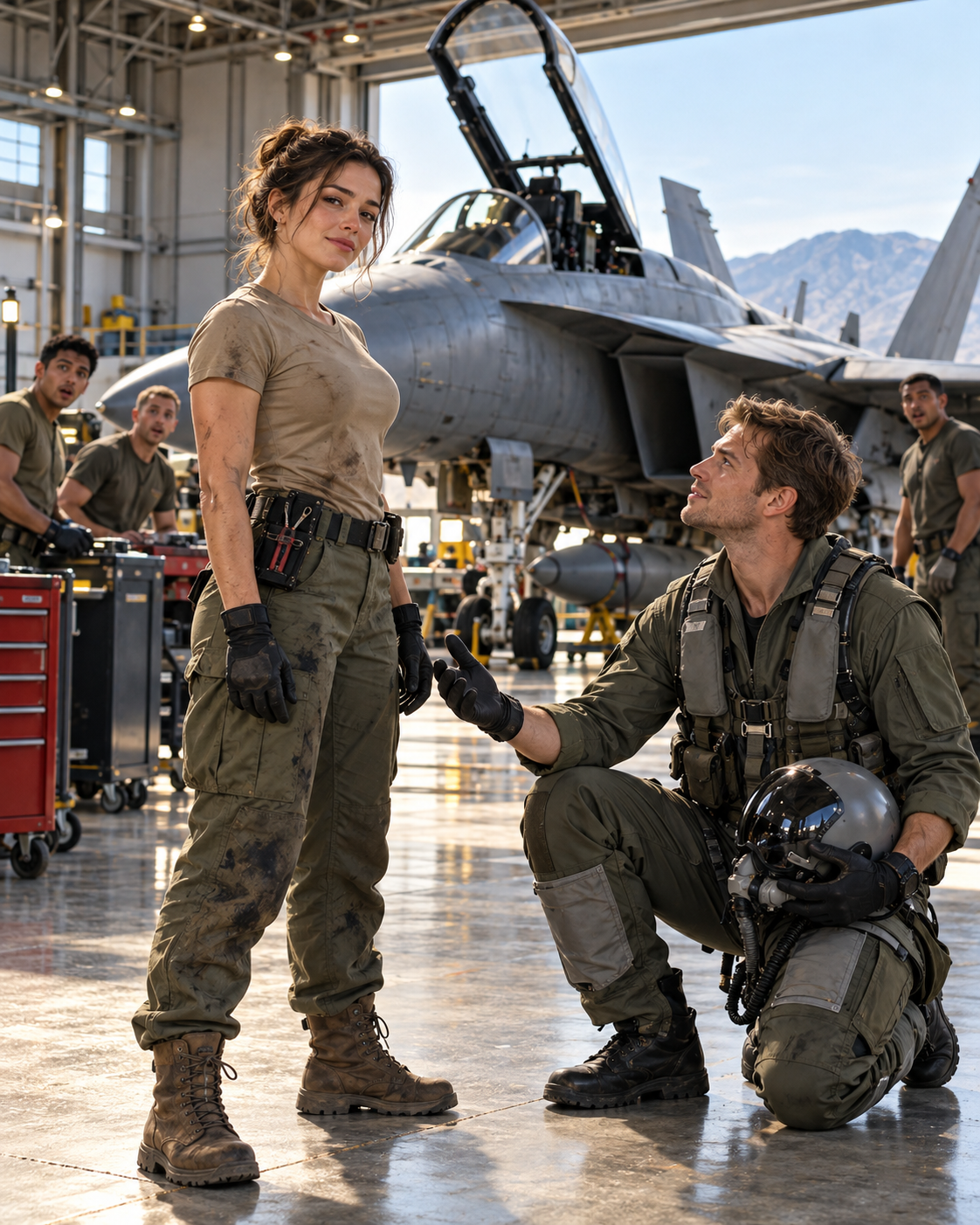
When Commander Grant Mercer humiliated me in front of an entire naval hangar and ordered me to stick to cleaning fighter jets
For several seconds, I couldn’t move.
The maintenance room continued buzzing around me, but every sound seemed to come from the other side of a wall.
Nate Collins.
The man who had flown beside me through combat missions, sleepless deployments, and one terrible night that had divided my life into before and after.
I tightened my grip on the headset.
“Where are you?”
“Tower control,” he answered. “Stay where you are until I get down there.”
Then the radio went quiet.
I placed the headset on its cradle and stared at the dark glass overlooking the hangar.
My reflection looked ordinary enough: tired eyes, a maintenance uniform, a streak of grease near my jaw, and a hearing aid tucked discreetly behind my right ear.
Nothing about the woman in the glass suggested she had ever been called the Navy’s most reliable emergency recovery pilot.
Nothing suggested she had spent five years wondering whether one mistake had cost another person his life.
Yet Nate had just told me the thing I had feared and hoped for in equal measure.
The report had been a lie.
And someone had changed it.
“What did he call you?” Senior Chief Dugan asked.
I turned.
He stood near the console, his face drained of its earlier arrogance.
“Hawk.”
“I heard that.” He glanced toward the hangar doors. “You said you were a civilian contractor.”
“I am.”
“That wasn’t what I asked.”
Before I could answer, the doors opened and Commander Mercer entered, still wearing his flight suit.
His face was pale, and rainwater dripped from the edges of his helmet.
“Who was on that radio?” he demanded.
Nobody spoke.
Mercer looked directly at me.
“That was you, wasn’t it?”
I didn’t answer immediately.
He stepped closer, his eyes flicking toward the headset.
“You gave Cole the instructions that saved my aircraft.”
“Your aircraft wasn’t the one in the cockpit.”
He looked as if he wanted to argue, then stopped.
For the first time since I had met him, Commander Mercer seemed to understand how little his rank could do for him in a room where the facts were already known.
“How did you know what was wrong?” he asked.
“I filed the warning three days ago.”
His gaze shifted toward Dugan.
The senior chief opened his mouth, but Mercer raised one hand.
“Don’t.”
The single word landed harder than a shout.
“I want that inspection report,” Mercer said. “And every related maintenance record.”
Dugan swallowed.
“Commander, we should wait until the engineering team—”
“I said every record.”
Mercer turned back to me.
“Ellis, I’m not going to pretend I understand what just happened. But I owe you an apology.”
I looked at the man who had laughed while his friends watched.
“An apology won’t repair a hydraulic pump.”
“No,” he said. “But I should have listened.”
I almost told him that he wasn’t the first officer to ignore my warnings and wouldn’t be the last.
Instead, I gathered my paperwork.
“Then start listening now.”
The doors opened again.
A tall man in a dark uniform stepped inside, his hair shorter than I remembered and silver beginning to show at his temples.
He stopped the moment he saw me.
For a breath, neither of us moved.
Then Nate smiled, and the expression nearly broke my heart.
“Hey, Hawk.”
My throat tightened.
“You’re late, Collins.”
He laughed once, but the sound faltered as he looked at the hearing aid behind my ear.
“I heard about your injury. I never knew you were here.”
“I didn’t exactly advertise it.”
He took another step, then stopped as if he wasn’t sure whether he was allowed to touch me.
I solved that for him by pulling him into an awkward, fierce embrace.
For five years, I had imagined what I might say if I ever saw him again.
I had rehearsed explanations, apologies, accusations, and a dozen ways to ask why he had disappeared after the investigation.
When the moment came, I could manage only one question.
“Why did you say the report was a lie?”
Nate’s smile vanished.
“Because I finally got a copy of the original flight records.”
He glanced at Mercer and Dugan.
“Not here.”
Mercer folded his arms.
“This concerns an aircraft failure at my station and the safety of my pilots. It concerns this command.”
“It concerns more than that,” Nate replied.
His voice had changed.
He no longer sounded like the easygoing wingman I remembered.
He sounded like someone who had spent years carrying a secret that was becoming too heavy to hold alone.
“Five years ago, someone altered the maintenance records on Mara’s final aircraft. They removed her warnings, changed the time stamps on the inspection entries, and rewrote the sequence of events leading to her ejection.”
My mouth went dry.
“Who?”
“I don’t know the whole chain yet,” he said. “But one name keeps appearing in the documents.”
He pulled a folded sheet from inside his jacket.
“Rear Admiral Charles Voss.”
The name struck me with the force of a memory I had spent years trying to bury.
Admiral Voss had commanded the aviation readiness program during my final deployment.
He had praised my performance at a squadron dinner shortly before the accident and personally assured me that the maintenance issue I’d reported was being handled.
After the crash, he had chaired the review that concluded I had pushed the aircraft beyond its safe operating limits.
I had seen him once afterward, in a sterile conference room with a recorder on the table.
He had told me that the service valued my courage but could not ignore the findings.
When I tried to show him the photographs I had taken before the flight, he said they had not been entered into the official evidence chain.
I had left that room believing that I had failed both my crew and the people who had trusted me to lead them.
“You have proof?” I asked.
“Enough to reopen the case,” Nate replied. “Not enough to explain why your aircraft was cleared in the first place.”
Commander Mercer took the paper from him and read it.
His expression hardened.
“Admiral Voss is currently overseeing the aircraft readiness review for our region.”
Nate nodded.
“That’s why I came here.”
“To see Mara?”
“To find the records before they disappeared again.”
I looked from one man to the other.
“What do my old records have to do with tonight’s failure?”
Nate met my eyes.
“Everything.”
He explained that the pump removed from Mercer’s aircraft belonged to a manufacturing batch that had been flagged during an earlier inspection cycle.
The original maintenance notes indicated inconsistent pressure regulation, the same general defect I had observed.
Several aircraft had undergone further checks, and the batch had supposedly been cleared after a corrective procedure.
But the records Nate had found suggested that some inspections had been marked complete before the work was actually carried out.
“We think the latest failure and your old accident may be connected,” he said.
I stared at the paper in my hands.
“Are you telling me the Navy knew these pumps could fail?”
“I’m telling you that someone may have known, and that the records don’t support the official explanation we were given.”
Dugan had gone very still.
Mercer noticed.
“Senior Chief, did you know this aircraft had a history of hydraulic pressure irregularities?”
Dugan rubbed the back of his neck.
“I knew there had been maintenance notes, but I was told the affected components had been reconditioned and certified.”
“By whom?”
“Supply command and the contractor.”
“Did you personally verify the work?”
Dugan hesitated.
“No.”
The honesty seemed to cost him something.
For years, I had imagined that those who ignored warnings did so because they were careless or cruel.
I had not considered how easily fear and pressure could become part of the same failure.
Dugan had been ordered to keep the squadron ready.
He had trusted a certification he should have questioned.
Then he had dismissed my report because accepting it would have meant admitting that the aircraft was not as ready as the schedule claimed.
None of that excused his decision.
But it made the shape of the problem more frightening.
The danger had not required one mastermind.
It had required a chain of people deciding that someone else’s assurance was good enough.
Mercer turned to Dugan.
“Secure the affected maintenance records. Nothing gets destroyed, altered, or removed without a documented chain of custody.”
Then he looked at me.
“Ellis, I want you in the technical review.”
I gave a quiet, bitter laugh.
“Yesterday you wanted me to clean the floor.”
His face reddened.
“Yesterday I was wrong.”
“That doesn’t mean I’m qualified to sign off on an aircraft.”
“I’m not asking you to certify anything. I’m asking you to explain what you saw and help the investigators understand what the records mean.”
For once, he had learned the difference between asking for experience and demanding obedience.
“I’ll cooperate,” I said. “But I’m not going to help anyone bury a warning.”
“I wouldn’t expect you to.”
The first inspection of the failed pump began before midnight.
The aircraft remained isolated in the hangar while the technical team documented its condition, preserved the components, and compared the physical evidence with the maintenance history.
I stayed outside the restricted work area until I was formally included in the review.
I did not touch anything that required a qualified technician’s handling or authorization.
I simply described what I had observed in my original inspection and showed the investigators the notes I had saved.
The pages were creased, stained by oil, and marked with my own handwriting.
They were also dated.
The time stamps mattered because the first record showed that the pressure anomaly had been reported before the aircraft was declared ready.
The second showed that my warning had been forwarded to the maintenance office.
The third showed that the request for a follow-up inspection had been closed without the supporting test record attached.
When the investigators asked Dugan why, he could not provide a satisfactory explanation.
“I was told the component had passed,” he said. “I didn’t know the documentation was incomplete.”
One investigator looked at him over her glasses.
“Did you verify the test result?”
“No.”
“Did you reopen the discrepancy when the contractor warning arrived?”
“No.”
“Why not?”
Dugan lowered his eyes.
“Because I believed I was being told the truth by people whose job it was to know.”
I recognized the answer.
It was the same one I had given myself on the morning of my last flight.
I had believed that if the maintenance board said the jet was ready, then the people behind the board must have checked every detail.
I had trusted the system because I was busy trusting my life to the aircraft.
A system could not function if every person assumed everyone else was lying.
But it also could not survive if nobody felt responsible for checking.
By dawn, investigators had identified discrepancies in multiple maintenance entries involving the same family of hydraulic components.
The findings did not establish that the same precise defect had caused every incident, but they were serious enough to widen the review.
There were unanswered questions about parts certification, inspection timing, and the authority used to close the original warnings.
Nate and I sat together in an empty briefing room while the investigators sorted through the initial documents.
For a long time, neither of us spoke.
Finally, he said, “I’ve wanted to call you for years.”
I looked at him.
“Then why didn’t you?”
He stared at his hands.
“Because I thought I had failed you.”
I felt anger rise, quick and familiar.
“You had the flight recorder. You were there. You could have told them what happened.”
“I did.”
His answer stopped me.
“I gave my statement. I described your warnings, the abnormal pressure, and the order to continue the flight. I signed the record.”
“Then why did the board say you supported their findings?”
“Because I never signed the final summary. I refused to endorse it, and they removed my statement from the main report. By then, I’d been transferred and told that the matter was closed.”
He looked up, his eyes bright with exhaustion.
“I tried to get copies. Every request came back with a different reason it couldn’t be released. Eventually, I was told that pursuing it could compromise the unit and the careers of people who had done their best.”
I remembered the investigation, the careful language, and the way every answer had seemed to lead toward another closed door.
“Why didn’t you tell me?”
“I wrote to you.”
My chest tightened.
“What?”
“Three times. The letters came back through the official channel. I thought you didn’t want to hear from me.”
I stared at him.
After my medical discharge, I had moved twice and changed my civilian contact information.
I had assumed no one from my old squadron wanted to speak to me because the official findings had made me a liability.
The silence between us had not been a decision we had made together.
It had been built out of fear, distance, and a system that had taught both of us to stop asking.
“I’m sorry,” he said.
I looked down at the scarred table.
“So am I.”
It was not enough to repair five years.
But it was the first honest conversation we had managed to finish.
Later that morning, Commander Mercer asked me to join him beside the grounded Super Hornet.
Ryan Cole was being monitored at the medical facility after the emergency landing, shaken and exhausted but alive.
Mercer had visited him before coming back to the hangar.
“He keeps saying he should have recognized the warning signs,” he told me.
I watched the technicians photograph the aircraft’s landing gear assembly.
“Did he know about your earlier report?”
“No. I didn’t show him.”
“Then don’t let him take responsibility for information he wasn’t given.”
Mercer nodded slowly.
“I told him something similar.”
He looked at the aircraft, his expression troubled.
“When I dismissed you in the hangar, I thought I was protecting my authority. I thought admitting uncertainty would make the pilots lose confidence in the people maintaining their jets.”
“And now?”
“Now I understand how fragile that confidence is if it depends on everyone pretending nothing is wrong.”
He turned toward me.
“I humiliated you in front of the squadron. I’m sorry for that, too.”
For once, I didn’t feel compelled to comfort the person apologizing.
“Remember it the next time someone brings you a report you don’t want to read,” I said.
“I will.”
The formal investigation grew larger over the following days.
An independent review team requested records from the maintenance contractor, the supply office, and the command responsible for certifying the affected equipment.
Several officials were temporarily removed from their duties while investigators examined the disputed documentation.
Admiral Voss issued a statement describing the review as a routine response to a technical discrepancy.
I read it in the staff room and felt a familiar coldness settle in my chest.
Even now, before the facts had been fully established, the language seemed designed to make the danger sound small.
A discrepancy.
An administrative concern.
A routine review.
Those were tidy words for the terror Ryan Cole had experienced above the clouds.
They were tidy words for the warnings I had filed and the years I had spent believing my own judgment had caused a tragedy.
Nate sat across from me.
“You don’t have to do this alone,” he said.
“I know.”
“Do you?”
I folded the statement and placed it on the table.
For a long time, I had told myself that asking for help was simply a more polished version of admitting defeat.
That belief had cost me more than I wanted to calculate.
“I think I’m learning,” I said.
The most difficult moment came when the investigators brought out the record from my final flight.
The official summary lay beside the original maintenance notes and a copy of the audio transcript from the communications system.
I had not seen the complete record since the board hearing.
The room was quiet as the investigator explained what had been verified and what remained uncertain.
My flight had been cleared despite an unresolved component discrepancy.
During the sortie, the hydraulic system began losing pressure.
I had reported the problem and requested permission to abort.
The response had been delayed, and the subsequent failure had forced an emergency recovery that left me badly injured.
My right ear had suffered permanent damage during the incident.
I had believed for years that a moment of poor judgment, a single overconfident maneuver, or a failure to react quickly enough had caused the entire disaster.
The records did not support that simple explanation.
They showed that the defect had been documented before takeoff and that my request to terminate the flight had been recorded.
They also showed that the final report omitted portions of the communication and used an inspection entry that did not match the original maintenance timeline.
The investigator pointed to a signature on the closure form.
“Admiral Voss approved the final certification review,” she said. “We’re investigating whether he knew the supporting records were incomplete and whether the changes to the accident report were authorized.”
I stared at the signature.
“Can you prove he personally altered it?”
“Not yet,” she replied. “We have evidence of inconsistencies and a record of his approval. The investigation will need to establish who made each change and why.”
I appreciated her refusal to offer me a conclusion the evidence had not yet earned.
I had lived long enough with one false conclusion.
I did not want another, even if it would have been easier to hate a single person than face the complicated truth.
When the meeting ended, I walked outside alone.
The sky had cleared, and sunlight glinted off the hangar roofs.
A pair of jets moved slowly across the taxiway while ground crews signaled to one another in practiced motions.
The sight brought back an ache so sharp I had to stop walking.
I used to know every part of that world.
I knew the anticipation before a launch, the strange calm that could descend before an emergency, and the relief of seeing a fellow pilot return safely.
I missed flying.
I missed the trust between wingmen, the shared jokes after long missions, and the feeling that all the hours of preparation had led to something meaningful.
But I also missed the person I had been before grief taught me to distrust myself.
For years, I had believed the only way forward was to erase the pilot and keep the survivor.
Now I wondered whether I could finally allow both to exist.
Nate found me near the perimeter fence.
He didn’t tell me I would be able to fly again.
He didn’t promise that the investigation would clear every doubt.
He simply stood beside me and watched the aircraft move through the afternoon light.
“Do you ever miss it?” he asked.
“Every day.”
He nodded.
“I miss flying with you.”
I swallowed.
“I miss flying with you, too.”
The admission hurt, but it did not destroy me.
It was possible to mourn something without making that grief the whole of a life.
In the weeks that followed, I helped the independent review team understand the maintenance records and identify where the inspection process had failed.
I was careful not to confuse my experience with authority I no longer held.
I offered observations, answered questions, and directed investigators toward documents I had retained.
I also refused to let my civilian status be used as a reason to dismiss the warnings I had made while working under that name.
At a public internal review, I sat before a panel of senior officers and described what had happened in the hangar, why I had filed the reports, and how the emergency had unfolded.
I spoke about the moment Mercer told me to clean the floor.
I spoke about Ryan Cole’s voice on the radio, the lowering fuel supply, and the relief when the landing gear finally extended.
Then I spoke about my last flight.
“I am not asking anyone to accept my account because of my previous rank or my flight record,” I said. “I’m asking that the documents be examined, the inconsistencies be explained, and the people who raised legitimate safety concerns be heard before an aircraft is cleared to fly.”
Nobody applauded.
This was not a performance.
The panel asked difficult questions, and I answered the ones I could.
When I didn’t know something, I said so.
When the evidence supported a conclusion, I pointed to the record.
When it didn’t, I refused to guess.
It was a different kind of flight, one in which the instruments were documents, the weather was uncertainty, and the landing required patience rather than speed.
The investigation did not end with one dramatic confession.
Instead, it established that critical maintenance documentation had been mishandled, that certain components had been cleared without complete supporting records, and that the earlier accident report required formal correction.
Questions remained about individual intent and the extent of responsibility held by each official.
Admiral Voss was removed from his readiness oversight duties while the remaining allegations were examined.
The maintenance contractor was required to review the affected components and provide complete traceability records.
The station changed how unresolved discrepancies were escalated, ensuring that a contractor’s warning could not be quietly closed without documented technical review.
Senior Chief Dugan was formally questioned about his decisions.
He later asked to speak with me.
“I thought I was keeping the squadron operational,” he said. “I thought the people above me had the complete picture.”
I looked at him across the small conference table.
“You were responsible for the aircraft you signed off on.”
“I know.”
“Then remember that the next time a report makes your day harder.”
He nodded, his face heavy with regret.
I didn’t forgive him in that room.
I didn’t need to decide what I felt about him to insist that the safety changes remain in place.
Some consequences are not punishments.
They are obligations that continue after the apology has been given.
Months later, a formal correction was issued to the findings of my old flight investigation.
The document did not return my commission or restore the years I had lost.
It did not erase the permanent damage to my hearing.
It did something smaller and, in its own way, more important.
It acknowledged that the original findings had omitted evidence, that the maintenance history had not been accurately represented, and that the conclusions about my actions could not stand as written.
I sat at my kitchen table and read it slowly.
Then I read it again.
For five years, I had carried the official report as if it were a verdict on my character.
I had believed it when it told me I was reckless.
I had believed it when it suggested that my injury and the end of my career were the consequences I deserved.
Now the institution that had issued it was admitting that its account had been flawed.
I expected to feel triumphant.
Instead, I cried.
I cried for the young pilot who had entered the hearing room believing she had failed everyone.
I cried for Nate, who had spent years trying to make his statement heard.
I cried for the people who had trusted the maintenance process and climbed into aircraft that should not have been declared ready.
And I cried for all the years I had spent living as though the best I could do was remain unnoticed.
I had wanted vindication to feel like a door opening onto the life I had lost.
Instead, it felt like finally putting down a weight I had forgotten I was allowed to set aside.
The following morning, I returned to the hangar.
My badge still read Mara Ellis.
The name no longer felt like a disguise.
It was the name I had used to build a quieter life, to learn a different trade, and to find purpose outside the cockpit.
I did not need to throw it away to reclaim my history.
Commander Mercer was waiting beside the aircraft bay.
He held a new maintenance review protocol, revised to require independent sign-off when a safety discrepancy remained unresolved.
“We’re making changes,” he told me. “Your recommendations were part of the process.”
I read the document carefully.
“Good.”
He hesitated.
“The squadron knows who you are now. Some of the younger pilots have been reading about your record.”
“I hope they’re reading the maintenance findings, too.”
He smiled faintly.
“They are.”
Ryan Cole visited a few days later, his arm out of the sling but his expression still carrying the memory of the storm.
He stopped in front of me and stood straight.
“I wanted to thank you in person,” he said. “When I heard your voice, I didn’t know who you were. But you sounded like someone who wasn’t going to let me die.”
I thought of the fear in his breathing that night.
“I couldn’t promise you that you’d land safely,” I told him. “I could only help you make the best decisions available.”
He nodded.
“That’s more than anyone else could do for me in that moment.”
Before leaving, he asked me what Hawk meant.
I considered the question.
“Someone who learned that seeing danger doesn’t always mean other people will believe you.”
He looked toward the aircraft.
“Will you ever fly again?”
The question followed me long after he left.
I had no simple answer.
My hearing loss was permanent, and I knew that returning to military aviation would require medical determinations and approvals I could not simply demand.
I wasn’t going to pretend that experience alone could overcome every safety requirement.
But I no longer believed that the end of my flight career meant the end of everything I had to offer.
I began working with the station’s emergency preparedness team, helping maintenance personnel and pilots understand how technical warnings could be lost between departments.
I taught young mechanics how to document concerns clearly and how to escalate them when the first response was dismissal.
I reminded squadron leaders that the person who noticed a fault might be the least senior person in the hangar.
And I made them repeat one principle until it became part of their vocabulary: a warning is not an act of disloyalty.
It is an opportunity to prevent a disaster.
Nate became a regular visitor.
Sometimes we talked about the investigation.
Sometimes we talked about old missions, people we had known, and places we would never see again.
We stopped trying to force every conversation toward the night that had divided our lives.
One afternoon, he found me standing beside a quiet aircraft, studying the curve of its wing.
“You know,” he said, “you don’t have to spend the rest of your life proving you were right.”
I turned toward him.
“What am I supposed to do instead?”
“Live.”
The simplicity of the answer irritated me at first.
Then I realized how long I had been treating survival as a duty that required constant evidence.
I had tried to prove I was not a failure by becoming useful in every room I entered.
I had tried to justify my place at the base by never asking for recognition.
I had treated my own pain as something to hide so other people could keep working without being reminded of what had happened.
Nate was right.
I could honor the past without spending every day arguing with it.
The aircraft that had failed during the storm was eventually returned to service only after its technical issues were addressed and the required inspections were completed.
Other affected components underwent additional review.
The process was slow, frustrating, and often less dramatic than the public might have expected.
But this time, paperwork was not being treated as a nuisance to be cleared before the next sortie.
It was being treated as a record of obligations owed to the people who trusted those machines.
On a clear morning near the end of the year, I stood at the edge of the runway and watched a formation climb into the sky.
The engines grew distant until the vibration faded beneath the quiet hum of traffic beyond the base.
I still couldn’t hear certain frequencies.
I still carried scars beneath my sleeves.
And I still sometimes woke from dreams in which a warning came too late and a voice on the radio called for help I couldn’t reach.
Healing, I had learned, did not mean that the past became harmless.
It meant I could remember it without letting it decide every part of my future.
I placed my hand against the fence and watched the aircraft disappear into the clouds.
Once, I had believed that being a pilot was the only thing that made me Hawk.
Then I believed losing that role meant I had lost myself.
Now I understood that the callsign had never belonged to the uniform, the rank, or the number of hours logged in the air.
It belonged to the part of me that kept paying attention when something felt wrong.
The part that spoke even when speaking came at a cost.
The part that refused to mistake obedience for integrity.
That evening, Nate brought me a copy of the final review’s latest findings.
At the bottom was a note from the investigators requesting one additional interview about a maintenance authorization connected to the old accident.
There was a signature I recognized, along with a date that placed the approval hours before my last flight.
Nate watched me read it.
“They’re still digging,” he said.
I folded the document and slipped it into my bag.
“Then we keep answering their questions.”
He smiled.
For the first time in years, the future didn’t look like a sky I was afraid to enter.
It looked like a place where I could choose my next step without asking permission from the worst day of my life.
The lesson I carried out of that hangar was not that one extraordinary person could save everyone.
It was that no one should have to be extraordinary before someone takes a warning seriously.
The pilot in the sky deserves a safe aircraft.
The mechanic beneath the wing deserves to be heard.
And the person who admits something is wrong deserves more than a joke, a closed file, or an order to stay quiet.
I had once believed courage meant bringing the aircraft home at any cost.
Now I knew courage could also mean telling the truth about why it nearly never came home at all.
I was still Mara Ellis to the civilians who worked beside me.
To Nate, I would always be Hawk.
And for the first time in five years, I could hear both names without feeling that one had to disappear for the other to survive.