When Commander Caleb Mercer humiliated me in front of twenty-one male fighter pilots at Naval Air Station Lemoore
Part 2
The first report came through in fragments.
A ground transport supporting the coastal exercise had suffered a mechanical failure, leaving two SEAL operators stranded near an exposed section of shoreline.
At first, the situation appeared manageable.
The team had communication equipment, the rescue helicopter was available, and the operators were trained to handle unexpected delays.
Then the storm arrived.
Rain swept across the coast in thick, slanting sheets, turning the ocean into a restless field of whitecaps and black water.
Wind speeds climbed, visibility collapsed, and the communication link with the stranded team began to deteriorate.
The operations center filled with overlapping voices.
A controller called out updated conditions while another officer attempted to establish a reliable connection with the operators.
Their last transmission was barely intelligible.
“Position… water rising… visibility near zero.”
Then static swallowed the rest.
I stood beside the tactical display, watching the markers on the map and listening to the radio traffic.
The two operators were near a stretch of coast where the terrain narrowed between rising ground and the sea.
If the waves continued to build, the route away from the shoreline could become impassable.
The rescue helicopter’s crew was ready, but the approach would be dangerous.
They needed an airborne aircraft to provide observation, relay information, and help the helicopter crew navigate the worst of the conditions.
Under normal circumstances, the squadron would have several options.
That afternoon, one by one, those options vanished.
A maintenance inspection grounded one aircraft.
Another pilot was out of position.
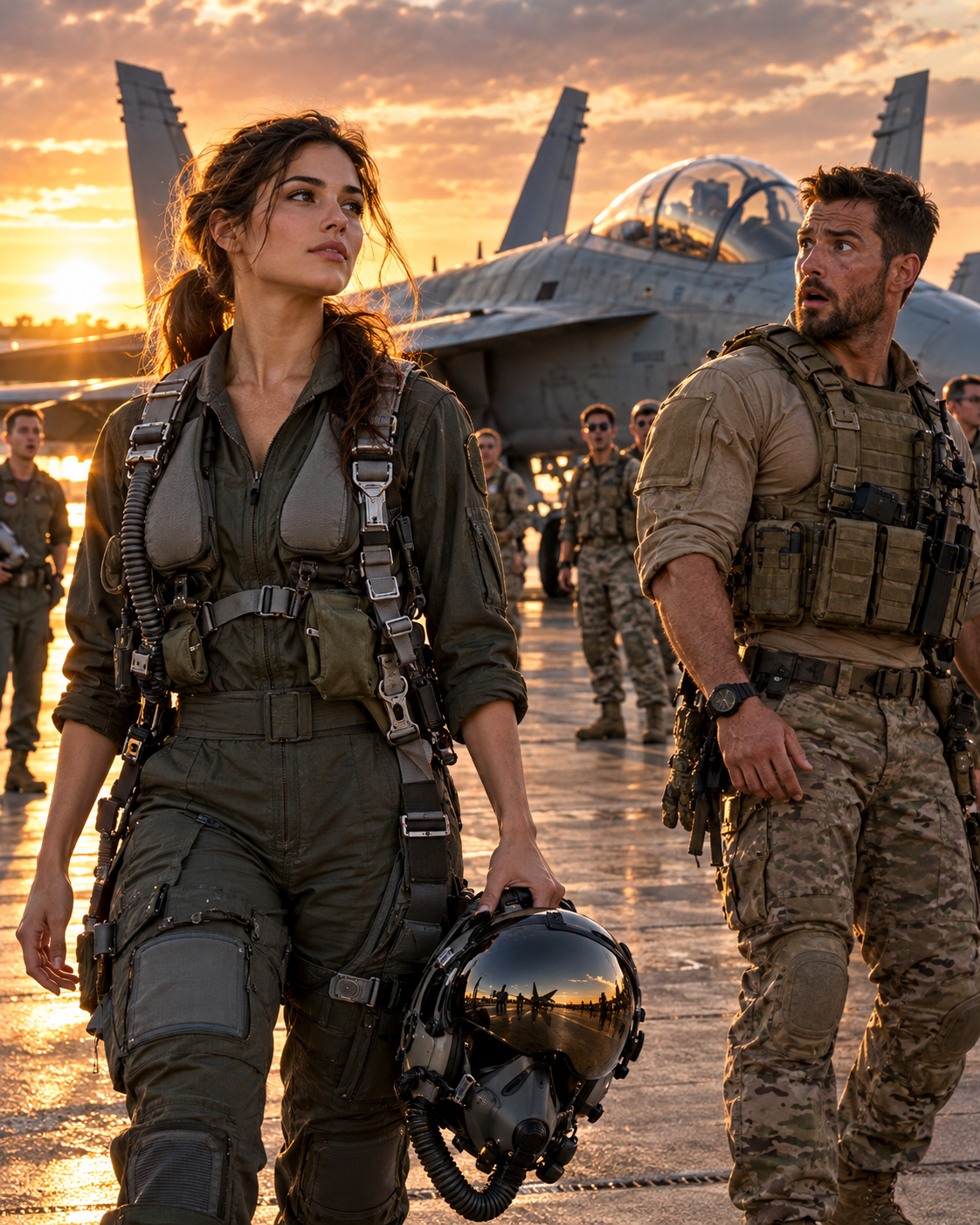
Two more jets were held back as the weather crossed the limits established for their planned sorties.
Then came the report that Commander Mercer had been grounded after a scratch was discovered on his canopy, requiring inspection before his aircraft could be cleared.
He appeared in the operations center, his jaw clenched as the latest weather update flashed across the screen.
“What’s the status of the rescue aircraft?”
“Standing by, sir. The crew is waiting on a decision regarding the airborne support.”
“And the other squadron aircraft?”
“Unable to launch within current restrictions, sir.”
Mercer stared at the screen.
The storm was no longer an inconvenience.
It was becoming a clock.
I watched the rescue helicopter’s position update, then looked at the coastal map again.
The operators were still alive.
They were also running out of time.
I stepped forward.
“I can provide airborne observation and relay support.”
Mercer turned sharply.
“No.”
The answer came so quickly that several people looked up.
“Sir, I have reviewed the storm movement. There is a narrow interval between the two cells, and the latest data suggests it may remain open long enough for a controlled approach.”
“You’ve reviewed a weather display,” he said. “That isn’t the same as flying through the conditions you’re describing.”
“No, sir.”
“Then you understand why I’m not sending you into that storm.”
I did understand.
An F/A-18 was a formidable aircraft, but it was not immune to weather, and courage did not make wind shear less dangerous.
A launch into severe conditions required a careful assessment of the aircraft, the mission, the crew, and the applicable safety limits.
I would not pretend otherwise.
But I also knew that the decision could not be made by pride or prejudice.
“Sir,” I said, keeping my voice level, “I’m not asking to demonstrate anything. I’m offering a capability that may help the rescue crew reach those men.”
Mercer’s face hardened.
“Your job is to follow orders.”
“Yes, sir.”
“Then stand by.”
He turned back to the controllers.
For a few seconds, nobody spoke to me.
I stepped away from the table, my hands clenched at my sides.
The old humiliation rose inside me, hot and familiar.
I could almost hear the ready room laughter again.
Quota.
Diversity hire.
Let’s see if the paperwork matches the pilot.
But this wasn’t the ready room.
Two men were trapped beside a rising ocean, and their lives were becoming a calculation measured in minutes.
I forced the anger down.
This was not about making Mercer regret his words.
It was not about proving that I belonged.
It was about whether I could help bring two people home.
I approached the senior controller, who was reviewing the latest reports.
“What’s the current communication window?”
He glanced at me, then at the screen.
“Intermittent. We get a few seconds at a time.”
“Can the helicopter crew hear the coastal team directly?”
“Not reliably.”
“Then they need someone who can maintain a clear relay and provide visual guidance.”
He exhaled slowly.
“That’s what the air-support request says.”
I looked at the weather plot again.
The two storm cells were closing together, but they had not yet merged.
Between them lay a narrow corridor of comparatively less violent air, an opening that would not last.
I could not guarantee that the corridor would remain safe.
I could only assess the changing conditions, understand the risk, and determine whether the mission could be attempted within the limits authorized by command.
The controller turned toward Mercer.
“Sir, we’re losing the window.”
Mercer said nothing.
Another radio transmission crackled through the speaker.
“…water… coming over… can’t hold…”
Then silence.
I looked at the controller.
“Request authorization for launch and airborne relay support.”
Mercer swung toward me.
“You have no idea what you’re asking.”
“I know exactly what I’m asking, sir.”
His eyes narrowed.
For the first time, I saw something beneath his contempt.
It wasn’t respect.
It was fear.
He was responsible for the squadron, and if I launched into conditions that overwhelmed the aircraft, the consequences would be catastrophic.
I understood that responsibility.
I also understood that doing nothing was not automatically the safest decision when lives were at stake.
Mercer looked at the weather plot, then at the rescue helicopter’s position.
He asked the controller for the latest wind data.
The answer came back worse than the previous report.
He closed his eyes for a moment, then opened them.
“Recheck the aircraft’s condition and the applicable launch limits. I want the duty officer’s assessment, and I want the rescue crew’s confirmation that airborne support will materially improve their approach.”
The room moved at once.
Maintenance personnel confirmed the aircraft assigned to me was serviceable.
The duty officer reviewed the changing conditions and the mission requirements.
The rescue crew confirmed that a reliable relay and visual observation could make the difference between an aborted approach and a controlled extraction.
The final decision rested with the officers responsible for the mission and the aircraft’s safe operation.
When authorization came, it came with clear restrictions and no promise that the weather would cooperate.
Mercer faced me.
“If you launch, you follow your limits. If conditions exceed them, you disengage. You do not sacrifice the aircraft trying to save a situation that cannot be saved.”
“Understood, sir.”
He held my gaze.
“And Vance?”
“Sir?”
“Bring yourself back.”
For a moment, the words sounded almost like an order he had been trying not to give.
Then his expression closed again.
I nodded and ran.
The hangar doors shuddered as the wind pushed against them.
Rain streaked across the concrete, and ground crew members moved quickly beneath the gray sky, securing equipment and preparing the aircraft.
My F/A-18 waited beneath the lights, its gray skin slick with moisture.
A crew chief met me beside the ladder.
“Ugly day to go flying, ma’am.”
“That’s one way to describe it.”
He checked my equipment and looked me in the eye.
“You need anything, you call it.”
“I will.”
I climbed into the cockpit and began the familiar sequence of checks.
For all the noise outside, the cockpit felt strangely quiet.
I checked the instruments, confirmed the aircraft’s status, reviewed the emergency procedures, and listened to the radio.
My breathing slowed.
This was the part I trusted.
Not because I believed I could control everything, but because preparation gave me a way to think when everything else became uncertain.
I thought of the two operators on the coast.
I thought of their families, who might never know how close they had come to losing them.
I thought of the men in my ready room who believed I had been handed my place without earning it.
Then I let those thoughts go.
None of them could help me fly.
The ground crew cleared the area, and the tower confirmed the launch authorization.
I advanced the throttle and felt the aircraft come alive beneath me.
The engines rose into a deep, vibrating roar.
For one brief second, the hangar, the squadron, and every cruel word seemed to fall away.
There was only the aircraft, the weather, and the responsibility waiting beyond the runway.
I began the takeoff roll.
Rain hammered the canopy, and the runway lights stretched into wavering lines beneath me.
The aircraft accelerated, the nose lifted, and the ground dropped away.
I was airborne.
The first wall of weather hit before I had fully cleared the coastline.
Turbulence jolted the aircraft, forcing me to concentrate on the instruments and maintain deliberate control inputs.
Rain reduced visibility to a shifting gray blur.
The ocean disappeared beneath the clouds, then emerged in fragments between curtains of water.
I followed the planned route while monitoring the changing conditions, the aircraft’s performance, and the latest information from the rescue crew.
The weather was worse than the initial reports had suggested.
Wind pushed against the aircraft in irregular bursts, and the storm cells were moving toward each other faster than I wanted.
I checked the available escape routes.
There was still a way out.
I needed to keep it that way.
“Rescue aircraft, Vance,” I called over the radio. “I’m approaching your support position. Confirm your status.”
A burst of static answered.
Then the helicopter pilot came through.
“Vance, we read you. Conditions are deteriorating rapidly. We need visual guidance to the extraction area.”
“Understood. I’ll establish observation and relay what I can verify.”
I advanced toward the coastline, watching the weather develop ahead.
The gap between the storm cells had narrowed into a dark, twisting corridor.
The air inside it might be less violent than the surrounding system, but it was not safe simply because it looked open.
I had to judge the movement continuously and remain ready to turn away if the aircraft or the conditions demanded it.
The radio crackled again.
“Coastal team, this is rescue. Do you copy?”
Only static.
I switched to the appropriate relay channel and tried to establish contact.
For several seconds, I heard nothing.
Then a man’s voice emerged through the interference, strained and distant.
“Two personnel… still together… water rising.”
I tightened my grip on the controls.
“Coastal team, this is Vance providing airborne support. I hear you. Stay together and follow your extraction instructions.”
“Copy… trying…”
The transmission broke apart.
I looked down through the rain.
The coastline was barely visible, a jagged line of dark rock between the sea and the storm.
Somewhere beneath me, two men were waiting for a helicopter that could not safely approach without better information.
I had made it to them.
Now I had to help get them out.
Part 3
I established the best observation position available while keeping the aircraft within the limits of the mission and the changing weather.
The storm pressed around me from every direction, and the narrow corridor between the two cells was closing.
I could not see the stranded operators continuously.
Sometimes the coastline appeared beneath a break in the rain; sometimes it vanished entirely, leaving only the instruments and the voices in my headset.
I relayed what I could verify to the helicopter crew, distinguishing what I could actually see from what the operators reported over the radio.
“Rescue, the coastline is intermittently visible. I have your approach area in sight between rain bands. Stand by for updated guidance.”
“Copy, Vance. We are proceeding cautiously.”
The helicopter crew knew their aircraft and their limits better than anyone.
My job was not to order them into danger.
My job was to give them the clearest picture I could while they made their own decisions.
A sudden burst of wind shook my aircraft.
The instruments remained readable, but the turbulence reminded me how quickly a manageable situation could turn.
I checked the weather again.
The gap was narrowing.
I calculated how long I could maintain the support position without losing a safe exit route, then passed the updated information to the rescue crew.
“Be advised, the weather window is closing. I can continue providing support for a limited period, but you should not commit to an approach that exceeds your aircraft’s limits.”
The helicopter pilot answered immediately.
“Understood. We are assessing the approach now.”
I looked toward the sea and caught a brief glimpse of the extraction area.
There were two figures near a rocky rise, almost swallowed by the rain.
They were moving, but the water was climbing around the lower ground.
I called the observation in.
“Rescue, I have two individuals near the rocky rise, just inland from the waterline. They appear to be together. Use your instruments and your own visual assessment to confirm before committing.”
The helicopter descended cautiously toward the area.
The wind shifted.
For a terrible moment, the aircraft seemed to hang in the rain, its lights appearing and disappearing as the clouds moved across the coast.
Then the pilot reported a loss of reliable visual reference.
“Vance, we have significant wind shear and poor visibility. We may have to break off.”
My stomach tightened.
I looked at the weather plot.
The corridor was becoming unstable.
I could hear the strain in the helicopter pilot’s voice, but I also knew what it meant to push beyond a safe limit because the people waiting on the ground were running out of time.
“Understood,” I replied. “Maintain your aircraft’s safety limits. I’ll continue relaying observations while conditions permit.”
The pilot acknowledged me.
I shifted my attention back to the coastline and watched for another opening.
Minutes passed with a strange, stretched quality, each one filled with tiny decisions.
I tracked the storm’s movement.
I watched the helicopter’s position.
I relayed brief observations when the rain thinned enough to reveal the terrain.
And I kept listening for the voices of the two operators.
At last, the radio crackled.
“Rescue, this is coastal team. We have visual on your lights.”
The words were faint, but they were unmistakable.
I leaned forward instinctively, as though the movement could bring their voices closer.
“Coastal team, Vance. Confirm you can follow the rescue crew’s instructions.”
“Affirmative. We can see them.”
The helicopter crew began a new approach when their assessment showed a workable opening.
I passed the latest verified observations, then fell silent so the pilots could concentrate.
The next moments were the longest of my life.
I watched the helicopter maneuver through the rain, holding the best available observation position while the weather battered my aircraft.
I could not make the wind obey.
I could not open the clouds.
I could not promise the men below that everything would be fine.
All I could do was remain focused, provide accurate information, and avoid turning one emergency into two.
The helicopter reached the extraction area.
“Visual contact confirmed,” the pilot reported.
My chest tightened.
“Copy. Continue as conditions permit.”
One operator moved toward the aircraft.
Then the second.
The rain swallowed them from sight.
For a few seconds, there was no confirmation, only the pounding weather and the sound of my own breathing.
Then the helicopter pilot came back over the radio.
“Both personnel aboard. We are departing the extraction area.”
I closed my eyes for half a heartbeat.
Two men.
Both alive.
Both aboard.
I wanted to laugh, but there was no room for it yet.
The helicopter still had to leave the coast, and I still had to get my aircraft home.
I passed the final weather observations, confirmed that the rescue crew had the information it needed, and began withdrawing along the safest available route.
The storm had not become kinder.
It had not recognized my determination or rewarded my courage.
It simply continued to exist, indifferent to who had won and who had lost.
I followed my instruments, monitored the aircraft, and kept my attention on the next decision.
By the time I returned to Lemoore, my hands ached from maintaining control through the turbulence.
The runway emerged beneath the clouds in a blur of lights and wet concrete.
I landed, taxied clear, and shut down the engines.
Only then did I realize how tightly I had been holding my jaw.
The canopy opened.
Cool air swept into the cockpit, carrying the smell of rain and fuel.
A crew chief stood beside the ladder, his expression unusually serious.
“Both SEALs are safe, ma’am.”
I nodded.
For a moment, I couldn’t find a reply.
I climbed down, removed my helmet, and stood beside the aircraft while the ground crew began its post-flight checks.
No one cheered.
No one applauded.
There was no cinematic rush of people congratulating me beneath the hangar lights.
There were procedures to complete, aircraft conditions to report, and questions to answer.
I was grateful for that.
The work mattered more than the appearance of triumph.
But when I walked into the operations center, I noticed that the room had changed.
The pilots who had once looked through me were now watching me.
Some looked embarrassed.
Some looked uncertain.
Others seemed to be reconsidering things they had believed so confidently only a few hours earlier.
Mercer stood near the tactical display.
He looked at me for a long moment.
“Report to the debrief room at oh-seven-hundred tomorrow,” he said.
“Yes, sir.”
I waited for him to say something about the flight.
He didn’t.
He simply turned away.
That night, sleep came in fragments.
Every time I closed my eyes, I heard the helicopter pilot reporting wind shear.
I saw the coastline disappearing beneath the rain.
I remembered the moment when the radio went silent and the rescue aircraft had considered breaking off.
I wasn’t frightened by what I had done.
I was frightened by how easily the outcome could have been different.
The two operators were alive, but that did not make the decisions simple or erase the risks.
I reviewed the flight in my mind, searching for every moment when I could have acted differently.
I wrote down what I wanted to examine during the debrief and made a note of the weather changes that had affected the mission.
Then I stopped myself.
I had a tendency to treat every success as a debt I still owed, as if surviving a difficult day meant I had to prove myself again tomorrow.
I sat at the edge of my bed and stared at my hands.
They were steady now.
I reminded myself that I had not flown into the storm to silence a room full of men.
I had flown because the mission required help, the responsible officers had authorized the attempt, and I believed I could contribute without abandoning sound judgment.
The distinction mattered.
If I let their contempt become the reason I took risks, then they would still be controlling my decisions.
I wanted something better than that.
At seven the next morning, I entered the debrief room with my notes tucked beneath my arm.
Every seat was occupied.
The squadron pilots sat around the table, unusually quiet, while Mercer stood near the front with his hands folded.
The recorded flight data had been reviewed, and the room’s main display showed the route, weather observations, and timeline of the rescue.
I took my place without speaking.
Mercer began with the technical review.
He asked about the aircraft’s performance, the evolving storm conditions, the communication interruptions, and the decisions made as the rescue window narrowed.
I answered carefully, explaining what I had observed and what I could not verify.
I did not exaggerate the difficulty.
I did not claim to have controlled the storm.
I described the decisions, the limits I monitored, and the moments when I had needed to revise my assessment.
When I finished, Mercer looked at the screen.
“Any questions?”
No one answered.
Then the door opened.
Master Chief Nathan Vance entered wearing his Navy working uniform, his expression unreadable.
He was the SEAL platoon commander who had overseen the coastal exercise and the father whose last name I happened to share.
Inside the squadron, he was known for speaking only when he had something worth saying.
He carried a folder in one hand.
Mercer straightened.
“Master Chief. We were just completing the debrief.”
“I know, Commander,” Nathan replied. “I’ve reviewed the rescue recordings and the flight data.”
He placed the folder on the table.
Then he looked around the room.
“I have one question. Who flew the airborne support during the extraction?”
The silence was immediate.
One of the pilots glanced at Mercer.
Another looked down at his notes.
Finally, a lieutenant near the far end of the table spoke.
“Lieutenant Commander Vance, Master Chief.”
Nathan nodded.
“Was that an assigned call sign?”
The lieutenant hesitated.
“No, Master Chief.”
“Then what were you calling her?”
Nobody moved.
I felt the old word approaching before anyone said it.
A pilot cleared his throat.
“Some people were calling her Quota.”
Nathan’s expression did not change.
But the temperature in the room seemed to drop.
He looked at the pilot who had spoken, then at the others.
“Quota,” he repeated.
The word sounded different in his voice.
It no longer sounded like a joke.
It sounded like evidence.
He turned toward me.
“Maya, stand up.”
I rose, my pulse suddenly loud in my ears.
For the first time since I had arrived at Lemoore, I wished I could disappear.
I didn’t want a public confrontation.
I didn’t want my father to rescue me from men who had decided I was weak.
And I certainly didn’t want my flight reduced to a family story.
Nathan studied me for a moment.
Then he addressed the room.
“Those two operators were trained to survive difficult situations. They had equipment, procedures, and years of experience. Yesterday, the weather took away most of the advantages they were supposed to have.”
He paused.
“The rescue crew had to make its own decisions, and Lieutenant Commander Vance provided the information they needed to assess the approach. She remained on station while conditions deteriorated, kept the communication relay going, and helped the crew find a way to extract both men.”
His gaze moved across the table.
“That doesn’t mean she was invincible. It doesn’t mean the storm couldn’t have killed her. And it certainly doesn’t mean anyone should ignore the limits of an aircraft just to prove a point.”
I felt my shoulders relax slightly.
He wasn’t turning me into a legend.
He was describing the work.
“Respect in this business,” he continued, “isn’t something you hand out because someone asks for it. It’s what you earn when the situation gets ugly and the people beside you need you to do your job.”
Then he looked directly at me.
“Yesterday, you did yours.”
I swallowed.
“Thank you, Master Chief.”
He shook his head.
“Don’t thank me. I didn’t fly that jet.”
He reached into his folder and pulled out a small card on which a single word had been written.
“From this day forward, your call sign is Widowmaker.”
The room remained utterly silent.
I stared at him.
“Master Chief?”
He held my gaze.
“Because every man who bet against you just lost that bet.”
Nobody laughed.
Nobody looked toward the coffee machine.
Mercer stood motionless at the front of the room, his expression stripped of its usual confidence.
Nathan set the card on the table in front of me.
“Remember what it means, Maya. Not that you’re better than everyone else. Not that you have something to prove every time you climb into a cockpit. It means the people who underestimate you may discover too late that they never understood what they were looking at.”
I looked down at the word.
Widowmaker.
It was fierce, almost brutal, and nothing like the person I had tried to become.
Yet beneath its sharp edges, I understood what he was giving me.
Not permission to hate the men who had mocked me.
Not a promise that I would never be afraid.
A name that could no longer be used to erase my work.
A name that had been earned in the same place where the old one had been used to diminish me.
I sat down slowly.
For several seconds, the only sound was the hum of the room’s ventilation.
Then Mercer stepped away from the display.
“Lieutenant Commander Vance.”
I looked up.
He appeared to struggle with the words before forcing them out.
“Your performance during the rescue was exceptional. Your judgment and communication helped the helicopter crew complete the extraction.”
He paused.
“I was wrong to dismiss your capabilities before seeing your work.”
The admission was brief, awkward, and incomplete.
It did not undo the weeks of humiliation.
It did not give me back the mornings when I had walked into the hangar feeling that I needed to earn the right to occupy the same space as everyone else.
But it was the first honest thing he had said to me.
“Thank you, Commander,” I replied.
I did not tell him it was all right.
Because it wasn’t.
And forgiveness, I had learned, was not something another person could demand simply because they had finally recognized the damage they had done.
The meeting continued.
We examined the decisions made during the rescue, the communication failures, and the weather assessment that would inform future exercises.
The squadron discussed what had worked, what had nearly failed, and what needed to change.
For the first time, the conversation centered on the mission rather than on whether I belonged.
When the debrief ended, the pilots filed out quietly.
One of the men who had called me Quota stopped beside my chair.
His face was flushed, and he looked as though he had rehearsed several apologies and rejected all of them.
“I was wrong,” he said.
I studied him.
“About what?”
He looked uncomfortable.
“About you.”
I gathered my notes.
“You didn’t know me well enough to be right or wrong about me.”
He nodded slowly.
“That’s fair.”
Then he walked away.
It wasn’t a dramatic reconciliation.
There was no sudden friendship, no promise that the past had vanished.
There was only a man beginning to understand that his assumptions had been a choice.
And that choice had consequences.
In the days that followed, the nickname Quota disappeared.
At first, the change was awkward.
Men who had once spoken over me began asking for my assessment during planning sessions.
Pilots who had dismissed my questions started discussing weather patterns and emergency procedures with me as colleagues.
Some were sincere.
Others were simply learning which words no longer earned a laugh.
I didn’t mistake silence for instant transformation.
Respect was not a switch that could be flipped by one dramatic flight.
It had to be demonstrated, practiced, and maintained.
So I kept doing what I had done from the beginning.
I arrived early.
I studied.
I asked questions.
I acknowledged mistakes.
I followed the rules that protected the people who trusted me with their lives.
And when someone called me Widowmaker for the first time over the squadron radio, I answered as calmly as I had answered to my own name.
“Copy. Widowmaker is on frequency.”
The words settled into the cockpit around me.
They no longer felt like a challenge.
They felt like a responsibility.
Weeks later, I stood beside my aircraft as the sun rose over the California flight line.
The sky was clear, the air was cool, and the runway stretched ahead beneath the pale morning light.
A young pilot approached me with a flight manual tucked beneath his arm.
He looked nervous.
“Ma’am, can I ask you something?”
“Of course.”
He glanced toward the other aircraft, then back at me.
“How did you keep going when everyone thought you didn’t belong?”
I considered giving him the easy answer.
Work harder.
Ignore them.
Prove them wrong.
Those things had helped, but they weren’t the whole truth.
“The hardest part,” I told him, “was learning not to let their opinion become the reason I flew.”
He frowned slightly.
“What do you mean?”
“If you fly because you’re angry, you’ll eventually take a risk for the wrong reason. If you fly because you’re desperate to prove something, you’ll start confusing danger with courage.”
I rested my hand on the edge of my helmet.
“Prepare until you know what you’re doing. Listen when someone has something worth teaching you. Respect the limits that keep people alive. Then do the job because it matters, not because someone is watching.”
He nodded, absorbing the answer.
“And if they still don’t respect you?”
I looked out across the flight line.
“Then keep becoming someone whose work speaks clearly, and don’t confuse their silence with the measure of your worth.”
He thanked me and walked away.
I watched him go, thinking about the woman who had entered that ready room three weeks earlier with a folder under her arm and a knot of humiliation in her stomach.
I wished I could tell her that one day the room would fall silent for a different reason.
I wished I could tell her that the word used to wound her would eventually lose its power.
But perhaps she had needed those difficult weeks to discover something that applause could never teach her.
She had needed to learn that belonging was not a gift granted by the loudest man in the room.
It was not a favor, a quota, or a temporary exception.
It was the result of preparation, judgment, responsibility, and the courage to keep doing the work when nobody offered encouragement.
The squadron would remember the storm.
They would remember the two operators brought safely home and the narrow window in which the rescue became possible.
They would remember the day Master Chief Nathan Vance walked into the debrief room and gave me a name nobody dared to turn into a joke.
But I would remember something quieter.
I would remember the moment the helicopter pilot confirmed that both men were aboard, when relief flooded through me so completely that I could barely speak.
I would remember that the rescue had never been about winning an argument.
It had been about two human beings who needed help and a team of people who refused to abandon them.
That was the meaning I carried into every flight afterward.
Not the satisfaction of proving someone wrong, though I would never pretend that satisfaction had not existed.
Not the thrill of being recognized, though recognition had mattered.
The deeper truth was that I had finally stopped measuring my place in the sky by the opinions of people standing on the ground.
I was Lieutenant Commander Maya Vance.
I was a naval aviator.
And I was Widowmaker.
Not because I could defeat every storm, not because I could never fail, and not because the men who underestimated me deserved to suffer.
I carried that call sign because, when the weather turned cruel and two strangers needed someone to do the work, I had answered the call with discipline, humility, and every skill I had spent years earning.
The next time I walked into the ready room, nobody laughed.
A few pilots nodded as I passed.
One moved his bag off the chair beside him so I could sit down.
Mercer glanced up from his paperwork and addressed me without sarcasm.
“Morning, Widowmaker.”
“Morning, Commander.”
I took my seat, opened my flight manual, and began preparing for the day.
Outside, another jet roared down the runway and rose into the morning sky.
I listened until the sound faded into the distance.
Then I turned the page.
Because the storm was behind me, but the work was not finished.
And I had never needed the room to applaud before I knew why I was there.